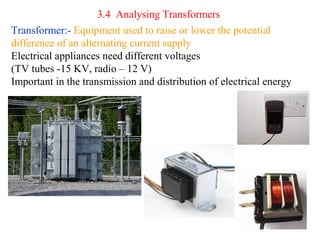
3.4 Analysing Transformers
Transformer:- Equipment used to raise or lower the potential
difference of an alternating current supply
Electrical appliances need different voltages
(TV tubes -15 KV, radio – 12 V)
Important in the transmission and distribution of electrical energy
Operating Principle of A transformer
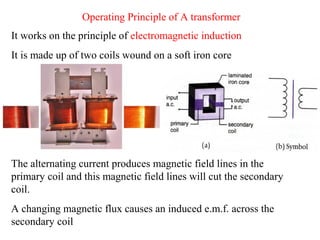
It works on the principle of electromagnetic induction
It is made up of two coils wound on a soft iron core
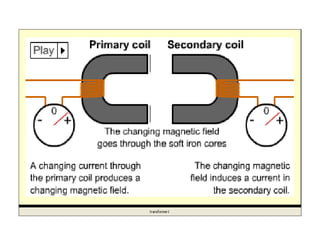
The alternating current produces magnetic field lines in the
primary coil and this magnetic field lines will cut the secondary
coil.
A changing magnetic flux causes an induced e.m.f. across the
secondary coil
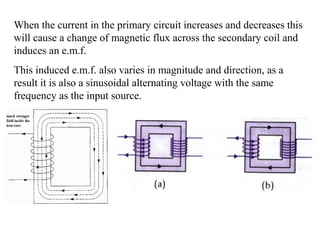
When the current in the primary circuit increases and decreases this
will cause a change of magnetic flux across the secondary coil and
induces an e.m.f.
This induced e.m.f. also varies in magnitude and direction, as a
result it is also a sinusoidal alternating voltage with the same
frequency as the input source.
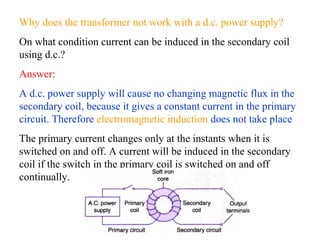
Why does the transformer not work with a d.c. power supply?
On what condition current can be induced in the secondary coil
using d.c.?
Answer:
A d.c. power supply will cause no changing magnetic flux in the
secondary coil, because it gives a constant current in the primary
circuit. Therefore electromagnetic induction does not take place
The primary current changes only at the instants when it is
switched on and off. A current will be induced in the secondary
coil if the switch in the primary coil is switched on and off
continually.
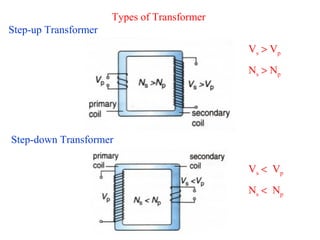
Types of Transformer
Step-up Transformer
Step-down Transformer
Vs > Vp
Ns > Np
Vs < Vp
Ns < Np
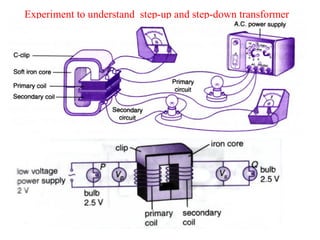
Experiment to understand step-up and step-down transformer
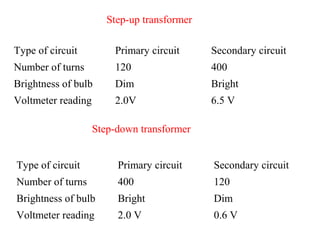
Type of circuit Primary circuit Secondary circuit
Number of turns 120 400
Brightness of bulb Dim Bright
Voltmeter reading 2.0V 6.5 V
Type of circuit Primary circuit Secondary circuit
Number of turns 400 120
Brightness of bulb Bright Dim
Voltmeter reading 2.0 V 0.6 V
Step-up transformer
Step-down transformer
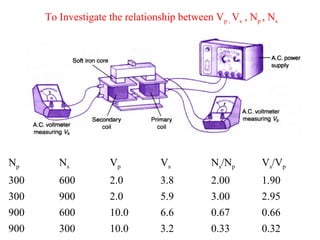
To Investigate the relationship between Vp , Vs , Np , Ns
Np Ns Vp Vs Ns/Np Vs/Vp
300 600 2.0 3.8 2.00 1.90
300 900 2.0 5.9 3.00 2.95
900 600 10.0 6.6 0.67 0.66
900 300 10.0 3.2 0.33 0.32
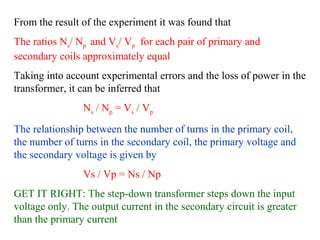
From the result of the experiment it was found that
The ratios Ns/ Np and Vs/ Vp for each pair of primary and
secondary coils approximately equal
Taking into account experimental errors and the loss of power in the
transformer, it can be inferred that
Ns / Np = Vs / Vp
The relationship between the number of turns in the primary coil,
the number of turns in the secondary coil, the primary voltage and
the secondary voltage is given by
Vs / Vp = Ns / Np
GET IT RIGHT: The step-down transformer steps down the input
voltage only. The output current in the secondary circuit is greater
than the primary current
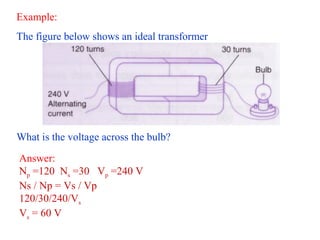
Example:
The figure below shows an ideal transformer
What is the voltage across the bulb?
Answer:
Np =120 Ns =30 Vp =240 V
Ns / Np = Vs / Vp
120/30/240/Vs
Vs = 60 V
Efficiency of a Transformer
The efficiency is defined as
E= [Output power/Input power ] x 100%
E= [ VsIs / Vp Ip ] x 100%.
In the process of transfer electrical energy from one circuit to
another a faction of it is lost as heat energy
Efficiency of transformer is normally less than 100%
Ideal Transformer
No energy loss, all the energy supplied to the primary coil will be
transferred to the secondary coil
Has efficiency of 100%
Output power = Input power
VsIs = Vp Ip or Vs / Vp = Ip / Is
Example:
Figure below shows a transformer with a bulb at its output
terminals. The bulb lights up with normal brightness.
(a) Determine the value of Np
(b) Calculate the efficiency of the transformer.
Answer:
(a) Np/ 150 = 240/12 Np =3000
(b) Efficiency = Output power/Input power x 100%
= 24/0.15 x 240 x 100%
= 66.7 %
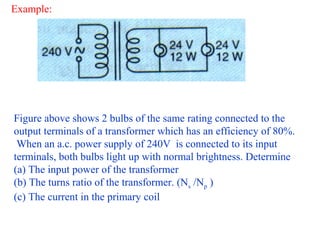
Example:
Figure above shows 2 bulbs of the same rating connected to the
output terminals of a transformer which has an efficiency of 80%.
When an a.c. power supply of 240V is connected to its input
terminals, both bulbs light up with normal brightness. Determine
(a) The input power of the transformer
(b) The turns ratio of the transformer. (Ns /Np )
(c) The current in the primary coil
Answer:
(a) Efficiency= [Output power / Input power ] x 100%
80% = [24/ Input power ]x 100%
Input power = 100/80 x 24= 30 W
( Total output power = V I =24 (I1+I2)
= 24(12/24+12/24)
=24x1=24W
OR total output power is= 12W+12W=24 W
(b) Vs /Vp =Ns /Np
Ns/Np =24/240
=1/10
(c)P = VI
I = P/V =30/240 = 1/8 A
Factors that affect the efficiency of a transformer and ways to
improve the efficiency of a transformer
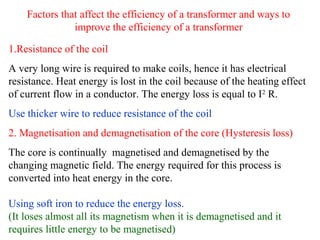
1.Resistance of the coil
A very long wire is required to make coils, hence it has electrical
resistance. Heat energy is lost in the coil because of the heating effect
of current flow in a conductor. The energy loss is equal to I2
R.
Use thicker wire to reduce resistance of the coil
2. Magnetisation and demagnetisation of the core (Hysteresis loss)
The core is continually magnetised and demagnetised by the
changing magnetic field. The energy required for this process is
converted into heat energy in the core.
Using soft iron to reduce the energy loss.
(It loses almost all its magnetism when it is demagnetised and it
requires little energy to be magnetised)
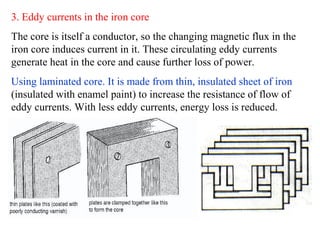
3. Eddy currents in the iron core
The core is itself a conductor, so the changing magnetic flux in the
iron core induces current in it. These circulating eddy currents
generate heat in the core and cause further loss of power.
Using laminated core. It is made from thin, insulated sheet of iron
(insulated with enamel paint) to increase the resistance of flow of
eddy currents. With less eddy currents, energy loss is reduced.
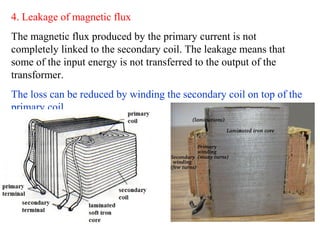
4. Leakage of magnetic flux
The magnetic flux produced by the primary current is not
completely linked to the secondary coil. The leakage means that
some of the input energy is not transferred to the output of the
transformer.
The loss can be reduced by winding the secondary coil on top of the
primary coil
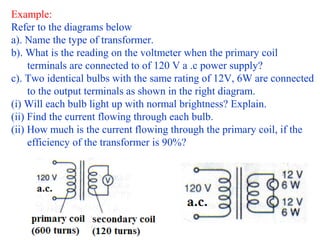
Example:
Refer to the diagrams below
a). Name the type of transformer.
b). What is the reading on the voltmeter when the primary coil
terminals are connected to of 120 V a .c power supply?
c). Two identical bulbs with the same rating of 12V, 6W are connected
to the output terminals as shown in the right diagram.
(i) Will each bulb light up with normal brightness? Explain.
(ii) Find the current flowing through each bulb.
(ii) How much is the current flowing through the primary coil, if the
efficiency of the transformer is 90%?
Answer:
a). Step-down transformer, because Ns < Np
b). Vs /Vp =Ns /Np Vs =Ns/Np x Vp
=120/600 x120 =24 V
c). i) Yes, each bulb will light up with normal brightness, because
the potential difference across each bulb is 12 V.
ii). From P = VI , hence 6 = 12 x Is
Is = 0.5A
iii). Efficiency= [ VsIs / Vp Ip ] x 100%
90% = Vs Is/VpIp x 100%
Ip = [24 x0.5/120 ]x 100/90
=0.111 A

3.4 analysing transformer

  • 1.
    3.4 Analysing Transformers Transformer:-Equipment used to raise or lower the potential difference of an alternating current supply Electrical appliances need different voltages (TV tubes -15 KV, radio – 12 V) Important in the transmission and distribution of electrical energy
  • 2.
    Operating Principle ofA transformer It works on the principle of electromagnetic induction It is made up of two coils wound on a soft iron core The alternating current produces magnetic field lines in the primary coil and this magnetic field lines will cut the secondary coil. A changing magnetic flux causes an induced e.m.f. across the secondary coil
  • 4.
    When the currentin the primary circuit increases and decreases this will cause a change of magnetic flux across the secondary coil and induces an e.m.f. This induced e.m.f. also varies in magnitude and direction, as a result it is also a sinusoidal alternating voltage with the same frequency as the input source.
  • 5.
    Why does thetransformer not work with a d.c. power supply? On what condition current can be induced in the secondary coil using d.c.? Answer: A d.c. power supply will cause no changing magnetic flux in the secondary coil, because it gives a constant current in the primary circuit. Therefore electromagnetic induction does not take place The primary current changes only at the instants when it is switched on and off. A current will be induced in the secondary coil if the switch in the primary coil is switched on and off continually.
  • 6.
    Types of Transformer Step-upTransformer Step-down Transformer Vs > Vp Ns > Np Vs < Vp Ns < Np
  • 7.
    Experiment to understandstep-up and step-down transformer
  • 8.
    Type of circuitPrimary circuit Secondary circuit Number of turns 120 400 Brightness of bulb Dim Bright Voltmeter reading 2.0V 6.5 V Type of circuit Primary circuit Secondary circuit Number of turns 400 120 Brightness of bulb Bright Dim Voltmeter reading 2.0 V 0.6 V Step-up transformer Step-down transformer
  • 9.
    To Investigate therelationship between Vp , Vs , Np , Ns Np Ns Vp Vs Ns/Np Vs/Vp 300 600 2.0 3.8 2.00 1.90 300 900 2.0 5.9 3.00 2.95 900 600 10.0 6.6 0.67 0.66 900 300 10.0 3.2 0.33 0.32
  • 10.
    From the resultof the experiment it was found that The ratios Ns/ Np and Vs/ Vp for each pair of primary and secondary coils approximately equal Taking into account experimental errors and the loss of power in the transformer, it can be inferred that Ns / Np = Vs / Vp The relationship between the number of turns in the primary coil, the number of turns in the secondary coil, the primary voltage and the secondary voltage is given by Vs / Vp = Ns / Np GET IT RIGHT: The step-down transformer steps down the input voltage only. The output current in the secondary circuit is greater than the primary current
  • 11.
    Example: The figure belowshows an ideal transformer What is the voltage across the bulb? Answer: Np =120 Ns =30 Vp =240 V Ns / Np = Vs / Vp 120/30/240/Vs Vs = 60 V
  • 12.
    Efficiency of aTransformer The efficiency is defined as E= [Output power/Input power ] x 100% E= [ VsIs / Vp Ip ] x 100%. In the process of transfer electrical energy from one circuit to another a faction of it is lost as heat energy Efficiency of transformer is normally less than 100% Ideal Transformer No energy loss, all the energy supplied to the primary coil will be transferred to the secondary coil Has efficiency of 100% Output power = Input power VsIs = Vp Ip or Vs / Vp = Ip / Is
  • 13.
    Example: Figure below showsa transformer with a bulb at its output terminals. The bulb lights up with normal brightness. (a) Determine the value of Np (b) Calculate the efficiency of the transformer. Answer: (a) Np/ 150 = 240/12 Np =3000 (b) Efficiency = Output power/Input power x 100% = 24/0.15 x 240 x 100% = 66.7 %
  • 14.
    Example: Figure above shows2 bulbs of the same rating connected to the output terminals of a transformer which has an efficiency of 80%. When an a.c. power supply of 240V is connected to its input terminals, both bulbs light up with normal brightness. Determine (a) The input power of the transformer (b) The turns ratio of the transformer. (Ns /Np ) (c) The current in the primary coil
  • 15.
    Answer: (a) Efficiency= [Outputpower / Input power ] x 100% 80% = [24/ Input power ]x 100% Input power = 100/80 x 24= 30 W ( Total output power = V I =24 (I1+I2) = 24(12/24+12/24) =24x1=24W OR total output power is= 12W+12W=24 W (b) Vs /Vp =Ns /Np Ns/Np =24/240 =1/10 (c)P = VI I = P/V =30/240 = 1/8 A
  • 16.
    Factors that affectthe efficiency of a transformer and ways to improve the efficiency of a transformer 1.Resistance of the coil A very long wire is required to make coils, hence it has electrical resistance. Heat energy is lost in the coil because of the heating effect of current flow in a conductor. The energy loss is equal to I2 R. Use thicker wire to reduce resistance of the coil 2. Magnetisation and demagnetisation of the core (Hysteresis loss) The core is continually magnetised and demagnetised by the changing magnetic field. The energy required for this process is converted into heat energy in the core. Using soft iron to reduce the energy loss. (It loses almost all its magnetism when it is demagnetised and it requires little energy to be magnetised)
  • 17.
    3. Eddy currentsin the iron core The core is itself a conductor, so the changing magnetic flux in the iron core induces current in it. These circulating eddy currents generate heat in the core and cause further loss of power. Using laminated core. It is made from thin, insulated sheet of iron (insulated with enamel paint) to increase the resistance of flow of eddy currents. With less eddy currents, energy loss is reduced.
  • 18.
    4. Leakage ofmagnetic flux The magnetic flux produced by the primary current is not completely linked to the secondary coil. The leakage means that some of the input energy is not transferred to the output of the transformer. The loss can be reduced by winding the secondary coil on top of the primary coil
  • 19.
    Example: Refer to thediagrams below a). Name the type of transformer. b). What is the reading on the voltmeter when the primary coil terminals are connected to of 120 V a .c power supply? c). Two identical bulbs with the same rating of 12V, 6W are connected to the output terminals as shown in the right diagram. (i) Will each bulb light up with normal brightness? Explain. (ii) Find the current flowing through each bulb. (ii) How much is the current flowing through the primary coil, if the efficiency of the transformer is 90%?
  • 20.
    Answer: a). Step-down transformer,because Ns < Np b). Vs /Vp =Ns /Np Vs =Ns/Np x Vp =120/600 x120 =24 V c). i) Yes, each bulb will light up with normal brightness, because the potential difference across each bulb is 12 V. ii). From P = VI , hence 6 = 12 x Is Is = 0.5A iii). Efficiency= [ VsIs / Vp Ip ] x 100% 90% = Vs Is/VpIp x 100% Ip = [24 x0.5/120 ]x 100/90 =0.111 A