SUBMITTED BY
S.SAVITH ANNAVI
XII – SCIENCE STREAM
1
A PROJECT REPORT ON
TRANSFORMER
SUBMITTED FOR SSCE
PHYSICS
PRATICAL EXAMINATION TO BE HELD ON 2025
CERTIFICATE
This is to certify that the project titled
“TRANSFORMER“ is a work done by S. SAVITH
ANNAVI during the year 2024 – 2025
SUBMITTED ON
INTERNAL EXAMINER: EXTERNAL
EXAMINER:
2
ACKNOWLEDGEMENT
I express my sincere gratitude to
Mr. Dr. R. KRISHNAMOORTHY Chairman
Sri Krish International School for his guidance throughout
the work on this project.
I am highly thankful to Mrs. Dr. S. UDAYA CHITRA
principal for her valuable guidance and for her constant
encouragement.
I am highly thankful to Mrs. NAVITHA ALVA for her
valuable guidance and for her constant encouragement.
I am highly thankful to Mr. MANOHAR T for his valuable
guidance and for his constant encouragement.
I take this opportunity to thank all those who have helped me to
complete this project in time.
PLACE: CHENNAI
DATE:
3
INDEX
CONTENT PAGE NO
Certificate 02
Acknowledgement 03
Topic 05
Introduction 06
Principle 07
Construction 08
Theory 9-11
Working 12
Material Required 14
Procedure 15
Observation 16
Application 18
Conclusion 19
Precaution 20
Bibliography 21
4 | P a g e
TOPIC
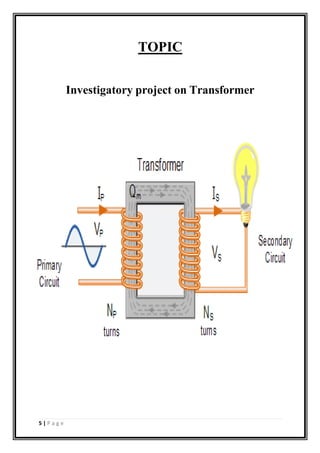
Investigatory project on Transformer
5 | P a g e
INTRODUCTION
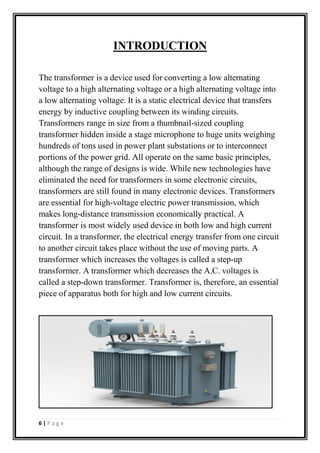
The transformer is a device used for converting a low alternating
voltage to a high alternating voltage or a high alternating voltage into
a low alternating voltage. It is a static electrical device that transfers
energy by inductive coupling between its winding circuits.
Transformers range in size from a thumbnail-sized coupling
transformer hidden inside a stage microphone to huge units weighing
hundreds of tons used in power plant substations or to interconnect
portions of the power grid. All operate on the same basic principles,
although the range of designs is wide. While new technologies have
eliminated the need for transformers in some electronic circuits,
transformers are still found in many electronic devices. Transformers
are essential for high-voltage electric power transmission, which
makes long-distance transmission economically practical. A
transformer is most widely used device in both low and high current
circuit. In a transformer, the electrical energy transfer from one circuit
to another circuit takes place without the use of moving parts. A
transformer which increases the voltages is called a step-up
transformer. A transformer which decreases the A.C. voltages is
called a step-down transformer. Transformer is, therefore, an essential
piece of apparatus both for high and low current circuits.
6 | P a g e
PRINCIPLE
The electric transformer works on the fundamental principle of
electromagnetic induction, a concept first discovered by Michael
Faraday in the 19th century. The transformer consists of two coils of
wire, known as the primary and secondary windings, which are usually
wound around a common magnetic core. When an alternating current
(AC) flows through the primary winding, it generates a changing
magnetic field around the coil. According to Faraday's law of
electromagnetic induction, this changing magnetic field induces an
electromotive force (EMF) or voltage in the secondary winding. The
key principle here is that the transformer relies on the mutual induction
between the primary and secondary windings through the magnetic flux
linkage.
7 | P a g e
CONSTRUCTION
A transformer consists of a rectangular shaft iron core made of
laminated sheets, well insulated from one another. Two coils
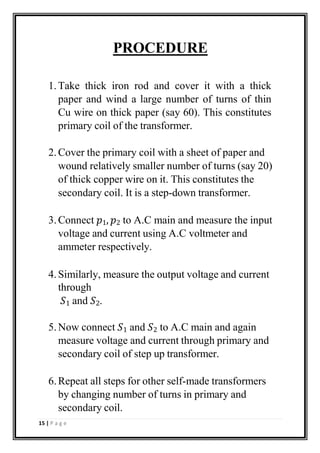
𝑃1 & 𝑃2 and 𝑆1 & 𝑆2are wound on the same core, but are well insulated
with each other. Note that the both the coils are insulated from the core,
the source of alternating e.m.f is connected to 𝑃1𝑃2, the primary coil
and a load resistance R is connected to 𝑆1𝑆2, the secondary coil through
an open switch S. thus there can be no current through the sec. coil so
long as the switch is open. For an ideal transformer, we assume that the
resistance of the primary & secondary winding is negligible. Further,
the energy loses due to magnetic the iron core is also negligible. For
operation at low frequency, we may have a soft iron. The soft iron core
is insulating by joining thin iron strips coated with varnish to insulate
them to reduce energy losses by eddy currents. The input circuit is
called primary. And the output circuit is called secondary.
8 | P a g e
THEORY
When an altering e.m.f. is supplied to the primary coil 𝑝1𝑝2 , an
alternating current starts falling in it. The altering current in the
primary produces a changing magnetic flux, which induces altering
voltage in the primary as well as in the secondary. In a good-
transformer, whole of the magnetic flux linked with primary is also
linked with the secondary, and then the induced e.m.f. induced in each
turn of the secondary is equal to that induced in each turn of the
primary. Thus, if 𝐸𝑝 and 𝐸𝑠 be the instantaneous values of the e.m.f.’s
induced in the primary and the secondary coil and 𝑁𝑝 and 𝑁𝑠 are the
no. of turns of the primary and secondary coils of the transformer and,
𝒅𝜱𝒃/𝒅𝒕 = rate of change of flux in each turn of the coil at this instant,
we have,
𝐸𝑝 = −𝑁𝑝𝑑𝛷ь /𝑑𝑡 -----------------------(1) and
𝐸𝑠 = −𝑁𝑠𝑑𝛷ь /𝑑𝑡 -----------------------(2)
Since the above relations are true at every instant,
so by dividing 2 by 1 we get,
𝐸𝑠⁄𝐸𝑝 = −𝑁𝑠⁄𝑁𝑝 -------------------------(3)
As 𝐸𝑝 is the instantaneous value of back e.m.f induced in the primary
coil p1, so the instantaneous current in primary coil is due to the
difference (𝐸 − 𝐸𝑝) in the instantaneous values of the applied and
back e.m.f. further if 𝑅𝑝 is the resistance of 𝑝1𝑝2 , coil, then the
instantaneous current 𝐼𝑝 in the primary coil is given by:
𝐼𝑃 = 𝐸 − 𝐸𝑝⁄𝑅𝑝
𝐸 − 𝐸𝑝 = 𝐼𝑝𝑅𝑝
9 | P a g e
When the resistance of the primary is small, 𝐼𝑝𝑅𝑝 can be neglected so
therefore,
𝐸 − 𝐸𝑝 = 0 or 𝐸 = 𝐸𝑝
Thus, 𝐵𝑎𝑐𝑘 𝑒. 𝑚. 𝑓 = 𝐼𝑛𝑝𝑢𝑡 𝑒. 𝑚. 𝑓
Hence equation (3) can be written as,
𝐸 ⁄𝐸
𝐼𝑛𝑝𝑢𝑡 𝑒.𝑚.𝑓
𝑠 𝑝 𝑠 𝑠 𝑝
= 𝐸 ⁄𝐸 = 𝑂𝑢𝑡𝑝𝑢𝑡 𝑒.𝑚.𝑓
= 𝑁 ⁄𝑁 = 𝐾
Where K is constant, called turn or transformation ratio.
In a step-up transformer
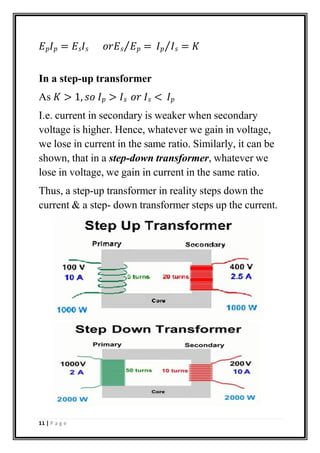
𝐸𝑠 > 𝐸 𝑠𝑜 𝐾 > 1, ℎ𝑒𝑛𝑐𝑒 𝑁𝑠 > 𝑁𝑝
In a step-down transformer
𝐸𝑠 < 𝐸 𝑠𝑜 𝐾 < 1, ℎ𝑒𝑛𝑐𝑒 𝑁𝑠 < 𝑁𝑝
If 𝐼𝑃 = Value of primary current at the same instant 𝑡
and
𝐼𝑠 = Value of secondary current at this instant, then
Input power at the instant 𝑡 = 𝐸𝑝𝐼𝑝 and
Output power at the same instant = 𝐸𝑠𝐼𝑠
If there are no losses of power in the transformer, then
Input power = output power or
10 | P a g e
𝐸𝑝𝐼𝑝 = 𝐸𝑠𝐼𝑠 𝑜𝑟𝐸𝑠⁄𝐸𝑝 = 𝐼𝑝⁄𝐼𝑠 = 𝐾
In a step-up transformer
As 𝐾 > 1, 𝑠𝑜 𝐼𝑝 > 𝐼𝑠 𝑜𝑟 𝐼𝑠 < 𝐼𝑝
I.e. current in secondary is weaker when secondary
voltage is higher. Hence, whatever we gain in voltage,
we lose in current in the same ratio. Similarly, it can be
shown, that in a step-down transformer, whatever we
lose in voltage, we gain in current in the same ratio.
Thus, a step-up transformer in reality steps down the
current & a step- down transformer steps up the current.
11 | P a g e
WORKING
A Transformer based on the Principle of mutual induction
according to this principle, the amount of magnetic flux
linked with a coil changing, an e.m.f is induced in the
neighbouring coil that is if a varying current is set-up in a
circuit induced e.m.f. is produced in the neighbouring
circuit. The varying current in a circuit produce varying
magnetic flux which induces e.m.f. in the neighbouring
circuit.
The transformer consists of two coils. They are insulated
with each other by insulated material and wound on a
common core. For operation at low frequency, we may
have a soft iron. The soft iron core is insulating by joining
thin iron strips coated with varnish to insulate them to
reduce energy losses by eddy currents. The input circuit is
called primary. And the output circuit is called secondary.
12 | P a g e
EFFICIENCY
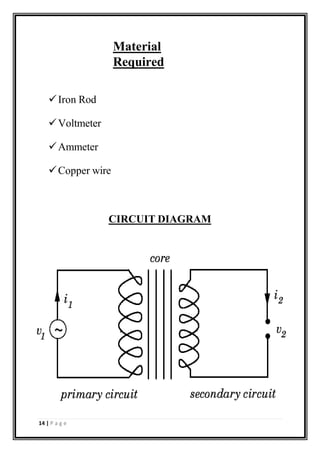
Efficiency of a transformer is defined as the ratio of
output power to the input power i.e.
𝜂 = 𝑂𝑢𝑡𝑝𝑢𝑡 𝑃𝑜𝑤𝑒𝑟⁄𝐼𝑛𝑝𝑢𝑡 𝑃𝑜𝑤𝑒𝑟 = 𝐸𝑠𝐼𝑠⁄𝐸𝑝𝐼𝑝
Thus, in an ideal transformer, where there is no power
losses, η = 1. But in actual practice, there are many
power losses; therefore, the efficiency of transformer
is less than one.
13 | P a g e
Material
Required
✓Iron Rod
✓Voltmeter
✓Ammeter
✓Copper wire
CIRCUIT DIAGRAM
14 | P a g e
PROCEDURE
1.Take thick iron rod and cover it with a thick
paper and wind a large number of turns of thin
Cu wire on thick paper (say 60). This constitutes
primary coil of the transformer.
2.Cover the primary coil with a sheet of paper and
wound relatively smaller number of turns (say 20)
of thick copper wire on it. This constitutes the
secondary coil. It is a step-down transformer.
3.Connect 𝑝1, 𝑝2 to A.C main and measure the input
voltage and current using A.C voltmeter and
ammeter respectively.
4.Similarly, measure the output voltage and current
through
𝑆1 and 𝑆2.
5.Now connect 𝑆1 and 𝑆2 to A.C main and again
measure voltage and current through primary and
secondary coil of step up transformer.
6.Repeat all steps for other self-made transformers
by changing number of turns in primary and
secondary coil.
15 | P a g e
OBSERVATION
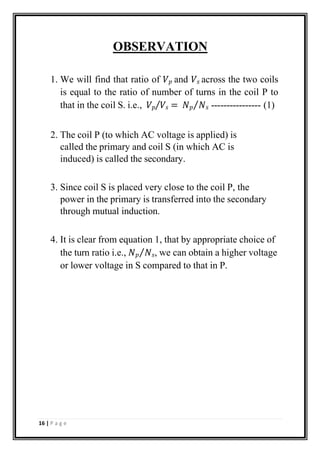
1. We will find that ratio of 𝑉𝑝 and 𝑉𝑠 across the two coils
is equal to the ratio of number of turns in the coil P to
that in the coil S. i.e., 𝑉𝑝⁄𝑉𝑠 = 𝑁𝑝⁄𝑁𝑠 ---------------- (1)
2. The coil P (to which AC voltage is applied) is
called the primary and coil S (in which AC is
induced) is called the secondary.
3. Since coil S is placed very close to the coil P, the
power in the primary is transferred into the secondary
through mutual induction.
4. It is clear from equation 1, that by appropriate choice of
the turn ratio i.e., 𝑁𝑝⁄𝑁𝑠, we can obtain a higher voltage
or lower voltage in S compared to that in P.
16 | P a g e
ENERGY LOSS
In practice, the output energy of a transformer is always less
than the input energy, because energy losses occur due to a
number of reasons as explained below.
Loss of Magnetic Flux: The coupling between the coils
is seldom perfect. So, whole of the magnetic flux
produced by the primary coil is not linked up with the
secondary coil.
Iron Loss: In actual iron cores in spite of
lamination, Eddy currents are produced. The
magnitude of eddy current may, however be small.
And a part of energy is lost as the heat produced in
the iron core.
Copper Loss: In practice, the coils of the transformer
possess resistance. So, a part of the energy is lost due
to the heat produced in the resistance of the coil.
Hysteresis Loss: The alternating current in the coil
tapes the iron core through complete cycle of
magnetization. So, Energy is lost due to hysteresis.
Magneto restriction: The alternating current in the
Transformer may be set its parts in to vibrations and
sound may be produced. It is called humming. Thus, a
part of energy may be lost due to humming.
17 | P a g e
APPLICATION OF TRANSFORMER
1. Electric Power Transmission: Transformers are crucial in
power transmission networks to step up voltage for efficient
long-distance transmission and step-down voltage for
distribution to end-users.
2. Voltage Regulation: Transformers help maintain a stable
voltage level by adjusting the voltage as needed, ensuring
consistent and reliable electrical supply.
3. Power Distribution: They are used in power distribution
systems to provide various voltage levels suitable for
residential, commercial, and industrial applications.
4. Power Supply Units: Transformers are employed in power
supply units of electronic devices, converting AC power from
outlets to the DC power needed by devices like computers and
chargers.
5. Voltage Transformation: Transformers change the voltage
levels, allowing electricity to be transmitted at high voltages to
reduce energy losses and then be distributed at lower voltages
for use.
6. Industrial Applications: Transformers power various
industrial machinery and equipment by adapting electrical
voltage to meet specific operational requirements.
7. Electrical Appliances: Many electronic devices and
appliances use transformers to convert electricity to the
required voltage for their operation.
18 | P a g e
CONCLUSION
The output voltage of the transformer across the
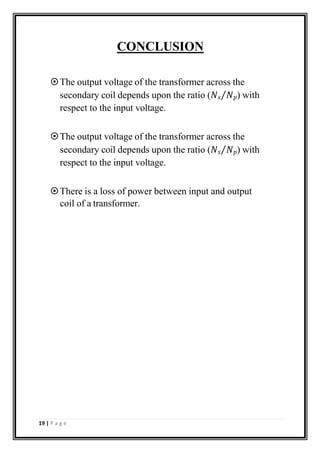
secondary coil depends upon the ratio (𝑁𝑠⁄𝑁𝑝) with
respect to the input voltage.
The output voltage of the transformer across the
secondary coil depends upon the ratio (𝑁𝑠⁄𝑁𝑝) with
respect to the input voltage.
There is a loss of power between input and output
coil of a transformer.
19 | P a g e
PRECAUTION
1. Ensure proper insulation between primary and
secondary coils to prevent short circuits.
2. While taking the readings of current and voltage the A.C
should remain constant
3. Use appropriate safety measures when working with AC
mains, including insulated tools and gloves.
4. Securely fasten all connections to prevent
accidental disconnections during the
experiment.
5. Verify the insulation on the iron rod to avoid electrical
shocks and ensure a safe working environment.
6. Double-check the circuit connections before
applying AC mains to avoid potential hazards.
7. Keep the experimental setup well-ventilated to
dissipate any heat generated during the experiment.
8. Have firefighting equipment nearby and follow
emergency procedures in case of unexpected events.
20 | P a g e

Transformer Investigatory Project (U).pdf

  • 1.
    SUBMITTED BY S.SAVITH ANNAVI XII– SCIENCE STREAM 1 A PROJECT REPORT ON TRANSFORMER SUBMITTED FOR SSCE PHYSICS PRATICAL EXAMINATION TO BE HELD ON 2025
  • 2.
    CERTIFICATE This is tocertify that the project titled “TRANSFORMER“ is a work done by S. SAVITH ANNAVI during the year 2024 – 2025 SUBMITTED ON INTERNAL EXAMINER: EXTERNAL EXAMINER: 2
  • 3.
    ACKNOWLEDGEMENT I express mysincere gratitude to Mr. Dr. R. KRISHNAMOORTHY Chairman Sri Krish International School for his guidance throughout the work on this project. I am highly thankful to Mrs. Dr. S. UDAYA CHITRA principal for her valuable guidance and for her constant encouragement. I am highly thankful to Mrs. NAVITHA ALVA for her valuable guidance and for her constant encouragement. I am highly thankful to Mr. MANOHAR T for his valuable guidance and for his constant encouragement. I take this opportunity to thank all those who have helped me to complete this project in time. PLACE: CHENNAI DATE: 3
  • 4.
    INDEX CONTENT PAGE NO Certificate02 Acknowledgement 03 Topic 05 Introduction 06 Principle 07 Construction 08 Theory 9-11 Working 12 Material Required 14 Procedure 15 Observation 16 Application 18 Conclusion 19 Precaution 20 Bibliography 21 4 | P a g e
  • 5.
    TOPIC Investigatory project onTransformer 5 | P a g e
  • 6.
    INTRODUCTION The transformer isa device used for converting a low alternating voltage to a high alternating voltage or a high alternating voltage into a low alternating voltage. It is a static electrical device that transfers energy by inductive coupling between its winding circuits. Transformers range in size from a thumbnail-sized coupling transformer hidden inside a stage microphone to huge units weighing hundreds of tons used in power plant substations or to interconnect portions of the power grid. All operate on the same basic principles, although the range of designs is wide. While new technologies have eliminated the need for transformers in some electronic circuits, transformers are still found in many electronic devices. Transformers are essential for high-voltage electric power transmission, which makes long-distance transmission economically practical. A transformer is most widely used device in both low and high current circuit. In a transformer, the electrical energy transfer from one circuit to another circuit takes place without the use of moving parts. A transformer which increases the voltages is called a step-up transformer. A transformer which decreases the A.C. voltages is called a step-down transformer. Transformer is, therefore, an essential piece of apparatus both for high and low current circuits. 6 | P a g e
  • 7.
    PRINCIPLE The electric transformerworks on the fundamental principle of electromagnetic induction, a concept first discovered by Michael Faraday in the 19th century. The transformer consists of two coils of wire, known as the primary and secondary windings, which are usually wound around a common magnetic core. When an alternating current (AC) flows through the primary winding, it generates a changing magnetic field around the coil. According to Faraday's law of electromagnetic induction, this changing magnetic field induces an electromotive force (EMF) or voltage in the secondary winding. The key principle here is that the transformer relies on the mutual induction between the primary and secondary windings through the magnetic flux linkage. 7 | P a g e
  • 8.
    CONSTRUCTION A transformer consistsof a rectangular shaft iron core made of laminated sheets, well insulated from one another. Two coils 𝑃1 & 𝑃2 and 𝑆1 & 𝑆2are wound on the same core, but are well insulated with each other. Note that the both the coils are insulated from the core, the source of alternating e.m.f is connected to 𝑃1𝑃2, the primary coil and a load resistance R is connected to 𝑆1𝑆2, the secondary coil through an open switch S. thus there can be no current through the sec. coil so long as the switch is open. For an ideal transformer, we assume that the resistance of the primary & secondary winding is negligible. Further, the energy loses due to magnetic the iron core is also negligible. For operation at low frequency, we may have a soft iron. The soft iron core is insulating by joining thin iron strips coated with varnish to insulate them to reduce energy losses by eddy currents. The input circuit is called primary. And the output circuit is called secondary. 8 | P a g e
  • 9.
    THEORY When an alteringe.m.f. is supplied to the primary coil 𝑝1𝑝2 , an alternating current starts falling in it. The altering current in the primary produces a changing magnetic flux, which induces altering voltage in the primary as well as in the secondary. In a good- transformer, whole of the magnetic flux linked with primary is also linked with the secondary, and then the induced e.m.f. induced in each turn of the secondary is equal to that induced in each turn of the primary. Thus, if 𝐸𝑝 and 𝐸𝑠 be the instantaneous values of the e.m.f.’s induced in the primary and the secondary coil and 𝑁𝑝 and 𝑁𝑠 are the no. of turns of the primary and secondary coils of the transformer and, 𝒅𝜱𝒃/𝒅𝒕 = rate of change of flux in each turn of the coil at this instant, we have, 𝐸𝑝 = −𝑁𝑝𝑑𝛷ь /𝑑𝑡 -----------------------(1) and 𝐸𝑠 = −𝑁𝑠𝑑𝛷ь /𝑑𝑡 -----------------------(2) Since the above relations are true at every instant, so by dividing 2 by 1 we get, 𝐸𝑠⁄𝐸𝑝 = −𝑁𝑠⁄𝑁𝑝 -------------------------(3) As 𝐸𝑝 is the instantaneous value of back e.m.f induced in the primary coil p1, so the instantaneous current in primary coil is due to the difference (𝐸 − 𝐸𝑝) in the instantaneous values of the applied and back e.m.f. further if 𝑅𝑝 is the resistance of 𝑝1𝑝2 , coil, then the instantaneous current 𝐼𝑝 in the primary coil is given by: 𝐼𝑃 = 𝐸 − 𝐸𝑝⁄𝑅𝑝 𝐸 − 𝐸𝑝 = 𝐼𝑝𝑅𝑝 9 | P a g e
  • 10.
    When the resistanceof the primary is small, 𝐼𝑝𝑅𝑝 can be neglected so therefore, 𝐸 − 𝐸𝑝 = 0 or 𝐸 = 𝐸𝑝 Thus, 𝐵𝑎𝑐𝑘 𝑒. 𝑚. 𝑓 = 𝐼𝑛𝑝𝑢𝑡 𝑒. 𝑚. 𝑓 Hence equation (3) can be written as, 𝐸 ⁄𝐸 𝐼𝑛𝑝𝑢𝑡 𝑒.𝑚.𝑓 𝑠 𝑝 𝑠 𝑠 𝑝 = 𝐸 ⁄𝐸 = 𝑂𝑢𝑡𝑝𝑢𝑡 𝑒.𝑚.𝑓 = 𝑁 ⁄𝑁 = 𝐾 Where K is constant, called turn or transformation ratio. In a step-up transformer 𝐸𝑠 > 𝐸 𝑠𝑜 𝐾 > 1, ℎ𝑒𝑛𝑐𝑒 𝑁𝑠 > 𝑁𝑝 In a step-down transformer 𝐸𝑠 < 𝐸 𝑠𝑜 𝐾 < 1, ℎ𝑒𝑛𝑐𝑒 𝑁𝑠 < 𝑁𝑝 If 𝐼𝑃 = Value of primary current at the same instant 𝑡 and 𝐼𝑠 = Value of secondary current at this instant, then Input power at the instant 𝑡 = 𝐸𝑝𝐼𝑝 and Output power at the same instant = 𝐸𝑠𝐼𝑠 If there are no losses of power in the transformer, then Input power = output power or 10 | P a g e
  • 11.
    𝐸𝑝𝐼𝑝 = 𝐸𝑠𝐼𝑠𝑜𝑟𝐸𝑠⁄𝐸𝑝 = 𝐼𝑝⁄𝐼𝑠 = 𝐾 In a step-up transformer As 𝐾 > 1, 𝑠𝑜 𝐼𝑝 > 𝐼𝑠 𝑜𝑟 𝐼𝑠 < 𝐼𝑝 I.e. current in secondary is weaker when secondary voltage is higher. Hence, whatever we gain in voltage, we lose in current in the same ratio. Similarly, it can be shown, that in a step-down transformer, whatever we lose in voltage, we gain in current in the same ratio. Thus, a step-up transformer in reality steps down the current & a step- down transformer steps up the current. 11 | P a g e
  • 12.
    WORKING A Transformer basedon the Principle of mutual induction according to this principle, the amount of magnetic flux linked with a coil changing, an e.m.f is induced in the neighbouring coil that is if a varying current is set-up in a circuit induced e.m.f. is produced in the neighbouring circuit. The varying current in a circuit produce varying magnetic flux which induces e.m.f. in the neighbouring circuit. The transformer consists of two coils. They are insulated with each other by insulated material and wound on a common core. For operation at low frequency, we may have a soft iron. The soft iron core is insulating by joining thin iron strips coated with varnish to insulate them to reduce energy losses by eddy currents. The input circuit is called primary. And the output circuit is called secondary. 12 | P a g e
  • 13.
    EFFICIENCY Efficiency of atransformer is defined as the ratio of output power to the input power i.e. 𝜂 = 𝑂𝑢𝑡𝑝𝑢𝑡 𝑃𝑜𝑤𝑒𝑟⁄𝐼𝑛𝑝𝑢𝑡 𝑃𝑜𝑤𝑒𝑟 = 𝐸𝑠𝐼𝑠⁄𝐸𝑝𝐼𝑝 Thus, in an ideal transformer, where there is no power losses, η = 1. But in actual practice, there are many power losses; therefore, the efficiency of transformer is less than one. 13 | P a g e
  • 14.
  • 15.
    PROCEDURE 1.Take thick ironrod and cover it with a thick paper and wind a large number of turns of thin Cu wire on thick paper (say 60). This constitutes primary coil of the transformer. 2.Cover the primary coil with a sheet of paper and wound relatively smaller number of turns (say 20) of thick copper wire on it. This constitutes the secondary coil. It is a step-down transformer. 3.Connect 𝑝1, 𝑝2 to A.C main and measure the input voltage and current using A.C voltmeter and ammeter respectively. 4.Similarly, measure the output voltage and current through 𝑆1 and 𝑆2. 5.Now connect 𝑆1 and 𝑆2 to A.C main and again measure voltage and current through primary and secondary coil of step up transformer. 6.Repeat all steps for other self-made transformers by changing number of turns in primary and secondary coil. 15 | P a g e
  • 16.
    OBSERVATION 1. We willfind that ratio of 𝑉𝑝 and 𝑉𝑠 across the two coils is equal to the ratio of number of turns in the coil P to that in the coil S. i.e., 𝑉𝑝⁄𝑉𝑠 = 𝑁𝑝⁄𝑁𝑠 ---------------- (1) 2. The coil P (to which AC voltage is applied) is called the primary and coil S (in which AC is induced) is called the secondary. 3. Since coil S is placed very close to the coil P, the power in the primary is transferred into the secondary through mutual induction. 4. It is clear from equation 1, that by appropriate choice of the turn ratio i.e., 𝑁𝑝⁄𝑁𝑠, we can obtain a higher voltage or lower voltage in S compared to that in P. 16 | P a g e
  • 17.
    ENERGY LOSS In practice,the output energy of a transformer is always less than the input energy, because energy losses occur due to a number of reasons as explained below. Loss of Magnetic Flux: The coupling between the coils is seldom perfect. So, whole of the magnetic flux produced by the primary coil is not linked up with the secondary coil. Iron Loss: In actual iron cores in spite of lamination, Eddy currents are produced. The magnitude of eddy current may, however be small. And a part of energy is lost as the heat produced in the iron core. Copper Loss: In practice, the coils of the transformer possess resistance. So, a part of the energy is lost due to the heat produced in the resistance of the coil. Hysteresis Loss: The alternating current in the coil tapes the iron core through complete cycle of magnetization. So, Energy is lost due to hysteresis. Magneto restriction: The alternating current in the Transformer may be set its parts in to vibrations and sound may be produced. It is called humming. Thus, a part of energy may be lost due to humming. 17 | P a g e
  • 18.
    APPLICATION OF TRANSFORMER 1.Electric Power Transmission: Transformers are crucial in power transmission networks to step up voltage for efficient long-distance transmission and step-down voltage for distribution to end-users. 2. Voltage Regulation: Transformers help maintain a stable voltage level by adjusting the voltage as needed, ensuring consistent and reliable electrical supply. 3. Power Distribution: They are used in power distribution systems to provide various voltage levels suitable for residential, commercial, and industrial applications. 4. Power Supply Units: Transformers are employed in power supply units of electronic devices, converting AC power from outlets to the DC power needed by devices like computers and chargers. 5. Voltage Transformation: Transformers change the voltage levels, allowing electricity to be transmitted at high voltages to reduce energy losses and then be distributed at lower voltages for use. 6. Industrial Applications: Transformers power various industrial machinery and equipment by adapting electrical voltage to meet specific operational requirements. 7. Electrical Appliances: Many electronic devices and appliances use transformers to convert electricity to the required voltage for their operation. 18 | P a g e
  • 19.
    CONCLUSION The output voltageof the transformer across the secondary coil depends upon the ratio (𝑁𝑠⁄𝑁𝑝) with respect to the input voltage. The output voltage of the transformer across the secondary coil depends upon the ratio (𝑁𝑠⁄𝑁𝑝) with respect to the input voltage. There is a loss of power between input and output coil of a transformer. 19 | P a g e
  • 20.
    PRECAUTION 1. Ensure properinsulation between primary and secondary coils to prevent short circuits. 2. While taking the readings of current and voltage the A.C should remain constant 3. Use appropriate safety measures when working with AC mains, including insulated tools and gloves. 4. Securely fasten all connections to prevent accidental disconnections during the experiment. 5. Verify the insulation on the iron rod to avoid electrical shocks and ensure a safe working environment. 6. Double-check the circuit connections before applying AC mains to avoid potential hazards. 7. Keep the experimental setup well-ventilated to dissipate any heat generated during the experiment. 8. Have firefighting equipment nearby and follow emergency procedures in case of unexpected events. 20 | P a g e