ifeu - Institut für Energie- und Umweltforschung Heidelberg GmbH 
Indirect Land Use Change (iLUC) 
and biogas industry 
Horst Fehrenbach 
EBA Conference 2014 
Egmond aan Zee, the Netherlands, 1 October 2014 
horst.fehrenbach@ifeu.de 
Horst Fehrenbach 1 October 2014 1
ifeu - Institut für Energie- und Umweltforschung Heidelberg GmbH 
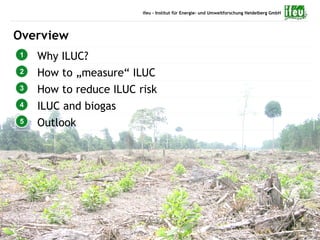
Overview 
1 Why ILUC? 
2 How to „measure“ ILUC 
3 How to reduce ILUC risk 
4 ILUC and biogas 
5 Outlook 
Horst Fehrenbach 1 October 2014 2
ifeu - Institut für Energie- und Umweltforschung Heidelberg GmbH 
Horst Fehrenbach 1 October 2014 3 
1 
Why ILUC? 
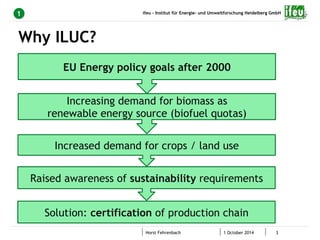
EU Energy policy goals after 2000 
Increasing demand for biomass as 
renewable energy source (biofuel quotas) 
Increased demand for crops / land use 
Raised awareness of sustainability requirements 
Solution: certification of production chain
ifeu - Institut für Energie- und Umweltforschung Heidelberg GmbH 
Thus certification is mandatory 
according to EU Directive 2009/28/EC 
(à list of land-use-related sustainability requirements) 
Horst Fehrenbach 1 October 2014 4 
1 Why ILUC? 
However certification … 
à does not cover the entire problem 
à is focussed only on direct effects 
à fails to prevent leakage effects 
Since 2006 many scientific articles and reports 
(also by US experts) are dealing with that issue.
ifeu - Institut für Energie- und Umweltforschung Heidelberg GmbH 
Horst Fehrenbach 1 October 2014 5 
1 Why ILUC? 
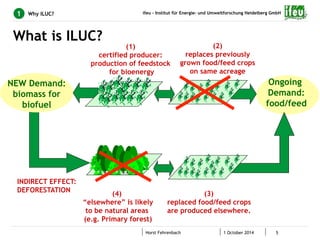
What is ILUC? 
(1) 
certified producer: 
production of feedstock 
for bioenergy 
(2) 
replaces previously 
grown food/feed crops 
on same acreage 
NEW Demand: 
biomass for 
biofuel 
Ongoing 
Demand: 
food/feed 
(3) 
replaced food/feed crops 
are produced elsewhere. 
(4) 
“elsewhere” is likely 
to be natural areas 
(e.g. Primary forest) 
INDIRECT EFFECT: 
DEFORESTATION
ifeu - Institut für Energie- und Umweltforschung Heidelberg GmbH 
Horst Fehrenbach 1 October 2014 6 
1 Why ILUC? 
Is ILUC relevant? 
IFPRI Report (October 2011): 
… emissions related to land use changes driven by 
biofuel policies are a serious concern. 
This finding is robust .... 
The LUC effect reduces the environmental gains of 
the biofuel policy and should not be neglected. 
Laborde, D., (2011). Assessing the Land Use Change Consequences of European Biofuel 
Policies, Final Report. ATLASS Consortium, Contract No SI2. 580403. 
Available at: 
http://www.ifpri.org/sites/default/files/publications/biofuelsreportec2011.pdf
ifeu - Institut für Energie- und Umweltforschung Heidelberg GmbH 
1 Why ILUC? 
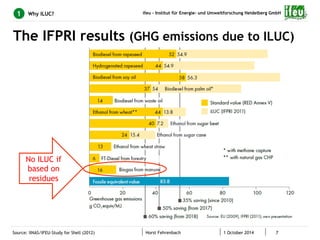
The IFPRI results (GHG emissions due to ILUC) 
Horst Fehrenbach 1 October 2014 7 
No ILUC if 
based on 
residues 
Source: IINAS/IFEU-Study for Shell (2012)
ifeu - Institut für Energie- und Umweltforschung Heidelberg GmbH 
How to measure ILUC 
Horst Fehrenbach 1 October 2014 8 
2 
First of all: 
all current ILUC assessments are expressed by 
Greenhouse gas emission (g CO2eq/MJ biofuel) 
However: 
ILUC is more than just a carbon debt 
Ø Biodiversity 
Ø Food security 
Ø local energy security 
Ø Water scarcity
ifeu - Institut für Energie- und Umweltforschung Heidelberg GmbH 
How to measure ILUC 
The indirectness counteracts any straight-forward 
approach to „measure“ ILUC 
Horst Fehrenbach 1 October 2014 9 
2 
Ø It is a matter of market relations 
Ø It is a matter of magnitude 
à There are many approaches out there, ranging 
from simple assumptive approaches to highly 
complex econometric models. 
à There is no way to avoid a large number of 
conventions and assumptions.
ifeu - Institut für Energie- und Umweltforschung Heidelberg GmbH 
How to measure ILUC 
Key issue: „who‘s responsible?“ 
Horst Fehrenbach 1 October 2014 10 
2 
Ø ILUC to be blamed rather on the policy than on 
the single producer. 
Ø ILUC effects are direct effects of someone else 
(sectoral thinking is implicating the problem) 
Ø Tendency to differ between low-ILUC-risk and 
high-ILUC-risk bioenergy 
(favoured by EU Commission).
ifeu - Institut für Energie- und Umweltforschung Heidelberg GmbH 
How to reduce ILUC risk 
Horst Fehrenbach 1 October 2014 11 
3 How to reduce ILUC risk 
Ø The EU Commission is tending to phase out 
First Generation biofuels (from crops à ILUC) 
and to promote 2nd Gen. from residues/waste. 
Ø Low Indirect Impact Biofuels (LIIB) by WWF/EFPL/Ecofys 
§ Biofuel feedstocks produced from yield increases. 
§ Biofuel feedstocks produced by increasing the overall 
system efficiency. 
§ Biofuel feedstocks produced on unused land with low 
carbon stocks and low biodiversity values. 
§ Biofuels produced from waste.
ifeu - Institut für Energie- und Umweltforschung Heidelberg GmbH 
Key issue “residues” 
Horst Fehrenbach 1 October 2014 12 
3 How to reduce ILUC risk 
Ø How exactly are residues defined? 
Ø What if the residue is already used for some 
other reasonable purpose? 
Ø Does double-counting (or even quadruple-counting) 
insentivise the „production“ of waste/ 
residues?
ifeu - Institut für Energie- und Umweltforschung Heidelberg GmbH 
Horst Fehrenbach 1 October 2014 13 
4 ILUC and biogas 
ILUC and biogas 
Ø Mode of utilization does not matter, only 
feedstock acquistion matters. 
à biogas = ILUC-relevant like any other biofuel 
Ø Biogas from crops (e.g. maize) need to be 
handled the same way as Biodiesel from 
rapeseed oder Ethanol from wheat. 
Ø Biogas from residues/waste: 
à consider the aspects from previous slides
ifeu - Institut für Energie- und Umweltforschung Heidelberg GmbH 
Considerations on „residues“ for biogas 
Horst Fehrenbach 1 October 2014 14 
4 ILUC and biogas 
Ø Manure: 
digestion does not compete with any other 
potential use of manure. 
à no ILUC at all 
Ø Industrial residues (e.g. glycerine) 
is there evidence that there is no competing 
use? 
The waste character has to be justified, 
otherwise the feedstock is a co-product 
à land use to be allocated 
à ILUC (?)
ifeu - Institut für Energie- und Umweltforschung Heidelberg GmbH 
Considerations on „residues“ for biogas 
Horst Fehrenbach 1 October 2014 15 
4 ILUC and biogas 
Ø Agricultural residues (e.g. straw): 
firstly: straw is a residue per RED definition 
à formally no ILUC 
secondly: is it actually a residue? 
Or rather a lucrative co-product? 
à industrial waste (slide before) 
à land use to be allocated 
à ILUC in actuality (?) 
(matter of market / magnitude)
ifeu - Institut für Energie- und Umweltforschung Heidelberg GmbH 
What about „low ILUC biogas“ 
Horst Fehrenbach 1 October 2014 16 
4 ILUC and biogas 
Ø LIIB criteria can be easily applied on biogas 
feedstock production: 
Ø e.g. Intercropping 
Ø e.g. plants leading to yield increases along 
the crop rotation 
Ø e.g. integration of biogas plants leading to 
increased overall system efficiency 
(integrated cycles which livestock 
à manure)
ifeu - Institut für Energie- und Umweltforschung Heidelberg GmbH 
5 
" The EU Commission is still pending the decision on 
how ILUC shall be handled for biofuels. 
Likely that crop-based biofuels will be phased out, 
residue-based biofuel featured. 
" The EU Commission will not set mandatory 
requirements for biogas (heat/power) à SWD(2014) 259 final 
Therefore: legally no ILUC for biogas 
" The discussion is ongoing anyhow 
§ land use is the most discussed environmental key 
aspect after climate change 
§ Food security remains an unsolved global issue. 
Horst Fehrenbach 1 October 2014 17 
OUTLOOK
ifeu - Institut für Energie- und Umweltforschung Heidelberg GmbH 
Thank you for listening 
Horst Fehrenbach 1 October 2014 18 
horst.fehrenbach@ifeu.de 
+49 6221 4767-16

Indirect land use change (iLUC) and biogas industry - Horst Fehrenbach

  • 1.
    ifeu - Institutfür Energie- und Umweltforschung Heidelberg GmbH Indirect Land Use Change (iLUC) and biogas industry Horst Fehrenbach EBA Conference 2014 Egmond aan Zee, the Netherlands, 1 October 2014 horst.fehrenbach@ifeu.de Horst Fehrenbach 1 October 2014 1
  • 2.
    ifeu - Institutfür Energie- und Umweltforschung Heidelberg GmbH Overview 1 Why ILUC? 2 How to „measure“ ILUC 3 How to reduce ILUC risk 4 ILUC and biogas 5 Outlook Horst Fehrenbach 1 October 2014 2
  • 3.
    ifeu - Institutfür Energie- und Umweltforschung Heidelberg GmbH Horst Fehrenbach 1 October 2014 3 1 Why ILUC? EU Energy policy goals after 2000 Increasing demand for biomass as renewable energy source (biofuel quotas) Increased demand for crops / land use Raised awareness of sustainability requirements Solution: certification of production chain
  • 4.
    ifeu - Institutfür Energie- und Umweltforschung Heidelberg GmbH Thus certification is mandatory according to EU Directive 2009/28/EC (à list of land-use-related sustainability requirements) Horst Fehrenbach 1 October 2014 4 1 Why ILUC? However certification … à does not cover the entire problem à is focussed only on direct effects à fails to prevent leakage effects Since 2006 many scientific articles and reports (also by US experts) are dealing with that issue.
  • 5.
    ifeu - Institutfür Energie- und Umweltforschung Heidelberg GmbH Horst Fehrenbach 1 October 2014 5 1 Why ILUC? What is ILUC? (1) certified producer: production of feedstock for bioenergy (2) replaces previously grown food/feed crops on same acreage NEW Demand: biomass for biofuel Ongoing Demand: food/feed (3) replaced food/feed crops are produced elsewhere. (4) “elsewhere” is likely to be natural areas (e.g. Primary forest) INDIRECT EFFECT: DEFORESTATION
  • 6.
    ifeu - Institutfür Energie- und Umweltforschung Heidelberg GmbH Horst Fehrenbach 1 October 2014 6 1 Why ILUC? Is ILUC relevant? IFPRI Report (October 2011): … emissions related to land use changes driven by biofuel policies are a serious concern. This finding is robust .... The LUC effect reduces the environmental gains of the biofuel policy and should not be neglected. Laborde, D., (2011). Assessing the Land Use Change Consequences of European Biofuel Policies, Final Report. ATLASS Consortium, Contract No SI2. 580403. Available at: http://www.ifpri.org/sites/default/files/publications/biofuelsreportec2011.pdf
  • 7.
    ifeu - Institutfür Energie- und Umweltforschung Heidelberg GmbH 1 Why ILUC? The IFPRI results (GHG emissions due to ILUC) Horst Fehrenbach 1 October 2014 7 No ILUC if based on residues Source: IINAS/IFEU-Study for Shell (2012)
  • 8.
    ifeu - Institutfür Energie- und Umweltforschung Heidelberg GmbH How to measure ILUC Horst Fehrenbach 1 October 2014 8 2 First of all: all current ILUC assessments are expressed by Greenhouse gas emission (g CO2eq/MJ biofuel) However: ILUC is more than just a carbon debt Ø Biodiversity Ø Food security Ø local energy security Ø Water scarcity
  • 9.
    ifeu - Institutfür Energie- und Umweltforschung Heidelberg GmbH How to measure ILUC The indirectness counteracts any straight-forward approach to „measure“ ILUC Horst Fehrenbach 1 October 2014 9 2 Ø It is a matter of market relations Ø It is a matter of magnitude à There are many approaches out there, ranging from simple assumptive approaches to highly complex econometric models. à There is no way to avoid a large number of conventions and assumptions.
  • 10.
    ifeu - Institutfür Energie- und Umweltforschung Heidelberg GmbH How to measure ILUC Key issue: „who‘s responsible?“ Horst Fehrenbach 1 October 2014 10 2 Ø ILUC to be blamed rather on the policy than on the single producer. Ø ILUC effects are direct effects of someone else (sectoral thinking is implicating the problem) Ø Tendency to differ between low-ILUC-risk and high-ILUC-risk bioenergy (favoured by EU Commission).
  • 11.
    ifeu - Institutfür Energie- und Umweltforschung Heidelberg GmbH How to reduce ILUC risk Horst Fehrenbach 1 October 2014 11 3 How to reduce ILUC risk Ø The EU Commission is tending to phase out First Generation biofuels (from crops à ILUC) and to promote 2nd Gen. from residues/waste. Ø Low Indirect Impact Biofuels (LIIB) by WWF/EFPL/Ecofys § Biofuel feedstocks produced from yield increases. § Biofuel feedstocks produced by increasing the overall system efficiency. § Biofuel feedstocks produced on unused land with low carbon stocks and low biodiversity values. § Biofuels produced from waste.
  • 12.
    ifeu - Institutfür Energie- und Umweltforschung Heidelberg GmbH Key issue “residues” Horst Fehrenbach 1 October 2014 12 3 How to reduce ILUC risk Ø How exactly are residues defined? Ø What if the residue is already used for some other reasonable purpose? Ø Does double-counting (or even quadruple-counting) insentivise the „production“ of waste/ residues?
  • 13.
    ifeu - Institutfür Energie- und Umweltforschung Heidelberg GmbH Horst Fehrenbach 1 October 2014 13 4 ILUC and biogas ILUC and biogas Ø Mode of utilization does not matter, only feedstock acquistion matters. à biogas = ILUC-relevant like any other biofuel Ø Biogas from crops (e.g. maize) need to be handled the same way as Biodiesel from rapeseed oder Ethanol from wheat. Ø Biogas from residues/waste: à consider the aspects from previous slides
  • 14.
    ifeu - Institutfür Energie- und Umweltforschung Heidelberg GmbH Considerations on „residues“ for biogas Horst Fehrenbach 1 October 2014 14 4 ILUC and biogas Ø Manure: digestion does not compete with any other potential use of manure. à no ILUC at all Ø Industrial residues (e.g. glycerine) is there evidence that there is no competing use? The waste character has to be justified, otherwise the feedstock is a co-product à land use to be allocated à ILUC (?)
  • 15.
    ifeu - Institutfür Energie- und Umweltforschung Heidelberg GmbH Considerations on „residues“ for biogas Horst Fehrenbach 1 October 2014 15 4 ILUC and biogas Ø Agricultural residues (e.g. straw): firstly: straw is a residue per RED definition à formally no ILUC secondly: is it actually a residue? Or rather a lucrative co-product? à industrial waste (slide before) à land use to be allocated à ILUC in actuality (?) (matter of market / magnitude)
  • 16.
    ifeu - Institutfür Energie- und Umweltforschung Heidelberg GmbH What about „low ILUC biogas“ Horst Fehrenbach 1 October 2014 16 4 ILUC and biogas Ø LIIB criteria can be easily applied on biogas feedstock production: Ø e.g. Intercropping Ø e.g. plants leading to yield increases along the crop rotation Ø e.g. integration of biogas plants leading to increased overall system efficiency (integrated cycles which livestock à manure)
  • 17.
    ifeu - Institutfür Energie- und Umweltforschung Heidelberg GmbH 5 " The EU Commission is still pending the decision on how ILUC shall be handled for biofuels. Likely that crop-based biofuels will be phased out, residue-based biofuel featured. " The EU Commission will not set mandatory requirements for biogas (heat/power) à SWD(2014) 259 final Therefore: legally no ILUC for biogas " The discussion is ongoing anyhow § land use is the most discussed environmental key aspect after climate change § Food security remains an unsolved global issue. Horst Fehrenbach 1 October 2014 17 OUTLOOK
  • 18.
    ifeu - Institutfür Energie- und Umweltforschung Heidelberg GmbH Thank you for listening Horst Fehrenbach 1 October 2014 18 horst.fehrenbach@ifeu.de +49 6221 4767-16