OBERBE TON-IN V ES T, Ltd.
man u­f ac t ure s rein f orce d
concrete structures to order.
The plant offers fully inte-
grated solutions and a wide
range of products for the
construction market.
T h e e n t e r p r is e u s e s
electricity and natural gas in
its production processes. The
main consumers are techno-
logical lines for the produc-
tion of concrete products
as well as gas boilers used
to heat inert concrete mix-
ture components and pro-
vide heating for industrial
premises.
About the Company
allows upgrading techno-
logical processes to reduce
energy intensity of produc-
tion, save costs of energy re-
sources and reduce adverse
environmental impact. This
translates into reduced unit
production costs and better
competitiveness.
In 2018 the enterprise
joined the Advisor y Ser-
vices for Energy Efficiency
in Companies Project im-
plemented in Ukraine by
Deutsche Gesellschaft für In-
ternationale Zusammenarbe-
it (GIZ) GmbH commissioned
by the German Government
in political partnership with
the Ministry of Economy of
Ukraine. The Project carried
out the energy ef f icien-
cy audit of the enterprise
according to the standard
The plant was commissioned
in 2008. It oper-ates today in
line with European manufac-
turing standards using the
full range of modern equip-
ment, progressive technolo-
gies, innovative designs and
quality raw materials.
To further comply with
high standards in the future,
the plant sticks to energy
ef ficiency principles. This
Path to Success
Establishment date
Location
Industry
No. shops
No. working shifts
Working shift duration
Staff
Output
2007
Zhytomyr
Non-metal
construction materials
1
2
8
215
46 617
hours
tons/year
Electricity
Natural gas
Total emissions
1 184,37
144 299
1 351
1 130,48
94 056
1 208
MWh
m3
tCO2eq
/year
2018 2019
Indicators
Review
Pilot Projects
on Energy Modernisation
in Industry
OBERBETON-INVEST,
Ltd.
МІНІСТЕРСТВО ЕКОНОМІКИ УКРАЇНИ
CO
M
PA
N
Y
Out of all the proposed energy
efficiency measures the enterprise
identified those most relevant for
implementation. These concerned
technological process optimisation
and increasing the efficiency of
the equipment. The measures were
successfully implemented.
Energy Efficiency
Measures
ISO 50002, type 2. The au-
dit resulted in the designing
of a range of recommended
measures, for the most part
related to optimisation of
energy-intensive production
process-es. The list included
a rather simple yet efficient
measure: modernisation of
efficiency of energy saving
potential of the plant.
Joining the Energy Effi-
ciency Network of Building
Material s Manuf ac turers ,
which was established in
2019 by the All-Ukrainian
Union of Building Materials
Manufacturers with support
the lighting system. The en-
terprise gave consideration
to the recommendations and
successfully implemented
most of the works with its
own resources. With support
from the GIZ a training was
carried out in parallel for en-
terprise employees in energy
from the GIZ, provided yet
another impetus for energy
modernisation. The sectoral
network unites 10 compa-
nies to share experience in
energy efficiency measures
implementation.
Concrete forming is one of the
technological processes for mak-
ing reinforced concrete products
at the plant. The process involves
a lengthy heating phase, which
is also rather energy-intensive.
Bringing the product’s surface
temperature to the neces-
sary level requires more than
10 hours. The hourly power for
the five production lines makes
113 kW, 40% which are for hydra-
tion heat.
In order to reduce the ener-
gy consumption of the process,
the enterprise was suggested to
change the moulding bed oper-
ating procedure and reduce the
heating time. As the measure
required an assessment of the
impact on product quality, plant
technologists were engaged in
the process and laboratory tests
were conducted. According to the
results of these studies it was de-
termined that the heating time
can be reduced by a maximum of
two hours.
Each hour less of the bed heat-
ing time allowed reducing the
consumption by 113 kWh. Tech-
nological requirements have
reduced the duration of the
moulding process by 2 hours.
Accordingly, the savings have
made 226 kWh per one such op-
eration. Given the slab forming
process on the one line averages
to more than 200 times a year, or
1,000 times for all the five lines,
the annual natural gas consump-
tion was reduced by 45.2 MWh,
or 4,860 m3
. This way the enter-
prise is saving more than UAH 55
thousand a year.
The implementation of this
measure does not require exter-
nal costs. However, it is impor-
tant to permanent monitoring
by the production laboratory is
necessary here to check on the
time when the bed heating starts
and stops. By sticking to these
heating process conditions the
enterprise was able to save 13%
of natural gas.
Duration of implementation
Implementation period
Implementation costs
Energy consumption
before implementation
after implementation
Energy savings
Savings from implementation
Simple payback period
Emission reduction
1 year
2019
n/a
339,00
293,80
45,20
55 144
n/a
9
UAH
MWh/year
MWh/year
MWh/year
UAH/year
tCO2eq
/year
Indicators
Reducing Moulding Bed Heating Time
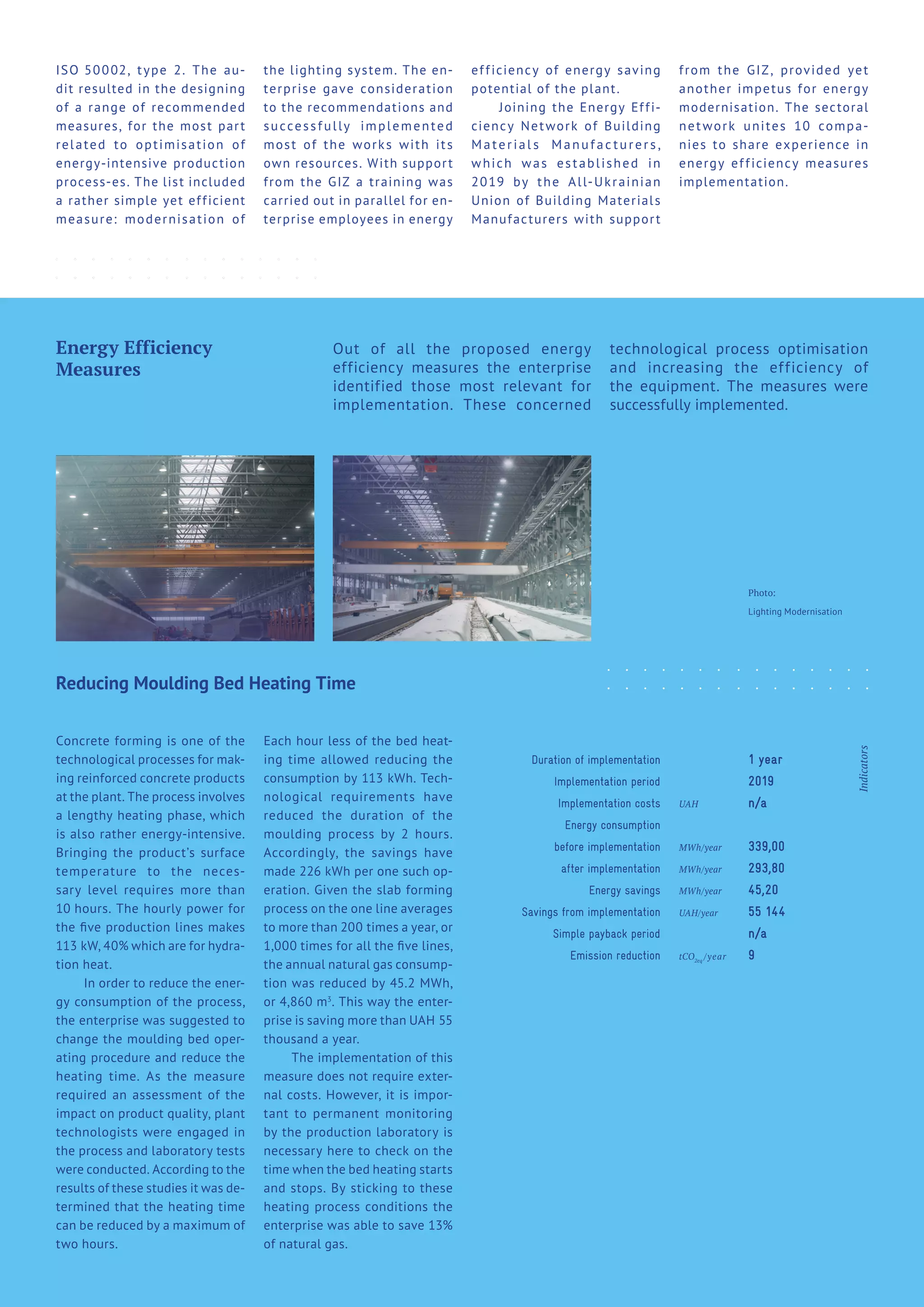
Lighting Modernisation
Photo:
Optimising Mould Heating Process
In order to save energy when heat-
ing the mould for reinforced con-
crete product manufacturing, a set
ofmeasuresweretaken:thetechni-
cal one, to insulate the sides of the
mould; and the organisational one
to reduce the heating time.
The survey of the mould re-
vealed significant energy losses
on its sides (walls) that account
for up to 80% total heat transfer
surface area. The temperature of
the mould’s outer surface is in the
range between 21 and 25°C. With
the ambient air temperature inside
the production shop at 12°С, a high
temperaturegradientoccurs,which
creates conditions for intensive
cooling of the vertical walls of the
mould and leads to significant heat
losses. To limit the heat exchange
between the wall and the environ-
ment and to respectively provide
for almost complete elimination of
mould cooling, thermal insulation
was performed. The mould walls
were insulated with extruded pol-
ystyrene foam with a thickness
of 30 mm and a density of 27kg/
m3
. The measure implementation
reduced heat losses by 80 kWh,
or 8.6 m3
natural gas per cycle. In
general, that has saved 8.7% natu-
ral gas used for mould heating. The
annualsavingsamountedtoalmost
UAH 20 thousand.
Wall insulation allowed to re-
view the mould heating procedure
regulations. For this, the plant's
product engineers held laborato-
ry studies to look into the effect
of heating time changes on prod-
uct quality. The reduction of the
mould heating time by one hour
saved8 MWh,or860m3
naturalgas
a year. The cost savings amounted
to about UAH 10 thousand a year.
The range of implemented
measures allowed the enterprise to
save 12.5% energy used for mould
heating.Thecostsavingequivalent
makes UAH 29.3 thousand/year.
Duration of implementation
Implementation period
Implementation costs
Energy consumption
before implementation
after implementation
Energy savings
Savings from implementation
Simple payback period
Emission reduction
24 months
2018 – 2020
20 000
192
168
24
29 280
1 year
5
UAH
MWh/year
MWh/year
MWh/year
UAH/year
tCO2eq
/year
Indicators
Lighting Modernisation
The enterprise took into account
the recommendations of the en-
ergy audit regarding feasibility
of lighting modernisation and
included respective works in the
annual energy modernisation ac-
tion program.
Until recently the plant
premises were illuminated with
69 500W gas discharge lamps.
The not really efficient lighting
system consumed 75.14 MWh a
year accounting for about 7% all
electricity consumed by the plant.
In the Q4/2019 the enter-
prise launched a partial replace-
ment of gas discharge lamps:
52 units were replaced with 90 
100W LED ones. The new lamps
consume less and give better
illumination.
This measure allowed the
enterprise to more than halve
its lighting electricity consump-
tion (by 54%). The cost savings
make about UAH 102 thousand/
year. The payback period of the
measure was less than a year. In
addition to cost reduction, the
modernisation has improved the
lighting conditions inside the
production premises thus bet-
tering the working conditions of
employees.
Duration of implementation
Implementation period
Implementation costs
Energy consumption
before implementation
after implementation
Energy savings
Savings from implementation
Simple payback period
Emission reduction
3 months
10.-12.2019
90 000
75,14
34,41
40,73
101 822
11 months
37
UAH
MWh/year
MWh/year
MWh/year
UAH/year
tCO2eq
/year
Indicators
Optimising Mould Heating
Process
Photo:
The adherence to the principles
of energy efficiency at the enter-
prise requires a sufficient level of
knowledge among the staff. For
this a training for plant employ-
ees on the topics of Lighting, Wa-
ter Boilers and Heat Distribution
was held with support from the
Advisory Services for Energy Effi-
ciency in Companies Project. The
acquired knowledge is now used
to optimise planning and imple-
ment energy efficiency measures
at various production sites.
Staff Training
The enterprise is motivated to
continue working towards en-
ergy efficiency. The plant cur-
rently plans to insulate walls of
all the moulds to reduce even
more natural gas consumption.
Works on lighting modernisation
will continue to complete the
replacement of gas discharge
lamps with LEDs. New planned
measures include, among others,
heat recovery from technological
equipment for hot water supply
purposes. The implementation
of these measures will reduce
plant’s energy consumption and
lessen negative impact on the
environment.
Company’s Plans for the Future
© GIZ 2021
Pilot Projects on Energy Modernisation
in Industry
01004, Кyiv
16b Antonovycha St.
T:   +38 044 594 07 60
F: +38 044 594 07 61
I: www.giz.de/ukraine-ua
www.eeplatform.org.ua
Fb: www.facebook.com/energyefficiency.ua
Total energy savings
Total reduction of emissions
Total cost savings
Investments
109,93
51
186 246
110 000
MWh/year
tCO2eq
/year
UAH/year
UAH
Total
energy savings
Indicators
5%
The specific electricity consumption for production was reduced
by almost 5% (from 26.36 to 25.09 kWh/m3
); the specific natural
gas consumption decreased by 31% (from 3.03 to 2.09 m3
). This
has subsequently reduced the total energy costs with effect on
the production costs.
The total savings exceed UAH 186 thousand/year. The investment
of UAH 110 thousand were returned practically in one year.
Lower energy consumption has contributed to a reduction of
greenhouse gas emissions by 51 tCO2eq.
Plant employees felt the benefits too enjoying better working
conditions due to lighting modernisation and better workplace
illumination. The training increased their knowledge of aspects
of energy saving at the workplace.
Membership in the Energy Efficiency Network of Building
Materials Manufacturers also brought new possibilities for the
enterprise. The participation in the Network allows construction
companies to share experience of energy-saving potential
implementation and to seek professional expert assistance in
measure implementation.
The participation in the Project on Advisory Services for Energy
Efficiency in Companies and implementation of the designed measures
in 2018 and 2019 allowed OBERBETON-INVEST, Ltd. to achieve quite
successful results.
Cumulative Results
•
•
•
•
«The introduction of energy efficiency measures
allows us to gradually improve technological
processes, and reduce energy consumption. This
way, we mitigate the negative impact on the
environment»
Oleh Sydorov
Director

Oberbeton-Invest

  • 1.
    OBERBE TON-IN VES T, Ltd. man u­f ac t ure s rein f orce d concrete structures to order. The plant offers fully inte- grated solutions and a wide range of products for the construction market. T h e e n t e r p r is e u s e s electricity and natural gas in its production processes. The main consumers are techno- logical lines for the produc- tion of concrete products as well as gas boilers used to heat inert concrete mix- ture components and pro- vide heating for industrial premises. About the Company allows upgrading techno- logical processes to reduce energy intensity of produc- tion, save costs of energy re- sources and reduce adverse environmental impact. This translates into reduced unit production costs and better competitiveness. In 2018 the enterprise joined the Advisor y Ser- vices for Energy Efficiency in Companies Project im- plemented in Ukraine by Deutsche Gesellschaft für In- ternationale Zusammenarbe- it (GIZ) GmbH commissioned by the German Government in political partnership with the Ministry of Economy of Ukraine. The Project carried out the energy ef f icien- cy audit of the enterprise according to the standard The plant was commissioned in 2008. It oper-ates today in line with European manufac- turing standards using the full range of modern equip- ment, progressive technolo- gies, innovative designs and quality raw materials. To further comply with high standards in the future, the plant sticks to energy ef ficiency principles. This Path to Success Establishment date Location Industry No. shops No. working shifts Working shift duration Staff Output 2007 Zhytomyr Non-metal construction materials 1 2 8 215 46 617 hours tons/year Electricity Natural gas Total emissions 1 184,37 144 299 1 351 1 130,48 94 056 1 208 MWh m3 tCO2eq /year 2018 2019 Indicators Review Pilot Projects on Energy Modernisation in Industry OBERBETON-INVEST, Ltd. МІНІСТЕРСТВО ЕКОНОМІКИ УКРАЇНИ CO M PA N Y
  • 2.
    Out of allthe proposed energy efficiency measures the enterprise identified those most relevant for implementation. These concerned technological process optimisation and increasing the efficiency of the equipment. The measures were successfully implemented. Energy Efficiency Measures ISO 50002, type 2. The au- dit resulted in the designing of a range of recommended measures, for the most part related to optimisation of energy-intensive production process-es. The list included a rather simple yet efficient measure: modernisation of efficiency of energy saving potential of the plant. Joining the Energy Effi- ciency Network of Building Material s Manuf ac turers , which was established in 2019 by the All-Ukrainian Union of Building Materials Manufacturers with support the lighting system. The en- terprise gave consideration to the recommendations and successfully implemented most of the works with its own resources. With support from the GIZ a training was carried out in parallel for en- terprise employees in energy from the GIZ, provided yet another impetus for energy modernisation. The sectoral network unites 10 compa- nies to share experience in energy efficiency measures implementation. Concrete forming is one of the technological processes for mak- ing reinforced concrete products at the plant. The process involves a lengthy heating phase, which is also rather energy-intensive. Bringing the product’s surface temperature to the neces- sary level requires more than 10 hours. The hourly power for the five production lines makes 113 kW, 40% which are for hydra- tion heat. In order to reduce the ener- gy consumption of the process, the enterprise was suggested to change the moulding bed oper- ating procedure and reduce the heating time. As the measure required an assessment of the impact on product quality, plant technologists were engaged in the process and laboratory tests were conducted. According to the results of these studies it was de- termined that the heating time can be reduced by a maximum of two hours. Each hour less of the bed heat- ing time allowed reducing the consumption by 113 kWh. Tech- nological requirements have reduced the duration of the moulding process by 2 hours. Accordingly, the savings have made 226 kWh per one such op- eration. Given the slab forming process on the one line averages to more than 200 times a year, or 1,000 times for all the five lines, the annual natural gas consump- tion was reduced by 45.2 MWh, or 4,860 m3 . This way the enter- prise is saving more than UAH 55 thousand a year. The implementation of this measure does not require exter- nal costs. However, it is impor- tant to permanent monitoring by the production laboratory is necessary here to check on the time when the bed heating starts and stops. By sticking to these heating process conditions the enterprise was able to save 13% of natural gas. Duration of implementation Implementation period Implementation costs Energy consumption before implementation after implementation Energy savings Savings from implementation Simple payback period Emission reduction 1 year 2019 n/a 339,00 293,80 45,20 55 144 n/a 9 UAH MWh/year MWh/year MWh/year UAH/year tCO2eq /year Indicators Reducing Moulding Bed Heating Time Lighting Modernisation Photo:
  • 3.
    Optimising Mould HeatingProcess In order to save energy when heat- ing the mould for reinforced con- crete product manufacturing, a set ofmeasuresweretaken:thetechni- cal one, to insulate the sides of the mould; and the organisational one to reduce the heating time. The survey of the mould re- vealed significant energy losses on its sides (walls) that account for up to 80% total heat transfer surface area. The temperature of the mould’s outer surface is in the range between 21 and 25°C. With the ambient air temperature inside the production shop at 12°С, a high temperaturegradientoccurs,which creates conditions for intensive cooling of the vertical walls of the mould and leads to significant heat losses. To limit the heat exchange between the wall and the environ- ment and to respectively provide for almost complete elimination of mould cooling, thermal insulation was performed. The mould walls were insulated with extruded pol- ystyrene foam with a thickness of 30 mm and a density of 27kg/ m3 . The measure implementation reduced heat losses by 80 kWh, or 8.6 m3 natural gas per cycle. In general, that has saved 8.7% natu- ral gas used for mould heating. The annualsavingsamountedtoalmost UAH 20 thousand. Wall insulation allowed to re- view the mould heating procedure regulations. For this, the plant's product engineers held laborato- ry studies to look into the effect of heating time changes on prod- uct quality. The reduction of the mould heating time by one hour saved8 MWh,or860m3 naturalgas a year. The cost savings amounted to about UAH 10 thousand a year. The range of implemented measures allowed the enterprise to save 12.5% energy used for mould heating.Thecostsavingequivalent makes UAH 29.3 thousand/year. Duration of implementation Implementation period Implementation costs Energy consumption before implementation after implementation Energy savings Savings from implementation Simple payback period Emission reduction 24 months 2018 – 2020 20 000 192 168 24 29 280 1 year 5 UAH MWh/year MWh/year MWh/year UAH/year tCO2eq /year Indicators Lighting Modernisation The enterprise took into account the recommendations of the en- ergy audit regarding feasibility of lighting modernisation and included respective works in the annual energy modernisation ac- tion program. Until recently the plant premises were illuminated with 69 500W gas discharge lamps. The not really efficient lighting system consumed 75.14 MWh a year accounting for about 7% all electricity consumed by the plant. In the Q4/2019 the enter- prise launched a partial replace- ment of gas discharge lamps: 52 units were replaced with 90  100W LED ones. The new lamps consume less and give better illumination. This measure allowed the enterprise to more than halve its lighting electricity consump- tion (by 54%). The cost savings make about UAH 102 thousand/ year. The payback period of the measure was less than a year. In addition to cost reduction, the modernisation has improved the lighting conditions inside the production premises thus bet- tering the working conditions of employees. Duration of implementation Implementation period Implementation costs Energy consumption before implementation after implementation Energy savings Savings from implementation Simple payback period Emission reduction 3 months 10.-12.2019 90 000 75,14 34,41 40,73 101 822 11 months 37 UAH MWh/year MWh/year MWh/year UAH/year tCO2eq /year Indicators Optimising Mould Heating Process Photo:
  • 4.
    The adherence tothe principles of energy efficiency at the enter- prise requires a sufficient level of knowledge among the staff. For this a training for plant employ- ees on the topics of Lighting, Wa- ter Boilers and Heat Distribution was held with support from the Advisory Services for Energy Effi- ciency in Companies Project. The acquired knowledge is now used to optimise planning and imple- ment energy efficiency measures at various production sites. Staff Training The enterprise is motivated to continue working towards en- ergy efficiency. The plant cur- rently plans to insulate walls of all the moulds to reduce even more natural gas consumption. Works on lighting modernisation will continue to complete the replacement of gas discharge lamps with LEDs. New planned measures include, among others, heat recovery from technological equipment for hot water supply purposes. The implementation of these measures will reduce plant’s energy consumption and lessen negative impact on the environment. Company’s Plans for the Future © GIZ 2021 Pilot Projects on Energy Modernisation in Industry 01004, Кyiv 16b Antonovycha St. T:   +38 044 594 07 60 F: +38 044 594 07 61 I: www.giz.de/ukraine-ua www.eeplatform.org.ua Fb: www.facebook.com/energyefficiency.ua Total energy savings Total reduction of emissions Total cost savings Investments 109,93 51 186 246 110 000 MWh/year tCO2eq /year UAH/year UAH Total energy savings Indicators 5% The specific electricity consumption for production was reduced by almost 5% (from 26.36 to 25.09 kWh/m3 ); the specific natural gas consumption decreased by 31% (from 3.03 to 2.09 m3 ). This has subsequently reduced the total energy costs with effect on the production costs. The total savings exceed UAH 186 thousand/year. The investment of UAH 110 thousand were returned practically in one year. Lower energy consumption has contributed to a reduction of greenhouse gas emissions by 51 tCO2eq. Plant employees felt the benefits too enjoying better working conditions due to lighting modernisation and better workplace illumination. The training increased their knowledge of aspects of energy saving at the workplace. Membership in the Energy Efficiency Network of Building Materials Manufacturers also brought new possibilities for the enterprise. The participation in the Network allows construction companies to share experience of energy-saving potential implementation and to seek professional expert assistance in measure implementation. The participation in the Project on Advisory Services for Energy Efficiency in Companies and implementation of the designed measures in 2018 and 2019 allowed OBERBETON-INVEST, Ltd. to achieve quite successful results. Cumulative Results • • • • «The introduction of energy efficiency measures allows us to gradually improve technological processes, and reduce energy consumption. This way, we mitigate the negative impact on the environment» Oleh Sydorov Director