International Indexed & Referred Research Journal, April, 2012. ISSN- 0974-2832, RNI-RAJBIL 2009/29954; VoL. IV * ISSUE-39
                                        Research Paper - Zoology
      Effect of Malathion and Cypermethrin on Biochemical
      Constituents of Freshwater Fish, Lepidocephalichthys
                       Guntea (Ham-buch)
                * Patil, M. U. ** Dr. Patole, S. S.                                                              April , 2012
 * Department of Zoology, Vimalai Uttamrao Patil College, Sakri.
 ** Associate professor, Department of Zoology, S. G. Patil, ASC College, Sakri. Dist- Dhule (M.S.).
A B S T R A C T
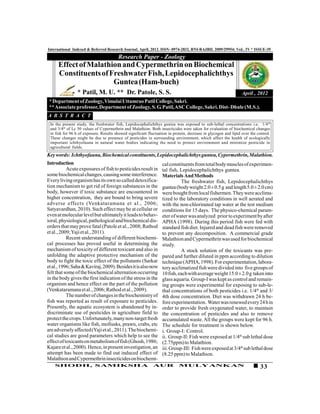
 In the present study, the freshwater fish, Lepidocephalichthys guntea was exposed to sub-lethal concentrations i.e. 1/4 th
 and 3/4th of Lc 50 values of Cypermethrin and Malathion. Both insecticides were taken for evaluation of biochemical changes
 in fish for 96 h of exposure. Results showed significant fluctuation in protein, decrease in glycogen and lipid over the control.
 These changes might be due to presence of pesticides in surrounding environment, which affect the health of ecologically
 important ichthyofauna in natural water bodies indicating the need to protect environment and minimize pesticide in
 agricultural fields.
Key words: Ichthyofauna, Biochemical constituents, Lepidocephalichthys guntea, Cypermethrin, Malathion.
Introduction                                                      cal constituents from total body muscles of experimen-
           Acute exposures of fish to pesticides result in        tal fish, Lepidocephalichthys guntea.
some biochemical changes, causing some interference.              Materials And Methods
Every living organism has its own so called detoxifica-                     The freshwater fish, Lepidocephalichthys
tion mechanism to get rid of foreign substances in the            guntea (body weight 2.0 ± 0.5 g and length 5.0 ± 2.0 cm)
body, however if toxic substance are encountered in               were bought from local fishermen. They were acclima-
higher concentration, they are bound to bring severe              tized to the laboratory conditions in well aerated and
adverse effects (Venkataramana et al., 2006;                      with the non-chlorinated tap water at the test medium
Satyavardhan, 2010). Such effect may be at cellular or            conditions for 15 days. The physico-chemical param-
even at molecular level but ultimately it leads to behav-         eter of water was analyzed prior to experiment by after
ioral, physiological, pathological and biochemical dis-           APHA (1998). During this period fish were fed with
orders that may prove fatal (Patole et al., 2008; Rathod          standard fish diet. Injured and dead fish were removed
et al., 2009; Yaji et al., 2011).                                 to prevent any decomposition. A commercial grade
           Recent understanding of different biochemi-            Malathion and Cypermethrin was used for biochemical
cal processes has proved useful in determining the                study.
mechanism of toxicity of different toxicant and also in                     A stock solution of the toxicants was pre-
unfolding the adaptive protective mechanism of the                pared and further diluted in ppm according to dilution
body to fight the toxic effect of the pollutants (Sarkar          technique (APHA, 1998). For experimentation, labora-
et al., 1996; Saha & Kaviraj, 2009). Besides it is also now       tory acclimatized fish were divided into five groups of
felt that some of the biochemical alternation occurring           10 fish, each with average weight 15.0 ± 2.0 g taken into
in the body gives the first indication of the stress in the       glass aquaria. Group-I was kept as control and remain-
organism and hence effect on the part of the pollution            ing groups were experimental for exposing to sub-le-
(Venkataramana et al., 2006; Rathod et al., 2009).                thal concentrations of both pesticides i.e. 1/4th and 3/
           The number of changes in the biochemistry of           4th dose concentration. Diet was withdrawn 24 h be-
fish was reported as result of exposure to pesticides.            fore experimentation. Water was renewed every 24 h in
Presently, the aquatic ecosystem is abandoned by in-              order to provide fresh oxygenated water, to maintain
discriminate use of pesticides in agriculture field to            the concentration of pesticides and also to remove
protect the crops. Unfortunately, many non-target fresh           accumulated waste. All the groups were kept for 96 h.
water organisms like fish, mollusks, prawn, crabs, etc            The schedule for treatment is shown below.
are adversely affected (Yaji et al., 2011). The biochemi-         i. Group-I: Control.
cal studies are good parameters which help to see the             ii. Group-II: Fish were exposed at 1/4th sub lethal dose
effect of toxicants on metabolism of fish (Ghosh, 1986;           (2.75ppm) to Malathion.
Kajare et al., 2000). Hence, in present investigation, an         iii. Group-III: Fish were exposed at 3/4th sub lethal dose
attempt has been made to find out induced effect of               (8.25 ppm) to Malathion.
Malathion and Cypermethrin insecticides on biochemi-
    SHODH, SAMIKSHA                                          AUR            MULYANKAN                                       33
International Indexed & Referred Research Journal, April, 2012. ISSN- 0974-2832, RNI-RAJBIL 2009/29954; VoL. IV * ISSUE-39

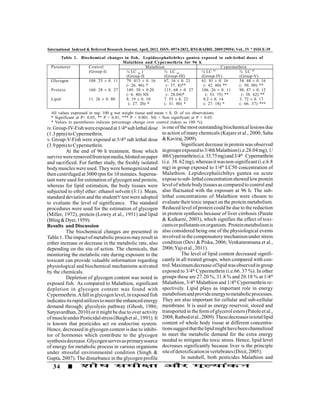
        Table 1. Biochemical changes in fish, Lepidocephalichthys guntea exposed to sub-lethal doses of
                                    Malathion and Cypermethrin for 96 h
  Parameter         Control                      Malathion                           Cypermethrin
                    (Group-I)         ¼ LC 50 )           ¾ LC 50         ¼ LC 50            ¾ LC 50
                                      (Group-II           (Group-III)     (Group-IV)         (Group-V)
  Glycogen          108. 25 ± 0. 11   79. 413 ± 0. 16     67. 16 ± 0. 21  61. 81 ± 0. 16     54. 44 ± 0. 16
                                      (- 26. 86) *         (- 37. 8)**     (- 42. 60) **     (- 50. 00) **
  Protein           160. 28 ± 0. 27   149. 30 ± 0.20      115. 68 ± 0. 27 106. 26 ± 0. 11    98. 87 ± 0. 12
                                      (- 6. 80) NS         (- 28.04)*       (- 33. 75) **     (- 38. 62) **
  Lipid             11. 26 ± 0. 80    8. 19 ± 0. 10       7. 55 ± 0. 22    8.2 ± 0. 14       3. 72 ± 0. 17
                                       (- 27. 20) *       (- 31. 80) *     (- 27. 18) *      (- 66. 37) ***

  All values expressed in mg/ 100 g wet weight tissue and mean ± S. D. of six observations.
  * Significant at P< 0.05, ** P < 0.01, *** P < 0.001. NS = Non significant at P > 0.05.
  * Values in parentheses indicate percentage change over control (taken as 100 %).
iv. Group-IV-Fish were exposed at 1/4th sub lethal dose       is one of the most outstanding biochemical lesions due
(1.3 ppm) to Cypermethrin.                                    to action of many chemicals (Kajare et al., 2000; Saha
v. Group-V-Fish were exposed at 3/4th sub lethal dose         & Kaviraj, 2009).
(3.9 ppm) to Cypermethrin.                                               Significant decrease in protein was observed
          At the end of 96 h treatment, those which           in groups exposed to 3/4th Malathion (i.e.28.04 mg), 1/
survive were removed from test media, blotted on paper        4th Cypermethrin (i.e. 33.75 mg) and 3/4th Cypermethrin
and sacrificed. For further study, the freshly isolated       (i.e. 38. 62 mg), whereas it was non-significant (i.e.6.8
body muscles were used. They were homogenized and             mg) in group exposed to 1/4th LC50 concentration of
then centrifuged at 3000 rpm for 10 minutes. Superna-         Malathion. Lepidocephalichthys guntea on acute
tant were used for estimation of glycogen and protein,        expose to sub- lethal concentration showed low protein
whereas for lipid estimation, the body tissues were           level of whole body tissues as compared to control and
subjected to ethyl ether: ethanol solvent (3:1). Mean,        also fluctuated with the exposure at 96 h. The sub-
standard deviation and the student't' test were adopted       lethal concentrations of Malathion were chosen to
to evaluate the level of significance. The standard           evaluate their toxic impact on the protein metabolism.
procedures were used for the estimation of glycogen           Reduced level of protein could be due to the reduction
(Miller, 1972), protein (Lowry et al., 1951) and lipid        in protein synthesis because of liver cirrhosis (Parate
(Bling & Dyer, 1959).                                         & Kulkarni, 2003), which signifies the effect of toxi-
Results and Discussion                                        cants or pollutants on organism. Protein metabolism is
          The biochemical changes are presented in            also considered being one of the physiological events
Table 1. The impact of metabolic process may result in        involved in the compensatory mechanism under stress
either increase or decrease in the metabolic rate, also       condition (Devi & Piska, 2006; Venkataramana et al.,
depending on the site of action. The chemicals, that          2006; Yaji et al., 2011).
monitoring the metabolic rate during exposure to the                     The level of lipid content decreased signifi-
toxicant can provide valuable information regarding           cantly in all treated groups, when compared with con-
physiological and biochemical mechanisms activated            trol. Maximum decrease of lipid was observed in group
by the chemicals.                                             exposed to 3/4th Cypermethrin (i.e.66. 37 %). In other
          Depletion of glycogen content was noted in          groups these are 27.20 %, 31.8 % and 20.18 % at 1/4th
exposed fish. As compared to Malathion, significant           Malathion, 3/4th Malathion and 1/4th Cypermethrin re-
depletion in glycogen content was found with                  spectively. Lipid plays as important role in energy
Cypermethrin. A fall in glycogen level, in exposed fish       metabolism and provide energy to metabolic processes.
indicates its rapid utilizes to meet the enhanced energy      They are also important for cellular and sub-cellular
demand through; glycolysis pathway (Ghosh, 1986;              membrane. It is used as energy reservoir, stored and
Satyavardhan, 2010) or it might be due to over activity       transported in the form of glycerol esters (Patole et al.,
of muscle under Pesticidal stress (Baigh et al., 1991). It    2008; Rathod et al., 2009). These decreases in total lipid
is known that pesticides act on endocrine system.             content of whole body tissue at different concentra-
Hence, decreased in glycogen content is due to inhibi-        tions suggest that the lipid might have been channelized
tor of hormones which contribute to the glycogen              to meet the metabolic demand for the extra energy
synthesis decrease. Glycogen serves as primary source         needed to mitigate the toxic stress. Hence, lipid level
of energy for metabolic process in various organisms          decreases significantly because liver is the principle
under stressful environmental condition (Singh &              site of detoxification in vertebrates (Dixit, 2005).
Gupta, 2007). The disturbance in the glycogen profile                    In nutshell, both pesticides Malathion and
   34
International Indexed & Referred Research Journal, April, 2012. ISSN- 0974-2832, RNI-RAJBIL 2009/29954; VoL. IV * ISSUE-39
Cypermethrin are highly toxic to Lepidocephalichthys                teolysis and lipolysis to meet the energy demand.
guntea at acute exposure leading to affect the nutritive            Acknowledgements
value of the fish as well as the entire metabolism studied                    Authors are thankful to principal, S. G. Patil
is found to be sensitive change which reflects changes              College, Sakri for providing necessary laboratory fa-
in normal activities of various functional systems. It is           cilities. Thanks are due to the Director, Zoological
concluded that, such toxicants induce alteration in                 survey of India, (WRO, Poona) for valuable think in
biochemical composition of fish muscles under Pesti-                identification of experimental fish.
cidal stress. It might be due to glycogenolysis, pro-

R E F E R E N C E
1. APHA/AWWA/WEF. (1998). Standard method for the evalu-            in fish, Nemacheilus evizardy (Day) Int. J. Pharmacol. Biol.
ation of water and waste water. 20th edition, American Public       Sci. 2: 63-68.
Health Association, New York, USA.                                  12. Rathod, D. S., Lokhande, M. V. and Shembekar, V. S.
2. Baigh, Md. Azar., Vijay Joseph, K. and Jayanta Rao, K.           (2009). Toxic impact of the biochemical composition of vital
(1991). Effect of hepatochlor on selected biochemical aspects       tissues of fish, Arias dussumieri. Shodh, Samiksha and Mulyankan.
in functionally different muscles of Channa punctutatus. J.         2: 147-149.
Environ. Bio.12: 341-345.                                           13. Saha, S. and Kaviraj, A. (2009). Effects of Cypermethrin
3. Bling, E. G. and Dyer, W. J. (1959). A rapid method of           on some biochemical parameters and its amelioration through
extraction and purification. Can J. Biochem. Physiol. 37: 911-      dietary supplementation of ascorbic acid in freshwater catfish,
927.                                                                Heteropneustes fossilis. Chemosphere.74:1254-1259.
4. Devi, J. A. and Piska, R. S. (2006). Effect of fluoride on       14. Sarkar, S. K., Medda, C., Bhattacharya, B., Ganguly, S. and
tissues proteins of freshwater cat fish, Clarias batrachus Linn.    Basu T. K. (1996). Effect of sub lethal doses of two organo-
J. Aqua. Boil. 21: 184-187.                                         phosphate insecticides on total protein and glycogen content
5. Dixit, Y. B. (2005). Biochemical changes in the liver of a       in fingerlings of two Indian major carps, Labeo rohita and
freshwater teleost, Heteropneustes fossilis (Bloch) exposed to      Cyprinus mrigala Adv. Bios. 15: 53-62.
rogor, J. Zool. 25: 51-53.                                          15 Satyavardhan, K. (2010). Effect of fenvalerate TM on
6. Ghosh, T. K. (1986). Effect of Dimethoate on tissue glyco-       various tissues of Channa punctatus (Bloch). World Appl. Sci.
gen content of some freshwater fish. Env. Ecol. 4: 554-557.         J. 10: 70-74.
7. Kajare, A., Singh, S. and Shrivastava, K. (2000). Malathion      16. Singh, D. and Gupta, R. C. (2007). Alteration in carbohy-
induced biochemical changes in the kidney of freshwater fish        drate metabolism in different tissues of a freshwater snail, Pila
Clarias batrachus. J. Ecotoxicol. Environ. Monit. 10: 11-14         globosa under the stress of azodyes. J. Env. Zool. 21: 327-330.
8. Lowry, O. H., Rosebrough, N. J., Farr A. L. and Randall, R.      17. Venkataramana, G. V., Sandhya Rani, P. N. and Murthy, P.
J. (1951). Protein measurement with Folin phenol reagent. J.        S. (2006). Impact of Malathion on the biochemical parameters
Biol. Chem. 193: 265-267.                                           of gobiid fish, Glossogobius giuris (Ham). J. Environ. Biol. 27:
9. Miller, G. L. (1972). Glycogen estimation by DNS method.         119-122.
Anal. Chem., 31: 426-428.                                           18. Yaji, A. G., Auja, J., Oniye, S. J., Adakole, J. A. and Usman,
10. Parate, S. K. and Kulkarni, K. M. (2003). Toxic influence       J. I. (2011). Effect of Cypermethrin on behavior and bio-
in total protein content in the muscle and gill of the freshwater   chemical indices of freshwater fish, Oreochromis niloticus.
crab, Paratelphusa jacquimmtii exposed to Cypermethrin.        J.   Elec. J. Environ, Agric and Food Chem. 10: 1927-1934.
Aqua Biol. 18:111-113.
11. Patole, S. S., Patil, M. and Mahajan, R. T. (2008). Studies
on metabolic changes during intoxication by phytotoxicants


    SHODH, SAMIKSHA                                           AUR            MULYANKAN                                        35

33 35

  • 1.
    International Indexed &Referred Research Journal, April, 2012. ISSN- 0974-2832, RNI-RAJBIL 2009/29954; VoL. IV * ISSUE-39 Research Paper - Zoology Effect of Malathion and Cypermethrin on Biochemical Constituents of Freshwater Fish, Lepidocephalichthys Guntea (Ham-buch) * Patil, M. U. ** Dr. Patole, S. S. April , 2012 * Department of Zoology, Vimalai Uttamrao Patil College, Sakri. ** Associate professor, Department of Zoology, S. G. Patil, ASC College, Sakri. Dist- Dhule (M.S.). A B S T R A C T In the present study, the freshwater fish, Lepidocephalichthys guntea was exposed to sub-lethal concentrations i.e. 1/4 th and 3/4th of Lc 50 values of Cypermethrin and Malathion. Both insecticides were taken for evaluation of biochemical changes in fish for 96 h of exposure. Results showed significant fluctuation in protein, decrease in glycogen and lipid over the control. These changes might be due to presence of pesticides in surrounding environment, which affect the health of ecologically important ichthyofauna in natural water bodies indicating the need to protect environment and minimize pesticide in agricultural fields. Key words: Ichthyofauna, Biochemical constituents, Lepidocephalichthys guntea, Cypermethrin, Malathion. Introduction cal constituents from total body muscles of experimen- Acute exposures of fish to pesticides result in tal fish, Lepidocephalichthys guntea. some biochemical changes, causing some interference. Materials And Methods Every living organism has its own so called detoxifica- The freshwater fish, Lepidocephalichthys tion mechanism to get rid of foreign substances in the guntea (body weight 2.0 ± 0.5 g and length 5.0 ± 2.0 cm) body, however if toxic substance are encountered in were bought from local fishermen. They were acclima- higher concentration, they are bound to bring severe tized to the laboratory conditions in well aerated and adverse effects (Venkataramana et al., 2006; with the non-chlorinated tap water at the test medium Satyavardhan, 2010). Such effect may be at cellular or conditions for 15 days. The physico-chemical param- even at molecular level but ultimately it leads to behav- eter of water was analyzed prior to experiment by after ioral, physiological, pathological and biochemical dis- APHA (1998). During this period fish were fed with orders that may prove fatal (Patole et al., 2008; Rathod standard fish diet. Injured and dead fish were removed et al., 2009; Yaji et al., 2011). to prevent any decomposition. A commercial grade Recent understanding of different biochemi- Malathion and Cypermethrin was used for biochemical cal processes has proved useful in determining the study. mechanism of toxicity of different toxicant and also in A stock solution of the toxicants was pre- unfolding the adaptive protective mechanism of the pared and further diluted in ppm according to dilution body to fight the toxic effect of the pollutants (Sarkar technique (APHA, 1998). For experimentation, labora- et al., 1996; Saha & Kaviraj, 2009). Besides it is also now tory acclimatized fish were divided into five groups of felt that some of the biochemical alternation occurring 10 fish, each with average weight 15.0 ± 2.0 g taken into in the body gives the first indication of the stress in the glass aquaria. Group-I was kept as control and remain- organism and hence effect on the part of the pollution ing groups were experimental for exposing to sub-le- (Venkataramana et al., 2006; Rathod et al., 2009). thal concentrations of both pesticides i.e. 1/4th and 3/ The number of changes in the biochemistry of 4th dose concentration. Diet was withdrawn 24 h be- fish was reported as result of exposure to pesticides. fore experimentation. Water was renewed every 24 h in Presently, the aquatic ecosystem is abandoned by in- order to provide fresh oxygenated water, to maintain discriminate use of pesticides in agriculture field to the concentration of pesticides and also to remove protect the crops. Unfortunately, many non-target fresh accumulated waste. All the groups were kept for 96 h. water organisms like fish, mollusks, prawn, crabs, etc The schedule for treatment is shown below. are adversely affected (Yaji et al., 2011). The biochemi- i. Group-I: Control. cal studies are good parameters which help to see the ii. Group-II: Fish were exposed at 1/4th sub lethal dose effect of toxicants on metabolism of fish (Ghosh, 1986; (2.75ppm) to Malathion. Kajare et al., 2000). Hence, in present investigation, an iii. Group-III: Fish were exposed at 3/4th sub lethal dose attempt has been made to find out induced effect of (8.25 ppm) to Malathion. Malathion and Cypermethrin insecticides on biochemi- SHODH, SAMIKSHA AUR MULYANKAN 33
  • 2.
    International Indexed &Referred Research Journal, April, 2012. ISSN- 0974-2832, RNI-RAJBIL 2009/29954; VoL. IV * ISSUE-39 Table 1. Biochemical changes in fish, Lepidocephalichthys guntea exposed to sub-lethal doses of Malathion and Cypermethrin for 96 h Parameter Control Malathion Cypermethrin (Group-I) ¼ LC 50 ) ¾ LC 50 ¼ LC 50 ¾ LC 50 (Group-II (Group-III) (Group-IV) (Group-V) Glycogen 108. 25 ± 0. 11 79. 413 ± 0. 16 67. 16 ± 0. 21 61. 81 ± 0. 16 54. 44 ± 0. 16 (- 26. 86) * (- 37. 8)** (- 42. 60) ** (- 50. 00) ** Protein 160. 28 ± 0. 27 149. 30 ± 0.20 115. 68 ± 0. 27 106. 26 ± 0. 11 98. 87 ± 0. 12 (- 6. 80) NS (- 28.04)* (- 33. 75) ** (- 38. 62) ** Lipid 11. 26 ± 0. 80 8. 19 ± 0. 10 7. 55 ± 0. 22 8.2 ± 0. 14 3. 72 ± 0. 17 (- 27. 20) * (- 31. 80) * (- 27. 18) * (- 66. 37) *** All values expressed in mg/ 100 g wet weight tissue and mean ± S. D. of six observations. * Significant at P< 0.05, ** P < 0.01, *** P < 0.001. NS = Non significant at P > 0.05. * Values in parentheses indicate percentage change over control (taken as 100 %). iv. Group-IV-Fish were exposed at 1/4th sub lethal dose is one of the most outstanding biochemical lesions due (1.3 ppm) to Cypermethrin. to action of many chemicals (Kajare et al., 2000; Saha v. Group-V-Fish were exposed at 3/4th sub lethal dose & Kaviraj, 2009). (3.9 ppm) to Cypermethrin. Significant decrease in protein was observed At the end of 96 h treatment, those which in groups exposed to 3/4th Malathion (i.e.28.04 mg), 1/ survive were removed from test media, blotted on paper 4th Cypermethrin (i.e. 33.75 mg) and 3/4th Cypermethrin and sacrificed. For further study, the freshly isolated (i.e. 38. 62 mg), whereas it was non-significant (i.e.6.8 body muscles were used. They were homogenized and mg) in group exposed to 1/4th LC50 concentration of then centrifuged at 3000 rpm for 10 minutes. Superna- Malathion. Lepidocephalichthys guntea on acute tant were used for estimation of glycogen and protein, expose to sub- lethal concentration showed low protein whereas for lipid estimation, the body tissues were level of whole body tissues as compared to control and subjected to ethyl ether: ethanol solvent (3:1). Mean, also fluctuated with the exposure at 96 h. The sub- standard deviation and the student't' test were adopted lethal concentrations of Malathion were chosen to to evaluate the level of significance. The standard evaluate their toxic impact on the protein metabolism. procedures were used for the estimation of glycogen Reduced level of protein could be due to the reduction (Miller, 1972), protein (Lowry et al., 1951) and lipid in protein synthesis because of liver cirrhosis (Parate (Bling & Dyer, 1959). & Kulkarni, 2003), which signifies the effect of toxi- Results and Discussion cants or pollutants on organism. Protein metabolism is The biochemical changes are presented in also considered being one of the physiological events Table 1. The impact of metabolic process may result in involved in the compensatory mechanism under stress either increase or decrease in the metabolic rate, also condition (Devi & Piska, 2006; Venkataramana et al., depending on the site of action. The chemicals, that 2006; Yaji et al., 2011). monitoring the metabolic rate during exposure to the The level of lipid content decreased signifi- toxicant can provide valuable information regarding cantly in all treated groups, when compared with con- physiological and biochemical mechanisms activated trol. Maximum decrease of lipid was observed in group by the chemicals. exposed to 3/4th Cypermethrin (i.e.66. 37 %). In other Depletion of glycogen content was noted in groups these are 27.20 %, 31.8 % and 20.18 % at 1/4th exposed fish. As compared to Malathion, significant Malathion, 3/4th Malathion and 1/4th Cypermethrin re- depletion in glycogen content was found with spectively. Lipid plays as important role in energy Cypermethrin. A fall in glycogen level, in exposed fish metabolism and provide energy to metabolic processes. indicates its rapid utilizes to meet the enhanced energy They are also important for cellular and sub-cellular demand through; glycolysis pathway (Ghosh, 1986; membrane. It is used as energy reservoir, stored and Satyavardhan, 2010) or it might be due to over activity transported in the form of glycerol esters (Patole et al., of muscle under Pesticidal stress (Baigh et al., 1991). It 2008; Rathod et al., 2009). These decreases in total lipid is known that pesticides act on endocrine system. content of whole body tissue at different concentra- Hence, decreased in glycogen content is due to inhibi- tions suggest that the lipid might have been channelized tor of hormones which contribute to the glycogen to meet the metabolic demand for the extra energy synthesis decrease. Glycogen serves as primary source needed to mitigate the toxic stress. Hence, lipid level of energy for metabolic process in various organisms decreases significantly because liver is the principle under stressful environmental condition (Singh & site of detoxification in vertebrates (Dixit, 2005). Gupta, 2007). The disturbance in the glycogen profile In nutshell, both pesticides Malathion and 34
  • 3.
    International Indexed &Referred Research Journal, April, 2012. ISSN- 0974-2832, RNI-RAJBIL 2009/29954; VoL. IV * ISSUE-39 Cypermethrin are highly toxic to Lepidocephalichthys teolysis and lipolysis to meet the energy demand. guntea at acute exposure leading to affect the nutritive Acknowledgements value of the fish as well as the entire metabolism studied Authors are thankful to principal, S. G. Patil is found to be sensitive change which reflects changes College, Sakri for providing necessary laboratory fa- in normal activities of various functional systems. It is cilities. Thanks are due to the Director, Zoological concluded that, such toxicants induce alteration in survey of India, (WRO, Poona) for valuable think in biochemical composition of fish muscles under Pesti- identification of experimental fish. cidal stress. It might be due to glycogenolysis, pro- R E F E R E N C E 1. APHA/AWWA/WEF. (1998). Standard method for the evalu- in fish, Nemacheilus evizardy (Day) Int. J. Pharmacol. Biol. ation of water and waste water. 20th edition, American Public Sci. 2: 63-68. Health Association, New York, USA. 12. Rathod, D. S., Lokhande, M. V. and Shembekar, V. S. 2. Baigh, Md. Azar., Vijay Joseph, K. and Jayanta Rao, K. (2009). Toxic impact of the biochemical composition of vital (1991). Effect of hepatochlor on selected biochemical aspects tissues of fish, Arias dussumieri. Shodh, Samiksha and Mulyankan. in functionally different muscles of Channa punctutatus. J. 2: 147-149. Environ. Bio.12: 341-345. 13. Saha, S. and Kaviraj, A. (2009). Effects of Cypermethrin 3. Bling, E. G. and Dyer, W. J. (1959). A rapid method of on some biochemical parameters and its amelioration through extraction and purification. Can J. Biochem. Physiol. 37: 911- dietary supplementation of ascorbic acid in freshwater catfish, 927. Heteropneustes fossilis. Chemosphere.74:1254-1259. 4. Devi, J. A. and Piska, R. S. (2006). Effect of fluoride on 14. Sarkar, S. K., Medda, C., Bhattacharya, B., Ganguly, S. and tissues proteins of freshwater cat fish, Clarias batrachus Linn. Basu T. K. (1996). Effect of sub lethal doses of two organo- J. Aqua. Boil. 21: 184-187. phosphate insecticides on total protein and glycogen content 5. Dixit, Y. B. (2005). Biochemical changes in the liver of a in fingerlings of two Indian major carps, Labeo rohita and freshwater teleost, Heteropneustes fossilis (Bloch) exposed to Cyprinus mrigala Adv. Bios. 15: 53-62. rogor, J. Zool. 25: 51-53. 15 Satyavardhan, K. (2010). Effect of fenvalerate TM on 6. Ghosh, T. K. (1986). Effect of Dimethoate on tissue glyco- various tissues of Channa punctatus (Bloch). World Appl. Sci. gen content of some freshwater fish. Env. Ecol. 4: 554-557. J. 10: 70-74. 7. Kajare, A., Singh, S. and Shrivastava, K. (2000). Malathion 16. Singh, D. and Gupta, R. C. (2007). Alteration in carbohy- induced biochemical changes in the kidney of freshwater fish drate metabolism in different tissues of a freshwater snail, Pila Clarias batrachus. J. Ecotoxicol. Environ. Monit. 10: 11-14 globosa under the stress of azodyes. J. Env. Zool. 21: 327-330. 8. Lowry, O. H., Rosebrough, N. J., Farr A. L. and Randall, R. 17. Venkataramana, G. V., Sandhya Rani, P. N. and Murthy, P. J. (1951). Protein measurement with Folin phenol reagent. J. S. (2006). Impact of Malathion on the biochemical parameters Biol. Chem. 193: 265-267. of gobiid fish, Glossogobius giuris (Ham). J. Environ. Biol. 27: 9. Miller, G. L. (1972). Glycogen estimation by DNS method. 119-122. Anal. Chem., 31: 426-428. 18. Yaji, A. G., Auja, J., Oniye, S. J., Adakole, J. A. and Usman, 10. Parate, S. K. and Kulkarni, K. M. (2003). Toxic influence J. I. (2011). Effect of Cypermethrin on behavior and bio- in total protein content in the muscle and gill of the freshwater chemical indices of freshwater fish, Oreochromis niloticus. crab, Paratelphusa jacquimmtii exposed to Cypermethrin. J. Elec. J. Environ, Agric and Food Chem. 10: 1927-1934. Aqua Biol. 18:111-113. 11. Patole, S. S., Patil, M. and Mahajan, R. T. (2008). Studies on metabolic changes during intoxication by phytotoxicants SHODH, SAMIKSHA AUR MULYANKAN 35