Continents Change Positions Over Time http://www.youtube.com/watch?v=RuScA58BgRE&feature=related
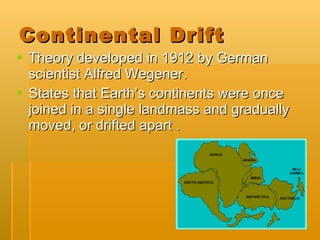
Continental Drift  Theory developed in 1912 by German scientist Alfred Wegener. States that Earth’s continents were once joined in a single landmass and gradually moved, or drifted apart .
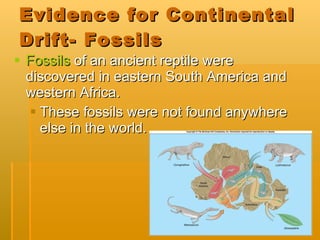
Evidence for Continental Drift- Fossils Fossils  of an ancient reptile were discovered in eastern South America and western Africa. These fossils were not found anywhere else in the world.
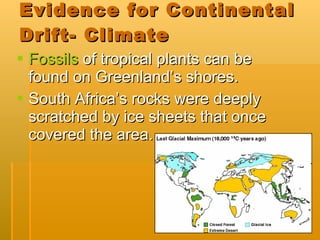
Evidence for Continental Drift- Climate Fossils  of tropical plants can be found on Greenland’s shores. South Africa’s rocks were deeply scratched by ice sheets that once covered the area.
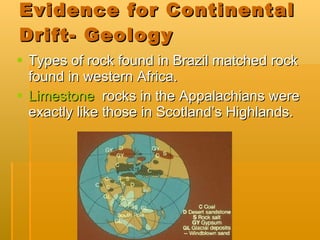
Evidence for Continental Drift- Geology Types of rock found in Brazil matched rock found in western Africa. Limestone   rocks in the Appalachians were exactly like those in Scotland’s Highlands.
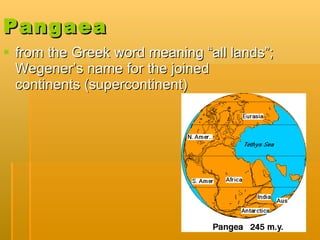
Pangaea   from the Greek word meaning “all lands”; Wegener’s name for the joined continents (supercontinent)
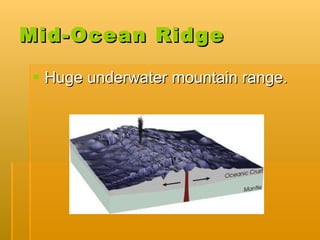
Mid-Ocean Ridge   Huge underwater mountain range.
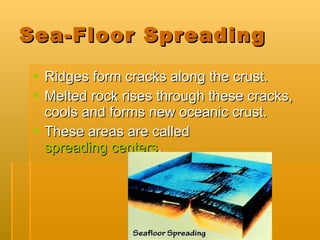
Sea-Floor Spreading Ridges form cracks along the crust. Melted rock rises through these cracks, cools and forms new oceanic crust. These areas are called  spreading centers .
Age of the Sea Floor Evidence that the sea floor is spreading apart came from the age of rocks in the crust. The youngest rock is closest to the ridge, while the oldest rock is farthest away. Continental crust (4 billion years old) is much older than oceanic crust (160-180 million
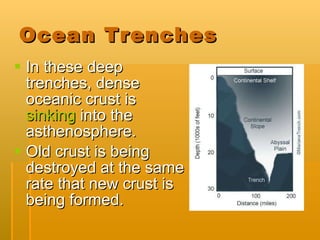
Ocean Trenches In these deep trenches, dense oceanic crust is  sinking  into the asthenosphere. Old crust is being destroyed at the same rate that new crust is being formed.
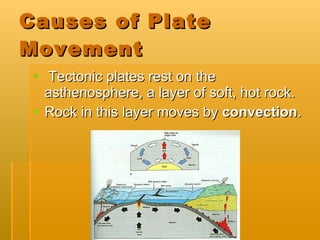
Causes of Plate Movement Tectonic plates rest on the asthenosphere, a layer of soft, hot rock. Rock in this layer moves by  convection .
Causes of Plate Movement Rocks in the asthenosphere act in a similar way. Hot, soft rock rises, cools and sinks, only to be heated and rise again. This sinking and rising motion, if it continues, is called a  convection current .  This current moves rocks in the mantle only a few centimeters a year.  Over millions of years, this moves plates thousands of kilometers.
Causes of Plate Movement Slab pull and ridge push also move these huge plates. slab pull - gravity pulls the edge of a cool, dense plate into the asthenosphere and the entire plate is dragged along. Ridge push - material from a mid-ocean ridge slides downhill from the ridge, pushing the rest of the plate.
Theory of plate tectonics  States the Earth’s lithosphere is made up of huge plates that move over the surface of the Earth.  Plates can move apart, push together, or scrape past each other. Most major earthquakes, volcanoes, and mountain ranges appear where tectonic plates meet.
http://www.classzone.com/books/earth_science/terc/content/visualizations/es3005/es3005page01.cfm

3.2

  • 1.
    Continents Change PositionsOver Time http://www.youtube.com/watch?v=RuScA58BgRE&feature=related
  • 2.
    Continental Drift Theory developed in 1912 by German scientist Alfred Wegener. States that Earth’s continents were once joined in a single landmass and gradually moved, or drifted apart .
  • 3.
    Evidence for ContinentalDrift- Fossils Fossils of an ancient reptile were discovered in eastern South America and western Africa. These fossils were not found anywhere else in the world.
  • 4.
    Evidence for ContinentalDrift- Climate Fossils of tropical plants can be found on Greenland’s shores. South Africa’s rocks were deeply scratched by ice sheets that once covered the area.
  • 5.
    Evidence for ContinentalDrift- Geology Types of rock found in Brazil matched rock found in western Africa. Limestone rocks in the Appalachians were exactly like those in Scotland’s Highlands.
  • 6.
    Pangaea from the Greek word meaning “all lands”; Wegener’s name for the joined continents (supercontinent)
  • 7.
    Mid-Ocean Ridge Huge underwater mountain range.
  • 8.
    Sea-Floor Spreading Ridgesform cracks along the crust. Melted rock rises through these cracks, cools and forms new oceanic crust. These areas are called spreading centers .
  • 9.
    Age of theSea Floor Evidence that the sea floor is spreading apart came from the age of rocks in the crust. The youngest rock is closest to the ridge, while the oldest rock is farthest away. Continental crust (4 billion years old) is much older than oceanic crust (160-180 million
  • 10.
    Ocean Trenches Inthese deep trenches, dense oceanic crust is sinking into the asthenosphere. Old crust is being destroyed at the same rate that new crust is being formed.
  • 11.
    Causes of PlateMovement Tectonic plates rest on the asthenosphere, a layer of soft, hot rock. Rock in this layer moves by convection .
  • 12.
    Causes of PlateMovement Rocks in the asthenosphere act in a similar way. Hot, soft rock rises, cools and sinks, only to be heated and rise again. This sinking and rising motion, if it continues, is called a convection current . This current moves rocks in the mantle only a few centimeters a year. Over millions of years, this moves plates thousands of kilometers.
  • 13.
    Causes of PlateMovement Slab pull and ridge push also move these huge plates. slab pull - gravity pulls the edge of a cool, dense plate into the asthenosphere and the entire plate is dragged along. Ridge push - material from a mid-ocean ridge slides downhill from the ridge, pushing the rest of the plate.
  • 14.
    Theory of platetectonics States the Earth’s lithosphere is made up of huge plates that move over the surface of the Earth. Plates can move apart, push together, or scrape past each other. Most major earthquakes, volcanoes, and mountain ranges appear where tectonic plates meet.
  • 15.