College of Engineering, Pune
Shivajinagar, Pune – 411005
Department of Computer Engineering and
Information Technology
SEMINAR REPORT ON
GUIDED BY
Prof. S. U. Ghumbre
Presented By
Tumma Ashwin – 30808010
T. Y. B. Tech (Computer)
2
College of Engineering, Pune
Shivajinagar, Pune – 411005
Department of Computer Engineering and
Information Technology
CERTIFICATE
This is to certify that, this Seminar Report entitled
“The Hidden Realm of Steganography”
is a bonafide record of Project work carried out by
Mr. Tumma Ashwin (30808010)
As per partial fulfillment of the award of post graduate degree
in B.Tech. (Computer Engineering) during the academic year
2009-2010
Date:
Place: Pune
(Prof. S. U. Ghumbre) (Prof. A. A. Sawant)
Seminar & Project Guide Head of Departm ent
3
ACKNOWLEDGMENTS
I feel great pleasure in submitting my seminar report on
“The Hidden Realm of Steganography”. I wish to express true
sense of gratitude towards my guide Prof. S. U. Ghumbre for
his constant encouragement and valuable guidance and for
providing all the necessary facilities, which were indispensable
in the completion of this seminar. I would like to thank our
Head of Department Prof. A. A. Sawant & all staff members
who extended their kind support during the accomplishment of
the seminar report. Finally, I express my sincere thanks to all
those who helped me directly & indirectly in many ways in
completion of this seminar.
Thank you.
Tumma Ashwin K. (30808010)
CONTENTS
Chapter
No
Name Page No
1
On Covert Communications
1.1 What is Steganography?
1.2 Where hidden data hides?
1.3 Where did it come from?
1.4 Who is using Stego?
1.5 Convert Channels
1.6 Steganography Terminologies
5
2
Hiding the Goods with Steganography
2.1 Principles
2.2 Types of Steganography
2.3 Putting all pieces together
7
3
Sending Stego Files across a Network
3.1 In an attachment
3.2 In a transmission
3.3 In Network Headers
3.4 Overt Protocol
11
4
General Techniques for detecting Stego
4.1 Steganalysis
4.2 Properties of Detection Programs
14
5
Future of Steganography
6.1 Improving the techniques
16
6 Conclusion 18
Appendix
A
List of Illustrations 19
Appendix
B
List of Acronyms 20
Appendix
C
Bibliography 21
4
5
1. On Covert Communications
1.1 What is Steganography?
Steganography derives from the Greek word, „Steganos‟,
meaning covered or secret, and „graphy‟ means writing or drawing. On
the simplest level, steganography is hidden writing, whether it
consists of invisible ink on paper or copyright information hidden in
an audio file.
Today, steganography is most often associated with data hidden
with other data in an electronic file. This is usually done by replacing
that least important or most redundant bits of data in the original file.
Where CRYPTOGRAPHY scrambles a message into a code to
obscure its meaning, steganography hides the message entirely.
1.2 Where hidden data hides?
It is possible to alter graphic or sound files slightly without
losing their overall viability for the viewer and listener. With audio,
you can use bits of file that contain sound not audible to the human
ear. With graphic images, you can remove redundant bits of color from
the image and still produce a picture that looks intact to human eye
and is difficult to discern from its original.
It is in those bits that stego hides its data. A stego program uses
an algorithm, to embed data in an image or sound file, and a
password scheme to allow you to retrieve information.
6
1.3 Where did it come from?
One of the earliest examples of steganography involved a Greek
fellow named Histiaeus. As a prisoner of a rival king, he needed a way
to get a secret message to his own army. His solution? Shave the head
of a willing slave and tattoo his message. When the slave‟s hair grew
back, off he went to deliver the hidden writing in person.
In 1499, Trithemius published Steganographia, one of the first
books about steganography.
Today, Steganography has come into its own on the Internet.
Used for transmitting data as well as for hiding trademarks in images
and music(called digital watermarking), electronically steganography
may ironally be one of the last bastions of information privacy in our
world today.
1.4 Who is using Stego?
The reality is that secret communication is used for a variety of
reasons and by a variety of people, from business people protecting
company trade secrets while traveling to criminals transmitting
nuisance. Governments hide information from other governments, and
technophiles amuse themselves by sending secret messages to each
other just for fun. The only tie that binds all these people is a desire to
hide something from someone else. Sadly, in a world on security alert,
the methods available to anybody who wants to hide information are
bound to become more sophisticated to match the times and will be
misused.
1.5 Covert Channels
When two parties communicate covertly over normal
communication channels they are , in essence, using covert
7
channels of communication. The goal is to use normal data objects
but modify them slightly so that they can be used to communicate
information secretly; however the modification should not make the
object being sent over the channel look unusual.
1.6 Steganography Terminologies
Carrier File – A file which has hidden information inside of it.
Steganalysis – The process of detecting hidden information inside of a
file.
Stego-Medium – The medium in which the information is hidden.
Redundant Bits – Pieces of information inside a file which can be
overwritten or altered with out
damaging the file.
Payload – The information which is to be concealed.
8
2. Hiding the Goods with Steganography
2.1 Principles of Steganography
Steganography involves hiding data in an overt message and
doing it in such a way that it is difficult for an adversary to detect and
difficult for an adversary to remove. Based on this goal, three core
principles can be used to measure the effectiveness of a given
technique: amount of data, difficulty of detection, and difficulty of
removal.
Amount of data suggests that the more data you can hide, the
better the technique.
Difficulty of detection relates to how easy it is for somebody to
detect that a message has been hidden.
Difficulty of removal involves the principle that someone
intercepting your file should not be able to remove the hidden data
easily.
2.2 Types of Steganography
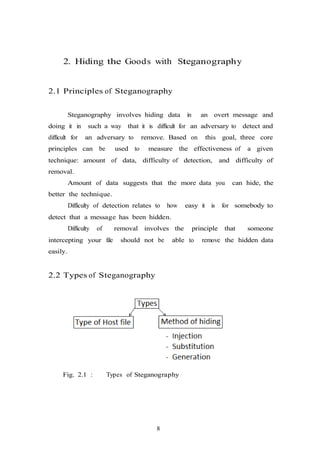
Fig. 2.1 : Types of Steganography
9
Injection:
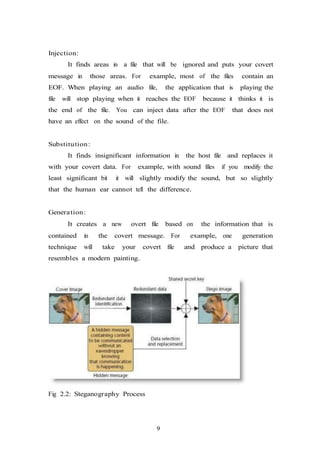
It finds areas in a file that will be ignored and puts your covert
message in those areas. For example, most of the files contain an
EOF. When playing an audio file, the application that is playing the
file will stop playing when it reaches the EOF because it thinks it is
the end of the file. You can inject data after the EOF that does not
have an effect on the sound of the file.
Substitution:
It finds insignificant information in the host file and replaces it
with your covert data. For example, with sound files if you modify the
least significant bit it will slightly modify the sound, but so slightly
that the human ear cannot tell the difference.
Generation:
It creates a new overt file based on the information that is
contained in the covert message. For example, one generation
technique will take your covert file and produce a picture that
resembles a modern painting.
Fig 2.2: Steganography Process
10
2.3 Putting All the Pieces Together
Because Cryptography and Steganography complement each
other, it is usually recommended that they be used together for a
higher level of security. After the secret message is written, it would
first be encrypted, then hidden in a host file.
11
3. Sending Stego Files across a Network
3.1 Network Stego Techniques
On a computer network you can use stego techniques to hide
files in traffic, transmit viruses, or hide the trail somebody when
moving around online. The four categories of of Network Stego
techniques are:
- Hiding in an attachment
- Hiding in a transmission
- Hiding in Network Headers
- Hiding in an overt channel
Hiding in an Attachm ent:
Hiding data in an attachment is the most basic form of using a
network to transmit stego from one person to another. Three most popular
ways to do this are with Email, by file transfer such as FTP, or by posting
a file on a website.
Hiding in Transmission:
When you hide stego in an attached file you need to use one program
to hide the data and another to transmit it. On the contrary, when you
hide information in a transmission, you use a single program to hide data
in a file and send the image.
Hiding in Network Headers:
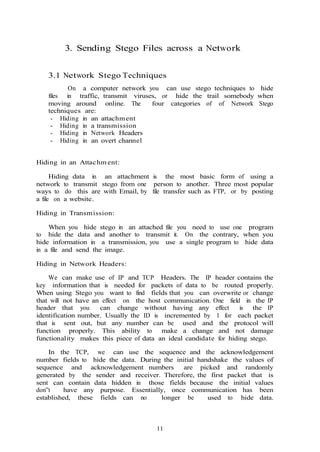
We can make use of IP and TCP Headers. The IP header contains the
key information that is needed for packets of data to be routed properly.
When using Stego you want to find fields that you can overwrite or change
that will not have an effect on the host communication. One field in the IP
header that you can change without having any effect is the IP
identification number. Usually the ID is incremented by 1 for each packet
that is sent out, but any number can be used and the protocol will
function properly. This ability to make a change and not damage
functionality makes this piece of data an ideal candidate for hiding stego.
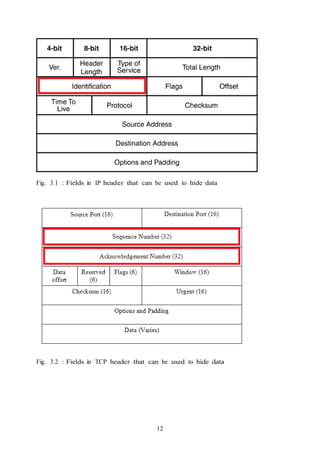
In the TCP, we can use the sequence and the acknowledgement
number fields to hide the data. During the initial handshake the values of
sequence and acknowledgement numbers are picked and randomly
generated by the sender and receiver. Therefore, the first packet that is
sent can contain data hidden in those fields because the initial values
don‟t have any purpose. Essentially, once communication has been
established, these fields can no longer be used to hide data.
12
Fig. 3.1 : Fields in IP header that can be used to hide data
Fig. 3.2 : Fields in TCP header that can be used to hide data
13
Hiding in an Overt Protocol:
Essentially, this is what is called as data camouflaging, where you
make data look like something else. With this technique you take data,
put it in normal network traffic, and modify the data in such a way that it
looks like the overt protocol.
For example, most networks carry large amounts of HTTP or Web
traffic. You could send data over port 80, and it would look like web
traffic. The problem is that, if someone examined the payload, it would not
look like normal web traffic, which usually contains HTML. What if you
added symbols such as <> , </> to the data? Because these are the types
of characters that HTML contains, the traffic would look like Web traffic
and probably would slip by the casual observer.
14
4. General Techniques for Detecting Stego
4.1 Steganalysts
“Steganalysts” is a relatively new term that was developed to refer to
someone who tries to break stego techniques. Even though the terms
„cryptanalyst‟ and „steganalyst‟ are similar, their roles are quite different.
The difference becomes obvious when you look at the goals of the two
techniques. A cryptanalyst tries to break an encrypted message to read it.
The goal of a steganalyst is to detect whether a message has data hidden
in it.
Once a steganalyst has determined that a file has a message hidden in
it and the message has been extracted, if it is encrypted it then becomes
the job of a cryptanalyst to try to break the ciphertext and figure out what
the plaintext message is.
4.2 Properties of Detection Programs
Finding random data is the heart of these programs. The easiest
way to find random data is to plot a histogram of the bytes across a file.
With most files that do not contain random data you would get a
histogram that has peaks and valleys where certain characters appear
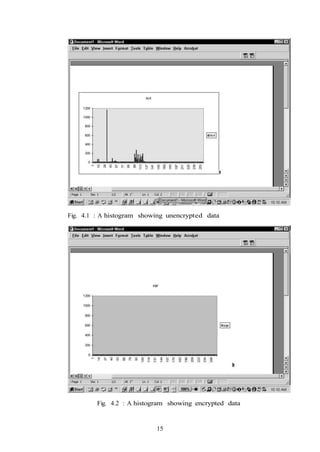
often and others appear only infrequently. Figure 4.1 is a histogram for
unencrypted data. You can see that certain values appear much more
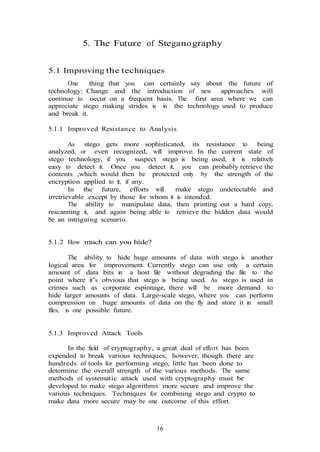
often than others. On the other hand, with encrypted data, because it is
random, you acquire a much flatter histogram, as you can see in Figure
4.2. You can see that, compared to Figure 4.1, Figure 4.2 looks extremely
flat. Every character appears with equal frequency. The program we‟re
building will calculate randomness; if a file has a flat histogram it will be
flagged. The program then checks the header and determines whether the
file is encrypted, compressed, or a JPEG image.
15
Fig. 4.1 : A histogram showing unencrypted data
Fig. 4.2 : A histogram showing encrypted data
16
5. The Future of Steganography
5.1 Improving the techniques
One thing that you can certainly say about the future of
technology: Change and the introduction of new approaches will
continue to occur on a frequent basis. The first area where we can
appreciate stego making strides is in the technology used to produce
and break it.
5.1.1 Improved Resistance to Analysis
As stego gets more sophisticated, its resistance to being
analyzed, or even recognized, will improve. In the current state of
stego technology, if you suspect stego is being used, it is relatively
easy to detect it. Once you detect it, you can probably retrieve the
contents ,which would then be protected only by the strength of the
encryption applied to it, if any.
In the future, efforts will make stego undetectable and
irretrievable except by those for whom it is intended.
The ability to manipulate data, then printing out a hard copy,
rescanning it, and again being able to retrieve the hidden data would
be an intriguing scenario.
5.1.2 How much can you hide?
The ability to hide huge amounts of data with stego is another
logical area for improvement. Currently stego can use only a certain
amount of data bits in a host file without degrading the file to the
point where it‟s obvious that stego is being used. As stego is used in
crimes such as corporate espionage, there will be more demand to
hide larger amounts of data. Large-scale stego, where you can perform
compression on huge amounts of data on the fly and store it in small
files, is one possible future.
5.1.3 Improved Attack Tools
In the field of cryptography, a great deal of effort has been
expended to break various techniques; however, though there are
hundreds of tools for performing stego, little has been done to
determine the overall strength of the various methods. The same
methods of systematic attack used with cryptography must be
developed to make stego algorithms more secure and improve the
various techniques. Techniques for combining stego and crypto to
make data more secure may be one outcome of this effort.
17
6.1.4 Where will Stego Tools Reside?
One vision of the future is something called as the Personal Net.
In this scenario, we will manage our own data, communications and
security. No longer we will trust our information and identities to a
public Internet, which we already know to be dangerous and lax about
security. We will all have greater power over our own security, and
stego is likely to be a part of that.
Browser technology will include filtering and permissions
features to locate and open embedded messages. Finally, attack tools
to break stego and crypto will become commonplace security
measures in corporations, and perhaps even on the personal desktop
and telecommunicating increases and workers must stay secure in
their home computing environment.
18
6. Conclusion
6.1 Conclusion:
Steganography is a fascinating and effective method of hiding
data that has been used throughout history. Methods that can be
employed to uncover such devious tactics, but the first step are
awareness that such methods even exist. There are many good
reasons as well to use this type of data hiding, including
watermarking or a more secure central storage method for such things
as passwords, or key processes. Regardless, the technology is easy to
use and difficult to detect. The more that you know about its features
and functionality, the more ahead you will be in the game.
However a contrary perspective on encryption was presented by
Freeh, a US politician, who commented to the Senate Judiciary
committee in September 1998 that “we are very concerned, as this
committee is, about the encryption situation, particularly as it relates
to fighting crime and fighting terrorism.....we believe that an
unrestricted proliferation of products without any kind of court access
and law enforcement access, will harm us, and make the fight much
more difficult” (cited in Hancock, 2001). He did not however mention
Steganography, but viewed encryption as harmful due to its potential
uses by terrorists.
Appendix A : List of Illustrations
Figure No. Figure Name
2.1 Types of Steganography
2.2 Steganography Process
3.1 Fields in IP Header that can be used to hide data
3.2 Fields in TCP Header that can be used to hide data
4.1 A histogram showing unencrypted data
4.2 A histogram showing encrypted data
19
Appendix B : List of Acronyms
Acronym Description
EOF End of File
IP Internet Protocol
TCP Transmission Control Protocol
JPG Joint Photographic Group
PNG Portable Network Graphics
20
Appendix C : Bibliography
Books
 Eric Cole, Hiding in Plain Text, Wiley Publishing,Inc. :2003
 V. K. Pachghare, Cryptography and Information Security,
Prentice-hall Of India Pvt Ltd
Papers
 Natarajan Meghanathan and Lopamudra Nayak,Steganalysis
Algorithms for Detecting the Hidden Information in Image,
Audio and Video Cover Media, Jackson State University,
1400 Lynch St., Jackson, USA.
Websites
 http://en.wikipedia.org/wiki/Steganography
 http://www.sarc-wv.com/news.aspx
21

30808010 report(1)

  • 1.
    College of Engineering,Pune Shivajinagar, Pune – 411005 Department of Computer Engineering and Information Technology SEMINAR REPORT ON GUIDED BY Prof. S. U. Ghumbre Presented By Tumma Ashwin – 30808010 T. Y. B. Tech (Computer)
  • 2.
    2 College of Engineering,Pune Shivajinagar, Pune – 411005 Department of Computer Engineering and Information Technology CERTIFICATE This is to certify that, this Seminar Report entitled “The Hidden Realm of Steganography” is a bonafide record of Project work carried out by Mr. Tumma Ashwin (30808010) As per partial fulfillment of the award of post graduate degree in B.Tech. (Computer Engineering) during the academic year 2009-2010 Date: Place: Pune (Prof. S. U. Ghumbre) (Prof. A. A. Sawant) Seminar & Project Guide Head of Departm ent
  • 3.
    3 ACKNOWLEDGMENTS I feel greatpleasure in submitting my seminar report on “The Hidden Realm of Steganography”. I wish to express true sense of gratitude towards my guide Prof. S. U. Ghumbre for his constant encouragement and valuable guidance and for providing all the necessary facilities, which were indispensable in the completion of this seminar. I would like to thank our Head of Department Prof. A. A. Sawant & all staff members who extended their kind support during the accomplishment of the seminar report. Finally, I express my sincere thanks to all those who helped me directly & indirectly in many ways in completion of this seminar. Thank you. Tumma Ashwin K. (30808010)
  • 4.
    CONTENTS Chapter No Name Page No 1 OnCovert Communications 1.1 What is Steganography? 1.2 Where hidden data hides? 1.3 Where did it come from? 1.4 Who is using Stego? 1.5 Convert Channels 1.6 Steganography Terminologies 5 2 Hiding the Goods with Steganography 2.1 Principles 2.2 Types of Steganography 2.3 Putting all pieces together 7 3 Sending Stego Files across a Network 3.1 In an attachment 3.2 In a transmission 3.3 In Network Headers 3.4 Overt Protocol 11 4 General Techniques for detecting Stego 4.1 Steganalysis 4.2 Properties of Detection Programs 14 5 Future of Steganography 6.1 Improving the techniques 16 6 Conclusion 18 Appendix A List of Illustrations 19 Appendix B List of Acronyms 20 Appendix C Bibliography 21 4
  • 5.
    5 1. On CovertCommunications 1.1 What is Steganography? Steganography derives from the Greek word, „Steganos‟, meaning covered or secret, and „graphy‟ means writing or drawing. On the simplest level, steganography is hidden writing, whether it consists of invisible ink on paper or copyright information hidden in an audio file. Today, steganography is most often associated with data hidden with other data in an electronic file. This is usually done by replacing that least important or most redundant bits of data in the original file. Where CRYPTOGRAPHY scrambles a message into a code to obscure its meaning, steganography hides the message entirely. 1.2 Where hidden data hides? It is possible to alter graphic or sound files slightly without losing their overall viability for the viewer and listener. With audio, you can use bits of file that contain sound not audible to the human ear. With graphic images, you can remove redundant bits of color from the image and still produce a picture that looks intact to human eye and is difficult to discern from its original. It is in those bits that stego hides its data. A stego program uses an algorithm, to embed data in an image or sound file, and a password scheme to allow you to retrieve information.
  • 6.
    6 1.3 Where didit come from? One of the earliest examples of steganography involved a Greek fellow named Histiaeus. As a prisoner of a rival king, he needed a way to get a secret message to his own army. His solution? Shave the head of a willing slave and tattoo his message. When the slave‟s hair grew back, off he went to deliver the hidden writing in person. In 1499, Trithemius published Steganographia, one of the first books about steganography. Today, Steganography has come into its own on the Internet. Used for transmitting data as well as for hiding trademarks in images and music(called digital watermarking), electronically steganography may ironally be one of the last bastions of information privacy in our world today. 1.4 Who is using Stego? The reality is that secret communication is used for a variety of reasons and by a variety of people, from business people protecting company trade secrets while traveling to criminals transmitting nuisance. Governments hide information from other governments, and technophiles amuse themselves by sending secret messages to each other just for fun. The only tie that binds all these people is a desire to hide something from someone else. Sadly, in a world on security alert, the methods available to anybody who wants to hide information are bound to become more sophisticated to match the times and will be misused. 1.5 Covert Channels When two parties communicate covertly over normal communication channels they are , in essence, using covert
  • 7.
    7 channels of communication.The goal is to use normal data objects but modify them slightly so that they can be used to communicate information secretly; however the modification should not make the object being sent over the channel look unusual. 1.6 Steganography Terminologies Carrier File – A file which has hidden information inside of it. Steganalysis – The process of detecting hidden information inside of a file. Stego-Medium – The medium in which the information is hidden. Redundant Bits – Pieces of information inside a file which can be overwritten or altered with out damaging the file. Payload – The information which is to be concealed.
  • 8.
    8 2. Hiding theGoods with Steganography 2.1 Principles of Steganography Steganography involves hiding data in an overt message and doing it in such a way that it is difficult for an adversary to detect and difficult for an adversary to remove. Based on this goal, three core principles can be used to measure the effectiveness of a given technique: amount of data, difficulty of detection, and difficulty of removal. Amount of data suggests that the more data you can hide, the better the technique. Difficulty of detection relates to how easy it is for somebody to detect that a message has been hidden. Difficulty of removal involves the principle that someone intercepting your file should not be able to remove the hidden data easily. 2.2 Types of Steganography Fig. 2.1 : Types of Steganography
  • 9.
    9 Injection: It finds areasin a file that will be ignored and puts your covert message in those areas. For example, most of the files contain an EOF. When playing an audio file, the application that is playing the file will stop playing when it reaches the EOF because it thinks it is the end of the file. You can inject data after the EOF that does not have an effect on the sound of the file. Substitution: It finds insignificant information in the host file and replaces it with your covert data. For example, with sound files if you modify the least significant bit it will slightly modify the sound, but so slightly that the human ear cannot tell the difference. Generation: It creates a new overt file based on the information that is contained in the covert message. For example, one generation technique will take your covert file and produce a picture that resembles a modern painting. Fig 2.2: Steganography Process
  • 10.
    10 2.3 Putting Allthe Pieces Together Because Cryptography and Steganography complement each other, it is usually recommended that they be used together for a higher level of security. After the secret message is written, it would first be encrypted, then hidden in a host file.
  • 11.
    11 3. Sending StegoFiles across a Network 3.1 Network Stego Techniques On a computer network you can use stego techniques to hide files in traffic, transmit viruses, or hide the trail somebody when moving around online. The four categories of of Network Stego techniques are: - Hiding in an attachment - Hiding in a transmission - Hiding in Network Headers - Hiding in an overt channel Hiding in an Attachm ent: Hiding data in an attachment is the most basic form of using a network to transmit stego from one person to another. Three most popular ways to do this are with Email, by file transfer such as FTP, or by posting a file on a website. Hiding in Transmission: When you hide stego in an attached file you need to use one program to hide the data and another to transmit it. On the contrary, when you hide information in a transmission, you use a single program to hide data in a file and send the image. Hiding in Network Headers: We can make use of IP and TCP Headers. The IP header contains the key information that is needed for packets of data to be routed properly. When using Stego you want to find fields that you can overwrite or change that will not have an effect on the host communication. One field in the IP header that you can change without having any effect is the IP identification number. Usually the ID is incremented by 1 for each packet that is sent out, but any number can be used and the protocol will function properly. This ability to make a change and not damage functionality makes this piece of data an ideal candidate for hiding stego. In the TCP, we can use the sequence and the acknowledgement number fields to hide the data. During the initial handshake the values of sequence and acknowledgement numbers are picked and randomly generated by the sender and receiver. Therefore, the first packet that is sent can contain data hidden in those fields because the initial values don‟t have any purpose. Essentially, once communication has been established, these fields can no longer be used to hide data.
  • 12.
    12 Fig. 3.1 :Fields in IP header that can be used to hide data Fig. 3.2 : Fields in TCP header that can be used to hide data
  • 13.
    13 Hiding in anOvert Protocol: Essentially, this is what is called as data camouflaging, where you make data look like something else. With this technique you take data, put it in normal network traffic, and modify the data in such a way that it looks like the overt protocol. For example, most networks carry large amounts of HTTP or Web traffic. You could send data over port 80, and it would look like web traffic. The problem is that, if someone examined the payload, it would not look like normal web traffic, which usually contains HTML. What if you added symbols such as <> , </> to the data? Because these are the types of characters that HTML contains, the traffic would look like Web traffic and probably would slip by the casual observer.
  • 14.
    14 4. General Techniquesfor Detecting Stego 4.1 Steganalysts “Steganalysts” is a relatively new term that was developed to refer to someone who tries to break stego techniques. Even though the terms „cryptanalyst‟ and „steganalyst‟ are similar, their roles are quite different. The difference becomes obvious when you look at the goals of the two techniques. A cryptanalyst tries to break an encrypted message to read it. The goal of a steganalyst is to detect whether a message has data hidden in it. Once a steganalyst has determined that a file has a message hidden in it and the message has been extracted, if it is encrypted it then becomes the job of a cryptanalyst to try to break the ciphertext and figure out what the plaintext message is. 4.2 Properties of Detection Programs Finding random data is the heart of these programs. The easiest way to find random data is to plot a histogram of the bytes across a file. With most files that do not contain random data you would get a histogram that has peaks and valleys where certain characters appear often and others appear only infrequently. Figure 4.1 is a histogram for unencrypted data. You can see that certain values appear much more often than others. On the other hand, with encrypted data, because it is random, you acquire a much flatter histogram, as you can see in Figure 4.2. You can see that, compared to Figure 4.1, Figure 4.2 looks extremely flat. Every character appears with equal frequency. The program we‟re building will calculate randomness; if a file has a flat histogram it will be flagged. The program then checks the header and determines whether the file is encrypted, compressed, or a JPEG image.
  • 15.
    15 Fig. 4.1 :A histogram showing unencrypted data Fig. 4.2 : A histogram showing encrypted data
  • 16.
    16 5. The Futureof Steganography 5.1 Improving the techniques One thing that you can certainly say about the future of technology: Change and the introduction of new approaches will continue to occur on a frequent basis. The first area where we can appreciate stego making strides is in the technology used to produce and break it. 5.1.1 Improved Resistance to Analysis As stego gets more sophisticated, its resistance to being analyzed, or even recognized, will improve. In the current state of stego technology, if you suspect stego is being used, it is relatively easy to detect it. Once you detect it, you can probably retrieve the contents ,which would then be protected only by the strength of the encryption applied to it, if any. In the future, efforts will make stego undetectable and irretrievable except by those for whom it is intended. The ability to manipulate data, then printing out a hard copy, rescanning it, and again being able to retrieve the hidden data would be an intriguing scenario. 5.1.2 How much can you hide? The ability to hide huge amounts of data with stego is another logical area for improvement. Currently stego can use only a certain amount of data bits in a host file without degrading the file to the point where it‟s obvious that stego is being used. As stego is used in crimes such as corporate espionage, there will be more demand to hide larger amounts of data. Large-scale stego, where you can perform compression on huge amounts of data on the fly and store it in small files, is one possible future. 5.1.3 Improved Attack Tools In the field of cryptography, a great deal of effort has been expended to break various techniques; however, though there are hundreds of tools for performing stego, little has been done to determine the overall strength of the various methods. The same methods of systematic attack used with cryptography must be developed to make stego algorithms more secure and improve the various techniques. Techniques for combining stego and crypto to make data more secure may be one outcome of this effort.
  • 17.
    17 6.1.4 Where willStego Tools Reside? One vision of the future is something called as the Personal Net. In this scenario, we will manage our own data, communications and security. No longer we will trust our information and identities to a public Internet, which we already know to be dangerous and lax about security. We will all have greater power over our own security, and stego is likely to be a part of that. Browser technology will include filtering and permissions features to locate and open embedded messages. Finally, attack tools to break stego and crypto will become commonplace security measures in corporations, and perhaps even on the personal desktop and telecommunicating increases and workers must stay secure in their home computing environment.
  • 18.
    18 6. Conclusion 6.1 Conclusion: Steganographyis a fascinating and effective method of hiding data that has been used throughout history. Methods that can be employed to uncover such devious tactics, but the first step are awareness that such methods even exist. There are many good reasons as well to use this type of data hiding, including watermarking or a more secure central storage method for such things as passwords, or key processes. Regardless, the technology is easy to use and difficult to detect. The more that you know about its features and functionality, the more ahead you will be in the game. However a contrary perspective on encryption was presented by Freeh, a US politician, who commented to the Senate Judiciary committee in September 1998 that “we are very concerned, as this committee is, about the encryption situation, particularly as it relates to fighting crime and fighting terrorism.....we believe that an unrestricted proliferation of products without any kind of court access and law enforcement access, will harm us, and make the fight much more difficult” (cited in Hancock, 2001). He did not however mention Steganography, but viewed encryption as harmful due to its potential uses by terrorists.
  • 19.
    Appendix A :List of Illustrations Figure No. Figure Name 2.1 Types of Steganography 2.2 Steganography Process 3.1 Fields in IP Header that can be used to hide data 3.2 Fields in TCP Header that can be used to hide data 4.1 A histogram showing unencrypted data 4.2 A histogram showing encrypted data 19
  • 20.
    Appendix B :List of Acronyms Acronym Description EOF End of File IP Internet Protocol TCP Transmission Control Protocol JPG Joint Photographic Group PNG Portable Network Graphics 20
  • 21.
    Appendix C :Bibliography Books  Eric Cole, Hiding in Plain Text, Wiley Publishing,Inc. :2003  V. K. Pachghare, Cryptography and Information Security, Prentice-hall Of India Pvt Ltd Papers  Natarajan Meghanathan and Lopamudra Nayak,Steganalysis Algorithms for Detecting the Hidden Information in Image, Audio and Video Cover Media, Jackson State University, 1400 Lynch St., Jackson, USA. Websites  http://en.wikipedia.org/wiki/Steganography  http://www.sarc-wv.com/news.aspx 21