Chameli Devi School Of
Engineering
STEGANOGRAPHY
Submitted By :-
Arvind Carpenter
Guided By :-
Ms. Renu Dangi
MAIN POINTS
 WHAT IS STEGANOGRAPHY?
 HISTORY
 STEGANOGRAPHY
 TOOLS
 STEGANOGRAPHY V/S CRYPTOGRAPHY
 TYPES OF STEGANOGRAPHY
 TECHNIQUES
 PRACTICAL APPROACH
 DETECTION
 ADVANTAGES
 NEGATIVE ASPECTS
 APPLICATIONS
 CONCLUSION
2
WHAT IS STEGANOGRAPHY?
 Definition
 Greek words
 STEGANOS-”Covered”
 GRAPHIE-”Writing”
 It is the process of hiding of secret message within an ordinary message and
extracting with its definition
 Anyone else viewing the message will fail to know it contains encrypted/hidden
data
 Invisible ink is also form of Steganography
 Used in World-War II
3
Steganography
 Modern digital steganography
 data is encrypted
 then inserted and hidden, using a special algorithm which may add and/or
modify the contents of the file
 This technique may simply append the data to the file, or disperse it throughout
 Carefully crafted programs apply the encrypted data such that patterns appear
normal.
4
Steganography-Requirements
 Security of the hidden communication
 Size of payload
 Robustness of malicious and unintentional attack
5
Steganography-Tools
Steganography Tools
 Steganos
 S-Tools (GIF, JPEG)
 StegHide (WAV, BMP)
 Invisible Secrets (JPEG)
 JPHide
 Camouflage
 Hiderman
 Many others…
6
Steganography-Carrier Files
Steganography Carrier Files
 bmp
 jpeg
 gif
 wav
 mp3
 Amongst others…
7
STEGANOGRAPHY TODAY
 Steganography Today, however, is significantly more sophisticated
than the examples above suggest, allowing a user to hide large
amounts of information within image and audio files. These forms of
steganography often are used in conjunction with cryptography so
that the information is doubly protected; first it is encrypted and then
hidden so that an adversary has to first find the information (an
often difficult task in and of itself) and then decrypt it.
8
Steganography v/s Cryptography
 Cryptography hides the contents of a secret message from a
malicious people, whereas Steganography even conceals the
existence of the message
 In cryptography, the structure of a message is scrambled to make it
meaningless and unintelligible unless the decryption key is available
 Steganography does not alter the structure of the secret message,
but hides it inside a cover-image so it cannot be seen.
9
Types of Steganography
 Steganography In Text/Documents
 Steganography In Images
 Steganography In Audio
 Steganography In Video
10
Steganography Techniques
 Injection: Injection is quite a simple method which simply involves
directly injecting the secret information into the carrier file.
 Substitution: Replacement of the least significant bits of information
that determine the meaningful content of the original file with new
data in a way that causes the least amount of distortion.
 Generation: The generation technique, unlike injection and
substitution, requires only a covert file, as it is used to create the
covert file.
11
Modern Steganography Techniques
 Masking and Filtering:
Is where information is hidden inside of a image using digital watermarks that
include information such as copyright, ownership, or licenses. The purpose is different
from traditional steganography since it is adding an attribute to the cover image thus
extending the amount of information presented.
 Algorithms and Transformations:
This technique hides data in mathematical functions that are often used in
compression algorithms. The idea of this method is to hide the secret message in the
data bits in the least significant coefficients.
 Least Significant Bit Insertion:
The most common and popular method of modern day steganography is to
make use of the LSB of a picture’s pixel information. Thus the overall image distortion is
kept to a minimum while the message is spaced out over the pixels in the images. This
technique works best when the image file is larger than the message file and if the
image is grayscale.
12
Images Based Techniques
 Least Significant Technique
 Masking and Filtering
13
Least Significant Bits
 Replaces significant bits with message to be encoded
 Most popular technique when dealing with images
 Simple, but susceptible to lossy compression and manipulation
 Best to use a grayscale palette or one with gradual changes in
shades
 Otherwise, it is best to use images with “noisy areas” – areas with
ample color variation and without large areas of solid color
14
• Example : Insert a word TEXT
- T = 01100010
- E = 01101111
- X = 01101101
- T = 01100010
• Image Bits before
• Image Bits after
15
15
LSB uses
 Storing passwords and/or other confidential information
 Covert communication of sensitive data
 Speculated uses in terrorist activities
 Being widely used to hide and/or transfer illegal content
16
Masking and Filtering
 Masks secret data over the original data by changing the
luminance of particular areas
 During masking, it embed the message within significant bits of the
cover image
 Not susceptible to lossy techniques because image manipulation
does not affect the secret message
17
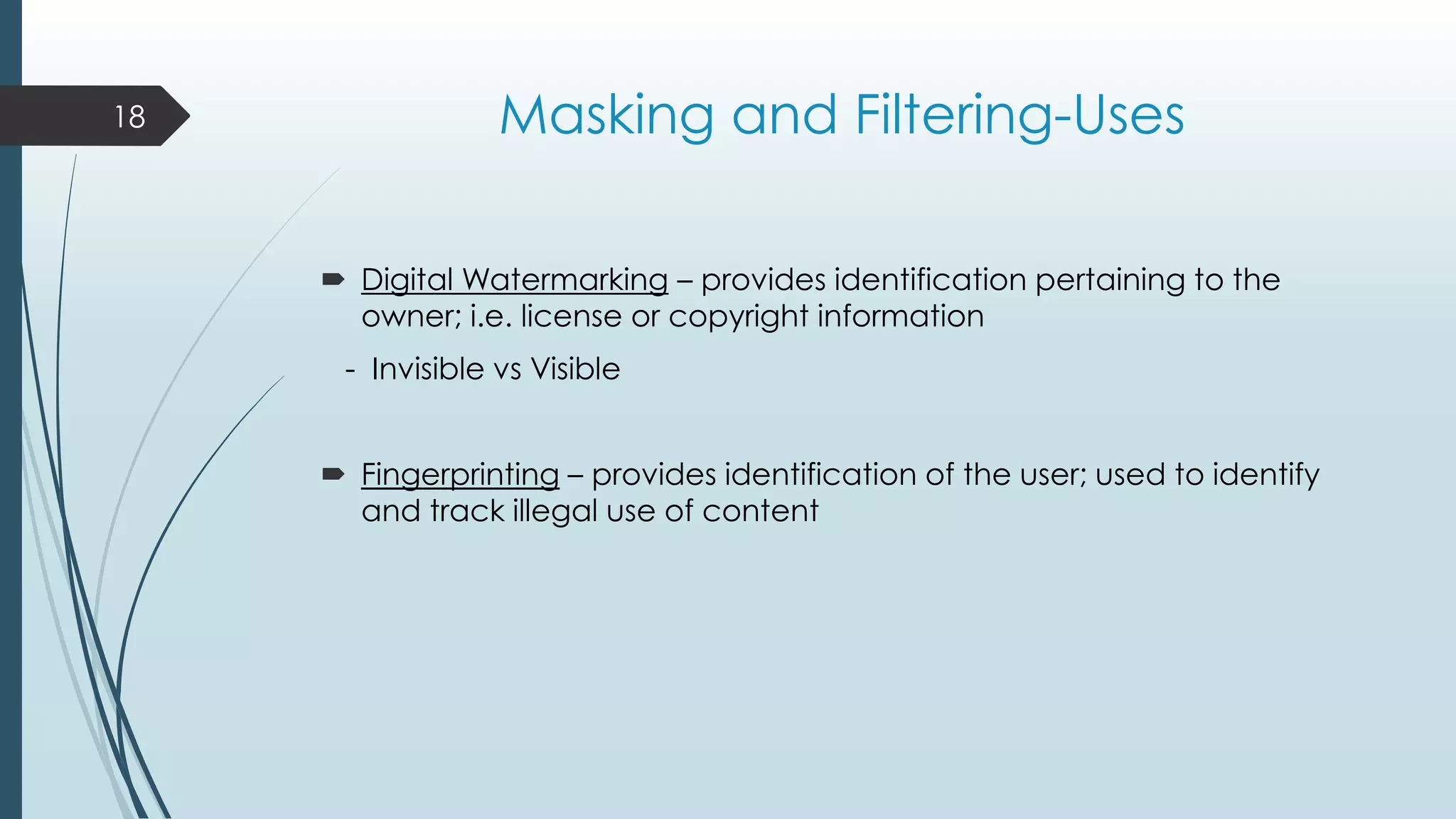
Masking and Filtering-Uses
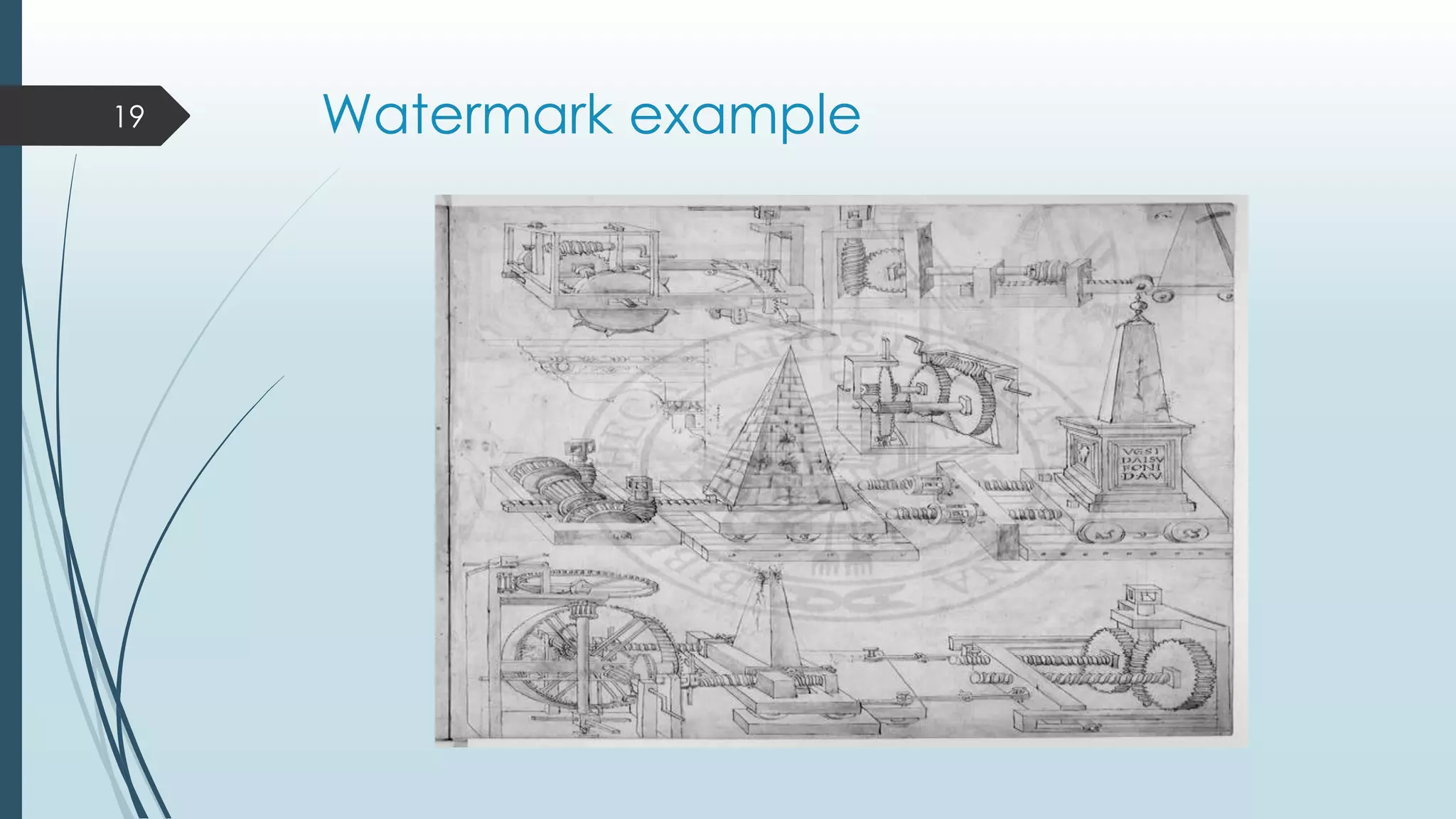
 Digital Watermarking – provides identification pertaining to the
owner; i.e. license or copyright information
- Invisible vs Visible
 Fingerprinting – provides identification of the user; used to identify
and track illegal use of content
18
Watermark example19
DETECTION
 Steganalysis- Identification of hidden data
 Definition
Identifying the existence of a message
Not extracting the message
Note: Technically, Steganography deals with the
concealment of a message, not the encryption of it
 Goal
 Accuracy
 Consistency
 Minimize false-positives
20
NEED FOR DETECTION
 Growing awareness of data hiding techniques and uses
 Availability and sophistication of shareware and
freeware data hiding software
 Concerns over use to hide serious crimes, e.g., drug
trafficking, pedophilia, terrorism
 Frees resources currently spent on investigating cases
with questionable/unknown payoff
 Legislative calls
21
Steganalysis-Methods Detection
Methods of detecting the use of Steganography
Visual Detection (JPEG, BMP, GIF, etc.)
Audible Detection (WAV, MPEG, etc.)
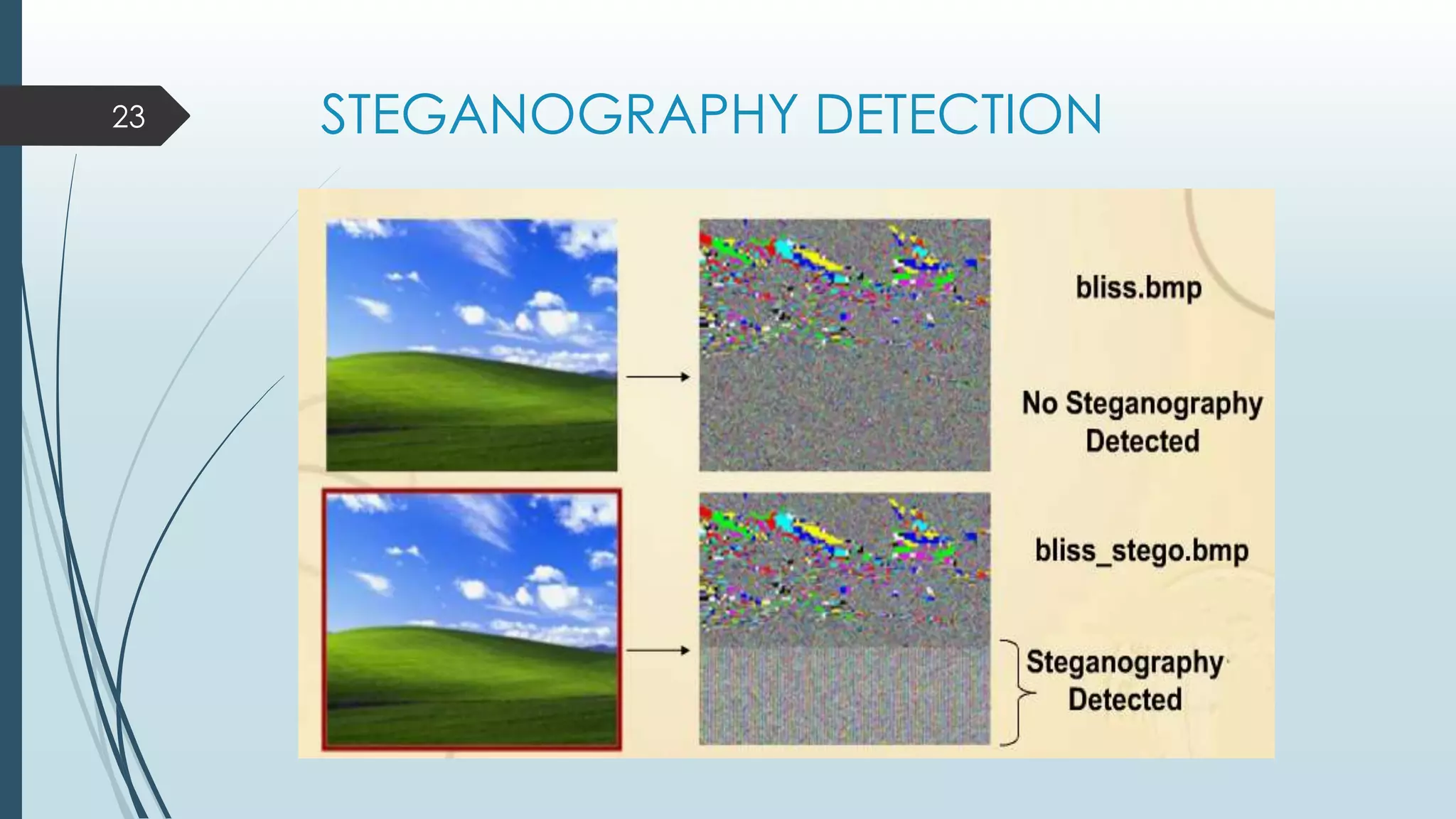
Statistical Detection (changes in patterns of the pixels
or LSB – Least Significant Bit) or Histogram Analysis
Structural Detection - View file properties/contents
size difference
date/time difference
contents – modifications
checksum
22
STEGANOGRAPHY DETECTION23
Steganalysis-Methods Detection
 Categories
 Anomaly
Histogram analysis
Change in file properties
Statistical Attack
Visually
Audible
 Signature
A pattern consistent with the program used
24
Anomaly-Histogram Analysis
 Histogram analysis can be used to possibly identify a file with a
hidden message
 By comparing histograms, we can see this histogram has a very
noticeable repetitive trend.
25
Steganalysis-Tools
 StegoWatch
 Identifies the presence of steganography through special statistical and analytical
programs.
 Accurate and comprehensive tool.
 Hides files in a video sequence
 Stegdetect :
 Automated tool for detecting steganographic content in images
 jsteg
 jphide (unix and windows) used for jpg
 invisible secrets
 outguess 01.3b
 F5 (header analysis)
 appendX and camouflage
26
Advantages
 It is used in the way of hiding not the Information but the
password to reach that Information.
 Messages do not attract attention to themselves i.e
difficult to detect. Only receiver can detect.
 The proposed technique uses LSB to hide data from a
pre defined position agreed between two parties. Same
position is only used once to enhance security.
 Can be applied differently in digital image, audio &
video file.
27
Negative Aspects
 Huge number of data results in huge file size, so some one can
suspect about it.
 In sending and receiving information can be leaked.
 It is Vulnerable to almost all media transformations.
 If this technique is used in a wrong way then this can be very much
dangerous.
28
Applications
 Confidential communication and secret data storing
 Protection of data alteration
 Used in modern printers
 Used by Terrorist(Al-Qaida hide info in porn videos)
 Protect copyrights, to maintain confidentiality.
 In 2010, the Federal Bureau of Investigation revealed that
the Russian foreign intelligence service uses customized
steganography software for embedding encrypted text
messages inside image files for certain communications with
"illegal agents" (agents under non-diplomatic cover)
stationed abroad
29
Conclusion
 Steganography is in the nascent stage of development.
 The importance of Steganography has not been realized to that
stage where it is preferred over its close rival “Encryption”.
 Steganography can be used as benefitial tool for privacy
 Lossless compression of images with a great deal of color variation
work best as a cover image to embed a message.
30
THANK YOU
31

Steganograpy

  • 1.
    Chameli Devi SchoolOf Engineering STEGANOGRAPHY Submitted By :- Arvind Carpenter Guided By :- Ms. Renu Dangi
  • 2.
    MAIN POINTS  WHATIS STEGANOGRAPHY?  HISTORY  STEGANOGRAPHY  TOOLS  STEGANOGRAPHY V/S CRYPTOGRAPHY  TYPES OF STEGANOGRAPHY  TECHNIQUES  PRACTICAL APPROACH  DETECTION  ADVANTAGES  NEGATIVE ASPECTS  APPLICATIONS  CONCLUSION 2
  • 3.
    WHAT IS STEGANOGRAPHY? Definition  Greek words  STEGANOS-”Covered”  GRAPHIE-”Writing”  It is the process of hiding of secret message within an ordinary message and extracting with its definition  Anyone else viewing the message will fail to know it contains encrypted/hidden data  Invisible ink is also form of Steganography  Used in World-War II 3
  • 4.
    Steganography  Modern digitalsteganography  data is encrypted  then inserted and hidden, using a special algorithm which may add and/or modify the contents of the file  This technique may simply append the data to the file, or disperse it throughout  Carefully crafted programs apply the encrypted data such that patterns appear normal. 4
  • 5.
    Steganography-Requirements  Security ofthe hidden communication  Size of payload  Robustness of malicious and unintentional attack 5
  • 6.
    Steganography-Tools Steganography Tools  Steganos S-Tools (GIF, JPEG)  StegHide (WAV, BMP)  Invisible Secrets (JPEG)  JPHide  Camouflage  Hiderman  Many others… 6
  • 7.
    Steganography-Carrier Files Steganography CarrierFiles  bmp  jpeg  gif  wav  mp3  Amongst others… 7
  • 8.
    STEGANOGRAPHY TODAY  SteganographyToday, however, is significantly more sophisticated than the examples above suggest, allowing a user to hide large amounts of information within image and audio files. These forms of steganography often are used in conjunction with cryptography so that the information is doubly protected; first it is encrypted and then hidden so that an adversary has to first find the information (an often difficult task in and of itself) and then decrypt it. 8
  • 9.
    Steganography v/s Cryptography Cryptography hides the contents of a secret message from a malicious people, whereas Steganography even conceals the existence of the message  In cryptography, the structure of a message is scrambled to make it meaningless and unintelligible unless the decryption key is available  Steganography does not alter the structure of the secret message, but hides it inside a cover-image so it cannot be seen. 9
  • 10.
    Types of Steganography Steganography In Text/Documents  Steganography In Images  Steganography In Audio  Steganography In Video 10
  • 11.
    Steganography Techniques  Injection:Injection is quite a simple method which simply involves directly injecting the secret information into the carrier file.  Substitution: Replacement of the least significant bits of information that determine the meaningful content of the original file with new data in a way that causes the least amount of distortion.  Generation: The generation technique, unlike injection and substitution, requires only a covert file, as it is used to create the covert file. 11
  • 12.
    Modern Steganography Techniques Masking and Filtering: Is where information is hidden inside of a image using digital watermarks that include information such as copyright, ownership, or licenses. The purpose is different from traditional steganography since it is adding an attribute to the cover image thus extending the amount of information presented.  Algorithms and Transformations: This technique hides data in mathematical functions that are often used in compression algorithms. The idea of this method is to hide the secret message in the data bits in the least significant coefficients.  Least Significant Bit Insertion: The most common and popular method of modern day steganography is to make use of the LSB of a picture’s pixel information. Thus the overall image distortion is kept to a minimum while the message is spaced out over the pixels in the images. This technique works best when the image file is larger than the message file and if the image is grayscale. 12
  • 13.
    Images Based Techniques Least Significant Technique  Masking and Filtering 13
  • 14.
    Least Significant Bits Replaces significant bits with message to be encoded  Most popular technique when dealing with images  Simple, but susceptible to lossy compression and manipulation  Best to use a grayscale palette or one with gradual changes in shades  Otherwise, it is best to use images with “noisy areas” – areas with ample color variation and without large areas of solid color 14
  • 15.
    • Example :Insert a word TEXT - T = 01100010 - E = 01101111 - X = 01101101 - T = 01100010 • Image Bits before • Image Bits after 15 15
  • 16.
    LSB uses  Storingpasswords and/or other confidential information  Covert communication of sensitive data  Speculated uses in terrorist activities  Being widely used to hide and/or transfer illegal content 16
  • 17.
    Masking and Filtering Masks secret data over the original data by changing the luminance of particular areas  During masking, it embed the message within significant bits of the cover image  Not susceptible to lossy techniques because image manipulation does not affect the secret message 17
  • 18.
    Masking and Filtering-Uses Digital Watermarking – provides identification pertaining to the owner; i.e. license or copyright information - Invisible vs Visible  Fingerprinting – provides identification of the user; used to identify and track illegal use of content 18
  • 19.
  • 20.
    DETECTION  Steganalysis- Identificationof hidden data  Definition Identifying the existence of a message Not extracting the message Note: Technically, Steganography deals with the concealment of a message, not the encryption of it  Goal  Accuracy  Consistency  Minimize false-positives 20
  • 21.
    NEED FOR DETECTION Growing awareness of data hiding techniques and uses  Availability and sophistication of shareware and freeware data hiding software  Concerns over use to hide serious crimes, e.g., drug trafficking, pedophilia, terrorism  Frees resources currently spent on investigating cases with questionable/unknown payoff  Legislative calls 21
  • 22.
    Steganalysis-Methods Detection Methods ofdetecting the use of Steganography Visual Detection (JPEG, BMP, GIF, etc.) Audible Detection (WAV, MPEG, etc.) Statistical Detection (changes in patterns of the pixels or LSB – Least Significant Bit) or Histogram Analysis Structural Detection - View file properties/contents size difference date/time difference contents – modifications checksum 22
  • 23.
  • 24.
    Steganalysis-Methods Detection  Categories Anomaly Histogram analysis Change in file properties Statistical Attack Visually Audible  Signature A pattern consistent with the program used 24
  • 25.
    Anomaly-Histogram Analysis  Histogramanalysis can be used to possibly identify a file with a hidden message  By comparing histograms, we can see this histogram has a very noticeable repetitive trend. 25
  • 26.
    Steganalysis-Tools  StegoWatch  Identifiesthe presence of steganography through special statistical and analytical programs.  Accurate and comprehensive tool.  Hides files in a video sequence  Stegdetect :  Automated tool for detecting steganographic content in images  jsteg  jphide (unix and windows) used for jpg  invisible secrets  outguess 01.3b  F5 (header analysis)  appendX and camouflage 26
  • 27.
    Advantages  It isused in the way of hiding not the Information but the password to reach that Information.  Messages do not attract attention to themselves i.e difficult to detect. Only receiver can detect.  The proposed technique uses LSB to hide data from a pre defined position agreed between two parties. Same position is only used once to enhance security.  Can be applied differently in digital image, audio & video file. 27
  • 28.
    Negative Aspects  Hugenumber of data results in huge file size, so some one can suspect about it.  In sending and receiving information can be leaked.  It is Vulnerable to almost all media transformations.  If this technique is used in a wrong way then this can be very much dangerous. 28
  • 29.
    Applications  Confidential communicationand secret data storing  Protection of data alteration  Used in modern printers  Used by Terrorist(Al-Qaida hide info in porn videos)  Protect copyrights, to maintain confidentiality.  In 2010, the Federal Bureau of Investigation revealed that the Russian foreign intelligence service uses customized steganography software for embedding encrypted text messages inside image files for certain communications with "illegal agents" (agents under non-diplomatic cover) stationed abroad 29
  • 30.
    Conclusion  Steganography isin the nascent stage of development.  The importance of Steganography has not been realized to that stage where it is preferred over its close rival “Encryption”.  Steganography can be used as benefitial tool for privacy  Lossless compression of images with a great deal of color variation work best as a cover image to embed a message. 30
  • 31.

Editor's Notes

  • #2 This presentation demonstrates the new capabilities of PowerPoint and it is best viewed in Slide Show. These slides are designed to give you great ideas for the presentations you’ll create in PowerPoint 2010! For more sample templates, click the File tab, and then on the New tab, click Sample Templates.