NIKHIL PANJWANI
MECHANICAL ENGINEERING
KID- K10854
Experimental Evaluation of A
cascade refrigeration system
prototype with CO2 and NH3
for freezing process applications
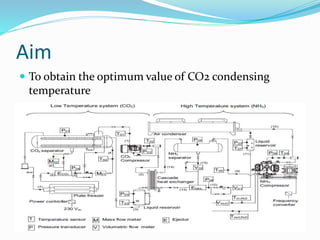
Aim
 To obtain the optimum value of CO2 condensing
temperature
Advantages and Disadvantages Of
Ammonia Refrigerant
 Advantages:
 naturally available
 excellent thermodynamic and transport properties as refrigerant
 Ozone friendly
• Disadvantages:
 toxicity
 Flammability
 Applications at temperatures lower than 35 degree C, the
volumetric displacement requirements of the NH3compressor
works out relatively higher.
 Evaporating pressure ˂ ambient pressure, could lead to leakage into
the system.
Advantages and Disadvantages Of
CO2
 Advantages:
 CO2 is environmentally friendly
 non-toxic
 non-explosive
 easily available
 can be used in refrigeration processes within a wide range of
temperatures.
 it is compatible with the oils commonly used in actual refrigeration
systems
 It offers low pressure ratios and low specific volume values which when
coupled with high pressure levels allows for reduction in size of
refrigeration components
 Disadvantage:
 high work pressures (7.2 MPa at 30 C)
Characteristics of prototype
 Designed to supply a horizontal plate freezer
 Refrigeration capacity of the plate freezer is 9 kW, at 50deg C of
evaporating temperature.
 The operating controller- PLC (Programmable Logic Controller).
 The controlled variables are: the condensing pressures of NH3, the
evaporating pressure of NH3 and the evaporating pressure of CO2.
 The condensing pressure of NH3 is controlled by modifying the
velocity of the fans of the air condenser.
 To control the evaporating pressure ofCO2, a flow line which connects
the CO2 compressor discharge line to its suction line was installed,
thus allowing the recirculation of a small portion of the mass flow of
compressed CO2. The recirculation of the mass flow of CO2 is
controlled using a valve installed in the flow line previously
mentioned.
 The evaporating pressure of NH3 is controlled by varying the capacity
of the high temperature system.
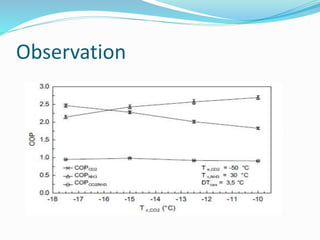
Observation
Observations...
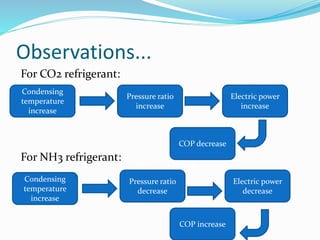
For CO2 refrigerant:
For NH3 refrigerant:
Condensing
temperature
increase
Pressure ratio
increase
Electric power
increase
COP decrease
Condensing
temperature
increase
COP increase
Electric power
decrease
Pressure ratio
decrease
Observations...
 The optimum CO2 condensing temperatures
experimentally measured were compared to the values
of the optimum CO2 condensing temperatures given
by several correlations published by different authors.
The resulting maximum difference was 2.4%.
Experimental Evaluation Of
Cascade Refrigeration Plant using
R134a and CO2 couple
Aim
 Energy performance analysis of the plant.
 Focusing on:
 compressors’ performance,
 temperature difference in the cascade heat exchanger,
 Cooling capacity,
 COP, and
 Compressors’ discharge temperatures
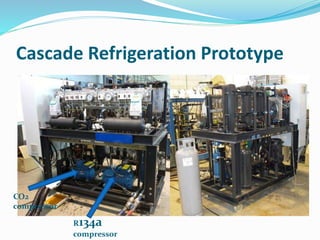
Cascade Refrigeration Prototype
CO2
compressor
R134a
compressor
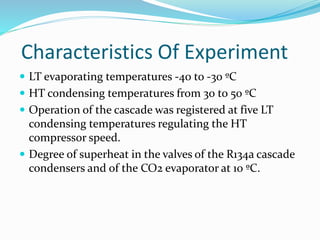
Characteristics Of Experiment
 LT evaporating temperatures -40 to -30 ºC
 HT condensing temperatures from 30 to 50 ºC
 Operation of the cascade was registered at five LT
condensing temperatures regulating the HT
compressor speed.
 Degree of superheat in the valves of the R134a cascade
condensers and of the CO2 evaporator at 10 ºC.
Observations And Conclusions..
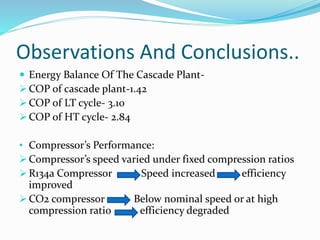
 Energy Balance Of The Cascade Plant-
 COP of cascade plant-1.42
 COP of LT cycle- 3.10
 COP of HT cycle- 2.84
• Compressor’s Performance:
 Compressor’s speed varied under fixed compression ratios
 R134a Compressor Speed increased efficiency
improved
 CO2 compressor Below nominal speed or at high
compression ratio efficiency degraded
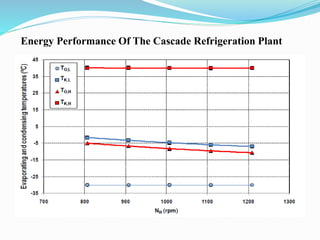
Energy Performance Of The Cascade Refrigeration Plant
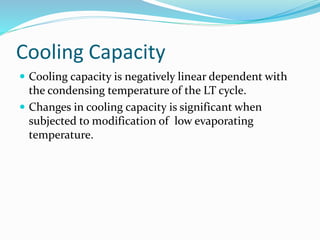
Cooling Capacity
 Cooling capacity is negatively linear dependent with
the condensing temperature of the LT cycle.
 Changes in cooling capacity is significant when
subjected to modification of low evaporating
temperature.
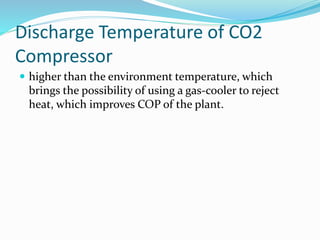
Discharge Temperature of CO2
Compressor
 higher than the environment temperature, which
brings the possibility of using a gas-cooler to reject
heat, which improves COP of the plant.
EXPERIMENTAL EVALUATION OF
A CASCADE REFRIGERATION
SYSTEM FOR LOW
TEMPERATURE APPLICATIONS
USING THE PAIR R22/R404A
Aim
 To obtain the condensing temperature of the LT that
provides an optimal value for the coefficient of
performance (COP) of the cycle.
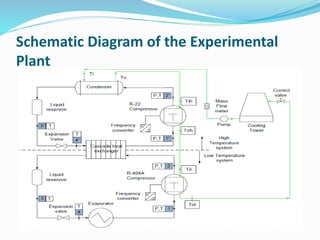
Schematic Diagram of the Experimental
Plant
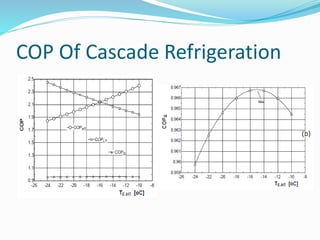
COP Of Cascade Refrigeration
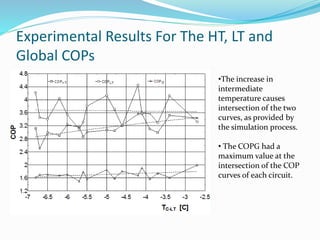
Experimental Results For The HT, LT and
Global COPs
•The increase in
intermediate
temperature causes
intersection of the two
curves, as provided by
the simulation process.
• The COPG had a
maximum value at the
intersection of the COP
curves of each circuit.
THANK YOU