MS Adila Hussain

1
A routine request, such as a request for
information, is one of the most common
kinds of writing. A request is routine when (1)
you are not asking a special favor, and (2) you
expect your request to be accepted. In a
routine request, it is not necessary to try to
persuade your reader because saying “yes” to
your request is a routine part of your reader’s
job.
•

Business orders

•

Information and action

•

Claims and adjustments

•

References and recommendations




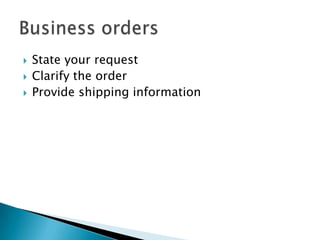
State your request
Clarify the order
Provide shipping information





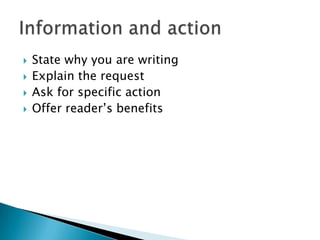
State why you are writing
Explain the request
Ask for specific action
Offer reader’s benefits




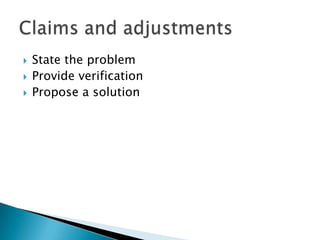
State the problem
Provide verification
Propose a solution




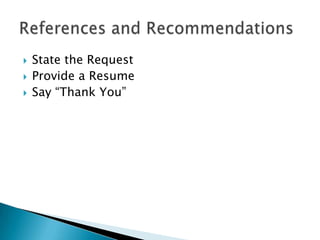
State the Request
Provide a Resume
Say “Thank You”
In business writing, a letter, memo, or email
that conveys negative or unpleasant
information--information that is likely to
disappoint, upset, or even anger a reader.
Negative

answer to routine request
Negative organizational news
Negative employment messages
Overall strategy.

Use the direct approach when the situation is
routine(between employees of the same company)
Or when you know that the reader would prefer the
bad news first.
Use the Indirect approach in all other cases.
Adopt an audience-centered tone.




Positive wording
Respectful language
The “You” attitude
Approaches
 Direct

Approach
Direct Approach is an approach in which we
express the bad news at the opening paragraph then
the explanation of bad –news and at the end there is
a courteous close .
 Indirect Approach
A Indirect Approach conventionally begins with a
neutral or positive buffer statement before
introducing the negative or unpleasant information.
This approach is called the indirect Approach.




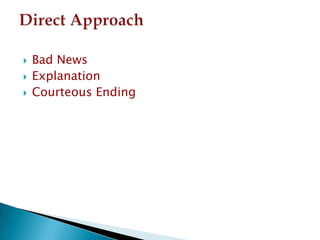
Bad News
Explanation
Courteous Ending
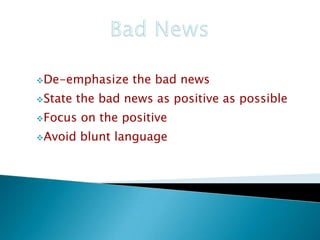
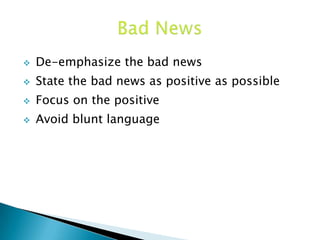
De-emphasize
State

the bad news

the bad news as positive as possible

Focus

on the positive

Avoid

blunt language
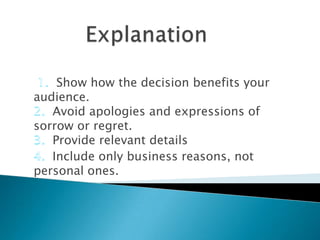
Show how the decision benefits your
audience.
Avoid apologies and expressions of
sorrow or regret.
Provide relevant details
Include only business reasons, not
personal ones.
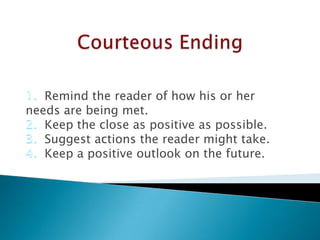
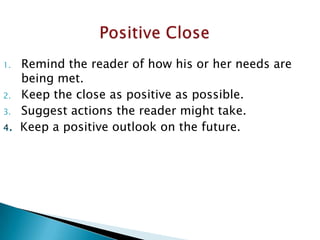
Remind the reader of how his or her
needs are being met.
Keep the close as positive as possible.
Suggest actions the reader might take.
Keep a positive outlook on the future.
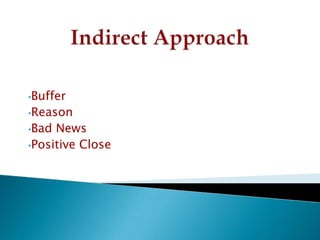
•Buffer
•Reason
•Bad

News
•Positive Close
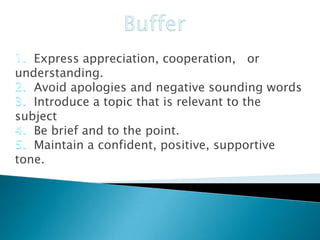
Express appreciation, cooperation, or
understanding.
Avoid apologies and negative sounding words
Introduce a topic that is relevant to the
subject
Be brief and to the point.
Maintain a confident, positive, supportive
tone.
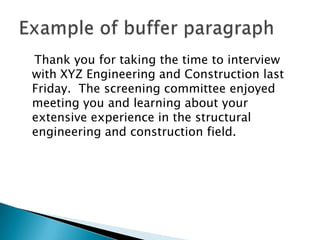
Thank you for taking the time to interview
with XYZ Engineering and Construction last
Friday. The screening committee enjoyed
meeting you and learning about your
extensive experience in the structural
engineering and construction field.
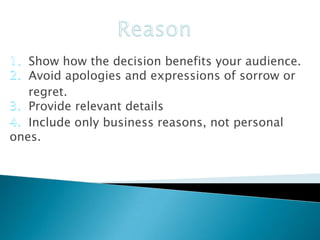
Show how the decision benefits your audience.
Avoid apologies and expressions of sorrow or
regret.
Provide relevant details
Include only business reasons, not personal
ones.


De-emphasize the bad news



State the bad news as positive as possible



Focus on the positive



Avoid blunt language
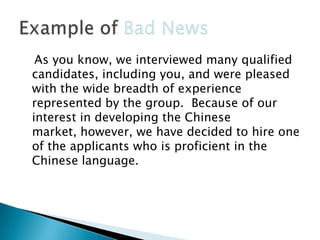
As you know, we interviewed many qualified
candidates, including you, and were pleased
with the wide breadth of experience
represented by the group. Because of our
interest in developing the Chinese
market, however, we have decided to hire one
of the applicants who is proficient in the
Chinese language.
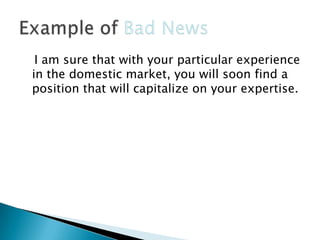
I am sure that with your particular experience
in the domestic market, you will soon find a
position that will capitalize on your expertise.
1.
2.
3.

Remind the reader of how his or her needs are
being met.
Keep the close as positive as possible.
Suggest actions the reader might take.
Keep a positive outlook on the future.
Thank you again for your interest in XYZ
Engineering and Construction. We wish you
the best in your future career.


All Rights Reserved by PUGC

Writing bad news messages

  • 1.
  • 3.
    A routine request,such as a request for information, is one of the most common kinds of writing. A request is routine when (1) you are not asking a special favor, and (2) you expect your request to be accepted. In a routine request, it is not necessary to try to persuade your reader because saying “yes” to your request is a routine part of your reader’s job.
  • 4.
    • Business orders • Information andaction • Claims and adjustments • References and recommendations
  • 5.
       State your request Clarifythe order Provide shipping information
  • 6.
        State why youare writing Explain the request Ask for specific action Offer reader’s benefits
  • 7.
       State the problem Provideverification Propose a solution
  • 8.
       State the Request Providea Resume Say “Thank You”
  • 9.
    In business writing,a letter, memo, or email that conveys negative or unpleasant information--information that is likely to disappoint, upset, or even anger a reader.
  • 10.
    Negative answer to routinerequest Negative organizational news Negative employment messages
  • 11.
    Overall strategy. Use thedirect approach when the situation is routine(between employees of the same company) Or when you know that the reader would prefer the bad news first. Use the Indirect approach in all other cases. Adopt an audience-centered tone.    Positive wording Respectful language The “You” attitude
  • 12.
    Approaches  Direct Approach Direct Approachis an approach in which we express the bad news at the opening paragraph then the explanation of bad –news and at the end there is a courteous close .  Indirect Approach A Indirect Approach conventionally begins with a neutral or positive buffer statement before introducing the negative or unpleasant information. This approach is called the indirect Approach.
  • 13.
  • 14.
    De-emphasize State the bad news thebad news as positive as possible Focus on the positive Avoid blunt language
  • 15.
    Show how thedecision benefits your audience. Avoid apologies and expressions of sorrow or regret. Provide relevant details Include only business reasons, not personal ones.
  • 16.
    Remind the readerof how his or her needs are being met. Keep the close as positive as possible. Suggest actions the reader might take. Keep a positive outlook on the future.
  • 17.
  • 18.
    Express appreciation, cooperation,or understanding. Avoid apologies and negative sounding words Introduce a topic that is relevant to the subject Be brief and to the point. Maintain a confident, positive, supportive tone.
  • 19.
    Thank you fortaking the time to interview with XYZ Engineering and Construction last Friday. The screening committee enjoyed meeting you and learning about your extensive experience in the structural engineering and construction field.
  • 20.
    Show how thedecision benefits your audience. Avoid apologies and expressions of sorrow or regret. Provide relevant details Include only business reasons, not personal ones.
  • 21.
     De-emphasize the badnews  State the bad news as positive as possible  Focus on the positive  Avoid blunt language
  • 22.
    As you know,we interviewed many qualified candidates, including you, and were pleased with the wide breadth of experience represented by the group. Because of our interest in developing the Chinese market, however, we have decided to hire one of the applicants who is proficient in the Chinese language.
  • 23.
    I am surethat with your particular experience in the domestic market, you will soon find a position that will capitalize on your expertise.
  • 24.
    1. 2. 3. Remind the readerof how his or her needs are being met. Keep the close as positive as possible. Suggest actions the reader might take. Keep a positive outlook on the future.
  • 25.
    Thank you againfor your interest in XYZ Engineering and Construction. We wish you the best in your future career.
  • 26.