
BLOCK CIPHER
AND
DATA ENCRYPTION
STANDARD

BLOCK CIPHER
A block cipher is a method of encrypting text(to produce
cipher text) in which cryptographic keys and algorithms
are applied to a block of data.
At once as a group rather than to a one bit.
 Typically, a block size of 64 or 128 bits is used.

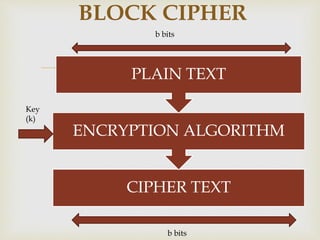
CIPHER TEXT
ENCRYPTION ALGORITHM
PLAIN TEXT
BLOCK CIPHER
b bits
b bits
Key
(k)

 A stream cipher is one that encrypts a digital data
stream one bit or one byte at a time.
 Since encryption if each digit is depend on current
state.
 Stream cipher is generally faster than block cipher.
STREAM CIPHER

Example of Stream
Cipher
Key
Stream
Plain text
Cipher text
Stream
Cipher text
Plain text
Key
(Example of stream encryption) (Example of stream decryption)

 Feistel cipher is proposed by the Claude Shannon and also
known as Feistel network.
 Feistel cipher is a symmetric structure used in the construction
of block cipher.
 Feistel cipher is iterative in nature and its internal functions
called round.
 Feistel networks are develop the concept of product cipher.
 The product cipher that combine the multiple rounds
of repeated operation, such as
Feistel Cipher

 Bit shifting(often called permutation box or P-box)
 Simple non-linear functions(often called substitution
boxes or S-box)
 Linear mixing(in the sense of modular algebra)
using Xor.
Feistel Cipher

 To produce function with large amount , Shannon
describe the Confusion and Diffusion.
 Confusion means that each character of the cipher
text should be depend on several part of the key.
 Confusion refers to making the relationship between
the cipher text and symmetric key.
Feistel Cipher

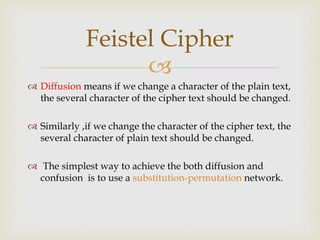
 Diffusion means if we change a character of the plain text,
the several character of the cipher text should be changed.
 Similarly ,if we change the character of the cipher text, the
several character of plain text should be changed.
 The simplest way to achieve the both diffusion and
confusion is to use a substitution-permutation network.
Feistel Cipher

 Substitution each plaintext element or group of
elements is uniquely replaced by a corresponding
cipher text element or group of elements.
 Permutation, a sequence of plaintext elements is
replaced by a permutation of that sequence.
 That is, no elements are added or deleted or replaced
in the sequence, rather the order in which the
elements appear in the sequence is changed.
Feistel Cipher

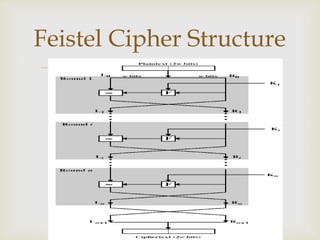
 In feistal cipher structure partitions input block into
two halves.
 The plaintext block is divided into two halves.
 The two halves of the data pass through rounds of
processing and then combine to produce the cipher
text block.
 Each round has as inputs and derived from the
previous round, as well as a sub key.
Feistel Cipher Structure

 All rounds have the same structure.
 A substitution is performed on the left half of the
data.
 This is done by applying a round function to the right
the data and the output of that function and the left
half of the data.
Cont..

Feistel Cipher Structure

 Block size: Larger block sizes mean greater security
(all other things being equal) but reduced
encryption/decryption speed for a given algorithm.
 Key size: Larger key size means greater security but
may decrease encryption/decryption speed.
 The greater security is achieved by greater resistance
to brute-force attacks and greater confusion.
Feistel Cipher Design
Principles

 Number of rounds: The essence of the Feistel cipher
is that a single round offers inadequate security but
that multiple rounds offer increasing security.
 A typical size is 16 rounds.
 Sub key generation algorithm: Greater complexity
in this algorithm should lead to greater difficulty of
cryptanalysis.
 Round function F: Again, greater complexity
generally means greater resistance to cryptanalysis.
Cont..

 The Data Encryption Standard (DES) has been the
most widely used data encryption algorithm.
 There are two main types of cryptography in use
symmetric or secret key cryptography and
asymmetric or public key cryptography.
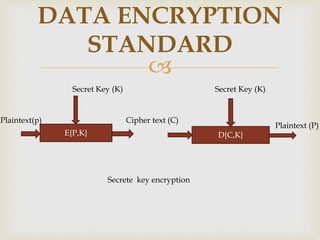
 Secret key cryptography, it involves the use of only
one key or same key which is used for both
encryption and decryption.
DATA ENCRYPTION
STANDARD

DATA ENCRYPTION
STANDARD
E{P,K} D{C,K}
Plaintext(p)
Secret Key (K)
Cipher text (C)
Secret Key (K)
Plaintext (P)
Secrete key encryption

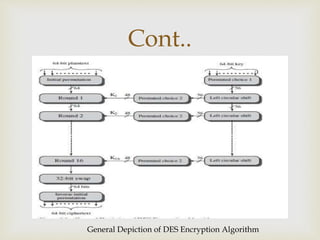
General Depiction of DES Encryption Algorithm
Cont..

 Block length is 64-bit.
 Key length is 56-bit.
 No of rounds is 16
 Each round is applied on one block cipher.
Cont..
 Substitution box(s-box) has extensively used in almost all
cryptographic algorithm, such as data encryption
standard(DES) and advance encryption standard(AES)
 S-box is basic component of symmetric key algorithm.
 The s-box provide the confusion.
 S-box is used to make the relation between the plain text
and the cipher text.
 the S-box takes m input and transform into n output bits.
 The s-box is an m*n substitution box that means we can
represent in matrix.
Substitution boxes

 PERMUTATION BOX(p-box) is a method of bit-
shuffling used to permute or transpose the bit across
s-box.
 A p-box is a permutation of all the bits.it take the
output of all the s-boxes of one round, permutes the
bits and feeds them into the s-box of the next round.
 At each round ,the round key is combined using
some group operations, typically xor.
PERMUTATION BOX

 DES (and most of the other major symmetric ciphers) is
based on a cipher known as the Feistel block cipher.
 It consists of a number of rounds where each round
contains bit-shuffling, non-linear substitutions (S-boxes)
and exclusive OR operations.
 As with most encryption schemes, DES expects two
inputs - the plaintext to be encrypted and the secret key.
Workings of DES
 The manner in which the plaintext is accepted, and the
key arrangement used for encryption and decryption,
both determine the type of cipher it is.
 DES is therefore a symmetric, 64 bit block cipher as it
uses the same key for both encryption and decryption and
only operates on 64 bit blocks of data at a time.
 The key size used is 56 bits, however a 64 bit (or eight-
byte)key is actually input.
 All blocks are numbered from left to right which makes
the eight bit
Cont..

 All blocks are numbered from left to right which
makes the eight bit
 Once a plain-text message is received to b encrypted,
it is arranged into 64 bit blocks required for input.
 If the number of bits in the message is not evenly
divisible by 64,then the last block will be padded.
Cont..


presentation based on data encryption standards

  • 1.
  • 2.
     BLOCK CIPHER A blockcipher is a method of encrypting text(to produce cipher text) in which cryptographic keys and algorithms are applied to a block of data. At once as a group rather than to a one bit.  Typically, a block size of 64 or 128 bits is used.
  • 3.
     CIPHER TEXT ENCRYPTION ALGORITHM PLAINTEXT BLOCK CIPHER b bits b bits Key (k)
  • 4.
      A streamcipher is one that encrypts a digital data stream one bit or one byte at a time.  Since encryption if each digit is depend on current state.  Stream cipher is generally faster than block cipher. STREAM CIPHER
  • 5.
     Example of Stream Cipher Key Stream Plaintext Cipher text Stream Cipher text Plain text Key (Example of stream encryption) (Example of stream decryption)
  • 6.
      Feistel cipheris proposed by the Claude Shannon and also known as Feistel network.  Feistel cipher is a symmetric structure used in the construction of block cipher.  Feistel cipher is iterative in nature and its internal functions called round.  Feistel networks are develop the concept of product cipher.  The product cipher that combine the multiple rounds of repeated operation, such as Feistel Cipher
  • 7.
      Bit shifting(oftencalled permutation box or P-box)  Simple non-linear functions(often called substitution boxes or S-box)  Linear mixing(in the sense of modular algebra) using Xor. Feistel Cipher
  • 8.
      To producefunction with large amount , Shannon describe the Confusion and Diffusion.  Confusion means that each character of the cipher text should be depend on several part of the key.  Confusion refers to making the relationship between the cipher text and symmetric key. Feistel Cipher
  • 9.
      Diffusion meansif we change a character of the plain text, the several character of the cipher text should be changed.  Similarly ,if we change the character of the cipher text, the several character of plain text should be changed.  The simplest way to achieve the both diffusion and confusion is to use a substitution-permutation network. Feistel Cipher
  • 10.
      Substitution eachplaintext element or group of elements is uniquely replaced by a corresponding cipher text element or group of elements.  Permutation, a sequence of plaintext elements is replaced by a permutation of that sequence.  That is, no elements are added or deleted or replaced in the sequence, rather the order in which the elements appear in the sequence is changed. Feistel Cipher
  • 11.
      In feistalcipher structure partitions input block into two halves.  The plaintext block is divided into two halves.  The two halves of the data pass through rounds of processing and then combine to produce the cipher text block.  Each round has as inputs and derived from the previous round, as well as a sub key. Feistel Cipher Structure
  • 12.
      All roundshave the same structure.  A substitution is performed on the left half of the data.  This is done by applying a round function to the right the data and the output of that function and the left half of the data. Cont..
  • 13.
  • 14.
      Block size:Larger block sizes mean greater security (all other things being equal) but reduced encryption/decryption speed for a given algorithm.  Key size: Larger key size means greater security but may decrease encryption/decryption speed.  The greater security is achieved by greater resistance to brute-force attacks and greater confusion. Feistel Cipher Design Principles
  • 15.
      Number ofrounds: The essence of the Feistel cipher is that a single round offers inadequate security but that multiple rounds offer increasing security.  A typical size is 16 rounds.  Sub key generation algorithm: Greater complexity in this algorithm should lead to greater difficulty of cryptanalysis.  Round function F: Again, greater complexity generally means greater resistance to cryptanalysis. Cont..
  • 16.
      The DataEncryption Standard (DES) has been the most widely used data encryption algorithm.  There are two main types of cryptography in use symmetric or secret key cryptography and asymmetric or public key cryptography.  Secret key cryptography, it involves the use of only one key or same key which is used for both encryption and decryption. DATA ENCRYPTION STANDARD
  • 17.
     DATA ENCRYPTION STANDARD E{P,K} D{C,K} Plaintext(p) SecretKey (K) Cipher text (C) Secret Key (K) Plaintext (P) Secrete key encryption
  • 18.
     General Depiction ofDES Encryption Algorithm Cont..
  • 19.
      Block lengthis 64-bit.  Key length is 56-bit.  No of rounds is 16  Each round is applied on one block cipher. Cont..
  • 20.
     Substitution box(s-box)has extensively used in almost all cryptographic algorithm, such as data encryption standard(DES) and advance encryption standard(AES)  S-box is basic component of symmetric key algorithm.  The s-box provide the confusion.  S-box is used to make the relation between the plain text and the cipher text.  the S-box takes m input and transform into n output bits.  The s-box is an m*n substitution box that means we can represent in matrix. Substitution boxes
  • 21.
      PERMUTATION BOX(p-box)is a method of bit- shuffling used to permute or transpose the bit across s-box.  A p-box is a permutation of all the bits.it take the output of all the s-boxes of one round, permutes the bits and feeds them into the s-box of the next round.  At each round ,the round key is combined using some group operations, typically xor. PERMUTATION BOX
  • 22.
      DES (andmost of the other major symmetric ciphers) is based on a cipher known as the Feistel block cipher.  It consists of a number of rounds where each round contains bit-shuffling, non-linear substitutions (S-boxes) and exclusive OR operations.  As with most encryption schemes, DES expects two inputs - the plaintext to be encrypted and the secret key. Workings of DES
  • 23.
     The mannerin which the plaintext is accepted, and the key arrangement used for encryption and decryption, both determine the type of cipher it is.  DES is therefore a symmetric, 64 bit block cipher as it uses the same key for both encryption and decryption and only operates on 64 bit blocks of data at a time.  The key size used is 56 bits, however a 64 bit (or eight- byte)key is actually input.  All blocks are numbered from left to right which makes the eight bit Cont..
  • 24.
      All blocksare numbered from left to right which makes the eight bit  Once a plain-text message is received to b encrypted, it is arranged into 64 bit blocks required for input.  If the number of bits in the message is not evenly divisible by 64,then the last block will be padded. Cont..
  • 25.