Programmable
Array Logic
By Shaurya Bahl
(21CSU189)
Contents
• Definition of Programmable Array Logic
(PAL)
• Block Diagram of PAL
• Circuit Diagram of PAL
• Comparison with other Programmable
Logic Devices
• Example of PAL
• Advantages of PAL
Definition of
Programmable
Array Logic
(PAL)
• Programmable Array Logic (PAL) is a
commonly Used programmable logic device
(PLD). It has programmable AND array and
fixed OR array.
• It is easier to use but not flexible as
compared to Programmable Logic Array
(PLA) because only the AND array is
programmable.
• The Limitation of PAL is number of AND
gates.
• PAL consists of small Programmable Read
Only Memory (PROM) and additional
output logic used to implement a particular
desired logic function with limited
components.
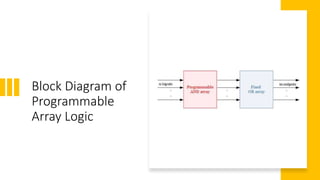
Block Diagram of
Programmable
Array Logic
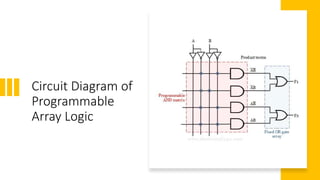
Circuit Diagram of
Programmable
Array Logic
Comparison
with other
Programmable
Logic Devices
• Main Difference between PLA, PAL and
ROM is their basic structure.
• In PLA, Programmable AND gate is followed
by programmable OR gate.
• In PAL, programmable AND gate is followed
by fixed OR gate.
• In ROM, fixed AND gate is followed by
programmable OR gate array.
Example of PAL (1 of 2)
• Example 1: Implement the Boolean functions
F1= A’BC’D + A’BCD’ + ABC’D and F2= A’BC’ +
A’BC + AB’C + ABC’ with PAL device.
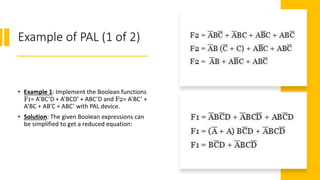
• Solution: The given Boolean expressions can
be simplified to get a reduced equation:
Example of PAL (2 of 2)
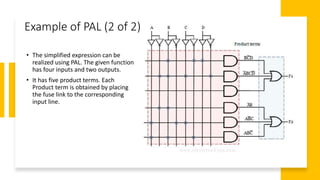
• The simplified expression can be
realized using PAL. The given function
has four inputs and two outputs.
• It has five product terms. Each
Product term is obtained by placing
the fuse link to the corresponding
input line.
Advantages of PAL
• Highly Efficient
• Low Production cost as compared to PLA
• Highly secure
• High Reliability
• Low power required for working
• More flexible to design
Thank You

Programmable Array Logic PPT by Shaurya21csu189.pptx

  • 1.
  • 2.
    Contents • Definition ofProgrammable Array Logic (PAL) • Block Diagram of PAL • Circuit Diagram of PAL • Comparison with other Programmable Logic Devices • Example of PAL • Advantages of PAL
  • 3.
    Definition of Programmable Array Logic (PAL) •Programmable Array Logic (PAL) is a commonly Used programmable logic device (PLD). It has programmable AND array and fixed OR array. • It is easier to use but not flexible as compared to Programmable Logic Array (PLA) because only the AND array is programmable. • The Limitation of PAL is number of AND gates. • PAL consists of small Programmable Read Only Memory (PROM) and additional output logic used to implement a particular desired logic function with limited components.
  • 4.
  • 5.
  • 6.
    Comparison with other Programmable Logic Devices •Main Difference between PLA, PAL and ROM is their basic structure. • In PLA, Programmable AND gate is followed by programmable OR gate. • In PAL, programmable AND gate is followed by fixed OR gate. • In ROM, fixed AND gate is followed by programmable OR gate array.
  • 7.
    Example of PAL(1 of 2) • Example 1: Implement the Boolean functions F1= A’BC’D + A’BCD’ + ABC’D and F2= A’BC’ + A’BC + AB’C + ABC’ with PAL device. • Solution: The given Boolean expressions can be simplified to get a reduced equation:
  • 8.
    Example of PAL(2 of 2) • The simplified expression can be realized using PAL. The given function has four inputs and two outputs. • It has five product terms. Each Product term is obtained by placing the fuse link to the corresponding input line.
  • 9.
    Advantages of PAL •Highly Efficient • Low Production cost as compared to PLA • Highly secure • High Reliability • Low power required for working • More flexible to design
  • 10.