4 Creative Critical
Reflection
How did you use integrate technology- software, hardware, online in
this project?
By Georgie Clements
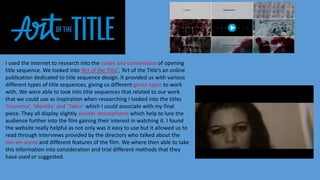
I used the internet to research into the codes and conventions of opening
title sequence. We looked into ‘Art of the Title’, ‘Art of the Title’s an online
publication dedicated to title sequence design. It provided us with various
different types of title sequences, giving us different genre types to work
with. We were able to look into title sequences that related to our work
that we could use as inspiration when researching I looked into the titles
‘lnsomnia’, ‘Identity’ and ‘Taken’ which I could associate with my final
piece. They all display slightly sinister atmospheres which help to lure the
audience further into the film gaining their interest in watching it. I found
the website really helpful as not only was it easy to use but it allowed us to
read through interviews provided by the directors who talked about the
mis-en-scene and different features of the film. We where then able to take
this information into consideration and trial different methods that they
have used or suggested.
Netflix is an American media service which streams online films, TV shows,
documentaries and other genres. When researching, I used ‘Netflix’ to
broaden our interpretations of different types of style in the genre:
Psychological thriller. I watched many thriller openings to collate a broad
understand of all the different ways we could introduce our film.
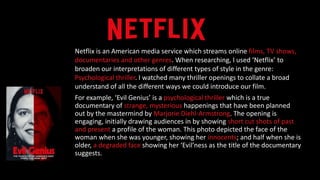
For example, ‘Evil Genius’ is a psychological thriller which is a true
documentary of strange, mysterious happenings that have been planned
out by the mastermind by Marjorie Diehl-Armstrong. The opening is
engaging, initially drawing audiences in by showing short cut shots of past
and present a profile of the woman. This photo depicted the face of the
woman when she was younger, showing her innocents; and half when she is
older, a degraded face showing her ‘Evil’ness as the title of the documentary
suggests.
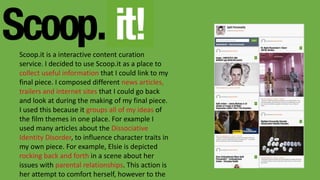
Scoop.it is a interactive content curation
service. I decided to use Scoop.it as a place to
collect useful information that I could link to my
final piece. I composed different news articles,
trailers and internet sites that I could go back
and look at during the making of my final piece.
I used this because it groups all of my ideas of
the film themes in one place. For example I
used many articles about the Dissociative
Identity Disorder, to influence character traits in
my own piece. For example, Elsie is depicted
rocking back and forth in a scene about her
issues with parental relationships. This action is
her attempt to comfort herself, however to the
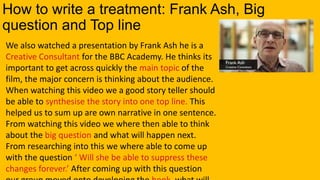
How to write a treatment: Frank Ash, Big
question and Top line
We also watched a presentation by Frank Ash he is a
Creative Consultant for the BBC Academy. He thinks its
important to get across quickly the main topic of the
film, the major concern is thinking about the audience.
When watching this video we a good story teller should
be able to synthesise the story into one top line. This
helped us to sum up are own narrative in one sentence.
From watching this video we where then able to think
about the big question and what will happen next.
From researching into this we where able to come up
with the question ‘ Will she be able to suppress these
changes forever.’ After coming up with this question
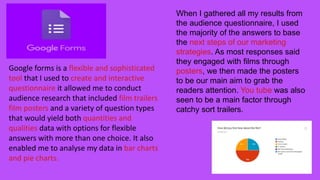
When I gathered all my results from
the audience questionnaire, I used
the majority of the answers to base
the next steps of our marketing
strategies. As most responses said
they engaged with films through
posters, we then made the posters
to be our main aim to grab the
readers attention. You tube was also
seen to be a main factor through
catchy sort trailers.
Google forms is a flexible and sophisticated
tool that I used to create and interactive
questionnaire it allowed me to conduct
audience research that included film trailers
film posters and a variety of question types
that would yield both quantities and
qualities data with options for flexible
answers with more than one choice. It also
enabled me to analyse my data in bar charts
and pie charts.
Piktochart is a web-based infographic application
which allows users without intensive experience as
graphic designers to easily create infographics and
visuals using themed templates.
Piktochart is an easy way to present our social
media platforms. This draws in our audience through
a variety of social media, engaging different types of
audiences.
In Matt Smith’s (a marketer for Lion Gate) video
presentation on his FDA website, he stressed that
film marketing had increased spending on social
media platforms to reach younger audiences who
are permanently online. Therefore, we have created
a set of social media presences for our film
‘Fractures’ including Facebook, Twitter and
Instagram.
YouTube was another website that I used to collect knowledge
which helped me to develop my piece. This was due to the
large variety of material that helped me in many different
aspects. YouTube is an American video-sharing website,
headquartered in San Bruno, California. We used it to
research film making & editing, such as Every Frame a Painting
and Creative Editing Techniques. This opened us up to
thinking more about our frame and where we place things
within it and the different camera angles that we are looking
to incorporate into our piece. By watching ‘Every Frame a
Painting’s’ video we where able to see how important the
placing of subjects in a frame is and how it can additional add
more to what could just be a simple frame.
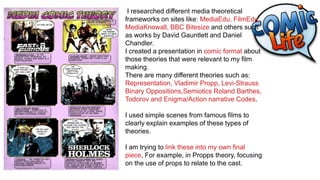
I researched different media theoretical
frameworks on sites like: MediaEdu, FilmEdu,
MediaKnowall, BBC Bitesize and others such
as works by David Gauntlett and Daniel
Chandler.
I created a presentation in comic format about
those theories that were relevant to my film
making.
There are many different theories such as:
Representation, Vladimir Propp, Levi-Strauss
Binary Oppositions,Semiotics Roland Barthes,
Todorov and Enigma/Action narrative Codes.
I used simple scenes from famous films to
clearly explain examples of these types of
theories.
I am trying to link these into my own final
piece, For example, in Propps theory, focusing
on the use of props to relate to the cast.
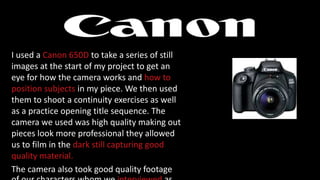
I used a Canon 650D to take a series of still
images at the start of my project to get an
eye for how the camera works and how to
position subjects in my piece. We then used
them to shoot a continuity exercises as well
as a practice opening title sequence. The
camera we used was high quality making out
pieces look more professional they allowed
us to film in the dark still capturing good
quality material.
The camera also took good quality footage
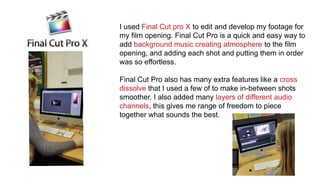
I used Final Cut pro X to edit and develop my footage for
my film opening. Final Cut Pro is a quick and easy way to
add background music creating atmosphere to the film
opening, and adding each shot and putting them in order
was so effortless.
Final Cut Pro also has many extra features like a cross
dissolve that I used a few of to make in-between shots
smoother. I also added many layers of different audio
channels, this gives me range of freedom to piece
together what sounds the best.
I used Google maps and Word Document to
construct my call Sheet, Risk Assessment
and a Shot List. All of these documents
were done before filming giving a
precise idea of our opening filming.
Our shot list is very detailed including props, location and the actors in the scene.
Knowing this detail before filming gives us a clear vision and it hugely helped us when it
came down to filming. We filmed most of the shots in one evening due to this shot list
because we knew what was needed.
We then did a simple, call sheet. This shows our location, cast, date, props and our
costume. It is an easy way to see our simple accessories to our production.
We also created a risk assessment, within this we depicted all the risks that could be
possible. This is important to show that we are cautious of the film setting to make sure
no accidents occur.
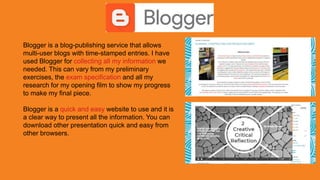
Blogger is a blog-publishing service that allows
multi-user blogs with time-stamped entries. I have
used Blogger for collecting all my information we
needed. This can vary from my preliminary
exercises, the exam specification and all my
research for my opening film to show my progress
to make my final piece.
Blogger is a quick and easy website to use and it is
a clear way to present all the information. You can
download other presentation quick and easy from
other browsers.
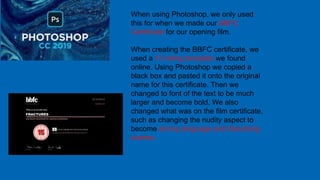
When using Photoshop, we only used
this for when we made our BBFC
Certificate for our opening film.
When creating the BBFC certificate, we
used a 15 rating template we found
online. Using Photoshop we copied a
black box and pasted it onto the original
name for this certificate. Then we
changed to font of the text to be much
larger and become bold. We also
changed what was on the film certificate,
such as changing the nudity aspect to
become strong language and disturbing
scenes.
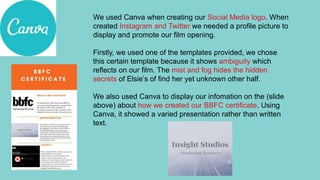
We used Canva when creating our Social Media logo. When
created Instagram and Twitter we needed a profile picture to
display and promote our film opening.
Firstly, we used one of the templates provided, we chose
this certain template because it shows ambiguity which
reflects on our film. The mist and fog hides the hidden
secrets of Elsie’s of find her yet unknown other half.
We also used Canva to display our infomation on the (slide
above) about how we created our BBFC certificate. Using
Canva, it showed a varied presentation rather than written
text.

4 Creative Critical Reflection

  • 1.
    4 Creative Critical Reflection Howdid you use integrate technology- software, hardware, online in this project? By Georgie Clements
  • 2.
    I used theinternet to research into the codes and conventions of opening title sequence. We looked into ‘Art of the Title’, ‘Art of the Title’s an online publication dedicated to title sequence design. It provided us with various different types of title sequences, giving us different genre types to work with. We were able to look into title sequences that related to our work that we could use as inspiration when researching I looked into the titles ‘lnsomnia’, ‘Identity’ and ‘Taken’ which I could associate with my final piece. They all display slightly sinister atmospheres which help to lure the audience further into the film gaining their interest in watching it. I found the website really helpful as not only was it easy to use but it allowed us to read through interviews provided by the directors who talked about the mis-en-scene and different features of the film. We where then able to take this information into consideration and trial different methods that they have used or suggested.
  • 3.
    Netflix is anAmerican media service which streams online films, TV shows, documentaries and other genres. When researching, I used ‘Netflix’ to broaden our interpretations of different types of style in the genre: Psychological thriller. I watched many thriller openings to collate a broad understand of all the different ways we could introduce our film. For example, ‘Evil Genius’ is a psychological thriller which is a true documentary of strange, mysterious happenings that have been planned out by the mastermind by Marjorie Diehl-Armstrong. The opening is engaging, initially drawing audiences in by showing short cut shots of past and present a profile of the woman. This photo depicted the face of the woman when she was younger, showing her innocents; and half when she is older, a degraded face showing her ‘Evil’ness as the title of the documentary suggests.
  • 4.
    Scoop.it is ainteractive content curation service. I decided to use Scoop.it as a place to collect useful information that I could link to my final piece. I composed different news articles, trailers and internet sites that I could go back and look at during the making of my final piece. I used this because it groups all of my ideas of the film themes in one place. For example I used many articles about the Dissociative Identity Disorder, to influence character traits in my own piece. For example, Elsie is depicted rocking back and forth in a scene about her issues with parental relationships. This action is her attempt to comfort herself, however to the
  • 5.
    How to writea treatment: Frank Ash, Big question and Top line We also watched a presentation by Frank Ash he is a Creative Consultant for the BBC Academy. He thinks its important to get across quickly the main topic of the film, the major concern is thinking about the audience. When watching this video we a good story teller should be able to synthesise the story into one top line. This helped us to sum up are own narrative in one sentence. From watching this video we where then able to think about the big question and what will happen next. From researching into this we where able to come up with the question ‘ Will she be able to suppress these changes forever.’ After coming up with this question
  • 6.
    When I gatheredall my results from the audience questionnaire, I used the majority of the answers to base the next steps of our marketing strategies. As most responses said they engaged with films through posters, we then made the posters to be our main aim to grab the readers attention. You tube was also seen to be a main factor through catchy sort trailers. Google forms is a flexible and sophisticated tool that I used to create and interactive questionnaire it allowed me to conduct audience research that included film trailers film posters and a variety of question types that would yield both quantities and qualities data with options for flexible answers with more than one choice. It also enabled me to analyse my data in bar charts and pie charts.
  • 7.
    Piktochart is aweb-based infographic application which allows users without intensive experience as graphic designers to easily create infographics and visuals using themed templates. Piktochart is an easy way to present our social media platforms. This draws in our audience through a variety of social media, engaging different types of audiences. In Matt Smith’s (a marketer for Lion Gate) video presentation on his FDA website, he stressed that film marketing had increased spending on social media platforms to reach younger audiences who are permanently online. Therefore, we have created a set of social media presences for our film ‘Fractures’ including Facebook, Twitter and Instagram.
  • 8.
    YouTube was anotherwebsite that I used to collect knowledge which helped me to develop my piece. This was due to the large variety of material that helped me in many different aspects. YouTube is an American video-sharing website, headquartered in San Bruno, California. We used it to research film making & editing, such as Every Frame a Painting and Creative Editing Techniques. This opened us up to thinking more about our frame and where we place things within it and the different camera angles that we are looking to incorporate into our piece. By watching ‘Every Frame a Painting’s’ video we where able to see how important the placing of subjects in a frame is and how it can additional add more to what could just be a simple frame.
  • 9.
    I researched differentmedia theoretical frameworks on sites like: MediaEdu, FilmEdu, MediaKnowall, BBC Bitesize and others such as works by David Gauntlett and Daniel Chandler. I created a presentation in comic format about those theories that were relevant to my film making. There are many different theories such as: Representation, Vladimir Propp, Levi-Strauss Binary Oppositions,Semiotics Roland Barthes, Todorov and Enigma/Action narrative Codes. I used simple scenes from famous films to clearly explain examples of these types of theories. I am trying to link these into my own final piece, For example, in Propps theory, focusing on the use of props to relate to the cast.
  • 10.
    I used aCanon 650D to take a series of still images at the start of my project to get an eye for how the camera works and how to position subjects in my piece. We then used them to shoot a continuity exercises as well as a practice opening title sequence. The camera we used was high quality making out pieces look more professional they allowed us to film in the dark still capturing good quality material. The camera also took good quality footage
  • 11.
    I used FinalCut pro X to edit and develop my footage for my film opening. Final Cut Pro is a quick and easy way to add background music creating atmosphere to the film opening, and adding each shot and putting them in order was so effortless. Final Cut Pro also has many extra features like a cross dissolve that I used a few of to make in-between shots smoother. I also added many layers of different audio channels, this gives me range of freedom to piece together what sounds the best.
  • 12.
    I used Googlemaps and Word Document to construct my call Sheet, Risk Assessment and a Shot List. All of these documents were done before filming giving a precise idea of our opening filming. Our shot list is very detailed including props, location and the actors in the scene. Knowing this detail before filming gives us a clear vision and it hugely helped us when it came down to filming. We filmed most of the shots in one evening due to this shot list because we knew what was needed. We then did a simple, call sheet. This shows our location, cast, date, props and our costume. It is an easy way to see our simple accessories to our production. We also created a risk assessment, within this we depicted all the risks that could be possible. This is important to show that we are cautious of the film setting to make sure no accidents occur.
  • 13.
    Blogger is ablog-publishing service that allows multi-user blogs with time-stamped entries. I have used Blogger for collecting all my information we needed. This can vary from my preliminary exercises, the exam specification and all my research for my opening film to show my progress to make my final piece. Blogger is a quick and easy website to use and it is a clear way to present all the information. You can download other presentation quick and easy from other browsers.
  • 14.
    When using Photoshop,we only used this for when we made our BBFC Certificate for our opening film. When creating the BBFC certificate, we used a 15 rating template we found online. Using Photoshop we copied a black box and pasted it onto the original name for this certificate. Then we changed to font of the text to be much larger and become bold. We also changed what was on the film certificate, such as changing the nudity aspect to become strong language and disturbing scenes.
  • 15.
    We used Canvawhen creating our Social Media logo. When created Instagram and Twitter we needed a profile picture to display and promote our film opening. Firstly, we used one of the templates provided, we chose this certain template because it shows ambiguity which reflects on our film. The mist and fog hides the hidden secrets of Elsie’s of find her yet unknown other half. We also used Canva to display our infomation on the (slide above) about how we created our BBFC certificate. Using Canva, it showed a varied presentation rather than written text.