Biological Compounds
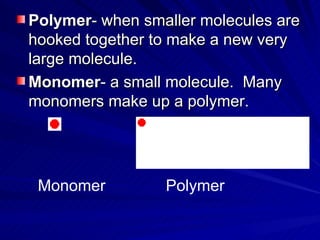
Polymer - when smaller molecules are hooked together to make a new very large molecule. Monomer - a small molecule.  Many monomers make up a polymer. Monomer Polymer
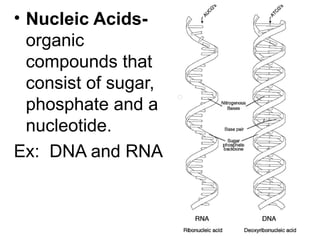
Nucleic Acids-  organic compounds that consist of sugar, phosphate and a nucleotide. Ex:  DNA and RNA
 
Nucleotides
Protein - large organic polymer formed by many organic monomers called amino acids.  All proteins contain an amine group (NH 2 ) and a carboxyl group.  These groups combine together to make a peptide.  The bond between them is called a peptide bond.
Carboxyl group Amine group Peptide  Peptide Bond Making of Protein
Carbohydrates - organic compounds that consist of carbon, oxygen and hydrogen.  There are 2 times as many hydrogens than carbon and oxygen. Ex:  C 6 H 12 O 6 Glucose  1:2:1
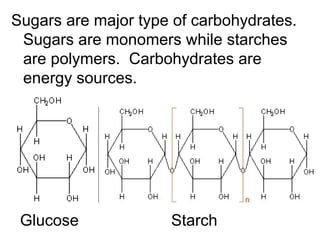
Sugars are major type of carbohydrates.  Sugars are monomers while starches are polymers.  Carbohydrates are energy sources. Glucose Starch
How Glucose is Formed
Lipid - organic compound that consist of carbon, oxygen, and hydrogen.  Does not have a 1:2:1 ratio.
Lipids include fats and oils.  They are made up of the same way but different because fats are solids and oils are liquid. Fat-Lard   Oil
Triglycerides
Steroids are also considered a lipid.  Steroids include cholesterol, estrogen, progesterone, testosterone, cortisone and Vitamin D.   Cholesterol


3 biological compounds

  • 1.
  • 2.
    Polymer - whensmaller molecules are hooked together to make a new very large molecule. Monomer - a small molecule. Many monomers make up a polymer. Monomer Polymer
  • 3.
    Nucleic Acids- organic compounds that consist of sugar, phosphate and a nucleotide. Ex: DNA and RNA
  • 4.
  • 5.
  • 6.
    Protein - largeorganic polymer formed by many organic monomers called amino acids. All proteins contain an amine group (NH 2 ) and a carboxyl group. These groups combine together to make a peptide. The bond between them is called a peptide bond.
  • 7.
    Carboxyl group Aminegroup Peptide Peptide Bond Making of Protein
  • 8.
    Carbohydrates - organiccompounds that consist of carbon, oxygen and hydrogen. There are 2 times as many hydrogens than carbon and oxygen. Ex: C 6 H 12 O 6 Glucose 1:2:1
  • 9.
    Sugars are majortype of carbohydrates. Sugars are monomers while starches are polymers. Carbohydrates are energy sources. Glucose Starch
  • 10.
  • 11.
    Lipid - organiccompound that consist of carbon, oxygen, and hydrogen. Does not have a 1:2:1 ratio.
  • 12.
    Lipids include fatsand oils. They are made up of the same way but different because fats are solids and oils are liquid. Fat-Lard Oil
  • 13.
  • 14.
    Steroids are alsoconsidered a lipid. Steroids include cholesterol, estrogen, progesterone, testosterone, cortisone and Vitamin D. Cholesterol
  • 15.
  • 16.
  • 17.