Organic Compounds and
Macromolecules
Comprehensive Study Material
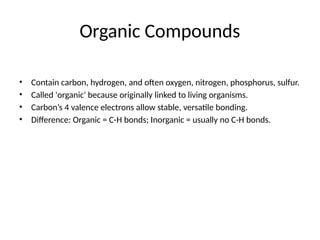
Organic Compounds
• Contain carbon, hydrogen, and often oxygen, nitrogen, phosphorus, sulfur.
• Called 'organic' because originally linked to living organisms.
• Carbon’s 4 valence electrons allow stable, versatile bonding.
• Difference: Organic = C-H bonds; Inorganic = usually no C-H bonds.
Macromolecules
• Macromolecules = 'large molecules' built from monomers.
• Monomers join via dehydration synthesis → polymers.
• Polymers broken by hydrolysis.
• 4 major types: Carbohydrates, Lipids, Proteins, Nucleic Acids.
Carbohydrates
• Made of C, H, O in 1:2:1 ratio.
• Monomer: monosaccharide (glucose, fructose, galactose).
• Disaccharides: sucrose, lactose, maltose.
• Polysaccharides: starch, glycogen, cellulose, chitin.
• Functions: energy (ATP), storage, structure, cell signaling.
Lipids
• Hydrophobic molecules made of C, H, (little O).
• Not true polymers, but built from glycerol + fatty acids.
• Triglycerides, phospholipids, steroids, waxes.
• Saturated = solid fats; Unsaturated = oils.
• Functions: long-term energy, membranes, insulation, hormones.
Proteins
• Composed of amino acids (20 types).
• Levels of structure: Primary, Secondary, Tertiary, Quaternary.
• Functions: structure (collagen, keratin), enzymes, transport, hormones,
antibodies.
• Peptide bonds join amino acids.
Nucleic Acids
• Monomer: nucleotide (sugar + phosphate + base).
• DNA: deoxyribonucleic acid — deoxyribose sugar, double helix, A-T, G-C
pairing.
• RNA: ribonucleic acid — ribose sugar, U replaces T, single-stranded.
• DNA stores genetic info; RNA carries out protein synthesis.
DNA Storage and Organization
• DNA in eukaryotes stored in nucleus.
• Wrapped around histone proteins → nucleosomes → chromatin.
• Condenses into chromosomes during cell division.
• Mitochondria & chloroplasts have circular DNA.
Nitrogenous Bases
• Purines: Adenine (A), Guanine (G).
• Pyrimidines: Cytosine (C), Thymine (T), Uracil (U).
• DNA base pairs: A-T, G-C.
• RNA base pairs: A-U, G-C.
Summary
• Organic compounds = foundation of life.
• Carbohydrates: quick energy + structure.
• Lipids: long-term energy + membranes.
• Proteins: versatile functions in structure, enzymes, defense.
• Nucleic acids: genetic information storage and transfer.
Organic_Compounds_Macromolecules_chem.pptx

  • 1.
  • 2.
    Organic Compounds • Containcarbon, hydrogen, and often oxygen, nitrogen, phosphorus, sulfur. • Called 'organic' because originally linked to living organisms. • Carbon’s 4 valence electrons allow stable, versatile bonding. • Difference: Organic = C-H bonds; Inorganic = usually no C-H bonds.
  • 3.
    Macromolecules • Macromolecules ='large molecules' built from monomers. • Monomers join via dehydration synthesis → polymers. • Polymers broken by hydrolysis. • 4 major types: Carbohydrates, Lipids, Proteins, Nucleic Acids.
  • 4.
    Carbohydrates • Made ofC, H, O in 1:2:1 ratio. • Monomer: monosaccharide (glucose, fructose, galactose). • Disaccharides: sucrose, lactose, maltose. • Polysaccharides: starch, glycogen, cellulose, chitin. • Functions: energy (ATP), storage, structure, cell signaling.
  • 5.
    Lipids • Hydrophobic moleculesmade of C, H, (little O). • Not true polymers, but built from glycerol + fatty acids. • Triglycerides, phospholipids, steroids, waxes. • Saturated = solid fats; Unsaturated = oils. • Functions: long-term energy, membranes, insulation, hormones.
  • 6.
    Proteins • Composed ofamino acids (20 types). • Levels of structure: Primary, Secondary, Tertiary, Quaternary. • Functions: structure (collagen, keratin), enzymes, transport, hormones, antibodies. • Peptide bonds join amino acids.
  • 7.
    Nucleic Acids • Monomer:nucleotide (sugar + phosphate + base). • DNA: deoxyribonucleic acid — deoxyribose sugar, double helix, A-T, G-C pairing. • RNA: ribonucleic acid — ribose sugar, U replaces T, single-stranded. • DNA stores genetic info; RNA carries out protein synthesis.
  • 8.
    DNA Storage andOrganization • DNA in eukaryotes stored in nucleus. • Wrapped around histone proteins → nucleosomes → chromatin. • Condenses into chromosomes during cell division. • Mitochondria & chloroplasts have circular DNA.
  • 9.
    Nitrogenous Bases • Purines:Adenine (A), Guanine (G). • Pyrimidines: Cytosine (C), Thymine (T), Uracil (U). • DNA base pairs: A-T, G-C. • RNA base pairs: A-U, G-C.
  • 10.
    Summary • Organic compounds= foundation of life. • Carbohydrates: quick energy + structure. • Lipids: long-term energy + membranes. • Proteins: versatile functions in structure, enzymes, defense. • Nucleic acids: genetic information storage and transfer.