Behavioral communication
“We cannot solve our problems with
the same thinking we used when we
created them”
-Albert Einstein
Behavioral Communication is a psychological
construct that addresses people's use of day-
to-day behaviors as a form of communication.
Specifically, it refers to people's tendency to
express feelings, needs, and thoughts by
means of indirect messages and behavioral
impacts.
• Basically, any behavior (or its absence when
one is expected) may be judged as
communicative if it has the intent to convey a
message.
• For example, an expressive hairstyle, a show
of a certain emotion, stonewalling (emotional
withdrawal), or simply doing (or not doing)
the dishes all can be means by which people
may convey messages to each other.
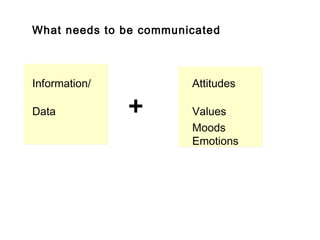
What needs to be communicated
Information/ Attitudes
Data + Values
Moods
Emotions
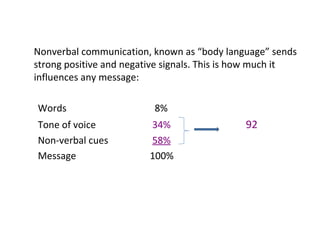
Nonverbal communication, known as “body language” sends
strong positive and negative signals. This is how much it
influences any message:
Words 8%
Tone of voice 34% 92
Non-verbal cues 58%
Message 100%
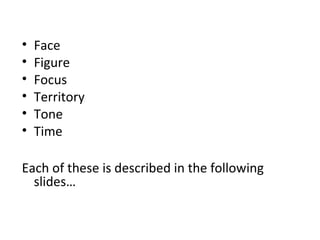
• Face
• Figure
• Focus
• Territory
• Tone
• Time
Each of these is described in the following
slides…
Face includes:
– Your expressions
– Your smile or lack thereof
– Tilt of the head; e.g., if your head is tilted to one
side, it usually indicates you are interested in what
someone is saying
What message are you sending if someone is presenting
a new idea and you are frowning?
• Figure includes:
– Your posture
– Your demeanor and gestures
– Your clothes and accessories such as jewelry
What message are you sending if you are dressed casually at
an important meeting?
• Focus is your eye contact with others
• The perception of eye contact differs by culture. For most
Americans…
– Staring makes other people uncomfortable
– Lack of eye contact can make you appear weak or not
trustworthy
– Glasses may interfere or enhance eye contact
What message are you sending if you are looking at other
things and people in a room when someone is speaking to
you?
• Territory focuses on how you use space. It is also called
proxemics.
• The perception of territory differs by culture. Most Americans
are comfortable with an individual space that is about an
arm’s length in diameter
What message are you sending if you keep moving closer to
a person who is backing away from you?
• Tone is a factor of your voice
– Pitch is the highness or lowness of voice
– Volume is how loud your voice is
– What message are you sending if during a disagreement
you start speaking very loudly?
• Time focuses on how you use time. It is also called
chronemics.
– Pace is how quickly you speak
– Response is how quickly you move
– Punctuality is your timeliness
What message are you sending if you are consistently late
for meetings?
BEHAVIORAL COMMUNICATION
• People are always communicating
• The meaning intended by the sender is never
exactly the message gotten by the receiver
• We can help to overcome barriers to
communication by being aware of them
• Verbal and non-verbal communication is
important in sending our messages
The construct of behavioral communication is
conceived as a variable of
Individual differences.
This means that some people more than
others tend to engage in behavioral
communication in spite of the plausible
alternatives of using verbal communication.
• BEHAVIORAL COMMUNICATION
• Understanding the forces that bring people together and keep them
together and those that divide and separate them.
• Our communication behavior is the very life blood of our relationship.
• How communication behavior affects our relationship ? OR vice versa
• Environment where the relationship develops can affect the way we
communicate.
• All our communication takes place within the context of some type of
relationships..
• Relationship expectations change as a result of communication behavior
and communication behavior changes as a result of relationship
expectations
BEHAVIORAL COMMUNICATION
• People are drawn to each other for many reasons
• Impulse to receive information / knowledge
• Impulse to express experiences
• Impulse to learn more about oneself
• Impulse to enhance enjoyment of certain activities
• Impulse to reduce uncertainties
What we see in others and how we perceive
them may be influenced by a host of factors-
• Our own cultural , educational and personal
background
• Our own needs, desires and emotional states
• The way we choose to overtly describe covert
feelings and impressions
• Method of self presentation used by others
• Conditions most likely to provide basis for
attraction
• Proximity
• Physical attractiveness
• Similarities of attitudes and beliefs
• Personal rewards derived from the other
persons
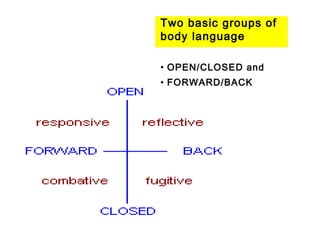
Two basic groups of
body language
• OPEN/CLOSED and
• FORWARD/BACK
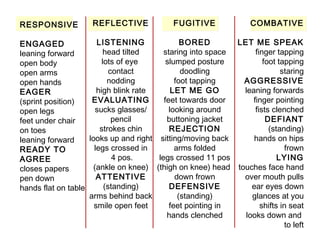
RESPONSIVE
ENGAGED
leaning forward
open body
open arms
open hands
EAGER
(sprint position)
open legs
feet under chair
on toes
leaning forward
READY TO
AGREE
closes papers
pen down
hands flat on table
REFLECTIVE
LISTENING
head tilted
lots of eye
contact
nodding
high blink rate
EVALUATING
sucks glasses/
pencil
strokes chin
looks up and right
legs crossed in
4 pos.
(ankle on knee)
ATTENTIVE
(standing)
arms behind back
smile open feet
FUGITIVE
BORED
staring into space
slumped posture
doodling
foot tapping
LET ME GO
feet towards door
looking around
buttoning jacket
REJECTION
sitting/moving back
arms folded
legs crossed 11 pos
(thigh on knee) head
down frown
DEFENSIVE
(standing)
feet pointing in
hands clenched
COMBATIVE
LET ME SPEAK
finger tapping
foot tapping
staring
AGGRESSIVE
leaning forwards
finger pointing
fists clenched
DEFIANT
(standing)
hands on hips
frown
LYING
touches face hand
over mouth pulls
ear eyes down
glances at you
shifts in seat
looks down and
to left
DIFFERENT TYPES
OFCOMMUNICATION BEHAVIOUR
• There are a variety of ways of behaving when we are
communicating with others.
• The appropriate choice of behaviour is vitally
important if we are to communicate effectively.
• There are 4 different types of behaviour:-
• Aggressive
• Submissive
• Avoidance
• Assertive
DIFFERENT TYPES OFCOMMUNICATION
BEHAVIOUR
• Aggressive behaviour –
offends or isolates someone else’s rights. It is a
showing, perhaps both physically and verbally, of
anger or dominance. It can be an automatic
reaction or a one-off reaction to a particularly
sensitive or threatening situation.
Aggression can sometimes be an expression of
fear, lack of self-esteem, or inability to control a
situation in any other way. Aggression places the
rights of the aggressor above the rights of the
other party and avoids responsibility.
• Avoidance behaviour-
is sometimes used to evade any confrontation. It
ignores the isolation of rights and responsibilities
through fear of the consequences or because you
don’t wish to be bothered with the consequences.
People can become very adept at avoiding
uncomfortable situations, either through refusal to
recognize the problem or by deliberately side stepping
confrontational situations. Avoidance can be displayed
in many ways -refusing to get a diagnostic test, not
answering the phone to certain people or avoiding
socialising in a certain place. Quite elaborate plans can
be devised to avoid a situation.
lets you reduce anxiety, guilt or fear by letting your views or thoughts be
misconstrued, ignored or lets you be taken advantage of. We often have this type of
behaviour instilled in us from parents, schools and hierarchical organisations. We often
experience an immediate pleasant effect from pleasing others and not rocking the
boat as we see it. This type of behaviour is often shown in not wanting to say no to
unreasonable requests, not wanting to draw attention to yourself, a belief that you are
not as good as others, wanting to appear polite and helpful in an excessive way, or
wanting to avoid a scene.
Submissive behaviour often leads to a build up of resentment which can show itself in
loss of self-esteem or an eventual aggressive outburst.
Submissive or accommodating behaviour-
Assertive Behaviour-
Many may associate the word with aggression or manipulation –a
method of getting what you want at the expense of others. There
are many issues revolving around sexual stereotyping when we
think of assertion. Men behaving assertively are thought to be in
control and masterful -women behaving assertively are thought of
as being aggressive, domineering or bossy! Assertive behaviour is
often thought of as a Win-Win situation where both parties in the
communication process benefit from increased effectiveness.
Assertive behaviour means stating your own feelings whilst
acknowledging the other persons point of view. It involves clear
and steady communication, standing up for your rights and beliefs,
whilst looking for ways to resolve possible problems.

2e45b bcrm 2013 1

  • 1.
    Behavioral communication “We cannotsolve our problems with the same thinking we used when we created them” -Albert Einstein
  • 2.
    Behavioral Communication isa psychological construct that addresses people's use of day- to-day behaviors as a form of communication. Specifically, it refers to people's tendency to express feelings, needs, and thoughts by means of indirect messages and behavioral impacts.
  • 3.
    • Basically, anybehavior (or its absence when one is expected) may be judged as communicative if it has the intent to convey a message.
  • 4.
    • For example,an expressive hairstyle, a show of a certain emotion, stonewalling (emotional withdrawal), or simply doing (or not doing) the dishes all can be means by which people may convey messages to each other.
  • 5.
    What needs tobe communicated Information/ Attitudes Data + Values Moods Emotions
  • 6.
    Nonverbal communication, knownas “body language” sends strong positive and negative signals. This is how much it influences any message: Words 8% Tone of voice 34% 92 Non-verbal cues 58% Message 100%
  • 7.
    • Face • Figure •Focus • Territory • Tone • Time Each of these is described in the following slides…
  • 8.
    Face includes: – Yourexpressions – Your smile or lack thereof – Tilt of the head; e.g., if your head is tilted to one side, it usually indicates you are interested in what someone is saying What message are you sending if someone is presenting a new idea and you are frowning?
  • 9.
    • Figure includes: –Your posture – Your demeanor and gestures – Your clothes and accessories such as jewelry What message are you sending if you are dressed casually at an important meeting?
  • 10.
    • Focus isyour eye contact with others • The perception of eye contact differs by culture. For most Americans… – Staring makes other people uncomfortable – Lack of eye contact can make you appear weak or not trustworthy – Glasses may interfere or enhance eye contact What message are you sending if you are looking at other things and people in a room when someone is speaking to you?
  • 11.
    • Territory focuseson how you use space. It is also called proxemics. • The perception of territory differs by culture. Most Americans are comfortable with an individual space that is about an arm’s length in diameter What message are you sending if you keep moving closer to a person who is backing away from you?
  • 12.
    • Tone isa factor of your voice – Pitch is the highness or lowness of voice – Volume is how loud your voice is – What message are you sending if during a disagreement you start speaking very loudly?
  • 13.
    • Time focuseson how you use time. It is also called chronemics. – Pace is how quickly you speak – Response is how quickly you move – Punctuality is your timeliness What message are you sending if you are consistently late for meetings?
  • 14.
    BEHAVIORAL COMMUNICATION • Peopleare always communicating • The meaning intended by the sender is never exactly the message gotten by the receiver • We can help to overcome barriers to communication by being aware of them • Verbal and non-verbal communication is important in sending our messages
  • 15.
    The construct ofbehavioral communication is conceived as a variable of Individual differences. This means that some people more than others tend to engage in behavioral communication in spite of the plausible alternatives of using verbal communication.
  • 16.
    • BEHAVIORAL COMMUNICATION •Understanding the forces that bring people together and keep them together and those that divide and separate them. • Our communication behavior is the very life blood of our relationship. • How communication behavior affects our relationship ? OR vice versa • Environment where the relationship develops can affect the way we communicate. • All our communication takes place within the context of some type of relationships.. • Relationship expectations change as a result of communication behavior and communication behavior changes as a result of relationship expectations
  • 17.
    BEHAVIORAL COMMUNICATION • Peopleare drawn to each other for many reasons • Impulse to receive information / knowledge • Impulse to express experiences • Impulse to learn more about oneself • Impulse to enhance enjoyment of certain activities • Impulse to reduce uncertainties
  • 18.
    What we seein others and how we perceive them may be influenced by a host of factors- • Our own cultural , educational and personal background • Our own needs, desires and emotional states • The way we choose to overtly describe covert feelings and impressions • Method of self presentation used by others
  • 19.
    • Conditions mostlikely to provide basis for attraction • Proximity • Physical attractiveness • Similarities of attitudes and beliefs • Personal rewards derived from the other persons
  • 20.
    Two basic groupsof body language • OPEN/CLOSED and • FORWARD/BACK
  • 21.
    RESPONSIVE ENGAGED leaning forward open body openarms open hands EAGER (sprint position) open legs feet under chair on toes leaning forward READY TO AGREE closes papers pen down hands flat on table REFLECTIVE LISTENING head tilted lots of eye contact nodding high blink rate EVALUATING sucks glasses/ pencil strokes chin looks up and right legs crossed in 4 pos. (ankle on knee) ATTENTIVE (standing) arms behind back smile open feet FUGITIVE BORED staring into space slumped posture doodling foot tapping LET ME GO feet towards door looking around buttoning jacket REJECTION sitting/moving back arms folded legs crossed 11 pos (thigh on knee) head down frown DEFENSIVE (standing) feet pointing in hands clenched COMBATIVE LET ME SPEAK finger tapping foot tapping staring AGGRESSIVE leaning forwards finger pointing fists clenched DEFIANT (standing) hands on hips frown LYING touches face hand over mouth pulls ear eyes down glances at you shifts in seat looks down and to left
  • 22.
    DIFFERENT TYPES OFCOMMUNICATION BEHAVIOUR •There are a variety of ways of behaving when we are communicating with others. • The appropriate choice of behaviour is vitally important if we are to communicate effectively. • There are 4 different types of behaviour:- • Aggressive • Submissive • Avoidance • Assertive
  • 23.
    DIFFERENT TYPES OFCOMMUNICATION BEHAVIOUR •Aggressive behaviour – offends or isolates someone else’s rights. It is a showing, perhaps both physically and verbally, of anger or dominance. It can be an automatic reaction or a one-off reaction to a particularly sensitive or threatening situation. Aggression can sometimes be an expression of fear, lack of self-esteem, or inability to control a situation in any other way. Aggression places the rights of the aggressor above the rights of the other party and avoids responsibility.
  • 24.
    • Avoidance behaviour- issometimes used to evade any confrontation. It ignores the isolation of rights and responsibilities through fear of the consequences or because you don’t wish to be bothered with the consequences. People can become very adept at avoiding uncomfortable situations, either through refusal to recognize the problem or by deliberately side stepping confrontational situations. Avoidance can be displayed in many ways -refusing to get a diagnostic test, not answering the phone to certain people or avoiding socialising in a certain place. Quite elaborate plans can be devised to avoid a situation.
  • 25.
    lets you reduceanxiety, guilt or fear by letting your views or thoughts be misconstrued, ignored or lets you be taken advantage of. We often have this type of behaviour instilled in us from parents, schools and hierarchical organisations. We often experience an immediate pleasant effect from pleasing others and not rocking the boat as we see it. This type of behaviour is often shown in not wanting to say no to unreasonable requests, not wanting to draw attention to yourself, a belief that you are not as good as others, wanting to appear polite and helpful in an excessive way, or wanting to avoid a scene. Submissive behaviour often leads to a build up of resentment which can show itself in loss of self-esteem or an eventual aggressive outburst. Submissive or accommodating behaviour-
  • 26.
    Assertive Behaviour- Many mayassociate the word with aggression or manipulation –a method of getting what you want at the expense of others. There are many issues revolving around sexual stereotyping when we think of assertion. Men behaving assertively are thought to be in control and masterful -women behaving assertively are thought of as being aggressive, domineering or bossy! Assertive behaviour is often thought of as a Win-Win situation where both parties in the communication process benefit from increased effectiveness. Assertive behaviour means stating your own feelings whilst acknowledging the other persons point of view. It involves clear and steady communication, standing up for your rights and beliefs, whilst looking for ways to resolve possible problems.