@aerialellis
It’s a way of life.
A way of life refers to the aspects
of culture that make up the lives
of its members such as
language, norms and values.
CULTURE
Culture makes up our identities.
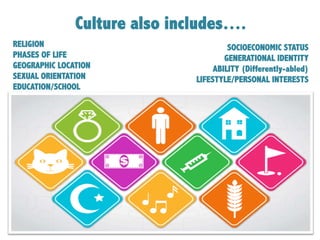
Culture also includes….
SOCIOECONOMIC STATUS
GENERATIONAL IDENTITY
ABILITY (Differently-abled)
LIFESTYLE/PERSONAL INTERESTS
RELIGION
PHASES OF LIFE
GEOGRAPHIC LOCATION
SEXUAL ORIENTATION
EDUCATION/SCHOOL
CULTURAL IDENTITY…
the identification with and
perceived acceptance into a
group that has a shared system of
symbols, meanings, and norms
is the way we manage
our identities.
It’s the process of
exchanging the symbols
we use to send messages
and create meaning.
SYMBOLS express
meaning using language
and behavior.
COMMUNICATION…
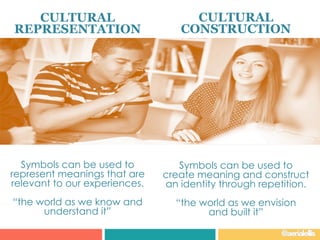
CULTURAL
CONSTRUCTION
Symbols can be used to
create meaning and construct
an identity through repetition.
“the world as we envision
and built it”
CULTURAL
REPRESENTATION
Symbols can be used to
represent meanings that are
relevant to our experiences.
“the world as we know and
understand it”
@aerialellis
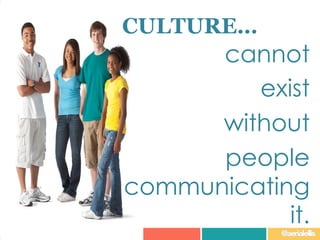
cannot
exist
without
people
communicating
it.
CULTURE…
@aerialellis
statements about the characteristics
and behaviors that describe a segment
of the members of cultural group.
Generalizations can be helpful in
understanding how to relate a cultural
group and interact with someone.
WE MAKE GENERALIZATIONS…
WE BELIEVE STEREOTYPES…
expectations that members of a
cultural group will have the same
characteristics.
Stereotypes do not leave room
for individual differences and
understanding about one person’s
way of life.
WE DEVELOP PREJUDICE…
a hostile attitude toward
members of a cultural group.
Prejudice is a belief that
stereotypes are associated with
all members of a cultural group.
WE SHOW DISCRIMIMATION…
the extension of prejudice into
behavior in a way that causes
different or negative treatment
of a member of stereotyped
group.
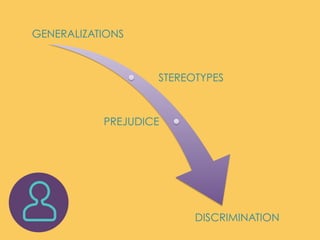
GENERALIZATIONS
STEREOTYPES
PREJUDICE
DISCRIMINATION
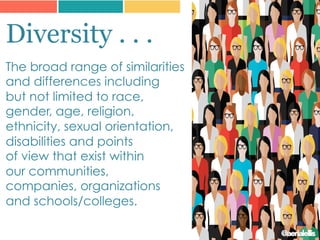
Diversity . . .
The broad range of similarities
and differences including
but not limited to race,
gender, age, religion,
ethnicity, sexual orientation,
disabilities and points
of view that exist within
our communities,
companies, organizations
and schools/colleges.
@aerialellis
Inclusion . . .
Providing equal opportunity
to all people to fully engage
themselves in creating an
environment and a cultural
attitude whereby everyone
and every group fits, feels
accepted, has value and
can contribute to society.
@aerialellis
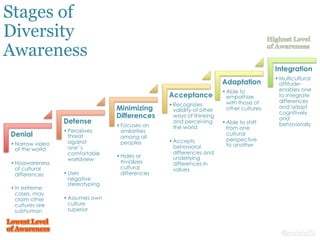
Stages of
Diversity
Awareness
Denial
• Narrow video
of the world
• Noawareness
of cultural
differences
• In extreme
cases, may
claim other
cultures are
subhuman
Defense
• Perceives
threat
against
one’s
comfortable
worldview
• Uses
negative
stereotyping
• Assumes own
culture
superior
Minimizing
Differences
• Focuses on
similarities
among all
peoples
• Hides or
trivializes
cultural
differences
Acceptance
• Recognizes
validity of other
ways of thinking
and perceiving
the world
• Accepts
behavioral
differences and
underlying
differences in
values
Adaptation
• Able to
empathize
with those of
other cultures
• Able to shift
from one
cultural
perspective
to another
Integration
• Multicultural
attitude-
enables one
to integrate
differences
and adapt
cognitively
and
behaviorally
@aerialellis
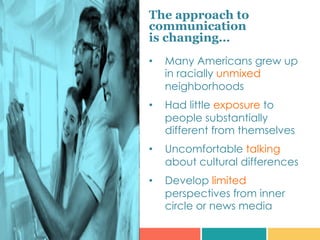
The approach to
communication
is changing…
•  Many Americans grew up
in racially unmixed
neighborhoods
•  Had little exposure to
people substantially
different from themselves
•  Uncomfortable talking
about cultural differences
•  Develop limited
perspectives from inner
circle or news media
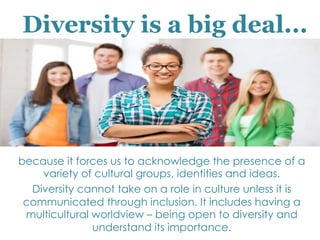
because it forces us to acknowledge the presence of a
variety of cultural groups, identities and ideas.
Diversity cannot take on a role in culture unless it is
communicated through inclusion. It includes having a
multicultural worldview – being open to diversity and
understand its importance.
Diversity is a big deal...
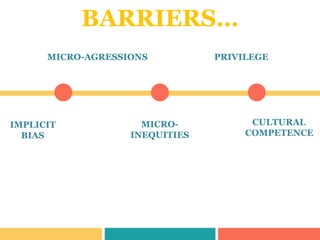
MICRO-AGRESSIONS
IMPLICIT
BIAS
MICRO-
INEQUITIES
CULTURAL
COMPETENCE
PRIVILEGE
BARRIERS…
IMPLICIT BIAS
(unconscious)
refers to judging people according to
unconscious stereotypes based on cultural
identity; when we have attitudes towards
or associate stereotypes with them without
our conscious knowledge.
It is a universal phenomenon,
not limited by race, gender, or
even country of origin, reinforced/
revealed through language
and behavior.	
  
MICRO-AGGRESSIONS
…brief and commonplace verbal,
behavioral, or environmental
indignities, whether intentional or
unintentional, that communicate
hostile, derogatory, or negative
slights and insults towards people of
marginalized groups.
@aerialellis
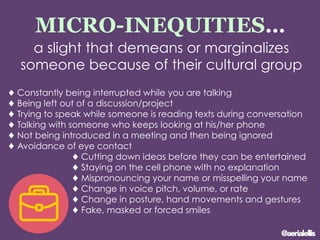
MICRO-INEQUITIES…
a slight that demeans or marginalizes
someone because of their cultural group
♦ Constantly being interrupted while you are talking
♦ Being left out of a discussion/project
♦ Trying to speak while someone is reading texts during conversation
♦ Talking with someone who keeps looking at his/her phone
♦ Not being introduced in a meeting and then being ignored
♦ Avoidance of eye contact
♦ Cutting down ideas before they can be entertained
♦ Staying on the cell phone with no explanation
♦ Mispronouncing your name or misspelling your name
♦ Change in voice pitch, volume, or rate
♦ Change in posture, hand movements and gestures
♦ Fake, masked or forced smiles
@aerialellis
WHAT LEADERS MUST CONSIDER
ABOUT BARRIERS ….
The complexity of communication
reveals how we can disagree and still
have respect each other unless the
disagreement is rooted in someone’s
oppression, and denial of
humanity and right to exist.
The process whereby a person is
granted more value, and given
better treatment, based on
membership in a group.
It is an extension of prejudice
into behavior in a way that
causes different or
negative treatment.
THE CONCEPT OF PRIVILEGE
Cultural privilege can be based on
race, social class, gender and more.
Most people in a culture give some
individuals more power based on
perceived group membership.
THE CONCEPT OF PRIVILEGE
We often maintain and
perpetuate patterns of
privilege in culture
unknowingly.
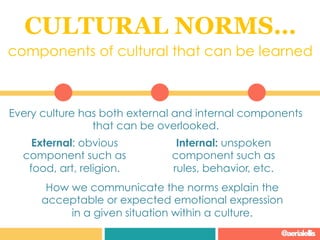
CULTURAL NORMS…
components of cultural that can be learned
How we communicate the norms explain the
acceptable or expected emotional expression
in a given situation within a culture.
Every culture has both external and internal components
that can be overlooked.
Internal: unspoken
component such as
rules, behavior, etc.	
  
External: obvious
component such as
food, art, religion.
@aerialellis
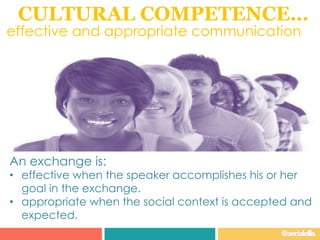
CULTURAL COMPETENCE…
effective and appropriate communication
An exchange is:
•  effective when the speaker accomplishes his or her
goal in the exchange.
•  appropriate when the social context is accepted and
expected.
@aerialellis
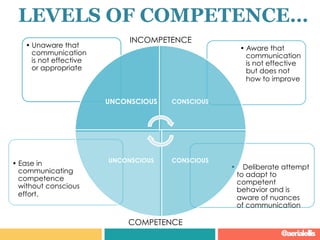
•  Deliberate attempt
to adapt to
competent
behavior and is
aware of nuances
of communication
• Ease in
communicating
competence
without conscious
effort.
• Aware that
communication
is not effective
but does not
how to improve
• Unaware that
communication
is not effective
or appropriate
UNCONSCIOUS CONSCIOUS
CONSCIOUSUNCONSCIOUS
LEVELS OF COMPETENCE…
COMPETENCE
INCOMPETENCE
@aerialellis
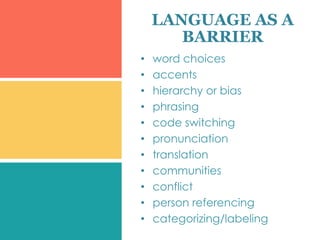
•  word choices
•  accents
•  hierarchy or bias
•  phrasing
•  code switching
•  pronunciation
•  translation
•  communities
•  conflict
•  person referencing
•  categorizing/labeling
LANGUAGE AS A
BARRIER
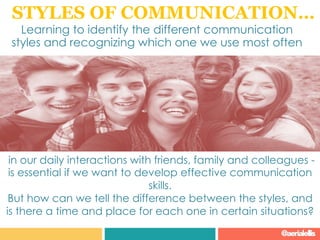
STYLES OF COMMUNICATION…
Learning to identify the different communication
styles and recognizing which one we use most often
in our daily interactions with friends, family and colleagues -
is essential if we want to develop effective communication
skills.
But how can we tell the difference between the styles, and
is there a time and place for each one in certain situations?
@aerialellis
•  Voice – medium pitch and speed and volume
•  Posture – open posture, symmetrical balance, tall,
relaxed, no fidgeting
•  Gestures – even, rounded, expansive
•  Facial expression – good eye contact
•  Spatial position – in control, respectful of others
People on the Receiving end feel…
•  They can take the person at their word
•  The person can cope with justified criticism and
accept compliments
•  Respect for the person
EFFECTIVE (ASSERTIVE)
COMMUNICATION	


@aerialellis
•  AGGRESSIVE: Frightening,
threatening, loud, hostile; Willing to
achieve goals at expense of others,
Out to "win”; Demanding, abrasive;
E x p l o s i v e , U n p r e d i c t a b l e ,
Intimidating, Bullying.
•  PASSIVE AGGRESSIVE: Indirectly
aggressive, Sarcastic, Devious,
Unreliable, Complaining, Sulky,
Patronizing, Gossips, Two-faced.
•  S U B M I S S I V E : A p o l o g e t i c ,
Avoiding any confrontation, Finding
difficulty in taking responsibility or
decisions, Yielding to someone
else's preferences, Opting out,
Feeling like a victim, Blaming others
for events, Refusing compliments.
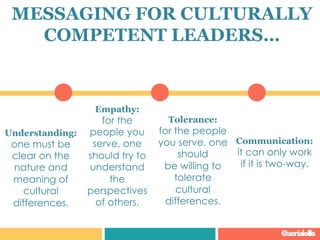
MESSAGING FOR CULTURALLY
COMPETENT LEADERS…
Communication:
it can only work
if it is two-way.
	
  
Understanding:
one must be
clear on the
nature and
meaning of
cultural
differences.
Empathy:
for the
people you
serve, one
should try to
understand
the
perspectives
of others.
Tolerance:
for the people
you serve, one
should
be willing to
tolerate
cultural
differences.
@aerialellis
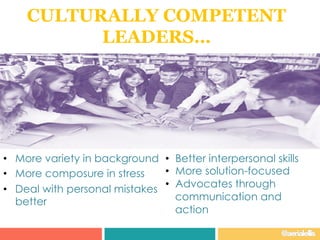
CULTURALLY COMPETENT
LEADERS…
•  More variety in background
•  More composure in stress
•  Deal with personal mistakes
better
•  Better interpersonal skills
•  More solution-focused
•  Advocates through
communication and
action
@aerialellis
@aerialellis
@aerialellis
@aerialellis
@aerialellis
SHARE YOUR FEEDBACK…
Consultant/Professor
hello@aerialellis.com
LET’S CONNECT

Creating Cultural Competency for Diversity and Inclusion

  • 1.
  • 4.
    It’s a wayof life. A way of life refers to the aspects of culture that make up the lives of its members such as language, norms and values. CULTURE Culture makes up our identities.
  • 6.
    Culture also includes…. SOCIOECONOMICSTATUS GENERATIONAL IDENTITY ABILITY (Differently-abled) LIFESTYLE/PERSONAL INTERESTS RELIGION PHASES OF LIFE GEOGRAPHIC LOCATION SEXUAL ORIENTATION EDUCATION/SCHOOL
  • 7.
    CULTURAL IDENTITY… the identificationwith and perceived acceptance into a group that has a shared system of symbols, meanings, and norms
  • 8.
    is the waywe manage our identities. It’s the process of exchanging the symbols we use to send messages and create meaning. SYMBOLS express meaning using language and behavior. COMMUNICATION…
  • 9.
    CULTURAL CONSTRUCTION Symbols can beused to create meaning and construct an identity through repetition. “the world as we envision and built it” CULTURAL REPRESENTATION Symbols can be used to represent meanings that are relevant to our experiences. “the world as we know and understand it” @aerialellis
  • 10.
  • 11.
    statements about thecharacteristics and behaviors that describe a segment of the members of cultural group. Generalizations can be helpful in understanding how to relate a cultural group and interact with someone. WE MAKE GENERALIZATIONS…
  • 12.
    WE BELIEVE STEREOTYPES… expectationsthat members of a cultural group will have the same characteristics. Stereotypes do not leave room for individual differences and understanding about one person’s way of life.
  • 13.
    WE DEVELOP PREJUDICE… ahostile attitude toward members of a cultural group. Prejudice is a belief that stereotypes are associated with all members of a cultural group.
  • 14.
    WE SHOW DISCRIMIMATION… theextension of prejudice into behavior in a way that causes different or negative treatment of a member of stereotyped group.
  • 15.
  • 16.
    Diversity . .. The broad range of similarities and differences including but not limited to race, gender, age, religion, ethnicity, sexual orientation, disabilities and points of view that exist within our communities, companies, organizations and schools/colleges. @aerialellis
  • 17.
    Inclusion . .. Providing equal opportunity to all people to fully engage themselves in creating an environment and a cultural attitude whereby everyone and every group fits, feels accepted, has value and can contribute to society. @aerialellis
  • 18.
    Stages of Diversity Awareness Denial • Narrow video ofthe world • Noawareness of cultural differences • In extreme cases, may claim other cultures are subhuman Defense • Perceives threat against one’s comfortable worldview • Uses negative stereotyping • Assumes own culture superior Minimizing Differences • Focuses on similarities among all peoples • Hides or trivializes cultural differences Acceptance • Recognizes validity of other ways of thinking and perceiving the world • Accepts behavioral differences and underlying differences in values Adaptation • Able to empathize with those of other cultures • Able to shift from one cultural perspective to another Integration • Multicultural attitude- enables one to integrate differences and adapt cognitively and behaviorally @aerialellis
  • 19.
    The approach to communication ischanging… •  Many Americans grew up in racially unmixed neighborhoods •  Had little exposure to people substantially different from themselves •  Uncomfortable talking about cultural differences •  Develop limited perspectives from inner circle or news media
  • 20.
    because it forcesus to acknowledge the presence of a variety of cultural groups, identities and ideas. Diversity cannot take on a role in culture unless it is communicated through inclusion. It includes having a multicultural worldview – being open to diversity and understand its importance. Diversity is a big deal...
  • 21.
  • 22.
    IMPLICIT BIAS (unconscious) refers tojudging people according to unconscious stereotypes based on cultural identity; when we have attitudes towards or associate stereotypes with them without our conscious knowledge. It is a universal phenomenon, not limited by race, gender, or even country of origin, reinforced/ revealed through language and behavior.  
  • 23.
    MICRO-AGGRESSIONS …brief and commonplaceverbal, behavioral, or environmental indignities, whether intentional or unintentional, that communicate hostile, derogatory, or negative slights and insults towards people of marginalized groups. @aerialellis
  • 24.
    MICRO-INEQUITIES… a slight thatdemeans or marginalizes someone because of their cultural group ♦ Constantly being interrupted while you are talking ♦ Being left out of a discussion/project ♦ Trying to speak while someone is reading texts during conversation ♦ Talking with someone who keeps looking at his/her phone ♦ Not being introduced in a meeting and then being ignored ♦ Avoidance of eye contact ♦ Cutting down ideas before they can be entertained ♦ Staying on the cell phone with no explanation ♦ Mispronouncing your name or misspelling your name ♦ Change in voice pitch, volume, or rate ♦ Change in posture, hand movements and gestures ♦ Fake, masked or forced smiles @aerialellis
  • 25.
    WHAT LEADERS MUSTCONSIDER ABOUT BARRIERS …. The complexity of communication reveals how we can disagree and still have respect each other unless the disagreement is rooted in someone’s oppression, and denial of humanity and right to exist.
  • 26.
    The process wherebya person is granted more value, and given better treatment, based on membership in a group. It is an extension of prejudice into behavior in a way that causes different or negative treatment. THE CONCEPT OF PRIVILEGE
  • 27.
    Cultural privilege canbe based on race, social class, gender and more. Most people in a culture give some individuals more power based on perceived group membership. THE CONCEPT OF PRIVILEGE We often maintain and perpetuate patterns of privilege in culture unknowingly.
  • 28.
    CULTURAL NORMS… components ofcultural that can be learned How we communicate the norms explain the acceptable or expected emotional expression in a given situation within a culture. Every culture has both external and internal components that can be overlooked. Internal: unspoken component such as rules, behavior, etc.   External: obvious component such as food, art, religion. @aerialellis
  • 29.
    CULTURAL COMPETENCE… effective andappropriate communication An exchange is: •  effective when the speaker accomplishes his or her goal in the exchange. •  appropriate when the social context is accepted and expected. @aerialellis
  • 30.
    •  Deliberate attempt toadapt to competent behavior and is aware of nuances of communication • Ease in communicating competence without conscious effort. • Aware that communication is not effective but does not how to improve • Unaware that communication is not effective or appropriate UNCONSCIOUS CONSCIOUS CONSCIOUSUNCONSCIOUS LEVELS OF COMPETENCE… COMPETENCE INCOMPETENCE @aerialellis
  • 31.
    •  word choices • accents •  hierarchy or bias •  phrasing •  code switching •  pronunciation •  translation •  communities •  conflict •  person referencing •  categorizing/labeling LANGUAGE AS A BARRIER
  • 32.
    STYLES OF COMMUNICATION… Learningto identify the different communication styles and recognizing which one we use most often in our daily interactions with friends, family and colleagues - is essential if we want to develop effective communication skills. But how can we tell the difference between the styles, and is there a time and place for each one in certain situations? @aerialellis
  • 33.
    •  Voice –medium pitch and speed and volume •  Posture – open posture, symmetrical balance, tall, relaxed, no fidgeting •  Gestures – even, rounded, expansive •  Facial expression – good eye contact •  Spatial position – in control, respectful of others People on the Receiving end feel… •  They can take the person at their word •  The person can cope with justified criticism and accept compliments •  Respect for the person EFFECTIVE (ASSERTIVE) COMMUNICATION     @aerialellis
  • 34.
    •  AGGRESSIVE: Frightening, threatening,loud, hostile; Willing to achieve goals at expense of others, Out to "win”; Demanding, abrasive; E x p l o s i v e , U n p r e d i c t a b l e , Intimidating, Bullying. •  PASSIVE AGGRESSIVE: Indirectly aggressive, Sarcastic, Devious, Unreliable, Complaining, Sulky, Patronizing, Gossips, Two-faced. •  S U B M I S S I V E : A p o l o g e t i c , Avoiding any confrontation, Finding difficulty in taking responsibility or decisions, Yielding to someone else's preferences, Opting out, Feeling like a victim, Blaming others for events, Refusing compliments.
  • 35.
    MESSAGING FOR CULTURALLY COMPETENTLEADERS… Communication: it can only work if it is two-way.   Understanding: one must be clear on the nature and meaning of cultural differences. Empathy: for the people you serve, one should try to understand the perspectives of others. Tolerance: for the people you serve, one should be willing to tolerate cultural differences. @aerialellis
  • 36.
    CULTURALLY COMPETENT LEADERS… •  Morevariety in background •  More composure in stress •  Deal with personal mistakes better •  Better interpersonal skills •  More solution-focused •  Advocates through communication and action @aerialellis
  • 38.
  • 39.
  • 40.
  • 41.
  • 42.
  • 43.