Nonverbal Communication
Cross Cultural Understanding
Rizki Wahyu Indriani
Aulia Novi Hapsari
Asty Asmarani Putri
Source : Beyond Language ; Intercultural Communication for
English as a Second Language by Deena R. Levine and
Mara B. Adelman
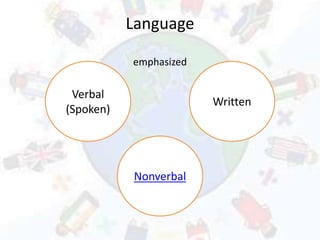
Language
emphasized
Verbal
(Spoken)
Written
Nonverbal
Nonverbal
• Nonverbal is communication that takes place
without words.
• Some types, people express more nonverbally
than verbally.
• Drawal continue to convey emotional
meaning.
Nonverbal
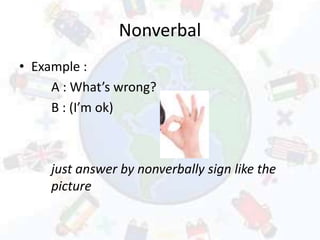
• Example :
A : What’s wrong?
B : (I’m ok)
just answer by nonverbally sign like the
picture
Nonverbal
• One study showed that 93% of the message
was transmitted by tone of voice & facial
expression whereas only 7% was transmitted
by words.
• we express 5 our emotions and attitudes more
nonverbally than verbally.
Cultural Differences in Nonverbal
Communication
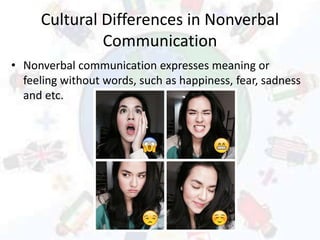
• Nonverbal communication expresses meaning or
feeling without words, such as happiness, fear, sadness
and etc.
Cultural Differences in Nonverbal
Communication
• Different nonverbal pattern across cultures
can make confusion for foreigners.
• For example, expression varies in feelings of
friendship….
Cultural Differences in Nonverbal
Communication
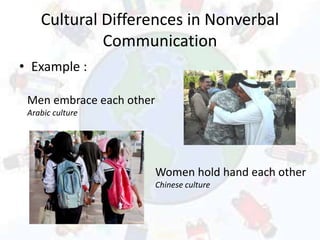
• Example :
Men embrace each other
Arabic culture
Women hold hand each other
Chinese culture
Cultural Differences in Nonverbal
Communication
What is acceptable in one culture may be
completely unacceptable in another. In order to
correctly interpret another culture’s style of
communication, it’s necessary to study nonverbal
communication.
Gesture
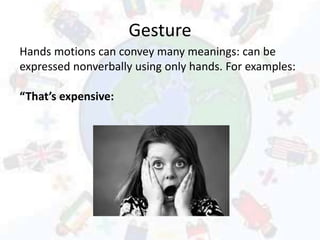
Hands motions can convey many meanings: can be
expressed nonverbally using only hands. For examples:
“That’s expensive:
“ come here “
“ Go away “
“ It’s OK “
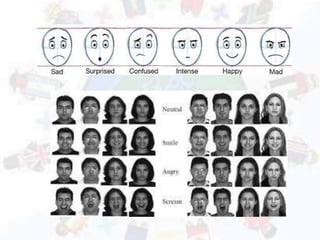
Facial Expression
• Carry meaning determined by context and
relationship.
For instance, “SMILE”
• A smile may show affection, convey
politeness, or disguise true feelings.
• Pain is conveyed by a grimace, which also
signifies disgust or disapproval surprise, shock
or disbelief can be shown by raising the
eyebrows.
Facial Expression
• People from certain ethnic backgrounds in
United States may use their hands, bodies,
and faces more than other Americans. There
are no fixed rules, and some people can be
“read like a book” others are difficult to read.
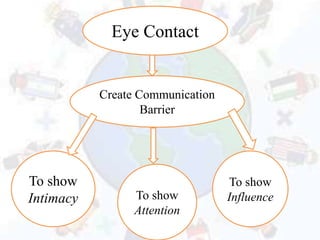
To show
Intimacy
Create Communication
Barrier
Eye Contact
To show
Attention
To show
Influence
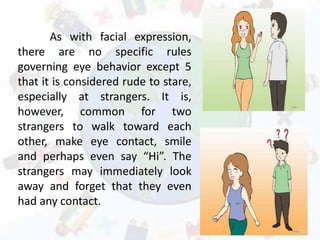
As with facial expression,
there are no specific rules
governing eye behavior except 5
that it is considered rude to stare,
especially at strangers. It is,
however, common for two
strangers to walk toward each
other, make eye contact, smile
and perhaps even say “Hi”. The
strangers may immediately look
away and forget that they even
had any contact.
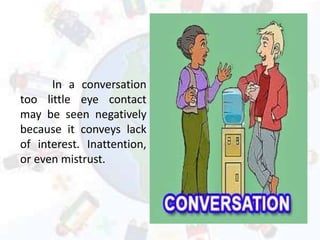
In a conversation
too little eye contact
may be seen negatively
because it conveys lack
of interest. Inattention,
or even mistrust.
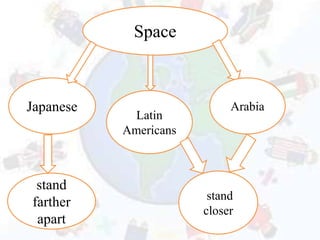
Japanese
Space
Latin
Americans
Arabia
stand
farther
apart
stand
closer
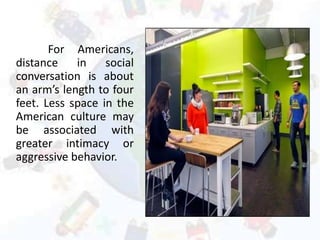
For Americans,
distance in social
conversation is about
an arm’s length to four
feet. Less space in the
American culture may
be associated with
greater intimacy or
aggressive behavior.
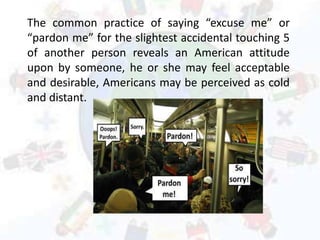
The common practice of saying “excuse me” or
“pardon me” for the slightest accidental touching 5
of another person reveals an American attitude
upon by someone, he or she may feel acceptable
and desirable, Americans may be perceived as cold
and distant.
Conclusion
Culture does not always determine the message
that our body movements convey. Contexts,
personalities, and relationship also influence them.
Therefore, no two people in any one society have the
same nonverbal behavior. However, like verbal
language, nonverbal 5 communication cannot be
completely separated from culture. Whether, we
emphasize differences or similarities, the “silent
language” is much louder then it first appears.
COMPREHENSION QUESTION
VOCABULARY EXERCISES
CONVERSATIONAL ACTIVITIES

Nonverbal communication

  • 1.
    Nonverbal Communication Cross CulturalUnderstanding Rizki Wahyu Indriani Aulia Novi Hapsari Asty Asmarani Putri Source : Beyond Language ; Intercultural Communication for English as a Second Language by Deena R. Levine and Mara B. Adelman
  • 2.
  • 3.
    Nonverbal • Nonverbal iscommunication that takes place without words. • Some types, people express more nonverbally than verbally. • Drawal continue to convey emotional meaning.
  • 4.
    Nonverbal • Example : A: What’s wrong? B : (I’m ok) just answer by nonverbally sign like the picture
  • 5.
    Nonverbal • One studyshowed that 93% of the message was transmitted by tone of voice & facial expression whereas only 7% was transmitted by words. • we express 5 our emotions and attitudes more nonverbally than verbally.
  • 6.
    Cultural Differences inNonverbal Communication • Nonverbal communication expresses meaning or feeling without words, such as happiness, fear, sadness and etc.
  • 7.
    Cultural Differences inNonverbal Communication • Different nonverbal pattern across cultures can make confusion for foreigners. • For example, expression varies in feelings of friendship….
  • 8.
    Cultural Differences inNonverbal Communication • Example : Men embrace each other Arabic culture Women hold hand each other Chinese culture
  • 9.
    Cultural Differences inNonverbal Communication What is acceptable in one culture may be completely unacceptable in another. In order to correctly interpret another culture’s style of communication, it’s necessary to study nonverbal communication.
  • 10.
    Gesture Hands motions canconvey many meanings: can be expressed nonverbally using only hands. For examples: “That’s expensive:
  • 11.
  • 12.
  • 13.
  • 14.
    Facial Expression • Carrymeaning determined by context and relationship. For instance, “SMILE” • A smile may show affection, convey politeness, or disguise true feelings. • Pain is conveyed by a grimace, which also signifies disgust or disapproval surprise, shock or disbelief can be shown by raising the eyebrows.
  • 16.
    Facial Expression • Peoplefrom certain ethnic backgrounds in United States may use their hands, bodies, and faces more than other Americans. There are no fixed rules, and some people can be “read like a book” others are difficult to read.
  • 17.
    To show Intimacy Create Communication Barrier EyeContact To show Attention To show Influence
  • 18.
    As with facialexpression, there are no specific rules governing eye behavior except 5 that it is considered rude to stare, especially at strangers. It is, however, common for two strangers to walk toward each other, make eye contact, smile and perhaps even say “Hi”. The strangers may immediately look away and forget that they even had any contact.
  • 19.
    In a conversation toolittle eye contact may be seen negatively because it conveys lack of interest. Inattention, or even mistrust.
  • 20.
  • 21.
    For Americans, distance insocial conversation is about an arm’s length to four feet. Less space in the American culture may be associated with greater intimacy or aggressive behavior.
  • 22.
    The common practiceof saying “excuse me” or “pardon me” for the slightest accidental touching 5 of another person reveals an American attitude upon by someone, he or she may feel acceptable and desirable, Americans may be perceived as cold and distant.
  • 23.
    Conclusion Culture does notalways determine the message that our body movements convey. Contexts, personalities, and relationship also influence them. Therefore, no two people in any one society have the same nonverbal behavior. However, like verbal language, nonverbal 5 communication cannot be completely separated from culture. Whether, we emphasize differences or similarities, the “silent language” is much louder then it first appears.
  • 24.
  • 25.
  • 26.