Situation:
You are at a party; an attractive
person glances in your direction
and smiles. Is that an invitation
to come over and start a
conversation? Or is this person
smiling because he/she has just
heard an amusing remark?
You are buying a used car. You
asked the owner whether there is
anything wrrong with it. He looks
you in the eye and says, “No way!
This car is in perfect shape.” Do
you believe him?
Situation:
Imagine that you are a professor. The
day after you give a midterm exam to
your class, one of the students comes to
see you and, with a look of pure
innocence, says: “I’m sorry i missed the
exam, but i was away on a field trip for
one of my other classes, and we got back
much later than i expected. Can i take a
makeup exam?” Do you accept this
story?
Situation:
SOCIAL
PERCEPTIO
N
Kristine Joey DB. Palencia
Master in Industrial Psychology
SOCIAL
PERCEPTIO
N
An active process (or set of processes) through which we seek to
know and understand others
It is one of the most basic—and important aspects of social life
SOCIAL PERCEPTION
• We try to understand other person’s current
feelings, moods and emotions—how they are
feeling right now, often provided by nonverbal
cues involving facial expressions, eye contact,
body posture and movements.
• We attempt to understand the more lasting
causes behind others’ behavior—the reasons
why they have acted in certain ways—motives,
intentions and traits.
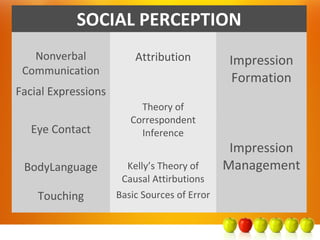
SOCIAL PERCEPTION
Nonverbal
Communication
Attribution Impression
Formation
Facial Expressions
Theory of
Correspondent
InferenceEye Contact
Impression
ManagementBodyLanguage Kelly’s Theory of
Causal Attirbutions
Touching Basic Sources of Error
Nonverbal
Communication
Information about our inner states is often revealed
through five basic channels: facial expressions, eye contact,
body movements, postures and touching.
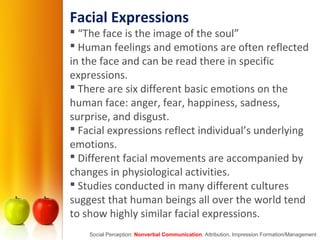
Facial Expressions
 “The face is the image of the soul”
 Human feelings and emotions are often reflected
in the face and can be read there in specific
expressions.
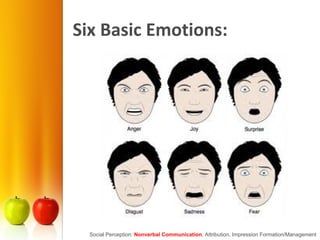
 There are six different basic emotions on the
human face: anger, fear, happiness, sadness,
surprise, and disgust.
 Facial expressions reflect individual’s underlying
emotions.
 Different facial movements are accompanied by
changes in physiological activities.
 Studies conducted in many different cultures
suggest that human beings all over the world tend
to show highly similar facial expressions.
Social Perception: Nonverbal Communication, Attribution, Impression Formation/Management
Six Basic Emotions:
Social Perception: Nonverbal Communication, Attribution, Impression Formation/Management
Eye Contact
 “Windows to the soul”
 We do often learn much of about others’
feelings from their eyes.
 We interpret a high level of gazing from
another as a sign of liking or friendliness.
 Staring—a form of eye contact in which
one person continues to gaze steadily at
another regardless of what the recipient
does.
Social Perception: Nonverbal Communication, Attribution, Impression Formation/Management
Body Language
 Our current moods or emotions are often
reflected in the position, posture and
movement of our bodies, in which, provide
us with useful information about others.
 It often reveals others‘ emotional states.
Large numbers of movements—especially
ones in which one part of the body does
something to another part, suggest
emotional arousal.
Social Perception: Nonverbal Communication, Attribution, Impression Formation/Management
 Aronoffs and colleages’ research on ballet dancers:
Dancers who played with dangerous, threatening
characters would show more diagonal and angular
postures, while dancers with warm and sympathetic
characters would show rounded postures.
 Large scale body movements or postures can sometimes
provide important information about others’ emotions, and
even about their apparent traits.
 Lynn and Mynier’s research on body posture and
movements (busy restaurants as the setting): In these
settings, they arranged for waiters and waitresses, when
taking drink orders from customers, either to stand
upright or to squat down next to the customers.
 Lynn and Mynier predicted that squatting down would be
interpreted as a sign of friendliness, because in that position
the waiter and waitresses would make more eye contact
with customers and would be physically closer to them.
Social Perception: Nonverbal Communication, Attribution, Impression Formation/Management
Touching
 The most intimate nonverbal cues.
 Factors to consider in touching: who does
the touching; the nature of physical contact;
the context in which it takes place.
 Touch can suggest affection, sexual interest,
dominance, caring, or even aggression.
 When touching is considered acceptable,
positive reactions often result. If it is
perceived as a status or power play, or if it is
too prolonged or intimate, touching may
evoke anxiety, anger, and other negative
reactions.
Social Perception: Nonverbal Communication, Attribution, Impression Formation/Management
Research findings on gender differences:
Among young couples, male are more likely
to touch females than vice versa. As age
increases, difference shrinks, females are
more likely to initiate touching than males.
Among younger couples, relationships are
not yet well established; prevailing gender
roles encourage visible gestures of
possessiveness such as touching by males. As
relatinship develops, however, gender roles
may require more gestures of possessiveness
by females.
Social Perception: Nonverbal Communication, Attribution, Impression Formation/Management
How to tell when
another person is lying?
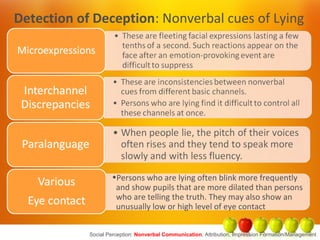
Detection of Deception: Nonverbal cues of Lying
•Persons who are lying often blink more frequently
and show pupils that are more dilated than persons
who are telling the truth. They may also show an
unusually low or high level of eye contact
Social Perception: Nonverbal Communication, Attribution, Impression Formation/Management
Attribution
Attribution refers to the process of understanding and
thinking about people within social situations, as one tends
to try and explain the behavior of others.
Correspondent Inference Theory
 Coined by Jones and Davis in 1965. The theory is concerned with how we
decide, on the basis of others’ overt actions, that they possess specific
traits or dispositions that they carry with them from situation to situation,
and that remain fairly stable over time.
• This theory simply says that people try to explain behavior by finding a
match between the behavior they can see and the stable qualities/
personality traits of the person displaying it.
• When we infer others’ traits form their behavior, we accomplish three
distinct tasks (Gilbert et al, 1988): we categorize an individual’s behavior,
characterize the behavior, and we correct our inferences about this
person’s traits in the light of information about the situation in which it
has occured.
• In sum, according to this theory, we are most likely to conclude that
others’ behavior reflects their stable traits when the behavior (1) is freely
chosen; (2) yields distinctive, noncommon effects; and (3) is low in social
desirability.
Social Perception: Nonverbal Communication, Attribution, Impression Formation/Management
Kelley’s Theory of Causal Attribution
• Illustrates that our knowledge of behavior is used to make
attributions based on the consensus, consistency and
distinctiveness of the available information. It looks at how
such information co-varies with each other so, is there
consensus (do other people behave in the same way as the
individual?), consistency (has the individual behaved in the
same way in the past, or on each occasion?) or, is there
distinctiveness (where different behavior is shown in similar,
but different, circumstances)? According to this model, an
internal (person) attribution will be made when there is low
consensus and distinctiveness but high consistency, otherwise
an external (situational) attribution is made. If consistency is
low, causes are discounted and alternatives sought.
Social Perception: Nonverbal Communication, Attribution, Impression Formation/Management
Attributional Bias
• Research has shown that a number of errors/biases occur when
making decisions about one’s own or others’ behavior.
• Fundamental Attribution Error—the strong tendency to explain
others’ actions in terms of dispositional (internal) rather than
situational (internal) causes. In short, we tend to perceive others as
acting as they do because they are “that kind of person”, rather
than because of the many external factors that may have affected
their behavior.
• The Actor-Observer Effect—the tendency to attribute our own
behavior to situational factors, but that others to dispositional
(internal) causes.
• The Self-Serving Bias—the tendency to attribute our own positive
outcomes to internal causes but negative ones to external factors.
Social Perception: Nonverbal Communication, Attribution, Impression Formation/Management
Formation
And
Impression
Management
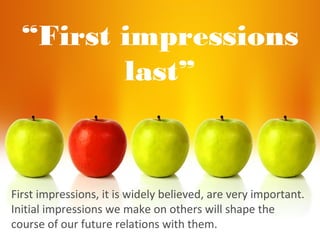
“First impressions
last”
First impressions, it is widely believed, are very important.
Initial impressions we make on others will shape the
course of our future relations with them.
Social Perception: Nonverbal Communication, Attribution, Impression
Impression Formation
• The process through which we form impressions of others.
• How do we combine so much diverse information about
others into unified impressions?
• We combine this information into a weighted average (each
piece of information is weighted in terms of its relative
importance).
• Factors that influence the relative weighting: (1) the source of
the input, (2) whether the information is positive or negative
in nature, (3) the extent to which the information describes
the behaviors/traits that are unusual or extreme, and (4)
information received first tends to be weighted more heavily
that information received later (this is known as a primacy
effect).
Social Perception: Nonverbal Communication, Attribution, Impression
Impressions of others involve both concrete examples of
behaviors others have performed that are consistent with a given
trait—exemplars—and mental summaries that are abstracted
from repeated observations of others’ behavior—abstractions.
Models of Impression Formation
Models that stress the role of behavioral exemplars suggest that
when we make judgements about others, we recall examples of
their behavior and base our judgements—and our impressions—
on these.
Models that stress the role of abstractions suggest that when we
make judgements about others, we simply bring our previously
formed abstractions to mind, and then use these as the basis for
our impressions and our decisions.
Social Perception: Nonverbal Communication, Attribution, Impression
The nature of impressions may shift as we gain
increasing experience with them.
At first, an impression consists largely of exemplars
(behavioral examples); but later, as our experience with
another person increases , our impression consists
mainly of mental abstractions derived from observations
of the person’s behavior.
Social Perception: Nonverbal Communication, Attribution, Impression
Impression Management
• Efforts by individuals to produce favorable impressions on
others (Self-presentation).
• the deliberate 'bending' of the truth in order to make a
favorable impression
• Persons who can perform impression management
successfully do often gain important advantages in many
situations.
What tactics do individuals
use to create favorable
impressions on others?
Social Perception: Nonverbal Communication, Attribution, Impression
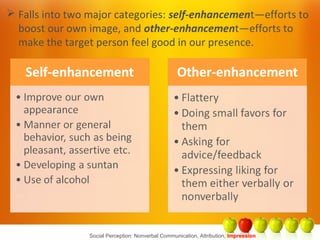
 Falls into two major categories: self-enhancement—efforts to
boost our own image, and other-enhancement—efforts to
make the target person feel good in our presence.
Impression-management is neither
good nor bad, it is an integral part of
our social interaction and everyone
gets involved in it everyday.
Thank you!
joey

Socialperception 130806180943-phpapp02

  • 1.
    Situation: You are ata party; an attractive person glances in your direction and smiles. Is that an invitation to come over and start a conversation? Or is this person smiling because he/she has just heard an amusing remark?
  • 2.
    You are buyinga used car. You asked the owner whether there is anything wrrong with it. He looks you in the eye and says, “No way! This car is in perfect shape.” Do you believe him? Situation:
  • 3.
    Imagine that youare a professor. The day after you give a midterm exam to your class, one of the students comes to see you and, with a look of pure innocence, says: “I’m sorry i missed the exam, but i was away on a field trip for one of my other classes, and we got back much later than i expected. Can i take a makeup exam?” Do you accept this story? Situation:
  • 4.
    SOCIAL PERCEPTIO N Kristine Joey DB.Palencia Master in Industrial Psychology
  • 5.
    SOCIAL PERCEPTIO N An active process(or set of processes) through which we seek to know and understand others It is one of the most basic—and important aspects of social life
  • 6.
    SOCIAL PERCEPTION • Wetry to understand other person’s current feelings, moods and emotions—how they are feeling right now, often provided by nonverbal cues involving facial expressions, eye contact, body posture and movements. • We attempt to understand the more lasting causes behind others’ behavior—the reasons why they have acted in certain ways—motives, intentions and traits.
  • 7.
    SOCIAL PERCEPTION Nonverbal Communication Attribution Impression Formation FacialExpressions Theory of Correspondent InferenceEye Contact Impression ManagementBodyLanguage Kelly’s Theory of Causal Attirbutions Touching Basic Sources of Error
  • 8.
    Nonverbal Communication Information about ourinner states is often revealed through five basic channels: facial expressions, eye contact, body movements, postures and touching.
  • 9.
    Facial Expressions  “Theface is the image of the soul”  Human feelings and emotions are often reflected in the face and can be read there in specific expressions.  There are six different basic emotions on the human face: anger, fear, happiness, sadness, surprise, and disgust.  Facial expressions reflect individual’s underlying emotions.  Different facial movements are accompanied by changes in physiological activities.  Studies conducted in many different cultures suggest that human beings all over the world tend to show highly similar facial expressions. Social Perception: Nonverbal Communication, Attribution, Impression Formation/Management
  • 10.
    Six Basic Emotions: SocialPerception: Nonverbal Communication, Attribution, Impression Formation/Management
  • 11.
    Eye Contact  “Windowsto the soul”  We do often learn much of about others’ feelings from their eyes.  We interpret a high level of gazing from another as a sign of liking or friendliness.  Staring—a form of eye contact in which one person continues to gaze steadily at another regardless of what the recipient does. Social Perception: Nonverbal Communication, Attribution, Impression Formation/Management
  • 12.
    Body Language  Ourcurrent moods or emotions are often reflected in the position, posture and movement of our bodies, in which, provide us with useful information about others.  It often reveals others‘ emotional states. Large numbers of movements—especially ones in which one part of the body does something to another part, suggest emotional arousal. Social Perception: Nonverbal Communication, Attribution, Impression Formation/Management
  • 13.
     Aronoffs andcolleages’ research on ballet dancers: Dancers who played with dangerous, threatening characters would show more diagonal and angular postures, while dancers with warm and sympathetic characters would show rounded postures.  Large scale body movements or postures can sometimes provide important information about others’ emotions, and even about their apparent traits.  Lynn and Mynier’s research on body posture and movements (busy restaurants as the setting): In these settings, they arranged for waiters and waitresses, when taking drink orders from customers, either to stand upright or to squat down next to the customers.  Lynn and Mynier predicted that squatting down would be interpreted as a sign of friendliness, because in that position the waiter and waitresses would make more eye contact with customers and would be physically closer to them. Social Perception: Nonverbal Communication, Attribution, Impression Formation/Management
  • 14.
    Touching  The mostintimate nonverbal cues.  Factors to consider in touching: who does the touching; the nature of physical contact; the context in which it takes place.  Touch can suggest affection, sexual interest, dominance, caring, or even aggression.  When touching is considered acceptable, positive reactions often result. If it is perceived as a status or power play, or if it is too prolonged or intimate, touching may evoke anxiety, anger, and other negative reactions. Social Perception: Nonverbal Communication, Attribution, Impression Formation/Management
  • 15.
    Research findings ongender differences: Among young couples, male are more likely to touch females than vice versa. As age increases, difference shrinks, females are more likely to initiate touching than males. Among younger couples, relationships are not yet well established; prevailing gender roles encourage visible gestures of possessiveness such as touching by males. As relatinship develops, however, gender roles may require more gestures of possessiveness by females. Social Perception: Nonverbal Communication, Attribution, Impression Formation/Management
  • 16.
    How to tellwhen another person is lying?
  • 17.
    Detection of Deception:Nonverbal cues of Lying •Persons who are lying often blink more frequently and show pupils that are more dilated than persons who are telling the truth. They may also show an unusually low or high level of eye contact Social Perception: Nonverbal Communication, Attribution, Impression Formation/Management
  • 18.
    Attribution Attribution refers tothe process of understanding and thinking about people within social situations, as one tends to try and explain the behavior of others.
  • 19.
    Correspondent Inference Theory Coined by Jones and Davis in 1965. The theory is concerned with how we decide, on the basis of others’ overt actions, that they possess specific traits or dispositions that they carry with them from situation to situation, and that remain fairly stable over time. • This theory simply says that people try to explain behavior by finding a match between the behavior they can see and the stable qualities/ personality traits of the person displaying it. • When we infer others’ traits form their behavior, we accomplish three distinct tasks (Gilbert et al, 1988): we categorize an individual’s behavior, characterize the behavior, and we correct our inferences about this person’s traits in the light of information about the situation in which it has occured. • In sum, according to this theory, we are most likely to conclude that others’ behavior reflects their stable traits when the behavior (1) is freely chosen; (2) yields distinctive, noncommon effects; and (3) is low in social desirability. Social Perception: Nonverbal Communication, Attribution, Impression Formation/Management
  • 20.
    Kelley’s Theory ofCausal Attribution • Illustrates that our knowledge of behavior is used to make attributions based on the consensus, consistency and distinctiveness of the available information. It looks at how such information co-varies with each other so, is there consensus (do other people behave in the same way as the individual?), consistency (has the individual behaved in the same way in the past, or on each occasion?) or, is there distinctiveness (where different behavior is shown in similar, but different, circumstances)? According to this model, an internal (person) attribution will be made when there is low consensus and distinctiveness but high consistency, otherwise an external (situational) attribution is made. If consistency is low, causes are discounted and alternatives sought. Social Perception: Nonverbal Communication, Attribution, Impression Formation/Management
  • 21.
    Attributional Bias • Researchhas shown that a number of errors/biases occur when making decisions about one’s own or others’ behavior. • Fundamental Attribution Error—the strong tendency to explain others’ actions in terms of dispositional (internal) rather than situational (internal) causes. In short, we tend to perceive others as acting as they do because they are “that kind of person”, rather than because of the many external factors that may have affected their behavior. • The Actor-Observer Effect—the tendency to attribute our own behavior to situational factors, but that others to dispositional (internal) causes. • The Self-Serving Bias—the tendency to attribute our own positive outcomes to internal causes but negative ones to external factors. Social Perception: Nonverbal Communication, Attribution, Impression Formation/Management
  • 22.
  • 23.
    “First impressions last” First impressions,it is widely believed, are very important. Initial impressions we make on others will shape the course of our future relations with them.
  • 24.
    Social Perception: NonverbalCommunication, Attribution, Impression Impression Formation • The process through which we form impressions of others. • How do we combine so much diverse information about others into unified impressions? • We combine this information into a weighted average (each piece of information is weighted in terms of its relative importance). • Factors that influence the relative weighting: (1) the source of the input, (2) whether the information is positive or negative in nature, (3) the extent to which the information describes the behaviors/traits that are unusual or extreme, and (4) information received first tends to be weighted more heavily that information received later (this is known as a primacy effect).
  • 25.
    Social Perception: NonverbalCommunication, Attribution, Impression Impressions of others involve both concrete examples of behaviors others have performed that are consistent with a given trait—exemplars—and mental summaries that are abstracted from repeated observations of others’ behavior—abstractions. Models of Impression Formation Models that stress the role of behavioral exemplars suggest that when we make judgements about others, we recall examples of their behavior and base our judgements—and our impressions— on these. Models that stress the role of abstractions suggest that when we make judgements about others, we simply bring our previously formed abstractions to mind, and then use these as the basis for our impressions and our decisions.
  • 26.
    Social Perception: NonverbalCommunication, Attribution, Impression The nature of impressions may shift as we gain increasing experience with them. At first, an impression consists largely of exemplars (behavioral examples); but later, as our experience with another person increases , our impression consists mainly of mental abstractions derived from observations of the person’s behavior.
  • 27.
    Social Perception: NonverbalCommunication, Attribution, Impression Impression Management • Efforts by individuals to produce favorable impressions on others (Self-presentation). • the deliberate 'bending' of the truth in order to make a favorable impression • Persons who can perform impression management successfully do often gain important advantages in many situations. What tactics do individuals use to create favorable impressions on others?
  • 28.
    Social Perception: NonverbalCommunication, Attribution, Impression  Falls into two major categories: self-enhancement—efforts to boost our own image, and other-enhancement—efforts to make the target person feel good in our presence.
  • 29.
    Impression-management is neither goodnor bad, it is an integral part of our social interaction and everyone gets involved in it everyday.
  • 30.