CARBOHYDRATES
Carbohydrates
DEFINITAION:
Carbohydrates are group of organic
compounds consist of carbon, hydrogen, and
oxygen
Composition
1. Starch
2. Sugars
3. cellulose
Classification of Carbohydrates
Carbohydrates, also known as saccharides
There are four major classes:
1. Monosaccharide or (simple sugar).
2. Disaccharides: contain 2 monosaccharide
Oligosaccharides: contain 3-12
monosaccharide
3. Polysaccharides (complex sugars): contain
more than 12 monosaccharide
Classification of Monosaccharide
Monosaccharide are single sugars that cannot
be broken down into other sugars.
Monosaccharide are classified according to
different characteristics:
• These are simple ,single sugars and do not
require digestion.
• These are rapidly carried to the liver after
the absorption in the intestine
Common Monosaccharides
• The most common monosaccharides are
glucose, fructose, and galactose.
• Glucose
• Galactose
• Fructose
Disaccharides
Disaccharides are formed by the combination
of two monosaccharides by a glycosidic bond.
This bond is formed when a water molecule is
removed, -H from the anomeric carbon of one
sugar and –OH from any other carbon of the
second sugar.
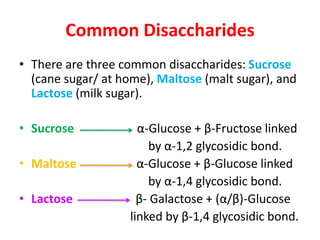
Common Disaccharides
• There are three common disaccharides: Sucrose
(cane sugar/ at home), Maltose (malt sugar), and
Lactose (milk sugar).
• Sucrose α-Glucose + β-Fructose linked
by α-1,2 glycosidic bond.
• Maltose α-Glucose + β-Glucose linked
by α-1,4 glycosidic bond.
• Lactose β- Galactose + (α/β)-Glucose
linked by β-1,4 glycosidic bond.
Polysaccharides
Polysaccharides are polymers of monosaccharides
There are two types of polysaccharides:
• Homopolysaccharides : contain one kind of
monosaccharide.
• Heteropolysaccharides : contain different kinds of
monosaccharides.
Common Polysaccharides
• The most common polysaccharides are: Starch,
cellulose, glycogen, and dextrin.
 All these polysaccharides are only made up of
glucose.
• Plants store their food as starch.
• Plants use cellulose as supporting and structural
parts (wood, cotton, paper).
• Animals store their food as glycogen. And in our
body, glucose is stored in the liver and muscles as
glycogen.
RDA FOR CHO
100-130g/day of CHO in the
form of glucose needed to the
brain above one year of age
The Nutrition Sources of
Carbohydrates
• There are both healthy and unhealthy sources of
carbohydrates. Healthy sources of carbohydrates
include both food sources-animal and plant
products, such as fresh fruits, vegetables, corn,
potatoes, milk and milk products. Unhealthy
sources include soda, white bread, artificial sugar,
pastries, and other highly processed foods.
• Carbohydrates can be found in different forms,
such as sugars, starch, and fibers. Here is a list of
carbohydrates from different sources and
different forms.
Functions of Carbohydrates
• Following are the important carbohydrates
functions:
• These are the main source of energy.
• It is a part of some connecting tissues.
• These also help in maintaining a healthy digestive
system.
• The fibre in carbohydrates helps in lowering
blood cholesterol.
• It retains protein from being burned so it can be
used to build and repair.
• Deficiency of carbohydrates can lead to
– Loss of stamina as they provide energy to the
body.
– Weakening of the body is also one of the factors
related to carbohydrates.
– Constipation
– Lethargy
– Bad breadth
– Dizziness
Energy
Energy, in simple terms, can be
defined as the capacity for doing
work.
Units of energy
The energy value of foods can be
expressed in terms of
kilocalories(Kcal) or megajoules(MJ)
1 Kcal = 4.184 KJ
1000Kcal = 4.184 Megajoules(MJ)
1 MJ = 240Kcal
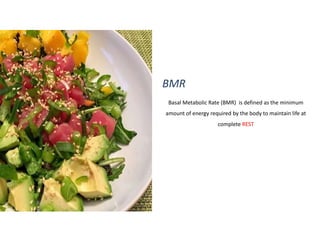
BMR
Basal Metabolic Rate (BMR) is defined as the minimum
amount of energy required by the body to maintain life at
complete REST
FACTORS AFFECTING
BMR
PREGNANCY
• The BMR is not changed during pregnancy.
• The higher value of BMR in late
pregnancy is due to the BMR of the
foetus.
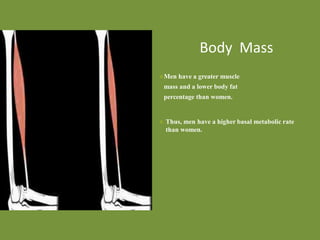
Body Mass
Men have a greater muscle
mass and a lower body fat
percentage than women.
 Thus, men have a higher basal metabolic rate
than women.
EMOTIONAL STATUS
Anxiety and tension may not
show on the face but they do
produce an increased tensing of
the muscles and release of
norepinephrine even though the
subject is seemingly quiet
sleep
During sleep the BMR is less than in
the waking state.
CLIMATE
 Exposure to cold temperature causes an increase in the
BMR, so as to create the extra heat needed to maintain
the body’s internal temperature.
AGE
 BMR reduces with age
 Children have higher BMR than adults.After 20
years, it drops about 2 per cent, per every 10 years
Hormonal changes
Aging is accompanied by hormonal shifts that can slow
down metabolic processes. For instance, women
experience a significant drop in estrogen during
menopause, which can lead to a lower BMR.
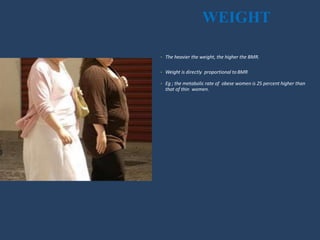
WEIGHT
• The heavier the weight, the higher the BMR.
• Weight is directly proportional to BMR
• Eg ; the metabolic rate of obese women is 25 percent higher than
that of thin women.
UNIT- II CARBOHYDRATES PPT FOR SEM  IInd SEM