Eating Disorders 101
www.NationalEatingDisorders.org
Helpline: myneda.org/helpline
Business Line: 212-575-6200
www.nationaleatingdisorders.org
What Are Eating Disorders?
• Life-threatening
• Extreme emotions and
behaviors surrounding
weight, food & size
• Biological, psychological
& sociocultural factors
www.nationaleatingdisorders.org
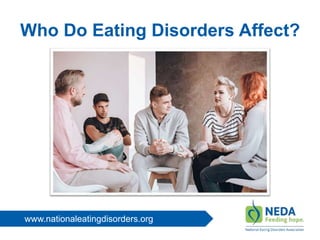
Who Do Eating Disorders Affect?
www.nationaleatingdisorders.org
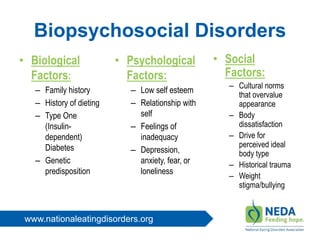
• Biological
Factors:
– Family history
– History of dieting
– Type One
(Insulin-
dependent)
Diabetes
– Genetic
predisposition
• Psychological
Factors:
– Low self esteem
– Relationship with
self
– Feelings of
inadequacy
– Depression,
anxiety, fear, or
loneliness
• Social
Factors:
– Cultural norms
that overvalue
appearance
– Body
dissatisfaction
– Drive for
perceived ideal
body type
– Historical trauma
– Weight
stigma/bullying
Biopsychosocial Disorders
www.nationaleatingdisorders.org
The 9 Truths About
Eating Disorders
• 1. Many people with eating disorders look healthy,
yet may be extremely ill.
• 2. Families are not to blame, and can be the
patients’ and providers’ best allies in treatment.
• 3. An eating disorder diagnosis is a health crisis that
disrupts personal and family functioning.
www.nationaleatingdisorders.org
The 9 Truths About
Eating Disorders
• 4. Eating disorders are not choices, but serious
biologically influenced illnesses.
• 5. Eating disorders affect people of all genders,
ages, races, ethnicities, body shapes and weights,
sexual orientations, and socioeconomic statuses.
• 6. Eating disorders carry an increased risk for both
suicide and medical complications.
www.nationaleatingdisorders.org
The 9 Truths About
Eating Disorders
• 7. Genes and environment play important roles in
the development of eating disorders.
• 8. Genes alone do not predict who will develop
eating disorders.
• 9. Full recovery from an eating disorder is possible.
Early detection and intervention are important.
WARNING SIGNS, SYMPTOMS
& HEALTH CONSEQUENCES
An Overview to Eating Disorders
www.nationaleatingdisorders.org
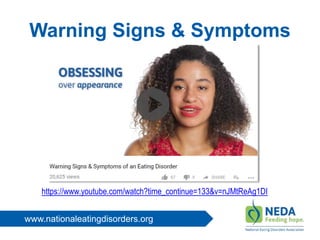
Warning Signs & Symptoms
https://www.youtube.com/watch?time_continue=133&v=nJMtReAg1DI
www.nationaleatingdisorders.org
Common Warning Signs
EMOTIONAL/BEHAVIORAL
• Weight loss, dieting, and
control of food are primary
concerns
• Food rituals
• Social withdrawal
• Frequent dieting, body
checking
• Extreme mood swings
PHYSICAL
• Noticeable weight fluctuations
• Gastrointestinal complaints
• Dizziness upon standing
• Difficulty concentrating,
sleeping
• Issues with dental, skin, hair,
and nail health
www.nationaleatingdisorders.org
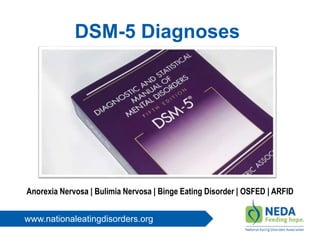
DSM-5 Diagnoses
Anorexia Nervosa | Bulimia Nervosa | Binge Eating Disorder | OSFED | ARFID
www.nationaleatingdisorders.org
Anorexia Nervosa (AN)
• Characterized primarily by self-starvation and
excessive weight loss
• Symptoms include:
– Inadequate food intake leading to a weight that is clearly too
low
– Disturbance in the experience of body weight or shape
– Intense fear of weight gain, obsession with weight, and
persistent behavior to prevent weight gain
– Inability to appreciate the severity of the situation
www.nationaleatingdisorders.org
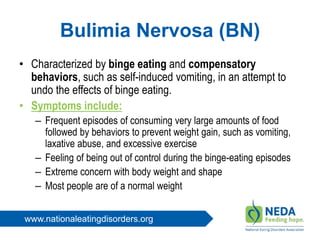
Bulimia Nervosa (BN)
• Characterized by binge eating and compensatory
behaviors, such as self-induced vomiting, in an attempt to
undo the effects of binge eating.
• Symptoms include:
– Frequent episodes of consuming very large amounts of food
followed by behaviors to prevent weight gain, such as vomiting,
laxative abuse, and excessive exercise
– Feeling of being out of control during the binge-eating episodes
– Extreme concern with body weight and shape
– Most people are of a normal weight
www.nationaleatingdisorders.org
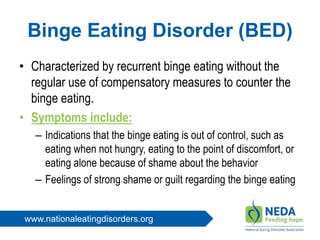
Binge Eating Disorder (BED)
• Characterized by recurrent binge eating without the
regular use of compensatory measures to counter the
binge eating.
• Symptoms include:
– Indications that the binge eating is out of control, such as
eating when not hungry, eating to the point of discomfort, or
eating alone because of shame about the behavior
– Feelings of strong shame or guilt regarding the binge eating
www.nationaleatingdisorders.org
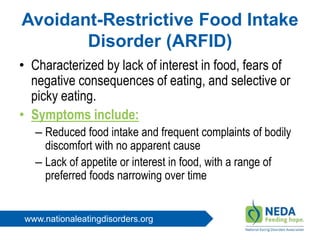
Avoidant-Restrictive Food Intake
Disorder (ARFID)
• Characterized by lack of interest in food, fears of
negative consequences of eating, and selective or
picky eating.
• Symptoms include:
– Reduced food intake and frequent complaints of bodily
discomfort with no apparent cause
– Lack of appetite or interest in food, with a range of
preferred foods narrowing over time
www.nationaleatingdisorders.org
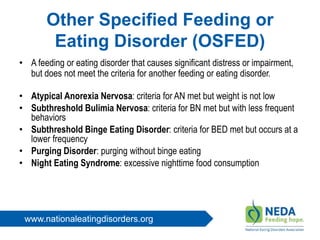
Other Specified Feeding or
Eating Disorder (OSFED)
• A feeding or eating disorder that causes significant distress or impairment,
but does not meet the criteria for another feeding or eating disorder.
• Atypical Anorexia Nervosa: criteria for AN met but weight is not low
• Subthreshold Bulimia Nervosa: criteria for BN met but with less frequent
behaviors
• Subthreshold Binge Eating Disorder: criteria for BED met but occurs at a
lower frequency
• Purging Disorder: purging without binge eating
• Night Eating Syndrome: excessive nighttime food consumption
www.nationaleatingdisorders.org
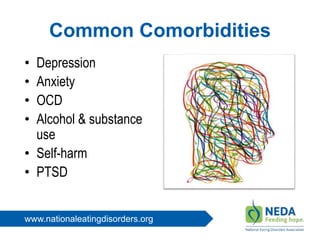
Common Comorbidities
• Depression
• Anxiety
• OCD
• Alcohol & substance
use
• Self-harm
• PTSD
www.nationaleatingdisorders.org
Health Consequences
• Cardiovascular (muscle loss, low or irregular
heartbeat)
• Gastrointestinal (bloating, nausea, constipation)
• Neurological (difficulty concentrating, sleep apnea)
• Endocrine (hormonal changes – estrogen,
testosterone, thyroid)
www.nationaleatingdisorders.org
Serious, Potentially
Fatal Illnesses
• Eating disorders have the second highest mortality rate
of all mental health disorders, surpassed only
by opioid addiction.
• Risk of death from suicide or medical complications is
markedly increased for individuals with eating
disorders.
• A study on BN and EDNOS found elevated mortality
risks similar to those for AN, despite being sometimes
viewed as “less severe”
BARRIERS TO CARE
Self-identification & Weight Stigma
www.nationaleatingdisorders.org
Barriers to Self Identification
• Often an individual with an eating disorder does not
believe they have a problem.
• Many people with eating disorders look healthy, yet
may be extremely ill.
• Eating disorders are often viewed as a disease that
only affects affluent, white women.
www.nationaleatingdisorders.org
What is Weight Stigma?
• Discrimination or stereotyping based on a person’s
weight.
• Risk factor for depression, body dissatisfaction, and
low self-esteem.
• Increases the risk of eating disorder symptoms.
www.nationaleatingdisorders.org
Weight Stigma in Healthcare
• Research shows that healthcare providers, when
talking to obese patients, tend to:
–Provide them with less health information
–Spend less time with them
–View them as undisciplined, annoying, and noncompliant
with treatment.
www.nationaleatingdisorders.org
Do you have higher weight
bias?
https://implicit.harvard.edu/implicit/takeatest.html
SEEKING TREATMENT
Help is Available!
www.nationaleatingdisorders.org
Serious, Life-Threatening,
& Treatable
• Eating disorders are not fads or phases, and they
have the second highest mortality rate of any
psychiatric disorder, surpassed only by opioid
addiction.
• Serious effects on health, productivity, and
relationships
• Early intervention increases likelihood of a full
recovery.
www.nationaleatingdisorders.org
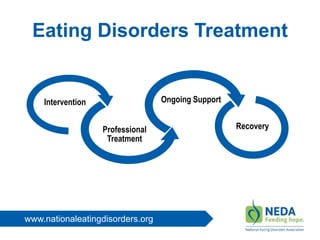
Eating Disorders Treatment
Intervention
Professional
Treatment
Ongoing Support
Recovery
www.nationaleatingdisorders.org
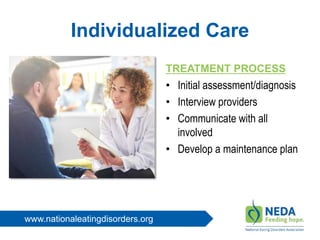
Individualized Care
TREATMENT PROCESS
• Initial assessment/diagnosis
• Interview providers
• Communicate with all
involved
• Develop a maintenance plan
www.nationaleatingdisorders.org
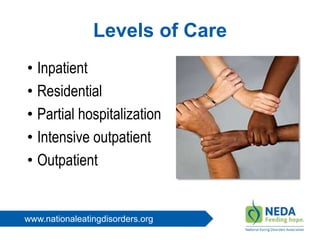
Levels of Care
• Inpatient
• Residential
• Partial hospitalization
• Intensive outpatient
• Outpatient
SUPPORT & RESOURCES
Where to Find Help
www.nationaleatingdisorders.org
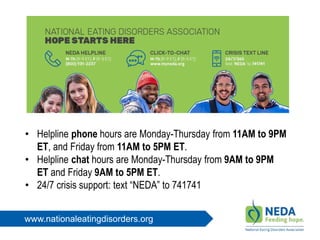
• Helpline phone hours are Monday-Thursday from 11AM to 9PM
ET, and Friday from 11AM to 5PM ET.
• Helpline chat hours are Monday-Thursday from 9AM to 9PM
ET and Friday 9AM to 5PM ET.
• 24/7 crisis support: text “NEDA” to 741741
www.nationaleatingdisorders.org
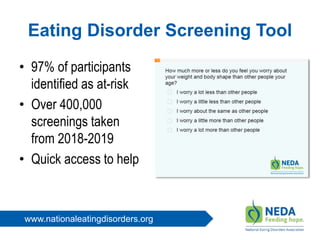
Eating Disorder Screening Tool
• 97% of participants
identified as at-risk
• Over 400,000
screenings taken
from 2018-2019
• Quick access to help
www.nationaleatingdisorders.org
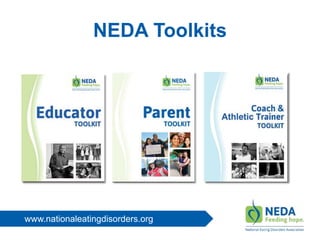
NEDA Toolkits
www.nationaleatingdisorders.org
Brochures
www.nationaleatingdisorders.org
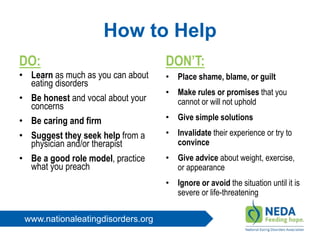
How to Help
DO:
• Learn as much as you can about
eating disorders
• Be honest and vocal about your
concerns
• Be caring and firm
• Suggest they seek help from a
physician and/or therapist
• Be a good role model, practice
what you preach
DON’T:
• Place shame, blame, or guilt
• Make rules or promises that you
cannot or will not uphold
• Give simple solutions
• Invalidate their experience or try to
convince
• Give advice about weight, exercise,
or appearance
• Ignore or avoid the situation until it is
severe or life-threatening
www.nationaleatingdisorders.org
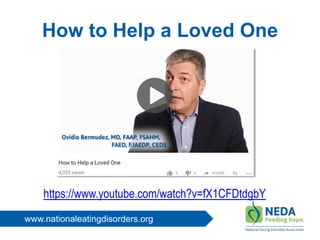
How to Help a Loved One
https://www.youtube.com/watch?v=fX1CFDtdgbY
www.nationaleatingdisorders.org
Talking about Eating Disorders
KEEP IN MIND:
• Don’t provide tips or play
the numbers game.
• Emphasize the
seriousness of eating
disorders without
portraying them as
hopeless.
• Watch out for the
appearance ideal.
• Don't focus on images or
descriptions of the body at
its unhealthiest point.
www.nationaleatingdisorders.org
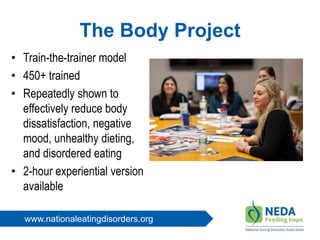
The Body Project
• Train-the-trainer model
• 450+ trained
• Repeatedly shown to
effectively reduce body
dissatisfaction, negative
mood, unhealthy dieting,
and disordered eating
• 2-hour experiential version
available
www.nationaleatingdisorders.org
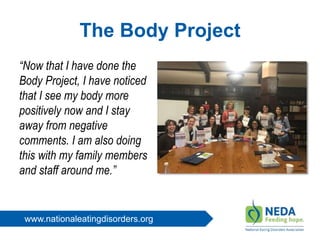
The Body Project
“Now that I have done the
Body Project, I have noticed
that I see my body more
positively now and I stay
away from negative
comments. I am also doing
this with my family members
and staff around me.”
www.nationaleatingdisorders.org
Get Involved With NEDA!
To learn more, contact:
• Business: (212) 575-6200
• NEDA Helpline:
myneda.org/helpline
Email: info@myneda.org

eating disorders