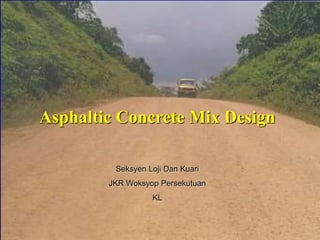
Asphaltic Concrete Mix Design
Seksyen Loji Dan Kuari
JKR Woksyop Persekutuan
KL
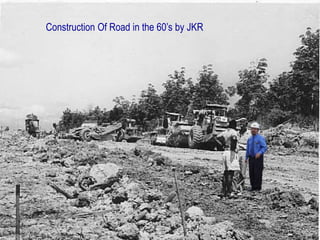
Construction Of Road in the 60’s by JKR
STILL Little PROBLEMS IN ROAD
RESURFACING !
Is this JKR Works After 100 Years
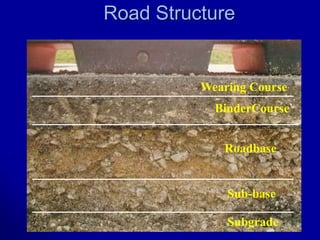
Subgrade
Road Structure
Wearing Course
BinderCourse`
Roadbase
Sub-base
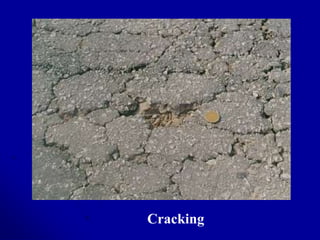
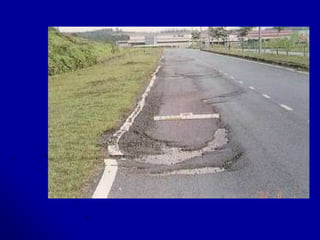
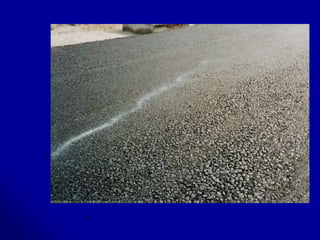
Cracking
Cracking
Why cracking in asphalt surfacing
undesirable?
1. It allows surface water to penetrate into the
lower pavement layers, causing localised
weakening of the pavement structure.
2. It reduces the dynamic modulus of the
surfacing, making it less able to distribute
imposed traffic loads.
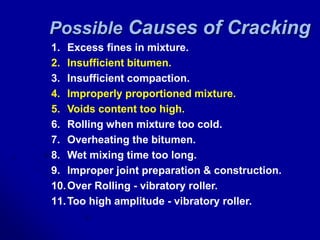
Possible Causes of Cracking
1. Excess fines in mixture.
2. Insufficient bitumen.
3. Insufficient compaction.
4. Improperly proportioned mixture.
5. Voids content too high.
6. Rolling when mixture too cold.
7. Overheating the bitumen.
8. Wet mixing time too long.
9. Improper joint preparation & construction.
10.Over Rolling - vibratory roller.
11.Too high amplitude - vibratory roller.
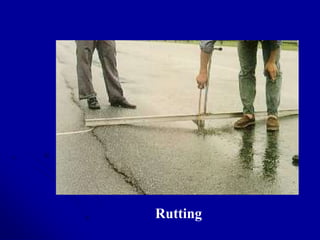
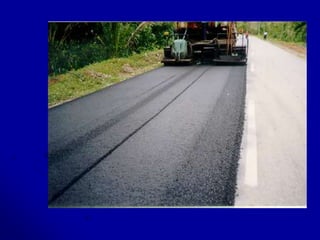
Rutting
Rutting
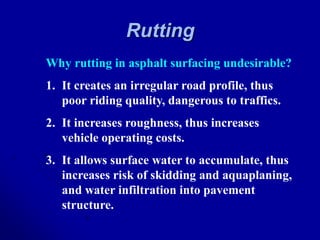
Why rutting in asphalt surfacing undesirable?
1. It creates an irregular road profile, thus
poor riding quality, dangerous to traffics.
2. It increases roughness, thus increases
vehicle operating costs.
3. It allows surface water to accumulate, thus
increases risk of skidding and aquaplaning,
and water infiltration into pavement
structure.
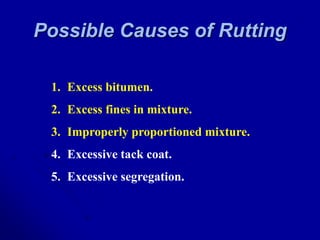
Possible Causes of Rutting
1. Excess bitumen.
2. Excess fines in mixture.
3. Improperly proportioned mixture.
4. Excessive tack coat.
5. Excessive segregation.
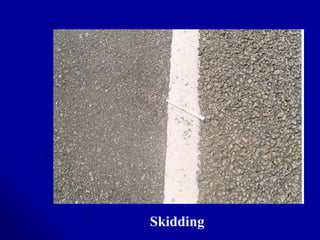
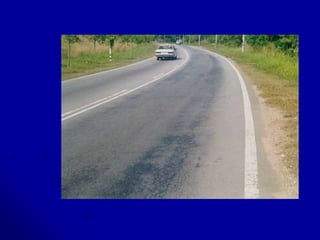
Skidding
Skidding
Does asphaltic concrete road surfacing
lack the necessary macrotexture for
skidding resistance at high speeds ?
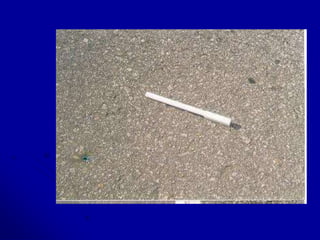
Possible Causes of Smooth
Surface Texture
1. Excess fines in mixture.
2. Excess bitumen.
3. Over rolling.
4. Rolling when mixture too hot.
5. Excessive segregation.
6. Abrasion of aggregates by traffic.
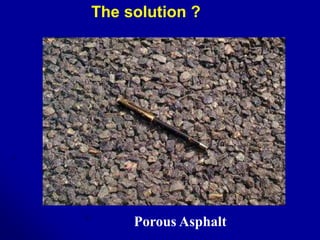
Porous Asphalt
The solution ?
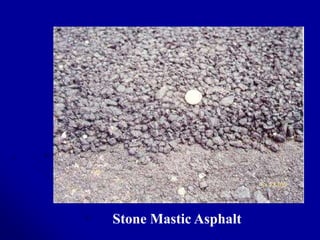
Stone Mastic Asphalt
Component Of Asphalt
 Aggregate
 Filler
 Bitumen
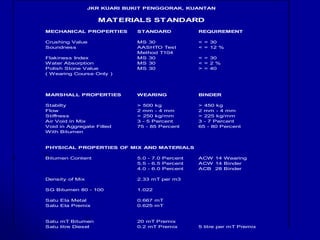
MECHANICAL PROPERTIES STANDARD REQUIREMENT
Crushing Value MS 30 < = 30
Soundness AASHTO Test < = 12 %
Method T104
Flakiness Index MS 30 < = 30
Water Absorption MS 30 < = 2 %
Polish Stone Value MS 30 > = 40
( Wearing Course Only )
MARSHALL PROPERTIES WEARING BINDER
Stabilty > 500 kg > 450 kg
Flow 2 mm - 4 mm 2 mm - 4 mm
Stiffness > 250 kg/mm > 225 kg/mm
Air Void in Mix 3 - 5 Percent 3 - 7 Percent
Void in Aggregate Filled 75 - 85 Percent 65 - 80 Percent
With Bitumen
PHYSICAL PROPERTIES OF MIX AND MATERIALS
Bitumen Content 5.0 - 7.0 Percent ACW 14 Wearing
5.5 - 6.5 Percent ACW 14 Binder
4.0 - 6.0 Percent ACB 28 Binder
Density of Mix 2.33 mT per m3
SG Bitumen 80 - 100 1.022
Satu Ela Metal 0.667 mT
Satu Ela Premix 0.625 mT
Satu mT Bitumen 20 mT Premix
Satu litre Diesel 0.2 mT Premix 5 litre per mT Premix
MATERIALS STANDARD
JKR KUARI BUKIT PENGGORAK, KUANTAN
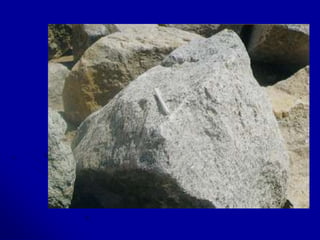
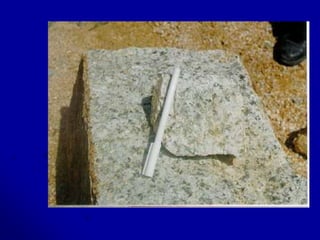
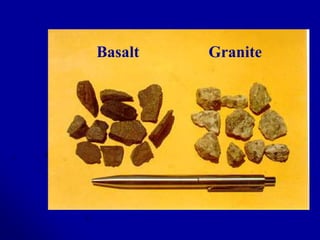
Aggregate - The Major Component Of Premix
Production.
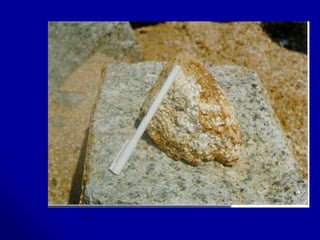
Basalt Granite
Coarse Aggregate Testing
1 Test Per Stockpile Per 2,500 Tons Of Asphaltic
Concrete Produced;
* Aggregate Crushing Value.
* Sodium Sulphate Soundness.
* Flakiness Index.
* Water Absorption.
* Polished Stone Value (Wearing Course Only).
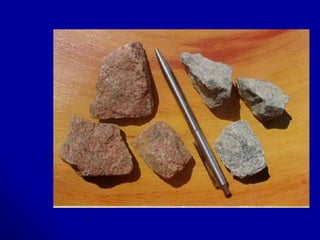
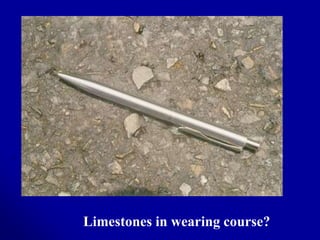
Limestones in wearing course?
Fine Aggregate Testing
1 test per stockpile per 2,500 tons of asphaltic
concrete produced;
* Sodium Sulphate Soundness.
* Water Absorption.
Sand or quarry dust?
Fine aggregate: Natural sand, mining sand or
quarry fines.
Cement or limestone?
Mineral filler: Rock dust, limestone dust, hydrated

lime or hydraulic cement.
Anti-stripping agent: Ordinary Portland cement.
Material passing 75 um to bitumen ratio by weight
0.6 - 1.2.
Mineral Filler / Anti Stripping Agent
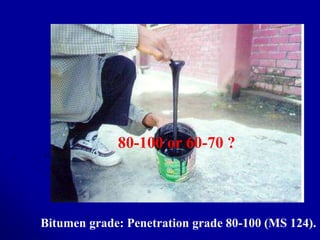
Bitumen grade: Penetration grade 80-100 (MS 124).
80-100 or 60-70 ?
Bitumen Testing
* Penetration.
* Softening point.
* Solubility in Trichloroethylene.
* Ductility.
* Flash point.
* Retained penetration after thin film oven.
* Loss on heating.
Test frequency: Not stated in JKR Guidelines or
JKR/SPJ. Recommends one set of test per every
bitumen delivery to the plant.
BITUMEN QUALITY
PENETRATION TEST
penetration
value
in 0.1 mm
100 gramme
needle
bitumen
at
25
degrees
Celsius
5 seconds
Mix Design
Mix Design Requirements
1. Grading of combined aggregates + filler -
Table 4.8 JKR/SPJ.
2. Bitumen content - Table 4.9 JKR/SPJ.
3. Marshall method of mix design - Clause
4.2.4.3 JKR/SPJ.
4. Test parameters of Marshall specimens -
Table 4.10 JKR/SPJ.
5. Establish design aggregate grading and
bitumen content with tolerances in Table 4.11
JKR/SPJ.
Mix Design Requirements
1. Grading of combined aggregates + filler -
Table 4.8 JKR/SPJ.
2. Bitumen content - Table 4.9 JKR/SPJ.
3. Marshall method of mix design - Clause
4.2.4.3 JKR/SPJ.
4. Test parameters of Marshall specimens -
Table 4.10 JKR/SPJ.
5. Establish design aggregate grading and
bitumen content with tolerances in Table 4.11
JKR/SPJ.
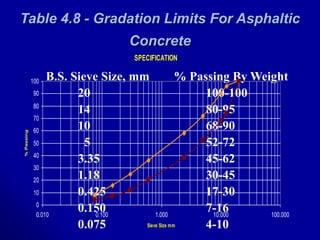
Table 4.8 - Gradation Limits For Asphaltic
Concrete
B.S. Sieve Size, mm % Passing By Weight
20 100-100
14 80-95
10 68-90
5 52-72
3.35 45-62
1.18 30-45
0.425 17-30
0.150 7-16
0.075 4-10
SPECIFICATION
0
10
20
30
40
50
60
70
80
90
100
0.010 0.100 1.000 10.000 100.000
Sieve Size mm
%
Passing
Mix Design Requirements
1. Grading of combined aggregates + filler -
Table 4.8 JKR/SPJ.
2. Bitumen content - Table 4.9 JKR/SPJ.
3. Marshall method of mix design - Clause
4.2.4.3 JKR/SPJ.
4. Test parameters of Marshall specimens -
Table 4.10 JKR/SPJ.
5. Establish design aggregate grading and
bitumen content with tolerances in Table 4.11
JKR/SPJ.
Mix Design Requirements
1. Grading of combined aggregates + filler -
Table 4.8 JKR/SPJ.
2. Bitumen content - Table 4.9 JKR/SPJ.
3. Marshall method of mix design - Clause
4.2.4.3 JKR/SPJ.
4. Test parameters of Marshall specimens -
Table 4.10 JKR/SPJ.
5. Establish design aggregate grading and
bitumen content with tolerances in Table 4.11
JKR/SPJ.
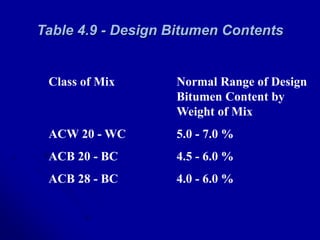
Table 4.9 - Design Bitumen Contents
Class of Mix Normal Range of Design
Bitumen Content by
Weight of Mix
ACW 20 - WC 5.0 - 7.0 %
ACB 20 - BC 4.5 - 6.0 %
ACB 28 - BC 4.0 - 6.0 %
Clause 4.2.4.3 Asphaltic Concrete Mix
Design
1. Prepare specimens for standard stability and
flow tests as per AASHTO T 245 using 75
blows/face.
2. Determine bulk specific gravity of specimens as
per AASHTO T 166.
3. Determine stability and flow values as per
AASHTO T 245.
4. Voids analysis; VMA, VFB, VIM.
Mix Design Method
MS 535
Specification for asphaltic concrete for road
pavement and airfield runway by the Marshall test
method.
Asphalt Institute MS-2
Mix design methods for asphalt concrete.
Mix Design Requirements
1. Grading of combined aggregates + filler -
Table 4.8 JKR/SPJ.
2. Bitumen content - Table 4.9 JKR/SPJ.
3. Marshall method of mix design - Clause
4.2.4.3 JKR/SPJ.
4. Test parameters of Marshall specimens -
Table 4.10 JKR/SPJ.
5. Establish design aggregate grading and
bitumen content with tolerances in Table 4.11
JKR/SPJ.
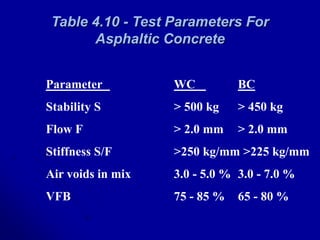
Table 4.10 - Test Parameters For
Asphaltic Concrete
Parameter WC BC
Stability S > 500 kg > 450 kg
Flow F > 2.0 mm > 2.0 mm
Stiffness S/F >250 kg/mm >225 kg/mm
Air voids in mix 3.0 - 5.0 % 3.0 - 7.0 %
VFB 75 - 85 % 65 - 80 %
Mix Design Requirements
1. Grading of combined aggregates + filler -
Table 4.8 JKR/SPJ.
2. Bitumen content - Table 4.9 JKR/SPJ.
3. Marshall method of mix design - Clause
4.2.4.3 JKR/SPJ.
4. Test parameters of Marshall specimens -
Table 4.10 JKR/SPJ.
5. Establish design aggregate grading and
bitumen content with tolerances in Table 4.11
JKR/SPJ.
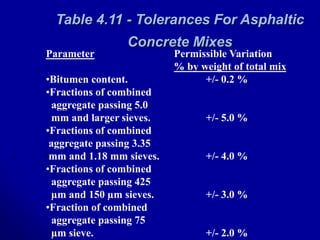
Table 4.11 - Tolerances For Asphaltic
Concrete Mixes
Parameter Permissible Variation
% by weight of total mix
•Bitumen content. +/- 0.2 %
•Fractions of combined
aggregate passing 5.0
mm and larger sieves. +/- 5.0 %
•Fractions of combined
aggregate passing 3.35
mm and 1.18 mm sieves. +/- 4.0 %
•Fractions of combined
aggregate passing 425
µm and 150 µm sieves. +/- 3.0 %
•Fraction of combined
aggregate passing 75
µm sieve. +/- 2.0 %
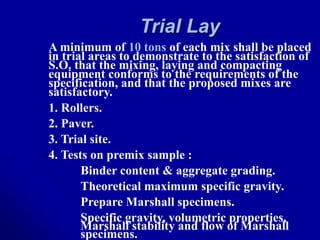
Trial Lay
A minimum of 10 tons of each mix shall be placed
in trial areas to demonstrate to the satisfaction of
S.O. that the mixing, laying and compacting
equipment conforms to the requirements of the
specification, and that the proposed mixes are
satisfactory.
1. Rollers.
2. Paver.
3. Trial site.
4. Tests on premix sample :
Binder content & aggregate grading.
Theoretical maximum specific gravity.
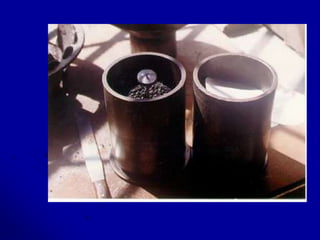
Prepare Marshall specimens.
Specific gravity, volumetric properties,
Marshall stability and flow of Marshall
specimens.
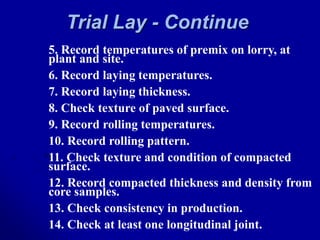
Trial Lay - Continue
5. Record temperatures of premix on lorry, at
plant and site.
6. Record laying temperatures.
7. Record laying thickness.
8. Check texture of paved surface.
9. Record rolling temperatures.
10. Record rolling pattern.
11. Check texture and condition of compacted
surface.
12. Record compacted thickness and density from
core samples.
13. Check consistency in production.
14. Check at least one longitudinal joint.
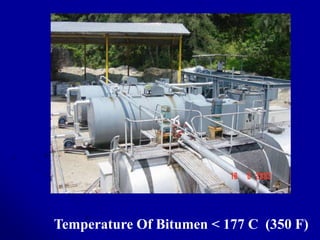
Temperature Of Bitumen < 177 C (350 F)
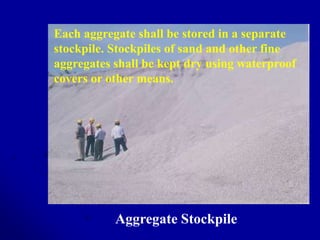
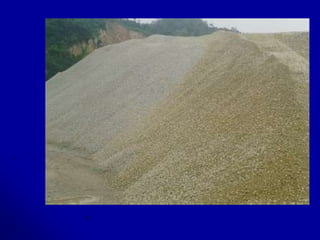
Aggregate Stockpile
Each aggregate shall be stored in a separate
stockpile. Stockpiles of sand and other fine
aggregates shall be kept dry using waterproof
covers or other means.
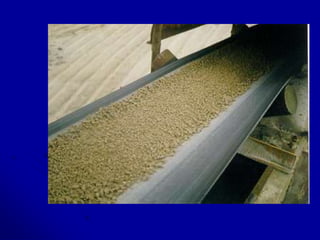
Aggregate Grading Test
Batch plant - 1 test per hot bin per day of
production.
Drum mix plant - 1 test per cold bin per day of
production.
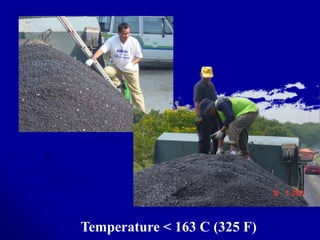
Temperature < 163 C (325 F)
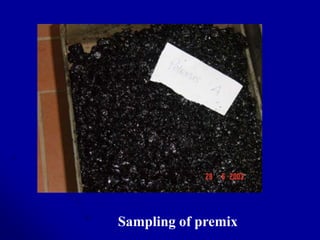
Sampling of premix
Sampling of Premix
Sample quantity:
> 20 mm (eg. ACB28) - minimum 24 kg.
< 20 mm (eg. ACW20) - minimum 16 kg.
Sampling from lorry:
> 20 mm - take 4 increments.
< 20 mm - take 3 increments.
One increment approx. 7 kg (use size 2 square-
mouth shovel).
Scoop 100 mm below surface.
Testing of Premix
1 test per 200 tons of asphaltic concrete produced;
* Bitumen content & grading.
* Maximum specific gravity.
* Preparation of Marshall specimens.
* Bulk specific gravity of Marshall specimens.
* Volumetric properties (VMA, VFB, VIM).
* Marshall stability & flow.
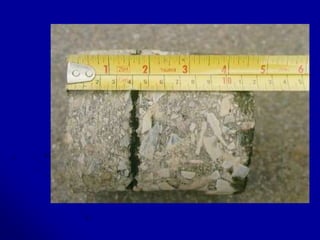
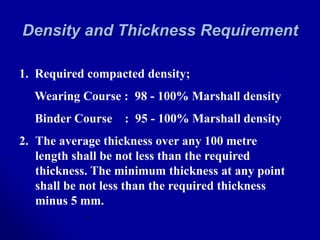
Density and Thickness Requirement
1. Required compacted density;
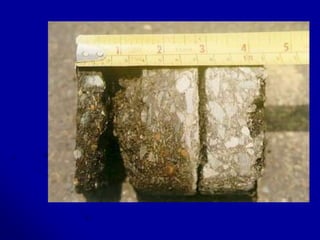
Wearing Course : 98 - 100% Marshall density
Binder Course : 95 - 100% Marshall density
2. The average thickness over any 100 metre
length shall be not less than the required
thickness. The minimum thickness at any point
shall be not less than the required thickness
minus 5 mm.
Terima Kasih

258681760-Asphaltic-Concrete-Mix-Design.ppt

  • 1.
    Asphaltic Concrete MixDesign Seksyen Loji Dan Kuari JKR Woksyop Persekutuan KL
  • 2.
    Construction Of Roadin the 60’s by JKR
  • 3.
    STILL Little PROBLEMSIN ROAD RESURFACING ! Is this JKR Works After 100 Years
  • 5.
  • 6.
  • 7.
    Cracking Why cracking inasphalt surfacing undesirable? 1. It allows surface water to penetrate into the lower pavement layers, causing localised weakening of the pavement structure. 2. It reduces the dynamic modulus of the surfacing, making it less able to distribute imposed traffic loads.
  • 8.
    Possible Causes ofCracking 1. Excess fines in mixture. 2. Insufficient bitumen. 3. Insufficient compaction. 4. Improperly proportioned mixture. 5. Voids content too high. 6. Rolling when mixture too cold. 7. Overheating the bitumen. 8. Wet mixing time too long. 9. Improper joint preparation & construction. 10.Over Rolling - vibratory roller. 11.Too high amplitude - vibratory roller.
  • 9.
  • 10.
    Rutting Why rutting inasphalt surfacing undesirable? 1. It creates an irregular road profile, thus poor riding quality, dangerous to traffics. 2. It increases roughness, thus increases vehicle operating costs. 3. It allows surface water to accumulate, thus increases risk of skidding and aquaplaning, and water infiltration into pavement structure.
  • 11.
    Possible Causes ofRutting 1. Excess bitumen. 2. Excess fines in mixture. 3. Improperly proportioned mixture. 4. Excessive tack coat. 5. Excessive segregation.
  • 12.
  • 13.
    Skidding Does asphaltic concreteroad surfacing lack the necessary macrotexture for skidding resistance at high speeds ?
  • 15.
    Possible Causes ofSmooth Surface Texture 1. Excess fines in mixture. 2. Excess bitumen. 3. Over rolling. 4. Rolling when mixture too hot. 5. Excessive segregation. 6. Abrasion of aggregates by traffic.
  • 17.
  • 18.
  • 19.
    Component Of Asphalt Aggregate  Filler  Bitumen
  • 20.
    MECHANICAL PROPERTIES STANDARDREQUIREMENT Crushing Value MS 30 < = 30 Soundness AASHTO Test < = 12 % Method T104 Flakiness Index MS 30 < = 30 Water Absorption MS 30 < = 2 % Polish Stone Value MS 30 > = 40 ( Wearing Course Only ) MARSHALL PROPERTIES WEARING BINDER Stabilty > 500 kg > 450 kg Flow 2 mm - 4 mm 2 mm - 4 mm Stiffness > 250 kg/mm > 225 kg/mm Air Void in Mix 3 - 5 Percent 3 - 7 Percent Void in Aggregate Filled 75 - 85 Percent 65 - 80 Percent With Bitumen PHYSICAL PROPERTIES OF MIX AND MATERIALS Bitumen Content 5.0 - 7.0 Percent ACW 14 Wearing 5.5 - 6.5 Percent ACW 14 Binder 4.0 - 6.0 Percent ACB 28 Binder Density of Mix 2.33 mT per m3 SG Bitumen 80 - 100 1.022 Satu Ela Metal 0.667 mT Satu Ela Premix 0.625 mT Satu mT Bitumen 20 mT Premix Satu litre Diesel 0.2 mT Premix 5 litre per mT Premix MATERIALS STANDARD JKR KUARI BUKIT PENGGORAK, KUANTAN
  • 23.
    Aggregate - TheMajor Component Of Premix Production.
  • 24.
  • 25.
    Coarse Aggregate Testing 1Test Per Stockpile Per 2,500 Tons Of Asphaltic Concrete Produced; * Aggregate Crushing Value. * Sodium Sulphate Soundness. * Flakiness Index. * Water Absorption. * Polished Stone Value (Wearing Course Only).
  • 27.
  • 30.
    Fine Aggregate Testing 1test per stockpile per 2,500 tons of asphaltic concrete produced; * Sodium Sulphate Soundness. * Water Absorption.
  • 31.
    Sand or quarrydust? Fine aggregate: Natural sand, mining sand or quarry fines.
  • 32.
    Cement or limestone? Mineralfiller: Rock dust, limestone dust, hydrated lime or hydraulic cement. Anti-stripping agent: Ordinary Portland cement. Material passing 75 um to bitumen ratio by weight 0.6 - 1.2. Mineral Filler / Anti Stripping Agent
  • 33.
    Bitumen grade: Penetrationgrade 80-100 (MS 124). 80-100 or 60-70 ?
  • 34.
    Bitumen Testing * Penetration. *Softening point. * Solubility in Trichloroethylene. * Ductility. * Flash point. * Retained penetration after thin film oven. * Loss on heating. Test frequency: Not stated in JKR Guidelines or JKR/SPJ. Recommends one set of test per every bitumen delivery to the plant.
  • 35.
    BITUMEN QUALITY PENETRATION TEST penetration value in0.1 mm 100 gramme needle bitumen at 25 degrees Celsius 5 seconds
  • 36.
  • 39.
    Mix Design Requirements 1.Grading of combined aggregates + filler - Table 4.8 JKR/SPJ. 2. Bitumen content - Table 4.9 JKR/SPJ. 3. Marshall method of mix design - Clause 4.2.4.3 JKR/SPJ. 4. Test parameters of Marshall specimens - Table 4.10 JKR/SPJ. 5. Establish design aggregate grading and bitumen content with tolerances in Table 4.11 JKR/SPJ.
  • 40.
    Mix Design Requirements 1.Grading of combined aggregates + filler - Table 4.8 JKR/SPJ. 2. Bitumen content - Table 4.9 JKR/SPJ. 3. Marshall method of mix design - Clause 4.2.4.3 JKR/SPJ. 4. Test parameters of Marshall specimens - Table 4.10 JKR/SPJ. 5. Establish design aggregate grading and bitumen content with tolerances in Table 4.11 JKR/SPJ.
  • 41.
    Table 4.8 -Gradation Limits For Asphaltic Concrete B.S. Sieve Size, mm % Passing By Weight 20 100-100 14 80-95 10 68-90 5 52-72 3.35 45-62 1.18 30-45 0.425 17-30 0.150 7-16 0.075 4-10 SPECIFICATION 0 10 20 30 40 50 60 70 80 90 100 0.010 0.100 1.000 10.000 100.000 Sieve Size mm % Passing
  • 42.
    Mix Design Requirements 1.Grading of combined aggregates + filler - Table 4.8 JKR/SPJ. 2. Bitumen content - Table 4.9 JKR/SPJ. 3. Marshall method of mix design - Clause 4.2.4.3 JKR/SPJ. 4. Test parameters of Marshall specimens - Table 4.10 JKR/SPJ. 5. Establish design aggregate grading and bitumen content with tolerances in Table 4.11 JKR/SPJ.
  • 43.
    Mix Design Requirements 1.Grading of combined aggregates + filler - Table 4.8 JKR/SPJ. 2. Bitumen content - Table 4.9 JKR/SPJ. 3. Marshall method of mix design - Clause 4.2.4.3 JKR/SPJ. 4. Test parameters of Marshall specimens - Table 4.10 JKR/SPJ. 5. Establish design aggregate grading and bitumen content with tolerances in Table 4.11 JKR/SPJ.
  • 44.
    Table 4.9 -Design Bitumen Contents Class of Mix Normal Range of Design Bitumen Content by Weight of Mix ACW 20 - WC 5.0 - 7.0 % ACB 20 - BC 4.5 - 6.0 % ACB 28 - BC 4.0 - 6.0 %
  • 45.
    Clause 4.2.4.3 AsphalticConcrete Mix Design 1. Prepare specimens for standard stability and flow tests as per AASHTO T 245 using 75 blows/face. 2. Determine bulk specific gravity of specimens as per AASHTO T 166. 3. Determine stability and flow values as per AASHTO T 245. 4. Voids analysis; VMA, VFB, VIM.
  • 46.
    Mix Design Method MS535 Specification for asphaltic concrete for road pavement and airfield runway by the Marshall test method. Asphalt Institute MS-2 Mix design methods for asphalt concrete.
  • 47.
    Mix Design Requirements 1.Grading of combined aggregates + filler - Table 4.8 JKR/SPJ. 2. Bitumen content - Table 4.9 JKR/SPJ. 3. Marshall method of mix design - Clause 4.2.4.3 JKR/SPJ. 4. Test parameters of Marshall specimens - Table 4.10 JKR/SPJ. 5. Establish design aggregate grading and bitumen content with tolerances in Table 4.11 JKR/SPJ.
  • 48.
    Table 4.10 -Test Parameters For Asphaltic Concrete Parameter WC BC Stability S > 500 kg > 450 kg Flow F > 2.0 mm > 2.0 mm Stiffness S/F >250 kg/mm >225 kg/mm Air voids in mix 3.0 - 5.0 % 3.0 - 7.0 % VFB 75 - 85 % 65 - 80 %
  • 49.
    Mix Design Requirements 1.Grading of combined aggregates + filler - Table 4.8 JKR/SPJ. 2. Bitumen content - Table 4.9 JKR/SPJ. 3. Marshall method of mix design - Clause 4.2.4.3 JKR/SPJ. 4. Test parameters of Marshall specimens - Table 4.10 JKR/SPJ. 5. Establish design aggregate grading and bitumen content with tolerances in Table 4.11 JKR/SPJ.
  • 50.
    Table 4.11 -Tolerances For Asphaltic Concrete Mixes Parameter Permissible Variation % by weight of total mix •Bitumen content. +/- 0.2 % •Fractions of combined aggregate passing 5.0 mm and larger sieves. +/- 5.0 % •Fractions of combined aggregate passing 3.35 mm and 1.18 mm sieves. +/- 4.0 % •Fractions of combined aggregate passing 425 µm and 150 µm sieves. +/- 3.0 % •Fraction of combined aggregate passing 75 µm sieve. +/- 2.0 %
  • 51.
    Trial Lay A minimumof 10 tons of each mix shall be placed in trial areas to demonstrate to the satisfaction of S.O. that the mixing, laying and compacting equipment conforms to the requirements of the specification, and that the proposed mixes are satisfactory. 1. Rollers. 2. Paver. 3. Trial site. 4. Tests on premix sample : Binder content & aggregate grading. Theoretical maximum specific gravity. Prepare Marshall specimens. Specific gravity, volumetric properties, Marshall stability and flow of Marshall specimens.
  • 52.
    Trial Lay -Continue 5. Record temperatures of premix on lorry, at plant and site. 6. Record laying temperatures. 7. Record laying thickness. 8. Check texture of paved surface. 9. Record rolling temperatures. 10. Record rolling pattern. 11. Check texture and condition of compacted surface. 12. Record compacted thickness and density from core samples. 13. Check consistency in production. 14. Check at least one longitudinal joint.
  • 53.
    Temperature Of Bitumen< 177 C (350 F)
  • 54.
    Aggregate Stockpile Each aggregateshall be stored in a separate stockpile. Stockpiles of sand and other fine aggregates shall be kept dry using waterproof covers or other means.
  • 55.
    Aggregate Grading Test Batchplant - 1 test per hot bin per day of production. Drum mix plant - 1 test per cold bin per day of production.
  • 58.
  • 59.
  • 60.
    Sampling of Premix Samplequantity: > 20 mm (eg. ACB28) - minimum 24 kg. < 20 mm (eg. ACW20) - minimum 16 kg. Sampling from lorry: > 20 mm - take 4 increments. < 20 mm - take 3 increments. One increment approx. 7 kg (use size 2 square- mouth shovel). Scoop 100 mm below surface.
  • 61.
    Testing of Premix 1test per 200 tons of asphaltic concrete produced; * Bitumen content & grading. * Maximum specific gravity. * Preparation of Marshall specimens. * Bulk specific gravity of Marshall specimens. * Volumetric properties (VMA, VFB, VIM). * Marshall stability & flow.
  • 67.
    Density and ThicknessRequirement 1. Required compacted density; Wearing Course : 98 - 100% Marshall density Binder Course : 95 - 100% Marshall density 2. The average thickness over any 100 metre length shall be not less than the required thickness. The minimum thickness at any point shall be not less than the required thickness minus 5 mm.
  • 70.