Applying Triangle Congruenceto Construct
Perpendicular Lines and Angle Bisector
OBJECTIVES:
K: define and illustrate perpendicular line and angle
bisector;
S: apply triangle congruence to construct perpendicular
line and angle bisector and solve missing parts.;
A: appreciate the importance of learning how to apply
triangle congruence in real-life situations.
2.
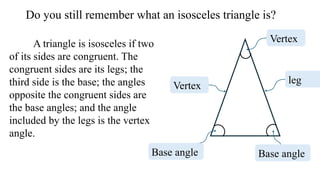
Do you stillremember what an isosceles triangle is?
A triangle is isosceles if two
of its sides are congruent. The
congruent sides are its legs; the
third side is the base; the angles
opposite the congruent sides are
the base angles; and the angle
included by the legs is the vertex
angle.
Vertex
Vertex
leg
Base angle
Base angle
3.
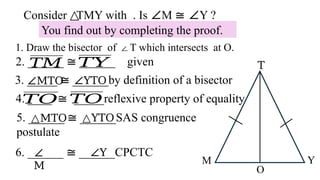
Consider TMY with. Is
△ ∠M ≅ ∠Y ?
You find out by completing the proof.
1. Draw the bisector of T which intersects at O.
∠
2. ______ ≅ ______ given
3. _____ ≅ ______by definition of a bisector
∠MTO ∠YTO
4. ____ ≅ _____reflexive property of equality
𝑇𝑂 𝑇𝑂
5. ______ ≅ ______SAS congruence
postulate
△MTO △YTO
𝑇𝑌
𝑇𝑀
6. ______ ≅ ______CPCTC
∠
M
∠Y
O
M Y
T
4.
A bisector isan object (a line, a ray, or line segment)
that cuts another object (an angle, a line segment) into two
equal parts. A bisector cannot bisect a line, because by
definition a line is infinite.
A perpendicular bisector is a line segment that aside
from splitting another segment into two equal parts, it also
forms a right angle (90˚ or 90 degrees) with the said
segment.
5.
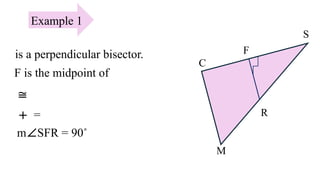
Example 1
is aperpendicular bisector.
F is the midpoint of
≅
+ =
m∠SFR = 90˚
R
M
S
C
F
6.
The Perpendicular BisectorTheorem states that a point
is on the perpendicular bisector of a segment if and only
if it is equidistant from the endpoints of the segment.
Example 2
7.
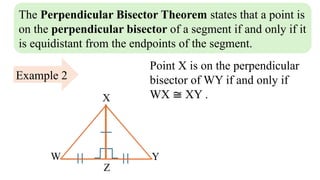
The Perpendicular BisectorTheorem states that a point is
on the perpendicular bisector of a segment if and only if it
is equidistant from the endpoints of the segment.
Z
W Y
X
Example 2
Point X is on the perpendicular
bisector of WY if and only if
WX ≅ XY .
8.
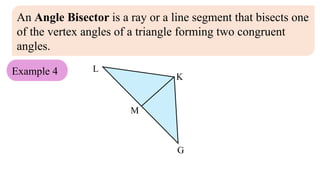
An Angle Bisectoris a ray or a line segment that bisects one
of the vertex angles of a triangle forming two congruent
angles.
Example 4
M
L
G
K
9.
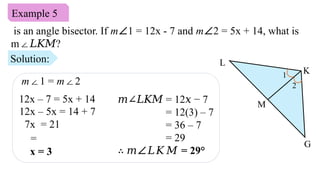
Example 5
is anangle bisector. If m∠1 = 12x - 7 and m∠2 = 5x + 14, what is
m ?
∠𝐿𝐾𝑀
M
L
G
K
1
2
Solution:
12x – 5x = 14 + 7
7x = 21
=
x = 3
𝑚∠𝐿𝐾𝑀 = 12 − 7
𝑥
= 12(3) – 7
= 36 – 7
= 29
∴ 𝑚∠𝐿𝐾𝑀 = 29°
m 1 =
∠ m 2
∠
12x – 7 = 5x + 14
10.
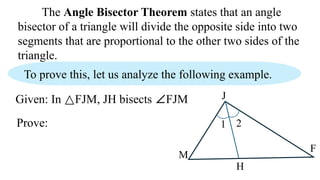
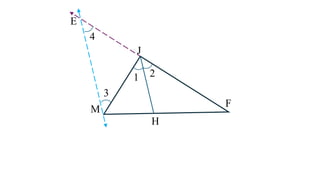
The Angle BisectorTheorem states that an angle
bisector of a triangle will divide the opposite side into two
segments that are proportional to the other two sides of the
triangle.
To prove this, let us analyze the following example.
Given: In △FJM, JH bisects ∠FJM
M
H
J
F
Prove: 1 2
M
H
J
F
1
2
E
4
3
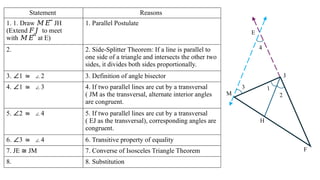
Statement Reasons
1. 1.Draw JH
𝑀𝐸 ⃡
(Extend to meet
𝐹 𝐽
with at E)
𝑀𝐸 ⃡
1. Parallel Postulate
2. 2. Side-Splitter Theorem: If a line is parallel to
one side of a triangle and intersects the other two
sides, it divides both sides proportionally.
3. ∠1 2
≅ ∠ 3. Definition of angle bisector
4. ∠1 3
≅ ∠ 4. If two parallel lines are cut by a transversal
( JM as the transversal, alternate interior angles
are congruent.
5. ∠2 4
≅ ∠ 5. If two parallel lines are cut by a transversal
( EJ as the transversal), corresponding angles are
congruent.
6. ∠3 4
≅ ∠ 6. Transitive property of equality
7. JE ≅ JM 7. Converse of Isosceles Triangle Theorem
8. 8. Substitution
13.
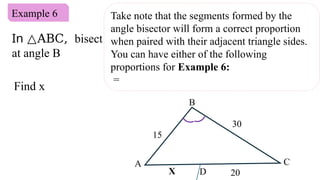
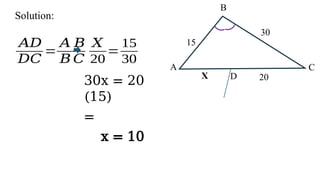
Example 6
Find x
Takenote that the segments formed by the
angle bisector will form a correct proportion
when paired with their adjacent triangle sides.
You can have either of the following
proportions for Example 6:
=
B
20
X
30
15
C
A
D
In △ABC, bisect
at angle B


![Euclidean Geometry, angles, lines and congruent triangles [Autosaved].pptx](https://cdn.slidesharecdn.com/ss_thumbnails/euclideangeometryangleslinesandcongruenttrianglesautosaved-250906144946-073f53ad-thumbnail.jpg?width=640&height=640&fit=bounds)


