Chapter 1
INTRODUCTION
Monoacylglylcerols (MAG) are the most widely used as emulsifiers in
food, pharmaceutical and cosmetic industries (Thude et al.,1997). They have
excellent emulsifying properties, are low odor and taste. MAG are
biodegradable and generally recognized as safe (GRAS). At present, they are
manufactured by continuous chemical glycerolysis of fats and oils at high
temperatures (220-250 °C) employing inorganic alkaline catalysts under
nitrogen gas atmosphere. The result is a crude mixture of mono-and
diglycerides (roughly equal amounts) and some unreacted triglycerides (overall
conversion 90 %). The product has several drawbacks, e.g., low yield, dark
color and burnt test etc. (Thude et al., 1997). Further separation is generally
carried out by molecular distillation yielding high-purity MAG (>90 %)
(Diks and Bosley, 2000).
Due to very high temperature applied during glycerolysis,
decomposition and oxidation reactions take place which often result in a darkcolored and burnt-flavor product. Obviously, this requires extensive purification
during further downstream processing. Because of the ambient reaction
temperature applied, biocatalysis can potentially yield a higher quality product
with lower energy consumption in a more ‘natural’ type process.
Lipases or glycerol ester hydrolases (EC 3.1.1.3) were originally
employed for the hydrolysis of ester bonds of triacylglycerols (TAG) to produce
free fatty acids (FFA), glycerol and partial acylglycerols (e.g., MAG
and diacylglycerols: DAG). In addition to plants and animals, these enzymes
are widespread in many microorganisms which are also capable of actively
producing these enzymes both in endogenous and exogenous forms
(Balcao et al., 1996).

1
2
By immobilizing the enzyme, it is possible to operate enzymatic
processes

continuously

with

all

the

attendant

advantages.

Enzyme

immobilization has been accomplished by chemical and physical attachment to
solid surfaces (Prazeres and Cabral, 1994). Several approaches for the synthesis
of MAG by immobilized lipase have been reports. They include selective
hydrolysis using 1,3-specific lipases (Holmberg and Osterberg, 1988),
esterification of FFA with glycerol (Kwon et al., 1995) and especially
glycerolysis of fats and oils (McNeill et al., 1991), which high yield of MAG
was obtained. Reactions were performed in reverse micelles, water-organic
biphasic systems, organic solvents, solvent free systems and in solid-state with
several reactors namely, batch stirred-tank reactors (BSTR), continuous stirredtank reactors (CSTR), packed-bed reactors (PBR), fluidized-bed reactors (FBR)
or membrane reactors (MR)(Thude et al., 1997).
The oil palm (Elaeis guineensis) is widely cultivated in Southern of
Thailand. The yield of palm olein is more than domestic food oil consumption
so the price is low. Production of MAG from palm olein is an alternative that
increases advantages and value added of palm olein. Consequently, the aim of
this research is to investigate the continuous glycerolysis of palm olein for
MAG production by immobilized lipase in suitable bioreactors and scale up the
system.
3
Literature Review
1. Palm Oil
The oil palm produces two distinct oils: palm oil from the fleshy
mesocarp and palm kernel oil from the fruit kernel. The usage of both oils is
extended by fractionation. Palm oil gives a more valuable olein (an excellent
frying oil) and a less valuable stearin (used in part as a replacement for tallow in
the oleochemical industry). The stearin is the major fraction of palm kernel oil.
The oils and their fractions can be further modified by blending with other oils,
by partial hydrogenation, or by interesterification. Further fractionation of the
palm oil fractions yields an intermediate fraction (PMF, palm midfraction) that
can be used as a cocoa butter extender (Gunstone, 1997). Palm oil is
characterized by high levels of carotene and of tocopherols and tocotrienols
(vitamin E), which can also be isolated or concentrated as products of
considerable value. Palm oil fatty acid distillate (PFAD), a by-product of the
principal refining procedure, is an important component of animal feed
(Gunstone, 1997).
Palm oil is widely used as a food oil with limited non-food uses also.
It differs from other commercially available oils in its fatty acid and TAG
composition. It contains almost equal amounts of saturated acids (mainly
palmitic with some stearic) and unsaturated acids (mainly oleic with some
linoleic acid). The proportion of palmitic and oleic acids in the major TAG
leads to stability of the crystals. These are very desirable in the production of
margarines and shortenings, especially those with high levels of unsaturated
acids. Some information on TAG composition is given in Table 1
(Gunstone, 1997). The major fatty acids in palm oil are palmitic acid and stearic
acid. While the major triacylglycerols are POP and POO or PLSt.
4
Table 1 Triacylglycerol composition of palm oil
(i)

Major triacylglycerols (%)
PPP

POP

PLP

POSt

POO,

PLO

OOO

Other

PLSt
7

33

7

6

23

7

3

14

5

43

8

4

29

8

2

1

7

31

9

6

23

9

4

11

(ii)

Distribution of fatty acids between sn-1, -2, and –3 positions (%)
16:0

18:0

18:1

18:2

TAG

48.4

3.7

36.3

10.0

Sn-1

60.1

3.4

26.8

9.3

Sn-2

13.3

0.2

67.9

17.5

Sn-3

71.9

7.6

14.4

3.2

Source : Gunstone (1997)

2. Lipases
Lipases or glycerol ester hydrolases (EC 3.1.1.3) were originally
employed for the hydrolysis of ester bonds of TAG to produce FFA, glycerol
and partial acylglycerols (MAG and DAG)
2.1 Sources of lipases
Lipases occur widely in animals, plants and microorganisms.
Numerous mammalian tissues, organs and fluids, such as pancreas, kidney,
adipose tissue, heart, brain, muscle and serum, have been known to contain
lipases. Among animal lipases pancreatic lipase has been studied most
extensively. The hog pancreatic lipase has been studied most extensively,
presumably because of its high concentration (2.5% of the total protein in the
pig pancreatic juice) and high turnover number. Moreover, the presence of
5
esterolytic enzymes in the milk of cow, sow, goat, sheep, and human has been
known for a long time (Shahani, 1975).
Numerous fruits, vegetables, plant tissues, and particularly plant
seeds, such as wheat, oat, rye, cotton, soybean, castor bean, and Vernonia
anthelmintica, have been known to exhibit lipase activity. Among the lipases of
plant origin, the acid lipase of castor bean (Ricinus communis) is the most
extensively investigated lipase that exists in dormant seeds (Shahani, 1975).
In general, the germ portions of wheat, rye, and barley contain a much higher
level of lipolytic enzyme activity than the endosperm, and the scutellum section
and aleurone layer are also reportedly rich in lipase. (Shahani, 1975)
During recent years considerable attention has been devoted to lipases
produced by microorganisms, presumably because of their stability and their
practical medical and industrial applications. Several microorganisms produce
intracellular or extracellular lipases. Especially, extracellular microbial lipases
have high potential for application and are appropriated for mass production.
A variety of microorganisims produce lipases. These include the genera of
Candida yeast; Rhizopus, Penicillium, Aspergillus, Geotrichium and Mucor
molds; and Pseudomonas, Achromobacter, and Staphylococcus bacteria
(Godtfredsen, 1993).
2.2 Function of lipases
Lipases catalyze three types of reaction. The catalytic action of lipases
is reversible. It catalyzes ester synthesis in a microaqeous system. However, in
view of biotransformation of oleochemical industry yielding value-added
products, the transesterification action seems more worthwhile than hydrolysis
and ester synthesis. The difference in free energy involved in TAG hydrolysis is
quite small and the net free energy of transesterification is zero. Consequently,
transesterification reaction takes place easily. Transesterification is categorized
into four subdivisions according to the chemical species with which the ester
reacts. Some researchers designate these four types of reaction by
6
“interesterification”

but

Yamane

(1987)

prefers

transesterification

to

interesterification as the technical term covering all four types of reaction
because in biochemistry transfer of a group from one chemical species to
another is called “trans”, such as transglycosylation, transpeptidylation,
transphophatidylation.

Therefore,

the

author

confines

the

term

interesterification only to the type 3 reaction (ester exchange) (Yamane, 1987).
However, Gandhi (1997) suggested that lipase catalyzed reaction has
classically been divided into two main categories: (i) hydrolysis, and
(ii) synthesis. Reactions under synthesis category can be further separated:
(a) esterification, (b) interesterification, (c) alcoholysis and (d) acidolysis
(Figure 1). The last three reactions are often grouped together into a single term,
viz, transesterification.
(i) Hydrolysis
'

'

RCOOH + R OH

RCOOR + H2O
(ii) Synthesis
(a) Esterification
'

'

RCOOH + R OH

RCOOR + H2O

(b) Interesterification
'

''

*

RCOOR + R COOR

*

''

(c) Alcoholysis
'

''

'

''

RCOOR + R OH

''

R COOR + RCOOH

RCOOR + R OH
(d) Acidolysis
'

RCOOR + R COOH

Figure 1 Types of reaction catalyzed by lipases
Source : Gandhi (1997)

'

RCOOR + R COOR

''

'
7
2.3 Specificity of lipases
Macrae (1983) divided lipases into three groups according to their
specificity. The first group shows no marked specificity both as regards the
position on the glycerol molecule which is attacked and the nature of the fatty
acid released. The second group of lipases catalyzes the release of fatty acids
specifically from the outer 1- and 3-positions of glycerides. The third group of
lipases catalyses the specific release of a particular type of fatty acid from
glyceride molecules.
However, Malcata et al. (1992) divided lipases into five major types :
(i) lipid class, (ii) positional, (iii) fatty acid, (iv) stereochemical and
(v) combinations thereof.
Lipid class selectivity has been observed in animal plasma which
apparently contains separate lipoprotein lipases for the hydrolysis of TAG,
DAG and MAG. A lipase produced by a strain of Penicillium cyclopium has
been shown to display its highest activity on MAG and much lower activity
toward DAG and TAG. This type of selectivity is dependent on temperature for
a lipase from Pseudomonas fluorescens (Malcata et al.,1992).
Lipases obtained from natural sources can be positionally nonspecific
or display one of two kinds of positional specificity: sn-1,3 specific or
sn-2 specific. Non-specific lipases hydrolyse all three ester bonds of
triglycerides equally well. Nonspecificity has been observed for lipases from
Chromobacterium viscosum, Pseudomonas fluorescens, Candida cylindracea,
Geotrichum candidum, and Penicillium cyclopium, and also for hepatic lipase.
Specificity of the sn-1,3 type is associated with the preferential release of fatty
acid residues from the terminal positions of the glycerol backbone rather than
from the central carbon atom, whereas sn-2 specificity refers to preferential
release from the central carbon atom. The sn-1,3 type of specificity has been
observed for pancreatic and adipose tissue lipases and lipase from
microorganism such as Rhizopus arrhizus, Aspergillus niger, Rhizopus delemar
8
and Mucor miehei. The sn-2 specificity is extremely rare, and it has been
ascribed to a lipase from Geotrichum candidum which has a particular ability to
hydrolyse oleic and linoleic acids from the sn-2 location. A more general
classification states that the positional specificity of lipases is not divided
clearly into the above categories; instead it changes continuously from highly
specific an-1,3 activity to a very weakly specific or completely nonspecific
activity (Malcata et al.,1992).
Lipase often exhibit a particular ability to release fatty acids whose
chain lengths or degrees of unsaturation fall within well-defined ranges. This
situation has been explored in the lipase-catalysed production of cheese-type
flavors. The lipase from Mucor miehei exhibits similar activities for release of
C4 and C6 acids at either pH 5.3 or 8.0; however, longer chain fatty acids are
released more slowly at the acidic pH. Experimental data for the fatty acid
specificities of lipases from Chromobacterium viscosum and Geotrichum
candidum indicate that the rate of attack by these lipases follows a bell-shaped
distribution in the number of carbon atoms in the hydrocarbon backbones of
unsaturated fatty acid residues. The distribution is centered at C8-C10
(Malcata et al.,1992).
Although early studies did not report evidence of any kinds of
stereospecificty for the catalytic action of lipases on fats and oils, a rather large
body of literature dealing with the preparation of chiral esters and alcohols via
lipase-mediated kinetic resolution of racemic (nontriglyceride) substrates is
currently available. A number of researchers have observed stereoselectivity for
the catalytic action of lipases on such substrates as straight-chain secondary
alcohols, acetonide and butyric acid optically active esters, oxazolidones,
glycidyl ethers, cyclohexanols, 2-benzylglycerol ether, sugar alcohols, and
several esters of ibuprofen. Stereoselectivity has also been observed with serum
lipoprotein lipase for hydrolysis of the enantiomeric esters at the sn-1 position,
and with human and rat lingual lipases for the hydrolysis of enantiomeric esters
9
at the sn-3 position. Finally, combinations of fatty acids and stereoselectivities
have been found with rat lingual and a human lipoprotein lipase preparation.
(Malcata et al.,1992)
Moreover, Diks and Bosley (2000) divided lipases into three classes
based on their specificity and selectivity (Table 2): 1) Regio- or positional
specific; 2) Fatty acid type specific; 3) Specific for a certain class of
acylglycerols, i.e., MAG, DAG or TAG.
Table 2 Major specificities of lipases and their applications
Specificity
Regio specificity
1,3-Regio specific

Lipases
Rhizomucor miehei
Rhizopus oryzae
Rhizopus arrhizus
Rhizopus delemar
Rhizopus niveus
Porcine pancreatic lipase
Non-specific

Fatty acid specific
Long chain polyunsaturated acids
Saturated acids
cis-∆9 unsaturated acids
Short acids
Acylglycerol specific
Monoacylglycerols
Mono-and
diacylglycerols
Triacylglycerols

Candida rugosa
Chromobacterium
viscosum
Pseudomonas fluorescens
Pseudomonas cepacia

Production of
Triglyceride synthesis
1,2(2,3)-diglycerides by
triglyceride hydrolysis
1,3-diglyceride by fatty acid
(directed) esterification
2-monoglycerides by
triglyceride hydrolysis
1(3)-monoglycerides by
fatty acid esterification
Fatty acid production by
hydrolysis
mono- and diglycerides by
directed glycerolysis
Selective hydrolysis

Geotrichum candidum
Candida rugosa
Fusarium oxysporum
Geotrichum candidum B
Cuphea sp.

Selective hydrolysis

Potato acylhydrolase
(patatin)
Penicillium camembertii
Penicillium cyclopium M1
Fusarium sp.
Penicillium roquefortii
Penicillium cyclopium M1
Penicillium expansum

Monoglycerides by fatty
acid esterification
Monoglycerides and
diglycerides by fatty acid
esterification
1,2-Diglycerides by
triglyceride hydrolysis or
alcoholysis

Source : Diks and Bosley (2000)
10
2.4 Application of lipase
Lipase can be employed in the production of pharmaceuticals,
cosmetics, leather, detergents, foods, perfumery, medical diagnostics, and other
organic synthetic materials (Gandhi, 1997). Table 3 lists major application areas
for lipases as well as the most important uses of the enzymes in the food sector
(Godtfredsen, 1993). Moreover, lipases have found applications in various
fields of biotransformations. These can be classified according to the nature of
the substrates into three main categories: (i) modification of fats and oils,
(ii) acylation/deacylation of carbohydrates and protecting/deprotecting of
peptides and (iii) synthesis of chiral compounds. The major focus will be given
to the first field. These can be classified depending on the targeted product into
the synthesis of MAG, an important class of emulsifiers and the synthesis of
structured triglycerides, which are used as, e.g., cocoa-butter equivalents or in
nutrition. Furthermore, lipases have found some special applications such as in
the selective enrichment of specific fatty acids.
3. Immobilized lipases
Lipases are spontaneously soluble in aqueous solutions (as a result of
their globular protein nature), but their natural substrates (i.e., lipids) are not.
Although use of a proper organic solvent or an emulsifier helps overcoming the
problem of intimate contact between substrate and enzyme. The practical use of
lipases in such pseudohomogeneous reaction systems poses technological
difficulties (viz. contamination of the products with residual enzymatic activity)
and economic difficulties (viz. use of the enzyme for a single reactor pass). The
former leads to constraint on the product level because the final characteristics
of the product depend on such postprocessing conditions as storage time and
temperature. The latter leads to constraints on the process level because the
useful life of the enzyme is restricted to the space time of the reactor (on the
assumption that the space time is small compared with the time scale associated
11
with deactivation of the enzyme). In both cases, part of the overall potential
enzymatic activity is lost. If the lipase is immobilized, then it becomes an
independent phase within the reaction system. which may be easily retained in
the reactor via mechanical means with concomitant advantages in preventing
contamination of the products and extending its useful active life
(Balcao et al., 1996).

Table 3 Industrial application areas for microbial lipases
Industry
Dairy
Bakery
Beverage
Food dressing
Health food
Meat and fish
Fat and oil
Chemical
Pharmaceutical
Cosmetic
Leather
Paper
Cleaning

Effect
Hydrolysis of milk fat
Cheese ripening
Modification of butter fat
Flavor improvement and shelf
life prolongation
Improved aroma
Quality improvement

Product
Flavor agents
Cheese
Butter
Bakery products

Beverages
Mayonnaise, dressings, and
whipped toppings
Transesterification
Health foods
Flavor development and fat Meat and fish products
removal
Transesterification
Cocoa butter, margarine
Hydrolysis
Fatty acids, glycerol, monoand diglycerides
Enantioselectivity
Chiral building blocks and
chemicals
Synthesis
Chemicals
Transesterification
Specialty lipids
Hydrolysis
Digestive aids
Synthesis
Emulsifiers, moisturing agents
Hydrolysis
Leather products
Hydrolysis
Paper products
Hydrolysis
Removal of cleaning agents,
e.g., surfactants

Source: Godtfredsen (1993)
12
Lipases are normally used in an immobilized form in industry because
reuse or continuous use of the immobilized lipase is made possible and the
separation of the product from the enzyme is easy. The stability of lipase is
often increased by immobilization. The advantages of the various types of
available enzyme reactors can also be more readily exploited by using
immobilized lipases, especially the use of packed-bed reactors. Brady et al.
(1988) searched for adsorbents suitable as supports for lipases. Adsorbents,
such as celite, cellulose, ethyl cellulose, silica gel, kieselguhr, clay, alumina,
CPG-100, carbon, Accurel, Celgard 2500, Profax PP, Microthene HDPE, etc.,
were screened as possible immobilization supports. Most of hydrophilic
materials were found to decrease tremendously the lipase activity upon
immobilization. On the other hand, hydrophobic microporous materials such as
Accurel and Celgard 2500 were found to provide better performances (Brady
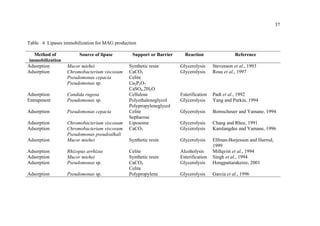
et al., 1988). In the Table 4, several immobilized lipases for MAG production
are listed.
13
14
4. Kinetics of reaction catalysed by immobilized lipases
The simplest kinetic model of lipase-catalysed reactions of ester bonds
can easily be derived from the classic Michaelis-Menten mechanism (Malcata
et al., 1992).
k1

E + S

ES

kcat

E + P + Q

(1)

k-1
where E denotes the immobilized enzyme, S the substrate (glyceride), ES the
enzyme-substrate complex, P product species containing one more alcohol
moiety than reactant S, and Q a free fatty acid. The rate of disappearance of
glyceride per unit volume of reacting fluid (-dCS/dt) can be represented in term
of this mechanism as,
-dCS
dt

=

Vmax CS

(2)

K m + CS

The kinetic parameters appearing in this expression are defined as
Vmax = kcatCE(tot) and Km = (kcat + k-1)/ k1. The parameter Vmax is the rate
observed when the lipase is saturated with substrate, Km is the MichaelisMenten constant, and the subscript tot denotes the total amount of enzyme
present in either the E or ES form (Malcata et al., 1992).
For a simple enzymatic reaction in soluble, the maximum intrinsic rate
of reaction is limited by the rate at which lipase and substrate come together in
the proper orientation. For the case of hydrolysis reaction, the substrate is often
part of the disperse phase of an emulsion, a micelle, or a monolayer which
contacts water. These structures may be orders of magnitude larger in size than
the supported enzyme for the case where the carrier exists in powdered form.
Thus, the maximum attainable rate is limited by the amount of lipase which can
interact with the substrate continuum. This phenomenon, which is similar in
nature to an adsorption process, can be schematically represented by equation
(1) provided that k1 and k-1 are interpreted as adsorption (kads) and desorption
(kdes) constants, respectively (Malcata et al., 1992).
15
In the case of lipases immobilized on continuous supports, or on
discrete supports larger in size than the individual droplets of substrate, the
above reasoning remains valid provided that the spacing between neighboring
molecules of immobilized lipase is still larger than the area of contact between
the droplet and the lipase carrier. For this situation, in contrast to the classic
Michaelis-Menten rate expression where the reaction rate increases linearly
with the total enzyme concentration, a limiting rate is approached as the lipase
concentration is increased. In the present case a balance on the total number of
adsorption sites is more relevant than a balance on the total number of active
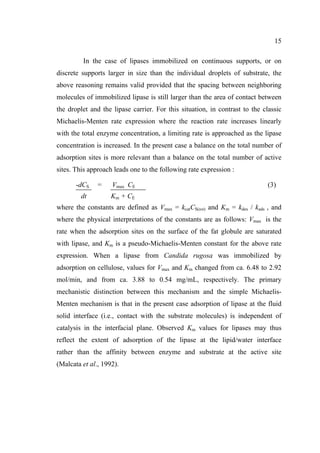
sites. This approach leads one to the following rate expression :
-dCS
dt

=

Vmax CE

(3)

K m + CE

where the constants are defined as Vmax = kcatCS(tot) and Km = kdes / kads , and
where the physical interpretations of the constants are as follows: Vmax is the
rate when the adsorption sites on the surface of the fat globule are saturated
with lipase, and Km is a pseudo-Michaelis-Menten constant for the above rate
expression. When a lipase from Candida rugosa was immobilized by
adsorption on cellulose, values for Vmax and Km changed from ca. 6.48 to 2.92
mol/min, and from ca. 3.88 to 0.54 mg/mL, respectively. The primary
mechanistic distinction between this mechanism and the simple MichaelisMenten mechanism is that in the present case adsorption of lipase at the fluid
solid interface (i.e., contact with the substrate molecules) is independent of
catalysis in the interfacial plane. Observed Km values for lipases may thus
reflect the extent of adsorption of the lipase at the lipid/water interface
rather than the affinity between enzyme and substrate at the active site
(Malcata et al., 1992).
16
5. MAG production and application
MAG are the most widely used as emulsifiers in the food,
pharmaceutical, and cosmetic industries (Thude et al.,1997). In phamaceuticals,
MAG are used as binders in tablets and as emollients for transdermal, slowrelease drugs (Jackson and King, 1997). Li and Ward (1993) reported that MAG
containing n-3-polyunsaturated fatty acids such as eicosapentaenoic acid (EPA)
and docosahexaenoic acid (DHA) may have positive preventive effects on
people with different cardiovascular disorders.

In the food industry, MAG and

DAG are the most common food emulsifiers (McEvily and Zaks, 1991). They
serve to stabilize emulsions in sauces and baked goods (Jackson and King,
1997). In cosmetic industries, they used as texturising agents in cosmetics
(Stevenson et al., 1993). Monopentadecanoylglycerol is used as a hair care
additive (Bornscheuer, 1995). MAG of octanoic and decanoic acid can act as
dyes and perfume bases in cosmetics, toiletries, and phamaceuticals. They are
also known to dissolve gallstones in humans (Gandhi, 1997). Furthermore, oleyl
monooleate is used in bath oils, cosmetic creams and lotions, hair preparations,
makeup, skin preparations and pharmaceuticals, etc (Gandhi, 1997).
In the current method, MAG are manufactured on an industrial scale
by continuous chemical glycerolysis of fats and oils at high temperature
(220-250°C) employing inorganic alkaline catalysts under a nitrogen gas
atmosphere (Sonntag, 1982). The product produced by this strategy has several
drawbacks (Bornscheuer, 1995). A molar excess of glycerol is used and because
the reaction temperature is greater than 220 °C, dark-colored by-products with
an undesirable flavor are formed. Moreover, the yield of MAG is rather low
(30-40%) (McNeill and Yamane, 1991). Molecular distillation is necessary
because MAG need to be highly pure in the food industry, since they have
better emulsifying properties than a mixture of different acylglycerols
(Bornscheuer, 1995).
17
Unlike ordinary chemical catalysts, enzymes have ability to catalyze
reactions under very mild conditions in aqueous solution at normal temperature
and pressure reducing the possibility of damage to heat-sensitive substrates and
also reducing the energy requirements and corrosion effects of the process.
Enzymes have high substrate specificity leading to a low content of undesirable
by-products in the reaction solution, thus decreasing not only material costs but
also downstream environmental burdens (Kennedy and Cabral, 1987).
Three lipase-catalyzed routes to MAG have been described:
(a) hydrolysis or alcoholysis of triglycerides, (b) glycerolysis of triglycerides
and (c) esterification or transesterification of glycerol with fatty acids or esters.
Method (a) yields an 2-MAG, while methods (b) and (c) usually yield an
equilibrium mixture of MAG, from which the predominant 1(3)-MAG can be
isolated in good yield (Bornscheuer, 1995). There are several MAG production
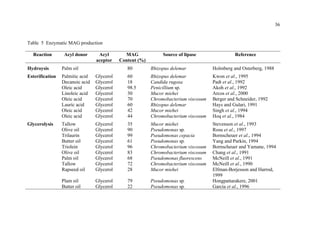
by lipases listed in Table 5.
5.1 Hydrolysis or alcoholysis of triglycerides to produce
2-monoglycerides
Hydrolysis or alcoholysis of triglycerides catalyzed by a 1,3-selective
lipase yield 2-MAG (Figure 2). Hydrolysis gave moderate yield of 2-MAG
(78%, corresponding to 26% per mol TAG) (Holmberg and Osterberg, 1988).
Acyl migration probably limited the yield by forming 1(3)-MAG which
underwent further hydrolysis. On the other hand, alcoholysis can be carried out
in non-polar solvents where acyl migration is slower. For this reason,
alcoholysis of triglycerides gave higher yield (75-97%, corresponding to
25-32 % per mol TAG) than hydrolysis. In addition, alcoholysis reaction is
often faster because there is no change in pH during the reaction and less
inhibition of lipase by free fatty acids.
18
19

OCOR
OCOR + 2 R'OH
OCOR

OH
OCOR + 2 RCOOR'
OH

1,3-selective
lipase

water or
triacylglycerol alcohol

fatty acid
2-MAG
1(3)-MAG or ester

Figure 2 Hydrolysis or alcoholysis of a triacylglycerol to produce 2-MAG
(acyl migration as indicated by the arrow might lead to 1(3)-MAG)
Source: Bornscheuer (1995)
5.2 Glycerolysis of triglycerides with glycerol
Compared to hydrolysis or alcoholysis, a glycerolysis of TAG is the
most economic method, because all three fatty acids bond to the TAG are
converted into product (Figure 3) (Yamane et al., 1986). One can use nonselective lipases for this reaction because even a 1,3-selective lipase yield one
2-MAG and two 1(3)-MAG. In practice, reaction conditions usually promote
acyl migration so that an equilibrium mixture of 9:1, 1(3)-MAG : 2-MAG is
formed.

OCOR
OCOR + 2
OCOR
triacylglycerol

OH
OH
OH
glycerol

lipase

2

OCOR
+ 2-MAG
OH
OH
1(3)-MAG

Figure 3 Glycerolysis of a triacylglycerol produces monoacylglycerol
Source: Bornscheuer (1995)
Glycerolysis of triglycerides in the liquid phase typically yield only
30-50% MAG, due to an unfavored equilibrium. A substantial shift of the
equilibrium in the glycerolysis can be achieved by performing the reaction in
a solid-phase system (McNeill et al., 1990). Initially, the reaction is carried out
in a liquid-liquid-emulsion of glycerol and triglyceride, then cooled to
20
crystallize 1(3)-MAG. Yield with this method increased to 70-99% depending
on the triglyceride serving as substrate (McNeill et al., 1990; McNeill and
Yamane, 1991; Bornscheuer and Yamane, 1994). This crystallization also
increases the relative amount of 1(3)-MAG over 2-MAG. Reaction temperature
is critical and must be kept just below the melting temperature of the
monoglycerides, e.g., for beef tallow, optimum temperature was 42 °C yielding
72% 1(3)-MAG using PFL or CVL (McNeill et al., 1990).
The disadvantage of glycerolysis in the solid state is the difficulty to
perform the reaction in a continuous manner, which requires a liquid phase.
Under these conditions, considerably lower yields of MAG are achieved.
To circumvent this problem, off-line extraction of MAG into hexane, filtration
of the enzyme and recycling of the non-monoglyceride portion with fresh tallow
for the next reaction cycle gave 69% MAG yield (Stevenson et al., 1993).
Performing the reaction in a continuous stirred vessel bioreactor with
polysulfone membrane for the glycerolysis of olive oil in AOT/isooctane
reverse micelles using a lipase immobilized on liposomes resulted in a high
operational stability of 45 days, however, six days were necessary to reach the
steady state (Chang et al., 1991).
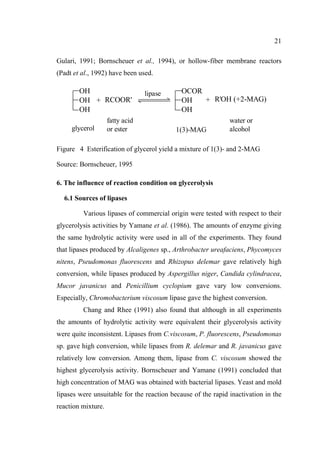
5.3 Esterification of glycerols with fatty acid or fatty acid esters
Esterification of glycerol with a fatty acid or a fatty acid ester also
yields MAG without wasting fatty acids (Figure 4). Reaction mixtures contain
polar protic reactants that promote acyl migration, so esterification yields an
equilibrium mixture of MAG. To shift the reaction toward MAG formation,
water or alcohol was removed using vacuum or molecular sieves (Miller et al.,
1988).
The low solubility of the glycerol in non-polar organic solvents
slows the reaction and promotes a side reaction –further acylation of the
more soluble MAG to DAG. To minimize this problem different solvents
(Akoh et al., 1992; Kwon et al., 1995), reverse micelles (Hayes and
21
Gulari, 1991; Bornscheuer et al., 1994), or hollow-fiber membrane reactors
(Padt et al., 1992) have been used.

OH
OH + RCOOR'
OH
glycerol

fatty acid
or ester

lipase

OCOR
+ R'OH (+2-MAG)
OH
OH
1(3)-MAG

water or
alcohol

Figure 4 Esterification of glycerol yield a mixture of 1(3)- and 2-MAG
Source: Bornscheuer, 1995
6. The influence of reaction condition on glycerolysis
6.1 Sources of lipases
Various lipases of commercial origin were tested with respect to their
glycerolysis activities by Yamane et al. (1986). The amounts of enzyme giving
the same hydrolytic activity were used in all of the experiments. They found
that lipases produced by Alcaligenes sp., Arthrobacter ureafaciens, Phycomyces
nitens, Pseudomonas fluorescens and Rhizopus delemar gave relatively high
conversion, while lipases produced by Aspergillus niger, Candida cylindracea,
Mucor javanicus and Penicillium cyclopium gave vary low conversions.
Especially, Chromobacterium viscosum lipase gave the highest conversion.
Chang and Rhee (1991) also found that although in all experiments
the amounts of hydrolytic activity were equivalent their glycerolysis activity
were quite inconsistent. Lipases from C.viscosum, P. fluorescens, Pseudomonas
sp. gave high conversion, while lipases from R. delemar and R. javanicus gave
relatively low conversion. Among them, lipase from C. viscosum showed the
highest glycerolysis activity. Bornscheuer and Yamane (1991) concluded that
high concentration of MAG was obtained with bacterial lipases. Yeast and mold
lipases were unsuitable for the reaction because of the rapid inactivation in the
reaction mixture.
22
6.2 Initial water content
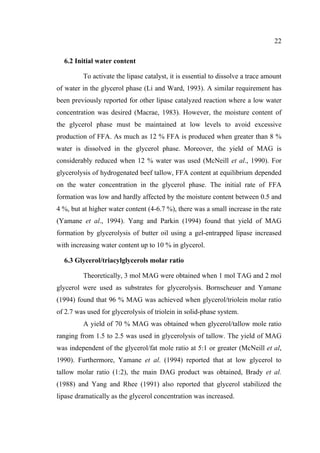
To activate the lipase catalyst, it is essential to dissolve a trace amount
of water in the glycerol phase (Li and Ward, 1993). A similar requirement has
been previously reported for other lipase catalyzed reaction where a low water
concentration was desired (Macrae, 1983). However, the moisture content of
the glycerol phase must be maintained at low levels to avoid excessive
production of FFA. As much as 12 % FFA is produced when greater than 8 %
water is dissolved in the glycerol phase. Moreover, the yield of MAG is
considerably reduced when 12 % water was used (McNeill et al., 1990). For
glycerolysis of hydrogenated beef tallow, FFA content at equilibrium depended
on the water concentration in the glycerol phase. The initial rate of FFA
formation was low and hardly affected by the moisture content between 0.5 and
4 %, but at higher water content (4-6.7 %), there was a small increase in the rate
(Yamane et al., 1994). Yang and Parkin (1994) found that yield of MAG
formation by glycerolysis of butter oil using a gel-entrapped lipase increased
with increasing water content up to 10 % in glycerol.
6.3 Glycerol/triacylglycerols molar ratio
Theoretically, 3 mol MAG were obtained when 1 mol TAG and 2 mol
glycerol were used as substrates for glycerolysis. Bornscheuer and Yamane
(1994) found that 96 % MAG was achieved when glycerol/triolein molar ratio
of 2.7 was used for glycerolysis of triolein in solid-phase system.
A yield of 70 % MAG was obtained when glycerol/tallow mole ratio
ranging from 1.5 to 2.5 was used in glycerolysis of tallow. The yield of MAG
was independent of the glycerol/fat mole ratio at 5:1 or greater (McNeill et al,
1990). Furthermore, Yamane et al. (1994) reported that at low glycerol to
tallow molar ratio (1:2), the main DAG product was obtained, Brady et al.
(1988) and Yang and Rhee (1991) also reported that glycerol stabilized the
lipase dramatically as the glycerol concentration was increased.
23
6.4 Temperature
McNeill et al. (1990) reported that the yield of MAG was greatly
influenced by the reaction temperature. At higher temperature (48-50 °C),
a yield of approximately 30 % MAG was obtained, while at lower temperature
(38-46 °C), a yield of approximately 70 % MAG was obtained. A sharp
transition was observed between the high and low yield equilibrium states. The
critical temperature (Tc) was found to be 46 °C in the case of tallow. Moreover,
McNeill and Yamane (1991) tried to improve the yield of MAG during
enzymatic glycerolysis. They found that temperature programming was the
most effective. With an initial temperature of 42 °C for 8-16 h followed by
incubation at 5 °C for up to 4 days, a yield of approximatelly 90 wt% MAG was
obtained from beef tallow, palm oil and palm stearin. For high melting point
fats, Tc is 35-45 °C, but for liquid oils Tc is 5-10 °C (McNeill and Yamane,
1991).
6.5 Organic solvents
Fukui et al. (1990) suggested that for bioconversion of various
lipophilic or water-insoluble compounds, it is essential to introduce organic
solvents into reaction systems to improve the solubility of these reactants.
Furthermore, organic solvents can shift the reaction equilibrium towards
synthesis in the case of hydrolytic enzyme by reducing the water content in the
systems. However, organic solvents produce various physicochemical effects on
enzyme molecules and the effects differ depending upon the kinds of organic
solvents and enzyme used.
Nonpolar solvents such as isooctane were used for hydrolysis
(Holmberg and Osterberg, 1988; Kosugi et al., 1990; Yang and Rhee, 1992),
esterification (Li and Ward, 1993) and glycerolysis (Chang et al., 1991).
Furthermore, Li and Ward (1993) found that a higher extent of esterification
was observed in isooctane and hexane as compared to other solvents but more
24
polar solvents, such as benzene and acetone were unsuitable for the synthetic
reaction. However, Yang and Rhee (1992) found that immobilized lipase was
less stable in hexane than in isooctane.
7. Bioreactors for MAG production
Various possibilities exist here for reactors containing immobilized
lipase, but most situations fall within one of the following cases: a) a lipase
contained in an aqueous phase and confined by a surfactant liquid membrane
within an organic liquid phase (Chane et al., 1991; Hayes and Gulari, 1991;
Singh et al., 1994), b) a lipase entrapped within a three dimensional polymeric
matrix dispersed within an organic liquid phase or an aqueous phase (Yang and
Parkin, 1994), and c) a lipase attached to a solid support and dispersed within an
organic liquid phase or an aqueous phase (Stevenson et al., 1993; Bonscheuer
and Yamane, 1994; Padt et al., 1992)
By the use of lipases in immobilized form for MAG production, the
biorectors (Figure 5) can be used in one of serveral possibilities, namely, in
batch stirred-tank reactors : BSTR (Figure 5a) (Stevenson et al., 1993;
Bornscheuer and Yamane, 1994; Yang and Parkin, 1994; Myrnes et al., 1995;
Kamlangdee and Yamane, 1996; Thude et al., 1997), packed-bed reactors :
PBR (Figure 5b) (Gancet, 1990; Stevenson et al., 1993; Jackson and King,
1997), continuous stirred-tank reactors : CSTR (Figure 5c) (Chane et al., 1991),
fluidized-bed reactors : FBR (Figure 5d) (Kosugi et al., 1990; Kosugi et al.,
1995) or membrane reactors : MR (Figure 5e) (Padt et al., 1992; Ohta et al.,
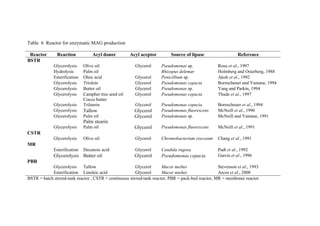
1989). There are several reactors for MAG production by lipases listed in
Table 6.
25

a)

b)

S

P

c)

d)
S

S

P

P

e)
E nzym e

S2

S1

P

Figure 5 Enzyme reactor designs
a) BSTR

b) PBR

d) FBR

c) CSTR

e) MR

•, immobilized enzyme; S, substrate; P, product
26
27
7.1 Batch stirred-tank reactors (BSTR)
BSTR is the reactor most commonly used. This reactor operates
batchwise and consists of a vessel in which the reactant fluid mixture is stirred
by some mechanical means (e.g., magnetic bars, submerged impellers,
reciprocal oscillators, or end-over-end rotators). The immobilized enzyme is
separated from the reaction medium at the end of the reaction by filtration or
centrifugation. These reactors are easy to operate (e.g., heat, cool, clean, and
maintainance) and normally require a very limited set of auxiliary equipment.
However, overall volumetric through put is relatively low because of dead times
taken up by the operations of emptying, cleaning, and filling. So an economic
constrain must be considered for large scale use (Balcao et al., 1996).
Stevenson et al. (1993) studied the glycerolysis of tallow by lipozyme
(immobilized Mucor meihei lipase) in BSTR at the reaction temperature of
50 °C for 24 h with a maximum yield of 35 % MAG. Cooling the reaction
below 42 °C after 48 h resulted in MAG crystallisation which improved the
yield to up to 50 %. An increase in the overall MAG yield up to 69 % was
achieved by recycling of the non-MAG portion with fresh tallow in other
reaction. Bornscheuer and Yamane (1994) studied the glycerolysis of triolein by
immobilized lipase in BSTR. It was found that lipase immobilized on celite
enhanced the long-term stability of the pure lipase from Pseudomonas cepacia.
The reaction temperature was 25 °C for the first 8 h, followed by cooling to
8 °C and the yield of 90 % MAG was obtained after 48 h. Yang and Parkin
(1994) studied MAG production from butteroil by glycerolysis with a gelentraped Pseudomonas sp. lipase in microaqueous media. They found that
optimum conditions for gel-entraped lipase-mediated glycerolysis of butteroil
were 35-40 °C, acyl group:glycerol molar ratio 0.30-0.70, and 4-6% water in
the glycerol phase, resulting in the formation of 60 % MAG after 72 h. Myrnes
et al. (1995) employed glycerolysis of marine oils by lipase AK from
Pseudomonas sp. in solvent-free BSTR with magnetic stirring. The yield of
28
MAG 42-53 % was obtained. Thude et al. (1997) studied lipase-catalyzed
glycerolysis of Campher tree seed oil and Cocoa-butter in BSTR. From nine
microbial

lipases,

lipases

from

Pseudomonas

cepacia

(PCL)

and

Chromobacterium viscosum (CVL) were suitable for the synthesis of MAG.
The glycerolysis of Campher tree seed oil was performed initially at 25 °C
followed by cooling to 7 °C resulted in 86% and 90 % MAG by PCL and CVL,
respectively. Maximum concentration of MAG from cocoa-butter was 89 %
with both lipases, when the reaction was performed at 25 °C.
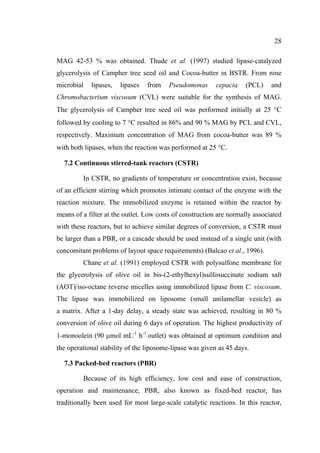
7.2 Continuous stirred-tank reactors (CSTR)
In CSTR, no gradients of temperature or concentration exist, because
of an efficient stirring which promotes intimate contact of the enzyme with the
reaction mixture. The immobilized enzyme is retained within the reactor by
means of a filter at the outlet. Low costs of construction are normally associated
with these reactors, but to achieve similar degrees of conversion, a CSTR must
be larger than a PBR, or a cascade should be used instead of a single unit (with
concomitant problems of layout space requirements) (Balcao et al., 1996).
Chane et al. (1991) employed CSTR with polysulfone membrane for
the glycerolysis of olive oil in bis-(2-ethylhexyl)sulfosuccinate sodium salt
(AOT)/iso-octane reverse micelles using immobilized lipase from C. viscosum.
The lipase was immobilized on liposome (small unilamellar vesicle) as
a matrix. After a 1-day delay, a steady state was achieved, resulting in 80 %
conversion of olive oil during 6 days of operation. The highest productivity of
1-monoolein (90 µmol mL-1 h-1 outlet) was obtained at optimum condition and
the operational stability of the liposome-lipase was given as 45 days.
7.3 Packed-bed reactors (PBR)
Because of its high efficiency, low cost and ease of construction,
operation and maintenance, PBR, also known as fixed-bed reactor, has
traditionally been used for most large-scale catalytic reactions. In this reactor,
29
the granules of immobilized enzyme are usually packed within a jacketed
thermostat column, thus providing a large surface area per unit volume of
reactor. In the presence of a single phase, pumping may be made upward
(to avoid extensive bypassing) or downward (to take advantage of gravitational
forces), whereas in a biphasic situation the two phases may be pumped in
opposite directions (countercurrent flows) with the most dense flowing
downward, or in the same direction (cocurrent flows). Great pressure drops are
normally associated with this kind of reactor, especially if diffusional
limitations are alleviated by decreasing the mesh size of the bed granules
(Balcao et al., 1996).
Gancet (1990) developed a two-fixed bed segment for the continuous
glycerolysis of beef tallow. At a residence time of 75 min, a yield of
38.8 g MAG/100 g beef tallow was obtained. The reactor system was run for
several months with a rather good operational stability of the mycelial lipase
from Rhizopus arrhizus. In continuous system, Stevenson et al. (1993) reported
the glycerolysis of tallow by lipozyme (immobilized Mucor meihei lipase) in
a column reactor without the addition of surfactants or emulsifiers at 50 °C.
The reaction was completed within 8 h and the final yield of MAG was
17- 19 %. Jackson and King (1997) described the transesterification of soybean
oil with glycerol, 1,2-propanodiol, and methanol by an immobilized lipase from
Candida antarctica in flowing supercritical carbon dioxide for the synthesis of
MAG. MAG was obtained at up to 87 wt%.
7.4 Fluidized-bed reactors (FBR)
A FBR is, in a sense, a hybrid of a CSTR and a PBR, for which the
upward linear velocity of reacting fluid is above the terminal velocity of the bed
of enzyme. The usually large pump size and power requirement, nevertheless
prevent extensive use of this type of reactor.
The process that used immobilized lipase in FBR for MAG production
has not been reported. However, FBR with immobilized lipase has been used
30
for fatty acid and glycerol production. For example, Kosugi et al. (1990)
described the FBR with immobilized lipase for fatty acid and glycerol
production by continuous hydrolysis of oil. The FBR system consists of settling
compartment and stirring compartment. Immobilized lipases are placed in
stirring compartment. The agitation is provided by a paddle-type stirring blade.
Kosugi et al. (1995) used counter-current FBR with immobilized lipases for
EPA and DHA production by hydrolysis of sardine oil. Pulse agitation was
provided from the bottom of the reactor by the pump.
7.5 Membrane reactors (MR)
Membrane or diaphragm reactor may be operated with one or two
liquid phases. In this reactor, the enzyme is immobilized onto the membrane,
which may take either a flat sheet (Garcia et al., 1992) or hollow fiber
(Pronk et al., 1992; Padt et al., 1992). Because of the role of the membrane in
the segregation of two immiscible fluids, MR is commonly employed for
biphasic liquid systems. Prevention and elimination of membrane pore plugging
are considerably more difficult than packed-bed plugging in a PBR, but the
lower pressure drops for a given specific area of reaction usually compensate
for such drawback (Balcao et al., 1996).
Padt et al. (1992) studied the enzymatic synthesis of MAG in MR
with an in-line adsorption column. The MR consists of a cellulose hollow-fiber
membrane module, an internal oil circuit and an external glycerol-water circuit.
Lipase from Candida rugosa is adsorbed at the inner fiber site. The oil circuit is
operated batch wise. To recover the monoesters produced, a silica 60 column is
placed in the oil phase of MR. When no adsorption column is used, the MAG
production is about 18 %w/w. The authors implied that MR can be used in
a continuous process using a sequence of column. They estimated a production
of 60 mol (15 kg) monoester g-1 enzyme. The half-life time of the lipase from
Candida rugosa was given as 50 days. Ohta et al. (1989) used the microporous
hydrophobic MR to study inhibition and inactivation of lipase by fat peroxide in
31
continuous glycerolysis of fat by lipase. However, MR with immobilized
lipases was used for another application, for example, fatty acid production by
hydrolysis of tallow (Taylor et al., 1992) and lipolysed butteroil production by
hydrolysis of milkfat (Garcia et al., 1992)
8. Scale up of MAG production
Transferring to an industrial scale processes successfully developed at
the laboratory scale is not a simple procedure. Scale up is defined as the
successful startup and operation of a commercial size unit whose design and
operating procedures are in part based upon experimentation and demonstration
at a smaller scale of operation (Sola and Godia, 1995).
The purpose of scale-up is the selection of design conditions and
operational procedures to insure that the effect of the different variables on the
process is the same in units of different size. The objective is then to obtain
similar yields with the same product distribution (quality). This process starts at
the laboratory scale and frequently must continue at the smallest possible scale,
for practical and economic reasons. When knowledge of the process is
incomplete or when relatively important amounts of product are needed
(for market evaluation, regulatory issues, etc.) it is necessary to employ pilot
plant of bigger sizes, currently referred to as demonstration units (Sola and
Godia, 1995).
Sweere et al. (1987) classified scale-up methods as
1. Fundamental method
2. Semi-fundamental method
3. Dimensional analysis/ regime analysis
4. Rules of thumb
5. Scale-down approach/ regime analysis
6. Trial and error
7. Multiplication of elements
32
Scale-up often results in both technical and economic compromises.
When developing a process, it is never possible to achieve a perfect anticipation
of its industrial performance, and time and budget limitations make it necessary
to take calculated risk in building the first industrial unit (Sola and
Godia, 1995).
9. Recovery of MAG
In the microemulsion system to produce MAG will end up with a
mixture of nonionic emulsifier, enzyme, solvents, fatty acids and esters.
Downstream processing involves several extraction steps and, unfortunately,
denaturation of the enzyme takes place. Therefore, the enzyme can be used for
one batch only (Padt et al., 1992).
Kwon et al. (1995) tried to use the difference in solubility of reaction
products in hexane. The solubility of MAG and DAG in hexane is very low in
comparison with that of fatty acid and TAG, as MAG and DAG have the
hydrophilic hydroxyl groups. Hence, hydrophilic products formed from
esterification reaction were allowed to precipitate in the reactor.
Stevenson et al. (1993) used hexane to recover MAG. The reaction
mixture was dissolved in hexane. Unreacted glycerol was separated out and
could be removed. After cooling to 4 °C, most of the MAG crystallized out and
could be filtered off and dried.
In the solid-phase system to produce MAG, downstream precessing as
presented by McNeill and Yamane (1991) involves a heating step to melt the
MAG products, which also results in activating the enzyme. In the same system,
Thude et al. (1997) used chloroform as solvent to suppress a lipase-catalyzed
back reaction. Isolation was performed at 4 °C. The organic layer was dried
with anhydrous sodium sulfate, filtered and excess solvent was evaporated.
Almost pure MAG (purity >95%) was isolated by silica gel chromatography
using chloroform for elution.
33
Padt et al. (1992) found that a silica 60 column has shown preferential
adsorption of monocaprinate. The adsorption of a mixture of decanoic acid,
MAG and DAG is based on two different mechanisms. The decanoic acid will
interact with hydroxyl groups at the silica gel surface, which results in a
noncompetitive decanoic acid adsorption onto 25 % of the silica gel surface.
On the remaining part of the silica gel surface, MAG and DAG adsorb
competitively. When a mild eluant is used, such as 5 % ethanol in hexane, only
the competitively adsorbed molecules are desorbed. This results in a
purification factor of approximately 90 % after desorption.
34
Objective
To produce MAG using continuous glycerolysis of palm olein with
glycerol by immobilized lipase in reactor
Scope of research works :
1. Selection of suitable commercail lipase for MAG production
2. Selection of suitable support to immobilize selected lipase
3. Selection of suitable reactor type for continuous MAG production
4. Optimization of continuous MAG production in selected reactor
4. Scale-up selected reactor for continuous MAG production
5. Selection of suitable method for MAG recovery
Table 6 Reactor for enzymatic MAG production
Reactor
BSTR

Reaction

Acyl donor

Acyl aceptor

Glycerolysis
Hydrolysis
Esterification
Glycerolysis
Glycerolysis
Glycerolysis

Olive oil
Palm oil
Oleic acid
Triolein
Butter oil
Campher tree seed oil
Cocco butter
Trilaurin

Glycerol

Glycerolysis
Glycerolysis
Glycerolysis

Tallow
Palm oil

Palm stearin

Source of lipase

Reference

Pseudomonas sp.
Rhizopus delemar
Penicillium sp.
Pseudomonas cepacia
Pseudomonas sp.
Pseudomonas cepacia

Rosu et al., 1997
Holmberg and Osterberg, 1988
Akoh et al., 1992
Bornscheuer and Yamane, 1994
Yang and Parkin, 1994
Thude et al., 1997

Glycerol
Glycerol

Pseudomonas cepacia
Pseudomonas fluorescens
Pseudomonas sp.

Bornscheuer et al., 1994
McNeill et al., 1990
McNeill and Yamane, 1991

Glycerol
Glycerol
Glycerol
Glycerol
Glycerol

Glycerolysis

Palm oil

Glycerol

Pseudomonas fluorescens

McNeill et al., 1991

Glycerolysis

Olive oil

Glycerol

Chromobacterium viscosum

Chang et al., 1991

Esterification

Decanoic acid

Glycerol

Candida rugosa

Glycerol

Pseudomonas cepacia

Padt et al., 1992
Garcia et al., 1996

CSTR
MR
Glycerolysis Butter oil
PBR
Glycerolysis Tallow
Glycerol
Stevenson et al., 1993
Mucor meihei
Esterification Linoleic acid
Glycerol
Arcos et al., 2000
Mucor miehei
BSTR = batch stirred-tank reactor , CSTR = continuous stirred-tank reactor, PBR = pack-bed reactor, MR = membrane reactor
36

Table 5 Enzymatic MAG production
Reaction

Acyl donor

Hydroysis

Palm oil

Esterification

Palmitic acid
Decanoic acid
Oleic acid
Linoleic acid
Oleic acid
Lauric acid
Oleic acid
Oleic acid

Glycerolysis

Acyl
aceptor

MAG
Content (%)

Source of lipase

Reference

80

Rhizopus delemar

Holmberg and Osterberg, 1988

Glycerol
Glycerol
Glycerol
Glycerol
Glycerol
Glycerol
Glycerol
Glycerol

60
18
98.5
30
70
60
42
44

Rhizopus delemar
Candida rugosa
Penicillium sp.
Mucor miehei
Chromobacterium viscosum
Rhizopus delemar
Mucor miehei
Chromobacterium viscosum

Kwon et al., 1995
Padt et al., 1992
Akoh et al., 1992
Arcos et al., 2000
Berger and Schneider, 1992
Hays and Gulari, 1991
Singh et al., 1994
Hoq et al., 1984

Tallow
Olive oil
Trilaurin
Butter oil
Triolein
Olive oil
Palm oil
Tallow
Rapseed oil

Glycerol
Glycerol
Glycerol
Glycerol
Glycerol
Glycerol
Glycerol
Glycerol
Glycerol

35
90
99
61
96
83
68
72
28

Mucor miehei
Pseudomonas sp.
Pseudomonas cepacia
Pseudomonas sp.
Chromobacterium viscosum
Pseudomonas fluorescens
Chromobacterium viscosum
Mucor miehei

Plam oil
Butter oil

Glycerol
Glycerol

79
22

Pseudomonas sp.
Pseudomonas sp.

Stevenson et al., 1993
Rosu et al., 1997
Bornscheuer et al., 1994
Yang and Parkin, 1994
Bornscheuer and Yamane, 1994
Chang et al., 1991
McNeill et al., 1991
McNeill et al., 1990
Elfman-Borjesson and Harrod,
1999
Hongpattarakere, 2001
Garcia et al., 1996
37

Table 4 Lipases immobilization for MAG production
Method of
immobilization
Adsorption
Adsorption

Source of lipase
Mucor miehei
Chromobacterium viscosum
Pseudomonas cepacia
Pseudomonas sp.

Adsorption
Entrapment

Candida rugosa
Pseudomonas sp.

Adsorption

Pseudomonas cepacia

Adsorption
Adsorption
Adsorption

Chromobacterium viscosum
Pseudomonas pseudoalkali
Mucor miehei

Adsorption
Adsorption
Adsorption

Rhizopus arrhizus
Mucor miehei
Pseudomonas sp.

Adsorption

Pseudomonas sp.

Support or Barrier

Reaction

Reference

Synthetic resin
CaCO3
Celite
Ca2P2O7
CaSO4.2H2O
Cellulose
Polyethaleneglycol
Polypropyleneglycol
Celite
Sepharose
Liposome
CaCO3

Glycerolysis
Glycerolysis

Stevenson et al., 1993
Rosu et al., 1997

Esterification
Glycerolysis

Padt et al., 1992
Yang and Parkin, 1994

Glycerolysis

Bornscheuer and Yamane, 1994

Glycerolysis
Glycerolysis

Chang and Rhee, 1991
Kamlangdee and Yamane, 1996

Synthetic resin

Glycerolysis

Celite
Synthetic resin
CaCO3
Celite
Polypropylene

Alcoholysis
Esterification
Glycerolysis

Elfman-Borjesson and Harrod,
1999
Millqvist et al., 1994
Singh et al., 1994
Hongpattarakeree, 2001

Glycerolysis

Garcia et al., 1996

243342 ch1

  • 1.
    Chapter 1 INTRODUCTION Monoacylglylcerols (MAG)are the most widely used as emulsifiers in food, pharmaceutical and cosmetic industries (Thude et al.,1997). They have excellent emulsifying properties, are low odor and taste. MAG are biodegradable and generally recognized as safe (GRAS). At present, they are manufactured by continuous chemical glycerolysis of fats and oils at high temperatures (220-250 °C) employing inorganic alkaline catalysts under nitrogen gas atmosphere. The result is a crude mixture of mono-and diglycerides (roughly equal amounts) and some unreacted triglycerides (overall conversion 90 %). The product has several drawbacks, e.g., low yield, dark color and burnt test etc. (Thude et al., 1997). Further separation is generally carried out by molecular distillation yielding high-purity MAG (>90 %) (Diks and Bosley, 2000). Due to very high temperature applied during glycerolysis, decomposition and oxidation reactions take place which often result in a darkcolored and burnt-flavor product. Obviously, this requires extensive purification during further downstream processing. Because of the ambient reaction temperature applied, biocatalysis can potentially yield a higher quality product with lower energy consumption in a more ‘natural’ type process. Lipases or glycerol ester hydrolases (EC 3.1.1.3) were originally employed for the hydrolysis of ester bonds of triacylglycerols (TAG) to produce free fatty acids (FFA), glycerol and partial acylglycerols (e.g., MAG and diacylglycerols: DAG). In addition to plants and animals, these enzymes are widespread in many microorganisms which are also capable of actively producing these enzymes both in endogenous and exogenous forms (Balcao et al., 1996). 1
  • 2.
    2 By immobilizing theenzyme, it is possible to operate enzymatic processes continuously with all the attendant advantages. Enzyme immobilization has been accomplished by chemical and physical attachment to solid surfaces (Prazeres and Cabral, 1994). Several approaches for the synthesis of MAG by immobilized lipase have been reports. They include selective hydrolysis using 1,3-specific lipases (Holmberg and Osterberg, 1988), esterification of FFA with glycerol (Kwon et al., 1995) and especially glycerolysis of fats and oils (McNeill et al., 1991), which high yield of MAG was obtained. Reactions were performed in reverse micelles, water-organic biphasic systems, organic solvents, solvent free systems and in solid-state with several reactors namely, batch stirred-tank reactors (BSTR), continuous stirredtank reactors (CSTR), packed-bed reactors (PBR), fluidized-bed reactors (FBR) or membrane reactors (MR)(Thude et al., 1997). The oil palm (Elaeis guineensis) is widely cultivated in Southern of Thailand. The yield of palm olein is more than domestic food oil consumption so the price is low. Production of MAG from palm olein is an alternative that increases advantages and value added of palm olein. Consequently, the aim of this research is to investigate the continuous glycerolysis of palm olein for MAG production by immobilized lipase in suitable bioreactors and scale up the system.
  • 3.
    3 Literature Review 1. PalmOil The oil palm produces two distinct oils: palm oil from the fleshy mesocarp and palm kernel oil from the fruit kernel. The usage of both oils is extended by fractionation. Palm oil gives a more valuable olein (an excellent frying oil) and a less valuable stearin (used in part as a replacement for tallow in the oleochemical industry). The stearin is the major fraction of palm kernel oil. The oils and their fractions can be further modified by blending with other oils, by partial hydrogenation, or by interesterification. Further fractionation of the palm oil fractions yields an intermediate fraction (PMF, palm midfraction) that can be used as a cocoa butter extender (Gunstone, 1997). Palm oil is characterized by high levels of carotene and of tocopherols and tocotrienols (vitamin E), which can also be isolated or concentrated as products of considerable value. Palm oil fatty acid distillate (PFAD), a by-product of the principal refining procedure, is an important component of animal feed (Gunstone, 1997). Palm oil is widely used as a food oil with limited non-food uses also. It differs from other commercially available oils in its fatty acid and TAG composition. It contains almost equal amounts of saturated acids (mainly palmitic with some stearic) and unsaturated acids (mainly oleic with some linoleic acid). The proportion of palmitic and oleic acids in the major TAG leads to stability of the crystals. These are very desirable in the production of margarines and shortenings, especially those with high levels of unsaturated acids. Some information on TAG composition is given in Table 1 (Gunstone, 1997). The major fatty acids in palm oil are palmitic acid and stearic acid. While the major triacylglycerols are POP and POO or PLSt.
  • 4.
    4 Table 1 Triacylglycerolcomposition of palm oil (i) Major triacylglycerols (%) PPP POP PLP POSt POO, PLO OOO Other PLSt 7 33 7 6 23 7 3 14 5 43 8 4 29 8 2 1 7 31 9 6 23 9 4 11 (ii) Distribution of fatty acids between sn-1, -2, and –3 positions (%) 16:0 18:0 18:1 18:2 TAG 48.4 3.7 36.3 10.0 Sn-1 60.1 3.4 26.8 9.3 Sn-2 13.3 0.2 67.9 17.5 Sn-3 71.9 7.6 14.4 3.2 Source : Gunstone (1997) 2. Lipases Lipases or glycerol ester hydrolases (EC 3.1.1.3) were originally employed for the hydrolysis of ester bonds of TAG to produce FFA, glycerol and partial acylglycerols (MAG and DAG) 2.1 Sources of lipases Lipases occur widely in animals, plants and microorganisms. Numerous mammalian tissues, organs and fluids, such as pancreas, kidney, adipose tissue, heart, brain, muscle and serum, have been known to contain lipases. Among animal lipases pancreatic lipase has been studied most extensively. The hog pancreatic lipase has been studied most extensively, presumably because of its high concentration (2.5% of the total protein in the pig pancreatic juice) and high turnover number. Moreover, the presence of
  • 5.
    5 esterolytic enzymes inthe milk of cow, sow, goat, sheep, and human has been known for a long time (Shahani, 1975). Numerous fruits, vegetables, plant tissues, and particularly plant seeds, such as wheat, oat, rye, cotton, soybean, castor bean, and Vernonia anthelmintica, have been known to exhibit lipase activity. Among the lipases of plant origin, the acid lipase of castor bean (Ricinus communis) is the most extensively investigated lipase that exists in dormant seeds (Shahani, 1975). In general, the germ portions of wheat, rye, and barley contain a much higher level of lipolytic enzyme activity than the endosperm, and the scutellum section and aleurone layer are also reportedly rich in lipase. (Shahani, 1975) During recent years considerable attention has been devoted to lipases produced by microorganisms, presumably because of their stability and their practical medical and industrial applications. Several microorganisms produce intracellular or extracellular lipases. Especially, extracellular microbial lipases have high potential for application and are appropriated for mass production. A variety of microorganisims produce lipases. These include the genera of Candida yeast; Rhizopus, Penicillium, Aspergillus, Geotrichium and Mucor molds; and Pseudomonas, Achromobacter, and Staphylococcus bacteria (Godtfredsen, 1993). 2.2 Function of lipases Lipases catalyze three types of reaction. The catalytic action of lipases is reversible. It catalyzes ester synthesis in a microaqeous system. However, in view of biotransformation of oleochemical industry yielding value-added products, the transesterification action seems more worthwhile than hydrolysis and ester synthesis. The difference in free energy involved in TAG hydrolysis is quite small and the net free energy of transesterification is zero. Consequently, transesterification reaction takes place easily. Transesterification is categorized into four subdivisions according to the chemical species with which the ester reacts. Some researchers designate these four types of reaction by
  • 6.
    6 “interesterification” but Yamane (1987) prefers transesterification to interesterification as thetechnical term covering all four types of reaction because in biochemistry transfer of a group from one chemical species to another is called “trans”, such as transglycosylation, transpeptidylation, transphophatidylation. Therefore, the author confines the term interesterification only to the type 3 reaction (ester exchange) (Yamane, 1987). However, Gandhi (1997) suggested that lipase catalyzed reaction has classically been divided into two main categories: (i) hydrolysis, and (ii) synthesis. Reactions under synthesis category can be further separated: (a) esterification, (b) interesterification, (c) alcoholysis and (d) acidolysis (Figure 1). The last three reactions are often grouped together into a single term, viz, transesterification. (i) Hydrolysis ' ' RCOOH + R OH RCOOR + H2O (ii) Synthesis (a) Esterification ' ' RCOOH + R OH RCOOR + H2O (b) Interesterification ' '' * RCOOR + R COOR * '' (c) Alcoholysis ' '' ' '' RCOOR + R OH '' R COOR + RCOOH RCOOR + R OH (d) Acidolysis ' RCOOR + R COOH Figure 1 Types of reaction catalyzed by lipases Source : Gandhi (1997) ' RCOOR + R COOR '' '
  • 7.
    7 2.3 Specificity oflipases Macrae (1983) divided lipases into three groups according to their specificity. The first group shows no marked specificity both as regards the position on the glycerol molecule which is attacked and the nature of the fatty acid released. The second group of lipases catalyzes the release of fatty acids specifically from the outer 1- and 3-positions of glycerides. The third group of lipases catalyses the specific release of a particular type of fatty acid from glyceride molecules. However, Malcata et al. (1992) divided lipases into five major types : (i) lipid class, (ii) positional, (iii) fatty acid, (iv) stereochemical and (v) combinations thereof. Lipid class selectivity has been observed in animal plasma which apparently contains separate lipoprotein lipases for the hydrolysis of TAG, DAG and MAG. A lipase produced by a strain of Penicillium cyclopium has been shown to display its highest activity on MAG and much lower activity toward DAG and TAG. This type of selectivity is dependent on temperature for a lipase from Pseudomonas fluorescens (Malcata et al.,1992). Lipases obtained from natural sources can be positionally nonspecific or display one of two kinds of positional specificity: sn-1,3 specific or sn-2 specific. Non-specific lipases hydrolyse all three ester bonds of triglycerides equally well. Nonspecificity has been observed for lipases from Chromobacterium viscosum, Pseudomonas fluorescens, Candida cylindracea, Geotrichum candidum, and Penicillium cyclopium, and also for hepatic lipase. Specificity of the sn-1,3 type is associated with the preferential release of fatty acid residues from the terminal positions of the glycerol backbone rather than from the central carbon atom, whereas sn-2 specificity refers to preferential release from the central carbon atom. The sn-1,3 type of specificity has been observed for pancreatic and adipose tissue lipases and lipase from microorganism such as Rhizopus arrhizus, Aspergillus niger, Rhizopus delemar
  • 8.
    8 and Mucor miehei.The sn-2 specificity is extremely rare, and it has been ascribed to a lipase from Geotrichum candidum which has a particular ability to hydrolyse oleic and linoleic acids from the sn-2 location. A more general classification states that the positional specificity of lipases is not divided clearly into the above categories; instead it changes continuously from highly specific an-1,3 activity to a very weakly specific or completely nonspecific activity (Malcata et al.,1992). Lipase often exhibit a particular ability to release fatty acids whose chain lengths or degrees of unsaturation fall within well-defined ranges. This situation has been explored in the lipase-catalysed production of cheese-type flavors. The lipase from Mucor miehei exhibits similar activities for release of C4 and C6 acids at either pH 5.3 or 8.0; however, longer chain fatty acids are released more slowly at the acidic pH. Experimental data for the fatty acid specificities of lipases from Chromobacterium viscosum and Geotrichum candidum indicate that the rate of attack by these lipases follows a bell-shaped distribution in the number of carbon atoms in the hydrocarbon backbones of unsaturated fatty acid residues. The distribution is centered at C8-C10 (Malcata et al.,1992). Although early studies did not report evidence of any kinds of stereospecificty for the catalytic action of lipases on fats and oils, a rather large body of literature dealing with the preparation of chiral esters and alcohols via lipase-mediated kinetic resolution of racemic (nontriglyceride) substrates is currently available. A number of researchers have observed stereoselectivity for the catalytic action of lipases on such substrates as straight-chain secondary alcohols, acetonide and butyric acid optically active esters, oxazolidones, glycidyl ethers, cyclohexanols, 2-benzylglycerol ether, sugar alcohols, and several esters of ibuprofen. Stereoselectivity has also been observed with serum lipoprotein lipase for hydrolysis of the enantiomeric esters at the sn-1 position, and with human and rat lingual lipases for the hydrolysis of enantiomeric esters
  • 9.
    9 at the sn-3position. Finally, combinations of fatty acids and stereoselectivities have been found with rat lingual and a human lipoprotein lipase preparation. (Malcata et al.,1992) Moreover, Diks and Bosley (2000) divided lipases into three classes based on their specificity and selectivity (Table 2): 1) Regio- or positional specific; 2) Fatty acid type specific; 3) Specific for a certain class of acylglycerols, i.e., MAG, DAG or TAG. Table 2 Major specificities of lipases and their applications Specificity Regio specificity 1,3-Regio specific Lipases Rhizomucor miehei Rhizopus oryzae Rhizopus arrhizus Rhizopus delemar Rhizopus niveus Porcine pancreatic lipase Non-specific Fatty acid specific Long chain polyunsaturated acids Saturated acids cis-∆9 unsaturated acids Short acids Acylglycerol specific Monoacylglycerols Mono-and diacylglycerols Triacylglycerols Candida rugosa Chromobacterium viscosum Pseudomonas fluorescens Pseudomonas cepacia Production of Triglyceride synthesis 1,2(2,3)-diglycerides by triglyceride hydrolysis 1,3-diglyceride by fatty acid (directed) esterification 2-monoglycerides by triglyceride hydrolysis 1(3)-monoglycerides by fatty acid esterification Fatty acid production by hydrolysis mono- and diglycerides by directed glycerolysis Selective hydrolysis Geotrichum candidum Candida rugosa Fusarium oxysporum Geotrichum candidum B Cuphea sp. Selective hydrolysis Selective hydrolysis Selective hydrolysis Potato acylhydrolase (patatin) Penicillium camembertii Penicillium cyclopium M1 Fusarium sp. Penicillium roquefortii Penicillium cyclopium M1 Penicillium expansum Monoglycerides by fatty acid esterification Monoglycerides and diglycerides by fatty acid esterification 1,2-Diglycerides by triglyceride hydrolysis or alcoholysis Source : Diks and Bosley (2000)
  • 10.
    10 2.4 Application oflipase Lipase can be employed in the production of pharmaceuticals, cosmetics, leather, detergents, foods, perfumery, medical diagnostics, and other organic synthetic materials (Gandhi, 1997). Table 3 lists major application areas for lipases as well as the most important uses of the enzymes in the food sector (Godtfredsen, 1993). Moreover, lipases have found applications in various fields of biotransformations. These can be classified according to the nature of the substrates into three main categories: (i) modification of fats and oils, (ii) acylation/deacylation of carbohydrates and protecting/deprotecting of peptides and (iii) synthesis of chiral compounds. The major focus will be given to the first field. These can be classified depending on the targeted product into the synthesis of MAG, an important class of emulsifiers and the synthesis of structured triglycerides, which are used as, e.g., cocoa-butter equivalents or in nutrition. Furthermore, lipases have found some special applications such as in the selective enrichment of specific fatty acids. 3. Immobilized lipases Lipases are spontaneously soluble in aqueous solutions (as a result of their globular protein nature), but their natural substrates (i.e., lipids) are not. Although use of a proper organic solvent or an emulsifier helps overcoming the problem of intimate contact between substrate and enzyme. The practical use of lipases in such pseudohomogeneous reaction systems poses technological difficulties (viz. contamination of the products with residual enzymatic activity) and economic difficulties (viz. use of the enzyme for a single reactor pass). The former leads to constraint on the product level because the final characteristics of the product depend on such postprocessing conditions as storage time and temperature. The latter leads to constraints on the process level because the useful life of the enzyme is restricted to the space time of the reactor (on the assumption that the space time is small compared with the time scale associated
  • 11.
    11 with deactivation ofthe enzyme). In both cases, part of the overall potential enzymatic activity is lost. If the lipase is immobilized, then it becomes an independent phase within the reaction system. which may be easily retained in the reactor via mechanical means with concomitant advantages in preventing contamination of the products and extending its useful active life (Balcao et al., 1996). Table 3 Industrial application areas for microbial lipases Industry Dairy Bakery Beverage Food dressing Health food Meat and fish Fat and oil Chemical Pharmaceutical Cosmetic Leather Paper Cleaning Effect Hydrolysis of milk fat Cheese ripening Modification of butter fat Flavor improvement and shelf life prolongation Improved aroma Quality improvement Product Flavor agents Cheese Butter Bakery products Beverages Mayonnaise, dressings, and whipped toppings Transesterification Health foods Flavor development and fat Meat and fish products removal Transesterification Cocoa butter, margarine Hydrolysis Fatty acids, glycerol, monoand diglycerides Enantioselectivity Chiral building blocks and chemicals Synthesis Chemicals Transesterification Specialty lipids Hydrolysis Digestive aids Synthesis Emulsifiers, moisturing agents Hydrolysis Leather products Hydrolysis Paper products Hydrolysis Removal of cleaning agents, e.g., surfactants Source: Godtfredsen (1993)
  • 12.
    12 Lipases are normallyused in an immobilized form in industry because reuse or continuous use of the immobilized lipase is made possible and the separation of the product from the enzyme is easy. The stability of lipase is often increased by immobilization. The advantages of the various types of available enzyme reactors can also be more readily exploited by using immobilized lipases, especially the use of packed-bed reactors. Brady et al. (1988) searched for adsorbents suitable as supports for lipases. Adsorbents, such as celite, cellulose, ethyl cellulose, silica gel, kieselguhr, clay, alumina, CPG-100, carbon, Accurel, Celgard 2500, Profax PP, Microthene HDPE, etc., were screened as possible immobilization supports. Most of hydrophilic materials were found to decrease tremendously the lipase activity upon immobilization. On the other hand, hydrophobic microporous materials such as Accurel and Celgard 2500 were found to provide better performances (Brady et al., 1988). In the Table 4, several immobilized lipases for MAG production are listed.
  • 13.
  • 14.
    14 4. Kinetics ofreaction catalysed by immobilized lipases The simplest kinetic model of lipase-catalysed reactions of ester bonds can easily be derived from the classic Michaelis-Menten mechanism (Malcata et al., 1992). k1 E + S ES kcat E + P + Q (1) k-1 where E denotes the immobilized enzyme, S the substrate (glyceride), ES the enzyme-substrate complex, P product species containing one more alcohol moiety than reactant S, and Q a free fatty acid. The rate of disappearance of glyceride per unit volume of reacting fluid (-dCS/dt) can be represented in term of this mechanism as, -dCS dt = Vmax CS (2) K m + CS The kinetic parameters appearing in this expression are defined as Vmax = kcatCE(tot) and Km = (kcat + k-1)/ k1. The parameter Vmax is the rate observed when the lipase is saturated with substrate, Km is the MichaelisMenten constant, and the subscript tot denotes the total amount of enzyme present in either the E or ES form (Malcata et al., 1992). For a simple enzymatic reaction in soluble, the maximum intrinsic rate of reaction is limited by the rate at which lipase and substrate come together in the proper orientation. For the case of hydrolysis reaction, the substrate is often part of the disperse phase of an emulsion, a micelle, or a monolayer which contacts water. These structures may be orders of magnitude larger in size than the supported enzyme for the case where the carrier exists in powdered form. Thus, the maximum attainable rate is limited by the amount of lipase which can interact with the substrate continuum. This phenomenon, which is similar in nature to an adsorption process, can be schematically represented by equation (1) provided that k1 and k-1 are interpreted as adsorption (kads) and desorption (kdes) constants, respectively (Malcata et al., 1992).
  • 15.
    15 In the caseof lipases immobilized on continuous supports, or on discrete supports larger in size than the individual droplets of substrate, the above reasoning remains valid provided that the spacing between neighboring molecules of immobilized lipase is still larger than the area of contact between the droplet and the lipase carrier. For this situation, in contrast to the classic Michaelis-Menten rate expression where the reaction rate increases linearly with the total enzyme concentration, a limiting rate is approached as the lipase concentration is increased. In the present case a balance on the total number of adsorption sites is more relevant than a balance on the total number of active sites. This approach leads one to the following rate expression : -dCS dt = Vmax CE (3) K m + CE where the constants are defined as Vmax = kcatCS(tot) and Km = kdes / kads , and where the physical interpretations of the constants are as follows: Vmax is the rate when the adsorption sites on the surface of the fat globule are saturated with lipase, and Km is a pseudo-Michaelis-Menten constant for the above rate expression. When a lipase from Candida rugosa was immobilized by adsorption on cellulose, values for Vmax and Km changed from ca. 6.48 to 2.92 mol/min, and from ca. 3.88 to 0.54 mg/mL, respectively. The primary mechanistic distinction between this mechanism and the simple MichaelisMenten mechanism is that in the present case adsorption of lipase at the fluid solid interface (i.e., contact with the substrate molecules) is independent of catalysis in the interfacial plane. Observed Km values for lipases may thus reflect the extent of adsorption of the lipase at the lipid/water interface rather than the affinity between enzyme and substrate at the active site (Malcata et al., 1992).
  • 16.
    16 5. MAG productionand application MAG are the most widely used as emulsifiers in the food, pharmaceutical, and cosmetic industries (Thude et al.,1997). In phamaceuticals, MAG are used as binders in tablets and as emollients for transdermal, slowrelease drugs (Jackson and King, 1997). Li and Ward (1993) reported that MAG containing n-3-polyunsaturated fatty acids such as eicosapentaenoic acid (EPA) and docosahexaenoic acid (DHA) may have positive preventive effects on people with different cardiovascular disorders. In the food industry, MAG and DAG are the most common food emulsifiers (McEvily and Zaks, 1991). They serve to stabilize emulsions in sauces and baked goods (Jackson and King, 1997). In cosmetic industries, they used as texturising agents in cosmetics (Stevenson et al., 1993). Monopentadecanoylglycerol is used as a hair care additive (Bornscheuer, 1995). MAG of octanoic and decanoic acid can act as dyes and perfume bases in cosmetics, toiletries, and phamaceuticals. They are also known to dissolve gallstones in humans (Gandhi, 1997). Furthermore, oleyl monooleate is used in bath oils, cosmetic creams and lotions, hair preparations, makeup, skin preparations and pharmaceuticals, etc (Gandhi, 1997). In the current method, MAG are manufactured on an industrial scale by continuous chemical glycerolysis of fats and oils at high temperature (220-250°C) employing inorganic alkaline catalysts under a nitrogen gas atmosphere (Sonntag, 1982). The product produced by this strategy has several drawbacks (Bornscheuer, 1995). A molar excess of glycerol is used and because the reaction temperature is greater than 220 °C, dark-colored by-products with an undesirable flavor are formed. Moreover, the yield of MAG is rather low (30-40%) (McNeill and Yamane, 1991). Molecular distillation is necessary because MAG need to be highly pure in the food industry, since they have better emulsifying properties than a mixture of different acylglycerols (Bornscheuer, 1995).
  • 17.
    17 Unlike ordinary chemicalcatalysts, enzymes have ability to catalyze reactions under very mild conditions in aqueous solution at normal temperature and pressure reducing the possibility of damage to heat-sensitive substrates and also reducing the energy requirements and corrosion effects of the process. Enzymes have high substrate specificity leading to a low content of undesirable by-products in the reaction solution, thus decreasing not only material costs but also downstream environmental burdens (Kennedy and Cabral, 1987). Three lipase-catalyzed routes to MAG have been described: (a) hydrolysis or alcoholysis of triglycerides, (b) glycerolysis of triglycerides and (c) esterification or transesterification of glycerol with fatty acids or esters. Method (a) yields an 2-MAG, while methods (b) and (c) usually yield an equilibrium mixture of MAG, from which the predominant 1(3)-MAG can be isolated in good yield (Bornscheuer, 1995). There are several MAG production by lipases listed in Table 5. 5.1 Hydrolysis or alcoholysis of triglycerides to produce 2-monoglycerides Hydrolysis or alcoholysis of triglycerides catalyzed by a 1,3-selective lipase yield 2-MAG (Figure 2). Hydrolysis gave moderate yield of 2-MAG (78%, corresponding to 26% per mol TAG) (Holmberg and Osterberg, 1988). Acyl migration probably limited the yield by forming 1(3)-MAG which underwent further hydrolysis. On the other hand, alcoholysis can be carried out in non-polar solvents where acyl migration is slower. For this reason, alcoholysis of triglycerides gave higher yield (75-97%, corresponding to 25-32 % per mol TAG) than hydrolysis. In addition, alcoholysis reaction is often faster because there is no change in pH during the reaction and less inhibition of lipase by free fatty acids.
  • 18.
  • 19.
    19 OCOR OCOR + 2R'OH OCOR OH OCOR + 2 RCOOR' OH 1,3-selective lipase water or triacylglycerol alcohol fatty acid 2-MAG 1(3)-MAG or ester Figure 2 Hydrolysis or alcoholysis of a triacylglycerol to produce 2-MAG (acyl migration as indicated by the arrow might lead to 1(3)-MAG) Source: Bornscheuer (1995) 5.2 Glycerolysis of triglycerides with glycerol Compared to hydrolysis or alcoholysis, a glycerolysis of TAG is the most economic method, because all three fatty acids bond to the TAG are converted into product (Figure 3) (Yamane et al., 1986). One can use nonselective lipases for this reaction because even a 1,3-selective lipase yield one 2-MAG and two 1(3)-MAG. In practice, reaction conditions usually promote acyl migration so that an equilibrium mixture of 9:1, 1(3)-MAG : 2-MAG is formed. OCOR OCOR + 2 OCOR triacylglycerol OH OH OH glycerol lipase 2 OCOR + 2-MAG OH OH 1(3)-MAG Figure 3 Glycerolysis of a triacylglycerol produces monoacylglycerol Source: Bornscheuer (1995) Glycerolysis of triglycerides in the liquid phase typically yield only 30-50% MAG, due to an unfavored equilibrium. A substantial shift of the equilibrium in the glycerolysis can be achieved by performing the reaction in a solid-phase system (McNeill et al., 1990). Initially, the reaction is carried out in a liquid-liquid-emulsion of glycerol and triglyceride, then cooled to
  • 20.
    20 crystallize 1(3)-MAG. Yieldwith this method increased to 70-99% depending on the triglyceride serving as substrate (McNeill et al., 1990; McNeill and Yamane, 1991; Bornscheuer and Yamane, 1994). This crystallization also increases the relative amount of 1(3)-MAG over 2-MAG. Reaction temperature is critical and must be kept just below the melting temperature of the monoglycerides, e.g., for beef tallow, optimum temperature was 42 °C yielding 72% 1(3)-MAG using PFL or CVL (McNeill et al., 1990). The disadvantage of glycerolysis in the solid state is the difficulty to perform the reaction in a continuous manner, which requires a liquid phase. Under these conditions, considerably lower yields of MAG are achieved. To circumvent this problem, off-line extraction of MAG into hexane, filtration of the enzyme and recycling of the non-monoglyceride portion with fresh tallow for the next reaction cycle gave 69% MAG yield (Stevenson et al., 1993). Performing the reaction in a continuous stirred vessel bioreactor with polysulfone membrane for the glycerolysis of olive oil in AOT/isooctane reverse micelles using a lipase immobilized on liposomes resulted in a high operational stability of 45 days, however, six days were necessary to reach the steady state (Chang et al., 1991). 5.3 Esterification of glycerols with fatty acid or fatty acid esters Esterification of glycerol with a fatty acid or a fatty acid ester also yields MAG without wasting fatty acids (Figure 4). Reaction mixtures contain polar protic reactants that promote acyl migration, so esterification yields an equilibrium mixture of MAG. To shift the reaction toward MAG formation, water or alcohol was removed using vacuum or molecular sieves (Miller et al., 1988). The low solubility of the glycerol in non-polar organic solvents slows the reaction and promotes a side reaction –further acylation of the more soluble MAG to DAG. To minimize this problem different solvents (Akoh et al., 1992; Kwon et al., 1995), reverse micelles (Hayes and
  • 21.
    21 Gulari, 1991; Bornscheueret al., 1994), or hollow-fiber membrane reactors (Padt et al., 1992) have been used. OH OH + RCOOR' OH glycerol fatty acid or ester lipase OCOR + R'OH (+2-MAG) OH OH 1(3)-MAG water or alcohol Figure 4 Esterification of glycerol yield a mixture of 1(3)- and 2-MAG Source: Bornscheuer, 1995 6. The influence of reaction condition on glycerolysis 6.1 Sources of lipases Various lipases of commercial origin were tested with respect to their glycerolysis activities by Yamane et al. (1986). The amounts of enzyme giving the same hydrolytic activity were used in all of the experiments. They found that lipases produced by Alcaligenes sp., Arthrobacter ureafaciens, Phycomyces nitens, Pseudomonas fluorescens and Rhizopus delemar gave relatively high conversion, while lipases produced by Aspergillus niger, Candida cylindracea, Mucor javanicus and Penicillium cyclopium gave vary low conversions. Especially, Chromobacterium viscosum lipase gave the highest conversion. Chang and Rhee (1991) also found that although in all experiments the amounts of hydrolytic activity were equivalent their glycerolysis activity were quite inconsistent. Lipases from C.viscosum, P. fluorescens, Pseudomonas sp. gave high conversion, while lipases from R. delemar and R. javanicus gave relatively low conversion. Among them, lipase from C. viscosum showed the highest glycerolysis activity. Bornscheuer and Yamane (1991) concluded that high concentration of MAG was obtained with bacterial lipases. Yeast and mold lipases were unsuitable for the reaction because of the rapid inactivation in the reaction mixture.
  • 22.
    22 6.2 Initial watercontent To activate the lipase catalyst, it is essential to dissolve a trace amount of water in the glycerol phase (Li and Ward, 1993). A similar requirement has been previously reported for other lipase catalyzed reaction where a low water concentration was desired (Macrae, 1983). However, the moisture content of the glycerol phase must be maintained at low levels to avoid excessive production of FFA. As much as 12 % FFA is produced when greater than 8 % water is dissolved in the glycerol phase. Moreover, the yield of MAG is considerably reduced when 12 % water was used (McNeill et al., 1990). For glycerolysis of hydrogenated beef tallow, FFA content at equilibrium depended on the water concentration in the glycerol phase. The initial rate of FFA formation was low and hardly affected by the moisture content between 0.5 and 4 %, but at higher water content (4-6.7 %), there was a small increase in the rate (Yamane et al., 1994). Yang and Parkin (1994) found that yield of MAG formation by glycerolysis of butter oil using a gel-entrapped lipase increased with increasing water content up to 10 % in glycerol. 6.3 Glycerol/triacylglycerols molar ratio Theoretically, 3 mol MAG were obtained when 1 mol TAG and 2 mol glycerol were used as substrates for glycerolysis. Bornscheuer and Yamane (1994) found that 96 % MAG was achieved when glycerol/triolein molar ratio of 2.7 was used for glycerolysis of triolein in solid-phase system. A yield of 70 % MAG was obtained when glycerol/tallow mole ratio ranging from 1.5 to 2.5 was used in glycerolysis of tallow. The yield of MAG was independent of the glycerol/fat mole ratio at 5:1 or greater (McNeill et al, 1990). Furthermore, Yamane et al. (1994) reported that at low glycerol to tallow molar ratio (1:2), the main DAG product was obtained, Brady et al. (1988) and Yang and Rhee (1991) also reported that glycerol stabilized the lipase dramatically as the glycerol concentration was increased.
  • 23.
    23 6.4 Temperature McNeill etal. (1990) reported that the yield of MAG was greatly influenced by the reaction temperature. At higher temperature (48-50 °C), a yield of approximately 30 % MAG was obtained, while at lower temperature (38-46 °C), a yield of approximately 70 % MAG was obtained. A sharp transition was observed between the high and low yield equilibrium states. The critical temperature (Tc) was found to be 46 °C in the case of tallow. Moreover, McNeill and Yamane (1991) tried to improve the yield of MAG during enzymatic glycerolysis. They found that temperature programming was the most effective. With an initial temperature of 42 °C for 8-16 h followed by incubation at 5 °C for up to 4 days, a yield of approximatelly 90 wt% MAG was obtained from beef tallow, palm oil and palm stearin. For high melting point fats, Tc is 35-45 °C, but for liquid oils Tc is 5-10 °C (McNeill and Yamane, 1991). 6.5 Organic solvents Fukui et al. (1990) suggested that for bioconversion of various lipophilic or water-insoluble compounds, it is essential to introduce organic solvents into reaction systems to improve the solubility of these reactants. Furthermore, organic solvents can shift the reaction equilibrium towards synthesis in the case of hydrolytic enzyme by reducing the water content in the systems. However, organic solvents produce various physicochemical effects on enzyme molecules and the effects differ depending upon the kinds of organic solvents and enzyme used. Nonpolar solvents such as isooctane were used for hydrolysis (Holmberg and Osterberg, 1988; Kosugi et al., 1990; Yang and Rhee, 1992), esterification (Li and Ward, 1993) and glycerolysis (Chang et al., 1991). Furthermore, Li and Ward (1993) found that a higher extent of esterification was observed in isooctane and hexane as compared to other solvents but more
  • 24.
    24 polar solvents, suchas benzene and acetone were unsuitable for the synthetic reaction. However, Yang and Rhee (1992) found that immobilized lipase was less stable in hexane than in isooctane. 7. Bioreactors for MAG production Various possibilities exist here for reactors containing immobilized lipase, but most situations fall within one of the following cases: a) a lipase contained in an aqueous phase and confined by a surfactant liquid membrane within an organic liquid phase (Chane et al., 1991; Hayes and Gulari, 1991; Singh et al., 1994), b) a lipase entrapped within a three dimensional polymeric matrix dispersed within an organic liquid phase or an aqueous phase (Yang and Parkin, 1994), and c) a lipase attached to a solid support and dispersed within an organic liquid phase or an aqueous phase (Stevenson et al., 1993; Bonscheuer and Yamane, 1994; Padt et al., 1992) By the use of lipases in immobilized form for MAG production, the biorectors (Figure 5) can be used in one of serveral possibilities, namely, in batch stirred-tank reactors : BSTR (Figure 5a) (Stevenson et al., 1993; Bornscheuer and Yamane, 1994; Yang and Parkin, 1994; Myrnes et al., 1995; Kamlangdee and Yamane, 1996; Thude et al., 1997), packed-bed reactors : PBR (Figure 5b) (Gancet, 1990; Stevenson et al., 1993; Jackson and King, 1997), continuous stirred-tank reactors : CSTR (Figure 5c) (Chane et al., 1991), fluidized-bed reactors : FBR (Figure 5d) (Kosugi et al., 1990; Kosugi et al., 1995) or membrane reactors : MR (Figure 5e) (Padt et al., 1992; Ohta et al., 1989). There are several reactors for MAG production by lipases listed in Table 6.
  • 25.
    25 a) b) S P c) d) S S P P e) E nzym e S2 S1 P Figure5 Enzyme reactor designs a) BSTR b) PBR d) FBR c) CSTR e) MR •, immobilized enzyme; S, substrate; P, product
  • 26.
  • 27.
    27 7.1 Batch stirred-tankreactors (BSTR) BSTR is the reactor most commonly used. This reactor operates batchwise and consists of a vessel in which the reactant fluid mixture is stirred by some mechanical means (e.g., magnetic bars, submerged impellers, reciprocal oscillators, or end-over-end rotators). The immobilized enzyme is separated from the reaction medium at the end of the reaction by filtration or centrifugation. These reactors are easy to operate (e.g., heat, cool, clean, and maintainance) and normally require a very limited set of auxiliary equipment. However, overall volumetric through put is relatively low because of dead times taken up by the operations of emptying, cleaning, and filling. So an economic constrain must be considered for large scale use (Balcao et al., 1996). Stevenson et al. (1993) studied the glycerolysis of tallow by lipozyme (immobilized Mucor meihei lipase) in BSTR at the reaction temperature of 50 °C for 24 h with a maximum yield of 35 % MAG. Cooling the reaction below 42 °C after 48 h resulted in MAG crystallisation which improved the yield to up to 50 %. An increase in the overall MAG yield up to 69 % was achieved by recycling of the non-MAG portion with fresh tallow in other reaction. Bornscheuer and Yamane (1994) studied the glycerolysis of triolein by immobilized lipase in BSTR. It was found that lipase immobilized on celite enhanced the long-term stability of the pure lipase from Pseudomonas cepacia. The reaction temperature was 25 °C for the first 8 h, followed by cooling to 8 °C and the yield of 90 % MAG was obtained after 48 h. Yang and Parkin (1994) studied MAG production from butteroil by glycerolysis with a gelentraped Pseudomonas sp. lipase in microaqueous media. They found that optimum conditions for gel-entraped lipase-mediated glycerolysis of butteroil were 35-40 °C, acyl group:glycerol molar ratio 0.30-0.70, and 4-6% water in the glycerol phase, resulting in the formation of 60 % MAG after 72 h. Myrnes et al. (1995) employed glycerolysis of marine oils by lipase AK from Pseudomonas sp. in solvent-free BSTR with magnetic stirring. The yield of
  • 28.
    28 MAG 42-53 %was obtained. Thude et al. (1997) studied lipase-catalyzed glycerolysis of Campher tree seed oil and Cocoa-butter in BSTR. From nine microbial lipases, lipases from Pseudomonas cepacia (PCL) and Chromobacterium viscosum (CVL) were suitable for the synthesis of MAG. The glycerolysis of Campher tree seed oil was performed initially at 25 °C followed by cooling to 7 °C resulted in 86% and 90 % MAG by PCL and CVL, respectively. Maximum concentration of MAG from cocoa-butter was 89 % with both lipases, when the reaction was performed at 25 °C. 7.2 Continuous stirred-tank reactors (CSTR) In CSTR, no gradients of temperature or concentration exist, because of an efficient stirring which promotes intimate contact of the enzyme with the reaction mixture. The immobilized enzyme is retained within the reactor by means of a filter at the outlet. Low costs of construction are normally associated with these reactors, but to achieve similar degrees of conversion, a CSTR must be larger than a PBR, or a cascade should be used instead of a single unit (with concomitant problems of layout space requirements) (Balcao et al., 1996). Chane et al. (1991) employed CSTR with polysulfone membrane for the glycerolysis of olive oil in bis-(2-ethylhexyl)sulfosuccinate sodium salt (AOT)/iso-octane reverse micelles using immobilized lipase from C. viscosum. The lipase was immobilized on liposome (small unilamellar vesicle) as a matrix. After a 1-day delay, a steady state was achieved, resulting in 80 % conversion of olive oil during 6 days of operation. The highest productivity of 1-monoolein (90 µmol mL-1 h-1 outlet) was obtained at optimum condition and the operational stability of the liposome-lipase was given as 45 days. 7.3 Packed-bed reactors (PBR) Because of its high efficiency, low cost and ease of construction, operation and maintenance, PBR, also known as fixed-bed reactor, has traditionally been used for most large-scale catalytic reactions. In this reactor,
  • 29.
    29 the granules ofimmobilized enzyme are usually packed within a jacketed thermostat column, thus providing a large surface area per unit volume of reactor. In the presence of a single phase, pumping may be made upward (to avoid extensive bypassing) or downward (to take advantage of gravitational forces), whereas in a biphasic situation the two phases may be pumped in opposite directions (countercurrent flows) with the most dense flowing downward, or in the same direction (cocurrent flows). Great pressure drops are normally associated with this kind of reactor, especially if diffusional limitations are alleviated by decreasing the mesh size of the bed granules (Balcao et al., 1996). Gancet (1990) developed a two-fixed bed segment for the continuous glycerolysis of beef tallow. At a residence time of 75 min, a yield of 38.8 g MAG/100 g beef tallow was obtained. The reactor system was run for several months with a rather good operational stability of the mycelial lipase from Rhizopus arrhizus. In continuous system, Stevenson et al. (1993) reported the glycerolysis of tallow by lipozyme (immobilized Mucor meihei lipase) in a column reactor without the addition of surfactants or emulsifiers at 50 °C. The reaction was completed within 8 h and the final yield of MAG was 17- 19 %. Jackson and King (1997) described the transesterification of soybean oil with glycerol, 1,2-propanodiol, and methanol by an immobilized lipase from Candida antarctica in flowing supercritical carbon dioxide for the synthesis of MAG. MAG was obtained at up to 87 wt%. 7.4 Fluidized-bed reactors (FBR) A FBR is, in a sense, a hybrid of a CSTR and a PBR, for which the upward linear velocity of reacting fluid is above the terminal velocity of the bed of enzyme. The usually large pump size and power requirement, nevertheless prevent extensive use of this type of reactor. The process that used immobilized lipase in FBR for MAG production has not been reported. However, FBR with immobilized lipase has been used
  • 30.
    30 for fatty acidand glycerol production. For example, Kosugi et al. (1990) described the FBR with immobilized lipase for fatty acid and glycerol production by continuous hydrolysis of oil. The FBR system consists of settling compartment and stirring compartment. Immobilized lipases are placed in stirring compartment. The agitation is provided by a paddle-type stirring blade. Kosugi et al. (1995) used counter-current FBR with immobilized lipases for EPA and DHA production by hydrolysis of sardine oil. Pulse agitation was provided from the bottom of the reactor by the pump. 7.5 Membrane reactors (MR) Membrane or diaphragm reactor may be operated with one or two liquid phases. In this reactor, the enzyme is immobilized onto the membrane, which may take either a flat sheet (Garcia et al., 1992) or hollow fiber (Pronk et al., 1992; Padt et al., 1992). Because of the role of the membrane in the segregation of two immiscible fluids, MR is commonly employed for biphasic liquid systems. Prevention and elimination of membrane pore plugging are considerably more difficult than packed-bed plugging in a PBR, but the lower pressure drops for a given specific area of reaction usually compensate for such drawback (Balcao et al., 1996). Padt et al. (1992) studied the enzymatic synthesis of MAG in MR with an in-line adsorption column. The MR consists of a cellulose hollow-fiber membrane module, an internal oil circuit and an external glycerol-water circuit. Lipase from Candida rugosa is adsorbed at the inner fiber site. The oil circuit is operated batch wise. To recover the monoesters produced, a silica 60 column is placed in the oil phase of MR. When no adsorption column is used, the MAG production is about 18 %w/w. The authors implied that MR can be used in a continuous process using a sequence of column. They estimated a production of 60 mol (15 kg) monoester g-1 enzyme. The half-life time of the lipase from Candida rugosa was given as 50 days. Ohta et al. (1989) used the microporous hydrophobic MR to study inhibition and inactivation of lipase by fat peroxide in
  • 31.
    31 continuous glycerolysis offat by lipase. However, MR with immobilized lipases was used for another application, for example, fatty acid production by hydrolysis of tallow (Taylor et al., 1992) and lipolysed butteroil production by hydrolysis of milkfat (Garcia et al., 1992) 8. Scale up of MAG production Transferring to an industrial scale processes successfully developed at the laboratory scale is not a simple procedure. Scale up is defined as the successful startup and operation of a commercial size unit whose design and operating procedures are in part based upon experimentation and demonstration at a smaller scale of operation (Sola and Godia, 1995). The purpose of scale-up is the selection of design conditions and operational procedures to insure that the effect of the different variables on the process is the same in units of different size. The objective is then to obtain similar yields with the same product distribution (quality). This process starts at the laboratory scale and frequently must continue at the smallest possible scale, for practical and economic reasons. When knowledge of the process is incomplete or when relatively important amounts of product are needed (for market evaluation, regulatory issues, etc.) it is necessary to employ pilot plant of bigger sizes, currently referred to as demonstration units (Sola and Godia, 1995). Sweere et al. (1987) classified scale-up methods as 1. Fundamental method 2. Semi-fundamental method 3. Dimensional analysis/ regime analysis 4. Rules of thumb 5. Scale-down approach/ regime analysis 6. Trial and error 7. Multiplication of elements
  • 32.
    32 Scale-up often resultsin both technical and economic compromises. When developing a process, it is never possible to achieve a perfect anticipation of its industrial performance, and time and budget limitations make it necessary to take calculated risk in building the first industrial unit (Sola and Godia, 1995). 9. Recovery of MAG In the microemulsion system to produce MAG will end up with a mixture of nonionic emulsifier, enzyme, solvents, fatty acids and esters. Downstream processing involves several extraction steps and, unfortunately, denaturation of the enzyme takes place. Therefore, the enzyme can be used for one batch only (Padt et al., 1992). Kwon et al. (1995) tried to use the difference in solubility of reaction products in hexane. The solubility of MAG and DAG in hexane is very low in comparison with that of fatty acid and TAG, as MAG and DAG have the hydrophilic hydroxyl groups. Hence, hydrophilic products formed from esterification reaction were allowed to precipitate in the reactor. Stevenson et al. (1993) used hexane to recover MAG. The reaction mixture was dissolved in hexane. Unreacted glycerol was separated out and could be removed. After cooling to 4 °C, most of the MAG crystallized out and could be filtered off and dried. In the solid-phase system to produce MAG, downstream precessing as presented by McNeill and Yamane (1991) involves a heating step to melt the MAG products, which also results in activating the enzyme. In the same system, Thude et al. (1997) used chloroform as solvent to suppress a lipase-catalyzed back reaction. Isolation was performed at 4 °C. The organic layer was dried with anhydrous sodium sulfate, filtered and excess solvent was evaporated. Almost pure MAG (purity >95%) was isolated by silica gel chromatography using chloroform for elution.
  • 33.
    33 Padt et al.(1992) found that a silica 60 column has shown preferential adsorption of monocaprinate. The adsorption of a mixture of decanoic acid, MAG and DAG is based on two different mechanisms. The decanoic acid will interact with hydroxyl groups at the silica gel surface, which results in a noncompetitive decanoic acid adsorption onto 25 % of the silica gel surface. On the remaining part of the silica gel surface, MAG and DAG adsorb competitively. When a mild eluant is used, such as 5 % ethanol in hexane, only the competitively adsorbed molecules are desorbed. This results in a purification factor of approximately 90 % after desorption.
  • 34.
    34 Objective To produce MAGusing continuous glycerolysis of palm olein with glycerol by immobilized lipase in reactor Scope of research works : 1. Selection of suitable commercail lipase for MAG production 2. Selection of suitable support to immobilize selected lipase 3. Selection of suitable reactor type for continuous MAG production 4. Optimization of continuous MAG production in selected reactor 4. Scale-up selected reactor for continuous MAG production 5. Selection of suitable method for MAG recovery
  • 35.
    Table 6 Reactorfor enzymatic MAG production Reactor BSTR Reaction Acyl donor Acyl aceptor Glycerolysis Hydrolysis Esterification Glycerolysis Glycerolysis Glycerolysis Olive oil Palm oil Oleic acid Triolein Butter oil Campher tree seed oil Cocco butter Trilaurin Glycerol Glycerolysis Glycerolysis Glycerolysis Tallow Palm oil Palm stearin Source of lipase Reference Pseudomonas sp. Rhizopus delemar Penicillium sp. Pseudomonas cepacia Pseudomonas sp. Pseudomonas cepacia Rosu et al., 1997 Holmberg and Osterberg, 1988 Akoh et al., 1992 Bornscheuer and Yamane, 1994 Yang and Parkin, 1994 Thude et al., 1997 Glycerol Glycerol Pseudomonas cepacia Pseudomonas fluorescens Pseudomonas sp. Bornscheuer et al., 1994 McNeill et al., 1990 McNeill and Yamane, 1991 Glycerol Glycerol Glycerol Glycerol Glycerol Glycerolysis Palm oil Glycerol Pseudomonas fluorescens McNeill et al., 1991 Glycerolysis Olive oil Glycerol Chromobacterium viscosum Chang et al., 1991 Esterification Decanoic acid Glycerol Candida rugosa Glycerol Pseudomonas cepacia Padt et al., 1992 Garcia et al., 1996 CSTR MR Glycerolysis Butter oil PBR Glycerolysis Tallow Glycerol Stevenson et al., 1993 Mucor meihei Esterification Linoleic acid Glycerol Arcos et al., 2000 Mucor miehei BSTR = batch stirred-tank reactor , CSTR = continuous stirred-tank reactor, PBR = pack-bed reactor, MR = membrane reactor
  • 36.
    36 Table 5 EnzymaticMAG production Reaction Acyl donor Hydroysis Palm oil Esterification Palmitic acid Decanoic acid Oleic acid Linoleic acid Oleic acid Lauric acid Oleic acid Oleic acid Glycerolysis Acyl aceptor MAG Content (%) Source of lipase Reference 80 Rhizopus delemar Holmberg and Osterberg, 1988 Glycerol Glycerol Glycerol Glycerol Glycerol Glycerol Glycerol Glycerol 60 18 98.5 30 70 60 42 44 Rhizopus delemar Candida rugosa Penicillium sp. Mucor miehei Chromobacterium viscosum Rhizopus delemar Mucor miehei Chromobacterium viscosum Kwon et al., 1995 Padt et al., 1992 Akoh et al., 1992 Arcos et al., 2000 Berger and Schneider, 1992 Hays and Gulari, 1991 Singh et al., 1994 Hoq et al., 1984 Tallow Olive oil Trilaurin Butter oil Triolein Olive oil Palm oil Tallow Rapseed oil Glycerol Glycerol Glycerol Glycerol Glycerol Glycerol Glycerol Glycerol Glycerol 35 90 99 61 96 83 68 72 28 Mucor miehei Pseudomonas sp. Pseudomonas cepacia Pseudomonas sp. Chromobacterium viscosum Chromobacterium viscosum Pseudomonas fluorescens Chromobacterium viscosum Mucor miehei Plam oil Butter oil Glycerol Glycerol 79 22 Pseudomonas sp. Pseudomonas sp. Stevenson et al., 1993 Rosu et al., 1997 Bornscheuer et al., 1994 Yang and Parkin, 1994 Bornscheuer and Yamane, 1994 Chang et al., 1991 McNeill et al., 1991 McNeill et al., 1990 Elfman-Borjesson and Harrod, 1999 Hongpattarakere, 2001 Garcia et al., 1996
  • 37.
    37 Table 4 Lipasesimmobilization for MAG production Method of immobilization Adsorption Adsorption Source of lipase Mucor miehei Chromobacterium viscosum Pseudomonas cepacia Pseudomonas sp. Adsorption Entrapment Candida rugosa Pseudomonas sp. Adsorption Pseudomonas cepacia Adsorption Adsorption Adsorption Chromobacterium viscosum Chromobacterium viscosum Pseudomonas pseudoalkali Mucor miehei Adsorption Adsorption Adsorption Rhizopus arrhizus Mucor miehei Pseudomonas sp. Adsorption Pseudomonas sp. Support or Barrier Reaction Reference Synthetic resin CaCO3 Celite Ca2P2O7 CaSO4.2H2O Cellulose Polyethaleneglycol Polypropyleneglycol Celite Sepharose Liposome CaCO3 Glycerolysis Glycerolysis Stevenson et al., 1993 Rosu et al., 1997 Esterification Glycerolysis Padt et al., 1992 Yang and Parkin, 1994 Glycerolysis Bornscheuer and Yamane, 1994 Glycerolysis Glycerolysis Chang and Rhee, 1991 Kamlangdee and Yamane, 1996 Synthetic resin Glycerolysis Celite Synthetic resin CaCO3 Celite Polypropylene Alcoholysis Esterification Glycerolysis Elfman-Borjesson and Harrod, 1999 Millqvist et al., 1994 Singh et al., 1994 Hongpattarakeree, 2001 Glycerolysis Garcia et al., 1996