Esterification of Palm Fatty Acid Distillate Using Heterogeneous
Sulfonated Microcrystalline Cellulose Catalyst and Its Comparison
with H2SO4 Catalyzed Reaction
Deepak D. Chabukswar, Parminder Kaur K. S. Heer, and Vilas G. Gaikar*
Department of Chemical Engineering, Institute of Chemical Technology, Matunga, Mumbai-400 019, India
*S Supporting Information
ABSTRACT: The kinetics of esterification of palm oil fatty acid distillate (PFAD) with methanol was investigated using
heterogeneous carbonized microcellulose sulfonic acid as catalyst and compared with the sulfuric acid catalyzed reaction,
considering liquid−liquid phase split during the progress of the reaction in both the cases. The solid catalyst was characterized for
acidity, thermal stability, and surface area. The residual glycerides in the PFAD were hydrolyzed prior to the esterification using
sulfuric acid as a catalyst. The esterification reaction was investigated for the effect of catalyst loading, temperature, and free fatty
acids (FFA) to methanol ratio, on the conversion of the fatty acids. Sulfuric acid was a better catalyst than sulfonated
microcrystalline cellulose, but the solid catalyst provides the ease of recovery. The sulfonated microcrystalline cellulose rendered
good conversion and reusability for esterification. The process engineering aspects of the esterification reaction are also briefly
discussed.
■ INTRODUCTION
Biodiesel, a mixture of fatty acid methyl esters (FAMEs), has
attracted considerable attention as an alternative to petro-based
transport fuels. The renewable nature of the vegetable oils
feedstock and the lower sulfur value of the biodiesel resulting in
the reduction of vehicular SOX emission and net carbon dioxide
emissions are responsible for this increasing interest.1−4
The
major feedstock for biodiesel comes from edible oils such as
soyabean oil, palm oil, and nonedible oils such as jatropha and
karanja oils. The production of biodiesel by alkali catalyzed
transesterification of neat vegetable oils, which by far is the
simplest method of preparing the fatty acid esters, has not been
commercialized to a large extent because of the higher cost of
raw materials and also because of the limited availability of the
feedstock in developing countries despite bringing considerable
land under cultivation for nonedible oil producing plants.5
The biodiesel manufacturing process has been under
intensive study in the past decade for development of new
technologies to enable the use of low cost waste oils as the
feedstock as compared to more expensive neat vegetable oils.
The biodiesel production from waste oils from different sources
is a challenging job because of the presence of free fatty acids
(FFAs) in such oils to varying degrees.6−8
The FFAs react with
the alkali that is used as a catalyst in the transesterification
process, to form soap that hinders subsequent phase separation
of the methyl esters from glycerol formed in the reaction. The
effectiveness of the alkali catalyst is significantly reduced in the
presence of moisture generated by the neutralization reaction
that reduces the overall conversion in a desired time frame and
thus demands larger amounts of the catalyst in the process. The
fatty acid salts also dissolve in the glycerol phase making
subsequent glycerol recovery cumbersome. Completely dry
conditions are the most essential to produce the fatty acid
methyl esters by the transesterification of triglycerides in the
shortest possible time as the reaction is extremely fast in the
absence of moisture and gets limited only by the mixing
conditions. The conventional alkali catalyzed transesterification
process, therefore, becomes inadequate to use cheaper raw
materials having significant FFA content.8
The pretreatment of
the waste oil to esterify the FFAs by acid catalyzed esterification
becomes a prerequisite in the biodiesel production by
conventional alkali catalyzed transesterification process.
On the other hand, feed stocks containing of mostly FFAs
with a limited content of triglycerides can be handled by direct
esterification process. Palm fatty acid distillate (PFAD) is a
byproduct of the palm oil refining process and mainly consists
of a mixture of fatty acids with a small percentage of mono-, di-,
and triglycerides and is comparatively far cheaper than palm oil
as a starting material for methyl esters production. Biodiesel
synthesis, by direct esterification of waste oils with methanol,
has been reported by many researchers using homogeneous and
heterogeneous acid catalysts.9−27
Homogeneous mineral acids such as H2SO4, phosphoric acid
(H3PO4), and organic acids like p-toluene sulfonic acid (p-
TSA), trichloroacetic acid (TCA), and methanesulfonic acid
(MSA) are routinely used as catalysts for the esterification
reactions.10−14
Since the recovery or post-treatment of the
catalyst remains the main concern in such homogeneous
catalyzed reactions, low cost sulfuric acid remains still the
catalyst of choice despite its corrosive nature, as it also can be
easily neutralized. The organic acids after neutralization, on the
other hand, add a significant load to the chemical oxygen
demand (COD) of the waste streams that is not easy to deal
with even by biological means.
Received: November 10, 2012
Revised: April 4, 2013
Accepted: May 13, 2013
Published: May 13, 2013
Article
pubs.acs.org/IECR
© 2013 American Chemical Society 7316 dx.doi.org/10.1021/ie303089u | Ind. Eng. Chem. Res. 2013, 52, 7316−7326
Heterogeneous catalysts offer major advantages of facile
separation from the reaction mixture and reusability and
substantial benefits from an environmental pollution point of
view. Inorganic solid acids such as niobic acid, silica and zeolite
supported Lewis acids, zirconium sulfate, and super acid
catalysts have been extensively studied for the esterification
reaction.16−20
Lipase catalyzed enzyme esterification has been
also reported, but the reaction rates are much slower as the
temperature and pressure conditions are too mild, usually not
exceeding 40−45 °C as enzyme denaturation leads to the loss
of its activity at higher temperatures. This is a serious drawback
of the enzymatic reaction in industrial conditions because of
poor volumetric productivity although enzymes can work very
well in the presence of water formed in the reversible
esterification reaction. Acidic ion-exchange resin catalysts,
such as CT-175 cation exchage resin, Dowex monosphere
550A, Amberlyst-15, and Nafion NR50, in H+
form, have all
been reported, sometimes even with supercritical methanol
conditions to take advantage of higher rates of the reaction at
higher operating temperatures.20−27
Many of these resin
catalysts, however, retain the water of esterification that often
decreases the reaction rates and conversions. The prior
literature indicates that cheaper feedstock, driving reaction to
completion, easily available and recyclable catalyst, and
moderate reaction times are the major concerns of the biodiesel
manufacturing process.
Kinetic modeling of esterification of fatty acids using
homogeneous and heterogeneous catalysts also has been
performed by several authors.28−35
Most of these papers refer
to a homogeneous liquid phase reaction using a large excess of
methanol and, therefore, use of a pseudohomogeneous power
law model or Eley−Rideal or Langmuir−Hinshelwood model
to describe the kinetics of homogeneous and heterogeneous
catalyzed reactions, respectively, is very common. However,
generation of water during the esterification reaction and
limited miscibility of methyl esters with methanol lead to a
biphasic reaction medium in both of these cases. The two liquid
phases attain equilibrium with respect to each other very
quickly. Therefore, it becomes necessary to understand the
thermodynamic framework of the reaction system, and the
effect of phase equilibrium between the two liquid phases on
the reaction kinetics of the esterification. Very few papers have
analyzed the kinetics of the esterification considering the
biphasic nature of the system.36,37
In this paper, PFAD is used for the production of FAMEs by
acid catalyzed esterification, after hydrolysis of residual
glycerides in the feed. The esterification reaction is conducted
with concentrated sulfuric acid as the homogeneous catalyst for
comparison with the esterification using a carbonized
sulfonated microcrystalline cellulose solid acid (CSMC) as a
heterogeneous catalyst. Sulfonation and incomplete carbon-
ization of natural products results in a rigid carbon framework
composed of small polycyclic carbon sheets in a three-
dimensional sp3
-bonded structure.38−42
Microcrystalline cellu-
lose is a very strong organic material consisting of
polysaccharide linear chains of β (1 → 4) linked D-glucose
units. Cellulose, as such, has hydrophobic surface and a high
amount of amorphous regions. Microcrystalline cellulose
material has a lower content of amorphous regions and a
higher degree of crystallinity and is usually obtained by partially
hydrolyzing cellulose with a mineral acid or by steam explosion
process. Sulfonation of such carbonaceous materials, such as
microcrystalline cellulose, is expected to afford a highly stable
solid with a high density of active sites, allowing high-
performance catalysts to be prepared from natural products.
The esterification of PFAD, with CSMC, is compared with that
using Amberlyst-15 under similar conditions.
■ EXPERIMENTAL SECTION
Materials. The palm fatty acid distillate (PFAD) was
procured from Royal Energy Ltd., Mumbai, as a yellow color
solid having melting point of 40 °C. Methanol (AR grade),
sulfuric acid (98%), and Amberlyst-15 were procured from SD,
Fine Chemicals, Mumbai. A crystalline powder sample of
microcrystalline cellulose (MC; surface area = 105.1 m2
/g, pore
size = 1.3 nm) was supplied by Godavari Biorefineries Ltd.,
Mumbai. The HPLC grade acetonitrile and acetone were
procured from Thermo Fischer Scientific, Mumbai, for the
analysis.
Catalyst Preparation. In a typical run, MC (10 g) was
taken along with dichloromethane (50 cm3
) in a reaction vessel
and chlorosulfonic acid (5 cm3
) was added dropwise into the
reaction vessel over a period of 2 h, under continuous stirring
conditions at 0 °C in an ice bath. The stirring was continued
until evolution of hydrochloric acid fumes stopped completely.
The reaction mixture was then filtered and the solid was
washed thoroughly with methanol and then dried at 40 °C for 3
h in an oven.
Amberlyst-15 catalyst was treated with H2SO4 solutions (0.1
mol/dm3
) and then washed with deionized water up to neutral
pH to remove free ions and then dried in an oven at 120 °C for
5 h before use.
Catalyst Characterization. The acidity of the catalyst was
determined by ammonia temperature programmed desorption
(NH3-TPD). The catalyst (0.2 g) was charged into a U-shaped
quartz sample tube and was heated at 180 °C under the flow of
helium for degasification. After cooling to ambient temperature
of 30 °C, ammonia was injected into the sample to saturate it.
The thermal desorption of ammonia was recorded under the
flow of helium and by raising the temperature at a rate of 5 °C/
min up to 180 °C.
The thermal stability of the catalyst was checked by
differential scanning calorimetry and thermal gravimetric
analysis (DSC/TGA). The catalyst (2 mg) was heated in the
sample compartment in the temperature range of 40−500 °C at
a constant rate of 5 °C/min. The surface morphology of
catalysts was studied by a scanning electron microscope
(JEOL/JSM 6380 LA).
The BET surface area was analyzed on Micrometrics unit
(ASAP 2020 V3.01 H). The catalyst (0.5 g) was charged into
U-shaped quartz sample tube that was put in a Dewar flask
containing liquid nitrogen. A prescribed amount of nitrogen
was passed for adsorption. The relative pressure difference was
measured to estimate the absorbed quantity of nitrogen.
Desorption of nitrogen was further carried out at room
temperature of 30 °C. The absorption and desorption values
were used in BET equation to estimate the surface area and
pore size. The X-ray diffraction of CSMC was also carried out
to determine its crystallinity.
Hydrolysis of Residual Glycerides in PFAD. The
hydrolysis reaction was conducted in a stirred reactor of
volume 250 cm3
(4.5 cm I.D.) equipped with a six blade turbine
impeller running at 1200 rpm. In a typical reaction, 100 g of
PFAD was first melted in the reactor at 90 °C for 10 min.
Water (25 g) and sulfuric acid 0.5% (w/w), as a catalyst were
added to the melt. The reaction mixture was vigorously agitated
Industrial & Engineering Chemistry Research Article
dx.doi.org/10.1021/ie303089u | Ind. Eng. Chem. Res. 2013, 52, 7316−73267317
at 1200 rpm for 30 min in an oil bath. After the reaction, the
reaction mixture was kept in the oil bath for 5 min to separate
into two phases. The organic phase was separated from the
aqueous phase and further used for the esterification reaction as
such. All esterification experiments were carried out with PFAD
pretreated by hydrolysis.
During the reaction, samples were withdrawn for the analysis
of FFA by titration. The organic and aqueous phase samples
were analyzed by HPLC equipped with a Hypersil C18 column
and a RI detector. A mixture of acetonitrile:acetone in the ratio
of 70:30 was used as a mobile phase at a flow rate of 0.3 cm3
/
min for the analysis of glycerides. The aqueous samples were
analyzed on the HPLC equipped with the RI detector.
Deionized water was used as the mobile phase at a flow rate
of 0.5 cm3
/min.
Esterification of PFAD. In a typical batch esterification
reaction, PFAD (50 g) was melted in a reaction vessel at 60 °C
for 20 min. The reaction was started by addition of methanol
(18 g) and 98% sulfuric acid (about 5% w/w of PFAD) or the
solid acid catalyst (about 3% w/w of PFAD). The reaction
mixture was maintained at 60 °C in an oil bath for desired time
period with vigorous agitation at 1200 rpm to eliminate the
effect of the external mass transfer limitations, if any, on the
conversion and/or rates. Samples were withdrawn from the
liquid reaction mixture at specified intervals of time for the
analysis of FFA, methanol, and sulfuric acid in the organic as
well as the aqueous phases. In the case of solid catalyst, after
termination of reaction, the reaction mixture was separated
from the solid acid catalyst by decantation.
The samples (0.5 g), withdrawn at specified intervals from
the reaction mixture, were dissolved in methanol (20 cm3
) to
get a clear solution. The solution was then titrated with an
alcoholic KOH solution (0.1 mol/dm3
) using phenolphthalein
as an indicator. The conversion was calculated from initial and
final FFA concentrations of the reaction mixture. The sample
was also analyzed on a HPLC equipped with a RI detector
(Jasco 1090 series) using a Hypersil C18 column (l 25 cm, D 5
mm). A mixture of acetonitrile:acetone in the ratio of 70:30 was
used as a mobile phase at a flow rate of 0.3 cm3
/min for the
analysis of methyl esters, methanol, and glycerides.
Adsorption of Methanol/Water on Catalyst. The
adsorption of methanol and water on the heterogeneous
catalyst was separately studied by conducting the adsorption
experiments of water and methanol from methyl ester
solutions. Batch adsorption studies were carried out at 60 °C
by equilibrating 3 g of CSMC in the stoppered conical flask
with 50 cm3
of water (or methanol) in methyl ester solutions at
known concentrations (0−2 wt %). Samples were prepared in
10 μL of acetonitrile:acetone (70:30) and injected on an HPLC
equipped with an RI detector (Jasco 1090 series) using a
Hypersil C18 column (l: 25 cm, D: 5 mm). The adsorbed
amounts of water and methanol were estimated from HPLC
analysis of residual concentration in the organic phase.
■ RESULTS AND DISCUSSION
Catalyst Characterization. The estimated acidity of
CSMC from the NH3-TPD plot is 2.5 mmol/g as compared
to 0.8 mmol/g for Amberlyst 15. The CSMC thus carries a
higher number of protonic acidic sites. The reported acidity of
another solid acid catalyst prepared in the same manner from
sugar was in the range of 1.5−1.9 mmol/g.41,42
The DSC and
TGA plots of CSMC (given in the Supporting Information)
show a weight loss of only 3−4% up to 270 °C indicating its
very good thermal stability. Beyond 270 °C, the material
showed a gradual weight loss up to 500 °C indicating the loss of
nongraphite carbon initially and then of the graphite carbon in
the higher temperature range. The scanning electron micro-
scope (SEM) images of MC showed an irregular network
structure and several closely linked pores which after
sulfonation and carbonization at 250 °C, disintegrated to
some extent with increased pore size to 4.25 nm. Microcrystal-
line cellulose is a very strong organic material consisting of
polysaccharide linear chains of β (1 → 4) linked D-glucose
units. The carbonization of the polysaccharides results in a rigid
carbon framework composed of small polycyclic carbon sheets
in a three-dimensional sp3
-bonded structure.38−40
Microcrystal-
line cellulose material has a higher degree of crystallinity and
thus relatively better hydrophobicity. It was expected that the
catalyst will have poorer water retention characteristics, helping
in maintaining the catalytic activity in the presence of water
generated during the reaction.
The BET surface area and mean pore size of the CSMC
catalyst are 105 m2
/g and 4.25 nm, respectively, whereas MC
had a BET surface area of 242 m2
/g and pore size of 1.3 nm. As
compared to reported D-glucose and sugar based catalysts,38−42
these values are higher and thus should be useful for dealing
with reacting molecules that are bigger in size. The mesoporic
structure also reduces the intraparticle diffusional limitations
commonly associated with the molecular sieve based acid
catalysts. The carbonization of carbohydrates, such as sugar,
leads to the formation of polycyclic carbon rings. The surface
area of the catalyst decreased as expected with increasing pore
size. The carbonization of sulfonated MC causes an increase in
pore size greatly that, however, allows easy migration of the
reacting species inside the catalyst matrix. The natural sources
thus produce carbon catalysts having different pore sizes after
the carbonization process. The X-ray diffraction (XRD)
spectrum of the CSMC exhibits one broad, strong diffraction
peak attributable to crystalline carbon composed of graphite
carbon sheets at an angle (2θ = 25°), oriented in a considerably
random fashion (given in the Supporting Information).
The infrared spectrum of MC showed a strong alcoholic
−OH stretching at 3440 cm−1
attributed to the −OH of the
polycyclic cellulose ring. The IR spectrum of CSMC shows
development of two new strong symmetric and asymmetric
stretching bands of sulfonate groups at 1156 and 1134 cm−1
,
respectively. The spectrum also shows formation of etheral
rings, characterized by a new peak at 1100−1164 cm−1
(given
in the Supporting Information). In the carbonization process,
all the volatile impurities evaporated from the cellulosic matrix.
Catalytic Activity of the Catalyst for Esterification. A
comparative study of CSMC with strongly acidic resin
Amberlyst-15 was done for the esterification reaction. The
CSMC catalyst showed a slightly higher esterification activity
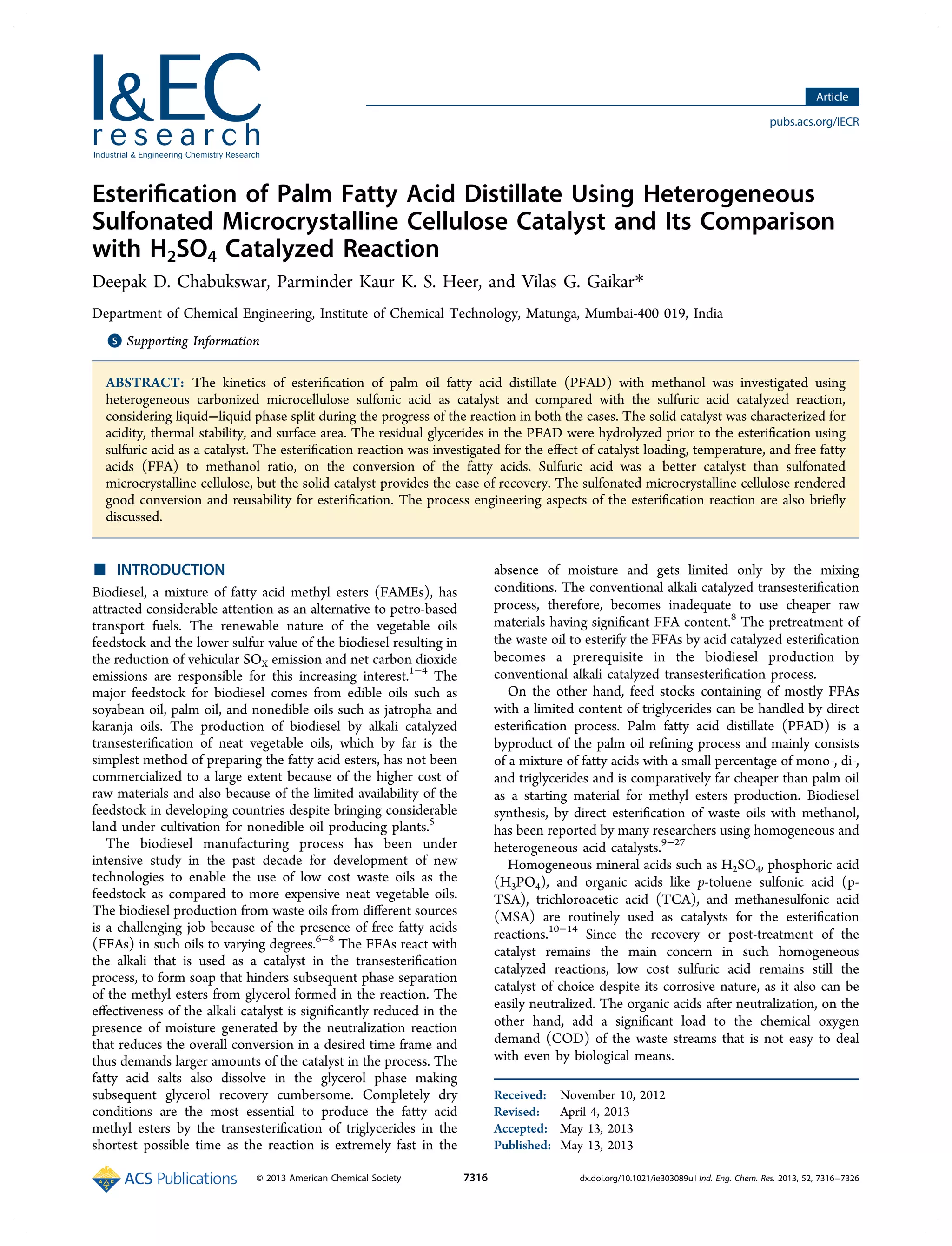
than Amberlyst-15 at the same catalyst loading (Figure 1). The
esterification of PFAD:methanol (1:3 mol ratio) with the
CSMC catalyst gave 62% conversion in 3 h, but the conversion
with Amberlyst-15 was 47%, in the same period. Since CSMC
exhibited a remarkable activity for the esterification reaction,
further studies were carried out by using only the CSMC
catalyst.
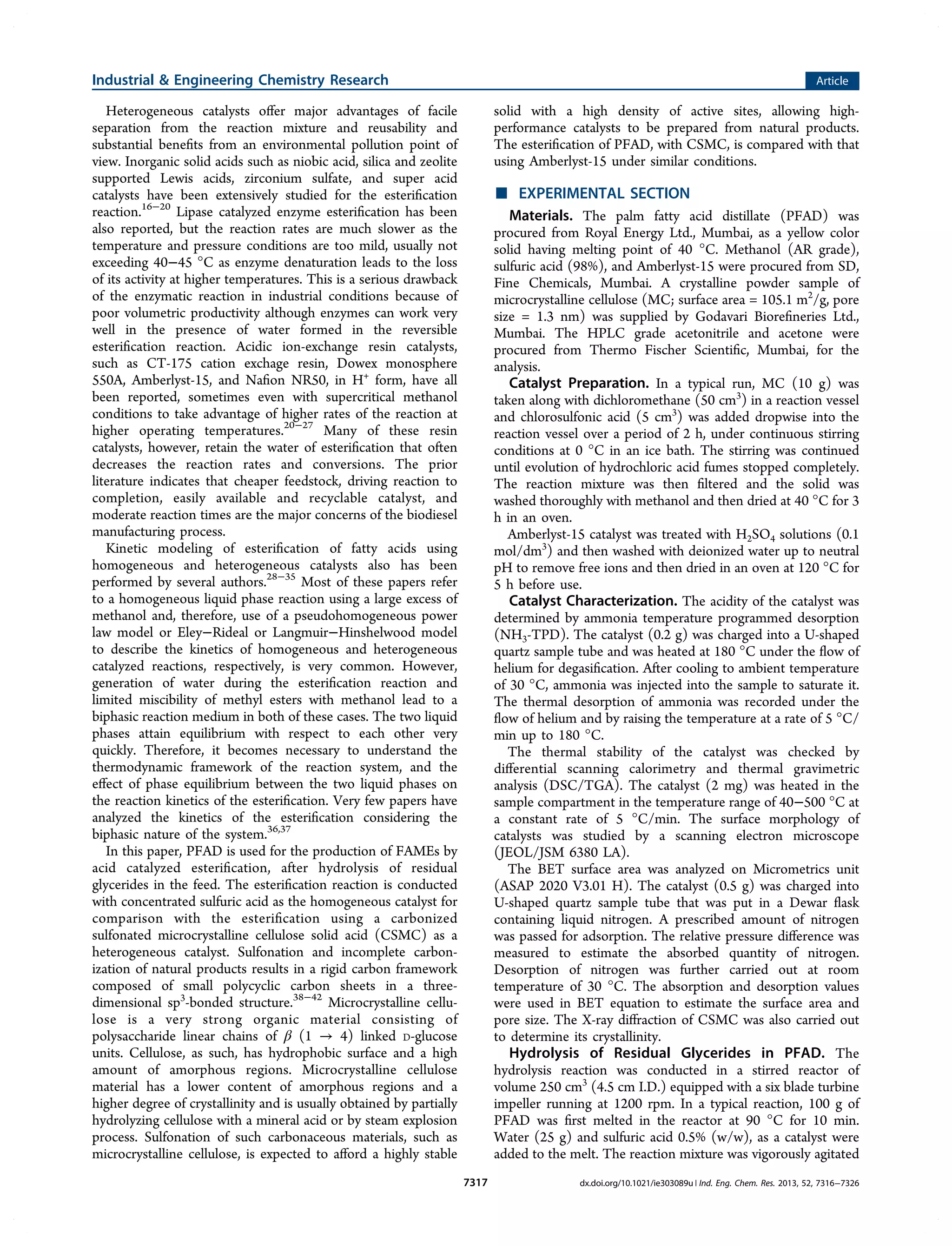
Effect of Reaction Temperature. Figure 2 shows the
effect of temperature on conversion with the same molar ratio
of methanol:FFA (3:1) using sulphuric acid and CSMC as
catalyst, respectively. The FFA conversion increased from 26%
at 40 °C to 52% at 50 °C and became 62% at 60 °C in 3 h of
Industrial & Engineering Chemistry Research Article
dx.doi.org/10.1021/ie303089u | Ind. Eng. Chem. Res. 2013, 52, 7316−73267318
the reaction time when CSMC was used as the catalyst in single
stage esterification. For the sulphuric acid catalyzed ester-
ification, the FFA conversion was similar to that obtained with
fresh CSMC catalyst, however, in much less time, 1 h.
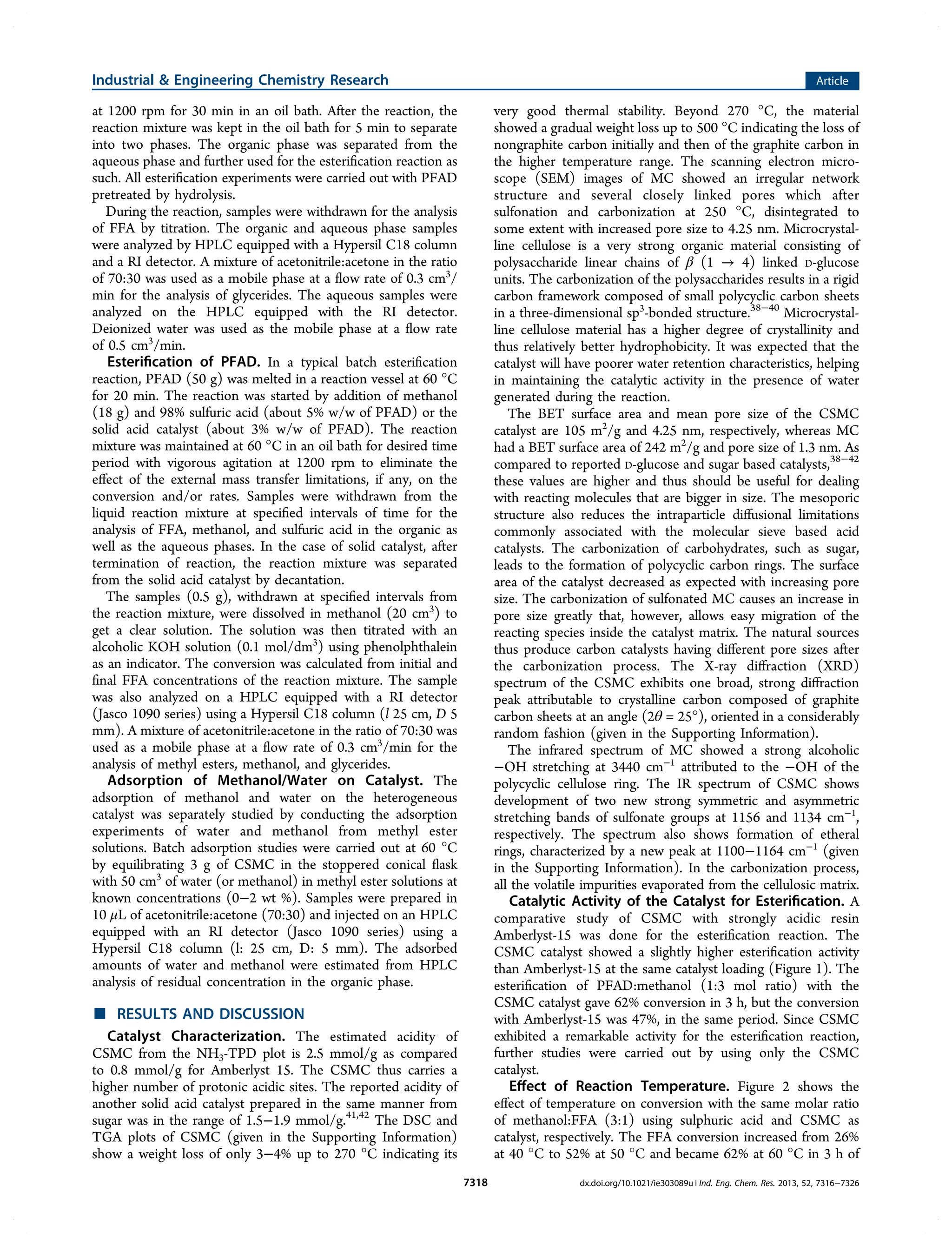
Effect of FFA to Methanol Molar Ratio. Figure 3 shows
the effect of molar ratio of PFAD to methanol in the feed, from
1:1 to 1:4 at same CSMC catalyst loading (3% w/w of PFAD)
and reaction temperature. As the initial concentration of
methanol in the initial feed mixture was increased, the
conversion of FFA also increased in the given time period. At
60 °C the conversion of FFA was 54% for the molar ratio of 1:1
in 3 h whereas the conversion increased to 62% and thereafter
to 68% with molar ratio of 1:3 and 1:4 in 3 h, respectively. The
conversion increased in given time with the increasing molar
ratio of FFA:methanol because, for the kinetically controlled
reaction, the rate depends on the concentrations of the
reactants and the equilibrium limited reaction is pushed toward
more conversion in the presence of increased amount of one of
the reactants. Higher temperatures and increasing methanol
content of the reaction mixture thus increase the rate of the
reaction and conversion in given time.
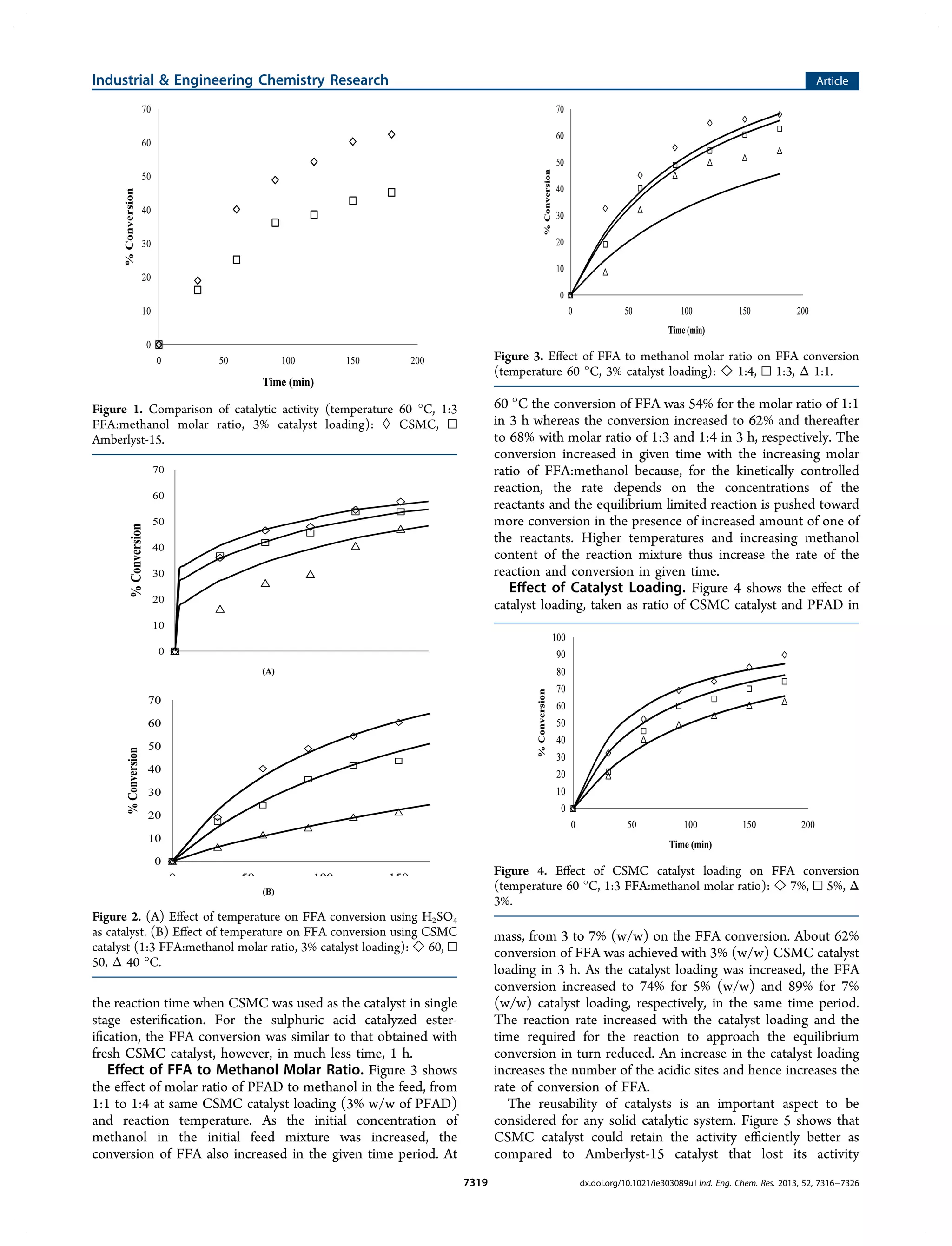
Effect of Catalyst Loading. Figure 4 shows the effect of
catalyst loading, taken as ratio of CSMC catalyst and PFAD in
mass, from 3 to 7% (w/w) on the FFA conversion. About 62%
conversion of FFA was achieved with 3% (w/w) CSMC catalyst
loading in 3 h. As the catalyst loading was increased, the FFA
conversion increased to 74% for 5% (w/w) and 89% for 7%
(w/w) catalyst loading, respectively, in the same time period.
The reaction rate increased with the catalyst loading and the
time required for the reaction to approach the equilibrium
conversion in turn reduced. An increase in the catalyst loading
increases the number of the acidic sites and hence increases the
rate of conversion of FFA.
The reusability of catalysts is an important aspect to be
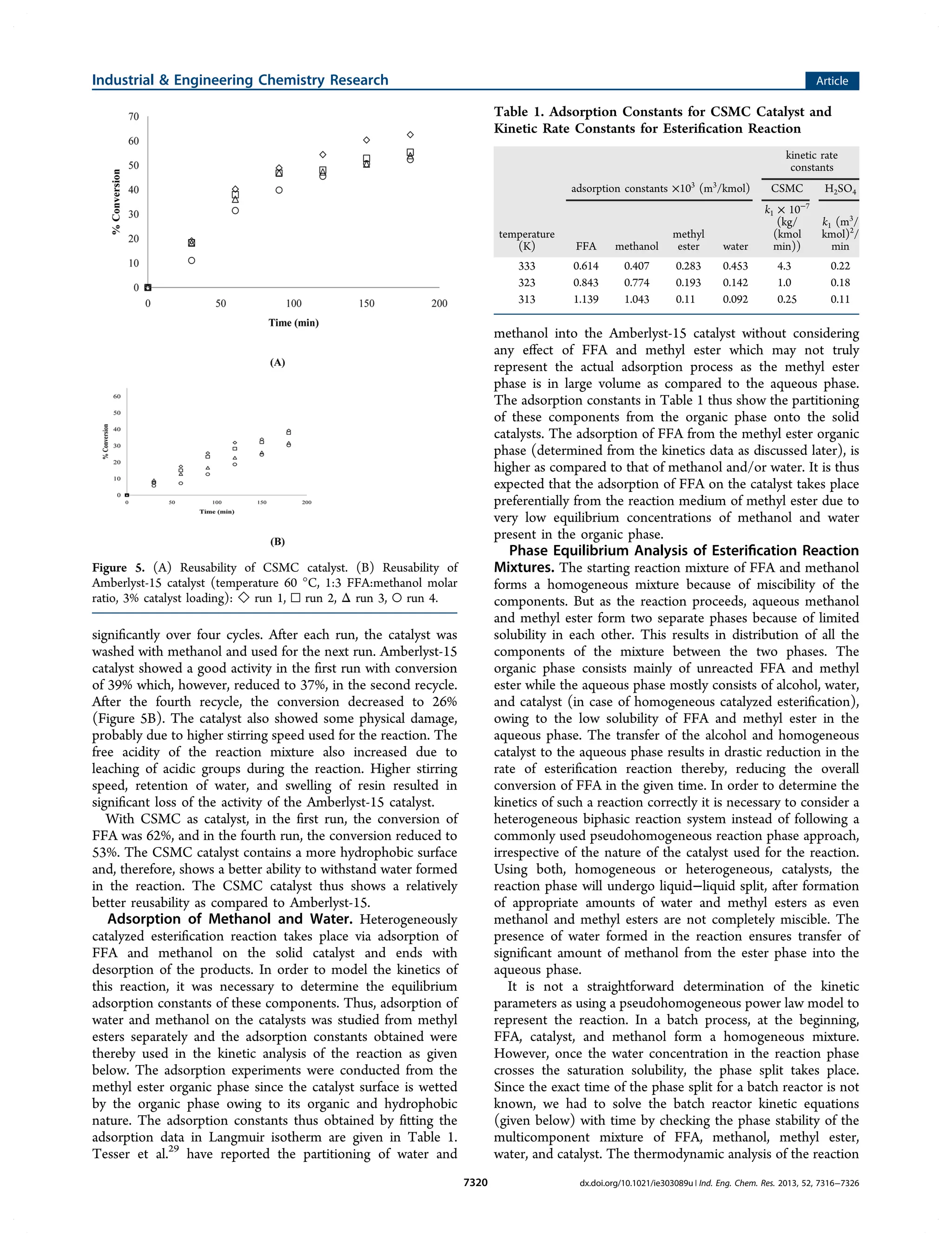
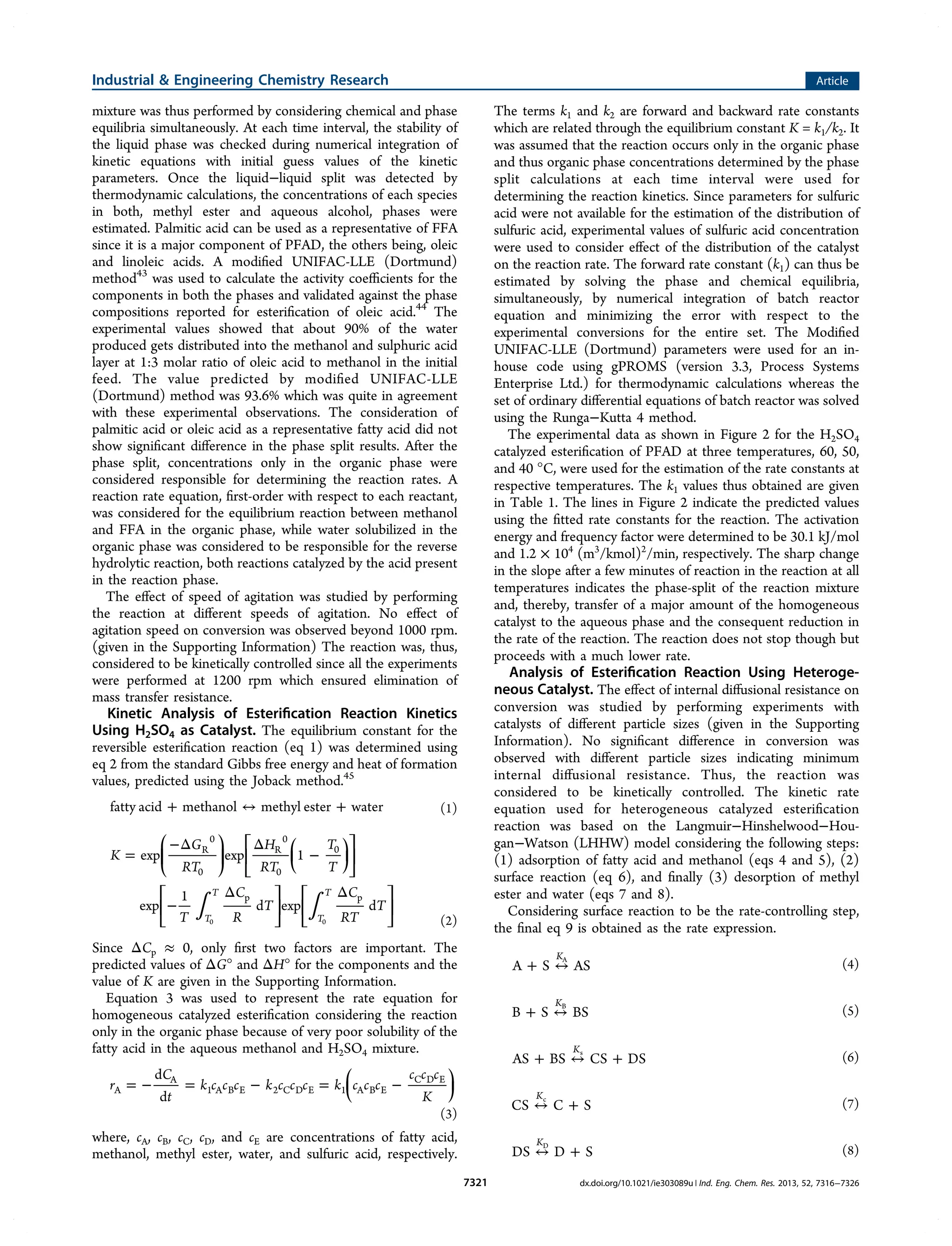
considered for any solid catalytic system. Figure 5 shows that
CSMC catalyst could retain the activity efficiently better as
compared to Amberlyst-15 catalyst that lost its activity
Figure 1. Comparison of catalytic activity (temperature 60 °C, 1:3
FFA:methanol molar ratio, 3% catalyst loading): ◊ CSMC, □
Amberlyst-15.
Figure 2. (A) Effect of temperature on FFA conversion using H2SO4
as catalyst. (B) Effect of temperature on FFA conversion using CSMC
catalyst (1:3 FFA:methanol molar ratio, 3% catalyst loading): ◇ 60, □
50, Δ 40 °C.
Figure 3. Effect of FFA to methanol molar ratio on FFA conversion
(temperature 60 °C, 3% catalyst loading): ◇ 1:4, □ 1:3, Δ 1:1.
Figure 4. Effect of CSMC catalyst loading on FFA conversion
(temperature 60 °C, 1:3 FFA:methanol molar ratio): ◇ 7%, □ 5%, Δ
3%.
Industrial & Engineering Chemistry Research Article
dx.doi.org/10.1021/ie303089u | Ind. Eng. Chem. Res. 2013, 52, 7316−73267319
significantly over four cycles. After each run, the catalyst was
washed with methanol and used for the next run. Amberlyst-15
catalyst showed a good activity in the first run with conversion
of 39% which, however, reduced to 37%, in the second recycle.
After the fourth recycle, the conversion decreased to 26%
(Figure 5B). The catalyst also showed some physical damage,
probably due to higher stirring speed used for the reaction. The
free acidity of the reaction mixture also increased due to
leaching of acidic groups during the reaction. Higher stirring
speed, retention of water, and swelling of resin resulted in
significant loss of the activity of the Amberlyst-15 catalyst.
With CSMC as catalyst, in the first run, the conversion of
FFA was 62%, and in the fourth run, the conversion reduced to
53%. The CSMC catalyst contains a more hydrophobic surface
and, therefore, shows a better ability to withstand water formed
in the reaction. The CSMC catalyst thus shows a relatively
better reusability as compared to Amberlyst-15.
Adsorption of Methanol and Water. Heterogeneously
catalyzed esterification reaction takes place via adsorption of
FFA and methanol on the solid catalyst and ends with
desorption of the products. In order to model the kinetics of
this reaction, it was necessary to determine the equilibrium
adsorption constants of these components. Thus, adsorption of
water and methanol on the catalysts was studied from methyl
esters separately and the adsorption constants obtained were
thereby used in the kinetic analysis of the reaction as given
below. The adsorption experiments were conducted from the
methyl ester organic phase since the catalyst surface is wetted
by the organic phase owing to its organic and hydrophobic
nature. The adsorption constants thus obtained by fitting the
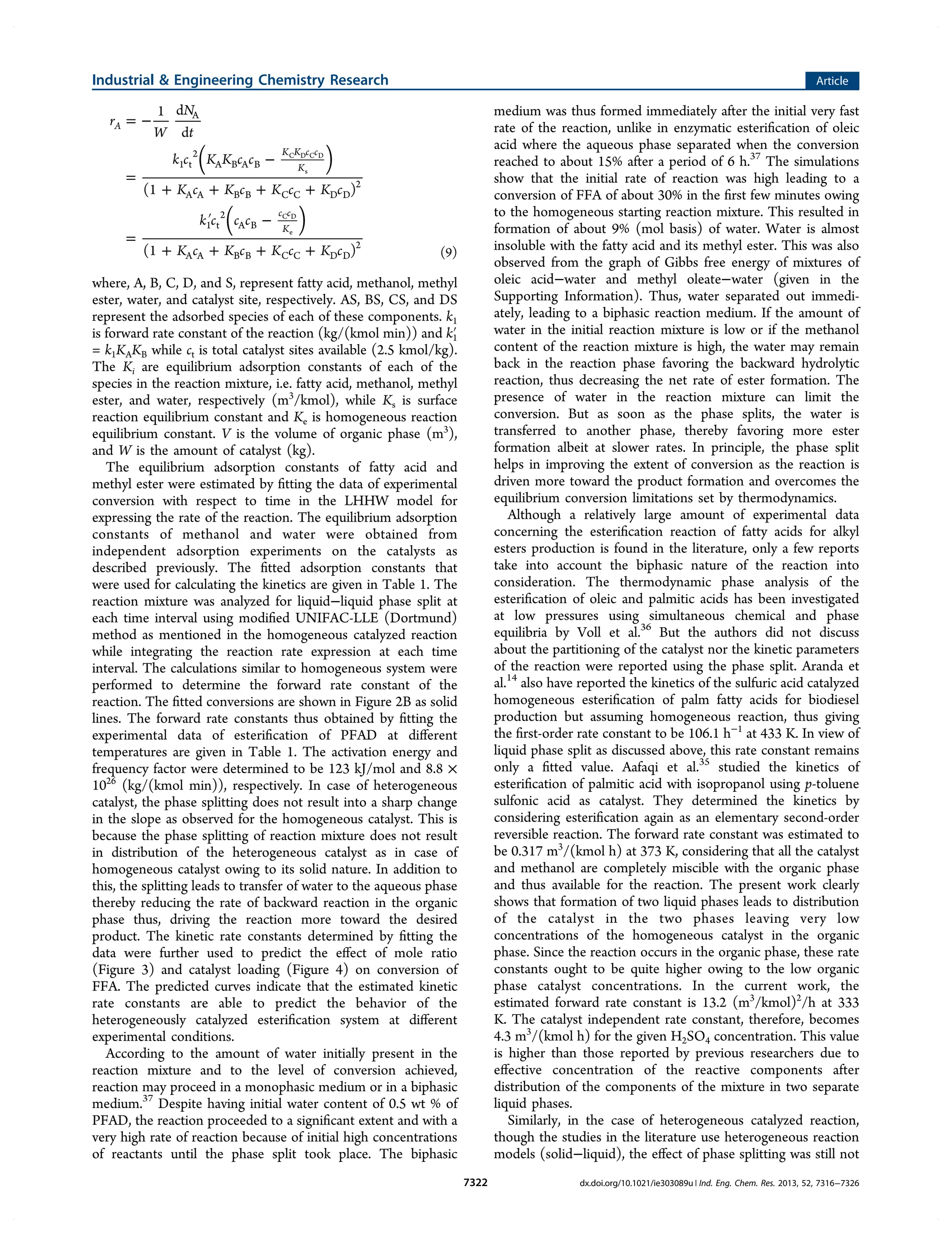
adsorption data in Langmuir isotherm are given in Table 1.
Tesser et al.29
have reported the partitioning of water and
methanol into the Amberlyst-15 catalyst without considering
any effect of FFA and methyl ester which may not truly
represent the actual adsorption process as the methyl ester
phase is in large volume as compared to the aqueous phase.
The adsorption constants in Table 1 thus show the partitioning
of these components from the organic phase onto the solid
catalysts. The adsorption of FFA from the methyl ester organic
phase (determined from the kinetics data as discussed later), is
higher as compared to that of methanol and/or water. It is thus
expected that the adsorption of FFA on the catalyst takes place
preferentially from the reaction medium of methyl ester due to
very low equilibrium concentrations of methanol and water
present in the organic phase.
Phase Equilibrium Analysis of Esterification Reaction
Mixtures. The starting reaction mixture of FFA and methanol
forms a homogeneous mixture because of miscibility of the
components. But as the reaction proceeds, aqueous methanol
and methyl ester form two separate phases because of limited
solubility in each other. This results in distribution of all the
components of the mixture between the two phases. The
organic phase consists mainly of unreacted FFA and methyl
ester while the aqueous phase mostly consists of alcohol, water,
and catalyst (in case of homogeneous catalyzed esterification),
owing to the low solubility of FFA and methyl ester in the
aqueous phase. The transfer of the alcohol and homogeneous
catalyst to the aqueous phase results in drastic reduction in the
rate of esterification reaction thereby, reducing the overall
conversion of FFA in the given time. In order to determine the
kinetics of such a reaction correctly it is necessary to consider a
heterogeneous biphasic reaction system instead of following a
commonly used pseudohomogeneous reaction phase approach,
irrespective of the nature of the catalyst used for the reaction.
Using both, homogeneous or heterogeneous, catalysts, the
reaction phase will undergo liquid−liquid split, after formation
of appropriate amounts of water and methyl esters as even
methanol and methyl esters are not completely miscible. The
presence of water formed in the reaction ensures transfer of
significant amount of methanol from the ester phase into the
aqueous phase.
It is not a straightforward determination of the kinetic
parameters as using a pseudohomogeneous power law model to
represent the reaction. In a batch process, at the beginning,
FFA, catalyst, and methanol form a homogeneous mixture.
However, once the water concentration in the reaction phase
crosses the saturation solubility, the phase split takes place.
Since the exact time of the phase split for a batch reactor is not
known, we had to solve the batch reactor kinetic equations
(given below) with time by checking the phase stability of the
multicomponent mixture of FFA, methanol, methyl ester,
water, and catalyst. The thermodynamic analysis of the reaction
Figure 5. (A) Reusability of CSMC catalyst. (B) Reusability of
Amberlyst-15 catalyst (temperature 60 °C, 1:3 FFA:methanol molar
ratio, 3% catalyst loading): ◇ run 1, □ run 2, Δ run 3, ○ run 4.
Table 1. Adsorption Constants for CSMC Catalyst and
Kinetic Rate Constants for Esterification Reaction
kinetic rate
constants
adsorption constants ×103
(m3
/kmol) CSMC H2SO4
temperature
(K) FFA methanol
methyl
ester water
k1 × 10−7
(kg/
(kmol
min))
k1 (m3
/
kmol)2
/
min
333 0.614 0.407 0.283 0.453 4.3 0.22
323 0.843 0.774 0.193 0.142 1.0 0.18
313 1.139 1.043 0.11 0.092 0.25 0.11
Industrial & Engineering Chemistry Research Article
dx.doi.org/10.1021/ie303089u | Ind. Eng. Chem. Res. 2013, 52, 7316−73267320
mixture was thus performed by considering chemical and phase
equilibria simultaneously. At each time interval, the stability of
the liquid phase was checked during numerical integration of
kinetic equations with initial guess values of the kinetic
parameters. Once the liquid−liquid split was detected by
thermodynamic calculations, the concentrations of each species
in both, methyl ester and aqueous alcohol, phases were
estimated. Palmitic acid can be used as a representative of FFA
since it is a major component of PFAD, the others being, oleic
and linoleic acids. A modified UNIFAC-LLE (Dortmund)
method43
was used to calculate the activity coefficients for the
components in both the phases and validated against the phase
compositions reported for esterification of oleic acid.44
The
experimental values showed that about 90% of the water
produced gets distributed into the methanol and sulphuric acid
layer at 1:3 molar ratio of oleic acid to methanol in the initial
feed. The value predicted by modified UNIFAC-LLE
(Dortmund) method was 93.6% which was quite in agreement
with these experimental observations. The consideration of
palmitic acid or oleic acid as a representative fatty acid did not
show significant difference in the phase split results. After the
phase split, concentrations only in the organic phase were
considered responsible for determining the reaction rates. A
reaction rate equation, first-order with respect to each reactant,
was considered for the equilibrium reaction between methanol
and FFA in the organic phase, while water solubilized in the
organic phase was considered to be responsible for the reverse
hydrolytic reaction, both reactions catalyzed by the acid present
in the reaction phase.
The effect of speed of agitation was studied by performing
the reaction at different speeds of agitation. No effect of
agitation speed on conversion was observed beyond 1000 rpm.
(given in the Supporting Information) The reaction was, thus,
considered to be kinetically controlled since all the experiments
were performed at 1200 rpm which ensured elimination of
mass transfer resistance.
Kinetic Analysis of Esterification Reaction Kinetics
Using H2SO4 as Catalyst. The equilibrium constant for the
reversible esterification reaction (eq 1) was determined using
eq 2 from the standard Gibbs free energy and heat of formation
values, predicted using the Joback method.45
+ ↔ +fatty acid methanol methyl ester water (1)
∫ ∫
=
−Δ Δ
−
−
Δ Δ
⎜ ⎟
⎛
⎝
⎜
⎞
⎠
⎟
⎡
⎣
⎢
⎛
⎝
⎞
⎠
⎤
⎦
⎥
⎡
⎣
⎢
⎤
⎦
⎥
⎡
⎣
⎢
⎤
⎦
⎥
K
G
RT
H
RT
T
T
T
C
R
T
C
RT
T
exp exp 1
exp
1
d exp d
T
T
T
T
R
0
0
R
0
0
0
p p
0 0 (2)
Since ΔCp ≈ 0, only first two factors are important. The
predicted values of ΔG° and ΔH° for the components and the
value of K are given in the Supporting Information.
Equation 3 was used to represent the rate equation for
homogeneous catalyzed esterification considering the reaction
only in the organic phase because of very poor solubility of the
fatty acid in the aqueous methanol and H2SO4 mixture.
= − = − = −⎜ ⎟
⎛
⎝
⎞
⎠
r
C
t
k c c c k c c c k c c c
c c c
K
d
d
A
A
1 A B E 2 C D E 1 A B E
C D E
(3)
where, cA, cB, cC, cD, and cE are concentrations of fatty acid,
methanol, methyl ester, water, and sulfuric acid, respectively.
The terms k1 and k2 are forward and backward rate constants
which are related through the equilibrium constant K = k1/k2. It
was assumed that the reaction occurs only in the organic phase
and thus organic phase concentrations determined by the phase
split calculations at each time interval were used for
determining the reaction kinetics. Since parameters for sulfuric
acid were not available for the estimation of the distribution of
sulfuric acid, experimental values of sulfuric acid concentration
were used to consider effect of the distribution of the catalyst
on the reaction rate. The forward rate constant (k1) can thus be
estimated by solving the phase and chemical equilibria,
simultaneously, by numerical integration of batch reactor
equation and minimizing the error with respect to the
experimental conversions for the entire set. The Modified
UNIFAC-LLE (Dortmund) parameters were used for an in-
house code using gPROMS (version 3.3, Process Systems
Enterprise Ltd.) for thermodynamic calculations whereas the
set of ordinary differential equations of batch reactor was solved
using the Runga−Kutta 4 method.
The experimental data as shown in Figure 2 for the H2SO4
catalyzed esterification of PFAD at three temperatures, 60, 50,
and 40 °C, were used for the estimation of the rate constants at
respective temperatures. The k1 values thus obtained are given
in Table 1. The lines in Figure 2 indicate the predicted values
using the fitted rate constants for the reaction. The activation
energy and frequency factor were determined to be 30.1 kJ/mol
and 1.2 × 10⁴
(m3
/kmol)2
/min, respectively. The sharp change
in the slope after a few minutes of reaction in the reaction at all
temperatures indicates the phase-split of the reaction mixture
and, thereby, transfer of a major amount of the homogeneous
catalyst to the aqueous phase and the consequent reduction in
the rate of the reaction. The reaction does not stop though but
proceeds with a much lower rate.
Analysis of Esterification Reaction Using Heteroge-
neous Catalyst. The effect of internal diffusional resistance on
conversion was studied by performing experiments with
catalysts of different particle sizes (given in the Supporting
Information). No significant difference in conversion was
observed with different particle sizes indicating minimum
internal diffusional resistance. Thus, the reaction was
considered to be kinetically controlled. The kinetic rate
equation used for heterogeneous catalyzed esterification
reaction was based on the Langmuir−Hinshelwood−Hou-
gan−Watson (LHHW) model considering the following steps:
(1) adsorption of fatty acid and methanol (eqs 4 and 5), (2)
surface reaction (eq 6), and finally (3) desorption of methyl
ester and water (eqs 7 and 8).
Considering surface reaction to be the rate-controlling step,
the final eq 9 is obtained as the rate expression.
+ ↔A S AS
KA
(4)
+ ↔B S BS
KB
(5)
+ ↔ +AS BS CS DS
Ks
(6)
↔ +CS C S
Kc
(7)
↔ +DS D S
KD
(8)
Industrial & Engineering Chemistry Research Article
dx.doi.org/10.1021/ie303089u | Ind. Eng. Chem. Res. 2013, 52, 7316−73267321
= −
=
−
+ + + +
=
′ −
+ + + +
( )
( )
r
W
N
t
k c K K c c
K c K c K c K c
k c c c
K c K c K c K c
1 d
d
(1 )
(1 )
A
K K c c
K
c c
K
A
1 t
2
A B A B
A A B B C C D D
2
1 t
2
A B
A A B B C C D D
2
C D C D
s
C D
e
(9)
where, A, B, C, D, and S, represent fatty acid, methanol, methyl
ester, water, and catalyst site, respectively. AS, BS, CS, and DS
represent the adsorbed species of each of these components. k1
is forward rate constant of the reaction (kg/(kmol min)) and k1′
= k1KAKB while ct is total catalyst sites available (2.5 kmol/kg).
The Ki are equilibrium adsorption constants of each of the
species in the reaction mixture, i.e. fatty acid, methanol, methyl
ester, and water, respectively (m3
/kmol), while Ks is surface
reaction equilibrium constant and Ke is homogeneous reaction
equilibrium constant. V is the volume of organic phase (m3
),
and W is the amount of catalyst (kg).
The equilibrium adsorption constants of fatty acid and
methyl ester were estimated by fitting the data of experimental
conversion with respect to time in the LHHW model for
expressing the rate of the reaction. The equilibrium adsorption
constants of methanol and water were obtained from
independent adsorption experiments on the catalysts as
described previously. The fitted adsorption constants that
were used for calculating the kinetics are given in Table 1. The
reaction mixture was analyzed for liquid−liquid phase split at
each time interval using modified UNIFAC-LLE (Dortmund)
method as mentioned in the homogeneous catalyzed reaction
while integrating the reaction rate expression at each time
interval. The calculations similar to homogeneous system were
performed to determine the forward rate constant of the
reaction. The fitted conversions are shown in Figure 2B as solid
lines. The forward rate constants thus obtained by fitting the
experimental data of esterification of PFAD at different
temperatures are given in Table 1. The activation energy and
frequency factor were determined to be 123 kJ/mol and 8.8 ×
1026
(kg/(kmol min)), respectively. In case of heterogeneous
catalyst, the phase splitting does not result into a sharp change
in the slope as observed for the homogeneous catalyst. This is
because the phase splitting of reaction mixture does not result
in distribution of the heterogeneous catalyst as in case of
homogeneous catalyst owing to its solid nature. In addition to
this, the splitting leads to transfer of water to the aqueous phase
thereby reducing the rate of backward reaction in the organic
phase thus, driving the reaction more toward the desired
product. The kinetic rate constants determined by fitting the
data were further used to predict the effect of mole ratio
(Figure 3) and catalyst loading (Figure 4) on conversion of
FFA. The predicted curves indicate that the estimated kinetic
rate constants are able to predict the behavior of the
heterogeneously catalyzed esterification system at different
experimental conditions.
According to the amount of water initially present in the
reaction mixture and to the level of conversion achieved,
reaction may proceed in a monophasic medium or in a biphasic
medium.37
Despite having initial water content of 0.5 wt % of
PFAD, the reaction proceeded to a significant extent and with a
very high rate of reaction because of initial high concentrations
of reactants until the phase split took place. The biphasic
medium was thus formed immediately after the initial very fast
rate of the reaction, unlike in enzymatic esterification of oleic
acid where the aqueous phase separated when the conversion
reached to about 15% after a period of 6 h.37
The simulations
show that the initial rate of reaction was high leading to a
conversion of FFA of about 30% in the first few minutes owing
to the homogeneous starting reaction mixture. This resulted in
formation of about 9% (mol basis) of water. Water is almost
insoluble with the fatty acid and its methyl ester. This was also
observed from the graph of Gibbs free energy of mixtures of
oleic acid−water and methyl oleate−water (given in the
Supporting Information). Thus, water separated out immedi-
ately, leading to a biphasic reaction medium. If the amount of
water in the initial reaction mixture is low or if the methanol
content of the reaction mixture is high, the water may remain
back in the reaction phase favoring the backward hydrolytic
reaction, thus decreasing the net rate of ester formation. The
presence of water in the reaction mixture can limit the
conversion. But as soon as the phase splits, the water is
transferred to another phase, thereby favoring more ester
formation albeit at slower rates. In principle, the phase split
helps in improving the extent of conversion as the reaction is
driven more toward the product formation and overcomes the
equilibrium conversion limitations set by thermodynamics.
Although a relatively large amount of experimental data
concerning the esterification reaction of fatty acids for alkyl
esters production is found in the literature, only a few reports
take into account the biphasic nature of the reaction into
consideration. The thermodynamic phase analysis of the
esterification of oleic and palmitic acids has been investigated
at low pressures using simultaneous chemical and phase
equilibria by Voll et al.36
But the authors did not discuss
about the partitioning of the catalyst nor the kinetic parameters
of the reaction were reported using the phase split. Aranda et
al.14
also have reported the kinetics of the sulfuric acid catalyzed
homogeneous esterification of palm fatty acids for biodiesel
production but assuming homogeneous reaction, thus giving
the first-order rate constant to be 106.1 h−1
at 433 K. In view of
liquid phase split as discussed above, this rate constant remains
only a fitted value. Aafaqi et al.35
studied the kinetics of
esterification of palmitic acid with isopropanol using p-toluene
sulfonic acid as catalyst. They determined the kinetics by
considering esterification again as an elementary second-order
reversible reaction. The forward rate constant was estimated to
be 0.317 m3
/(kmol h) at 373 K, considering that all the catalyst
and methanol are completely miscible with the organic phase
and thus available for the reaction. The present work clearly
shows that formation of two liquid phases leads to distribution
of the catalyst in the two phases leaving very low
concentrations of the homogeneous catalyst in the organic
phase. Since the reaction occurs in the organic phase, these rate
constants ought to be quite higher owing to the low organic
phase catalyst concentrations. In the current work, the
estimated forward rate constant is 13.2 (m3
/kmol)2
/h at 333
K. The catalyst independent rate constant, therefore, becomes
4.3 m3
/(kmol h) for the given H2SO4 concentration. This value
is higher than those reported by previous researchers due to
effective concentration of the reactive components after
distribution of the components of the mixture in two separate
liquid phases.
Similarly, in the case of heterogeneous catalyzed reaction,
though the studies in the literature use heterogeneous reaction
models (solid−liquid), the effect of phase splitting was still not
Industrial & Engineering Chemistry Research Article
dx.doi.org/10.1021/ie303089u | Ind. Eng. Chem. Res. 2013, 52, 7316−73267322
considered. Esterification of palmitic acid with iso-propanol by
using zinc ethanoate supported over silica gel as catalyst was
carried out by Aafaqi et al.35
They have also used LHHW
model considering surface reaction as the controlling
mechanism for predicting the kinetics of the reaction. The
concentrations used for the fitting were, however, the bulk
overall pseudophase concentrations neglecting the phase
separation. The kinetics of esterification of oleic acid using an
acid ion exchange polymeric resin has been studied by Tesser et
al.29
using the Eley−Rideal model. The experimental data have
been interpreted with a kinetic model based on an ion exchange
reaction mechanism that takes into account also the physical
partitioning effects of the various components of the reacting
mixture between the liquid phase internal and external to the
resins but not the formation of two separate liquid phases. The
current work considers the similar LHHW model but
incorporates the effect of phase splitting on the reaction
kinetics by considering phase equilibria of the reaction system.
The organic phase was considered as the reaction phase in
contact with the catalyst active sites.
At equilibrium, the water produced in the reaction is mainly
distributed into the aqueous phase, with a small amount
remaining in the organic phase. The presence of water in a
monophasic system would shift the reaction equilibrium to the
reactants because of the hydrolysis reaction. Thus, consid-
eration of a homogeneous/monophasic kinetics would lead to
erroneous prediction of the rate constant. However, when two
liquid phases are considered, the water formed in the reaction
medium is not available in the organic phase, allowing the
reaction to proceed to products, thus representing the real
scenario. Thus, prediction of liquid−liquid equilibrium must be
used for reliable prediction of the chemical equilibrium of
esterification reaction of fatty acids. Even for the heterogeneous
catalyzed reactions, the separation of aqueous phase is an
important factor, which probably was not observed because of
significant water retention by the catalysts in the previous
reports. The CSMC catalysts, being highly hydrophobic, retains
far less water, as shown by the poor adsorption constant of
water on the catalyst. An ideal catalyst of esterification would be
a completely hydrophobic catalyst which would retain no water
at all. In that case, the reaction can be taken to completion
without any large excess of methanol. Even if the reaction
equilibrium constant seems to be low, the phase separation
drives the reaction toward more ester formation. Had water
formed in the reaction not separated into a second liquid phase,
the reaction would have faced significant equilibrium limitation.
Essentially, it is the liquid split that helps in driving the reaction
to higher conversions due to limited water solubility in the
organic phase.
Process Engineering Aspects of PFAD Esterification. A
single stage esterification reaction does not give complete
conversion of PFAD as desired even with using 200% excess
methanol in a batch reactor. One can use a large excess of
methanol to drive the reaction to almost complete conversion.
Many laboratory batch kinetics studies are based on the molar
ratio of methanol to FFA from 6 to 10, in some cases using still
higher values, to drive the reaction to completion. But the
entire excess amount of methanol ends up in the aqueous phase
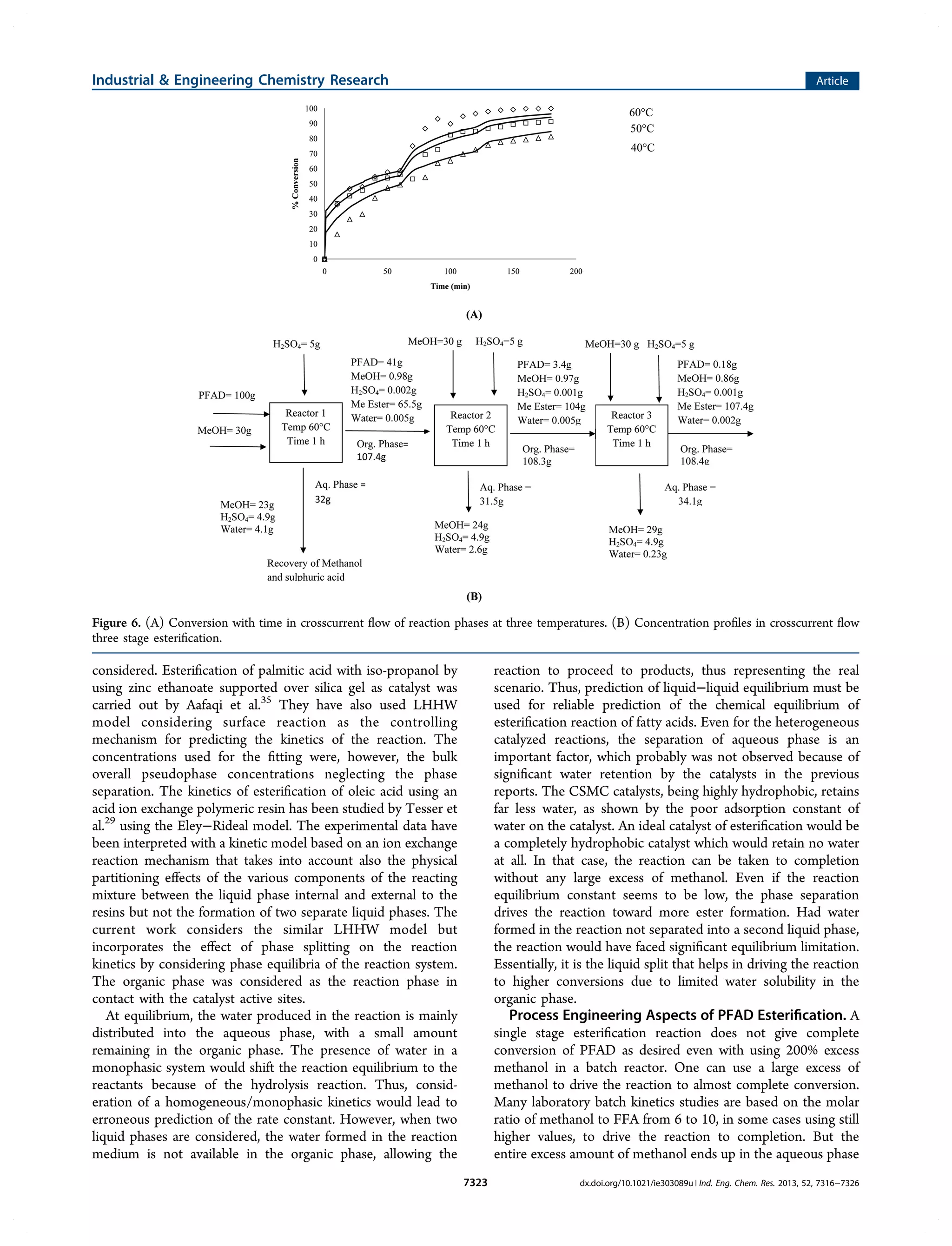
Figure 6. (A) Conversion with time in crosscurrent flow of reaction phases at three temperatures. (B) Concentration profiles in crosscurrent flow
three stage esterification.
Industrial & Engineering Chemistry Research Article
dx.doi.org/10.1021/ie303089u | Ind. Eng. Chem. Res. 2013, 52, 7316−73267323
which has to be separated. This methanol is recovered by
distillation in subsequent operations for recycle. In order to
obtain relatively anhydrous methanol, as required for the
esterification reactions, a high reflux ratio is commonly
employed. This distillation operation adds a significant energy
cost to the recovery operation and also to the product cost.
The phase split, on one hand, helps in driving the reaction
toward formation of more esters in the organic phase where
only the soluble amount of water can facilitate the hydrolytic
reaction. A common engineering principle of separating one of
the products from the equilibrium limited reaction mixture can
be exploited to reduce the excess amount of methanol used for
the reaction. The phase split, because of not only the
immiscibility of water with the organic esters and FFA but
also the partial immiscibility of methanol with the methyl
esters, can be judiciously exploited.
We decided to, therefore, investigate a process where
methanol and FFA are brought in contact with each other in
crosscurrent and countercurrent manners. The process was
simulated in a series of batch reaction operations of three
stages.
The crosscurrent operation is more common where fresh
methanol and acid catalyst are added to the reaction phase to
improve the rate and conversion of the reaction. At each
temperature, the reaction with sulfuric acid as catalyst was
carried in three steps by adding fresh methanol and the catalyst
in each step, keeping the reaction time of 1 h the same for each
stage. The organic phase was separated from the aqueous phase
and then treated with fresh methanol and catalyst in subsequent
step. Figure 6 shows typical concentrations of the components
in different phases at each stage. The FFA conversion increases
from 81% at 40 °C to 98% at 60 °C after the third step in total
reaction time of 3 h. The breaks in FFA conversion profiles at 1
h intervals in Figure 6 are because of the fresh methanol
addition. The second and third stages of the reaction start with
two phases as methanol is partially miscible with the ester
phase. Thus, a significant percentage of the homogeneous
catalyst gets transferred to the methanolic phase immediately,
and therefore, no sudden change was observed in the second
and third stages of reaction as was seen in the first stage. The
lines in Figure 6 are predicted conversions in the second and
third stages using the rate constants fitted earlier that show that
the FFA conversion can go beyond 98% when operated in three
stages. This crosscurrent approach still uses a significantly large
amount of methanol for keeping the methanol to organic phase
at 3 in each stage. If the amount of the methanol is reduced in
the second and third stages to keep in line with reduced
quantity of PFAD in the reaction phase, the rate goes down
substantially, probably because of lower concentrations of
methanol in the organic phase as methanol gets diluted by
water formed in the reaction.
The conversion of FFA to corresponding methyl esters thus
can be increased to almost completion using sulfuric acid as the
catalyst and fresh methanol in each stage. However, the total
amount of methanol with respect to FFA can be still
prohibitively higher in such a multistage reaction system as
all the methanol ends up in the aqueous phase and requires
recovery later by distillation. The cost of distillation, to recover
almost unhydrous methanol for the esterification reaction, adds
to the cost of the product and thus this ratio has to be brought
down to reasonable level.
In the countercurrent manner of conducting this reaction,
however, in principle, the first stage gets fresh FFA feed, that is
contacted with the aqueous phase coming from the second
stage while the organic phase from the second phase is
contacted in the third stage reactor with fresh methanol feed.
The limited miscibility of methyl ester product with methanol
allows phase separation of methanol from the final product in
the third stage, and it can be charged into the second reactor
after the separation. All the three reactors thus work with two-
phase systems, the first reactor giving aqueous methanol as
another product stream of the process that can be sent for the
methanol recovery. The organic phase reaching to the third
reactor attains almost 90% conversion and meets the entire
amount of methanol charged in the system where the operating
ratio of methanol to unreacted FFA in the organic phase is very
high and thus ensures FFA conversion in excess of 98%. The
first reactor has the highest feed concentration of FFA and the
reaction is driven toward the ester formation to a significant
extent even when the entire amount of water generated in the
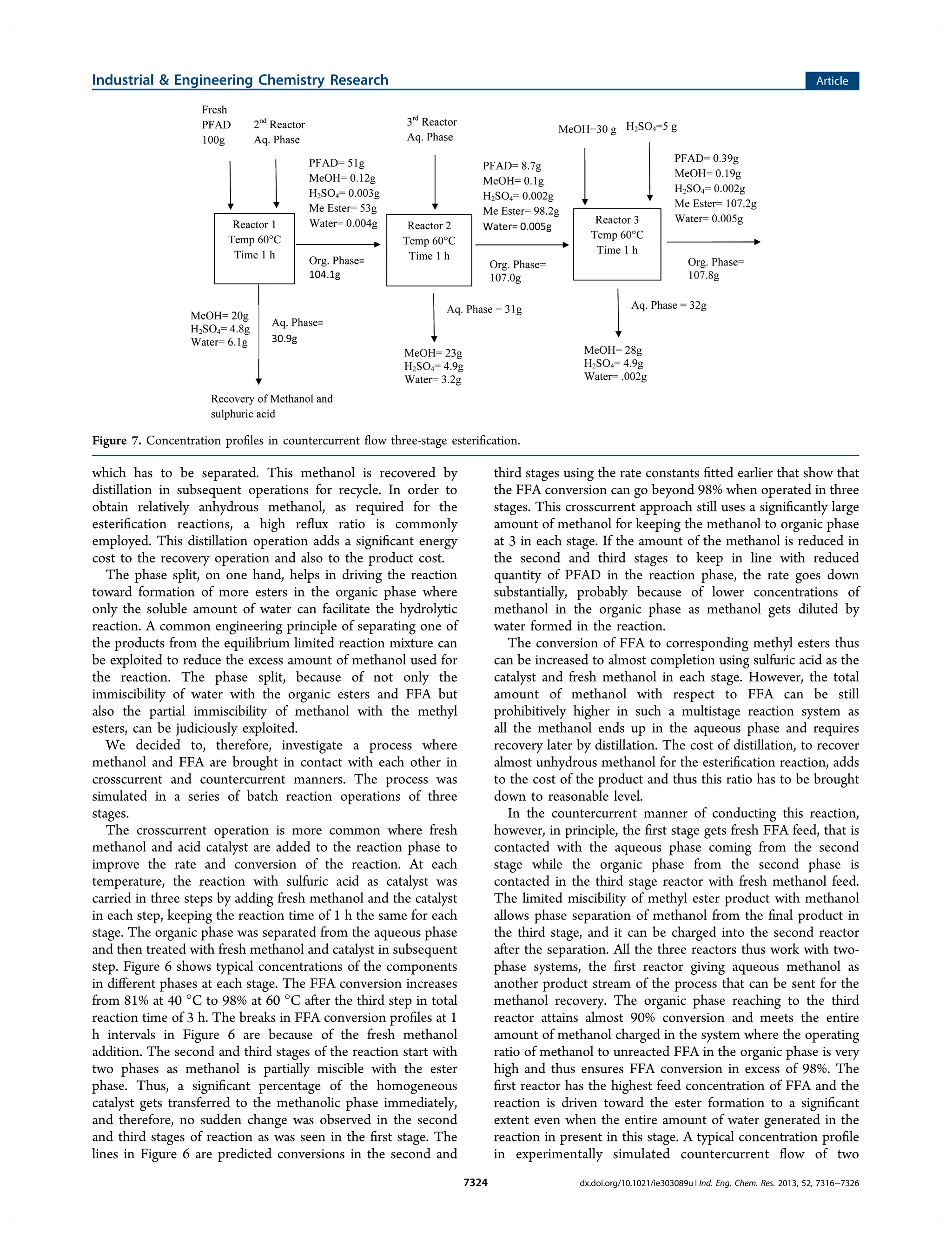
reaction in present in this stage. A typical concentration profile
in experimentally simulated countercurrent flow of two
Figure 7. Concentration profiles in countercurrent flow three-stage esterification.
Industrial & Engineering Chemistry Research Article
dx.doi.org/10.1021/ie303089u | Ind. Eng. Chem. Res. 2013, 52, 7316−73267324
reactants is given in Figure 7, with the methanol to FFA molar
ratio of 3:1. It is clear that even with the lower molar ratio for
the entire system, it is possible to approach the conversion in
excess of 98%. For still higher conversions, the organic phase
will have to be dried completely before it is fed to the third
reactor. The reduced methanol feed to the system also means
less methanol to be distilled in the distillation column bringing
down the energy penalty by a factor more than two as
compared to commonly used crosscurrent operation. The less
load on the distillation column reduces the capital cost of the
unit as a smaller diameter column is required for the distillation.
We have also considered the removal of glycerides from the
PFAD by hydrolysis as pretreatment of the PFAD feed. We
conducted the hydrolysis step to convert the residual glycerides
in the feedstock to FFAs which are further converted to methyl
esters by the acid catalyzed esterification. The hydrolysis
reaction, if conducted with dilute H2SO4, then the FFA feed is
available for the esterification system directly without any
drying step as it anyway is contacted with aqueous methanol in
the first stage of the esterification. The major advantage of the
hydrolysis step is the absence of glycerol in the aqueous acidic
methanol stream from the esterification process. The glycerol, if
present, makes methanol recovery from this aqueous stream
difficult due to its decomposition under acidic conditions in the
presence of homogeneous acid catalyst like H2SO4 unless it is
neutralized. It is necessary to distill a major amount of
methanol before the neutralization of the catalyst acid, as FFAs
solubilized in the aqueous methanol can also undergo reaction
with the alkali. On distilling out the major amount of methanol
from the aqueous phase, without increasing the temperatures of
the solutions in excess of 100 °C, the FFAs separate out from
the aqueous acidic solutions. After separation of the FFA from
the acidic phase, and then neutralization of the homogeneous
acid catalyst, the remaining amount of methanol, if any, can be
distilled out. Even a small amount of fatty acid carried into
aqueous methanol solutions can otherwise give rise to soap
while neutralizing the mineral acid and then causing foaming in
the recovery column that makes the column operation difficult.
H2SO4 still remains the cheapest catalyst for the esterification
process, as the other homogeneous catalysts like aromatic/
aliphatic sulfonic catalysts on neutralization give rise a
significant organic load on microbial wastewater treatment
process. The development of carbonized sulfonated MC is
likely to provide a better solution in such multistage reaction
system. In principle the multistage esterification, either
crosscurrent or countercurrent, can also be used for the
heterogeneous catalyst, provided the activity is retained in
presence of large amount of water in the reaction phase.
■ CONCLUSIONS
Carbonized sulfonated microcrystalline cellulose (CSMC) gave
better conversion and water tolerance in esterification reaction
of PFAD with methanol as compared to Amberlyst-15 catalyst.
The kinetic data analysis considering phase equilibrium
simultaneously with reaction equilibrium allows identification
of true kinetic parameters of the esterification reaction. The
presented methodology represents the two phase esterification
reaction system in a more realistic way. Also a countercurrent
approach of two reaction phases has been demonstrated for
homogeneous catalyst to take the reaction to almost
completion without using a large excess of methanol that is
more attractive for the industrial adoption of the process.
■ ASSOCIATED CONTENT
*S Supporting Information
The characterization of CSMC catalyst using NH3-TPD, DSC-
TGA, SEM, XRD, and FT-IR, esterification crosscurrent and
countercurrent flow block diagram, effect of particle size of
CSMC catalyst on conversion, Gibbs free energy of oleic acid−
water and methyl oleate−water mixtures, and the values of
standard Gibbs free energy, heat of formation, and thermody-
namic equilibrium constant. This information is available free of
charge via the Internet at http://pubs.acs.org/.
■ AUTHOR INFORMATION
Corresponding Author
*E-mail: vg.gaikar@ictmumbai.edu.in. Phone: 091-22-
33612013. Fax: 091-22-33611020.
Notes
The authors declare no competing financial interest.
■ ACKNOWLEDGMENTS
We would like to acknowledge financial support provided by
University Grant Commission (UGC).
■ REFERENCES
(1) Ma, F. R.; Hanna, M. A. Biodiesel production: A review.
Bioresour. Technol. 1999, 70, 1.
(2) Kulkarni, M. G.; Dalai, A. K. Waste cooking oil − an economical
source for biodiesel: A review. Ind. Eng. Chem. Res. 2006, 45, 2901.
(3) Xing-cai, L.; Jian-guang, Y.; Wu-gao, Z.; Zhen, H. Effect of cetane
number improver on heat release rate and emissions of high speed
diesel engine fueled with ethanol−diesel blend fuel. Fuel 2004, 83,
2013.
(4) Ajav, E. A.; Singh, B.; Bhattacharya, T. K. Experimental study of
some performance parameters of a constant speed stationary diesel
engine using ethanol−diesel blends as fuel. Biomass Bioenerg. 1999, 17,
357.
(5) Watanabe, Y.; Shimada, Y.; Sugihara, A.; Noda, H.; Fukuda, H.;
Tominaga, Y. Production of biodiesel fuel from vegetable oil using
immobilized Candida antarctica lipase. J. Am. Oil. Chem. Soc. 2000, 77,
355.
(6) Zafiropoulos, N. A.; Ngo, H. L.; Foglia, T. A.; Samulski, E. T.;
Lin, W. Catalytic synthesis of biodiesel from high free fatty acid-
containing feedstocks. Chem. Commun. 2007, 35, 3670.
(7) Canakci, M.; Van, G. Pilot plant to produce biodiesel from high
free fatty acid feedstocks. T. ASAE 2003, 46, 945.
(8) Meng, X.; Chen, G.; Wang, Y. Biodiesel production from waste
cooking oil via alkali catalyst and its engine test. Fuel Process. Technol.
2008, 89, 851.
(9) Lotero, E.; Liu, Y. J.; Lopez, D. E.; Suwannakaran, K.; Bruce, D.
A.; Goodwin, J. G. Synthesis of biodiesel via acid catalysis. Ind. Eng.
Chem. Res. 2005, 44, 5353.
(10) Berrios, M.; Siles, J.; Martin, M. A. A kinetics study of the
Esterification of free fatty acids (FFA) in sunflower oil. Fuel 2007, 86,
2383.
(11) Sebos, I. Transesterification of vegetable oil to biodiesel fuel
using acid catalysts in the presence of diethyl ether. Fuel 2009, 88, 81.
(12) Benson, T.; Hernandez, R.; French, T.; Alley, E.; Holmes, W.
Reactions of fatty acids in superacid media: Identification of
equilibrium products. J. Mol. Catal. A: Chem. 2007, 274, 154.
(13) Edgar, L.; James, G. Goodwin, Jr. Synthesis of Biodiesel via Acid
Catalysis. Ind. Eng. Chem. Res. 2005, 44, 5353.
(14) Aranda, D. A. G.; Santos, R. T. P.; Tapanes, N. C. O.; Ramos, A.
L. D.; Antunes, O. A. C. Acid-catalyzed homogeneous esterification
reaction for biodiesel production from palm fatty acids. Catal. Lett.
2008, 122, 20.
Industrial & Engineering Chemistry Research Article
dx.doi.org/10.1021/ie303089u | Ind. Eng. Chem. Res. 2013, 52, 7316−73267325
(15) Chin, S. Y.; Bhatia, S. Characterization and activity of zinc
acetate complex supported over functionalized silica as a catalyst for
the production of isopropyl palmitate. Appl. Catal., A 2006, 297, 8.
(16) Gerhard, K. A. Comparison of used cooking oils: A very
heterogeneous feedstock for biodiesel. Bioresour. Technol. 2009, 100,
5796.
(17) Teo, H.; Saha, B. Heterogeneous catalyzed esterification of
acetic acid with isoamyl alcohol: Kinetic studies. J. Catal. 2004, 228,
174.
(18) Yadav, G. D.; Nair, J. J. Sulfated zirconia and its modified
versions as promising catalysts for industrial processes. Microporous
Mesoporous Mater. 1999, 33, 1.
(19) Dossin, T. F.; Reyniers, M. F.; Marin, G. B. Kinetics of
heterogeneously MgO-catalyzed Transesterification. Appl. Catal., B
2006, 61, 35.
(20) Van Rhijn, W. M.; Vos, De, D. E.; Sels, B. F.; Bossaert, W. D.;
Jacobs, P. A. Sulfonic acid functionalised ordered mesoporous
materials as catalysts for condensation and esterification reactions.
Chem. Commun. 1998, 317.
(21) Harmer, M. A.; Farneth, W. E.; Sun, Q. Towards the sulfuric
acid of solids. Adv. Mater. 1998, 10, 1255.
(22) Goto, S.; Takeuchi, M.; Matouq, M. H. Kinetics of Esterification
of Palmitic Acid with Isobutyl Alcohol on Ion-Exchange Resin Pellets.
Int. J. Chem. Kinet. 1992, 24, 587.
(23) Kulkarni, M. G.; Gopinath, R.; Meher, L. C.; Dalai, A. K. Solid
acid catalyzed biodiesel production by simultaneous esterification and
transesterification. Green Chem. 2006, 8, 1056.
(24) Alime, I. Z. C. I.; Halit, L. H. Kinetics of synthesis of Isobutyl
propionate over Amberlyst-15. Turk. J. Chem. 2007, 31, 493.
(25) Amelia, Q. Y.; Bhatia, S. Esterification of palmitic acid with
methanol in the presence of microprous ion exchange resin as catalyst.
IIUM Eng. J. 2004, 5, 35.
(26) Kiss, A. A.; Dimian, A. C.; Rothenberg, G. Solid acid catalysts
for biodiesel production − towards sustainable energy. Adv. Synth.
Catal. 2006, 348, 75.
(27) Nalan, O. Z.; Nuray, O. Esterification of free fatty acid in waste
cooking oil WCO: Role of ion exchange resin. Fuel 2008, 87, 1789.
(28) Tesser, R. L.; Casale, D.; Verde, M.; Serio, E.; Santacesaria, E.
Kinetics of free fatty acids esterification: batch and loop reactor
modeling. Chem. Eng. J. 2009, 154, 25.
(29) Tesser, R. L.; Casale, D. V.; Serio, E.; Santacesaria, E. Kinetics
and modeling of fatty acids esterification on acid exchange resins.
Chem. Eng. J. 2010, 157, 539.
(30) Mengyu, G.; Deng, P.; Li, M.; Jainbing, H.; En, Y. The Kinetics
of the esterification of free fatty acids in waste cooking oil using
Fe2(SO4)3/C catalyst. Chin. J. Chem. Eng. 2009, 17, 83.
(31) Berrios, M. J.; Siles, M. A.; Martin, A. Kinetic study of the
esterification of free fatty acids (FFA) in sunflower oil. Fuel 2007, 86,
2383.
(32) Tesser, R.; Serio, M.; Guida, M.; Nastasi, M.; Santacesaria, E.
Kinetics of oleic acid esterification with methanol in the presence of
triglycerides. Ind. Eng. Chem. Res. 2005, 44, 7978.
(33) Marchetti, J. M.; Errazu, A. F. Comparison of different
heterogeneous catalysts and different alcohols for the esterification
reaction of oleic acid. Fuel 2008, 87, 3477.
(34) Marchetti, J. M.; Errazu, A. F. Esterification of free fatty acids
using sulfuric acid as catalyst in the presence of triglycerides. Biomass
Bioenerg. 2008, 32, 892.
(35) Aafaqi, R.; Mohamed, A. R.; Bhatia, S. Kinetics of esterification
of palmitic acid with isopropanol using p-toluene sulfonic acid and zinc
ethanoate supported over silica gel as catalysts. J. Chem. Technol.
Biotechnol. 2004, 79, 1127.
(36) Voll, F. A. P.; Silva, C.; Rossi, C. C. R. S.; Guirardello, R.;
Castilhos, F.; Oliveira, J. V.; Cardozo-Filho, L. Thermodynamic
analysis of fatty acid esterification for fatty acid alkyl esters production.
Biomass Bioenerg. 2011, 35, 781.
(37) Foresti, M. L.; Pedernera, M.; Ferreira, M. L.; Bucala, V. Kinetic
modeling of enzymatic ethyl oleate synthesis carried out in biphasic
systems. Appl. Catal. A: Gen. 2008, 334, 65.
(38) Takagaki, A.; Toda, M.; Okamura, M.; Kondo, J. N.; Hayashi, S.;
Domen, K.; Hara, M. Esterification of higher fatty acids by a novel
strong solid acid. Catal. Today 2006, 116, 157.
(39) Toda, M.; Takagaki, A.; Okamura, M.; Kondo, J. N.; Hayashi, S.;
Domen, K.; Hara, M. Green chemistry − biodiesel made with sugar
catalyst. Nature 2005, 438, 178.
(40) Okamura, M.; Takagaki, A.; Toda, M.; Kondo, J. N.; Domen, K.;
Tatsumi, T.; Hara, M.; Hayashi, S. Acid-catalyzed reactions on flexible
polycyclic aromatic carbon in amorphous carbon. Chem. Mater. 2006,
18, 3039.
(41) Lou, W. Efficient production of biodiesel from high free fatty
acid-containing waste oils using various carbohydrate-derived solid
acid catalysts. Bioresour. Technol. 2008, 99, 8752.
(42) Zong, M. H.; Wu, H. Preparation of a sugar catalyst and its use
for highly efficient Production of biodiesel. Green Chem. 2007, 9, 434.
(43) Jurgen, G.; Jiding, L.; Martin, S. A. Modified UNIFAC Model. 2.
Present Parameter Matrix and Results for Different Thermodynamic
Properties. Ind. Eng. Chem. Res. 1993, 32, 178.
(44) Park, J. Y.; Wang, Z. M.; Kima, D. K.; Lee, J. S. Effects of water
on the esterification of free fatty acids by acid catalysts. Renewable
Energy 2010, 35, 614.
(45) Poling, B. E.; Prausnitz, J. M.; O’Connell, J. P. The Properties of
Gases and Liquids; McGraw-Hill: New York, 1977.
Industrial & Engineering Chemistry Research Article
dx.doi.org/10.1021/ie303089u | Ind. Eng. Chem. Res. 2013, 52, 7316−73267326

Ie303089u

  • 1.
    Esterification of PalmFatty Acid Distillate Using Heterogeneous Sulfonated Microcrystalline Cellulose Catalyst and Its Comparison with H2SO4 Catalyzed Reaction Deepak D. Chabukswar, Parminder Kaur K. S. Heer, and Vilas G. Gaikar* Department of Chemical Engineering, Institute of Chemical Technology, Matunga, Mumbai-400 019, India *S Supporting Information ABSTRACT: The kinetics of esterification of palm oil fatty acid distillate (PFAD) with methanol was investigated using heterogeneous carbonized microcellulose sulfonic acid as catalyst and compared with the sulfuric acid catalyzed reaction, considering liquid−liquid phase split during the progress of the reaction in both the cases. The solid catalyst was characterized for acidity, thermal stability, and surface area. The residual glycerides in the PFAD were hydrolyzed prior to the esterification using sulfuric acid as a catalyst. The esterification reaction was investigated for the effect of catalyst loading, temperature, and free fatty acids (FFA) to methanol ratio, on the conversion of the fatty acids. Sulfuric acid was a better catalyst than sulfonated microcrystalline cellulose, but the solid catalyst provides the ease of recovery. The sulfonated microcrystalline cellulose rendered good conversion and reusability for esterification. The process engineering aspects of the esterification reaction are also briefly discussed. ■ INTRODUCTION Biodiesel, a mixture of fatty acid methyl esters (FAMEs), has attracted considerable attention as an alternative to petro-based transport fuels. The renewable nature of the vegetable oils feedstock and the lower sulfur value of the biodiesel resulting in the reduction of vehicular SOX emission and net carbon dioxide emissions are responsible for this increasing interest.1−4 The major feedstock for biodiesel comes from edible oils such as soyabean oil, palm oil, and nonedible oils such as jatropha and karanja oils. The production of biodiesel by alkali catalyzed transesterification of neat vegetable oils, which by far is the simplest method of preparing the fatty acid esters, has not been commercialized to a large extent because of the higher cost of raw materials and also because of the limited availability of the feedstock in developing countries despite bringing considerable land under cultivation for nonedible oil producing plants.5 The biodiesel manufacturing process has been under intensive study in the past decade for development of new technologies to enable the use of low cost waste oils as the feedstock as compared to more expensive neat vegetable oils. The biodiesel production from waste oils from different sources is a challenging job because of the presence of free fatty acids (FFAs) in such oils to varying degrees.6−8 The FFAs react with the alkali that is used as a catalyst in the transesterification process, to form soap that hinders subsequent phase separation of the methyl esters from glycerol formed in the reaction. The effectiveness of the alkali catalyst is significantly reduced in the presence of moisture generated by the neutralization reaction that reduces the overall conversion in a desired time frame and thus demands larger amounts of the catalyst in the process. The fatty acid salts also dissolve in the glycerol phase making subsequent glycerol recovery cumbersome. Completely dry conditions are the most essential to produce the fatty acid methyl esters by the transesterification of triglycerides in the shortest possible time as the reaction is extremely fast in the absence of moisture and gets limited only by the mixing conditions. The conventional alkali catalyzed transesterification process, therefore, becomes inadequate to use cheaper raw materials having significant FFA content.8 The pretreatment of the waste oil to esterify the FFAs by acid catalyzed esterification becomes a prerequisite in the biodiesel production by conventional alkali catalyzed transesterification process. On the other hand, feed stocks containing of mostly FFAs with a limited content of triglycerides can be handled by direct esterification process. Palm fatty acid distillate (PFAD) is a byproduct of the palm oil refining process and mainly consists of a mixture of fatty acids with a small percentage of mono-, di-, and triglycerides and is comparatively far cheaper than palm oil as a starting material for methyl esters production. Biodiesel synthesis, by direct esterification of waste oils with methanol, has been reported by many researchers using homogeneous and heterogeneous acid catalysts.9−27 Homogeneous mineral acids such as H2SO4, phosphoric acid (H3PO4), and organic acids like p-toluene sulfonic acid (p- TSA), trichloroacetic acid (TCA), and methanesulfonic acid (MSA) are routinely used as catalysts for the esterification reactions.10−14 Since the recovery or post-treatment of the catalyst remains the main concern in such homogeneous catalyzed reactions, low cost sulfuric acid remains still the catalyst of choice despite its corrosive nature, as it also can be easily neutralized. The organic acids after neutralization, on the other hand, add a significant load to the chemical oxygen demand (COD) of the waste streams that is not easy to deal with even by biological means. Received: November 10, 2012 Revised: April 4, 2013 Accepted: May 13, 2013 Published: May 13, 2013 Article pubs.acs.org/IECR © 2013 American Chemical Society 7316 dx.doi.org/10.1021/ie303089u | Ind. Eng. Chem. Res. 2013, 52, 7316−7326
  • 2.
    Heterogeneous catalysts offermajor advantages of facile separation from the reaction mixture and reusability and substantial benefits from an environmental pollution point of view. Inorganic solid acids such as niobic acid, silica and zeolite supported Lewis acids, zirconium sulfate, and super acid catalysts have been extensively studied for the esterification reaction.16−20 Lipase catalyzed enzyme esterification has been also reported, but the reaction rates are much slower as the temperature and pressure conditions are too mild, usually not exceeding 40−45 °C as enzyme denaturation leads to the loss of its activity at higher temperatures. This is a serious drawback of the enzymatic reaction in industrial conditions because of poor volumetric productivity although enzymes can work very well in the presence of water formed in the reversible esterification reaction. Acidic ion-exchange resin catalysts, such as CT-175 cation exchage resin, Dowex monosphere 550A, Amberlyst-15, and Nafion NR50, in H+ form, have all been reported, sometimes even with supercritical methanol conditions to take advantage of higher rates of the reaction at higher operating temperatures.20−27 Many of these resin catalysts, however, retain the water of esterification that often decreases the reaction rates and conversions. The prior literature indicates that cheaper feedstock, driving reaction to completion, easily available and recyclable catalyst, and moderate reaction times are the major concerns of the biodiesel manufacturing process. Kinetic modeling of esterification of fatty acids using homogeneous and heterogeneous catalysts also has been performed by several authors.28−35 Most of these papers refer to a homogeneous liquid phase reaction using a large excess of methanol and, therefore, use of a pseudohomogeneous power law model or Eley−Rideal or Langmuir−Hinshelwood model to describe the kinetics of homogeneous and heterogeneous catalyzed reactions, respectively, is very common. However, generation of water during the esterification reaction and limited miscibility of methyl esters with methanol lead to a biphasic reaction medium in both of these cases. The two liquid phases attain equilibrium with respect to each other very quickly. Therefore, it becomes necessary to understand the thermodynamic framework of the reaction system, and the effect of phase equilibrium between the two liquid phases on the reaction kinetics of the esterification. Very few papers have analyzed the kinetics of the esterification considering the biphasic nature of the system.36,37 In this paper, PFAD is used for the production of FAMEs by acid catalyzed esterification, after hydrolysis of residual glycerides in the feed. The esterification reaction is conducted with concentrated sulfuric acid as the homogeneous catalyst for comparison with the esterification using a carbonized sulfonated microcrystalline cellulose solid acid (CSMC) as a heterogeneous catalyst. Sulfonation and incomplete carbon- ization of natural products results in a rigid carbon framework composed of small polycyclic carbon sheets in a three- dimensional sp3 -bonded structure.38−42 Microcrystalline cellu- lose is a very strong organic material consisting of polysaccharide linear chains of β (1 → 4) linked D-glucose units. Cellulose, as such, has hydrophobic surface and a high amount of amorphous regions. Microcrystalline cellulose material has a lower content of amorphous regions and a higher degree of crystallinity and is usually obtained by partially hydrolyzing cellulose with a mineral acid or by steam explosion process. Sulfonation of such carbonaceous materials, such as microcrystalline cellulose, is expected to afford a highly stable solid with a high density of active sites, allowing high- performance catalysts to be prepared from natural products. The esterification of PFAD, with CSMC, is compared with that using Amberlyst-15 under similar conditions. ■ EXPERIMENTAL SECTION Materials. The palm fatty acid distillate (PFAD) was procured from Royal Energy Ltd., Mumbai, as a yellow color solid having melting point of 40 °C. Methanol (AR grade), sulfuric acid (98%), and Amberlyst-15 were procured from SD, Fine Chemicals, Mumbai. A crystalline powder sample of microcrystalline cellulose (MC; surface area = 105.1 m2 /g, pore size = 1.3 nm) was supplied by Godavari Biorefineries Ltd., Mumbai. The HPLC grade acetonitrile and acetone were procured from Thermo Fischer Scientific, Mumbai, for the analysis. Catalyst Preparation. In a typical run, MC (10 g) was taken along with dichloromethane (50 cm3 ) in a reaction vessel and chlorosulfonic acid (5 cm3 ) was added dropwise into the reaction vessel over a period of 2 h, under continuous stirring conditions at 0 °C in an ice bath. The stirring was continued until evolution of hydrochloric acid fumes stopped completely. The reaction mixture was then filtered and the solid was washed thoroughly with methanol and then dried at 40 °C for 3 h in an oven. Amberlyst-15 catalyst was treated with H2SO4 solutions (0.1 mol/dm3 ) and then washed with deionized water up to neutral pH to remove free ions and then dried in an oven at 120 °C for 5 h before use. Catalyst Characterization. The acidity of the catalyst was determined by ammonia temperature programmed desorption (NH3-TPD). The catalyst (0.2 g) was charged into a U-shaped quartz sample tube and was heated at 180 °C under the flow of helium for degasification. After cooling to ambient temperature of 30 °C, ammonia was injected into the sample to saturate it. The thermal desorption of ammonia was recorded under the flow of helium and by raising the temperature at a rate of 5 °C/ min up to 180 °C. The thermal stability of the catalyst was checked by differential scanning calorimetry and thermal gravimetric analysis (DSC/TGA). The catalyst (2 mg) was heated in the sample compartment in the temperature range of 40−500 °C at a constant rate of 5 °C/min. The surface morphology of catalysts was studied by a scanning electron microscope (JEOL/JSM 6380 LA). The BET surface area was analyzed on Micrometrics unit (ASAP 2020 V3.01 H). The catalyst (0.5 g) was charged into U-shaped quartz sample tube that was put in a Dewar flask containing liquid nitrogen. A prescribed amount of nitrogen was passed for adsorption. The relative pressure difference was measured to estimate the absorbed quantity of nitrogen. Desorption of nitrogen was further carried out at room temperature of 30 °C. The absorption and desorption values were used in BET equation to estimate the surface area and pore size. The X-ray diffraction of CSMC was also carried out to determine its crystallinity. Hydrolysis of Residual Glycerides in PFAD. The hydrolysis reaction was conducted in a stirred reactor of volume 250 cm3 (4.5 cm I.D.) equipped with a six blade turbine impeller running at 1200 rpm. In a typical reaction, 100 g of PFAD was first melted in the reactor at 90 °C for 10 min. Water (25 g) and sulfuric acid 0.5% (w/w), as a catalyst were added to the melt. The reaction mixture was vigorously agitated Industrial & Engineering Chemistry Research Article dx.doi.org/10.1021/ie303089u | Ind. Eng. Chem. Res. 2013, 52, 7316−73267317
  • 3.
    at 1200 rpmfor 30 min in an oil bath. After the reaction, the reaction mixture was kept in the oil bath for 5 min to separate into two phases. The organic phase was separated from the aqueous phase and further used for the esterification reaction as such. All esterification experiments were carried out with PFAD pretreated by hydrolysis. During the reaction, samples were withdrawn for the analysis of FFA by titration. The organic and aqueous phase samples were analyzed by HPLC equipped with a Hypersil C18 column and a RI detector. A mixture of acetonitrile:acetone in the ratio of 70:30 was used as a mobile phase at a flow rate of 0.3 cm3 / min for the analysis of glycerides. The aqueous samples were analyzed on the HPLC equipped with the RI detector. Deionized water was used as the mobile phase at a flow rate of 0.5 cm3 /min. Esterification of PFAD. In a typical batch esterification reaction, PFAD (50 g) was melted in a reaction vessel at 60 °C for 20 min. The reaction was started by addition of methanol (18 g) and 98% sulfuric acid (about 5% w/w of PFAD) or the solid acid catalyst (about 3% w/w of PFAD). The reaction mixture was maintained at 60 °C in an oil bath for desired time period with vigorous agitation at 1200 rpm to eliminate the effect of the external mass transfer limitations, if any, on the conversion and/or rates. Samples were withdrawn from the liquid reaction mixture at specified intervals of time for the analysis of FFA, methanol, and sulfuric acid in the organic as well as the aqueous phases. In the case of solid catalyst, after termination of reaction, the reaction mixture was separated from the solid acid catalyst by decantation. The samples (0.5 g), withdrawn at specified intervals from the reaction mixture, were dissolved in methanol (20 cm3 ) to get a clear solution. The solution was then titrated with an alcoholic KOH solution (0.1 mol/dm3 ) using phenolphthalein as an indicator. The conversion was calculated from initial and final FFA concentrations of the reaction mixture. The sample was also analyzed on a HPLC equipped with a RI detector (Jasco 1090 series) using a Hypersil C18 column (l 25 cm, D 5 mm). A mixture of acetonitrile:acetone in the ratio of 70:30 was used as a mobile phase at a flow rate of 0.3 cm3 /min for the analysis of methyl esters, methanol, and glycerides. Adsorption of Methanol/Water on Catalyst. The adsorption of methanol and water on the heterogeneous catalyst was separately studied by conducting the adsorption experiments of water and methanol from methyl ester solutions. Batch adsorption studies were carried out at 60 °C by equilibrating 3 g of CSMC in the stoppered conical flask with 50 cm3 of water (or methanol) in methyl ester solutions at known concentrations (0−2 wt %). Samples were prepared in 10 μL of acetonitrile:acetone (70:30) and injected on an HPLC equipped with an RI detector (Jasco 1090 series) using a Hypersil C18 column (l: 25 cm, D: 5 mm). The adsorbed amounts of water and methanol were estimated from HPLC analysis of residual concentration in the organic phase. ■ RESULTS AND DISCUSSION Catalyst Characterization. The estimated acidity of CSMC from the NH3-TPD plot is 2.5 mmol/g as compared to 0.8 mmol/g for Amberlyst 15. The CSMC thus carries a higher number of protonic acidic sites. The reported acidity of another solid acid catalyst prepared in the same manner from sugar was in the range of 1.5−1.9 mmol/g.41,42 The DSC and TGA plots of CSMC (given in the Supporting Information) show a weight loss of only 3−4% up to 270 °C indicating its very good thermal stability. Beyond 270 °C, the material showed a gradual weight loss up to 500 °C indicating the loss of nongraphite carbon initially and then of the graphite carbon in the higher temperature range. The scanning electron micro- scope (SEM) images of MC showed an irregular network structure and several closely linked pores which after sulfonation and carbonization at 250 °C, disintegrated to some extent with increased pore size to 4.25 nm. Microcrystal- line cellulose is a very strong organic material consisting of polysaccharide linear chains of β (1 → 4) linked D-glucose units. The carbonization of the polysaccharides results in a rigid carbon framework composed of small polycyclic carbon sheets in a three-dimensional sp3 -bonded structure.38−40 Microcrystal- line cellulose material has a higher degree of crystallinity and thus relatively better hydrophobicity. It was expected that the catalyst will have poorer water retention characteristics, helping in maintaining the catalytic activity in the presence of water generated during the reaction. The BET surface area and mean pore size of the CSMC catalyst are 105 m2 /g and 4.25 nm, respectively, whereas MC had a BET surface area of 242 m2 /g and pore size of 1.3 nm. As compared to reported D-glucose and sugar based catalysts,38−42 these values are higher and thus should be useful for dealing with reacting molecules that are bigger in size. The mesoporic structure also reduces the intraparticle diffusional limitations commonly associated with the molecular sieve based acid catalysts. The carbonization of carbohydrates, such as sugar, leads to the formation of polycyclic carbon rings. The surface area of the catalyst decreased as expected with increasing pore size. The carbonization of sulfonated MC causes an increase in pore size greatly that, however, allows easy migration of the reacting species inside the catalyst matrix. The natural sources thus produce carbon catalysts having different pore sizes after the carbonization process. The X-ray diffraction (XRD) spectrum of the CSMC exhibits one broad, strong diffraction peak attributable to crystalline carbon composed of graphite carbon sheets at an angle (2θ = 25°), oriented in a considerably random fashion (given in the Supporting Information). The infrared spectrum of MC showed a strong alcoholic −OH stretching at 3440 cm−1 attributed to the −OH of the polycyclic cellulose ring. The IR spectrum of CSMC shows development of two new strong symmetric and asymmetric stretching bands of sulfonate groups at 1156 and 1134 cm−1 , respectively. The spectrum also shows formation of etheral rings, characterized by a new peak at 1100−1164 cm−1 (given in the Supporting Information). In the carbonization process, all the volatile impurities evaporated from the cellulosic matrix. Catalytic Activity of the Catalyst for Esterification. A comparative study of CSMC with strongly acidic resin Amberlyst-15 was done for the esterification reaction. The CSMC catalyst showed a slightly higher esterification activity than Amberlyst-15 at the same catalyst loading (Figure 1). The esterification of PFAD:methanol (1:3 mol ratio) with the CSMC catalyst gave 62% conversion in 3 h, but the conversion with Amberlyst-15 was 47%, in the same period. Since CSMC exhibited a remarkable activity for the esterification reaction, further studies were carried out by using only the CSMC catalyst. Effect of Reaction Temperature. Figure 2 shows the effect of temperature on conversion with the same molar ratio of methanol:FFA (3:1) using sulphuric acid and CSMC as catalyst, respectively. The FFA conversion increased from 26% at 40 °C to 52% at 50 °C and became 62% at 60 °C in 3 h of Industrial & Engineering Chemistry Research Article dx.doi.org/10.1021/ie303089u | Ind. Eng. Chem. Res. 2013, 52, 7316−73267318
  • 4.
    the reaction timewhen CSMC was used as the catalyst in single stage esterification. For the sulphuric acid catalyzed ester- ification, the FFA conversion was similar to that obtained with fresh CSMC catalyst, however, in much less time, 1 h. Effect of FFA to Methanol Molar Ratio. Figure 3 shows the effect of molar ratio of PFAD to methanol in the feed, from 1:1 to 1:4 at same CSMC catalyst loading (3% w/w of PFAD) and reaction temperature. As the initial concentration of methanol in the initial feed mixture was increased, the conversion of FFA also increased in the given time period. At 60 °C the conversion of FFA was 54% for the molar ratio of 1:1 in 3 h whereas the conversion increased to 62% and thereafter to 68% with molar ratio of 1:3 and 1:4 in 3 h, respectively. The conversion increased in given time with the increasing molar ratio of FFA:methanol because, for the kinetically controlled reaction, the rate depends on the concentrations of the reactants and the equilibrium limited reaction is pushed toward more conversion in the presence of increased amount of one of the reactants. Higher temperatures and increasing methanol content of the reaction mixture thus increase the rate of the reaction and conversion in given time. Effect of Catalyst Loading. Figure 4 shows the effect of catalyst loading, taken as ratio of CSMC catalyst and PFAD in mass, from 3 to 7% (w/w) on the FFA conversion. About 62% conversion of FFA was achieved with 3% (w/w) CSMC catalyst loading in 3 h. As the catalyst loading was increased, the FFA conversion increased to 74% for 5% (w/w) and 89% for 7% (w/w) catalyst loading, respectively, in the same time period. The reaction rate increased with the catalyst loading and the time required for the reaction to approach the equilibrium conversion in turn reduced. An increase in the catalyst loading increases the number of the acidic sites and hence increases the rate of conversion of FFA. The reusability of catalysts is an important aspect to be considered for any solid catalytic system. Figure 5 shows that CSMC catalyst could retain the activity efficiently better as compared to Amberlyst-15 catalyst that lost its activity Figure 1. Comparison of catalytic activity (temperature 60 °C, 1:3 FFA:methanol molar ratio, 3% catalyst loading): ◊ CSMC, □ Amberlyst-15. Figure 2. (A) Effect of temperature on FFA conversion using H2SO4 as catalyst. (B) Effect of temperature on FFA conversion using CSMC catalyst (1:3 FFA:methanol molar ratio, 3% catalyst loading): ◇ 60, □ 50, Δ 40 °C. Figure 3. Effect of FFA to methanol molar ratio on FFA conversion (temperature 60 °C, 3% catalyst loading): ◇ 1:4, □ 1:3, Δ 1:1. Figure 4. Effect of CSMC catalyst loading on FFA conversion (temperature 60 °C, 1:3 FFA:methanol molar ratio): ◇ 7%, □ 5%, Δ 3%. Industrial & Engineering Chemistry Research Article dx.doi.org/10.1021/ie303089u | Ind. Eng. Chem. Res. 2013, 52, 7316−73267319
  • 5.
    significantly over fourcycles. After each run, the catalyst was washed with methanol and used for the next run. Amberlyst-15 catalyst showed a good activity in the first run with conversion of 39% which, however, reduced to 37%, in the second recycle. After the fourth recycle, the conversion decreased to 26% (Figure 5B). The catalyst also showed some physical damage, probably due to higher stirring speed used for the reaction. The free acidity of the reaction mixture also increased due to leaching of acidic groups during the reaction. Higher stirring speed, retention of water, and swelling of resin resulted in significant loss of the activity of the Amberlyst-15 catalyst. With CSMC as catalyst, in the first run, the conversion of FFA was 62%, and in the fourth run, the conversion reduced to 53%. The CSMC catalyst contains a more hydrophobic surface and, therefore, shows a better ability to withstand water formed in the reaction. The CSMC catalyst thus shows a relatively better reusability as compared to Amberlyst-15. Adsorption of Methanol and Water. Heterogeneously catalyzed esterification reaction takes place via adsorption of FFA and methanol on the solid catalyst and ends with desorption of the products. In order to model the kinetics of this reaction, it was necessary to determine the equilibrium adsorption constants of these components. Thus, adsorption of water and methanol on the catalysts was studied from methyl esters separately and the adsorption constants obtained were thereby used in the kinetic analysis of the reaction as given below. The adsorption experiments were conducted from the methyl ester organic phase since the catalyst surface is wetted by the organic phase owing to its organic and hydrophobic nature. The adsorption constants thus obtained by fitting the adsorption data in Langmuir isotherm are given in Table 1. Tesser et al.29 have reported the partitioning of water and methanol into the Amberlyst-15 catalyst without considering any effect of FFA and methyl ester which may not truly represent the actual adsorption process as the methyl ester phase is in large volume as compared to the aqueous phase. The adsorption constants in Table 1 thus show the partitioning of these components from the organic phase onto the solid catalysts. The adsorption of FFA from the methyl ester organic phase (determined from the kinetics data as discussed later), is higher as compared to that of methanol and/or water. It is thus expected that the adsorption of FFA on the catalyst takes place preferentially from the reaction medium of methyl ester due to very low equilibrium concentrations of methanol and water present in the organic phase. Phase Equilibrium Analysis of Esterification Reaction Mixtures. The starting reaction mixture of FFA and methanol forms a homogeneous mixture because of miscibility of the components. But as the reaction proceeds, aqueous methanol and methyl ester form two separate phases because of limited solubility in each other. This results in distribution of all the components of the mixture between the two phases. The organic phase consists mainly of unreacted FFA and methyl ester while the aqueous phase mostly consists of alcohol, water, and catalyst (in case of homogeneous catalyzed esterification), owing to the low solubility of FFA and methyl ester in the aqueous phase. The transfer of the alcohol and homogeneous catalyst to the aqueous phase results in drastic reduction in the rate of esterification reaction thereby, reducing the overall conversion of FFA in the given time. In order to determine the kinetics of such a reaction correctly it is necessary to consider a heterogeneous biphasic reaction system instead of following a commonly used pseudohomogeneous reaction phase approach, irrespective of the nature of the catalyst used for the reaction. Using both, homogeneous or heterogeneous, catalysts, the reaction phase will undergo liquid−liquid split, after formation of appropriate amounts of water and methyl esters as even methanol and methyl esters are not completely miscible. The presence of water formed in the reaction ensures transfer of significant amount of methanol from the ester phase into the aqueous phase. It is not a straightforward determination of the kinetic parameters as using a pseudohomogeneous power law model to represent the reaction. In a batch process, at the beginning, FFA, catalyst, and methanol form a homogeneous mixture. However, once the water concentration in the reaction phase crosses the saturation solubility, the phase split takes place. Since the exact time of the phase split for a batch reactor is not known, we had to solve the batch reactor kinetic equations (given below) with time by checking the phase stability of the multicomponent mixture of FFA, methanol, methyl ester, water, and catalyst. The thermodynamic analysis of the reaction Figure 5. (A) Reusability of CSMC catalyst. (B) Reusability of Amberlyst-15 catalyst (temperature 60 °C, 1:3 FFA:methanol molar ratio, 3% catalyst loading): ◇ run 1, □ run 2, Δ run 3, ○ run 4. Table 1. Adsorption Constants for CSMC Catalyst and Kinetic Rate Constants for Esterification Reaction kinetic rate constants adsorption constants ×103 (m3 /kmol) CSMC H2SO4 temperature (K) FFA methanol methyl ester water k1 × 10−7 (kg/ (kmol min)) k1 (m3 / kmol)2 / min 333 0.614 0.407 0.283 0.453 4.3 0.22 323 0.843 0.774 0.193 0.142 1.0 0.18 313 1.139 1.043 0.11 0.092 0.25 0.11 Industrial & Engineering Chemistry Research Article dx.doi.org/10.1021/ie303089u | Ind. Eng. Chem. Res. 2013, 52, 7316−73267320
  • 6.
    mixture was thusperformed by considering chemical and phase equilibria simultaneously. At each time interval, the stability of the liquid phase was checked during numerical integration of kinetic equations with initial guess values of the kinetic parameters. Once the liquid−liquid split was detected by thermodynamic calculations, the concentrations of each species in both, methyl ester and aqueous alcohol, phases were estimated. Palmitic acid can be used as a representative of FFA since it is a major component of PFAD, the others being, oleic and linoleic acids. A modified UNIFAC-LLE (Dortmund) method43 was used to calculate the activity coefficients for the components in both the phases and validated against the phase compositions reported for esterification of oleic acid.44 The experimental values showed that about 90% of the water produced gets distributed into the methanol and sulphuric acid layer at 1:3 molar ratio of oleic acid to methanol in the initial feed. The value predicted by modified UNIFAC-LLE (Dortmund) method was 93.6% which was quite in agreement with these experimental observations. The consideration of palmitic acid or oleic acid as a representative fatty acid did not show significant difference in the phase split results. After the phase split, concentrations only in the organic phase were considered responsible for determining the reaction rates. A reaction rate equation, first-order with respect to each reactant, was considered for the equilibrium reaction between methanol and FFA in the organic phase, while water solubilized in the organic phase was considered to be responsible for the reverse hydrolytic reaction, both reactions catalyzed by the acid present in the reaction phase. The effect of speed of agitation was studied by performing the reaction at different speeds of agitation. No effect of agitation speed on conversion was observed beyond 1000 rpm. (given in the Supporting Information) The reaction was, thus, considered to be kinetically controlled since all the experiments were performed at 1200 rpm which ensured elimination of mass transfer resistance. Kinetic Analysis of Esterification Reaction Kinetics Using H2SO4 as Catalyst. The equilibrium constant for the reversible esterification reaction (eq 1) was determined using eq 2 from the standard Gibbs free energy and heat of formation values, predicted using the Joback method.45 + ↔ +fatty acid methanol methyl ester water (1) ∫ ∫ = −Δ Δ − − Δ Δ ⎜ ⎟ ⎛ ⎝ ⎜ ⎞ ⎠ ⎟ ⎡ ⎣ ⎢ ⎛ ⎝ ⎞ ⎠ ⎤ ⎦ ⎥ ⎡ ⎣ ⎢ ⎤ ⎦ ⎥ ⎡ ⎣ ⎢ ⎤ ⎦ ⎥ K G RT H RT T T T C R T C RT T exp exp 1 exp 1 d exp d T T T T R 0 0 R 0 0 0 p p 0 0 (2) Since ΔCp ≈ 0, only first two factors are important. The predicted values of ΔG° and ΔH° for the components and the value of K are given in the Supporting Information. Equation 3 was used to represent the rate equation for homogeneous catalyzed esterification considering the reaction only in the organic phase because of very poor solubility of the fatty acid in the aqueous methanol and H2SO4 mixture. = − = − = −⎜ ⎟ ⎛ ⎝ ⎞ ⎠ r C t k c c c k c c c k c c c c c c K d d A A 1 A B E 2 C D E 1 A B E C D E (3) where, cA, cB, cC, cD, and cE are concentrations of fatty acid, methanol, methyl ester, water, and sulfuric acid, respectively. The terms k1 and k2 are forward and backward rate constants which are related through the equilibrium constant K = k1/k2. It was assumed that the reaction occurs only in the organic phase and thus organic phase concentrations determined by the phase split calculations at each time interval were used for determining the reaction kinetics. Since parameters for sulfuric acid were not available for the estimation of the distribution of sulfuric acid, experimental values of sulfuric acid concentration were used to consider effect of the distribution of the catalyst on the reaction rate. The forward rate constant (k1) can thus be estimated by solving the phase and chemical equilibria, simultaneously, by numerical integration of batch reactor equation and minimizing the error with respect to the experimental conversions for the entire set. The Modified UNIFAC-LLE (Dortmund) parameters were used for an in- house code using gPROMS (version 3.3, Process Systems Enterprise Ltd.) for thermodynamic calculations whereas the set of ordinary differential equations of batch reactor was solved using the Runga−Kutta 4 method. The experimental data as shown in Figure 2 for the H2SO4 catalyzed esterification of PFAD at three temperatures, 60, 50, and 40 °C, were used for the estimation of the rate constants at respective temperatures. The k1 values thus obtained are given in Table 1. The lines in Figure 2 indicate the predicted values using the fitted rate constants for the reaction. The activation energy and frequency factor were determined to be 30.1 kJ/mol and 1.2 × 10⁴ (m3 /kmol)2 /min, respectively. The sharp change in the slope after a few minutes of reaction in the reaction at all temperatures indicates the phase-split of the reaction mixture and, thereby, transfer of a major amount of the homogeneous catalyst to the aqueous phase and the consequent reduction in the rate of the reaction. The reaction does not stop though but proceeds with a much lower rate. Analysis of Esterification Reaction Using Heteroge- neous Catalyst. The effect of internal diffusional resistance on conversion was studied by performing experiments with catalysts of different particle sizes (given in the Supporting Information). No significant difference in conversion was observed with different particle sizes indicating minimum internal diffusional resistance. Thus, the reaction was considered to be kinetically controlled. The kinetic rate equation used for heterogeneous catalyzed esterification reaction was based on the Langmuir−Hinshelwood−Hou- gan−Watson (LHHW) model considering the following steps: (1) adsorption of fatty acid and methanol (eqs 4 and 5), (2) surface reaction (eq 6), and finally (3) desorption of methyl ester and water (eqs 7 and 8). Considering surface reaction to be the rate-controlling step, the final eq 9 is obtained as the rate expression. + ↔A S AS KA (4) + ↔B S BS KB (5) + ↔ +AS BS CS DS Ks (6) ↔ +CS C S Kc (7) ↔ +DS D S KD (8) Industrial & Engineering Chemistry Research Article dx.doi.org/10.1021/ie303089u | Ind. Eng. Chem. Res. 2013, 52, 7316−73267321
  • 7.
    = − = − + ++ + = ′ − + + + + ( ) ( ) r W N t k c K K c c K c K c K c K c k c c c K c K c K c K c 1 d d (1 ) (1 ) A K K c c K c c K A 1 t 2 A B A B A A B B C C D D 2 1 t 2 A B A A B B C C D D 2 C D C D s C D e (9) where, A, B, C, D, and S, represent fatty acid, methanol, methyl ester, water, and catalyst site, respectively. AS, BS, CS, and DS represent the adsorbed species of each of these components. k1 is forward rate constant of the reaction (kg/(kmol min)) and k1′ = k1KAKB while ct is total catalyst sites available (2.5 kmol/kg). The Ki are equilibrium adsorption constants of each of the species in the reaction mixture, i.e. fatty acid, methanol, methyl ester, and water, respectively (m3 /kmol), while Ks is surface reaction equilibrium constant and Ke is homogeneous reaction equilibrium constant. V is the volume of organic phase (m3 ), and W is the amount of catalyst (kg). The equilibrium adsorption constants of fatty acid and methyl ester were estimated by fitting the data of experimental conversion with respect to time in the LHHW model for expressing the rate of the reaction. The equilibrium adsorption constants of methanol and water were obtained from independent adsorption experiments on the catalysts as described previously. The fitted adsorption constants that were used for calculating the kinetics are given in Table 1. The reaction mixture was analyzed for liquid−liquid phase split at each time interval using modified UNIFAC-LLE (Dortmund) method as mentioned in the homogeneous catalyzed reaction while integrating the reaction rate expression at each time interval. The calculations similar to homogeneous system were performed to determine the forward rate constant of the reaction. The fitted conversions are shown in Figure 2B as solid lines. The forward rate constants thus obtained by fitting the experimental data of esterification of PFAD at different temperatures are given in Table 1. The activation energy and frequency factor were determined to be 123 kJ/mol and 8.8 × 1026 (kg/(kmol min)), respectively. In case of heterogeneous catalyst, the phase splitting does not result into a sharp change in the slope as observed for the homogeneous catalyst. This is because the phase splitting of reaction mixture does not result in distribution of the heterogeneous catalyst as in case of homogeneous catalyst owing to its solid nature. In addition to this, the splitting leads to transfer of water to the aqueous phase thereby reducing the rate of backward reaction in the organic phase thus, driving the reaction more toward the desired product. The kinetic rate constants determined by fitting the data were further used to predict the effect of mole ratio (Figure 3) and catalyst loading (Figure 4) on conversion of FFA. The predicted curves indicate that the estimated kinetic rate constants are able to predict the behavior of the heterogeneously catalyzed esterification system at different experimental conditions. According to the amount of water initially present in the reaction mixture and to the level of conversion achieved, reaction may proceed in a monophasic medium or in a biphasic medium.37 Despite having initial water content of 0.5 wt % of PFAD, the reaction proceeded to a significant extent and with a very high rate of reaction because of initial high concentrations of reactants until the phase split took place. The biphasic medium was thus formed immediately after the initial very fast rate of the reaction, unlike in enzymatic esterification of oleic acid where the aqueous phase separated when the conversion reached to about 15% after a period of 6 h.37 The simulations show that the initial rate of reaction was high leading to a conversion of FFA of about 30% in the first few minutes owing to the homogeneous starting reaction mixture. This resulted in formation of about 9% (mol basis) of water. Water is almost insoluble with the fatty acid and its methyl ester. This was also observed from the graph of Gibbs free energy of mixtures of oleic acid−water and methyl oleate−water (given in the Supporting Information). Thus, water separated out immedi- ately, leading to a biphasic reaction medium. If the amount of water in the initial reaction mixture is low or if the methanol content of the reaction mixture is high, the water may remain back in the reaction phase favoring the backward hydrolytic reaction, thus decreasing the net rate of ester formation. The presence of water in the reaction mixture can limit the conversion. But as soon as the phase splits, the water is transferred to another phase, thereby favoring more ester formation albeit at slower rates. In principle, the phase split helps in improving the extent of conversion as the reaction is driven more toward the product formation and overcomes the equilibrium conversion limitations set by thermodynamics. Although a relatively large amount of experimental data concerning the esterification reaction of fatty acids for alkyl esters production is found in the literature, only a few reports take into account the biphasic nature of the reaction into consideration. The thermodynamic phase analysis of the esterification of oleic and palmitic acids has been investigated at low pressures using simultaneous chemical and phase equilibria by Voll et al.36 But the authors did not discuss about the partitioning of the catalyst nor the kinetic parameters of the reaction were reported using the phase split. Aranda et al.14 also have reported the kinetics of the sulfuric acid catalyzed homogeneous esterification of palm fatty acids for biodiesel production but assuming homogeneous reaction, thus giving the first-order rate constant to be 106.1 h−1 at 433 K. In view of liquid phase split as discussed above, this rate constant remains only a fitted value. Aafaqi et al.35 studied the kinetics of esterification of palmitic acid with isopropanol using p-toluene sulfonic acid as catalyst. They determined the kinetics by considering esterification again as an elementary second-order reversible reaction. The forward rate constant was estimated to be 0.317 m3 /(kmol h) at 373 K, considering that all the catalyst and methanol are completely miscible with the organic phase and thus available for the reaction. The present work clearly shows that formation of two liquid phases leads to distribution of the catalyst in the two phases leaving very low concentrations of the homogeneous catalyst in the organic phase. Since the reaction occurs in the organic phase, these rate constants ought to be quite higher owing to the low organic phase catalyst concentrations. In the current work, the estimated forward rate constant is 13.2 (m3 /kmol)2 /h at 333 K. The catalyst independent rate constant, therefore, becomes 4.3 m3 /(kmol h) for the given H2SO4 concentration. This value is higher than those reported by previous researchers due to effective concentration of the reactive components after distribution of the components of the mixture in two separate liquid phases. Similarly, in the case of heterogeneous catalyzed reaction, though the studies in the literature use heterogeneous reaction models (solid−liquid), the effect of phase splitting was still not Industrial & Engineering Chemistry Research Article dx.doi.org/10.1021/ie303089u | Ind. Eng. Chem. Res. 2013, 52, 7316−73267322
  • 8.
    considered. Esterification ofpalmitic acid with iso-propanol by using zinc ethanoate supported over silica gel as catalyst was carried out by Aafaqi et al.35 They have also used LHHW model considering surface reaction as the controlling mechanism for predicting the kinetics of the reaction. The concentrations used for the fitting were, however, the bulk overall pseudophase concentrations neglecting the phase separation. The kinetics of esterification of oleic acid using an acid ion exchange polymeric resin has been studied by Tesser et al.29 using the Eley−Rideal model. The experimental data have been interpreted with a kinetic model based on an ion exchange reaction mechanism that takes into account also the physical partitioning effects of the various components of the reacting mixture between the liquid phase internal and external to the resins but not the formation of two separate liquid phases. The current work considers the similar LHHW model but incorporates the effect of phase splitting on the reaction kinetics by considering phase equilibria of the reaction system. The organic phase was considered as the reaction phase in contact with the catalyst active sites. At equilibrium, the water produced in the reaction is mainly distributed into the aqueous phase, with a small amount remaining in the organic phase. The presence of water in a monophasic system would shift the reaction equilibrium to the reactants because of the hydrolysis reaction. Thus, consid- eration of a homogeneous/monophasic kinetics would lead to erroneous prediction of the rate constant. However, when two liquid phases are considered, the water formed in the reaction medium is not available in the organic phase, allowing the reaction to proceed to products, thus representing the real scenario. Thus, prediction of liquid−liquid equilibrium must be used for reliable prediction of the chemical equilibrium of esterification reaction of fatty acids. Even for the heterogeneous catalyzed reactions, the separation of aqueous phase is an important factor, which probably was not observed because of significant water retention by the catalysts in the previous reports. The CSMC catalysts, being highly hydrophobic, retains far less water, as shown by the poor adsorption constant of water on the catalyst. An ideal catalyst of esterification would be a completely hydrophobic catalyst which would retain no water at all. In that case, the reaction can be taken to completion without any large excess of methanol. Even if the reaction equilibrium constant seems to be low, the phase separation drives the reaction toward more ester formation. Had water formed in the reaction not separated into a second liquid phase, the reaction would have faced significant equilibrium limitation. Essentially, it is the liquid split that helps in driving the reaction to higher conversions due to limited water solubility in the organic phase. Process Engineering Aspects of PFAD Esterification. A single stage esterification reaction does not give complete conversion of PFAD as desired even with using 200% excess methanol in a batch reactor. One can use a large excess of methanol to drive the reaction to almost complete conversion. Many laboratory batch kinetics studies are based on the molar ratio of methanol to FFA from 6 to 10, in some cases using still higher values, to drive the reaction to completion. But the entire excess amount of methanol ends up in the aqueous phase Figure 6. (A) Conversion with time in crosscurrent flow of reaction phases at three temperatures. (B) Concentration profiles in crosscurrent flow three stage esterification. Industrial & Engineering Chemistry Research Article dx.doi.org/10.1021/ie303089u | Ind. Eng. Chem. Res. 2013, 52, 7316−73267323
  • 9.
    which has tobe separated. This methanol is recovered by distillation in subsequent operations for recycle. In order to obtain relatively anhydrous methanol, as required for the esterification reactions, a high reflux ratio is commonly employed. This distillation operation adds a significant energy cost to the recovery operation and also to the product cost. The phase split, on one hand, helps in driving the reaction toward formation of more esters in the organic phase where only the soluble amount of water can facilitate the hydrolytic reaction. A common engineering principle of separating one of the products from the equilibrium limited reaction mixture can be exploited to reduce the excess amount of methanol used for the reaction. The phase split, because of not only the immiscibility of water with the organic esters and FFA but also the partial immiscibility of methanol with the methyl esters, can be judiciously exploited. We decided to, therefore, investigate a process where methanol and FFA are brought in contact with each other in crosscurrent and countercurrent manners. The process was simulated in a series of batch reaction operations of three stages. The crosscurrent operation is more common where fresh methanol and acid catalyst are added to the reaction phase to improve the rate and conversion of the reaction. At each temperature, the reaction with sulfuric acid as catalyst was carried in three steps by adding fresh methanol and the catalyst in each step, keeping the reaction time of 1 h the same for each stage. The organic phase was separated from the aqueous phase and then treated with fresh methanol and catalyst in subsequent step. Figure 6 shows typical concentrations of the components in different phases at each stage. The FFA conversion increases from 81% at 40 °C to 98% at 60 °C after the third step in total reaction time of 3 h. The breaks in FFA conversion profiles at 1 h intervals in Figure 6 are because of the fresh methanol addition. The second and third stages of the reaction start with two phases as methanol is partially miscible with the ester phase. Thus, a significant percentage of the homogeneous catalyst gets transferred to the methanolic phase immediately, and therefore, no sudden change was observed in the second and third stages of reaction as was seen in the first stage. The lines in Figure 6 are predicted conversions in the second and third stages using the rate constants fitted earlier that show that the FFA conversion can go beyond 98% when operated in three stages. This crosscurrent approach still uses a significantly large amount of methanol for keeping the methanol to organic phase at 3 in each stage. If the amount of the methanol is reduced in the second and third stages to keep in line with reduced quantity of PFAD in the reaction phase, the rate goes down substantially, probably because of lower concentrations of methanol in the organic phase as methanol gets diluted by water formed in the reaction. The conversion of FFA to corresponding methyl esters thus can be increased to almost completion using sulfuric acid as the catalyst and fresh methanol in each stage. However, the total amount of methanol with respect to FFA can be still prohibitively higher in such a multistage reaction system as all the methanol ends up in the aqueous phase and requires recovery later by distillation. The cost of distillation, to recover almost unhydrous methanol for the esterification reaction, adds to the cost of the product and thus this ratio has to be brought down to reasonable level. In the countercurrent manner of conducting this reaction, however, in principle, the first stage gets fresh FFA feed, that is contacted with the aqueous phase coming from the second stage while the organic phase from the second phase is contacted in the third stage reactor with fresh methanol feed. The limited miscibility of methyl ester product with methanol allows phase separation of methanol from the final product in the third stage, and it can be charged into the second reactor after the separation. All the three reactors thus work with two- phase systems, the first reactor giving aqueous methanol as another product stream of the process that can be sent for the methanol recovery. The organic phase reaching to the third reactor attains almost 90% conversion and meets the entire amount of methanol charged in the system where the operating ratio of methanol to unreacted FFA in the organic phase is very high and thus ensures FFA conversion in excess of 98%. The first reactor has the highest feed concentration of FFA and the reaction is driven toward the ester formation to a significant extent even when the entire amount of water generated in the reaction in present in this stage. A typical concentration profile in experimentally simulated countercurrent flow of two Figure 7. Concentration profiles in countercurrent flow three-stage esterification. Industrial & Engineering Chemistry Research Article dx.doi.org/10.1021/ie303089u | Ind. Eng. Chem. Res. 2013, 52, 7316−73267324
  • 10.
    reactants is givenin Figure 7, with the methanol to FFA molar ratio of 3:1. It is clear that even with the lower molar ratio for the entire system, it is possible to approach the conversion in excess of 98%. For still higher conversions, the organic phase will have to be dried completely before it is fed to the third reactor. The reduced methanol feed to the system also means less methanol to be distilled in the distillation column bringing down the energy penalty by a factor more than two as compared to commonly used crosscurrent operation. The less load on the distillation column reduces the capital cost of the unit as a smaller diameter column is required for the distillation. We have also considered the removal of glycerides from the PFAD by hydrolysis as pretreatment of the PFAD feed. We conducted the hydrolysis step to convert the residual glycerides in the feedstock to FFAs which are further converted to methyl esters by the acid catalyzed esterification. The hydrolysis reaction, if conducted with dilute H2SO4, then the FFA feed is available for the esterification system directly without any drying step as it anyway is contacted with aqueous methanol in the first stage of the esterification. The major advantage of the hydrolysis step is the absence of glycerol in the aqueous acidic methanol stream from the esterification process. The glycerol, if present, makes methanol recovery from this aqueous stream difficult due to its decomposition under acidic conditions in the presence of homogeneous acid catalyst like H2SO4 unless it is neutralized. It is necessary to distill a major amount of methanol before the neutralization of the catalyst acid, as FFAs solubilized in the aqueous methanol can also undergo reaction with the alkali. On distilling out the major amount of methanol from the aqueous phase, without increasing the temperatures of the solutions in excess of 100 °C, the FFAs separate out from the aqueous acidic solutions. After separation of the FFA from the acidic phase, and then neutralization of the homogeneous acid catalyst, the remaining amount of methanol, if any, can be distilled out. Even a small amount of fatty acid carried into aqueous methanol solutions can otherwise give rise to soap while neutralizing the mineral acid and then causing foaming in the recovery column that makes the column operation difficult. H2SO4 still remains the cheapest catalyst for the esterification process, as the other homogeneous catalysts like aromatic/ aliphatic sulfonic catalysts on neutralization give rise a significant organic load on microbial wastewater treatment process. The development of carbonized sulfonated MC is likely to provide a better solution in such multistage reaction system. In principle the multistage esterification, either crosscurrent or countercurrent, can also be used for the heterogeneous catalyst, provided the activity is retained in presence of large amount of water in the reaction phase. ■ CONCLUSIONS Carbonized sulfonated microcrystalline cellulose (CSMC) gave better conversion and water tolerance in esterification reaction of PFAD with methanol as compared to Amberlyst-15 catalyst. The kinetic data analysis considering phase equilibrium simultaneously with reaction equilibrium allows identification of true kinetic parameters of the esterification reaction. The presented methodology represents the two phase esterification reaction system in a more realistic way. Also a countercurrent approach of two reaction phases has been demonstrated for homogeneous catalyst to take the reaction to almost completion without using a large excess of methanol that is more attractive for the industrial adoption of the process. ■ ASSOCIATED CONTENT *S Supporting Information The characterization of CSMC catalyst using NH3-TPD, DSC- TGA, SEM, XRD, and FT-IR, esterification crosscurrent and countercurrent flow block diagram, effect of particle size of CSMC catalyst on conversion, Gibbs free energy of oleic acid− water and methyl oleate−water mixtures, and the values of standard Gibbs free energy, heat of formation, and thermody- namic equilibrium constant. This information is available free of charge via the Internet at http://pubs.acs.org/. ■ AUTHOR INFORMATION Corresponding Author *E-mail: vg.gaikar@ictmumbai.edu.in. Phone: 091-22- 33612013. Fax: 091-22-33611020. Notes The authors declare no competing financial interest. ■ ACKNOWLEDGMENTS We would like to acknowledge financial support provided by University Grant Commission (UGC). ■ REFERENCES (1) Ma, F. R.; Hanna, M. A. Biodiesel production: A review. Bioresour. Technol. 1999, 70, 1. (2) Kulkarni, M. G.; Dalai, A. K. Waste cooking oil − an economical source for biodiesel: A review. Ind. Eng. Chem. Res. 2006, 45, 2901. (3) Xing-cai, L.; Jian-guang, Y.; Wu-gao, Z.; Zhen, H. Effect of cetane number improver on heat release rate and emissions of high speed diesel engine fueled with ethanol−diesel blend fuel. Fuel 2004, 83, 2013. (4) Ajav, E. A.; Singh, B.; Bhattacharya, T. K. Experimental study of some performance parameters of a constant speed stationary diesel engine using ethanol−diesel blends as fuel. Biomass Bioenerg. 1999, 17, 357. (5) Watanabe, Y.; Shimada, Y.; Sugihara, A.; Noda, H.; Fukuda, H.; Tominaga, Y. Production of biodiesel fuel from vegetable oil using immobilized Candida antarctica lipase. J. Am. Oil. Chem. Soc. 2000, 77, 355. (6) Zafiropoulos, N. A.; Ngo, H. L.; Foglia, T. A.; Samulski, E. T.; Lin, W. Catalytic synthesis of biodiesel from high free fatty acid- containing feedstocks. Chem. Commun. 2007, 35, 3670. (7) Canakci, M.; Van, G. Pilot plant to produce biodiesel from high free fatty acid feedstocks. T. ASAE 2003, 46, 945. (8) Meng, X.; Chen, G.; Wang, Y. Biodiesel production from waste cooking oil via alkali catalyst and its engine test. Fuel Process. Technol. 2008, 89, 851. (9) Lotero, E.; Liu, Y. J.; Lopez, D. E.; Suwannakaran, K.; Bruce, D. A.; Goodwin, J. G. Synthesis of biodiesel via acid catalysis. Ind. Eng. Chem. Res. 2005, 44, 5353. (10) Berrios, M.; Siles, J.; Martin, M. A. A kinetics study of the Esterification of free fatty acids (FFA) in sunflower oil. Fuel 2007, 86, 2383. (11) Sebos, I. Transesterification of vegetable oil to biodiesel fuel using acid catalysts in the presence of diethyl ether. Fuel 2009, 88, 81. (12) Benson, T.; Hernandez, R.; French, T.; Alley, E.; Holmes, W. Reactions of fatty acids in superacid media: Identification of equilibrium products. J. Mol. Catal. A: Chem. 2007, 274, 154. (13) Edgar, L.; James, G. Goodwin, Jr. Synthesis of Biodiesel via Acid Catalysis. Ind. Eng. Chem. Res. 2005, 44, 5353. (14) Aranda, D. A. G.; Santos, R. T. P.; Tapanes, N. C. O.; Ramos, A. L. D.; Antunes, O. A. C. Acid-catalyzed homogeneous esterification reaction for biodiesel production from palm fatty acids. Catal. Lett. 2008, 122, 20. Industrial & Engineering Chemistry Research Article dx.doi.org/10.1021/ie303089u | Ind. Eng. Chem. Res. 2013, 52, 7316−73267325
  • 11.
    (15) Chin, S.Y.; Bhatia, S. Characterization and activity of zinc acetate complex supported over functionalized silica as a catalyst for the production of isopropyl palmitate. Appl. Catal., A 2006, 297, 8. (16) Gerhard, K. A. Comparison of used cooking oils: A very heterogeneous feedstock for biodiesel. Bioresour. Technol. 2009, 100, 5796. (17) Teo, H.; Saha, B. Heterogeneous catalyzed esterification of acetic acid with isoamyl alcohol: Kinetic studies. J. Catal. 2004, 228, 174. (18) Yadav, G. D.; Nair, J. J. Sulfated zirconia and its modified versions as promising catalysts for industrial processes. Microporous Mesoporous Mater. 1999, 33, 1. (19) Dossin, T. F.; Reyniers, M. F.; Marin, G. B. Kinetics of heterogeneously MgO-catalyzed Transesterification. Appl. Catal., B 2006, 61, 35. (20) Van Rhijn, W. M.; Vos, De, D. E.; Sels, B. F.; Bossaert, W. D.; Jacobs, P. A. Sulfonic acid functionalised ordered mesoporous materials as catalysts for condensation and esterification reactions. Chem. Commun. 1998, 317. (21) Harmer, M. A.; Farneth, W. E.; Sun, Q. Towards the sulfuric acid of solids. Adv. Mater. 1998, 10, 1255. (22) Goto, S.; Takeuchi, M.; Matouq, M. H. Kinetics of Esterification of Palmitic Acid with Isobutyl Alcohol on Ion-Exchange Resin Pellets. Int. J. Chem. Kinet. 1992, 24, 587. (23) Kulkarni, M. G.; Gopinath, R.; Meher, L. C.; Dalai, A. K. Solid acid catalyzed biodiesel production by simultaneous esterification and transesterification. Green Chem. 2006, 8, 1056. (24) Alime, I. Z. C. I.; Halit, L. H. Kinetics of synthesis of Isobutyl propionate over Amberlyst-15. Turk. J. Chem. 2007, 31, 493. (25) Amelia, Q. Y.; Bhatia, S. Esterification of palmitic acid with methanol in the presence of microprous ion exchange resin as catalyst. IIUM Eng. J. 2004, 5, 35. (26) Kiss, A. A.; Dimian, A. C.; Rothenberg, G. Solid acid catalysts for biodiesel production − towards sustainable energy. Adv. Synth. Catal. 2006, 348, 75. (27) Nalan, O. Z.; Nuray, O. Esterification of free fatty acid in waste cooking oil WCO: Role of ion exchange resin. Fuel 2008, 87, 1789. (28) Tesser, R. L.; Casale, D.; Verde, M.; Serio, E.; Santacesaria, E. Kinetics of free fatty acids esterification: batch and loop reactor modeling. Chem. Eng. J. 2009, 154, 25. (29) Tesser, R. L.; Casale, D. V.; Serio, E.; Santacesaria, E. Kinetics and modeling of fatty acids esterification on acid exchange resins. Chem. Eng. J. 2010, 157, 539. (30) Mengyu, G.; Deng, P.; Li, M.; Jainbing, H.; En, Y. The Kinetics of the esterification of free fatty acids in waste cooking oil using Fe2(SO4)3/C catalyst. Chin. J. Chem. Eng. 2009, 17, 83. (31) Berrios, M. J.; Siles, M. A.; Martin, A. Kinetic study of the esterification of free fatty acids (FFA) in sunflower oil. Fuel 2007, 86, 2383. (32) Tesser, R.; Serio, M.; Guida, M.; Nastasi, M.; Santacesaria, E. Kinetics of oleic acid esterification with methanol in the presence of triglycerides. Ind. Eng. Chem. Res. 2005, 44, 7978. (33) Marchetti, J. M.; Errazu, A. F. Comparison of different heterogeneous catalysts and different alcohols for the esterification reaction of oleic acid. Fuel 2008, 87, 3477. (34) Marchetti, J. M.; Errazu, A. F. Esterification of free fatty acids using sulfuric acid as catalyst in the presence of triglycerides. Biomass Bioenerg. 2008, 32, 892. (35) Aafaqi, R.; Mohamed, A. R.; Bhatia, S. Kinetics of esterification of palmitic acid with isopropanol using p-toluene sulfonic acid and zinc ethanoate supported over silica gel as catalysts. J. Chem. Technol. Biotechnol. 2004, 79, 1127. (36) Voll, F. A. P.; Silva, C.; Rossi, C. C. R. S.; Guirardello, R.; Castilhos, F.; Oliveira, J. V.; Cardozo-Filho, L. Thermodynamic analysis of fatty acid esterification for fatty acid alkyl esters production. Biomass Bioenerg. 2011, 35, 781. (37) Foresti, M. L.; Pedernera, M.; Ferreira, M. L.; Bucala, V. Kinetic modeling of enzymatic ethyl oleate synthesis carried out in biphasic systems. Appl. Catal. A: Gen. 2008, 334, 65. (38) Takagaki, A.; Toda, M.; Okamura, M.; Kondo, J. N.; Hayashi, S.; Domen, K.; Hara, M. Esterification of higher fatty acids by a novel strong solid acid. Catal. Today 2006, 116, 157. (39) Toda, M.; Takagaki, A.; Okamura, M.; Kondo, J. N.; Hayashi, S.; Domen, K.; Hara, M. Green chemistry − biodiesel made with sugar catalyst. Nature 2005, 438, 178. (40) Okamura, M.; Takagaki, A.; Toda, M.; Kondo, J. N.; Domen, K.; Tatsumi, T.; Hara, M.; Hayashi, S. Acid-catalyzed reactions on flexible polycyclic aromatic carbon in amorphous carbon. Chem. Mater. 2006, 18, 3039. (41) Lou, W. Efficient production of biodiesel from high free fatty acid-containing waste oils using various carbohydrate-derived solid acid catalysts. Bioresour. Technol. 2008, 99, 8752. (42) Zong, M. H.; Wu, H. Preparation of a sugar catalyst and its use for highly efficient Production of biodiesel. Green Chem. 2007, 9, 434. (43) Jurgen, G.; Jiding, L.; Martin, S. A. Modified UNIFAC Model. 2. Present Parameter Matrix and Results for Different Thermodynamic Properties. Ind. Eng. Chem. Res. 1993, 32, 178. (44) Park, J. Y.; Wang, Z. M.; Kima, D. K.; Lee, J. S. Effects of water on the esterification of free fatty acids by acid catalysts. Renewable Energy 2010, 35, 614. (45) Poling, B. E.; Prausnitz, J. M.; O’Connell, J. P. The Properties of Gases and Liquids; McGraw-Hill: New York, 1977. Industrial & Engineering Chemistry Research Article dx.doi.org/10.1021/ie303089u | Ind. Eng. Chem. Res. 2013, 52, 7316−73267326