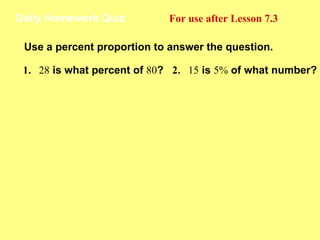
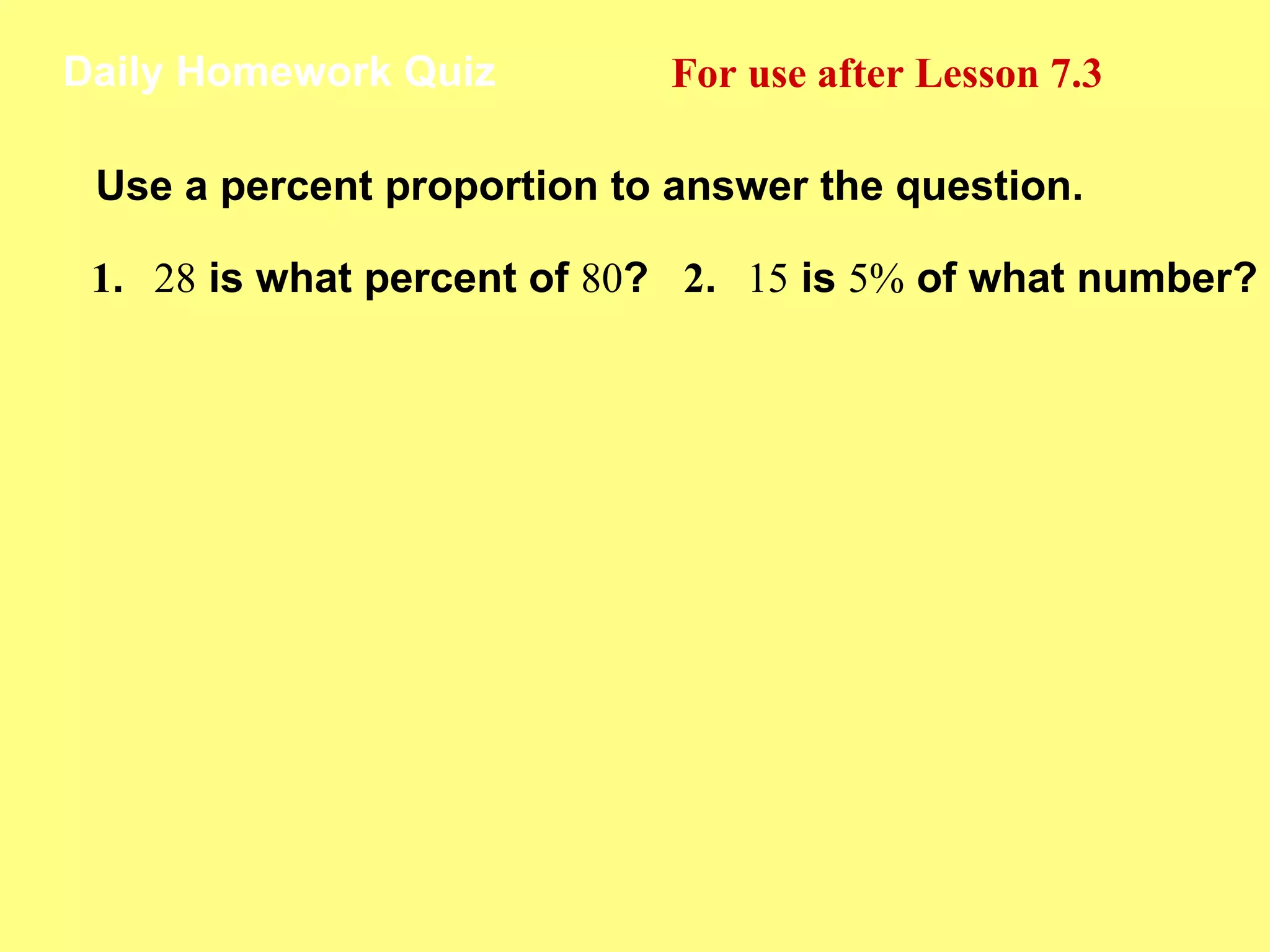
Daily Homework Quiz For use after Lesson 7.3 Use a percent proportion to answer the question. 1 . 28  is what percent of  80 ? 2 . 15  is  5%  of what number?
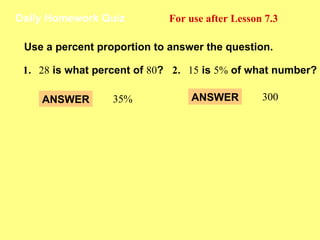
Daily Homework Quiz For use after Lesson 7.3 Use a percent proportion to answer the question. 1 . 28  is what percent of  80 ? 2 . 15  is  5%  of what number? ANSWER 35% ANSWER 300
Chapter 8.1 Lines and Angles
Essential Questions Why is it important to be able to identify congruent triangles in everyday life? Where in real life can you use the properties of isosceles and equilateral triangles? How are the relationships between lines and planes used in the real world? What areas in the real world are properties of parallel lines important?
Chapter 8 Section 1 Vocabulary 1-14
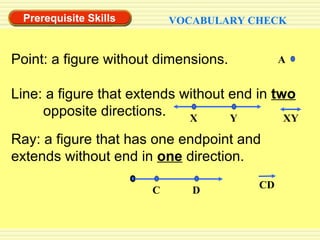
Prerequisite Skills VOCABULARY CHECK Point: a figure without dimensions. Line: a figure that extends without end in  two   opposite directions. X Y XY CD A Ray: a figure that has one endpoint and  extends without end in  one  direction. C D
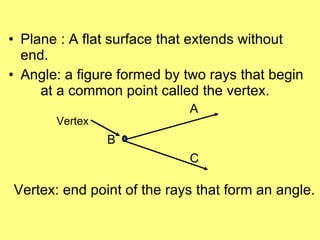
Plane : A flat surface that extends without  end. Angle: a figure formed by two rays that begin  at a common point called the vertex. Vertex Vertex: end point of the rays that form an angle. C A B
Degree: unit of measure. 95 0
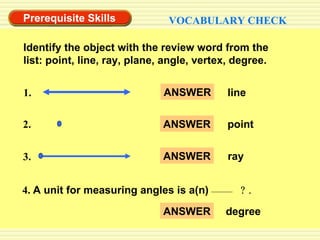
Prerequisite Skills VOCABULARY CHECK Identify the object with the review word from the list: point, line, ray, plane, angle, vertex, degree. 2. 1. 3. ANSWER line ANSWER point ANSWER ray 4.  A unit for measuring angles is a(n)   ? . ANSWER degree
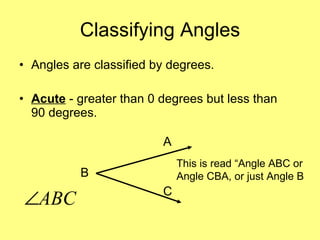
Classifying Angles Angles are classified by degrees. Acute  - greater than 0 degrees but less than 90 degrees. C A B This is read “Angle ABC or Angle CBA, or just Angle B
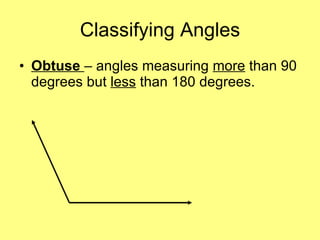
Classifying Angles Obtuse  – angles measuring  more  than 90 degrees but  less  than 180 degrees.
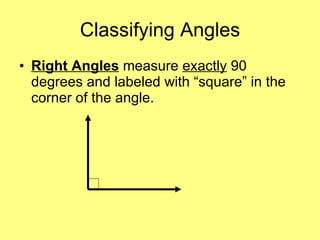
Classifying Angles Right Angles  measure  exactly  90 degrees and labeled with “square” in the corner of the angle.
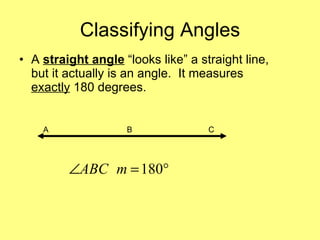
Classifying Angles A  straight angle  “looks like” a straight line, but it actually is an angle.  It measures  exactly  180 degrees.  A  B  C
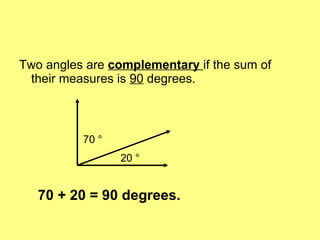
Two angles are  complementary  if the sum of their measures is  90  degrees. 70  ° 20 ° 70 + 20 = 90 degrees.
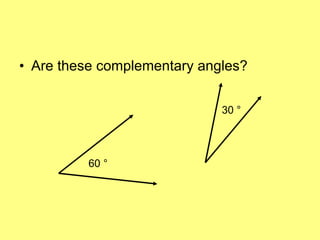
Are these complementary angles? 60 ° 30 °
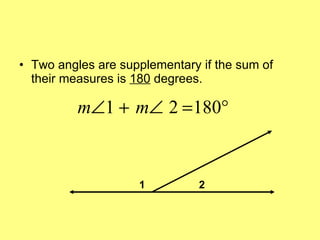
Two angles are supplementary if the sum of their measures is  180  degrees.  2
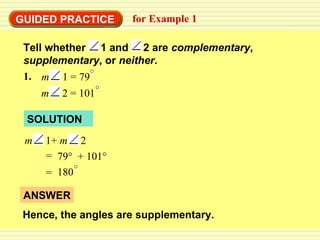
GUIDED PRACTICE for Example 1 SOLUTION Tell whether  1 and  2 are  complementary ,  supplementary , or  neither . 1. m   1 = 79 m   2 = 101 m   1+  m   2   = 79 °   + 101 ° ANSWER Hence, the angles are supplementary. = 180
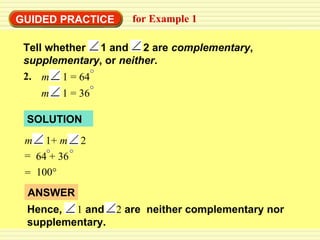
GUIDED PRACTICE for Example 1 SOLUTION Tell whether  1 and  2 are  complementary ,  supplementary , or  neither . 2. m   1 = 64 m   1 = 36 m   1+  m   2   = 100 ° = 64 + 36 ANSWER Hence,  1  and  2  are  neither complementary nor supplementary.
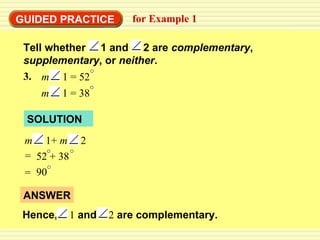
GUIDED PRACTICE for Example 1 SOLUTION Tell whether  1 and  2 are  complementary ,  supplementary , or  neither . 3. m   1 = 52 m   1 = 38 m   1+  m   2   = 52 + 38 = 90 ANSWER Hence,  1  and  2  are complementary.
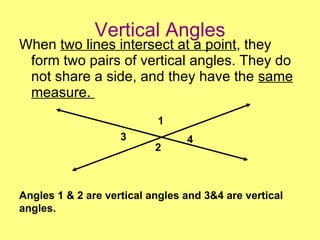
Vertical Angles When  two lines intersect at a point , they form two pairs of vertical angles. They do not share a side, and they have the  same measure.   1 3 4 2 Angles 1 & 2 are vertical angles and 3&4 are vertical angles.
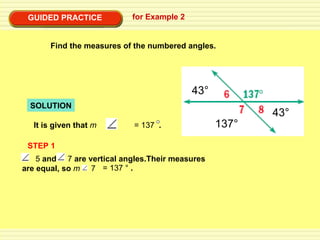
GUIDED PRACTICE for Example 2 Find the measures of the numbered angles. SOLUTION STEP 1 137° 43° 43° It is given that  m   5 = 137  . 5  and  7  are vertical angles.Their measures are equal, so  m  7 = 137 °  .
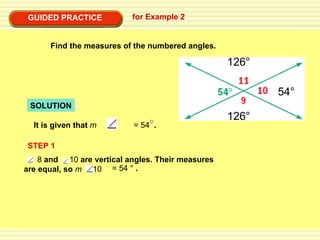
GUIDED PRACTICE for Example 2 Find the measures of the numbered angles. SOLUTION STEP 1 54° 126° 126° It is given that  m   8 = 54  . 8  and  10  are vertical angles. Their measures are equal, so  m  10 = 54 °  .
Homework Page 406 #1-11

8.1 angles 1

  • 1.
    Daily Homework QuizFor use after Lesson 7.3 Use a percent proportion to answer the question. 1 . 28 is what percent of 80 ? 2 . 15 is 5% of what number?
  • 2.
    Daily Homework QuizFor use after Lesson 7.3 Use a percent proportion to answer the question. 1 . 28 is what percent of 80 ? 2 . 15 is 5% of what number? ANSWER 35% ANSWER 300
  • 3.
  • 4.
    Essential Questions Whyis it important to be able to identify congruent triangles in everyday life? Where in real life can you use the properties of isosceles and equilateral triangles? How are the relationships between lines and planes used in the real world? What areas in the real world are properties of parallel lines important?
  • 5.
    Chapter 8 Section1 Vocabulary 1-14
  • 6.
    Prerequisite Skills VOCABULARYCHECK Point: a figure without dimensions. Line: a figure that extends without end in two opposite directions. X Y XY CD A Ray: a figure that has one endpoint and extends without end in one direction. C D
  • 7.
    Plane : Aflat surface that extends without end. Angle: a figure formed by two rays that begin at a common point called the vertex. Vertex Vertex: end point of the rays that form an angle. C A B
  • 8.
    Degree: unit ofmeasure. 95 0
  • 9.
    Prerequisite Skills VOCABULARYCHECK Identify the object with the review word from the list: point, line, ray, plane, angle, vertex, degree. 2. 1. 3. ANSWER line ANSWER point ANSWER ray 4. A unit for measuring angles is a(n) ? . ANSWER degree
  • 10.
    Classifying Angles Anglesare classified by degrees. Acute - greater than 0 degrees but less than 90 degrees. C A B This is read “Angle ABC or Angle CBA, or just Angle B
  • 11.
    Classifying Angles Obtuse – angles measuring more than 90 degrees but less than 180 degrees.
  • 12.
    Classifying Angles RightAngles measure exactly 90 degrees and labeled with “square” in the corner of the angle.
  • 13.
    Classifying Angles A straight angle “looks like” a straight line, but it actually is an angle. It measures exactly 180 degrees. A B C
  • 14.
    Two angles are complementary if the sum of their measures is 90 degrees. 70 ° 20 ° 70 + 20 = 90 degrees.
  • 15.
    Are these complementaryangles? 60 ° 30 °
  • 16.
    Two angles aresupplementary if the sum of their measures is 180 degrees. 2
  • 17.
    GUIDED PRACTICE forExample 1 SOLUTION Tell whether 1 and 2 are complementary , supplementary , or neither . 1. m 1 = 79 m 2 = 101 m 1+ m 2 = 79 ° + 101 ° ANSWER Hence, the angles are supplementary. = 180
  • 18.
    GUIDED PRACTICE forExample 1 SOLUTION Tell whether 1 and 2 are complementary , supplementary , or neither . 2. m 1 = 64 m 1 = 36 m 1+ m 2 = 100 ° = 64 + 36 ANSWER Hence, 1 and 2 are neither complementary nor supplementary.
  • 19.
    GUIDED PRACTICE forExample 1 SOLUTION Tell whether 1 and 2 are complementary , supplementary , or neither . 3. m 1 = 52 m 1 = 38 m 1+ m 2 = 52 + 38 = 90 ANSWER Hence, 1 and 2 are complementary.
  • 20.
    Vertical Angles When two lines intersect at a point , they form two pairs of vertical angles. They do not share a side, and they have the same measure. 1 3 4 2 Angles 1 & 2 are vertical angles and 3&4 are vertical angles.
  • 21.
    GUIDED PRACTICE forExample 2 Find the measures of the numbered angles. SOLUTION STEP 1 137° 43° 43° It is given that m 5 = 137 . 5 and 7 are vertical angles.Their measures are equal, so m 7 = 137 ° .
  • 22.
    GUIDED PRACTICE forExample 2 Find the measures of the numbered angles. SOLUTION STEP 1 54° 126° 126° It is given that m 8 = 54 . 8 and 10 are vertical angles. Their measures are equal, so m 10 = 54 ° .
  • 23.