SLIDESMANIA.COM
TRANSPORTING THE
VICTIM
SLIDESMANIA.COM
Learning Competency:
• The learners demonstrate proper techniques in
carrying and transporting the victim of unintentional
injuries.
SLIDESMANIA.COM
Did you know?
• When dealing with a wounded or
unconscious person, it is crucial to
examine in the same place where he was
found, without moving or transporting the
victim until first aid care has been
provided since, otherwise, there is a risk
of aggravating the situation and causing
new wounds.
• Only in extreme situations (fire,
electrocution, asphyxia, flooding, trapping,
etc.) should the victim be transferred with
the maximum care to the closest place
where first aid can be provided.
SLIDESMANIA.COM
SLIDESMANIA.COM
Did you know?
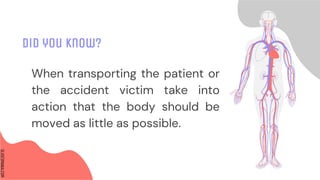
When transporting the patient or
the accident victim take into
action that the body should be
moved as little as possible.
SLIDESMANIA.COM
01
TRANSPORT WITHOUT STRECTHER
● This is required when the accident victim
must be moved quickly away from the
place where he is, or when it is not
possible to reach the scene with a
stretcher.
SLIDESMANIA.COM
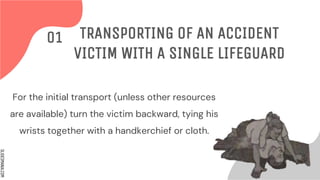
For the initial transport (unless other resources
are available) turn the victim backward, tying his
wrists together with a handkerchief or cloth.
TRANSPORTING OF AN ACCIDENT
VICTIM WITH A SINGLE LIFEGUARD
01
SLIDESMANIA.COM
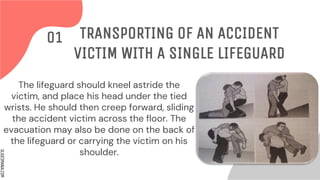
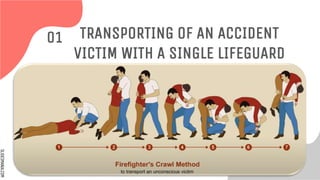
The lifeguard should kneel astride the
victim, and place his head under the tied
wrists. He should then creep forward, sliding
the accident victim across the floor. The
evacuation may also be done on the back of
the lifeguard or carrying the victim on his
shoulder.
TRANSPORTING OF AN ACCIDENT
VICTIM WITH A SINGLE LIFEGUARD
01
SLIDESMANIA.COM
TRANSPORTING OF AN ACCIDENT
VICTIM WITH A SINGLE LIFEGUARD
01
SLIDESMANIA.COM
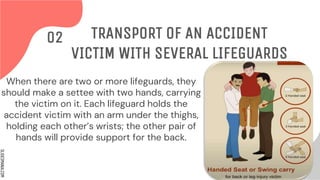
When there are two or more lifeguards, they
should make a settee with two hands, carrying
the victim on it. Each lifeguard holds the
accident victim with an arm under the thighs,
holding each other’s wrists; the other pair of
hands will provide support for the back.
TRANSPORT OF AN ACCIDENT
VICTIM WITH SEVERAL LIFEGUARDS
02
SLIDESMANIA.COM
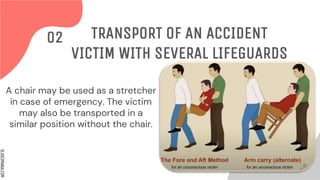
A chair may be used as a stretcher
in case of emergency. The victim
may also be transported in a
similar position without the chair.
TRANSPORT OF AN ACCIDENT
VICTIM WITH SEVERAL LIFEGUARDS
02
SLIDESMANIA.COM
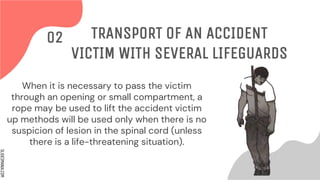
When it is necessary to pass the victim
through an opening or small compartment, a
rope may be used to lift the accident victim
up methods will be used only when there is no
suspicion of lesion in the spinal cord (unless
there is a life-threatening situation).
TRANSPORT OF AN ACCIDENT
VICTIM WITH SEVERAL LIFEGUARDS
02
SLIDESMANIA.COM
TRANSPORT WITH A STRETCHER
The ideal procedure for carrying injured
patience is the STRETCHER.
02
SLIDESMANIA.COM
SLIDESMANIA.COM
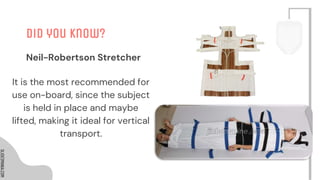
Did you know?
It is the most recommended for
use on-board, since the subject
is held in place and maybe
lifted, making it ideal for vertical
transport.
Neil-Robertson Stretcher
SLIDESMANIA.COM
SLIDESMANIA.COM
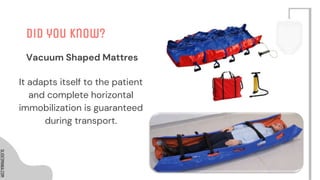
Did you know?
It adapts itself to the patient
and complete horizontal
immobilization is guaranteed
during transport.
Vacuum Shaped Mattres
SLIDESMANIA.COM
SLIDESMANIA.COM
Did you know?
It may be used when other
resources are not available.
Improvised Stretchers
SLIDESMANIA.COM
Following rules must be taken into account;
FOR THE TRANSPORT OF AN INJURED
PATIENT IN A STRETCHER
01
1. Carry the stretcher to the place where the accident victim is, and
not vice versa.
2. Place the injured victim with paramount care, always respecting
the block head-neck-trunk-legs;
SLIDESMANIA.COM
Clearly, animals know more than we
think, and think a great deal more than
we know.
― Irene M. Pepperberg

Medical Presentation · SlidesMania.pptx

  • 1.
  • 2.
    SLIDESMANIA.COM Learning Competency: • Thelearners demonstrate proper techniques in carrying and transporting the victim of unintentional injuries.
  • 3.
    SLIDESMANIA.COM Did you know? •When dealing with a wounded or unconscious person, it is crucial to examine in the same place where he was found, without moving or transporting the victim until first aid care has been provided since, otherwise, there is a risk of aggravating the situation and causing new wounds. • Only in extreme situations (fire, electrocution, asphyxia, flooding, trapping, etc.) should the victim be transferred with the maximum care to the closest place where first aid can be provided.
  • 4.
    SLIDESMANIA.COM SLIDESMANIA.COM Did you know? Whentransporting the patient or the accident victim take into action that the body should be moved as little as possible.
  • 5.
    SLIDESMANIA.COM 01 TRANSPORT WITHOUT STRECTHER ●This is required when the accident victim must be moved quickly away from the place where he is, or when it is not possible to reach the scene with a stretcher.
  • 6.
    SLIDESMANIA.COM For the initialtransport (unless other resources are available) turn the victim backward, tying his wrists together with a handkerchief or cloth. TRANSPORTING OF AN ACCIDENT VICTIM WITH A SINGLE LIFEGUARD 01
  • 7.
    SLIDESMANIA.COM The lifeguard shouldkneel astride the victim, and place his head under the tied wrists. He should then creep forward, sliding the accident victim across the floor. The evacuation may also be done on the back of the lifeguard or carrying the victim on his shoulder. TRANSPORTING OF AN ACCIDENT VICTIM WITH A SINGLE LIFEGUARD 01
  • 8.
    SLIDESMANIA.COM TRANSPORTING OF ANACCIDENT VICTIM WITH A SINGLE LIFEGUARD 01
  • 9.
    SLIDESMANIA.COM When there aretwo or more lifeguards, they should make a settee with two hands, carrying the victim on it. Each lifeguard holds the accident victim with an arm under the thighs, holding each other’s wrists; the other pair of hands will provide support for the back. TRANSPORT OF AN ACCIDENT VICTIM WITH SEVERAL LIFEGUARDS 02
  • 10.
    SLIDESMANIA.COM A chair maybe used as a stretcher in case of emergency. The victim may also be transported in a similar position without the chair. TRANSPORT OF AN ACCIDENT VICTIM WITH SEVERAL LIFEGUARDS 02
  • 11.
    SLIDESMANIA.COM When it isnecessary to pass the victim through an opening or small compartment, a rope may be used to lift the accident victim up methods will be used only when there is no suspicion of lesion in the spinal cord (unless there is a life-threatening situation). TRANSPORT OF AN ACCIDENT VICTIM WITH SEVERAL LIFEGUARDS 02
  • 12.
    SLIDESMANIA.COM TRANSPORT WITH ASTRETCHER The ideal procedure for carrying injured patience is the STRETCHER. 02
  • 13.
    SLIDESMANIA.COM SLIDESMANIA.COM Did you know? Itis the most recommended for use on-board, since the subject is held in place and maybe lifted, making it ideal for vertical transport. Neil-Robertson Stretcher
  • 14.
    SLIDESMANIA.COM SLIDESMANIA.COM Did you know? Itadapts itself to the patient and complete horizontal immobilization is guaranteed during transport. Vacuum Shaped Mattres
  • 15.
    SLIDESMANIA.COM SLIDESMANIA.COM Did you know? Itmay be used when other resources are not available. Improvised Stretchers
  • 16.
    SLIDESMANIA.COM Following rules mustbe taken into account; FOR THE TRANSPORT OF AN INJURED PATIENT IN A STRETCHER 01 1. Carry the stretcher to the place where the accident victim is, and not vice versa. 2. Place the injured victim with paramount care, always respecting the block head-neck-trunk-legs;
  • 17.
    SLIDESMANIA.COM Clearly, animals knowmore than we think, and think a great deal more than we know. ― Irene M. Pepperberg