Dr. Amit Goswami
Introduction
 Mazur and Clark(1983)
 Mesenchymal tumor
 From embryological mesoderm of gastrointestinal
  tract
 <1% of all GIT tumors
 Hirota et.al(1998):Mutation in KIT
 Interstitial cell of Cajal: Common precursor?
Demography
   Incidence:15-20 per million
   M>F
   Age:40-80yrs(median age 60yrs)
   Mostly sporadic
   Familial( Neurofibromatosis, Carney triad)


           Eisenberg BL,Judson I.Surgery and imitanib in the management of GIST:emerging approaches to adjuvant and
                                                                    neoadjuvant therapy.Ann Surg Oncol 2004;11:465-475
       Gold JS,Matteo RP.Combined surgical and molecular therapy: The gastrointestinal stromal tumor model.Ann surg
                                                                                                            2006;244:176
    DeMatteo RP,Lewis JJ,Leung D et al.Two hundred Gastrointestinal stromal tumors: recurrence patterns and prognostic
                                                                            factors for survival.Ann surg 2000;231(1):51-8
       Takazawa Y,sakurai S,Sakuma Y et al.Gastrointstinal stromal tumors of neurofibromatosis type I.Am J surg Pathol
                                                                                                        2005;29(6):755-63
Location
 Stomach :50% MC
 Esophagus:5%
 Small Intestine:25%
 Colon and rectum:10%
 Extra-intestinal:10%


                     Rubin BP.Gastrointestinal stromal tumors: an update.Histopathology 2006;48:83-96
                                                                             Clin Cancer Res 9(9):2003
Clinical Presentation
 Non specific
 Depends on site
 GIST of GIT: GI bleeding MC
 Others
   -Abd. Mass
   -Pain abdomen
   -Abd.distension
   -Intestinal obstruction
 Asymptomatic:30%
Pathology
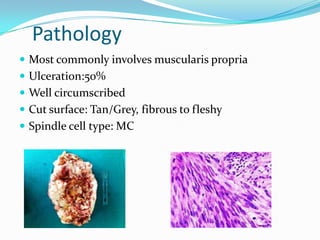
 Most commonly involves muscularis propria
 Ulceration:50%
 Well circumscribed
 Cut surface: Tan/Grey, fibrous to fleshy
 Spindle cell type: MC
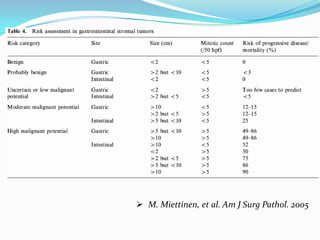
Malignant Potential
• Features favoring benign lesions :
   – Size less than 5 cm

   – Low number of mitosis per HPF

   – No mucosal invasion

   – Low cellularity

   – Low markers of cell proliferation

 Tumor site: Stomach vs bowel
 Site of metastasis: Liver(50%),peritoneum(20-40%)
 M. Miettinen, et al. Am J Surg Pathol. 2005
Diagnosis
 Clinical, radiological and pathological characteristics

 CECT- Imaging modality of choice

 Endoscopic ultrasound: Small tumor

 MRI: Rectal GISTs

 PET scan: Assessment of therapy


    Blay JY,Bonvalot S,Casali P et al.Consensus meeting for the management of gastrointestinal stromal tumors.Ann
                                                                                          Oncology 2005;16:566-578
CECT
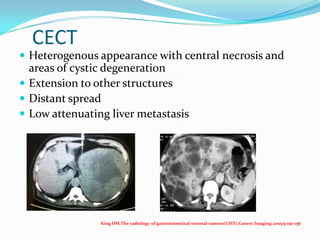
 Heterogenous appearance with central necrosis and
  areas of cystic degeneration
 Extension to other structures
 Distant spread
 Low attenuating liver metastasis


                King DM.The radiology of gastrointestinal stromal tumors(GIST).Cancer Imaging 2005;5:150-156
MRI
 Solid portion-low intensity on T1 weighted and high
  intensity on T2 weighted images
 Enhancement with gadolinium
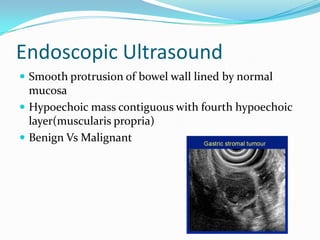
Endoscopic Ultrasound
 Smooth protrusion of bowel wall lined by normal
  mucosa
 Hypoechoic mass contiguous with fourth hypoechoic
  layer(muscularis propria)
 Benign Vs Malignant
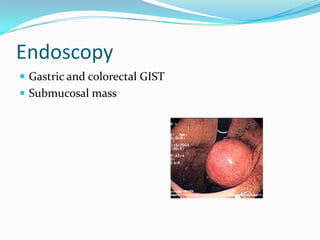
Endoscopy
 Gastric and colorectal GIST
 Submucosal mass
Pre-op Biopsy
 Usually not done
     -Tumor seedling
     -Bleeding
 Endoscopic biopsy
     -Less bleeding
     -Confirm diagnosis
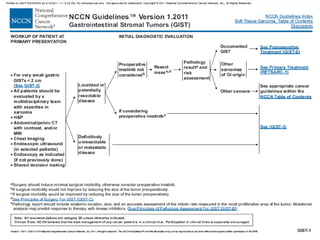
Treatment
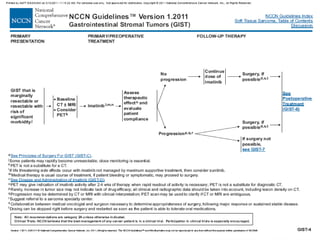
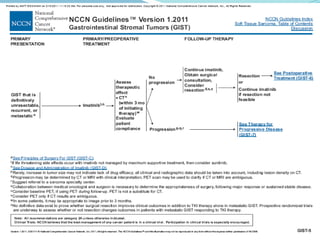
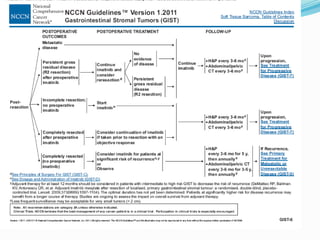
 Surgical resection is preferred

 Locally advanced: Targeted therapy

 Radiation/Chemotherapy: Ineffective


                            DemetriGD,BenjaminRS,BlankeCD,etal.NCCNTaskForcereport:managementof
                       patientswithgastrointestinalstromaltumor(GIST)dupdateoftheNCCNclinicalpractice
                                                      guidelines.JNatlComprCancNetw2007;5(Suppl2):S1–29
Surgical therapy
 Complete en-block removal
 Site specific
 Avoidance of tumor rupture
 Lymphadenectomy not advocated
 Final goal: complete tumor resection with a negative
  margin, intact pseudocasule
 Positive resection margin: Re-excision


 DeMatteo RP,Lewis JJ,Leung D et al.Two hundred Gastrointestinal stromal tumors: recurrence patterns and prognostic
                                                                         factors for survival.Ann surg 2000;231(1):51-8

       Blay JY,Bonvalot S,Casali P et al.Consensus meeting for the management of gastrointestinal stromal tumors.Ann
                                                                                              Oncology 2005;16:566-57
Site specific surgery
 Esophagus: esophagestectomy/esophageal sparing
  wide local excision
 Stomach
     Small-wedge resection
     Large-subtotal/total gastrectomy


                   BlumMG,BilimoriaKY,WayneJD,etal.S urgical considerations for the management and
                     Resection of esophageal gastrointestinal stromal tumors.AnnThoracSurg2007;84(5):
                                                                                             1717–23.
                   WinfieldRD,HochwaldSN,VogelSB,etal. Presentation and management of gastrointes-
                        tinal stromaltumors of the duodenum.AmSurg2006;72(8):719–22[discussion:722–3

                       WayneJD,BellRHJr.Limited gastric resection.SurgClinNorthAm2005;85(5):1009–20,
                                                                                                 vii.
 Small intestine
   Duodenum: Partial duodenal resection/Whipple’s
   Small Intestine: Segmental resection
 Colorectum
        Colon: Colectomy
       Rectum: Anterior resection/Abdominoperineal
                resection
 Extra-intestinal: En block resection with adequate
                                      margin
                                    Berman J,O’Leary TJ.Gastrointestinal stromal tumor workshop.Hum Pathol 2001;32:578-582
  Blay JY,Bonvalot S,Casali P et al.Consensus meeting for the management of gastrointestinal stromal tumors.Ann Oncology
                                                                                                            2005;16:566-57
Molecular targeted therapy(TKI)
 Joensuu and colleague(2001)
 Success: Lack of progression
 Standard starting dose :400 mg/day
 Ideal dose: not determined
 Neoadjuvant role:
    -Severe organ dysfunction (eg: for rectal or
  esophageal tumors)
    -Negative margin difficult
 Resistance: Primary/Secondary
Imitanib trials
TRIALS           DOSE                 PARTIAL                   STABLE           PROGRES COMMENTS
                                      RESPONSE                  DIS              S
EORTC            400,600,800          51%                       31%              8%                  TTR 1WK
2001,2002        or 1000mg/d                                                                         MTD 800mg/d
US               400mg/d              67%                       16%              17%                 No difference
MULTICENTER      600mg/d              66%                       18%              8%
2002,2004
EORTC            400mg/d              50%                       32%              13%                 32% severe tox
2003             800mg/d              54%                       32%              8%                  50%severe tox
                                                                                                     Improved PFS
                                                                                                     for 800mg/d
INTERGROUP       400mg/d              49%                       22%                                  36%severe tox
2003             800mg/d              48%                       22%                                  52%severe tox
                                                                                                     No difference in
                                                                                                     PFS

  TTR=Time to recurrence, MTD=Maximal tolerated dose, PFS=Progression free survival
                    GoldJS,DeMatteoRP.Combined surgical and moleculartherapy:the gastrointestinal stromal tumor
                    model. AnnSurg2006;244:176
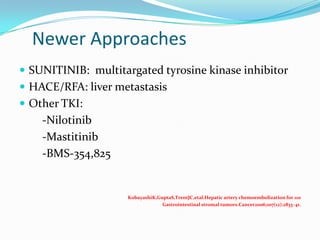
Newer Approaches
 SUNITINIB: multitargated tyrosine kinase inhibitor
 HACE/RFA: liver metastasis
 Other TKI:
    -Nilotinib
    -Mastitinib
    -BMS-354,825


                    KobayashiK,GuptaS,TrentJC,etal.Hepatic artery chemoembolization for 110
                                 Gastrointestinal stromal tumors.Cancer2006;107(12):2833–41.
Summary
 Rare
 Mostly sporadic and single
 Anywhere in GI Tract- Stomach MC
 Evaluation – EUS, CT, PET CT
 Varied clinical presentation- GI bleed MC
 Treatment of choice – Surgery, potentially
               curative
Summary
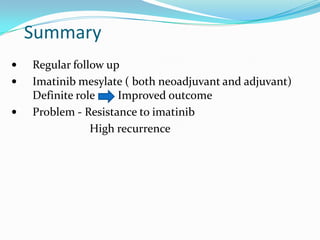
   Regular follow up
   Imatinib mesylate ( both neoadjuvant and adjuvant)
    Definite role    Improved outcome
   Problem - Resistance to imatinib
                High recurrence
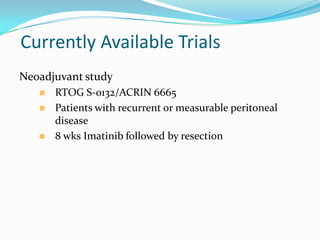
Currently Available Trials
Neoadjuvant study
      RTOG S-0132/ACRIN 6665
      Patients with recurrent or measurable peritoneal
       disease
      8 wks Imatinib followed by resection
Currently Available Trials
Adjuvant study EORTC 64024
 Patients with R0 resections eligible
 Patients stratified according to risk factors
 Patients randomized to either
      Imatinib 400 mg/day X 2 years
      Observation
Gastrointestinal stromal tumor(gist)

Gastrointestinal stromal tumor(gist)

  • 1.
  • 2.
    Introduction  Mazur andClark(1983)  Mesenchymal tumor  From embryological mesoderm of gastrointestinal tract  <1% of all GIT tumors  Hirota et.al(1998):Mutation in KIT  Interstitial cell of Cajal: Common precursor?
  • 3.
    Demography  Incidence:15-20 per million  M>F  Age:40-80yrs(median age 60yrs)  Mostly sporadic  Familial( Neurofibromatosis, Carney triad) Eisenberg BL,Judson I.Surgery and imitanib in the management of GIST:emerging approaches to adjuvant and neoadjuvant therapy.Ann Surg Oncol 2004;11:465-475 Gold JS,Matteo RP.Combined surgical and molecular therapy: The gastrointestinal stromal tumor model.Ann surg 2006;244:176 DeMatteo RP,Lewis JJ,Leung D et al.Two hundred Gastrointestinal stromal tumors: recurrence patterns and prognostic factors for survival.Ann surg 2000;231(1):51-8 Takazawa Y,sakurai S,Sakuma Y et al.Gastrointstinal stromal tumors of neurofibromatosis type I.Am J surg Pathol 2005;29(6):755-63
  • 4.
    Location  Stomach :50%MC  Esophagus:5%  Small Intestine:25%  Colon and rectum:10%  Extra-intestinal:10% Rubin BP.Gastrointestinal stromal tumors: an update.Histopathology 2006;48:83-96 Clin Cancer Res 9(9):2003
  • 5.
    Clinical Presentation  Nonspecific  Depends on site  GIST of GIT: GI bleeding MC  Others -Abd. Mass -Pain abdomen -Abd.distension -Intestinal obstruction  Asymptomatic:30%
  • 6.
    Pathology  Most commonlyinvolves muscularis propria  Ulceration:50%  Well circumscribed  Cut surface: Tan/Grey, fibrous to fleshy  Spindle cell type: MC
  • 7.
    Malignant Potential • Featuresfavoring benign lesions : – Size less than 5 cm – Low number of mitosis per HPF – No mucosal invasion – Low cellularity – Low markers of cell proliferation  Tumor site: Stomach vs bowel  Site of metastasis: Liver(50%),peritoneum(20-40%)
  • 8.
     M. Miettinen,et al. Am J Surg Pathol. 2005
  • 9.
    Diagnosis  Clinical, radiologicaland pathological characteristics  CECT- Imaging modality of choice  Endoscopic ultrasound: Small tumor  MRI: Rectal GISTs  PET scan: Assessment of therapy Blay JY,Bonvalot S,Casali P et al.Consensus meeting for the management of gastrointestinal stromal tumors.Ann Oncology 2005;16:566-578
  • 10.
    CECT  Heterogenous appearancewith central necrosis and areas of cystic degeneration  Extension to other structures  Distant spread  Low attenuating liver metastasis King DM.The radiology of gastrointestinal stromal tumors(GIST).Cancer Imaging 2005;5:150-156
  • 11.
    MRI  Solid portion-lowintensity on T1 weighted and high intensity on T2 weighted images  Enhancement with gadolinium
  • 12.
    Endoscopic Ultrasound  Smoothprotrusion of bowel wall lined by normal mucosa  Hypoechoic mass contiguous with fourth hypoechoic layer(muscularis propria)  Benign Vs Malignant
  • 13.
    Endoscopy  Gastric andcolorectal GIST  Submucosal mass
  • 14.
    Pre-op Biopsy  Usuallynot done -Tumor seedling -Bleeding  Endoscopic biopsy -Less bleeding -Confirm diagnosis
  • 15.
    Treatment  Surgical resectionis preferred  Locally advanced: Targeted therapy  Radiation/Chemotherapy: Ineffective DemetriGD,BenjaminRS,BlankeCD,etal.NCCNTaskForcereport:managementof patientswithgastrointestinalstromaltumor(GIST)dupdateoftheNCCNclinicalpractice guidelines.JNatlComprCancNetw2007;5(Suppl2):S1–29
  • 17.
    Surgical therapy  Completeen-block removal  Site specific  Avoidance of tumor rupture  Lymphadenectomy not advocated  Final goal: complete tumor resection with a negative margin, intact pseudocasule  Positive resection margin: Re-excision DeMatteo RP,Lewis JJ,Leung D et al.Two hundred Gastrointestinal stromal tumors: recurrence patterns and prognostic factors for survival.Ann surg 2000;231(1):51-8 Blay JY,Bonvalot S,Casali P et al.Consensus meeting for the management of gastrointestinal stromal tumors.Ann Oncology 2005;16:566-57
  • 18.
    Site specific surgery Esophagus: esophagestectomy/esophageal sparing wide local excision  Stomach Small-wedge resection Large-subtotal/total gastrectomy BlumMG,BilimoriaKY,WayneJD,etal.S urgical considerations for the management and Resection of esophageal gastrointestinal stromal tumors.AnnThoracSurg2007;84(5): 1717–23. WinfieldRD,HochwaldSN,VogelSB,etal. Presentation and management of gastrointes- tinal stromaltumors of the duodenum.AmSurg2006;72(8):719–22[discussion:722–3 WayneJD,BellRHJr.Limited gastric resection.SurgClinNorthAm2005;85(5):1009–20, vii.
  • 19.
     Small intestine Duodenum: Partial duodenal resection/Whipple’s Small Intestine: Segmental resection  Colorectum Colon: Colectomy Rectum: Anterior resection/Abdominoperineal resection  Extra-intestinal: En block resection with adequate margin Berman J,O’Leary TJ.Gastrointestinal stromal tumor workshop.Hum Pathol 2001;32:578-582 Blay JY,Bonvalot S,Casali P et al.Consensus meeting for the management of gastrointestinal stromal tumors.Ann Oncology 2005;16:566-57
  • 24.
    Molecular targeted therapy(TKI) Joensuu and colleague(2001)  Success: Lack of progression  Standard starting dose :400 mg/day  Ideal dose: not determined  Neoadjuvant role: -Severe organ dysfunction (eg: for rectal or esophageal tumors) -Negative margin difficult  Resistance: Primary/Secondary
  • 25.
    Imitanib trials TRIALS DOSE PARTIAL STABLE PROGRES COMMENTS RESPONSE DIS S EORTC 400,600,800 51% 31% 8% TTR 1WK 2001,2002 or 1000mg/d MTD 800mg/d US 400mg/d 67% 16% 17% No difference MULTICENTER 600mg/d 66% 18% 8% 2002,2004 EORTC 400mg/d 50% 32% 13% 32% severe tox 2003 800mg/d 54% 32% 8% 50%severe tox Improved PFS for 800mg/d INTERGROUP 400mg/d 49% 22% 36%severe tox 2003 800mg/d 48% 22% 52%severe tox No difference in PFS TTR=Time to recurrence, MTD=Maximal tolerated dose, PFS=Progression free survival GoldJS,DeMatteoRP.Combined surgical and moleculartherapy:the gastrointestinal stromal tumor model. AnnSurg2006;244:176
  • 26.
    Newer Approaches  SUNITINIB:multitargated tyrosine kinase inhibitor  HACE/RFA: liver metastasis  Other TKI: -Nilotinib -Mastitinib -BMS-354,825 KobayashiK,GuptaS,TrentJC,etal.Hepatic artery chemoembolization for 110 Gastrointestinal stromal tumors.Cancer2006;107(12):2833–41.
  • 27.
    Summary  Rare  Mostlysporadic and single  Anywhere in GI Tract- Stomach MC  Evaluation – EUS, CT, PET CT  Varied clinical presentation- GI bleed MC  Treatment of choice – Surgery, potentially curative
  • 28.
    Summary  Regular follow up  Imatinib mesylate ( both neoadjuvant and adjuvant) Definite role Improved outcome  Problem - Resistance to imatinib High recurrence
  • 29.
    Currently Available Trials Neoadjuvantstudy  RTOG S-0132/ACRIN 6665  Patients with recurrent or measurable peritoneal disease  8 wks Imatinib followed by resection
  • 30.
    Currently Available Trials Adjuvantstudy EORTC 64024  Patients with R0 resections eligible  Patients stratified according to risk factors  Patients randomized to either  Imatinib 400 mg/day X 2 years  Observation