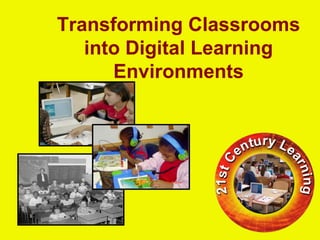
Transforming Classrooms
into Digital Learning
Environments
Our Students are Digital
“Natives”
• 2 billion songs per month downloaded
• 3 billion text messages per month
• Four new roles
– Digital Pioneers
– Creative producers
– Everyday communicators
– Information gatherers
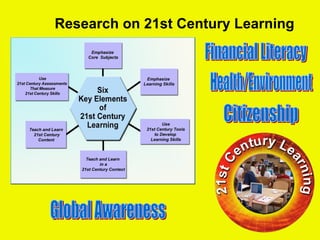
Research on 21st Century Learning
No Child Left Behind
•Requires that by 2006 all students in grade 8
must be technologically literate.
•Florida uses the National Education Technology
Standards for Teachers and Students to define
‘technologically literate.’
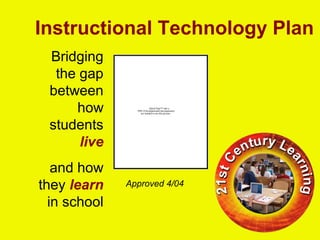
Instructional Technology Plan
Bridging
the gap
between
how
students
live
and how
they learn
in school
QuickTime™ and a
TIFF (Uncompressed) decompressor
are needed to see this picture.
Approved 4/04
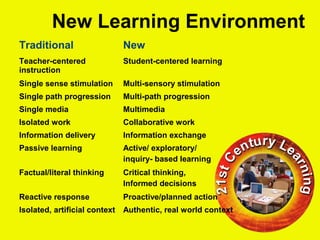
Traditional New
Teacher-centered
instruction
Student-centered learning
Single sense stimulation Multi-sensory stimulation
Single path progression Multi-path progression
Single media Multimedia
Isolated work Collaborative work
Information delivery Information exchange
Passive learning Active/ exploratory/
inquiry- based learning
Factual/literal thinking Critical thinking,
Informed decisions
Reactive response Proactive/planned action
Isolated, artificial context Authentic, real world context
New Learning Environment
Main
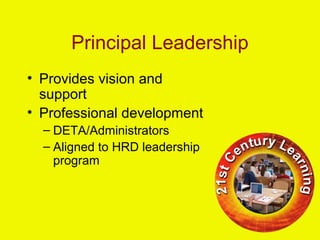
Principal Leadership
• Provides vision and
support
• Professional development
– DETA/Administrators
– Aligned to HRD leadership
program
Technical Support
• District-based
– Technology infrastructure
– System support
• School-based
– Day to day operations
Professional Development
• Assessing teacher needs (ITTS Tool)
• Entry level skill development
– Video tutorials
– Hands-On workshops
• Intermediate level
– Digital Education Teacher Academy
• Advanced
– Peer Coaching
– Project based learning
Goal: Move from entry to intermediate to
advanced integration
Model the Digital Learning
Process (1-to-1)
• Student laptops
• Continuous staff development
• New instructional strategies
• School-wide wireless network
• Technical Support
• Leadership, school/district
• Outside evaluation
Student Technology Refresh
•Leased - 1:6 ratio (laptops/students)
in all schools
– Carts of Wireless laptops
– 30,000 Macintosh
– 10,000 Dell
– Access Points
– Servers
– Printers
•Removal of old equipment
•Professional Development
Emerged from 1:1 evaluation findings
Digital Classroom Tools
• New educational specifications
• Affects new schools/classrooms
• 05-06 - wireless carts
• 06-07 - video projectors/carts
• 07-08 - TBA
• 08-09 - TBA
• 09-10 - TBA
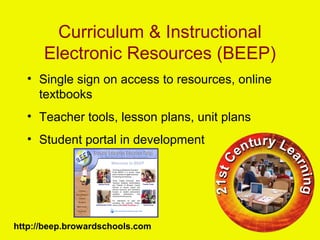
Curriculum & Instructional
Electronic Resources (BEEP)
• Single sign on access to resources, online
textbooks
• Teacher tools, lesson plans, unit plans
• Student portal in development
http://beep.browardschools.com
Project-Based Learning
• Global Learning Initiative through
Digital Education for students
• 4 pilot school locations in 2006
• Added 5 schools in 2007
• EETT Grant
– 27 more schools in 2008-09
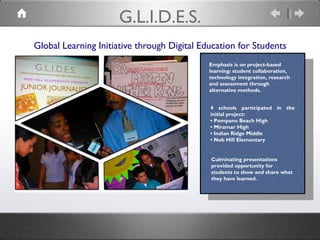
Global Learning Initiative through Digital Education for Students
G.L.I.D.E.S.
4 schools participated in the
initial project:
• Pompano Beach High
• Miramar High
• Indian Ridge Middle
• Nob Hill Elementary
Emphasis is on project-based
learning: student collaboration,
technology integration, research
and assessment through
alternative methods.
Culminating presentations
provided opportunity for
students to show and share what
they have learned.
Global Learning Initiative through Digital Education for Students
G.L.I.D.E.S.
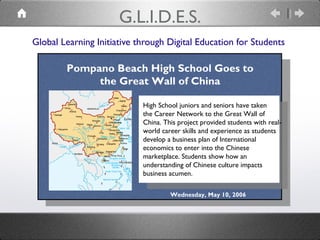
Pompano Beach High School Goes to
the Great Wall of China
Wednesday, May 10, 2006
High School juniors and seniors have taken
the Career Network to the Great Wall of
China. This project provided students with real-
world career skills and experience as students
develop a business plan of International
economics to enter into the Chinese
marketplace. Students show how an
understanding of Chinese culture impacts
business acumen.
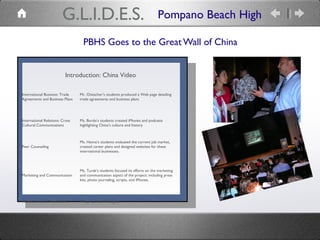
PBHS Goes to the Great Wall of China
Introduction: China Video
International Business: Trade
Agreements and Business Plans
Mr. Oistacher’s students produced a Web page detailing
trade agreements and business plans
International Relations: Cross
Cultural Communications
Ms. Burdo’s students created iMovies and podcasts
highlighting China’s culture and history
Peer Counseling
Ms. Hanna’s students evaluated the current job market,
created career plans and designed websites for these
international businesses.
Marketing and Communication
Ms. Turek’s students focused its efforts on the marketing
and communication aspect of the project: including press
kits, photo journaling, scripts, and iMovies.
Videos: Skits of “Iron & Silk” Wrap-up: final Thoughts
Pompano Beach HighG.L.I.D.E.S.
Teacher/Student Recognition
Program (VTRP)
QuickTime™ and a
TIFF (Uncompressed) decompressor
are needed to see this picture.
Reward “best
practices”
Share “best
practices” through
BEEP
Remind community
of our commitment to
digital education
QuickTime™ and a
H.263 decompressor
are needed to see this picture.
Digital Students
share their work!

21st century

  • 1.
  • 2.
    Our Students areDigital “Natives” • 2 billion songs per month downloaded • 3 billion text messages per month • Four new roles – Digital Pioneers – Creative producers – Everyday communicators – Information gatherers
  • 3.
    Research on 21stCentury Learning
  • 4.
    No Child LeftBehind •Requires that by 2006 all students in grade 8 must be technologically literate. •Florida uses the National Education Technology Standards for Teachers and Students to define ‘technologically literate.’
  • 5.
    Instructional Technology Plan Bridging thegap between how students live and how they learn in school QuickTime™ and a TIFF (Uncompressed) decompressor are needed to see this picture. Approved 4/04
  • 6.
    Traditional New Teacher-centered instruction Student-centered learning Singlesense stimulation Multi-sensory stimulation Single path progression Multi-path progression Single media Multimedia Isolated work Collaborative work Information delivery Information exchange Passive learning Active/ exploratory/ inquiry- based learning Factual/literal thinking Critical thinking, Informed decisions Reactive response Proactive/planned action Isolated, artificial context Authentic, real world context New Learning Environment
  • 7.
  • 8.
    Principal Leadership • Providesvision and support • Professional development – DETA/Administrators – Aligned to HRD leadership program
  • 9.
    Technical Support • District-based –Technology infrastructure – System support • School-based – Day to day operations
  • 10.
    Professional Development • Assessingteacher needs (ITTS Tool) • Entry level skill development – Video tutorials – Hands-On workshops • Intermediate level – Digital Education Teacher Academy • Advanced – Peer Coaching – Project based learning Goal: Move from entry to intermediate to advanced integration
  • 11.
    Model the DigitalLearning Process (1-to-1) • Student laptops • Continuous staff development • New instructional strategies • School-wide wireless network • Technical Support • Leadership, school/district • Outside evaluation
  • 12.
    Student Technology Refresh •Leased- 1:6 ratio (laptops/students) in all schools – Carts of Wireless laptops – 30,000 Macintosh – 10,000 Dell – Access Points – Servers – Printers •Removal of old equipment •Professional Development Emerged from 1:1 evaluation findings
  • 13.
    Digital Classroom Tools •New educational specifications • Affects new schools/classrooms • 05-06 - wireless carts • 06-07 - video projectors/carts • 07-08 - TBA • 08-09 - TBA • 09-10 - TBA
  • 14.
    Curriculum & Instructional ElectronicResources (BEEP) • Single sign on access to resources, online textbooks • Teacher tools, lesson plans, unit plans • Student portal in development http://beep.browardschools.com
  • 15.
    Project-Based Learning • GlobalLearning Initiative through Digital Education for students • 4 pilot school locations in 2006 • Added 5 schools in 2007 • EETT Grant – 27 more schools in 2008-09
  • 16.
    Global Learning Initiativethrough Digital Education for Students G.L.I.D.E.S. 4 schools participated in the initial project: • Pompano Beach High • Miramar High • Indian Ridge Middle • Nob Hill Elementary Emphasis is on project-based learning: student collaboration, technology integration, research and assessment through alternative methods. Culminating presentations provided opportunity for students to show and share what they have learned.
  • 17.
    Global Learning Initiativethrough Digital Education for Students G.L.I.D.E.S. Pompano Beach High School Goes to the Great Wall of China Wednesday, May 10, 2006 High School juniors and seniors have taken the Career Network to the Great Wall of China. This project provided students with real- world career skills and experience as students develop a business plan of International economics to enter into the Chinese marketplace. Students show how an understanding of Chinese culture impacts business acumen.
  • 18.
    PBHS Goes tothe Great Wall of China Introduction: China Video International Business: Trade Agreements and Business Plans Mr. Oistacher’s students produced a Web page detailing trade agreements and business plans International Relations: Cross Cultural Communications Ms. Burdo’s students created iMovies and podcasts highlighting China’s culture and history Peer Counseling Ms. Hanna’s students evaluated the current job market, created career plans and designed websites for these international businesses. Marketing and Communication Ms. Turek’s students focused its efforts on the marketing and communication aspect of the project: including press kits, photo journaling, scripts, and iMovies. Videos: Skits of “Iron & Silk” Wrap-up: final Thoughts Pompano Beach HighG.L.I.D.E.S.
  • 19.
    Teacher/Student Recognition Program (VTRP) QuickTime™and a TIFF (Uncompressed) decompressor are needed to see this picture. Reward “best practices” Share “best practices” through BEEP Remind community of our commitment to digital education
  • 20.
    QuickTime™ and a H.263decompressor are needed to see this picture. Digital Students share their work!

Editor's Notes

  • #2 Today, I would like to update the group on Broward’s vision for transforming its learning environments to meet the needs of a 21st century world, giving you some background on what led us to our current status, why we choose the path we took, and where we hope to go in terms of the teaching and learning that occurs in Broward schools.
  • #3 Technology is now fully integrated into our students’ daily lives. Young people simply use new media as tools to make their lives easier, strengthen their existing friendship networks and are involved in creative production from uploading and editing photos to building and maintaining web sites. Research study entitled”Their Space: Education for a digital generation” polled this digital generation and found the following which may be contrary to society’s assumptions about students use of technology. 1.These students are capable of self-regulation when kept well informed about the levels of risk and safety around using the Internet. 2. Students had their own hierarchy of digital activities when it came to assesing the potential for learning 3. They used technology in ways that in the past would have labelled them as “geek” but they were not all using it in the same way. Here are the four new roles Digital Pioneers - this group were blogging before the phrase had been coined Creative producers - building websites, posting movies, photos and music to share with friends, family and beyond Everyday communicators - making their lives easier through text messaging, cell phones and the like Information gathers are Google and Wikipedia addicts Way of describing life with digital technology from the perspective of children
  • #4 David Warlick (author of Redefining Literacy for the 21st Century) .... It is not enough for students to just know content they must be able to apply it in a way that will be meaningful for the 21st century. Reading must evolve into exposing knowledge ... Reading + information literacy Writing must evolve into expressing ideas ... Writing + video + audio + graphics Our ways of employing skills must contain key elements of mathematical /algebraic thinking We must include ethical use .... Copyright, fair use of hardware and software,,,,etc. Citizenship takes on a new dimension - includes learning to live in a global world where citizenship goes beyond our borders Health and the environment translates to the understanding of global warming, environmental protection, individual health and societal health Financial and business literacy translates to understanding how to conduct business across the globe Skils include critical thinking, project management, working in teams, seamless use of digital tools for communication and information analysis and studying content in depth
  • #5 <number> Passed in 2000, No Child Left behind sets requirements for technology use. Technology literacy is the ability to responsibly use appropriate technology to communicate, solve problems, and access, manage, integrate, evaluate, and create information to improve learning in all subject areas and to acquire lifelong knowledge and skills in the 21st century.
  • #6 How did Broward respond to this research and its understanding of what our digital students need? In 2004, Broward developed an Instructional Technology plan aimed at systematically moving towards its vision. From 2004 to the present, Broward has been implementing this plan which includes many projects which I will put in context today.
  • #7 One of the most difficult conditions to meet is that of a student center learning environment. Traditional educational practices no longer provide students with all the necessary skills for economic survival in today’s workplace. Students today must apply strategies for solving problems using appropriate tools for learning, collaborating, and communicating. The chart lists characteristics representing traditional approaches to learning and corresponding strategies associated with new learning environments.
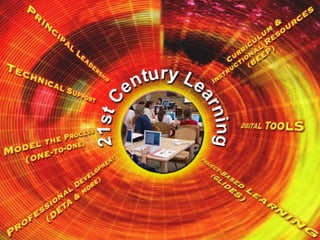
  • #8 How did Broward go about moving into vision into action? And what did Broward learn along the way that impacted future decisions? This graphic shows that to create a new learning environment takes a system approach. All the parts lead to the creation of the whole. Any part that is not moving along will affect the growth of the whole. I am going to start with where Broward started in 2004 with the implementation of the one to one model which we called the digital learning environment study. Then, I will be coming back to this visual to show how it all fits together.
  • #12 Learning
  • #13 The
  • #21 Nob Hill Elementary students - 5th grade Studying the everglades Clip is on Rachel Carson and how her work affected environmental awareness today Digital video camera, imovie, sound, clip art, copyright notice. Conclude: skills children are developing through these activities, such as creativity, communication and collaboration are those that will enable them to succeed in a globally networked, knowledge-driven world.!