The question
“Find the most substantial estimates of the
percentage improvements in US building energy
efficiency that will be possible over the next 10-
20 years.”


Focus on building energy use
United States or developed country context
Both technical and policy drivers
Fast moving field - current citations needed
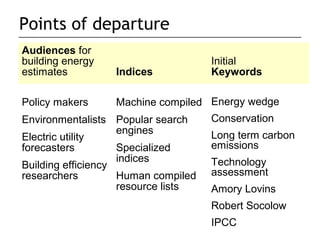
Points of departure
Audiences for
building energy                      Initial
estimates         Indices            Keywords

Policy makers     Machine compiled Energy wedge
Environmentalists Popular search     Conservation
                    engines          Long term carbon
Electric utility
forecasters         Specialized      emissions
                    indices          Technology
Building efficiency
researchers         Human compiled   assessment
                    resource lists   Amory Lovins
                                     Robert Socolow
                                     IPCC
Mild performance anxiety sets in
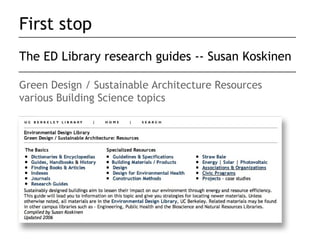
First stop
The ED Library research guides -- Susan Koskinen

Green Design / Sustainable Architecture Resources
various Building Science topics
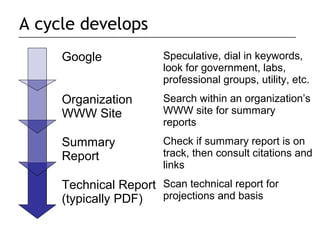
A cycle develops
     Google             Speculative, dial in keywords,
                        look for government, labs,
                        professional groups, utility, etc.
     Organization       Search within an organization’s
     WWW Site           WWW site for summary
                        reports
     Summary            Check if summary report is on
     Report             track, then consult citations and
                        links
     Technical Report Scan technical report for
     (typically PDF)  projections and basis
Summary of the search
In two hours I visited
approximately 75 URLs
and downloaded 15 PDF
documents

The search involved a
dozen “Google-to-
detailed-PDF” cycles and
multiple false starts.

As often happens, the
question became complex.
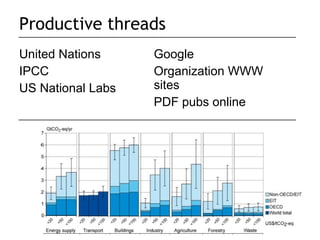
Productive threads
United Nations     Google
IPCC               Organization WWW
US National Labs   sites
                   PDF pubs online
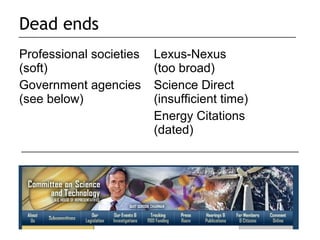
Dead ends
Professional societies   Lexus-Nexus
(soft)                   (too broad)
Government agencies      Science Direct
(see below)              (insufficient time)
                         Energy Citations
                         (dated)
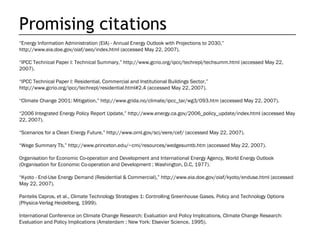
Promising citations
“Energy Information Administration (EIA) - Annual Energy Outlook with Projections to 2030,”
http://www.eia.doe.gov/oiaf/aeo/index.html (accessed May 22, 2007).

“IPCC Technical Paper I: Technical Summary,” http://www.gcrio.org/ipcc/techrepI/techsumm.html (accessed May 22,
2007).

“IPCC Technical Paper I: Residential, Commercial and Institutional Buildings Sector,”
http://www.gcrio.org/ipcc/techrepI/residential.html#2.4 (accessed May 22, 2007).

“Climate Change 2001: Mitigation,” http://www.grida.no/climate/ipcc_tar/wg3/093.htm (accessed May 22, 2007).

“2006 Integrated Energy Policy Report Update,” http://www.energy.ca.gov/2006_policy_update/index.html (accessed May
22, 2007).

“Scenarios for a Clean Energy Future,” http://www.ornl.gov/sci/eere/cef/ (accessed May 22, 2007).

“Wege Summary Tb,” http://www.princeton.edu/~cmi/resources/wedgesumtb.htm (accessed May 22, 2007).

Organisation for Economic Co-operation and Development and International Energy Agency, World Energy Outlook
(Organisation for Economic Co-operation and Development ; Washington, D.C, 1977).

“Kyoto - End-Use Energy Demand (Residential & Commercial),” http://www.eia.doe.gov/oiaf/kyoto/enduse.html (accessed
May 22, 2007).

Pantelis Capros, et al., Climate Technology Strategies 1: Controlling Greenhouse Gases. Policy and Technology Options
(Physica-Verlag Heidelberg, 1999).

International Conference on Climate Change Research: Evaluation and Policy Implications, Climate Change Research:
Evaluation and Policy Implications (Amsterdam ; New York: Elsevier Science, 1995).
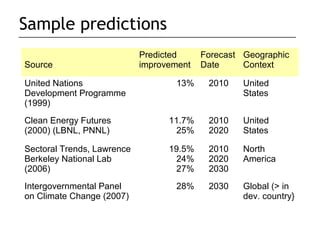
Sample predictions
                            Predicted     Forecast Geographic
Source                      improvement   Date     Context

United Nations                     13%     2010    United
Development Programme                              States
(1999)
Clean Energy Futures              11.7%    2010    United
(2000) (LBNL, PNNL)                25%     2020    States

Sectoral Trends, Lawrence         19.5%    2010    North
Berkeley National Lab              24%     2020    America
(2006)                             27%     2030
Intergovernmental Panel            28%     2030    Global (> in
on Climate Change (2007)                           dev. country}
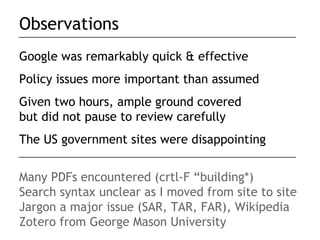
Observations
Google was remarkably quick & effective
Policy issues more important than assumed
Given two hours, ample ground covered
but did not pause to review carefully
The US government sites were disappointing


Many PDFs encountered (crtl-F “building*)
Search syntax unclear as I moved from site to site
Jargon a major issue (SAR, TAR, FAR), Wikipedia
Zotero from George Mason University

214 benton.ppt

  • 1.
    The question “Find themost substantial estimates of the percentage improvements in US building energy efficiency that will be possible over the next 10- 20 years.” Focus on building energy use United States or developed country context Both technical and policy drivers Fast moving field - current citations needed
  • 2.
    Points of departure Audiencesfor building energy Initial estimates Indices Keywords Policy makers Machine compiled Energy wedge Environmentalists Popular search Conservation engines Long term carbon Electric utility forecasters Specialized emissions indices Technology Building efficiency researchers Human compiled assessment resource lists Amory Lovins Robert Socolow IPCC
  • 3.
  • 4.
    First stop The EDLibrary research guides -- Susan Koskinen Green Design / Sustainable Architecture Resources various Building Science topics
  • 5.
    A cycle develops Google Speculative, dial in keywords, look for government, labs, professional groups, utility, etc. Organization Search within an organization’s WWW Site WWW site for summary reports Summary Check if summary report is on Report track, then consult citations and links Technical Report Scan technical report for (typically PDF) projections and basis
  • 6.
    Summary of thesearch In two hours I visited approximately 75 URLs and downloaded 15 PDF documents The search involved a dozen “Google-to- detailed-PDF” cycles and multiple false starts. As often happens, the question became complex.
  • 7.
    Productive threads United Nations Google IPCC Organization WWW US National Labs sites PDF pubs online
  • 8.
    Dead ends Professional societies Lexus-Nexus (soft) (too broad) Government agencies Science Direct (see below) (insufficient time) Energy Citations (dated)
  • 9.
    Promising citations “Energy InformationAdministration (EIA) - Annual Energy Outlook with Projections to 2030,” http://www.eia.doe.gov/oiaf/aeo/index.html (accessed May 22, 2007). “IPCC Technical Paper I: Technical Summary,” http://www.gcrio.org/ipcc/techrepI/techsumm.html (accessed May 22, 2007). “IPCC Technical Paper I: Residential, Commercial and Institutional Buildings Sector,” http://www.gcrio.org/ipcc/techrepI/residential.html#2.4 (accessed May 22, 2007). “Climate Change 2001: Mitigation,” http://www.grida.no/climate/ipcc_tar/wg3/093.htm (accessed May 22, 2007). “2006 Integrated Energy Policy Report Update,” http://www.energy.ca.gov/2006_policy_update/index.html (accessed May 22, 2007). “Scenarios for a Clean Energy Future,” http://www.ornl.gov/sci/eere/cef/ (accessed May 22, 2007). “Wege Summary Tb,” http://www.princeton.edu/~cmi/resources/wedgesumtb.htm (accessed May 22, 2007). Organisation for Economic Co-operation and Development and International Energy Agency, World Energy Outlook (Organisation for Economic Co-operation and Development ; Washington, D.C, 1977). “Kyoto - End-Use Energy Demand (Residential & Commercial),” http://www.eia.doe.gov/oiaf/kyoto/enduse.html (accessed May 22, 2007). Pantelis Capros, et al., Climate Technology Strategies 1: Controlling Greenhouse Gases. Policy and Technology Options (Physica-Verlag Heidelberg, 1999). International Conference on Climate Change Research: Evaluation and Policy Implications, Climate Change Research: Evaluation and Policy Implications (Amsterdam ; New York: Elsevier Science, 1995).
  • 10.
    Sample predictions Predicted Forecast Geographic Source improvement Date Context United Nations 13% 2010 United Development Programme States (1999) Clean Energy Futures 11.7% 2010 United (2000) (LBNL, PNNL) 25% 2020 States Sectoral Trends, Lawrence 19.5% 2010 North Berkeley National Lab 24% 2020 America (2006) 27% 2030 Intergovernmental Panel 28% 2030 Global (> in on Climate Change (2007) dev. country}
  • 11.
    Observations Google was remarkablyquick & effective Policy issues more important than assumed Given two hours, ample ground covered but did not pause to review carefully The US government sites were disappointing Many PDFs encountered (crtl-F “building*) Search syntax unclear as I moved from site to site Jargon a major issue (SAR, TAR, FAR), Wikipedia Zotero from George Mason University