RFPs
SSP | 5 Oct 2016
Cara S. Rivera | Managing Partner | KWF Consulting
Overview
Definition and types
Process: At-a-glance
Elements of RFP
Packaging RFP
Evaluating proposals
Negotiations
3October2016KWFConsulting
2
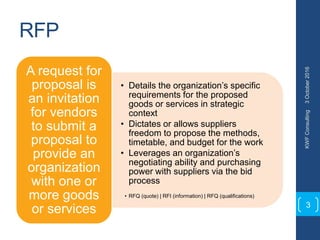
RFP
• Details the organization’s specific
requirements for the proposed
goods or services in strategic
context
• Dictates or allows suppliers
freedom to propose the methods,
timetable, and budget for the work
• Leverages an organization’s
negotiating ability and purchasing
power with suppliers via the bid
process
• RFQ (quote) | RFI (information) | RFQ (qualifications)
A request for
proposal is
an invitation
for vendors
to submit a
proposal to
provide an
organization
with one or
more goods
or services
3October2016KWFConsulting
3
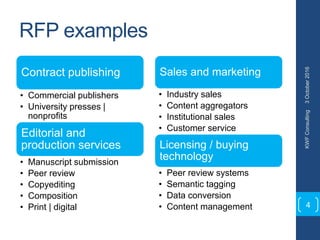
RFP examples
Contract publishing
• Commercial publishers
• University presses |
nonprofits
Editorial and
production services
• Manuscript submission
• Peer review
• Copyediting
• Composition
• Print | digital
Sales and marketing
• Industry sales
• Content aggregators
• Institutional sales
• Customer service
Licensing / buying
technology
• Peer review systems
• Semantic tagging
• Data conversion
• Content management
3October2016KWFConsulting
4
Role of the consultant
Objectivity and
experience
Broad and deep
market knowledge
Effective and
efficient approach
Apples to apples
comparisons
Good cop/bad cop
negotiating
3October2016KWFConsulting
5
Assist in contract negotiations
Evaluate proposals and facilitate
presentations
Prepare and distribute RFP
Assess needs through discovery
process
The process at-a-glance
3October2016KWFConsulting
6
Presentations
4-6 weeks
Agenda /
invitations
Hold
presentations
Discussion /
decision
Inform
suppliers
Contract
negotiations
Transition
Proposals
4-6 weeks
Proposals
received
Proposals
analyzed
Review with
stakeholders
Finalists
selected
Q&A with
remaining
suppliers
RFP
2-4 weeks
Need
assessment
Suppliers
selected |
prescreened
Data
gathered
RFP
prepared
RFP
distributed
Q&A from
suppliers
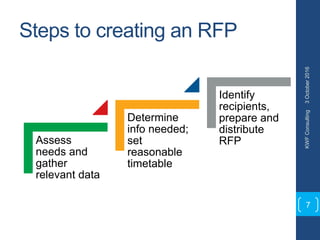
Steps to creating an RFP
3October2016KWFConsulting
7
Assess
needs and
gather
relevant data
Determine
info needed;
set
reasonable
timetable
Identify
recipients,
prepare and
distribute
RFP
Elements of an RFP
Organizational overview
Business problem (opportunity) prompting RFP
Results of any needs assessment conducted
Schedule of important dates
• RFP response due
• Presentations/demos
• Decision expected
• Sale / transition
Contact names, sources/ protocol for Q&A
3October2016KWFConsulting
8
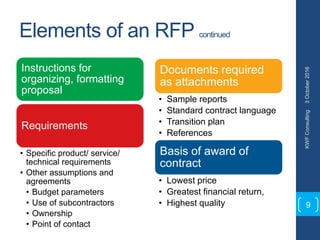
Elements of an RFP continued
Instructions for
organizing, formatting
proposal
Requirements
• Specific product/ service/
technical requirements
• Other assumptions and
agreements
• Budget parameters
• Use of subcontractors
• Ownership
• Point of contact
Documents required
as attachments
• Sample reports
• Standard contract language
• Transition plan
• References
Basis of award of
contract
• Lowest price
• Greatest financial return,
• Highest quality
3October2016KWFConsulting
9
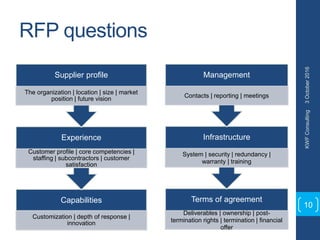
RFP questions
3October2016KWFConsulting
10
Capabilities
Customization | depth of response |
innovation
Experience
Customer profile | core competencies |
staffing | subcontractors | customer
satisfaction
Supplier profile
The organization | location | size | market
position | future vision
Terms of agreement
Deliverables | ownership | post-
termination rights | termination | financial
offer
Infrastructure
System | security | redundancy |
warranty | training
Management
Contacts | reporting | meetings
Packaging the RFP
Cover letter/invitation
• Pre-qualify
• NDA
Single document
• MS Word or PDF
• Linkable table of contents
• Tables to show history/trends
Excel file for apples-to-apples comparison
Concise and proofread
3October2016KWFConsulting
11
What happens after vendors
receive an RFP?
3October2016KWFConsulting
12
Read RFP
Ask questions
Do homework
Determine fit,
rough numbers
Submit
proposal?
Gather
information
Brainstorm
Prepare
projections
Determine
offer
Write proposal
Evaluating proposals
3October2016KWFConsulting
13
Points of
differentiation
Supplier
knowledge
Supplier
resources
Customer
support
Supplier
personnel
Supplier
capabilities
The
financial
offer
Reputation
/ culture
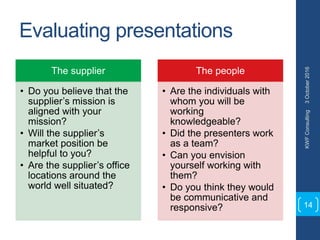
Evaluating presentations
The supplier
• Do you believe that the
supplier’s mission is
aligned with your
mission?
• Will the supplier’s
market position be
helpful to you?
• Are the supplier’s office
locations around the
world well situated?
The people
• Are the individuals with
whom you will be
working
knowledgeable?
• Did the presenters work
as a team?
• Can you envision
yourself working with
them?
• Do you think they would
be communicative and
responsive?
3October2016KWFConsulting
14
Evaluating presentations
continued
Quality
• Will the supplier uphold
your high quality
standards?
• Is their vision for the
deliverable/s aligned
with yours?
• Are the supplier’s
products/services state-
of-the-art?
Capabilities
• Did the supplier provide
a convincing plan?
• Does the supplier have
the necessary expertise
/ control over
subcontractors?
• Are you satisfied with
how you will be treated
vis-à-vis other
customers?
• Can they deliver?
The Financial Offer
• Will you receive
complete and regular
financial reporting?
• Are the
costs/royalties/financial
terms easy to
understand?
• Are appropriate rights
retained during and after
the agreement period?
• Are there business
terms that you would
like to negotiate before
entering into contract
discussions?
3October2016KWFConsulting
15
Steps in negotiation
3October2016KWFConsulting
16
Predetermine
essential, fall-
back/ trade-off,
ideal positions
Settle all business
terms pre-contract
Read and mark up
agreement;
ensure contract
reflects proposal,
agreed on terms;
lastly, legal review
Contract negotiating tips
• “Approve” (revised) proposal
• Agree on all business terms before negotiating contract
• Communicate any truly nonnegotiable clauses before contract
(good faith)
• Convert individual wants into shared problems
• Don’t rewrite unless you need to eliminate ambiguity or
change the meaning
• Work with an attorney experienced in publishing
Reducing
the stress
levels
• What is at the heart of your/my concern? What is the purpose
of this clause?
• Can I explain to you the situation I’m worried about and can
we put our heads together to think about how this situation
could be avoided?
• If we removed the clause, would or could another clause come
into play if we found ourselves in this (unlikely) situation?
• Is it time to brainstorm with some colleagues?
Questions
to bypass
impasse
3October2016KWFConsulting
17
Financial comparison
3October2016KWFConsulting
18
Thankyou!
Cara S. Kaufman | Managing Partner | KWF Consulting
410 812 5460 | cara.rivera@kwfco.com
3October2016KWFConsulting
19

10052016 ssp seminar2_rivera

  • 1.
    RFPs SSP | 5Oct 2016 Cara S. Rivera | Managing Partner | KWF Consulting
  • 2.
    Overview Definition and types Process:At-a-glance Elements of RFP Packaging RFP Evaluating proposals Negotiations 3October2016KWFConsulting 2
  • 3.
    RFP • Details theorganization’s specific requirements for the proposed goods or services in strategic context • Dictates or allows suppliers freedom to propose the methods, timetable, and budget for the work • Leverages an organization’s negotiating ability and purchasing power with suppliers via the bid process • RFQ (quote) | RFI (information) | RFQ (qualifications) A request for proposal is an invitation for vendors to submit a proposal to provide an organization with one or more goods or services 3October2016KWFConsulting 3
  • 4.
    RFP examples Contract publishing •Commercial publishers • University presses | nonprofits Editorial and production services • Manuscript submission • Peer review • Copyediting • Composition • Print | digital Sales and marketing • Industry sales • Content aggregators • Institutional sales • Customer service Licensing / buying technology • Peer review systems • Semantic tagging • Data conversion • Content management 3October2016KWFConsulting 4
  • 5.
    Role of theconsultant Objectivity and experience Broad and deep market knowledge Effective and efficient approach Apples to apples comparisons Good cop/bad cop negotiating 3October2016KWFConsulting 5 Assist in contract negotiations Evaluate proposals and facilitate presentations Prepare and distribute RFP Assess needs through discovery process
  • 6.
    The process at-a-glance 3October2016KWFConsulting 6 Presentations 4-6weeks Agenda / invitations Hold presentations Discussion / decision Inform suppliers Contract negotiations Transition Proposals 4-6 weeks Proposals received Proposals analyzed Review with stakeholders Finalists selected Q&A with remaining suppliers RFP 2-4 weeks Need assessment Suppliers selected | prescreened Data gathered RFP prepared RFP distributed Q&A from suppliers
  • 7.
    Steps to creatingan RFP 3October2016KWFConsulting 7 Assess needs and gather relevant data Determine info needed; set reasonable timetable Identify recipients, prepare and distribute RFP
  • 8.
    Elements of anRFP Organizational overview Business problem (opportunity) prompting RFP Results of any needs assessment conducted Schedule of important dates • RFP response due • Presentations/demos • Decision expected • Sale / transition Contact names, sources/ protocol for Q&A 3October2016KWFConsulting 8
  • 9.
    Elements of anRFP continued Instructions for organizing, formatting proposal Requirements • Specific product/ service/ technical requirements • Other assumptions and agreements • Budget parameters • Use of subcontractors • Ownership • Point of contact Documents required as attachments • Sample reports • Standard contract language • Transition plan • References Basis of award of contract • Lowest price • Greatest financial return, • Highest quality 3October2016KWFConsulting 9
  • 10.
    RFP questions 3October2016KWFConsulting 10 Capabilities Customization |depth of response | innovation Experience Customer profile | core competencies | staffing | subcontractors | customer satisfaction Supplier profile The organization | location | size | market position | future vision Terms of agreement Deliverables | ownership | post- termination rights | termination | financial offer Infrastructure System | security | redundancy | warranty | training Management Contacts | reporting | meetings
  • 11.
    Packaging the RFP Coverletter/invitation • Pre-qualify • NDA Single document • MS Word or PDF • Linkable table of contents • Tables to show history/trends Excel file for apples-to-apples comparison Concise and proofread 3October2016KWFConsulting 11
  • 12.
    What happens aftervendors receive an RFP? 3October2016KWFConsulting 12 Read RFP Ask questions Do homework Determine fit, rough numbers Submit proposal? Gather information Brainstorm Prepare projections Determine offer Write proposal
  • 13.
  • 14.
    Evaluating presentations The supplier •Do you believe that the supplier’s mission is aligned with your mission? • Will the supplier’s market position be helpful to you? • Are the supplier’s office locations around the world well situated? The people • Are the individuals with whom you will be working knowledgeable? • Did the presenters work as a team? • Can you envision yourself working with them? • Do you think they would be communicative and responsive? 3October2016KWFConsulting 14
  • 15.
    Evaluating presentations continued Quality • Willthe supplier uphold your high quality standards? • Is their vision for the deliverable/s aligned with yours? • Are the supplier’s products/services state- of-the-art? Capabilities • Did the supplier provide a convincing plan? • Does the supplier have the necessary expertise / control over subcontractors? • Are you satisfied with how you will be treated vis-à-vis other customers? • Can they deliver? The Financial Offer • Will you receive complete and regular financial reporting? • Are the costs/royalties/financial terms easy to understand? • Are appropriate rights retained during and after the agreement period? • Are there business terms that you would like to negotiate before entering into contract discussions? 3October2016KWFConsulting 15
  • 16.
    Steps in negotiation 3October2016KWFConsulting 16 Predetermine essential,fall- back/ trade-off, ideal positions Settle all business terms pre-contract Read and mark up agreement; ensure contract reflects proposal, agreed on terms; lastly, legal review
  • 17.
    Contract negotiating tips •“Approve” (revised) proposal • Agree on all business terms before negotiating contract • Communicate any truly nonnegotiable clauses before contract (good faith) • Convert individual wants into shared problems • Don’t rewrite unless you need to eliminate ambiguity or change the meaning • Work with an attorney experienced in publishing Reducing the stress levels • What is at the heart of your/my concern? What is the purpose of this clause? • Can I explain to you the situation I’m worried about and can we put our heads together to think about how this situation could be avoided? • If we removed the clause, would or could another clause come into play if we found ourselves in this (unlikely) situation? • Is it time to brainstorm with some colleagues? Questions to bypass impasse 3October2016KWFConsulting 17
  • 18.
  • 19.
    Thankyou! Cara S. Kaufman| Managing Partner | KWF Consulting 410 812 5460 | cara.rivera@kwfco.com 3October2016KWFConsulting 19