Consortia Expectations
for Licensing and Pricing

    SSP Fall Educational Seminar
 Innovations in Pricing and Licensing
         November 14, 2007


        http://muse.jhu.edu
Outline for Today
• Consortia 101
• Consortia Pricing Models and
  Considerations
• Consortia Licensing Expectations
• Resources


            http://muse.jhu.edu
Library consortia come in
 many flavors…


         http://muse.jhu.edu
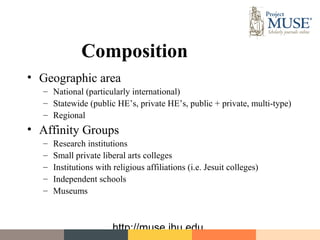
Composition
• Geographic area
  – National (particularly international)
  – Statewide (public HE’s, private HE’s, public + private, multi-type)
  – Regional
• Affinity Groups
  –   Research institutions
  –   Small private liberal arts colleges
  –   Institutions with religious affiliations (i.e. Jesuit colleges)
  –   Independent schools
  –   Museums


                        http://muse.jhu.edu
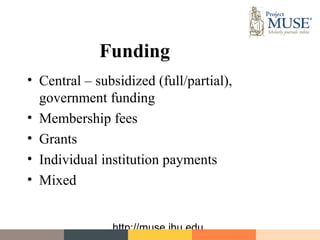
Funding
• Central – subsidized (full/partial),
  government funding
• Membership fees
• Grants
• Individual institution payments
• Mixed


               http://muse.jhu.edu
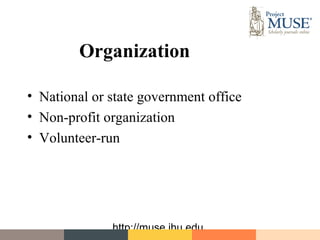
Organization

• National or state government office
• Non-profit organization
• Volunteer-run


              http://muse.jhu.edu
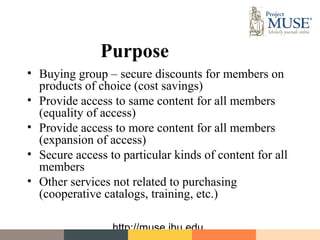
Purpose
• Buying group – secure discounts for members on
  products of choice (cost savings)
• Provide access to same content for all members
  (equality of access)
• Provide access to more content for all members
  (expansion of access)
• Secure access to particular kinds of content for all
  members
• Other services not related to purchasing
  (cooperative catalogs, training, etc.)

                 http://muse.jhu.edu
Services consortia may provide…
•    Single point of contact for multiple sales
•    Opportunities for group sales presentations
•    Consolidation of billing and collections
•    Renewals
•    First line customer support
•    Gathering/updating technical data
•    Conduit for dissemination of information to
     subscribers
                   http://muse.jhu.edu
Consortia as marketing partners…
•   Mentions in newsletters
•   Links on web sites
•   Materials in member mailings
•   Visibility at member events
•   Special promotions or offers
•   Group trials
•   Mail/email lists


                 http://muse.jhu.edu
Some benefits of working with consortia…
• Increase reach and market penetration (especially
  when launching a new product)
• Access to new markets and customers
• Greater dissemination of content
• “Serendipity factor” for bundled content (new
  readers)
• Reduction in overhead/expenses (accounts payable,
  accounts receivable, customer service, renewals, order
  entry, sales force)

                  http://muse.jhu.edu
Some challenges of working with consortia…
 • Must have enough content to garner consortia interest
 • Decision by committee
 • Lengthy negotiations which do not always lead to a sale
 • Contract negotiations may require legal expertise
 • Contract requirements (functionality, service guarantees)
   may be beyond current capabilities
 • Centralized funding disbursements may not be on track
   with subscription term
 • Centralized or subsidized funding may not be stable
 • Substantial risks if too much business is tied up in
   consortia, and one or more unexpectedly cancel

                    http://muse.jhu.edu
There are as many ways of
 pricing to consortia as there
 are flavors of consortia…


          http://muse.jhu.edu
Selected Pricing Models
• Special per-user price based on total FTE
• Pricing based on current print holdings “plus”
• Sliding volume discounts based on number of
  participants
• Flat rate discounts based on services provided
• Standard discount for all consortia
• Customized price based on composition of
  members, level of participation, other factors
• Multi-year contracts
   – Annual price caps
   – Contractual spend

                  http://muse.jhu.edu
ICOLC “Preferred Pricing Practices”
 International Coalition of Library Consortia
 Statement of Current Perspective and Preferred Practices for Selection
     and Purchase of Electronic Information (October, 2004)


 • Electronic and paper purchasing unbundled
 • Allow print cancellation
 • Flexibility in bundled collections (ability to switch
   out titles, shave off titles)
 • Shift from “print plus” to “electronic plus” model


                        http://muse.jhu.edu
Some considerations…
• What types of content/journals benefit from consortia
  sales, and which may experience considerable risk?
  (widely held journals vs. niche titles, society journals)
• Do you have the expertise and resources in house, or
  easily available, for license negotiation, contract
  review, pricing analysis, risk analysis, and other
  elements essential to successful consortia sales?
• Does the pricing to consortia accurately reflect the
  value to the publisher of consortia sales? Does the
  additional business balance potential lost revenue?

                   http://muse.jhu.edu
More considerations…
• Consortia sales may reduce personnel needs in
  customer service and fulfillment, but require new
  hires in sales and technical development – what, if
  any, are the savings?
• Consortia can ask for and expect more in terms of
  functionality, service, customization – who pays
  for this, especially if consortia prices are
  discounted? If all customers benefit from
  enhancements made to meet consortia demands, is
  it fair for all to absorb some of the cost?

                 http://muse.jhu.edu
Licensing expectations are as
 varied as consortium types
 and pricing models…


         http://muse.jhu.edu
ICOLC “Goals for Access”
International Coalition of Library Consortia
Statement of Current Perspective and Preferred Practices for Selection
    and Purchase of Electronic Information (October, 2004)


• Facilitate information technologies
• Educational “exceptions” to national copyright
  laws not lost in electronic environment
• Permanent access and archiving
• Effective measures of use and value
• “Broadest possible access”

                       http://muse.jhu.edu
ICOLC Guidelines for Usage
International Coalition of Library Consortia
Revised Guidelines for Statistical Measures of Usage of Web-Based
    Information Resources (September, 2006)


• Reiterates endorsement of Project COUNTER
• Endorses NISO’s Standardized Usage Statistics
  Harvesting Initiative (SUSHI)
• Endorses XML delivery of usage statistics


                      http://muse.jhu.edu
Model NESLi2 License
National Electronic Site Licensing Initiative (UK)
Model NESLi2 License for Journals (most recent revision, May 2007)

•   Compliance with COUNTER
•   Compliance with Open URL
•   Compliance with W3C standards
•   Compliance with Project Transfer
•   Support access via Athens/Shibboleth
•   Allow interlibrary loan
•   Allow authors’ deposit of material in institutional repositories
•   Electronic version available simultaneously with print
•   “Acceptable levels of service”
•   Cancellation/substitution options for multi-year deals
•   Perpetual access


                            http://muse.jhu.edu
Resources
• International Coalition of Library Consortia (ICOLC)
       www.library.yale.edu/consortia
• Model NESLi2 Licence for Journals
       www.nesli2.ac.uk/model.htm
• Project COUNTER (usage statistics)
       www.projectcounter.org
• National Information Standards Organization (Open URL,
  SUSHI)
       www.niso.org
• Project Transfer Code of Practice
       www.projecttransfer.org
• W3C standards
       www.w3.org

                   http://muse.jhu.edu
Contact Information
Melanie Schaffner
Marketing and Sales Manager, Project MUSE
melanie@muse.jhu.edu
410-516-3846


             http://muse.jhu.edu

245 m schaffner

  • 1.
    Consortia Expectations for Licensingand Pricing SSP Fall Educational Seminar Innovations in Pricing and Licensing November 14, 2007 http://muse.jhu.edu
  • 2.
    Outline for Today •Consortia 101 • Consortia Pricing Models and Considerations • Consortia Licensing Expectations • Resources http://muse.jhu.edu
  • 3.
    Library consortia comein many flavors… http://muse.jhu.edu
  • 4.
    Composition • Geographic area – National (particularly international) – Statewide (public HE’s, private HE’s, public + private, multi-type) – Regional • Affinity Groups – Research institutions – Small private liberal arts colleges – Institutions with religious affiliations (i.e. Jesuit colleges) – Independent schools – Museums http://muse.jhu.edu
  • 5.
    Funding • Central –subsidized (full/partial), government funding • Membership fees • Grants • Individual institution payments • Mixed http://muse.jhu.edu
  • 6.
    Organization • National orstate government office • Non-profit organization • Volunteer-run http://muse.jhu.edu
  • 7.
    Purpose • Buying group– secure discounts for members on products of choice (cost savings) • Provide access to same content for all members (equality of access) • Provide access to more content for all members (expansion of access) • Secure access to particular kinds of content for all members • Other services not related to purchasing (cooperative catalogs, training, etc.) http://muse.jhu.edu
  • 8.
    Services consortia mayprovide… • Single point of contact for multiple sales • Opportunities for group sales presentations • Consolidation of billing and collections • Renewals • First line customer support • Gathering/updating technical data • Conduit for dissemination of information to subscribers http://muse.jhu.edu
  • 9.
    Consortia as marketingpartners… • Mentions in newsletters • Links on web sites • Materials in member mailings • Visibility at member events • Special promotions or offers • Group trials • Mail/email lists http://muse.jhu.edu
  • 10.
    Some benefits ofworking with consortia… • Increase reach and market penetration (especially when launching a new product) • Access to new markets and customers • Greater dissemination of content • “Serendipity factor” for bundled content (new readers) • Reduction in overhead/expenses (accounts payable, accounts receivable, customer service, renewals, order entry, sales force) http://muse.jhu.edu
  • 11.
    Some challenges ofworking with consortia… • Must have enough content to garner consortia interest • Decision by committee • Lengthy negotiations which do not always lead to a sale • Contract negotiations may require legal expertise • Contract requirements (functionality, service guarantees) may be beyond current capabilities • Centralized funding disbursements may not be on track with subscription term • Centralized or subsidized funding may not be stable • Substantial risks if too much business is tied up in consortia, and one or more unexpectedly cancel http://muse.jhu.edu
  • 12.
    There are asmany ways of pricing to consortia as there are flavors of consortia… http://muse.jhu.edu
  • 13.
    Selected Pricing Models •Special per-user price based on total FTE • Pricing based on current print holdings “plus” • Sliding volume discounts based on number of participants • Flat rate discounts based on services provided • Standard discount for all consortia • Customized price based on composition of members, level of participation, other factors • Multi-year contracts – Annual price caps – Contractual spend http://muse.jhu.edu
  • 14.
    ICOLC “Preferred PricingPractices” International Coalition of Library Consortia Statement of Current Perspective and Preferred Practices for Selection and Purchase of Electronic Information (October, 2004) • Electronic and paper purchasing unbundled • Allow print cancellation • Flexibility in bundled collections (ability to switch out titles, shave off titles) • Shift from “print plus” to “electronic plus” model http://muse.jhu.edu
  • 15.
    Some considerations… • Whattypes of content/journals benefit from consortia sales, and which may experience considerable risk? (widely held journals vs. niche titles, society journals) • Do you have the expertise and resources in house, or easily available, for license negotiation, contract review, pricing analysis, risk analysis, and other elements essential to successful consortia sales? • Does the pricing to consortia accurately reflect the value to the publisher of consortia sales? Does the additional business balance potential lost revenue? http://muse.jhu.edu
  • 16.
    More considerations… • Consortiasales may reduce personnel needs in customer service and fulfillment, but require new hires in sales and technical development – what, if any, are the savings? • Consortia can ask for and expect more in terms of functionality, service, customization – who pays for this, especially if consortia prices are discounted? If all customers benefit from enhancements made to meet consortia demands, is it fair for all to absorb some of the cost? http://muse.jhu.edu
  • 17.
    Licensing expectations areas varied as consortium types and pricing models… http://muse.jhu.edu
  • 18.
    ICOLC “Goals forAccess” International Coalition of Library Consortia Statement of Current Perspective and Preferred Practices for Selection and Purchase of Electronic Information (October, 2004) • Facilitate information technologies • Educational “exceptions” to national copyright laws not lost in electronic environment • Permanent access and archiving • Effective measures of use and value • “Broadest possible access” http://muse.jhu.edu
  • 19.
    ICOLC Guidelines forUsage International Coalition of Library Consortia Revised Guidelines for Statistical Measures of Usage of Web-Based Information Resources (September, 2006) • Reiterates endorsement of Project COUNTER • Endorses NISO’s Standardized Usage Statistics Harvesting Initiative (SUSHI) • Endorses XML delivery of usage statistics http://muse.jhu.edu
  • 20.
    Model NESLi2 License NationalElectronic Site Licensing Initiative (UK) Model NESLi2 License for Journals (most recent revision, May 2007) • Compliance with COUNTER • Compliance with Open URL • Compliance with W3C standards • Compliance with Project Transfer • Support access via Athens/Shibboleth • Allow interlibrary loan • Allow authors’ deposit of material in institutional repositories • Electronic version available simultaneously with print • “Acceptable levels of service” • Cancellation/substitution options for multi-year deals • Perpetual access http://muse.jhu.edu
  • 21.
    Resources • International Coalitionof Library Consortia (ICOLC) www.library.yale.edu/consortia • Model NESLi2 Licence for Journals www.nesli2.ac.uk/model.htm • Project COUNTER (usage statistics) www.projectcounter.org • National Information Standards Organization (Open URL, SUSHI) www.niso.org • Project Transfer Code of Practice www.projecttransfer.org • W3C standards www.w3.org http://muse.jhu.edu
  • 22.
    Contact Information Melanie Schaffner Marketingand Sales Manager, Project MUSE melanie@muse.jhu.edu 410-516-3846 http://muse.jhu.edu