How to Write a Paper http://essayacademia.com/
How do I start?
1. Know Due Dates and Plan Accordingly * Always look at least  3   weeks   ahead in your calendar!!! * Have a calendar with all of your assignments written in it.
2. Choose a Topic *Possible topics will most likely be found in you syllabus. *Choose a topic that is interesting to you!! *Always check with your professor if you want to research a topic that is not in your syllabus.
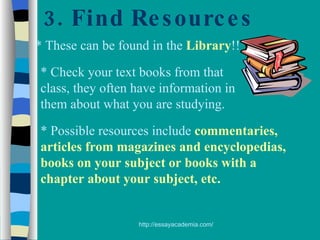
3. Find Resources * These can be found in the  Library !! * Check your text books from that class, they often have information in them about what you are studying. * Possible resources include  commentaries, articles from magazines and encyclopedias, books on your subject or books with a chapter about your subject, etc.
Now What??
Research your topic and take notes!! *This process  should  take the most time, so be patient and have fun learning new information.
The Notebook Method - use a notebook and write all of your notes in it. Pros -  Everything is in one place Cons - hard to organize when you are ready to write the paper
The Book Method - sit in front of your computer with all of your books around you.  As you find something to use in your paper, type it on the computer.
The Note Card Method Pros :   All of your notes are in one place, easy to organize Cons :   Note taking takes a long time
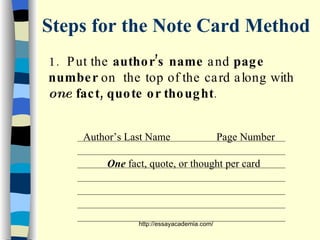
Author’s Last Name Page Number One  fact, quote, or thought per card Steps for the Note Card Method 1.  Put the  author’s name  and  page number  on  the top of the card along with  one  fact, quote or thought .
2.  Always keep track of bibliographical information in a notebook or on one note card. 3.  Keep note cards for research, your own thoughts or questions and for possible thesis statements. 4.  When finished taking notes, organize cards in stacks of main topics, introduction and conclusion. This forms your outline.
5.  Type out notes in the order you want them.  Make sure to include references and quotation marks. 6.  Add in your own thoughts and transitions. 7.  Write your introduction and  conclusion.  Don’t forget your  thesis!!!
Tips for   Research 1.  Photocopy sources 2. Document everything you photocopy or take notes on.
When your research is finished...
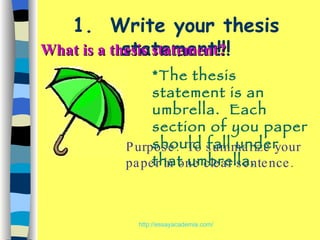
1.  Write your thesis statement!!! What is a thesis statement? Purpose:  To summarize your paper in one clear sentence. *The thesis statement is an umbrella.  Each section of you paper should fall under that umbrella.
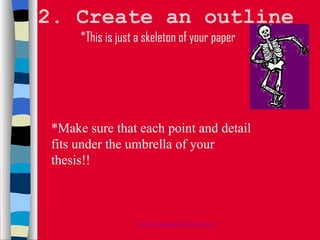
2. Create an outline *Make sure that each point and detail fits under the umbrella of your thesis!! *This is just a skeleton of your paper
Structure of a Paper
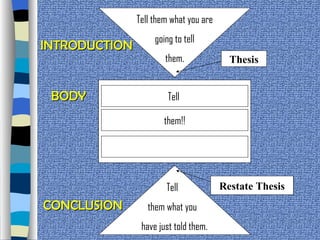
Tell them what you are going to tell  them. Tell  them!! Tell  them what you  have just told them. Thesis Restate Thesis BODY CONCLUSION INTRODUCTION
Write the  Body  of your paper first. *The body contains all of your main points and supporting details.
Write the  Conclusion  after you write the body. *The conclusion is usually one paragraph. *Restate your thesis in the conclusion. *Summarize what you have just told your reader in the body. *Wrap up the paper with a bang!!
Write the  Introduction  last. *The Introduction should catch the reader’s attention. *The Introduction can be more than one paragraph. *Intro should end with your  Thesis Statement .
You’re not finished yet!!!
Proof Read!! *You read it and look for mistakes.  Then correct them!! *Have someone else read it and look for mistakes.   *A friend that you trust *An RA
Edit *Rewrite/Make corrections *Make sure all of the corrections fit under the umbrella of your thesis. *Reread -  make sure the paper makes sense!! *Your final draft should not be your first draft.
Common Mistakes
1.  Starting too late 2.  Using 1st or 2nd person *Always look at least  3 weeks  ahead in your calendar and plan accordingly. * Never  use the words  I, You, We or They  in a paper unless the professor assigns an application section.
3.  Using contractions 4.  Shifting verb tense *Don’t shorten words--use  Do not  instead of Don’t and  Is Not  instead of isn’t, etc. *Make sure all of your verbs are in the same tense
6.  Not using transition sentences *If one paragraph is about frogs and the next one is about heaven, tell me how you got from frogs to heaven. 5.  Putting more than one thought in a paragraph *Each paragraph should start with a topic sentence and each sentence in the paragraph should fall under that topic sentence.
7.  Format, Format, Format!!! *Get a  Term Paper Guide  from the bookstore and follow the format guidelines.
8.  Run on sentences or  patterned sentences *Don’t make it sound like a Dick and Jane book.  Vary the length and pattern of your sentences. *Don’t use run on sentences even if you like them because they can get very long and tedious for your professor to read because they read a lot of papers. 9.  Not using spell check

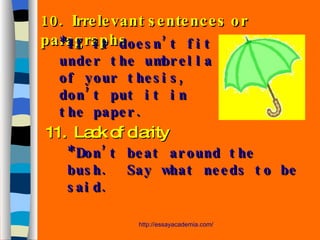
10.  Irrelevant sentences or paragraphs 11.  Lack of clarity *If it doesn’t fit under the umbrella of your thesis, don’t put it in the paper. *Don’t beat around the bush.  Say what needs to be said.
12.  Using personal thoughts without the support of research 13.  Not giving credit *This is  not  an opinion paper.  This is a research paper, everything in it must be supported by research. *You  must  give credit to the author of  all  the quotes and ideas that aren’t your own.
14.  Documentation *Paraphrase:  Put the  authors’ thoughts in your own words .  This still needs to be documented because it is not your own thought. *A  quote  is anything,  three words or more, that is not your own .  Quotes need to have quotation marks around them and need to be documented. *A quote that is  four or more lines long needs to be indented .
Review
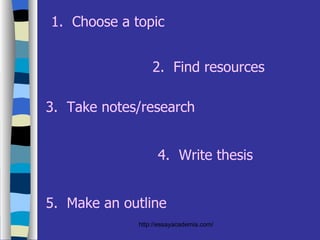
1.  Choose a topic 2.  Find resources 3.  Take notes/research 4.  Write thesis 5.  Make an outline
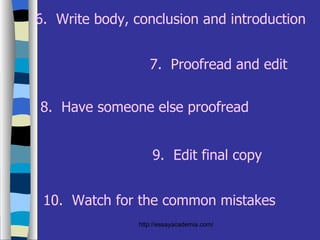
7.  Proofread and edit 8.  Have someone else proofread 9.  Edit final copy 10.  Watch for the common mistakes 6.  Write body, conclusion and introduction

Structure of Term papers

  • 1.
    How to Writea Paper http://essayacademia.com/
  • 2.
    How do Istart?
  • 3.
    1. Know DueDates and Plan Accordingly * Always look at least 3 weeks ahead in your calendar!!! * Have a calendar with all of your assignments written in it.
  • 4.
    2. Choose aTopic *Possible topics will most likely be found in you syllabus. *Choose a topic that is interesting to you!! *Always check with your professor if you want to research a topic that is not in your syllabus.
  • 5.
    3. Find Resources* These can be found in the Library !! * Check your text books from that class, they often have information in them about what you are studying. * Possible resources include commentaries, articles from magazines and encyclopedias, books on your subject or books with a chapter about your subject, etc.
  • 6.
  • 7.
    Research your topicand take notes!! *This process should take the most time, so be patient and have fun learning new information.
  • 8.
    The Notebook Method- use a notebook and write all of your notes in it. Pros - Everything is in one place Cons - hard to organize when you are ready to write the paper
  • 9.
    The Book Method- sit in front of your computer with all of your books around you. As you find something to use in your paper, type it on the computer.
  • 10.
    The Note CardMethod Pros : All of your notes are in one place, easy to organize Cons : Note taking takes a long time
  • 11.
    Author’s Last NamePage Number One fact, quote, or thought per card Steps for the Note Card Method 1. Put the author’s name and page number on the top of the card along with one fact, quote or thought .
  • 12.
    2. Alwayskeep track of bibliographical information in a notebook or on one note card. 3. Keep note cards for research, your own thoughts or questions and for possible thesis statements. 4. When finished taking notes, organize cards in stacks of main topics, introduction and conclusion. This forms your outline.
  • 13.
    5. Typeout notes in the order you want them. Make sure to include references and quotation marks. 6. Add in your own thoughts and transitions. 7. Write your introduction and conclusion. Don’t forget your thesis!!!
  • 14.
    Tips for Research 1. Photocopy sources 2. Document everything you photocopy or take notes on.
  • 15.
    When your researchis finished...
  • 16.
    1. Writeyour thesis statement!!! What is a thesis statement? Purpose: To summarize your paper in one clear sentence. *The thesis statement is an umbrella. Each section of you paper should fall under that umbrella.
  • 17.
    2. Create anoutline *Make sure that each point and detail fits under the umbrella of your thesis!! *This is just a skeleton of your paper
  • 18.
  • 19.
    Tell them whatyou are going to tell them. Tell them!! Tell them what you have just told them. Thesis Restate Thesis BODY CONCLUSION INTRODUCTION
  • 20.
    Write the Body of your paper first. *The body contains all of your main points and supporting details.
  • 21.
    Write the Conclusion after you write the body. *The conclusion is usually one paragraph. *Restate your thesis in the conclusion. *Summarize what you have just told your reader in the body. *Wrap up the paper with a bang!!
  • 22.
    Write the Introduction last. *The Introduction should catch the reader’s attention. *The Introduction can be more than one paragraph. *Intro should end with your Thesis Statement .
  • 23.
  • 24.
    Proof Read!! *Youread it and look for mistakes. Then correct them!! *Have someone else read it and look for mistakes. *A friend that you trust *An RA
  • 25.
    Edit *Rewrite/Make corrections*Make sure all of the corrections fit under the umbrella of your thesis. *Reread - make sure the paper makes sense!! *Your final draft should not be your first draft.
  • 26.
  • 27.
    1. Startingtoo late 2. Using 1st or 2nd person *Always look at least 3 weeks ahead in your calendar and plan accordingly. * Never use the words I, You, We or They in a paper unless the professor assigns an application section.
  • 28.
    3. Usingcontractions 4. Shifting verb tense *Don’t shorten words--use Do not instead of Don’t and Is Not instead of isn’t, etc. *Make sure all of your verbs are in the same tense
  • 29.
    6. Notusing transition sentences *If one paragraph is about frogs and the next one is about heaven, tell me how you got from frogs to heaven. 5. Putting more than one thought in a paragraph *Each paragraph should start with a topic sentence and each sentence in the paragraph should fall under that topic sentence.
  • 30.
    7. Format,Format, Format!!! *Get a Term Paper Guide from the bookstore and follow the format guidelines.
  • 31.
    8. Runon sentences or patterned sentences *Don’t make it sound like a Dick and Jane book. Vary the length and pattern of your sentences. *Don’t use run on sentences even if you like them because they can get very long and tedious for your professor to read because they read a lot of papers. 9. Not using spell check
  • 32.
    10. Irrelevantsentences or paragraphs 11. Lack of clarity *If it doesn’t fit under the umbrella of your thesis, don’t put it in the paper. *Don’t beat around the bush. Say what needs to be said.
  • 33.
    12. Usingpersonal thoughts without the support of research 13. Not giving credit *This is not an opinion paper. This is a research paper, everything in it must be supported by research. *You must give credit to the author of all the quotes and ideas that aren’t your own.
  • 34.
    14. Documentation*Paraphrase: Put the authors’ thoughts in your own words . This still needs to be documented because it is not your own thought. *A quote is anything, three words or more, that is not your own . Quotes need to have quotation marks around them and need to be documented. *A quote that is four or more lines long needs to be indented .
  • 35.
  • 36.
    1. Choosea topic 2. Find resources 3. Take notes/research 4. Write thesis 5. Make an outline
  • 37.
    7. Proofreadand edit 8. Have someone else proofread 9. Edit final copy 10. Watch for the common mistakes 6. Write body, conclusion and introduction