2.1 Life As We Name It
Learning Outcomes:
                            1. Identify differences among domains and kingdoms.
Readings: 2: 46-47, 12:     2. Name common species using scientific nomenclature.
313-338

Reading Quiz Due before class on Wednesday Sept 16th

Assignment Reminder: Welcome Survey on Vista due Wed. Sept. 23rd

New Assignment: Student Attitudes about Biology, complete by Monday Sept. 21st

Taxonomy:
- a way of classifying and naming all living things
- based on similarities between organisms

Classifying living organisms has been of importance to biologists for hundreds of years.
Originally characteristics used were structural or morphological (how an organism looked). Organisms can also
be classified based on organisms’ ecological roles, their chemical characteristics and now a lot of importance is
place on how genetically similar organisms are (DNA comparisons).

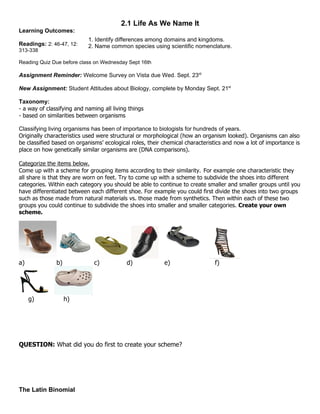
Categorize the items below.
Come up with a scheme for grouping items according to their similarity. For example one characteristic they
all share is that they are worn on feet. Try to come up with a scheme to subdivide the shoes into different
categories. Within each category you should be able to continue to create smaller and smaller groups until you
have differentiated between each different shoe. For example you could first divide the shoes into two groups
such as those made from natural materials vs. those made from synthetics. Then within each of these two
groups you could continue to subdivide the shoes into smaller and smaller categories. Create your own
scheme.


a)             b)             c)            d)            e)                  f)


     g)             h)


QUESTION: What did you do first to create your scheme?


The Latin Binomial
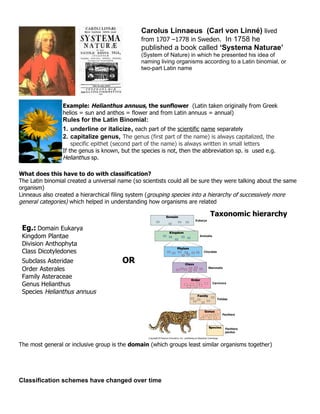
Carolus Linnaeus (Carl von Linné) lived
                                                from 1707 –1778 in Sweden. In 1758 he
                                                published a book called ‘Systema Naturae’
                                                (System of Nature) in which he presented his idea of
                                                naming living organisms according to a Latin binomial, or
                                                two-part Latin name


                 Example: Helianthus annuus, the sunflower (Latin taken originally from Greek
                 helios = sun and anthos = flower and from Latin annuus = annual)
                 Rules for the Latin Binomial:
                 1. underline or italicize, each part of the scientific name separately
                 2. capitalize genus, The genus (first part of the name) is always capitalized, the
                     specific epithet (second part of the name) is always written in small letters
                 If the genus is known, but the species is not, then the abbreviation sp. is used e.g.
                 Helianthus sp.

What does this have to do with classification?
The Latin binomial created a universal name (so scientists could all be sure they were talking about the same
organism)
Linneaus also created a hierarchical filing system (grouping species into a hierarchy of successively more
general categories) which helped in understanding how organisms are related

                                                                           Taxonomic hierarchy
 Eg.: Domain Eukarya
 Kingdom Plantae
 Division Anthophyta
 Class Dicotyledones
 Subclass Asteridae                     OR
 Order Asterales
 Family Asteraceae
 Genus Helianthus
 Species Helianthus annuus


The most general or inclusive group is the domain (which groups least similar organisms together)


Classification schemes have changed over time
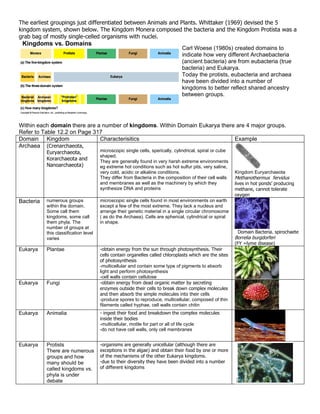
The earliest groupings just differentiated between Animals and Plants. Whittaker (1969) devised the 5
kingdom system, shown below. The Kingdom Monera composed the bacteria and the Kingdom Protista was a
grab bag of mostly single-celled organisms with nuclei.
 Kingdoms vs. Domains
                                                                                Carl Woese (1980s) created domains to
                                                                                indicate how very different Archaebacteria
                                                                                (ancient bacteria) are from eubacteria (true
                                                                                bacteria) and Eukarya.
                                                                                Today the protists, eubacteria and archaea
                                                                                have been divided into a number of
                                                                                kingdoms to better reflect shared ancestry
                                                                                between groups.


Within each domain there are a number of kingdoms. Within Domain Eukarya there are 4 major groups.
Refer to Table 12.2 on Page 317
Domain Kingdom                Characterisitics                                Example
Archaea (Crenarchaeota,
           Euryarchaeota,              microscopic single cells, sperically, cylindrical, spiral or cube
                                       shaped.
           Korarchaeota and            They are generally found in very harsh extreme environments
           Nanoarchaeota)              eg extreme hot conditions such as hot sulfur pits, very saline,
                                       very cold, acidic or alkaline conditions.                           Kingdom Euryarchaeota
                                       They differ from Bacteria in the composition of their cell walls    Methanothermus fervidus
                                       and membranes as well as the machinery by which they                lives in hot ponds’ producing
                                       synthesize DNA and proteins                                         methane, cannot tolerate
                                                                                                           oxygen
Bacteria   numerous groups             microscopic single cells found in most environments on earth
           within the domain.          except a few of the most extreme. They lack a nucleus and
           Some call them              arrange their genetic material in a single circular chromosome
           kingdoms, some call         ( as do the Archaea). Cells are spherical, cylindrical or spiral
           them phyla. The             in shape.
           number of groups at
           this classification level                                                                         Domain Bacteria. spirochaete
           varies                                                                                          Borrelia burgdorferi
                                                                                                           (FY =lyme disease)
Eukarya    Plantae                     -obtain energy from the sun through photosynthesis. Their
                                       cells contain organelles called chloroplasts which are the sites
                                       of photosynthesis
                                       -multicellular and contain some type of pigments to absorb
                                       light and perform photosynthesis
                                       -cell walls contain cellulose
Eukarya    Fungi                       -obtain energy from dead organic matter by secreting
                                       enzymes outside their cells to break down complex molecules
                                       and then absorb the simple molecules into their cells
                                       -produce spores to reproduce, multicellular, composed of thin
                                       filaments called hyphae, cell walls contain chitin
Eukarya    Animalia                    - ingest their food and breakdown the complex molecules
                                       inside their bodies
                                       -multicellular, motile for part or all of life cycle
                                       -do not have cell walls, only cell membranes


Eukarya    Protists                    -organisms are generally unicellular (although there are
           There are numerous          exceptions in the algae) and obtain their food by one or more
           groups and how              of the mechanisms of the other Eukarya kingdoms.
           many should be              -due to their diversity they have been divided into a number
           called kingdoms vs.         of different kingdoms
           phyla is under
           debate
You will be shown a number of pictures of organisms in class. Identify which group you think each of these
organisms belongs to and why you think so.

a)                                                   b)

c)                                                   d)

e)                                                   f)

g)                                                   h)

i)                                                   j)

k)                                                   l)

m)                                                   n)

o)                                                   p)

Questions to consider:
1. Members of the Kingdom Plantae have rigid cell walls made out of cellulose and some other tough polymers
which support the plants and allow them to grow to some height. Members of Kingdom Animalia lack cell walls,
so what do they use as a means of support to allow them obtain some height?


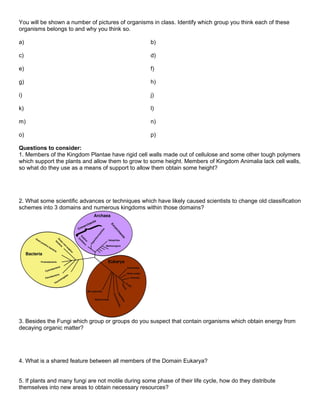
2. What some scientific advances or techniques which have likely caused scientists to change old classification
schemes into 3 domains and numerous kingdoms within those domains?


3. Besides the Fungi which group or groups do you suspect that contain organisms which obtain energy from
decaying organic matter?


4. What is a shared feature between all members of the Domain Eukarya?


5. If plants and many fungi are not motile during some phase of their life cycle, how do they distribute
themselves into new areas to obtain necessary resources?
6. You go butterfly watching with a friend and using a field guide identify two species Polygonia progne and
Polygonia satyrus. How do you know that they are in the same class order and family within the Biological
classification hierarchy?


7. There are only several basic cell shapes for Archaea and Bacteria. What are other characteristics within
these domains that would allow for more detailed classification into smaller subdivisions of organisms?


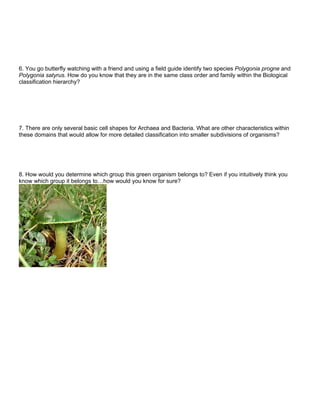
8. How would you determine which group this green organism belongs to? Even if you intuitively think you
know which group it belongs to…how would you know for sure?

2.1 Life As We Name It

  • 1.
    2.1 Life AsWe Name It Learning Outcomes: 1. Identify differences among domains and kingdoms. Readings: 2: 46-47, 12: 2. Name common species using scientific nomenclature. 313-338 Reading Quiz Due before class on Wednesday Sept 16th Assignment Reminder: Welcome Survey on Vista due Wed. Sept. 23rd New Assignment: Student Attitudes about Biology, complete by Monday Sept. 21st Taxonomy: - a way of classifying and naming all living things - based on similarities between organisms Classifying living organisms has been of importance to biologists for hundreds of years. Originally characteristics used were structural or morphological (how an organism looked). Organisms can also be classified based on organisms’ ecological roles, their chemical characteristics and now a lot of importance is place on how genetically similar organisms are (DNA comparisons). Categorize the items below. Come up with a scheme for grouping items according to their similarity. For example one characteristic they all share is that they are worn on feet. Try to come up with a scheme to subdivide the shoes into different categories. Within each category you should be able to continue to create smaller and smaller groups until you have differentiated between each different shoe. For example you could first divide the shoes into two groups such as those made from natural materials vs. those made from synthetics. Then within each of these two groups you could continue to subdivide the shoes into smaller and smaller categories. Create your own scheme. a) b) c) d) e) f) g) h) QUESTION: What did you do first to create your scheme? The Latin Binomial
  • 2.
    Carolus Linnaeus (Carlvon Linné) lived from 1707 –1778 in Sweden. In 1758 he published a book called ‘Systema Naturae’ (System of Nature) in which he presented his idea of naming living organisms according to a Latin binomial, or two-part Latin name Example: Helianthus annuus, the sunflower (Latin taken originally from Greek helios = sun and anthos = flower and from Latin annuus = annual) Rules for the Latin Binomial: 1. underline or italicize, each part of the scientific name separately 2. capitalize genus, The genus (first part of the name) is always capitalized, the specific epithet (second part of the name) is always written in small letters If the genus is known, but the species is not, then the abbreviation sp. is used e.g. Helianthus sp. What does this have to do with classification? The Latin binomial created a universal name (so scientists could all be sure they were talking about the same organism) Linneaus also created a hierarchical filing system (grouping species into a hierarchy of successively more general categories) which helped in understanding how organisms are related Taxonomic hierarchy Eg.: Domain Eukarya Kingdom Plantae Division Anthophyta Class Dicotyledones Subclass Asteridae OR Order Asterales Family Asteraceae Genus Helianthus Species Helianthus annuus The most general or inclusive group is the domain (which groups least similar organisms together) Classification schemes have changed over time
  • 3.
    The earliest groupingsjust differentiated between Animals and Plants. Whittaker (1969) devised the 5 kingdom system, shown below. The Kingdom Monera composed the bacteria and the Kingdom Protista was a grab bag of mostly single-celled organisms with nuclei. Kingdoms vs. Domains Carl Woese (1980s) created domains to indicate how very different Archaebacteria (ancient bacteria) are from eubacteria (true bacteria) and Eukarya. Today the protists, eubacteria and archaea have been divided into a number of kingdoms to better reflect shared ancestry between groups. Within each domain there are a number of kingdoms. Within Domain Eukarya there are 4 major groups. Refer to Table 12.2 on Page 317 Domain Kingdom Characterisitics Example Archaea (Crenarchaeota, Euryarchaeota, microscopic single cells, sperically, cylindrical, spiral or cube shaped. Korarchaeota and They are generally found in very harsh extreme environments Nanoarchaeota) eg extreme hot conditions such as hot sulfur pits, very saline, very cold, acidic or alkaline conditions. Kingdom Euryarchaeota They differ from Bacteria in the composition of their cell walls Methanothermus fervidus and membranes as well as the machinery by which they lives in hot ponds’ producing synthesize DNA and proteins methane, cannot tolerate oxygen Bacteria numerous groups microscopic single cells found in most environments on earth within the domain. except a few of the most extreme. They lack a nucleus and Some call them arrange their genetic material in a single circular chromosome kingdoms, some call ( as do the Archaea). Cells are spherical, cylindrical or spiral them phyla. The in shape. number of groups at this classification level Domain Bacteria. spirochaete varies Borrelia burgdorferi (FY =lyme disease) Eukarya Plantae -obtain energy from the sun through photosynthesis. Their cells contain organelles called chloroplasts which are the sites of photosynthesis -multicellular and contain some type of pigments to absorb light and perform photosynthesis -cell walls contain cellulose Eukarya Fungi -obtain energy from dead organic matter by secreting enzymes outside their cells to break down complex molecules and then absorb the simple molecules into their cells -produce spores to reproduce, multicellular, composed of thin filaments called hyphae, cell walls contain chitin Eukarya Animalia - ingest their food and breakdown the complex molecules inside their bodies -multicellular, motile for part or all of life cycle -do not have cell walls, only cell membranes Eukarya Protists -organisms are generally unicellular (although there are There are numerous exceptions in the algae) and obtain their food by one or more groups and how of the mechanisms of the other Eukarya kingdoms. many should be -due to their diversity they have been divided into a number called kingdoms vs. of different kingdoms phyla is under debate
  • 4.
    You will beshown a number of pictures of organisms in class. Identify which group you think each of these organisms belongs to and why you think so. a) b) c) d) e) f) g) h) i) j) k) l) m) n) o) p) Questions to consider: 1. Members of the Kingdom Plantae have rigid cell walls made out of cellulose and some other tough polymers which support the plants and allow them to grow to some height. Members of Kingdom Animalia lack cell walls, so what do they use as a means of support to allow them obtain some height? 2. What some scientific advances or techniques which have likely caused scientists to change old classification schemes into 3 domains and numerous kingdoms within those domains? 3. Besides the Fungi which group or groups do you suspect that contain organisms which obtain energy from decaying organic matter? 4. What is a shared feature between all members of the Domain Eukarya? 5. If plants and many fungi are not motile during some phase of their life cycle, how do they distribute themselves into new areas to obtain necessary resources?
  • 5.
    6. You gobutterfly watching with a friend and using a field guide identify two species Polygonia progne and Polygonia satyrus. How do you know that they are in the same class order and family within the Biological classification hierarchy? 7. There are only several basic cell shapes for Archaea and Bacteria. What are other characteristics within these domains that would allow for more detailed classification into smaller subdivisions of organisms? 8. How would you determine which group this green organism belongs to? Even if you intuitively think you know which group it belongs to…how would you know for sure?