About Plant Biology
      Chapter 1
Why Study Plant Biology?
• Show interrelationships between plants
  and other fields of study
• Prepare for careers in plant biology
• Gain fundamental knowledge for upper
  division plant biology courses
• Share expertise gained with nonbotanists
What is a Plant?
• An organism that is green and
  photosynthetic
• Additional characteristics
  – Cell wall composed of cellulose
  – Multicellular body
  – Can control water loss
  – Have strengthening tissues
  – Can reproduce by means of microscopic,
    drought-resistant spores
Ecologic Services
• Sources of food, fabric, shelter, medicine
• Produce atmospheric oxygen and organic
  nitrogen
• Build new land
• Inhibit erosion
• Control atmospheric temperature
• Decompose and cycle essential mineral
  nutrients
Importance of Plants to Human
           Civilizations
• Trees for lumber to make warships
• Fuel to smelt metals, cure pottery,
  generate power and heat
• Sources of wealth
  – spices
• Sources of industrial products
  – Rubber
  – oil
Natural Plant Losses
• Plant losses occurring at a faster rate than
  ever before
• Factors include
  – Agriculture
  – Urbanization
  – Overgrazing
  – Pollution
  – Extinction
Environmental Laws
• Described in 1961 by plant biologist Barry
  Commoner
• Laws becoming more true every day
• Four “environmental laws”
  – Everything is connected to everything else.
  – Everything must go somewhere.
  – Nature knows best.
  – There is no such thing as a free lunch.
Scientific Method
• Codefined and promoted in 17th century by Rene
  Decartes and Francis Bacon
• Steps involved in scientific method
  –   Make observations
  –   Ask questions
  –   Make educated guesses about possible answers
  –   Base predictions on the guesses
  –   Devise ways to test predictions
  –   Draw conclusions
Scientific Method
• Hypothesis – “educated guess” based on
  observations and questioning
• Predicted result occurs – hypothesis is
  most likely correct
• Individuals using scientific method should
  be objective and unbiased
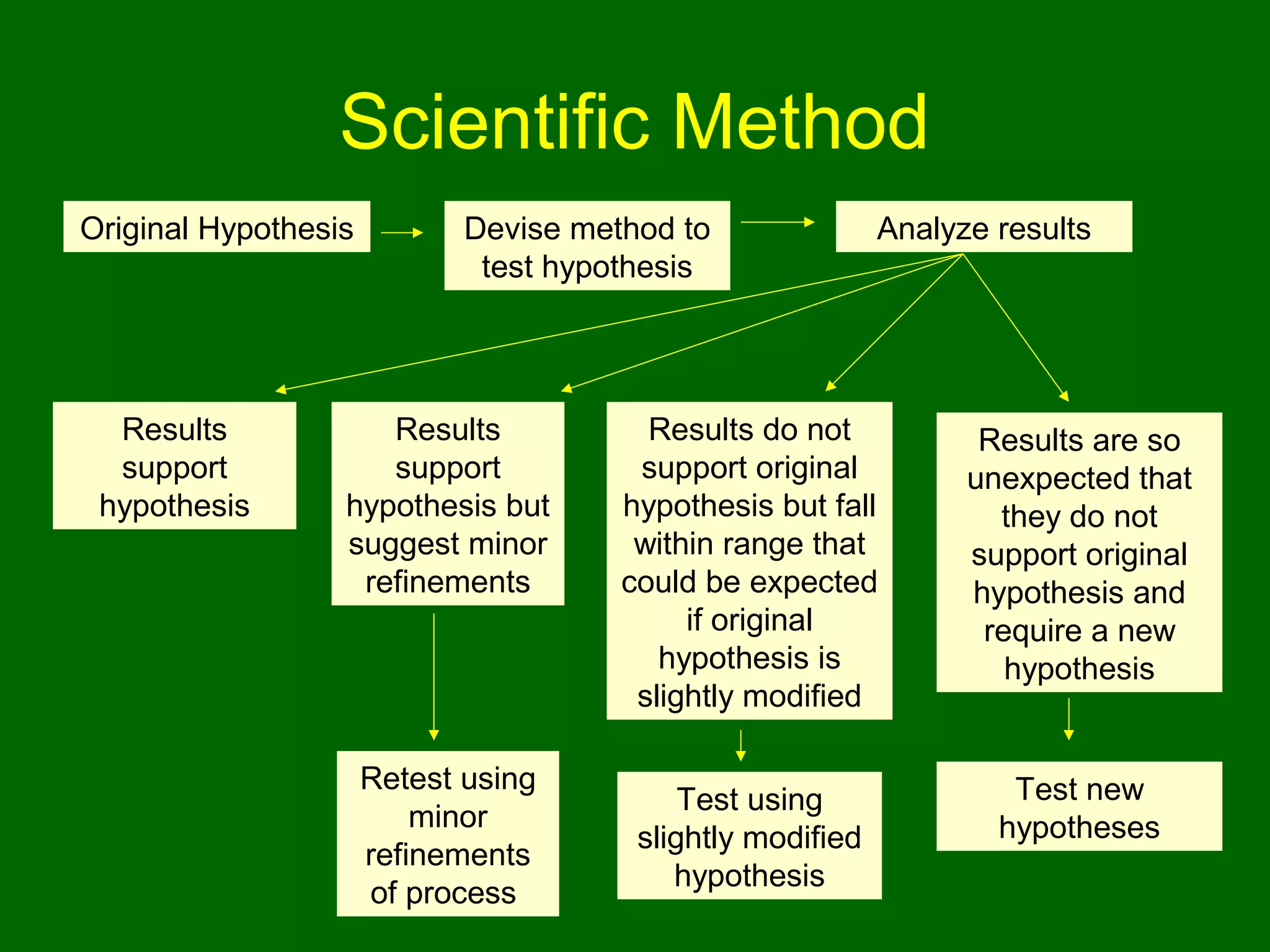
Scientific Method
Original Hypothesis          Devise method to               Analyze results
                              test hypothesis


  Results            Results             Results do not            Results are so
  support            support            support original          unexpected that
 hypothesis       hypothesis but       hypothesis but fall          they do not
                  suggest minor         within range that         support original
                   refinements         could be expected          hypothesis and
                                            if original            require a new
                                          hypothesis is              hypothesis
                                        slightly modified

                      Retest using                                   Test new
                                            Test using
                          minor                                     hypotheses
                                        slightly modified
                      refinements
                                           hypothesis
                      of process
Studying Plants From Different
           Perspectives
• Plant genetics – study of plant heredity
• Plant systematics – study of plant evolution and
  classification
• Plant ecology – study of how the environment
  affects plant organisms
• Plant anatomy – study of a plant’s internal
  structure
• Plant morphology – study of how a plant
  develops from a single cell into its diverse
  tissues and organs
Study Plants from Taxonomic
             Classification
•   Microbiology – study of bacteria
•   Mycology – study of fungi
•   Phycology – study of algae
•   Bryology – study of mosses
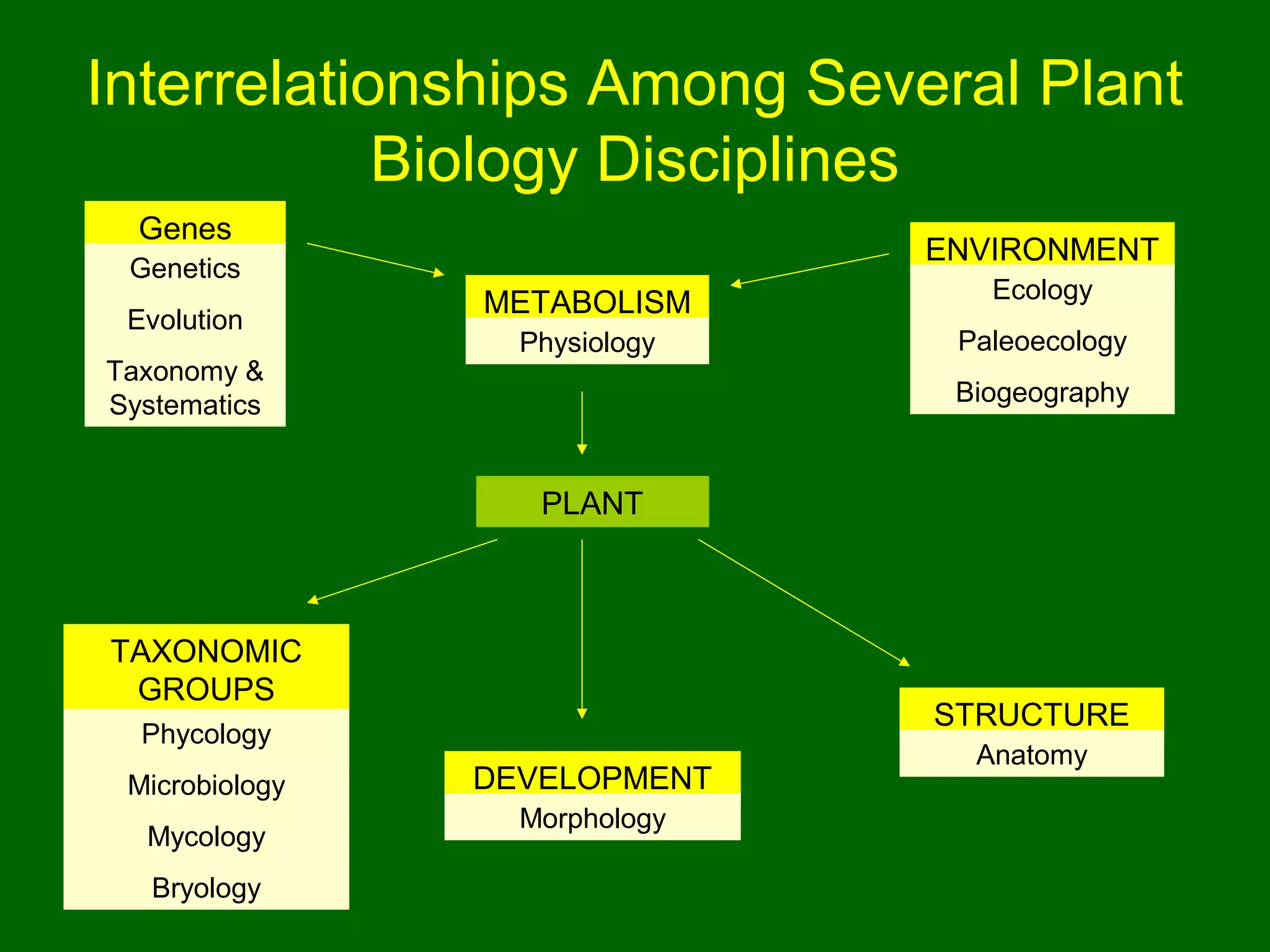
Interrelationships Among Several Plant
            Biology Disciplines
  Genes
                               ENVIRONMENT
 Genetics
                METABOLISM        Ecology
 Evolution
                  Physiology    Paleoecology
Taxonomy &
Systematics                     Biogeography


                   PLANT


TAXONOMIC
 GROUPS
                               STRUCTURE
  Phycology
                                 Anatomy
 Microbiology   DEVELOPMENT
                  Morphology
  Mycology
   Bryology
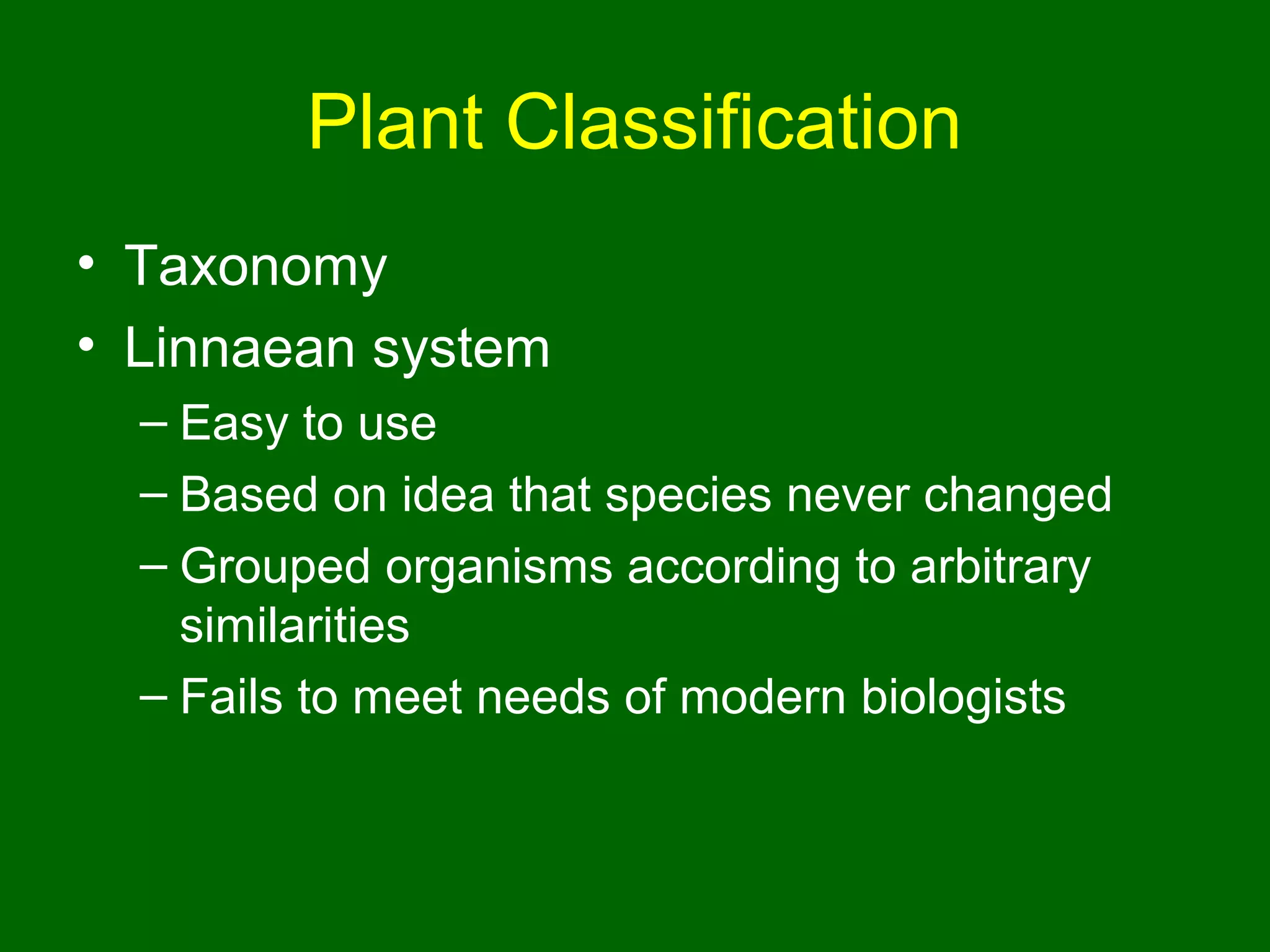
Plant Classification
• Taxonomy
• Linnaean system
  – Easy to use
  – Based on idea that species never changed
  – Grouped organisms according to arbitrary
    similarities
  – Fails to meet needs of modern biologists
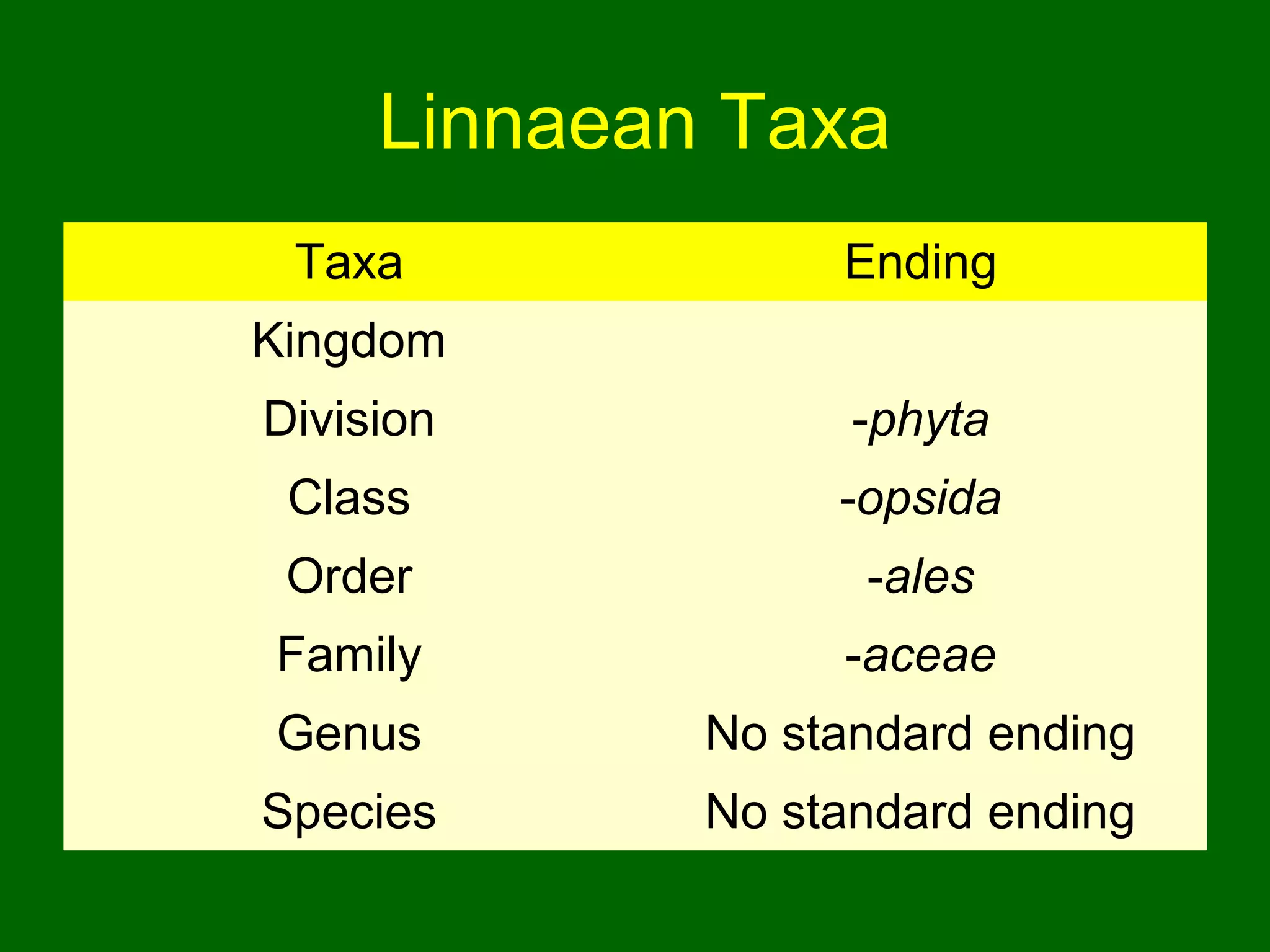
Linnaean Taxa
 Taxa             Ending
Kingdom
Division           -phyta
 Class            -opsida
 Order             -ales
Family            -aceae
Genus        No standard ending
Species      No standard ending
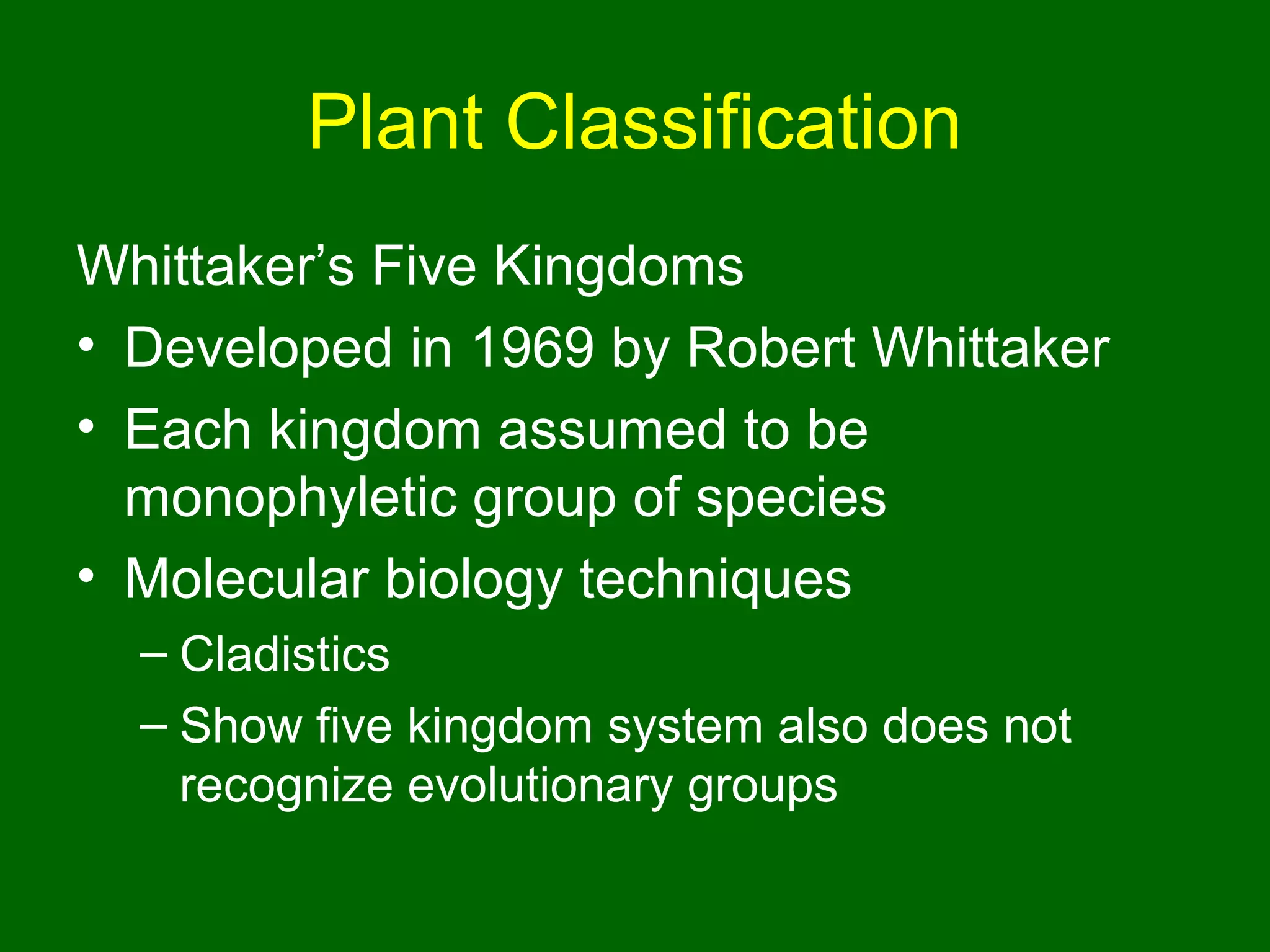
Plant Classification
Whittaker’s Five Kingdoms
• Developed in 1969 by Robert Whittaker
• Each kingdom assumed to be
  monophyletic group of species
• Molecular biology techniques
  – Cladistics
  – Show five kingdom system also does not
    recognize evolutionary groups
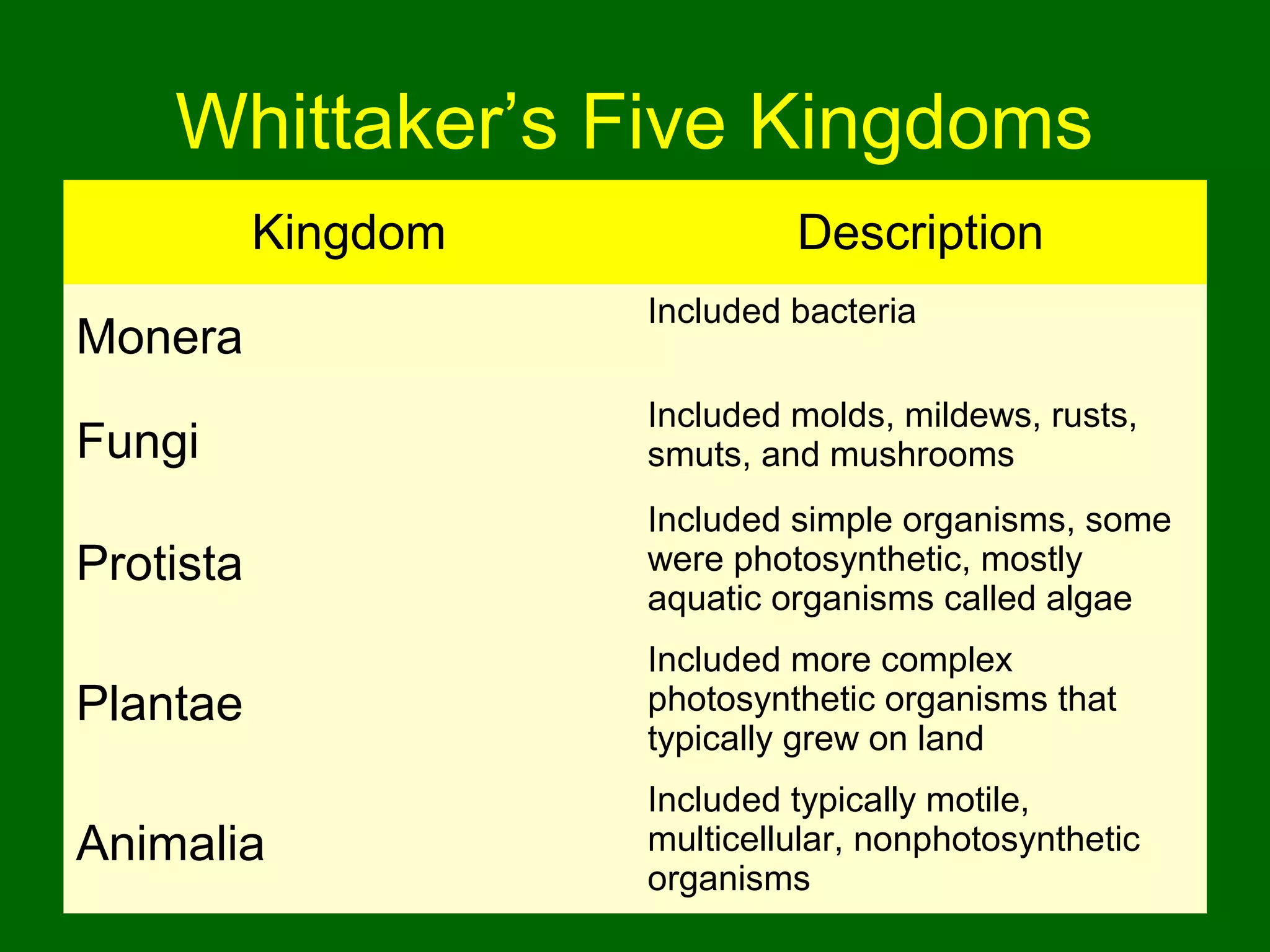
Whittaker’s Five Kingdoms
           Kingdom            Description
                     Included bacteria
Monera
                     Included molds, mildews, rusts,
Fungi                smuts, and mushrooms
                     Included simple organisms, some
Protista             were photosynthetic, mostly
                     aquatic organisms called algae
                     Included more complex
Plantae              photosynthetic organisms that
                     typically grew on land
                     Included typically motile,
Animalia             multicellular, nonphotosynthetic
                     organisms
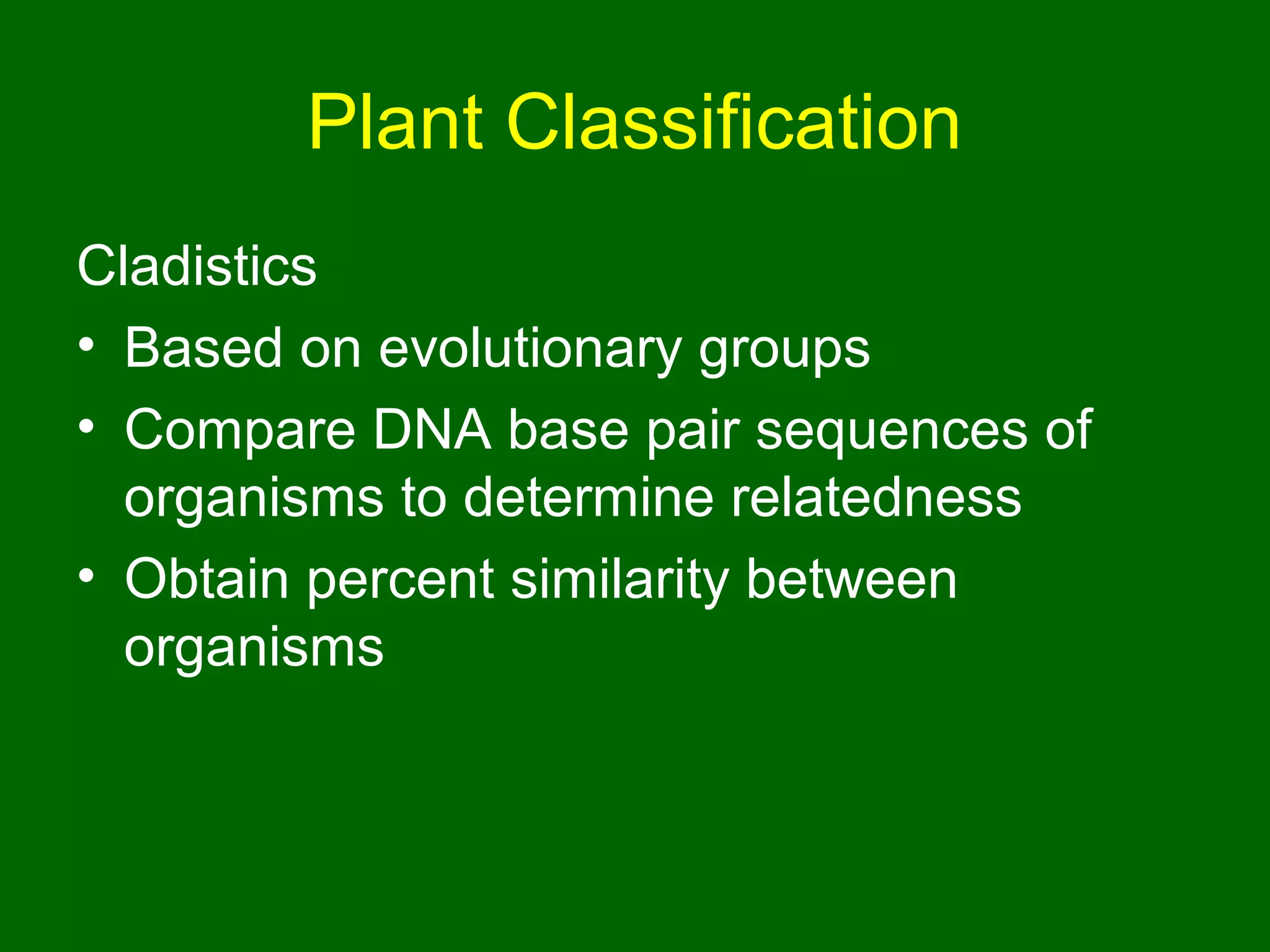
Plant Classification
Cladistics
• Based on evolutionary groups
• Compare DNA base pair sequences of
  organisms to determine relatedness
• Obtain percent similarity between
  organisms
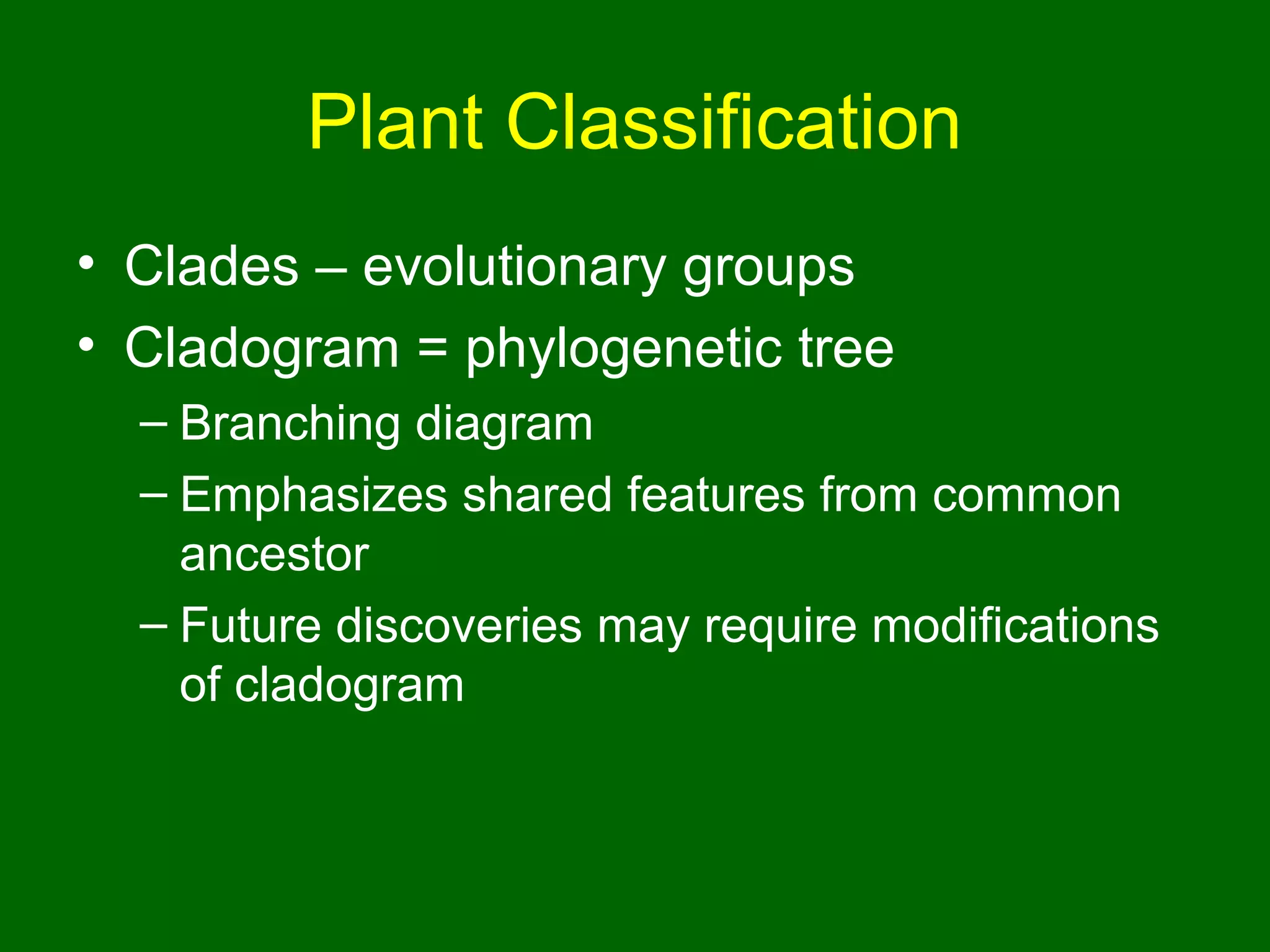
Plant Classification
• Clades – evolutionary groups
• Cladogram = phylogenetic tree
  – Branching diagram
  – Emphasizes shared features from common
    ancestor
  – Future discoveries may require modifications
    of cladogram
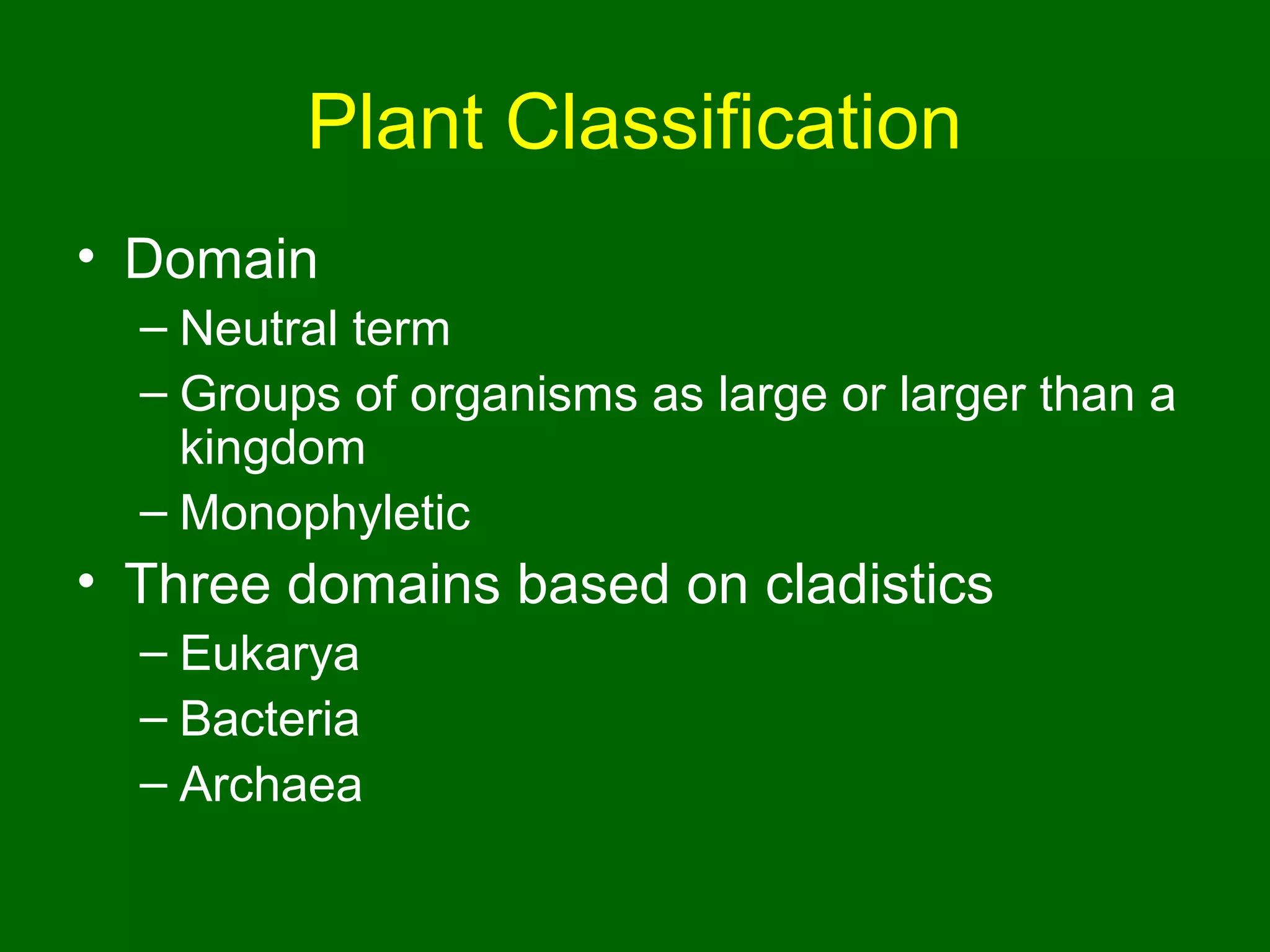
Plant Classification
• Domain
  – Neutral term
  – Groups of organisms as large or larger than a
    kingdom
  – Monophyletic
• Three domains based on cladistics
  – Eukarya
  – Bacteria
  – Archaea
Domain Eukarya
• Made up of Whittaker’s plant, animal, and
  fungal kingdoms
• Eukaryotic cells
  – Membrane-bounded organelles
• Linear chromosomes
• Protists
  – Not monophyletic
  – Controversy over where to place organisms
Domain Bacteria
• Organisms originally were placed in
  Whittaker’s Kingdom Monera
• Microscopic
• Prokaryotic cells
  – No membrane-bounded organelles
  – Circular chromosome
• Sexual reproduction unknown
• Found in every habitat on Earth
Domain Bacteria
Beneficial aspects
• Decomposers
• Some carry on photosynthesis
  – Cyanobacteria or blue-green algae
• Nitrogen fixation
  – Convert inorganic N2 into ammonium for plant
    use
  – Cyanobacteria
Domain Bacteria
Detrimental effects
• Pathogens – cause diseases
• Human diseases
  – Botulism, bubonic plague, cholera, syphilis,
    tetanus, tuberculosis
• Plant diseases
Domain Archaea
• Organisms originally were placed in
  Whittaker’s Kingdom Monera
• Prokaryotic
• Different cell structure and chemistry than
  organisms in Domain Bacteria
Domain Archaea
Divided into three groups based on habitat
• Bacteria of sulfur-rich anaerobic hot
  springs and deep ocean hydrothermal
  vents
• Bacteria of anaerobic swamps and termite
  intestines
• Bacteria of extremely saline waters
  – Extreme halophiles
  – Photosynthetic – pigment bacteriorhodopsin
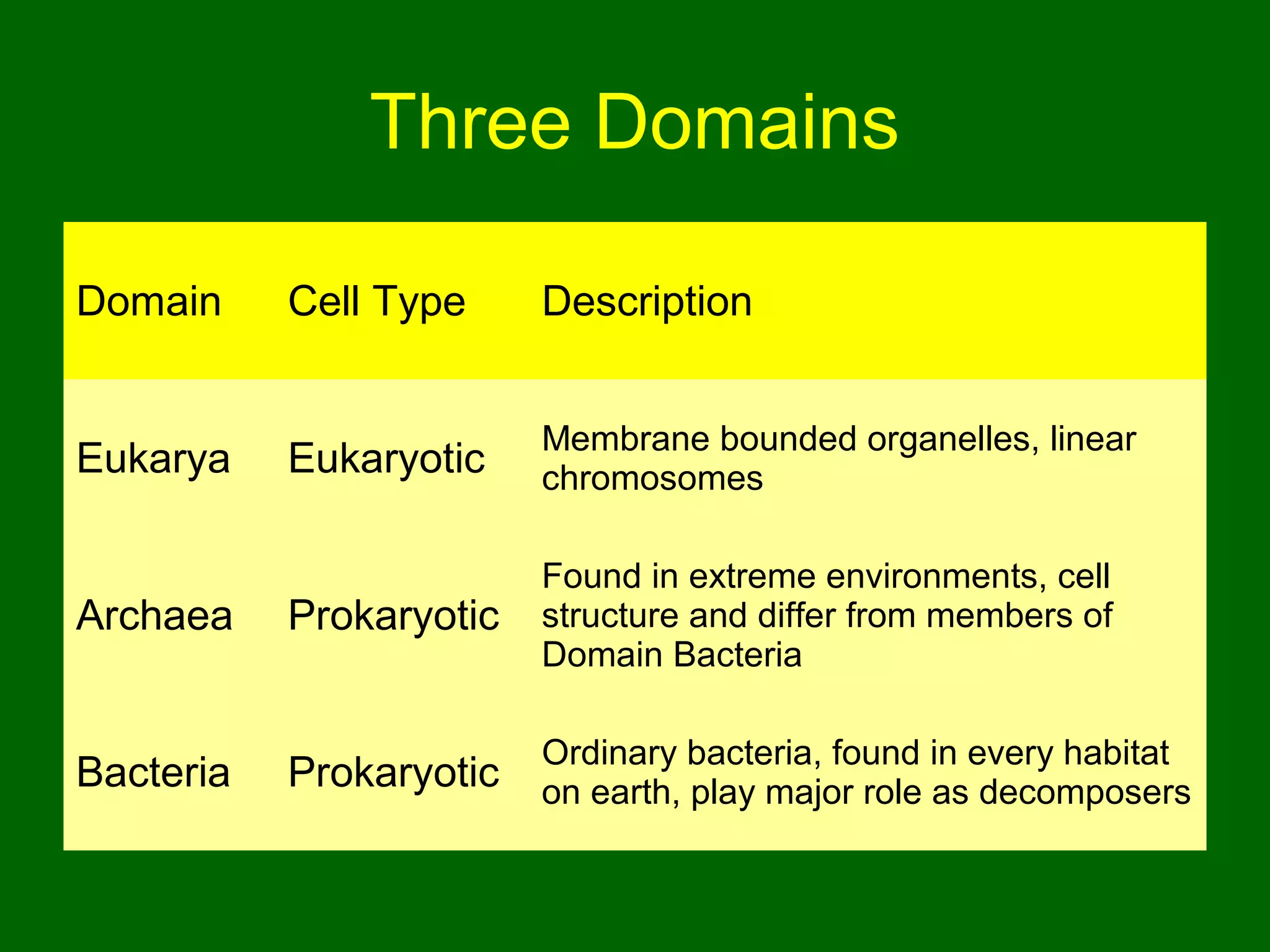
Three Domains

Domain     Cell Type     Description


                         Membrane bounded organelles, linear
Eukarya    Eukaryotic    chromosomes

                         Found in extreme environments, cell
Archaea    Prokaryotic   structure and differ from members of
                         Domain Bacteria

                         Ordinary bacteria, found in every habitat
Bacteria   Prokaryotic   on earth, play major role as decomposers
Kingdom Fungi
• Eukaryotic cells
• Typically microscopic and filamentous
• Rigid cell wall made of chitin
• Reproduce sexually in a variety of
  complex life cycles and spores
• Widely distributed throughout world –
  mainly terrestrial
Kingdom Fungi
Economic importance
• Decomposers
• Form associations with roots of plants
• Important foods for animals and humans
  – Mushrooms, morels
• Decomposing action of yeast
  – Flavored cheeses, leavened bread, alcoholic
    beverages
Kingdom Fungi
Economic importance
• Production of antibiotics
  – Penicillium
• Pathogens
  – Invade both plant and animal tissue
  – Cause illnesses
  – Reduce crop yields
Kingdom Protista
• Eukaryotic cells
• Reproduce both sexually and asexually
• Catch-all group
  – Photosynthetic organisms – algae
  – Nonphotosynthetic organisms – slime molds,
    foraminiferans, protozoans
Kingdom Protista
Algae
• Arrangements
  – Single cells, clusters, filaments, sheets, three-
    dimensional packets of cells
• Photosynthetic
• Float in uppermost layers of all oceans
  and lakes
Kingdom Protista
• Phytoplankton
  – “grasses of the sea”
  – Microscopic algae
  – Form base of natural food chain
  – Produce 50% of all oxygen in atmosphere
Kingdom Plantae
• Included all organisms informally called
  plants
• Bodies more complex than bacteria, fungi,
  or protists
• Eukaryotic
Kingdom Plantae
• Unique biochemical traits of plants
  – Cell walls composed of cellulose
  – Accumulate starch as carbohydrate storage
    product
  – Special types of chlorophylls and other
    pigments
Kingdom Plantae
Ecologic and economic importance of plants
• Form base of terrestrial food chains
• Principal human crops
• Provide building materials, clothing,
  cordage, medicines, and beverages
Challenge for 21 Century
                           st


While the human population increases, the
 major challenge of retaining natural
 biological diversity and developing a
 sustainable use of the world’s forests,
 grasslands, and cropland remains. As
 you study plant biology, think of the ways
 that you can contribute to this challenge.

Chapter1

  • 1.
  • 2.
    Why Study PlantBiology? • Show interrelationships between plants and other fields of study • Prepare for careers in plant biology • Gain fundamental knowledge for upper division plant biology courses • Share expertise gained with nonbotanists
  • 3.
    What is aPlant? • An organism that is green and photosynthetic • Additional characteristics – Cell wall composed of cellulose – Multicellular body – Can control water loss – Have strengthening tissues – Can reproduce by means of microscopic, drought-resistant spores
  • 4.
    Ecologic Services • Sourcesof food, fabric, shelter, medicine • Produce atmospheric oxygen and organic nitrogen • Build new land • Inhibit erosion • Control atmospheric temperature • Decompose and cycle essential mineral nutrients
  • 5.
    Importance of Plantsto Human Civilizations • Trees for lumber to make warships • Fuel to smelt metals, cure pottery, generate power and heat • Sources of wealth – spices • Sources of industrial products – Rubber – oil
  • 6.
    Natural Plant Losses •Plant losses occurring at a faster rate than ever before • Factors include – Agriculture – Urbanization – Overgrazing – Pollution – Extinction
  • 7.
    Environmental Laws • Describedin 1961 by plant biologist Barry Commoner • Laws becoming more true every day • Four “environmental laws” – Everything is connected to everything else. – Everything must go somewhere. – Nature knows best. – There is no such thing as a free lunch.
  • 8.
    Scientific Method • Codefinedand promoted in 17th century by Rene Decartes and Francis Bacon • Steps involved in scientific method – Make observations – Ask questions – Make educated guesses about possible answers – Base predictions on the guesses – Devise ways to test predictions – Draw conclusions
  • 9.
    Scientific Method • Hypothesis– “educated guess” based on observations and questioning • Predicted result occurs – hypothesis is most likely correct • Individuals using scientific method should be objective and unbiased
  • 10.
    Scientific Method Original Hypothesis Devise method to Analyze results test hypothesis Results Results Results do not Results are so support support support original unexpected that hypothesis hypothesis but hypothesis but fall they do not suggest minor within range that support original refinements could be expected hypothesis and if original require a new hypothesis is hypothesis slightly modified Retest using Test new Test using minor hypotheses slightly modified refinements hypothesis of process
  • 11.
    Studying Plants FromDifferent Perspectives • Plant genetics – study of plant heredity • Plant systematics – study of plant evolution and classification • Plant ecology – study of how the environment affects plant organisms • Plant anatomy – study of a plant’s internal structure • Plant morphology – study of how a plant develops from a single cell into its diverse tissues and organs
  • 12.
    Study Plants fromTaxonomic Classification • Microbiology – study of bacteria • Mycology – study of fungi • Phycology – study of algae • Bryology – study of mosses
  • 13.
    Interrelationships Among SeveralPlant Biology Disciplines Genes ENVIRONMENT Genetics METABOLISM Ecology Evolution Physiology Paleoecology Taxonomy & Systematics Biogeography PLANT TAXONOMIC GROUPS STRUCTURE Phycology Anatomy Microbiology DEVELOPMENT Morphology Mycology Bryology
  • 14.
    Plant Classification • Taxonomy •Linnaean system – Easy to use – Based on idea that species never changed – Grouped organisms according to arbitrary similarities – Fails to meet needs of modern biologists
  • 15.
    Linnaean Taxa Taxa Ending Kingdom Division -phyta Class -opsida Order -ales Family -aceae Genus No standard ending Species No standard ending
  • 16.
    Plant Classification Whittaker’s FiveKingdoms • Developed in 1969 by Robert Whittaker • Each kingdom assumed to be monophyletic group of species • Molecular biology techniques – Cladistics – Show five kingdom system also does not recognize evolutionary groups
  • 17.
    Whittaker’s Five Kingdoms Kingdom Description Included bacteria Monera Included molds, mildews, rusts, Fungi smuts, and mushrooms Included simple organisms, some Protista were photosynthetic, mostly aquatic organisms called algae Included more complex Plantae photosynthetic organisms that typically grew on land Included typically motile, Animalia multicellular, nonphotosynthetic organisms
  • 18.
    Plant Classification Cladistics • Basedon evolutionary groups • Compare DNA base pair sequences of organisms to determine relatedness • Obtain percent similarity between organisms
  • 19.
    Plant Classification • Clades– evolutionary groups • Cladogram = phylogenetic tree – Branching diagram – Emphasizes shared features from common ancestor – Future discoveries may require modifications of cladogram
  • 20.
    Plant Classification • Domain – Neutral term – Groups of organisms as large or larger than a kingdom – Monophyletic • Three domains based on cladistics – Eukarya – Bacteria – Archaea
  • 21.
    Domain Eukarya • Madeup of Whittaker’s plant, animal, and fungal kingdoms • Eukaryotic cells – Membrane-bounded organelles • Linear chromosomes • Protists – Not monophyletic – Controversy over where to place organisms
  • 22.
    Domain Bacteria • Organismsoriginally were placed in Whittaker’s Kingdom Monera • Microscopic • Prokaryotic cells – No membrane-bounded organelles – Circular chromosome • Sexual reproduction unknown • Found in every habitat on Earth
  • 23.
    Domain Bacteria Beneficial aspects •Decomposers • Some carry on photosynthesis – Cyanobacteria or blue-green algae • Nitrogen fixation – Convert inorganic N2 into ammonium for plant use – Cyanobacteria
  • 24.
    Domain Bacteria Detrimental effects •Pathogens – cause diseases • Human diseases – Botulism, bubonic plague, cholera, syphilis, tetanus, tuberculosis • Plant diseases
  • 25.
    Domain Archaea • Organismsoriginally were placed in Whittaker’s Kingdom Monera • Prokaryotic • Different cell structure and chemistry than organisms in Domain Bacteria
  • 26.
    Domain Archaea Divided intothree groups based on habitat • Bacteria of sulfur-rich anaerobic hot springs and deep ocean hydrothermal vents • Bacteria of anaerobic swamps and termite intestines • Bacteria of extremely saline waters – Extreme halophiles – Photosynthetic – pigment bacteriorhodopsin
  • 27.
    Three Domains Domain Cell Type Description Membrane bounded organelles, linear Eukarya Eukaryotic chromosomes Found in extreme environments, cell Archaea Prokaryotic structure and differ from members of Domain Bacteria Ordinary bacteria, found in every habitat Bacteria Prokaryotic on earth, play major role as decomposers
  • 28.
    Kingdom Fungi • Eukaryoticcells • Typically microscopic and filamentous • Rigid cell wall made of chitin • Reproduce sexually in a variety of complex life cycles and spores • Widely distributed throughout world – mainly terrestrial
  • 29.
    Kingdom Fungi Economic importance •Decomposers • Form associations with roots of plants • Important foods for animals and humans – Mushrooms, morels • Decomposing action of yeast – Flavored cheeses, leavened bread, alcoholic beverages
  • 30.
    Kingdom Fungi Economic importance •Production of antibiotics – Penicillium • Pathogens – Invade both plant and animal tissue – Cause illnesses – Reduce crop yields
  • 31.
    Kingdom Protista • Eukaryoticcells • Reproduce both sexually and asexually • Catch-all group – Photosynthetic organisms – algae – Nonphotosynthetic organisms – slime molds, foraminiferans, protozoans
  • 32.
    Kingdom Protista Algae • Arrangements – Single cells, clusters, filaments, sheets, three- dimensional packets of cells • Photosynthetic • Float in uppermost layers of all oceans and lakes
  • 33.
    Kingdom Protista • Phytoplankton – “grasses of the sea” – Microscopic algae – Form base of natural food chain – Produce 50% of all oxygen in atmosphere
  • 34.
    Kingdom Plantae • Includedall organisms informally called plants • Bodies more complex than bacteria, fungi, or protists • Eukaryotic
  • 35.
    Kingdom Plantae • Uniquebiochemical traits of plants – Cell walls composed of cellulose – Accumulate starch as carbohydrate storage product – Special types of chlorophylls and other pigments
  • 36.
    Kingdom Plantae Ecologic andeconomic importance of plants • Form base of terrestrial food chains • Principal human crops • Provide building materials, clothing, cordage, medicines, and beverages
  • 37.
    Challenge for 21Century st While the human population increases, the major challenge of retaining natural biological diversity and developing a sustainable use of the world’s forests, grasslands, and cropland remains. As you study plant biology, think of the ways that you can contribute to this challenge.