Global System for Mobile  Communication (GSM) and  Basic Cellular Network Concept Submitted by: Anoop William
INTRODUCTION Stands for Global System for Mobile Communications  Developed in 1991 it is one of the most popular standard for mobile phone communication in the world today(mainly is Europe and Asia).  It’s the standard used in most of India like Airtel, Idea, Hutch etc Advantages low terminal and service cost,  support for international roaming,  ISDN ( Integrated Services Digital Network)   compatibility  support for range of new services and facilities,  spectral efficiency `
Some cellular phone concepts To start with, one of the most interesting things about a cell phone is that it is actually a radio -- an extremely sophisticated radio, but a radio nonetheless  A cell phone is a full-duplex device. That means that you use one frequency for talking and a second, separate frequency for listening. Both people on the call can talk at once. (walkie-talkies and CB radios are half duplex system)
ARCHITECTURE The architecture of the GSM system with its hardware can broadly be grouped into three main areas:  1)The Mobile Station  (carried by the subscriber)   2)The Base Station Subsystem  (controls the radio link with the Mobile Station) 3)The Network Subsystem  ( Switching Center, performs the switching of calls between the mobile and other fixed or mobile network users, as well as management of mobile services, such as authentication )
MOBILE STATION Mobile stations (MS), mobile equipment (ME) or as they are most widely known, cell or mobile phones are the section of a GSM cellular network that the user sees and operates.  There are a number of elements to the cell phone, although the two main elements are the  main hardware  and the  SIM . Main Hardware :  The hardware itself contains the main elements of the mobile phone including the display, case, battery, and the electronics used to generate the signal, and process the data receiver and to be transmitted.  It also contains a number known as the  International Mobile Equipment Identity (IMEI).  This is installed in the phone at manufacture and "cannot" be changed. It is accessed by the network during registration to check whether the equipment has been reported as stolen . The SIM or Subscriber Identity Module:  It contains the information that provides the identity of the user to the network. It contains are variety of information including a number known as the  International Mobile Subscriber Identity (IMSI).
Base Station Subsystem The Base Station Subsystem (BSS)  section of the GSM network is fundamentally associated with communicating with the mobiles on the network.  It consists of two elements, namely the  Base Transceiver Station (BTS)  and the  Base Station Controller (BSC). Base Transceiver Station (BTS): The BTS used in a GSM network comprises the radio transmitter receivers, and their associated antennas that transmit and receive to directly communicate with the mobiles. The BTS is the defining element for each cell.  Base Station Controller (BSC): The BSC forms the next stage in the GSM network. It controls a group of BTSs, and is often co-located with one of the BTSs in its group. It manages the radio resources and controls items such as handover within the group of BTSs, channels and the like  The BSC is the connection between the mobile and the  Mobile service Switching Center (MSC).  
NETWORK SUBSYSTEM The central component of the Network Subsystem is the  Mobile services Switching Center (MSC).    It acts like a normal switching node of ISDN, and in addition provides all the functionality needed to handle a mobile subscriber, such as registration, authentication, location updating, handovers, and call routing to a roaming subscriber.   The Home Location Register (HLR) and Visitor Location Register (VLR), together with the MSC, provide the call­routing and (possibly international) roaming capabilities of GSM  The HLR contains all the administrative information of each subscriber registered in the corresponding GSM network, along with the current location of the mobile. Logically its one HLR per GSM network.   The Visitor Location Register contains selected administrative information from the HLR, necessary for call control and provision of the subscribed services, for each mobile currently located in the geographical area controlled by the VLR. The geographical area controlled by  MSC corresponds to that controlled by the VLR
FREQUENCY REUSE A cell-phone carrier typically gets 832 radio frequencies to use in a city.  Each cell phone uses two frequencies per call -- a duplex channel -- so there are typically 395 voice channels per carrier. (The other 42 frequencies are used for control channels -- more on this later.)  Therefore, each cell has about 56 voice channels available. In other words, in any cell, 56 people can be talking on their cell phone at one time. The genius of the cellular system is the division of a city into small  cells . This allows extensive  frequency reuse  across a city, so that millions of people can use cell phones simultaneously.  A single cell uses one-seventh of the available duplex voice channels. That is, each cell (of the seven on a hexagonal grid) is using one-seventh of the available channels so it has a unique set of frequencies and there are no collisions
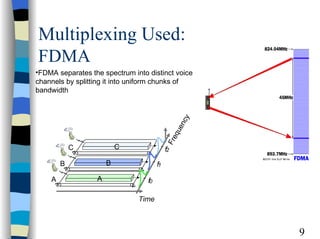
Multiplexing Used: FDMA FDMA separates the spectrum into distinct voice channels by splitting it into uniform chunks of bandwidth  A A B B C C Frequency Time f 2 f 1 f 0
TDMA Each conversation gets the radio for one-third of the time. This is possible because voice data that has been converted to digital information is compressed so that it takes up significantly less transmission space. Hence capacity becomes 3 times. In GSM mostly its divided into 8 time slots. C B A C B A C B A C B A C A B Time f 0 Frequency
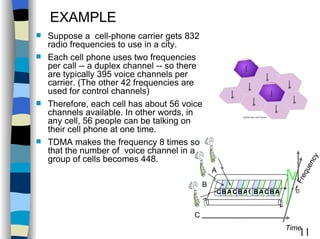
Suppose a  cell-phone carrier gets 832 radio frequencies to use in a city.  Each cell phone uses two frequencies per call -- a duplex channel -- so there are typically 395 voice channels per carrier. (The other 42 frequencies are used for control channels)  Therefore, each cell has about 56 voice channels available. In other words, in any cell, 56 people can be talking on their cell phone at one time.  TDMA makes the frequency 8 times so that the number of  voice channel in a group of cells becomes 448. EXAMPLE C B A C B A C B A C B A C A B Time f 0 Frequency
REFERENCE www.wikipedia.com/gsm www.howstuffwork.com/cellphone Overview of  GSM - by  John Scourias

My Seminar

  • 1.
    Global System forMobile Communication (GSM) and Basic Cellular Network Concept Submitted by: Anoop William
  • 2.
    INTRODUCTION Stands forGlobal System for Mobile Communications Developed in 1991 it is one of the most popular standard for mobile phone communication in the world today(mainly is Europe and Asia). It’s the standard used in most of India like Airtel, Idea, Hutch etc Advantages low terminal and service cost, support for international roaming, ISDN ( Integrated Services Digital Network) compatibility support for range of new services and facilities, spectral efficiency `
  • 3.
    Some cellular phoneconcepts To start with, one of the most interesting things about a cell phone is that it is actually a radio -- an extremely sophisticated radio, but a radio nonetheless A cell phone is a full-duplex device. That means that you use one frequency for talking and a second, separate frequency for listening. Both people on the call can talk at once. (walkie-talkies and CB radios are half duplex system)
  • 4.
    ARCHITECTURE The architectureof the GSM system with its hardware can broadly be grouped into three main areas: 1)The Mobile Station (carried by the subscriber) 2)The Base Station Subsystem (controls the radio link with the Mobile Station) 3)The Network Subsystem ( Switching Center, performs the switching of calls between the mobile and other fixed or mobile network users, as well as management of mobile services, such as authentication )
  • 5.
    MOBILE STATION Mobilestations (MS), mobile equipment (ME) or as they are most widely known, cell or mobile phones are the section of a GSM cellular network that the user sees and operates. There are a number of elements to the cell phone, although the two main elements are the main hardware and the SIM . Main Hardware : The hardware itself contains the main elements of the mobile phone including the display, case, battery, and the electronics used to generate the signal, and process the data receiver and to be transmitted. It also contains a number known as the International Mobile Equipment Identity (IMEI). This is installed in the phone at manufacture and "cannot" be changed. It is accessed by the network during registration to check whether the equipment has been reported as stolen . The SIM or Subscriber Identity Module: It contains the information that provides the identity of the user to the network. It contains are variety of information including a number known as the International Mobile Subscriber Identity (IMSI).
  • 6.
    Base Station SubsystemThe Base Station Subsystem (BSS) section of the GSM network is fundamentally associated with communicating with the mobiles on the network. It consists of two elements, namely the Base Transceiver Station (BTS) and the Base Station Controller (BSC). Base Transceiver Station (BTS): The BTS used in a GSM network comprises the radio transmitter receivers, and their associated antennas that transmit and receive to directly communicate with the mobiles. The BTS is the defining element for each cell. Base Station Controller (BSC): The BSC forms the next stage in the GSM network. It controls a group of BTSs, and is often co-located with one of the BTSs in its group. It manages the radio resources and controls items such as handover within the group of BTSs, channels and the like The BSC is the connection between the mobile and the Mobile service Switching Center (MSC).  
  • 7.
    NETWORK SUBSYSTEM Thecentral component of the Network Subsystem is the Mobile services Switching Center (MSC).   It acts like a normal switching node of ISDN, and in addition provides all the functionality needed to handle a mobile subscriber, such as registration, authentication, location updating, handovers, and call routing to a roaming subscriber.  The Home Location Register (HLR) and Visitor Location Register (VLR), together with the MSC, provide the call­routing and (possibly international) roaming capabilities of GSM The HLR contains all the administrative information of each subscriber registered in the corresponding GSM network, along with the current location of the mobile. Logically its one HLR per GSM network.   The Visitor Location Register contains selected administrative information from the HLR, necessary for call control and provision of the subscribed services, for each mobile currently located in the geographical area controlled by the VLR. The geographical area controlled by  MSC corresponds to that controlled by the VLR
  • 8.
    FREQUENCY REUSE Acell-phone carrier typically gets 832 radio frequencies to use in a city. Each cell phone uses two frequencies per call -- a duplex channel -- so there are typically 395 voice channels per carrier. (The other 42 frequencies are used for control channels -- more on this later.) Therefore, each cell has about 56 voice channels available. In other words, in any cell, 56 people can be talking on their cell phone at one time. The genius of the cellular system is the division of a city into small cells . This allows extensive frequency reuse across a city, so that millions of people can use cell phones simultaneously. A single cell uses one-seventh of the available duplex voice channels. That is, each cell (of the seven on a hexagonal grid) is using one-seventh of the available channels so it has a unique set of frequencies and there are no collisions
  • 9.
    Multiplexing Used: FDMAFDMA separates the spectrum into distinct voice channels by splitting it into uniform chunks of bandwidth A A B B C C Frequency Time f 2 f 1 f 0
  • 10.
    TDMA Each conversationgets the radio for one-third of the time. This is possible because voice data that has been converted to digital information is compressed so that it takes up significantly less transmission space. Hence capacity becomes 3 times. In GSM mostly its divided into 8 time slots. C B A C B A C B A C B A C A B Time f 0 Frequency
  • 11.
    Suppose a cell-phone carrier gets 832 radio frequencies to use in a city. Each cell phone uses two frequencies per call -- a duplex channel -- so there are typically 395 voice channels per carrier. (The other 42 frequencies are used for control channels) Therefore, each cell has about 56 voice channels available. In other words, in any cell, 56 people can be talking on their cell phone at one time. TDMA makes the frequency 8 times so that the number of voice channel in a group of cells becomes 448. EXAMPLE C B A C B A C B A C B A C A B Time f 0 Frequency
  • 12.