http://mac.citi.sinica.edu.tw/~yang/
yhyang@ailabs.tw
yang@citi.sinica.edu.tw
Yi-Hsuan Yang Ph.D. 1,2
1 Taiwan AI Labs
2 Research Center for IT Innovation, Academia Sinica
October 26, 2021
About Me
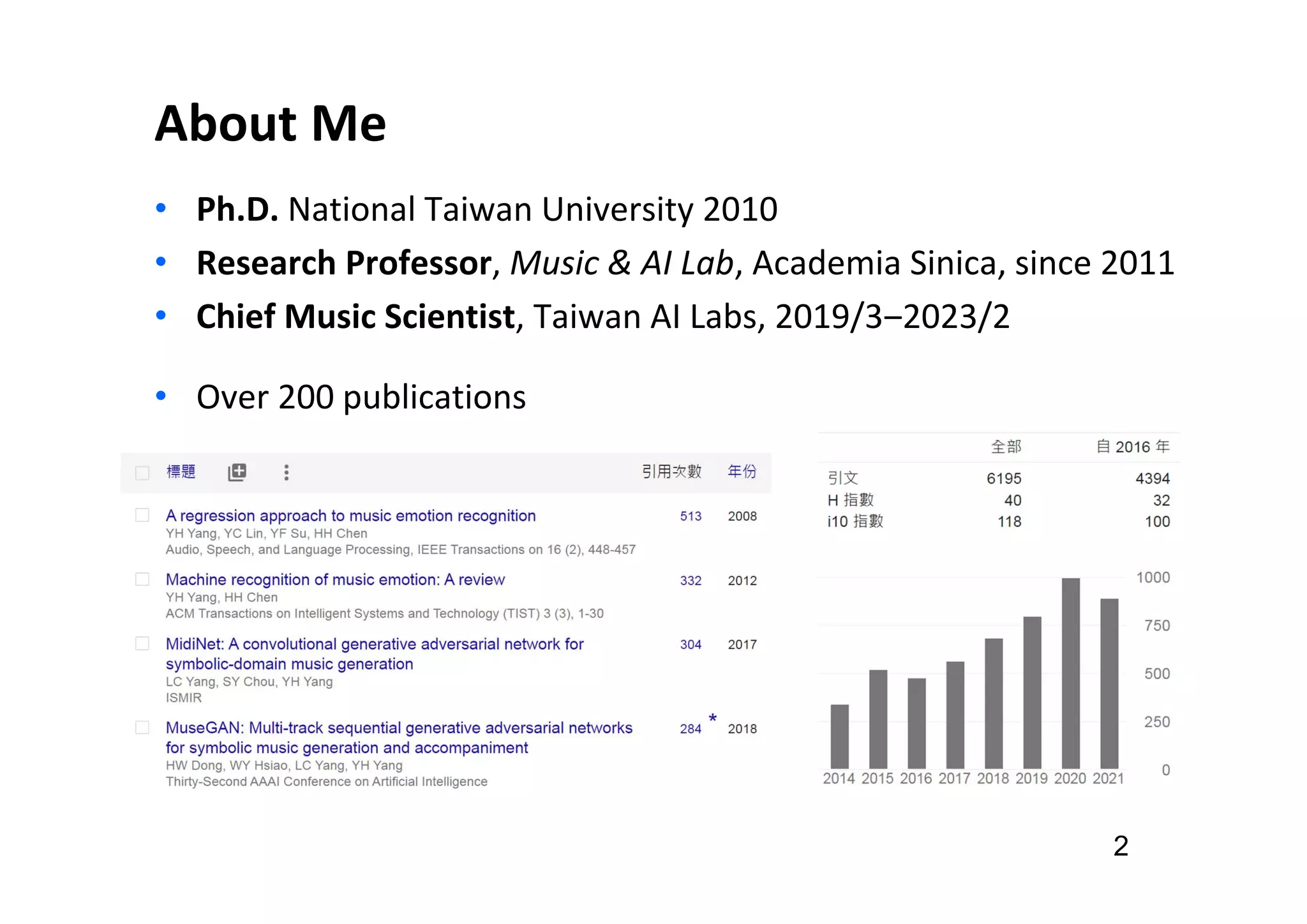
• Ph.D. National Taiwan University 2010
• Research Professor, Music & AI Lab, Academia Sinica, since 2011
• Chief Music Scientist, Taiwan AI Labs, 2019/3‒2023/2
• Over 200 publications
2
About the Music and AI Lab @ Sinica
About Academia Sinica
 National academy of Taiwan, founded in 1928
 About 1,000 Full/Associate/Assistant Researchers
About Music and AI Lab (musicai)
 Since Sep 2011
 Members
 PI [me]
 research assistants
 PhD/master students
3
About the Music AI Team @
About Taiwan AI Labs
 Privately-funded research organization,
founded by Ethan Tu (PTT) in 2017
 Three main research area: 1) HCI, 2) medicine, 3) smart city
About the Music AI team
 Members
 scientist [me; since March 2019]
 ML engineers (for models)
 musicians
 program manager
 software engineers (for frontend/backend)
4
(an image of our musicians)
Outline
• Types of music related research/products
• Fundamentals of music signal processing
• Types of data
9
Types of Music Related Research/Products
10
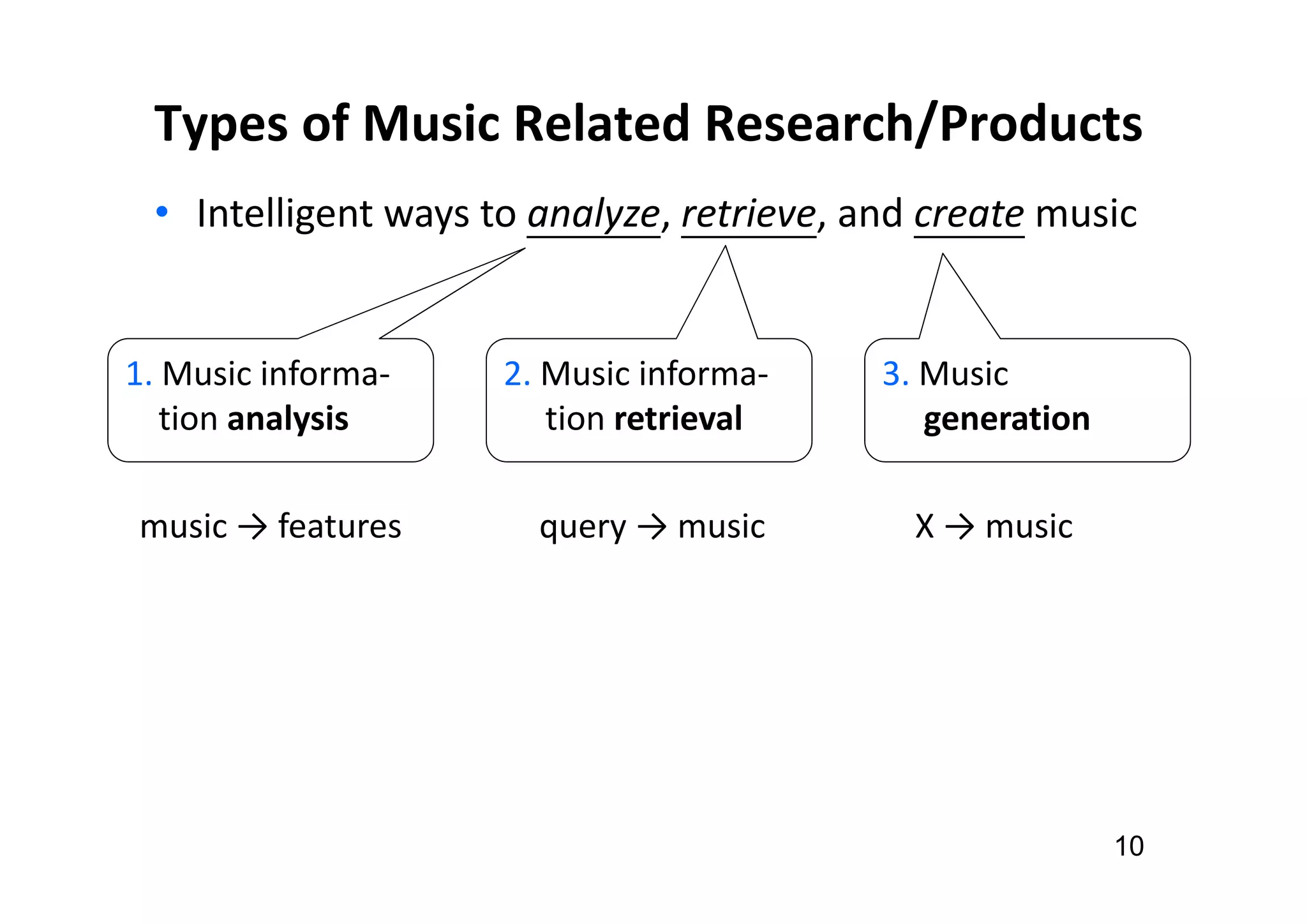
• Intelligent ways to analyze, retrieve, and create music
1. Music informa-
tion analysis
2. Music informa-
tion retrieval
3. Music
generation
music → features query → music X → music
Types of Music Related Research/Products
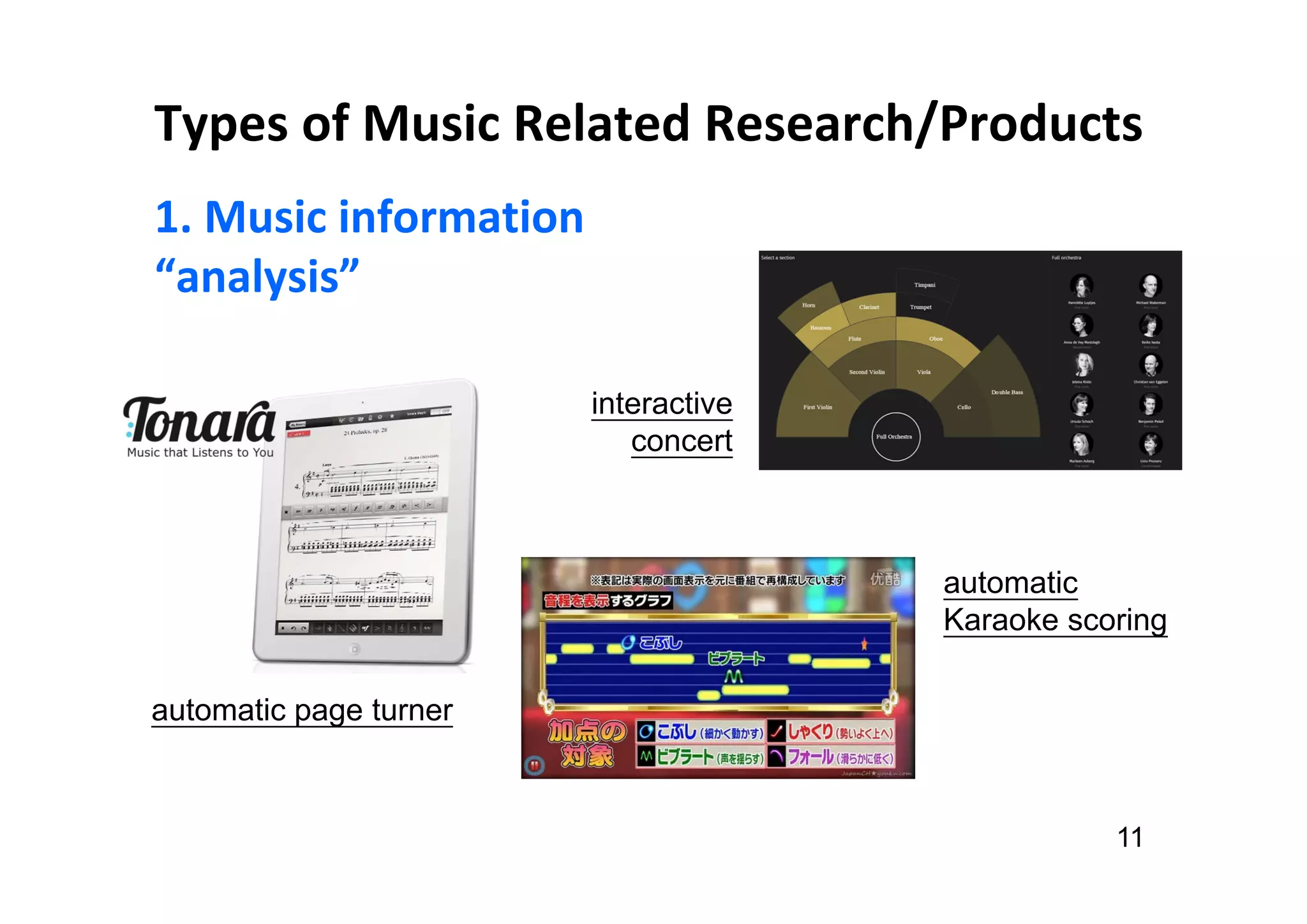
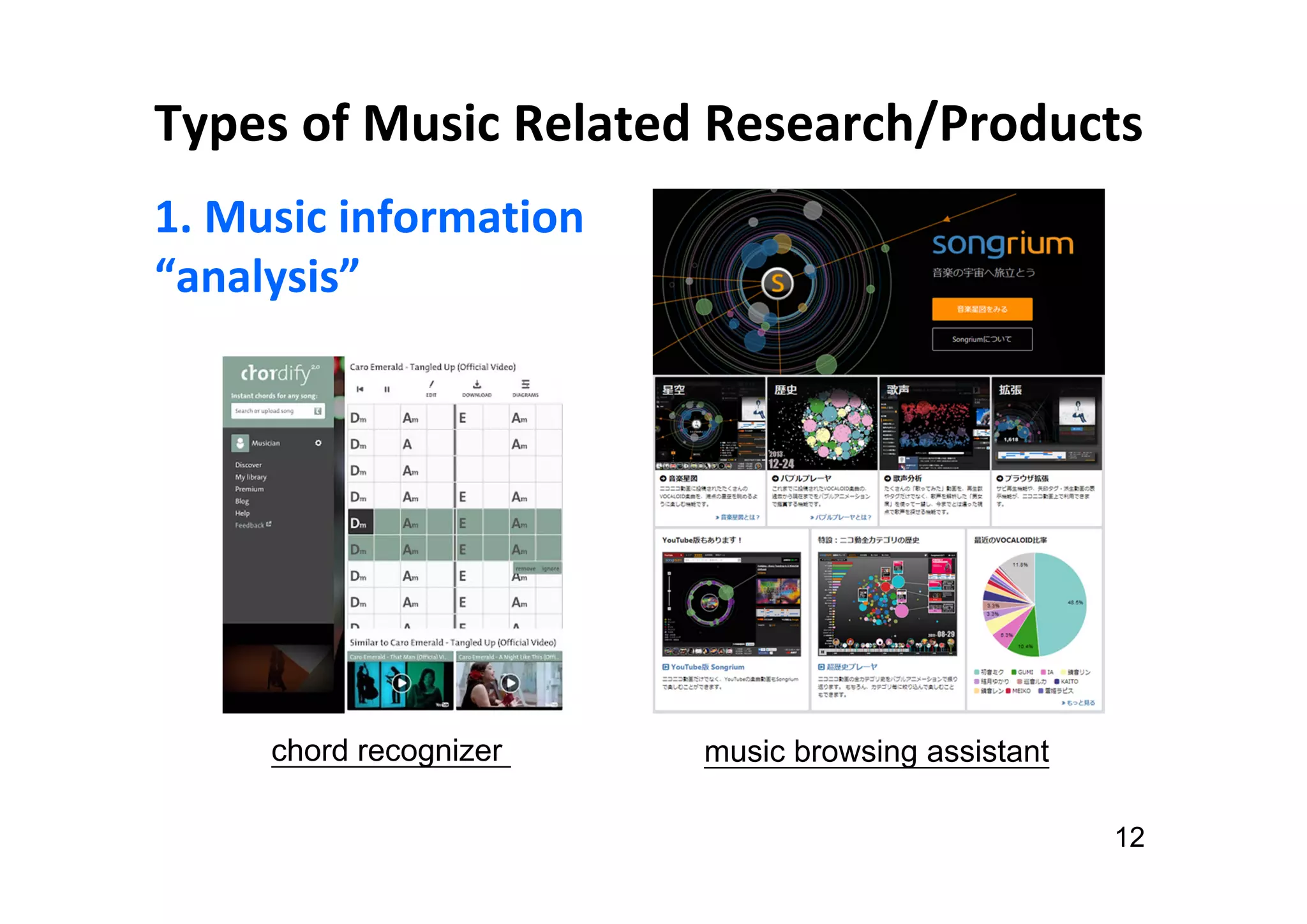
1. Music information
“analysis”
11
automatic page turner
automatic
Karaoke scoring
interactive
concert
Types of Music Related Research/Products
1. Music information
“analysis”
12
chord recognizer music browsing assistant
Types of Music Related Research/Products
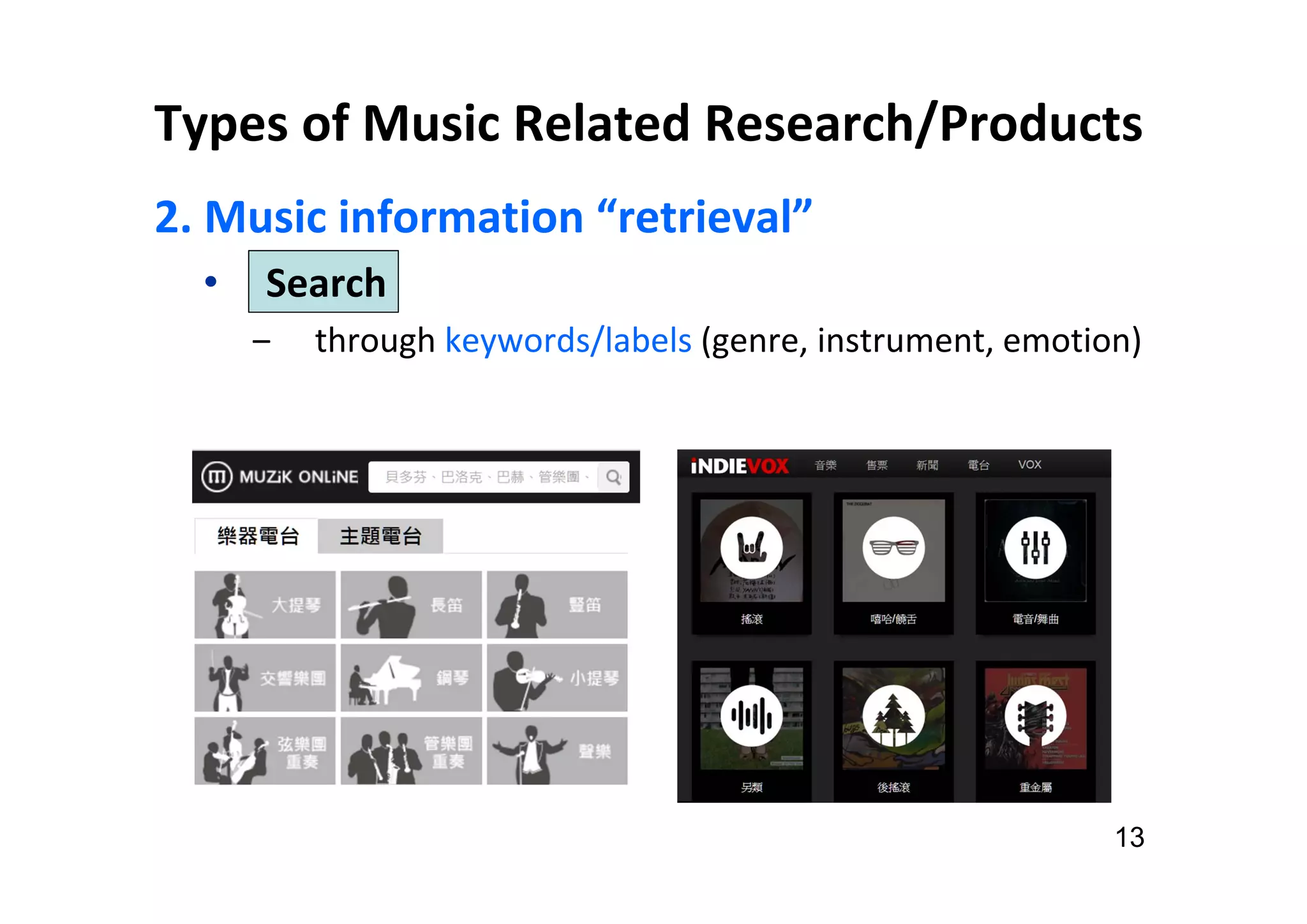
2. Music information “retrieval”
• Search
‒ through keywords/labels (genre, instrument, emotion)
13
Types of Music Related Research/Products
2. Music information “retrieval”
• Search
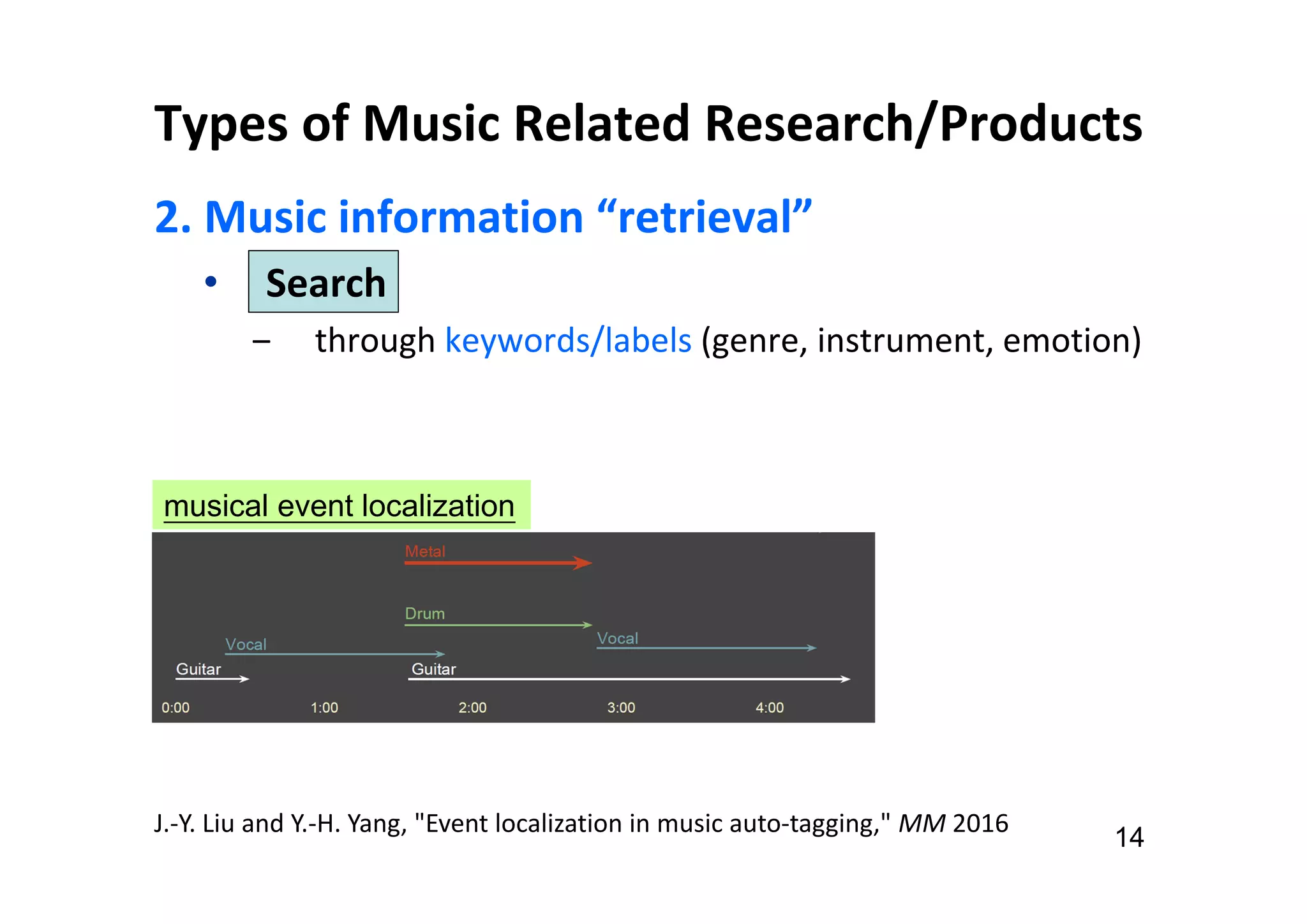
‒ through keywords/labels (genre, instrument, emotion)
14
musical event localization
J.-Y. Liu and Y.-H. Yang, "Event localization in music auto-tagging," MM 2016
Types of Music Related Research/Products
2. Music information “retrieval”
• Search
‒ through keywords/labels (genre, instrument, emotion)
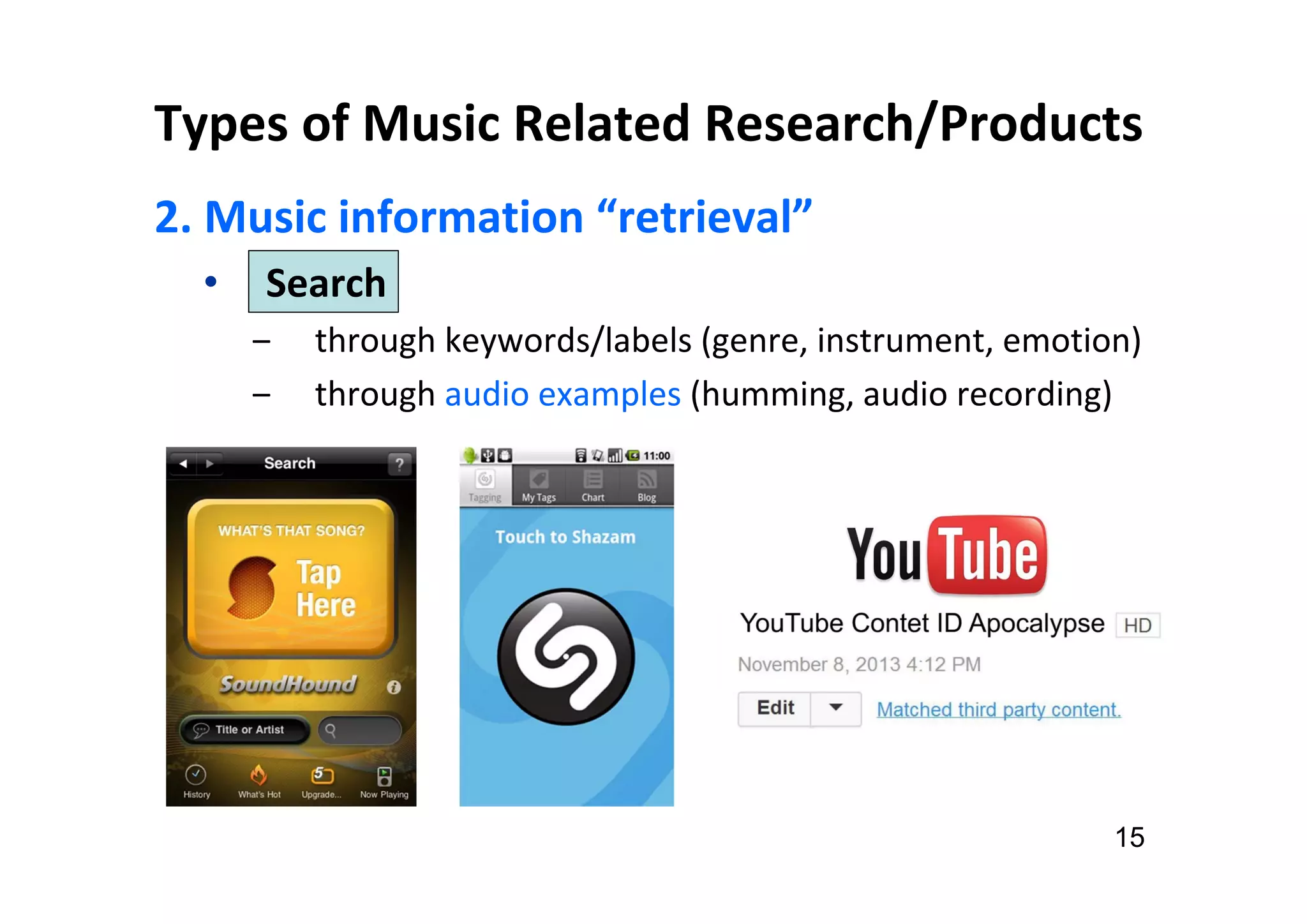
‒ through audio examples (humming, audio recording)
15
Types of Music Related Research/Products
2. Music information “retrieval”
• Search
‒ through keywords/labels (genre, instrument, emotion)
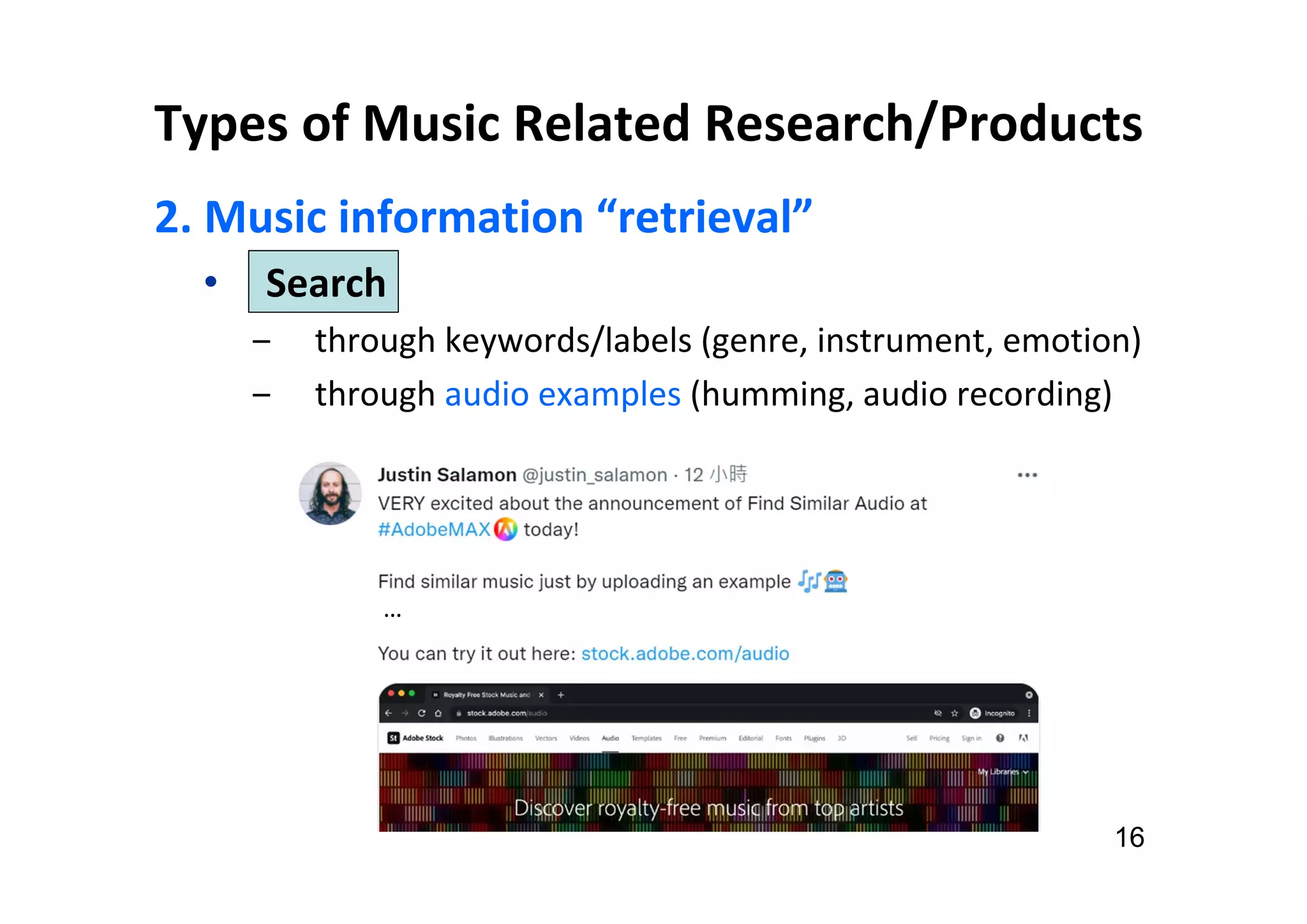
‒ through audio examples (humming, audio recording)
16
…
Types of Music Related Research/Products
2. Music information “retrieval”
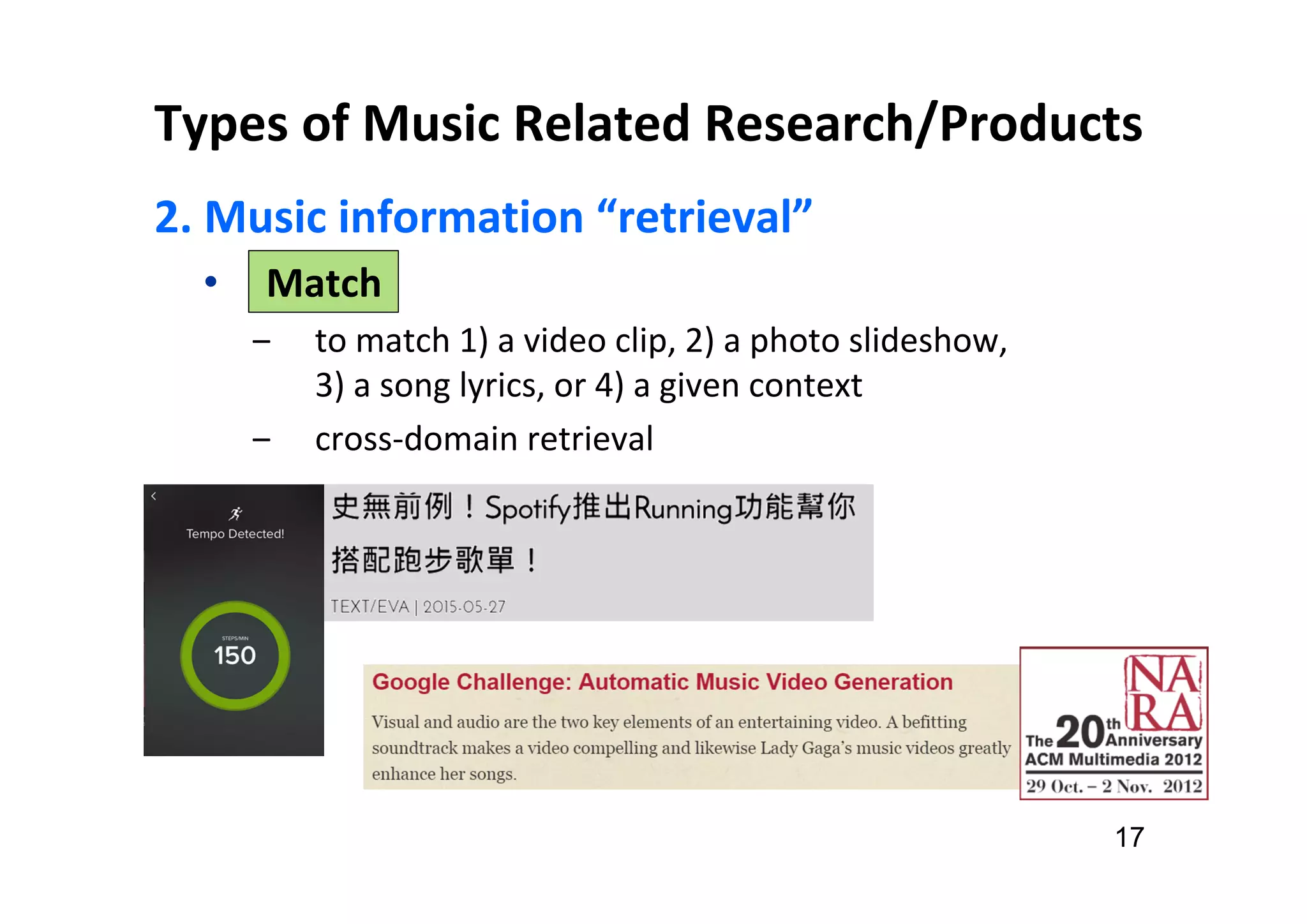
• Match
‒ to match 1) a video clip, 2) a photo slideshow,
3) a song lyrics, or 4) a given context
‒ cross-domain retrieval
17
Types of Music Related Research/Products
2. Music information “retrieval”
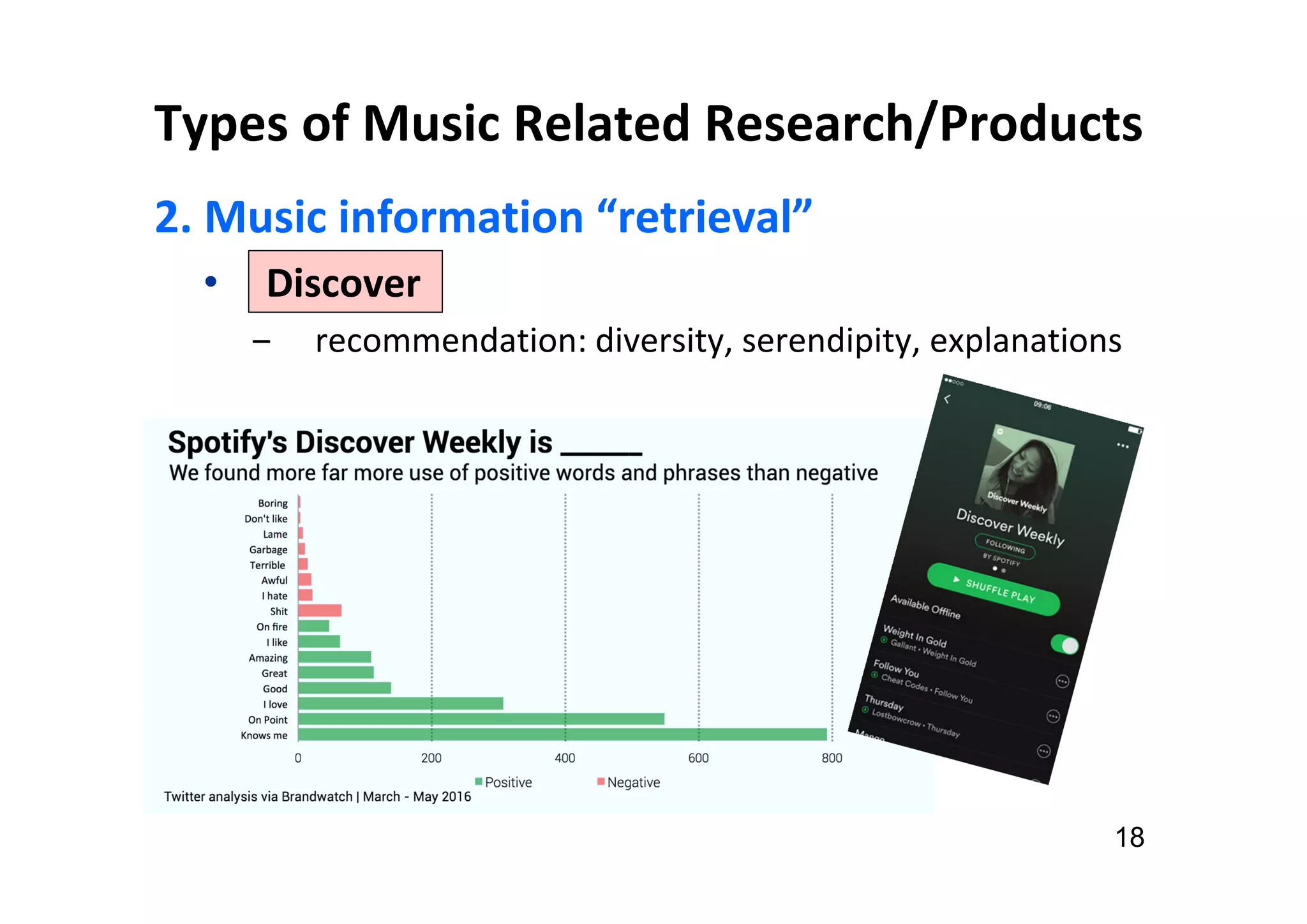
• Discover
‒ recommendation: diversity, serendipity, explanations
18
Types of Music Related Research/Products
2. Music information “retrieval”
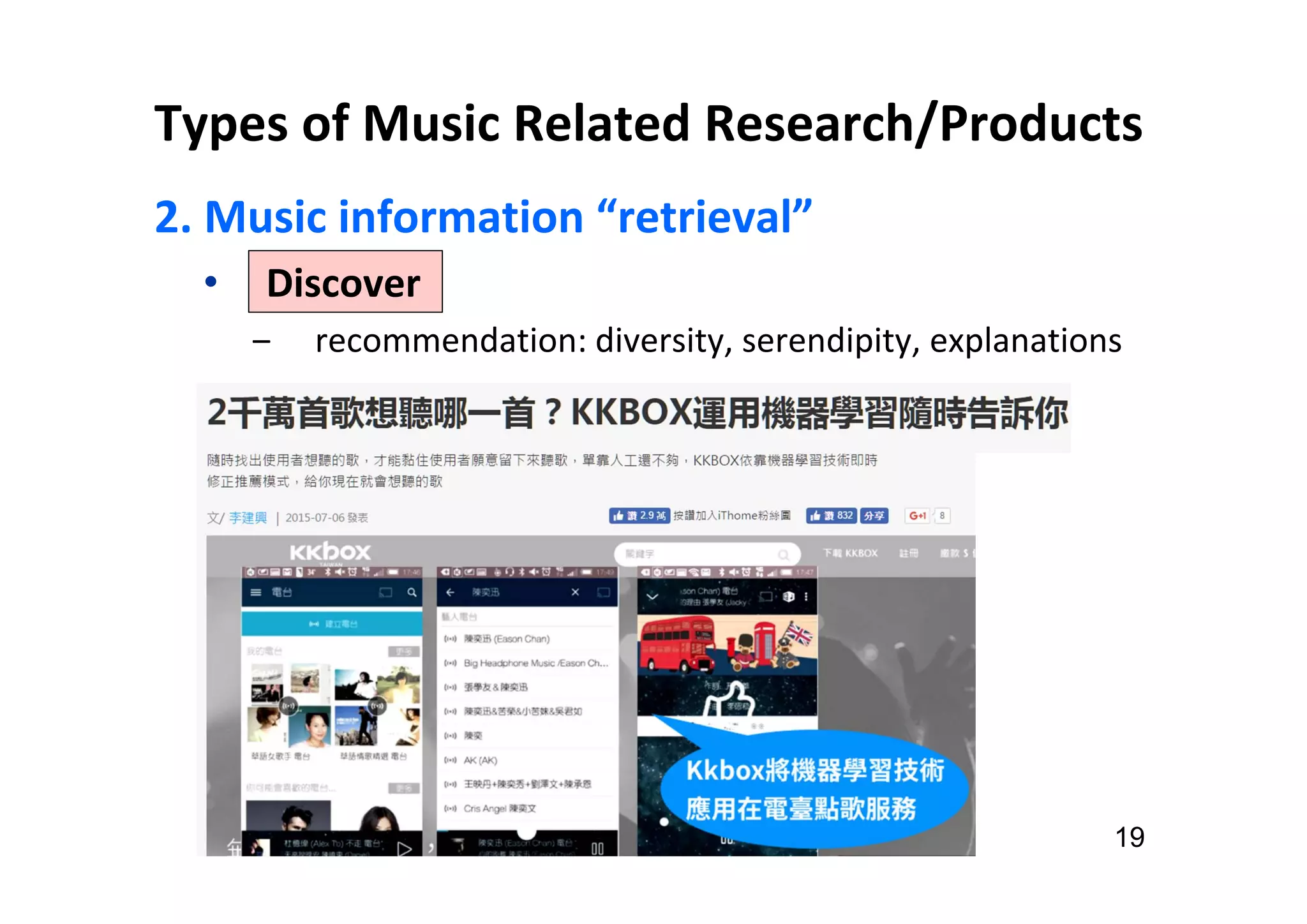
• Discover
‒ recommendation: diversity, serendipity, explanations
19
Types of Music Related Research/Products
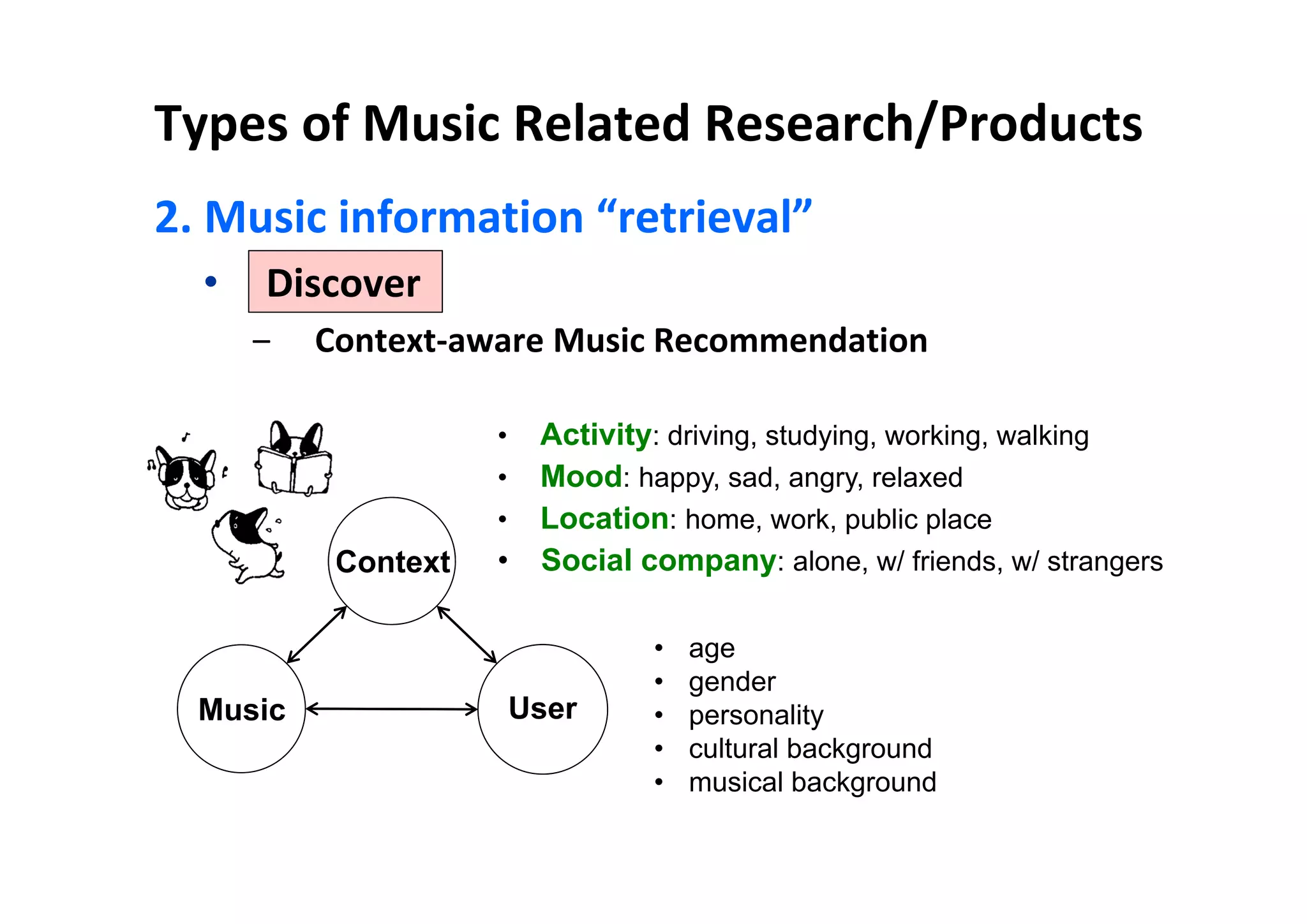
Context
Music User
• Activity: driving, studying, working, walking
• Mood: happy, sad, angry, relaxed
• Location: home, work, public place
• Social company: alone, w/ friends, w/ strangers
• age
• gender
• personality
• cultural background
• musical background
2. Music information “retrieval”
• Discover
‒ Context-aware Music Recommendation
Types of Music Related Research/Products
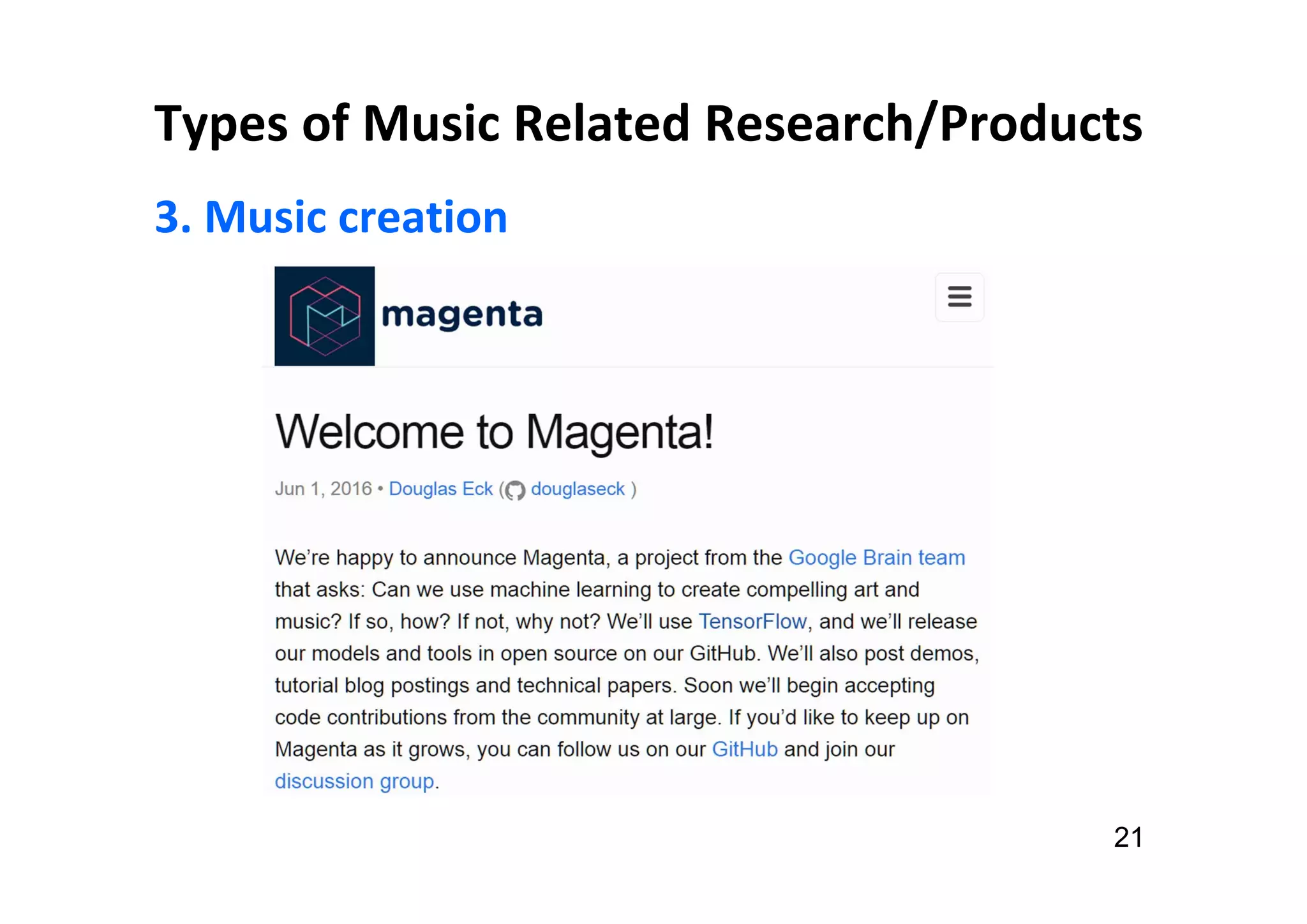
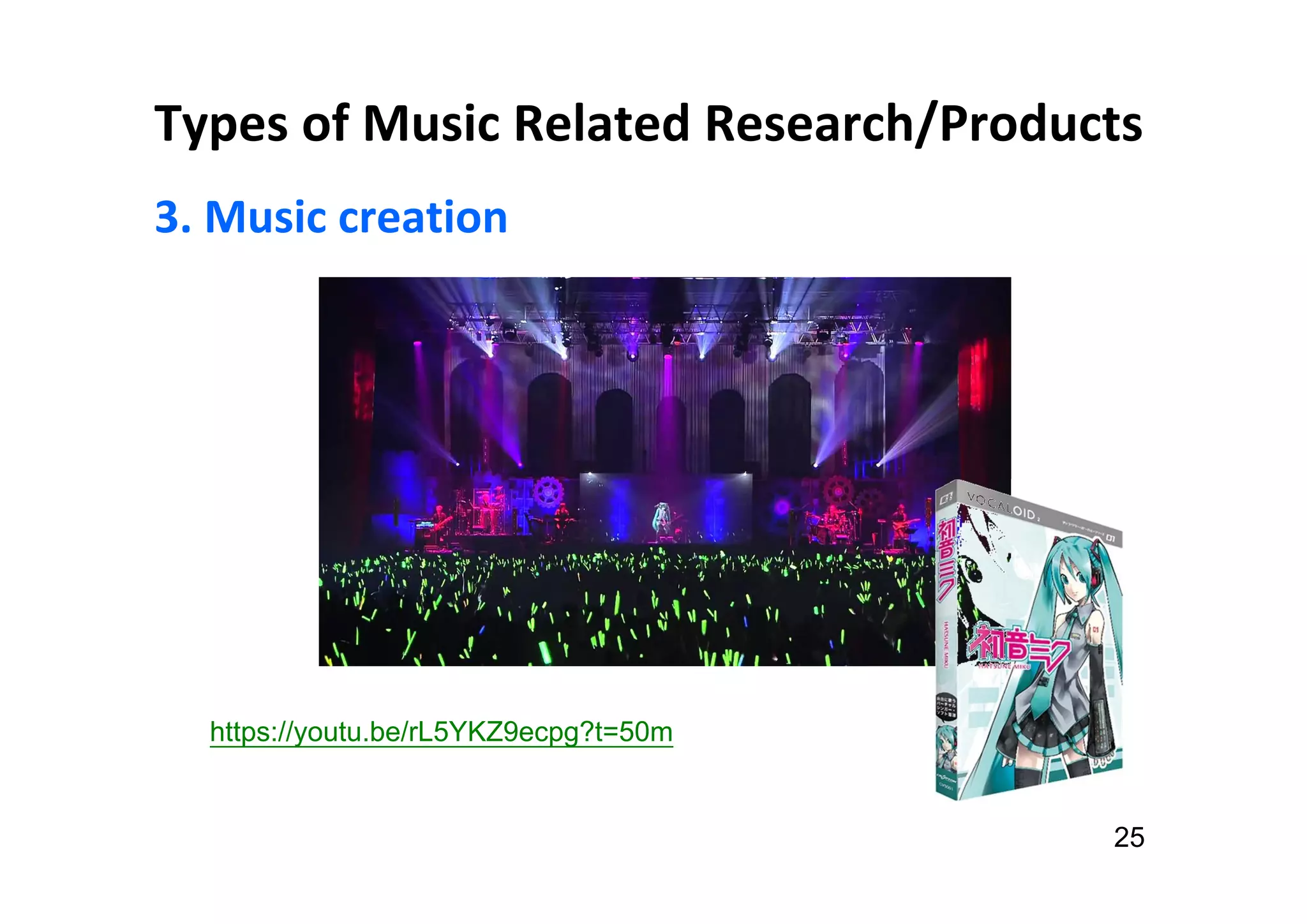
3. Music creation
21
Types of Music Related Research/Products
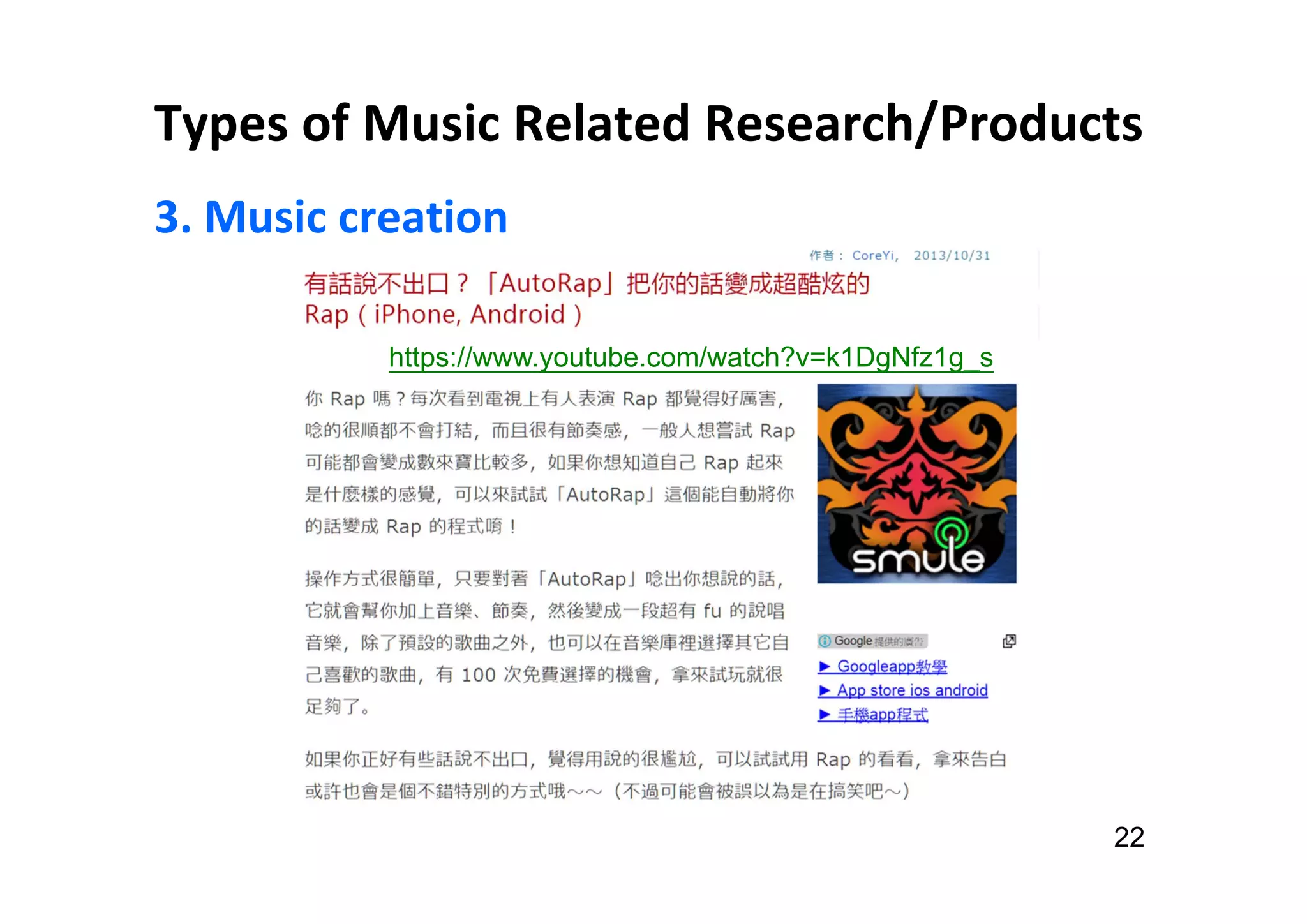
3. Music creation
22
https://www.youtube.com/watch?v=k1DgNfz1g_s
Types of Music Related Research/Products
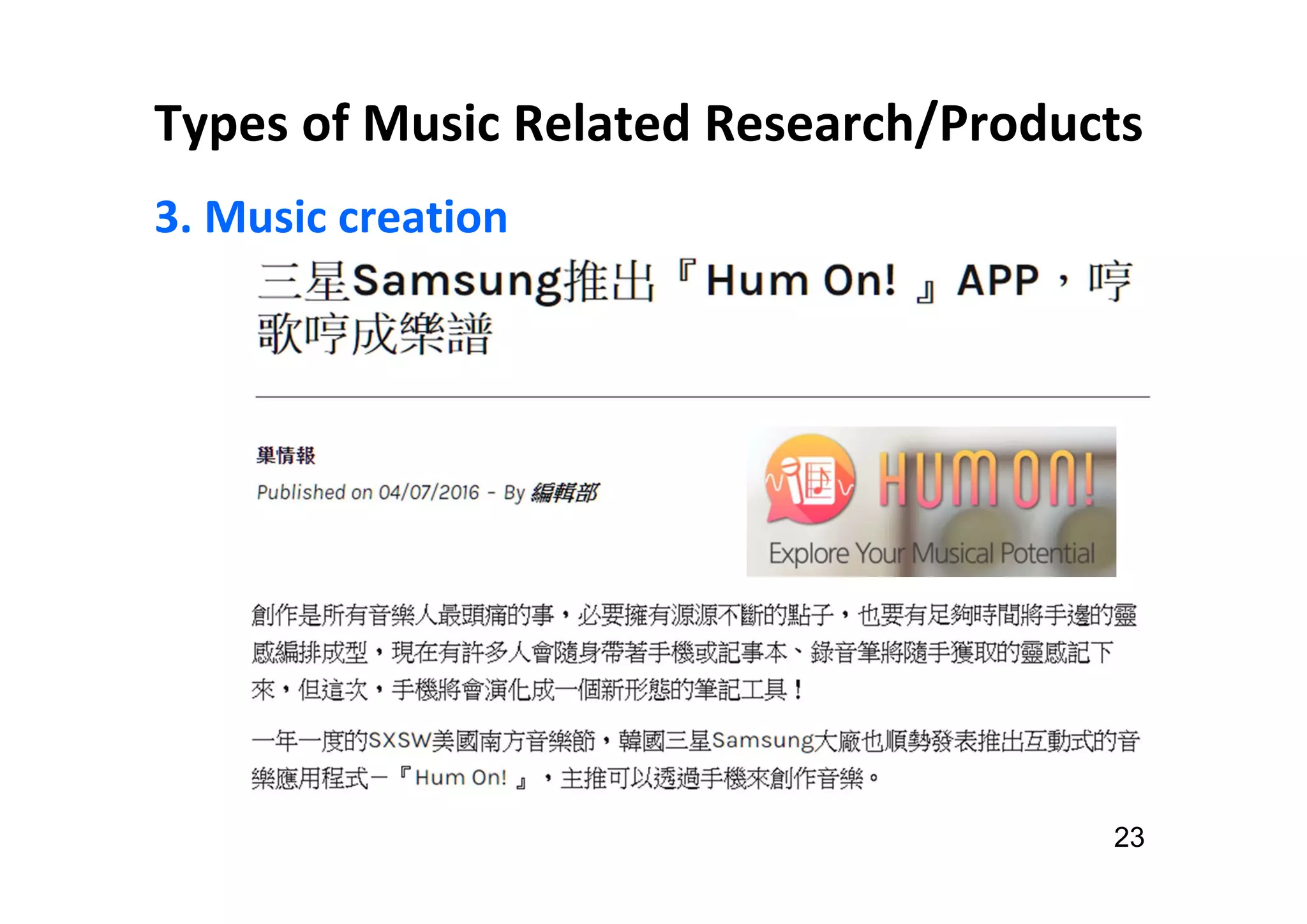
3. Music creation
23
Types of Music Related Research/Products
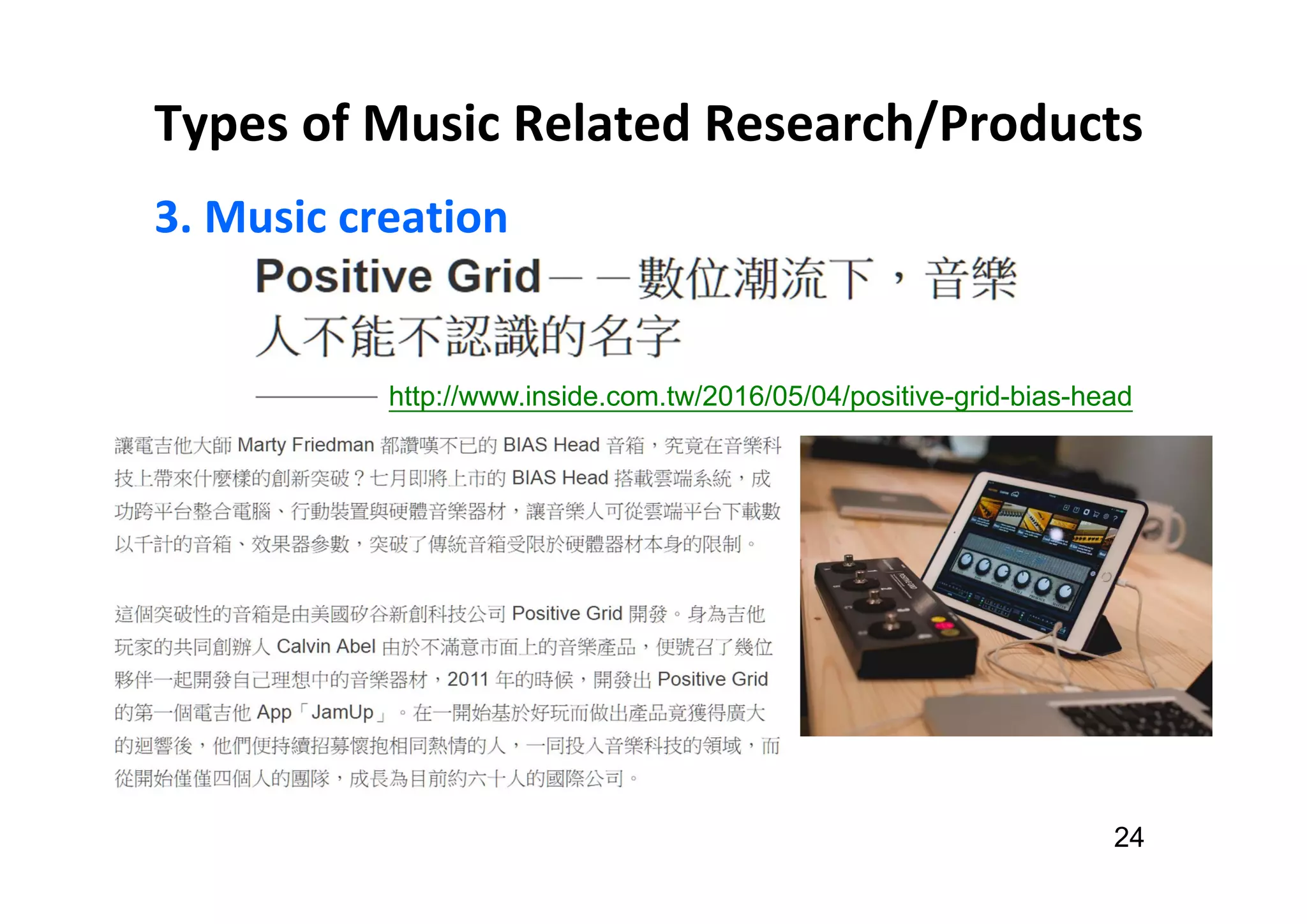
3. Music creation
24
http://www.inside.com.tw/2016/05/04/positive-grid-bias-head
Types of Music Related Research/Products
3. Music creation
25
https://youtu.be/rL5YKZ9ecpg?t=50m
Types of Music Related Research/Products
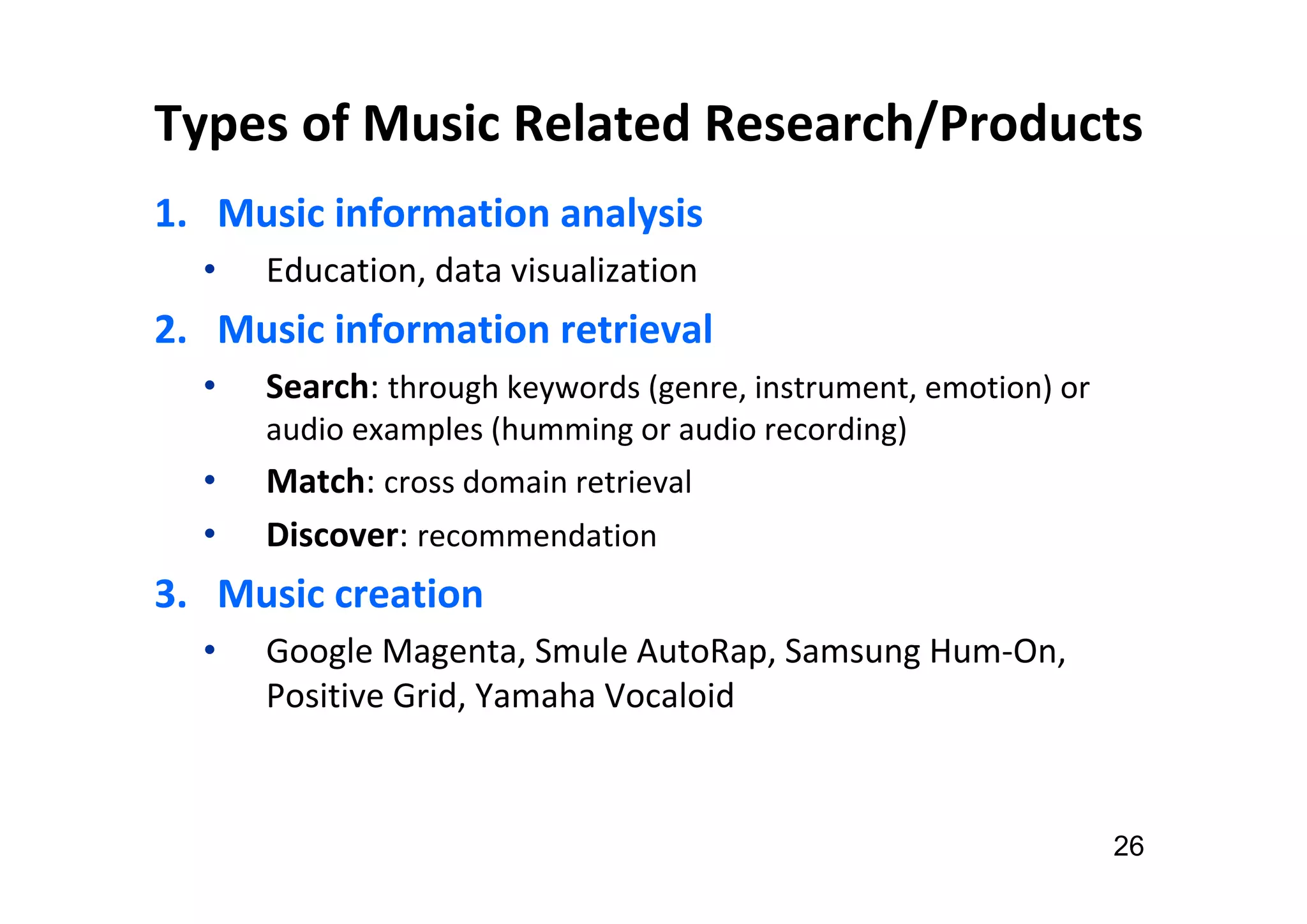
1. Music information analysis
• Education, data visualization
2. Music information retrieval
• Search: through keywords (genre, instrument, emotion) or
audio examples (humming or audio recording)
• Match: cross domain retrieval
• Discover: recommendation
3. Music creation
• Google Magenta, Smule AutoRap, Samsung Hum-On,
Positive Grid, Yamaha Vocaloid
26
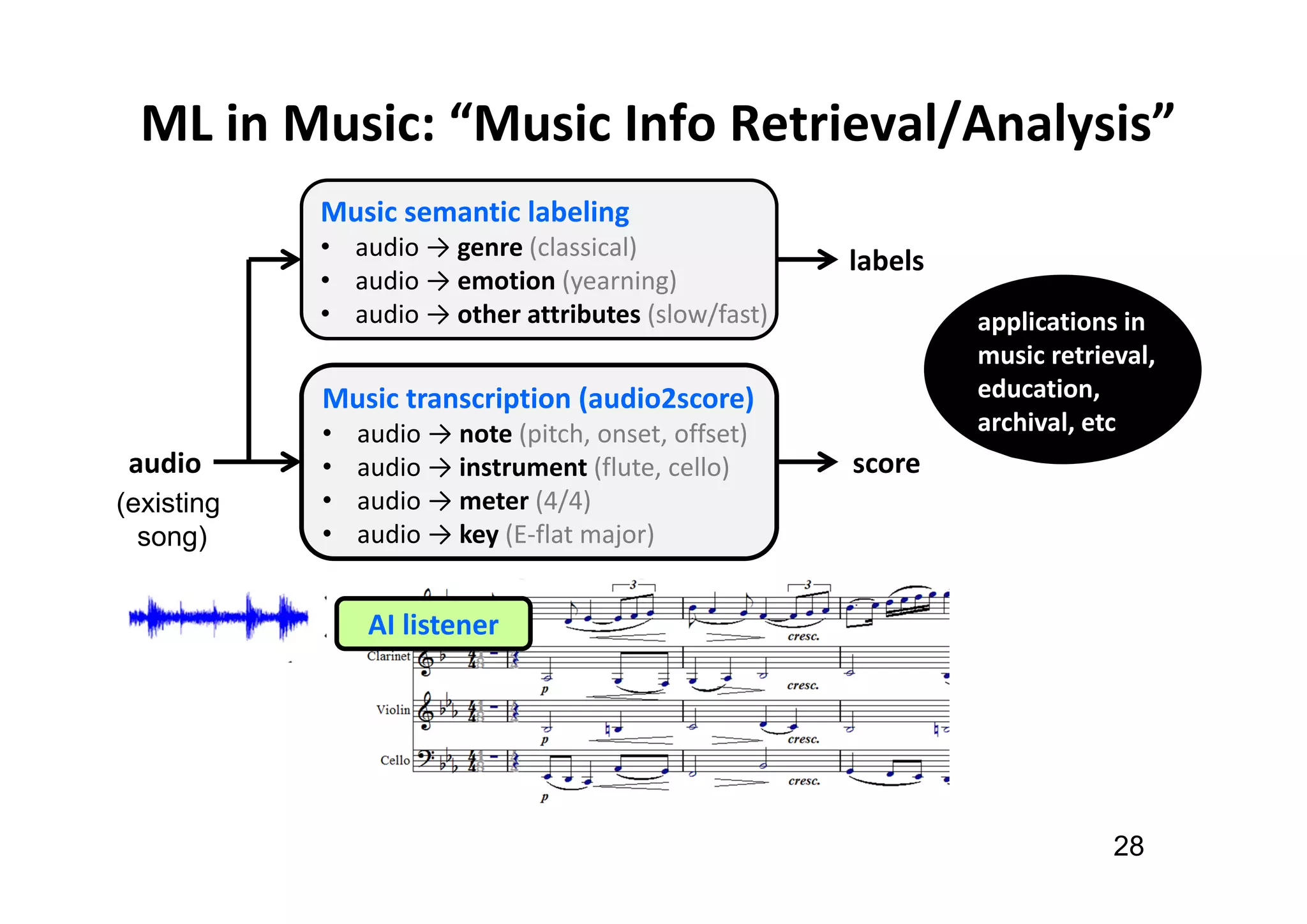
ML in Music: “Music Info Retrieval/Analysis”
28
Music transcription (audio2score)
• audio → note (pitch, onset, offset)
• audio → instrument (flute, cello)
• audio → meter (4/4)
• audio → key (E-flat major)
audio score
Music semantic labeling
• audio → genre (classical)
• audio → emotion (yearning)
• audio → other attributes (slow/fast)
labels
applications in
music retrieval,
education,
archival, etc
(existing
song)
AI listener
Music transcription (audio2score)
• audio → note (pitch, onset, offset)
• audio → instrument (flute, cello)
• audio → meter (4/4)
• audio → key (E-flat major)
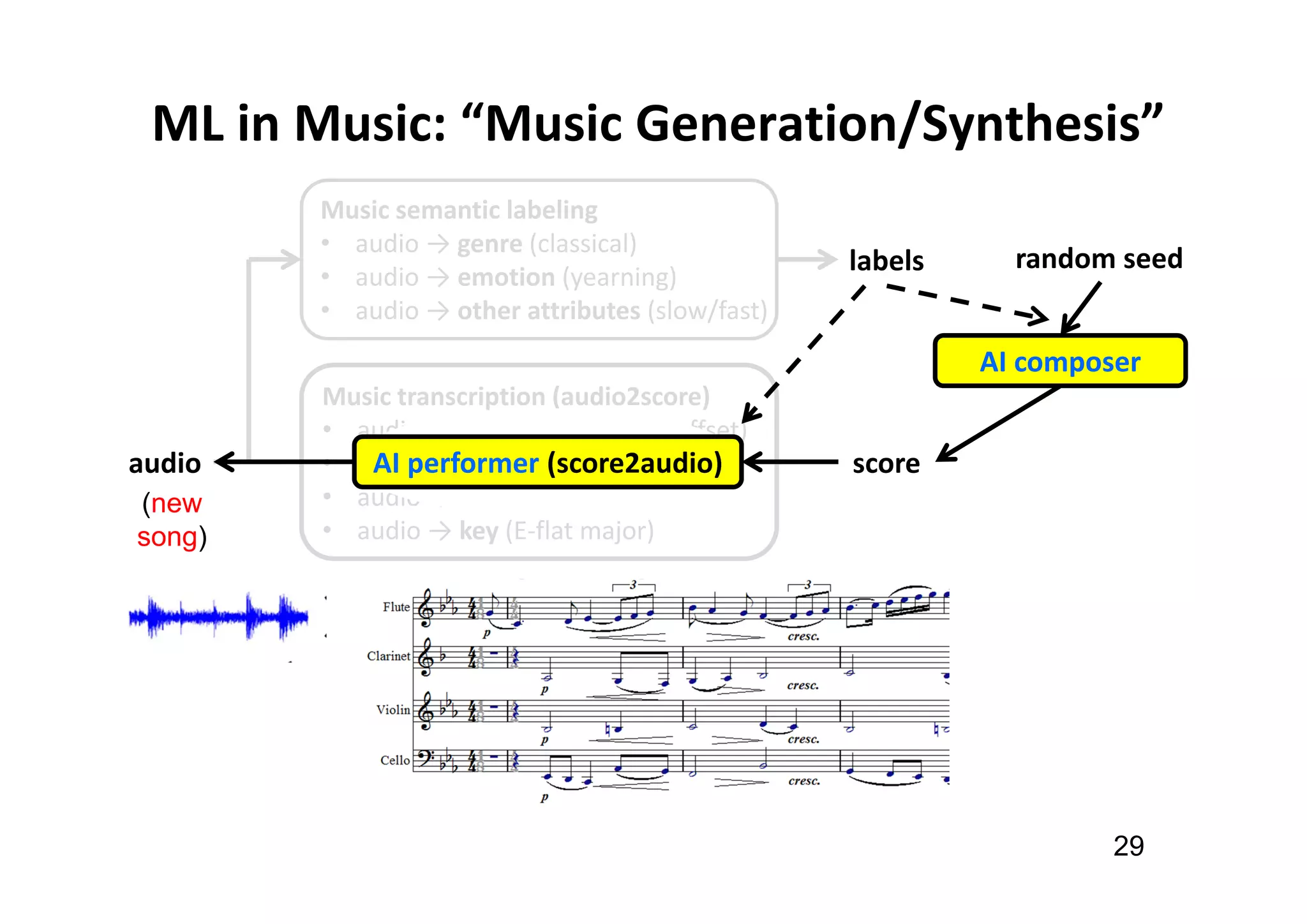
ML in Music: “Music Generation/Synthesis”
29
audio score
Music semantic labeling
• audio → genre (classical)
• audio → emotion (yearning)
• audio → other attributes (slow/fast)
labels
(new
song)
AI composer
random seed
AI performer (score2audio)
Music transcription (audio2score)
• audio → note (pitch, onset, offset)
• audio → instrument (flute, cello)
• audio → meter (4/4)
• audio → key (E-flat major)
ML in Music: “Music Generation/Synthesis”
30
audio
features
Music semantic labeling
• audio → genre (classical)
• audio → emotion (yearning)
• audio → other attributes (slow/fast)
labels
(existing
songs)
AI listener
score
AI DJ
audio
(a new
song)
remix, mashup, etc
(image from the Internet)
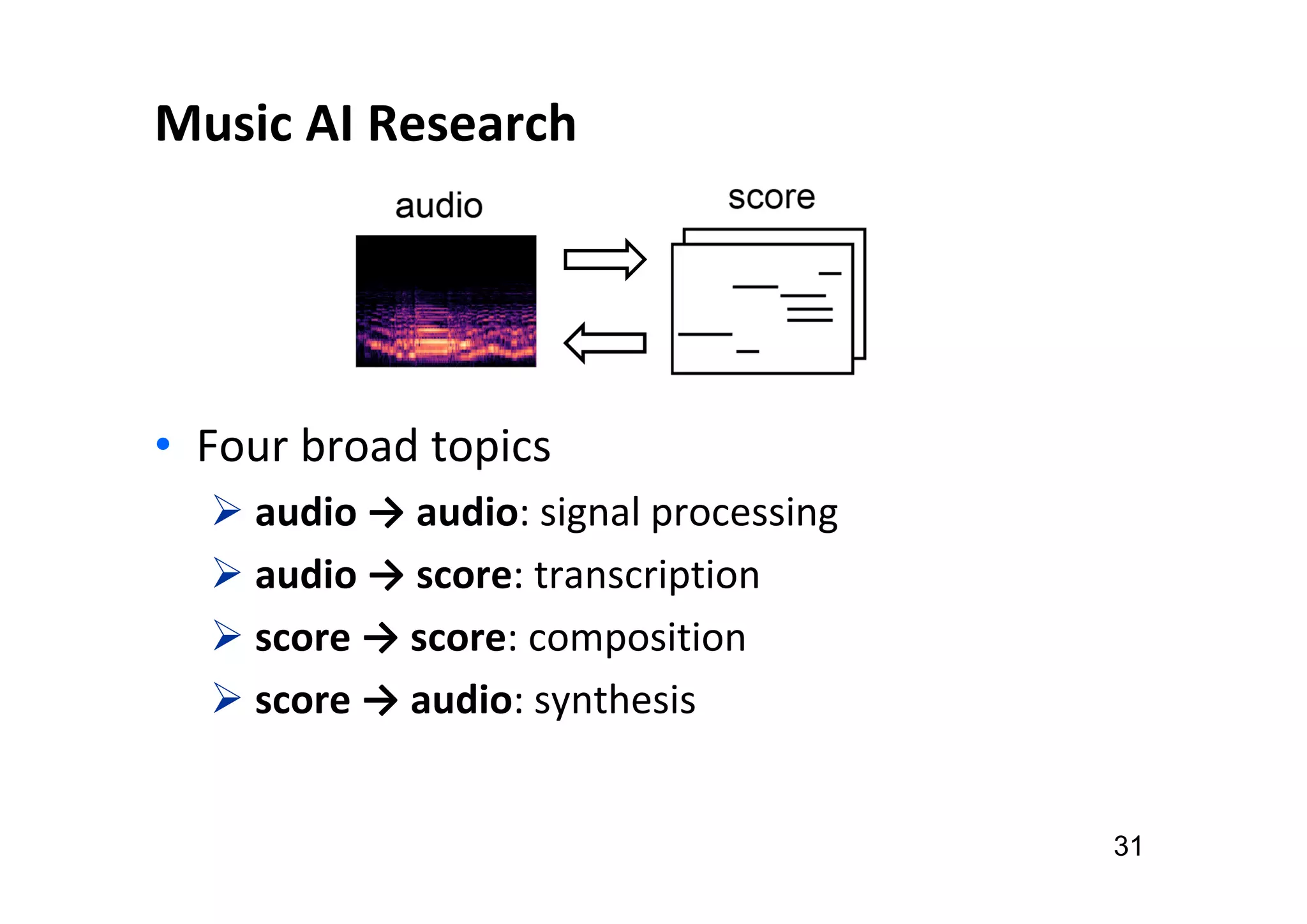
Music AI Research
• Four broad topics
 audio → audio: signal processing
 audio → score: transcription
 score → score: composition
 score → audio: synthesis
31
Outline
• Types of music related research/products
• Fundamentals of music signal processing
• Types of data
32
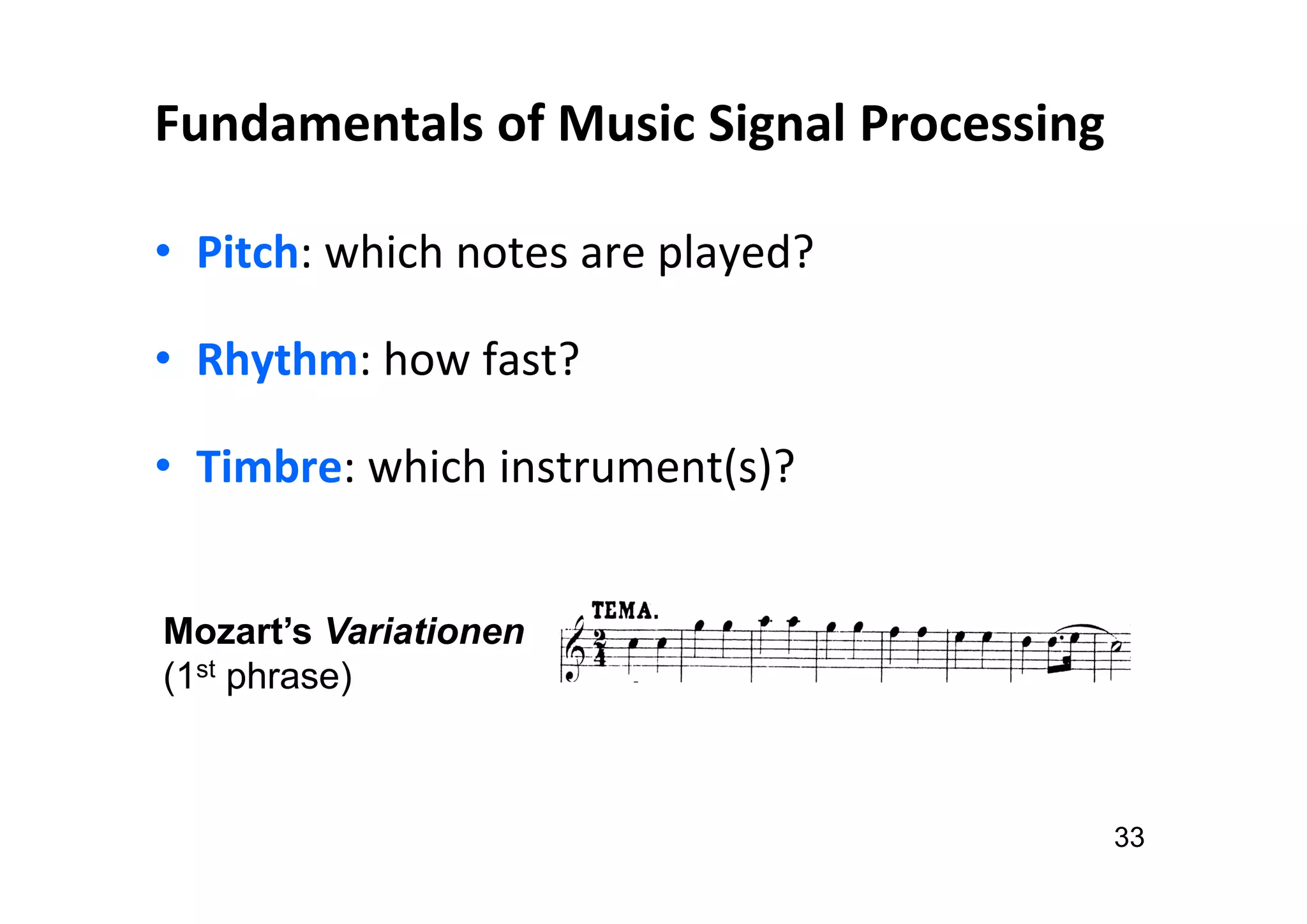
Fundamentals of Music Signal Processing
• Pitch: which notes are played?
• Rhythm: how fast?
• Timbre: which instrument(s)?
33
Mozart’s Variationen
(1st phrase)
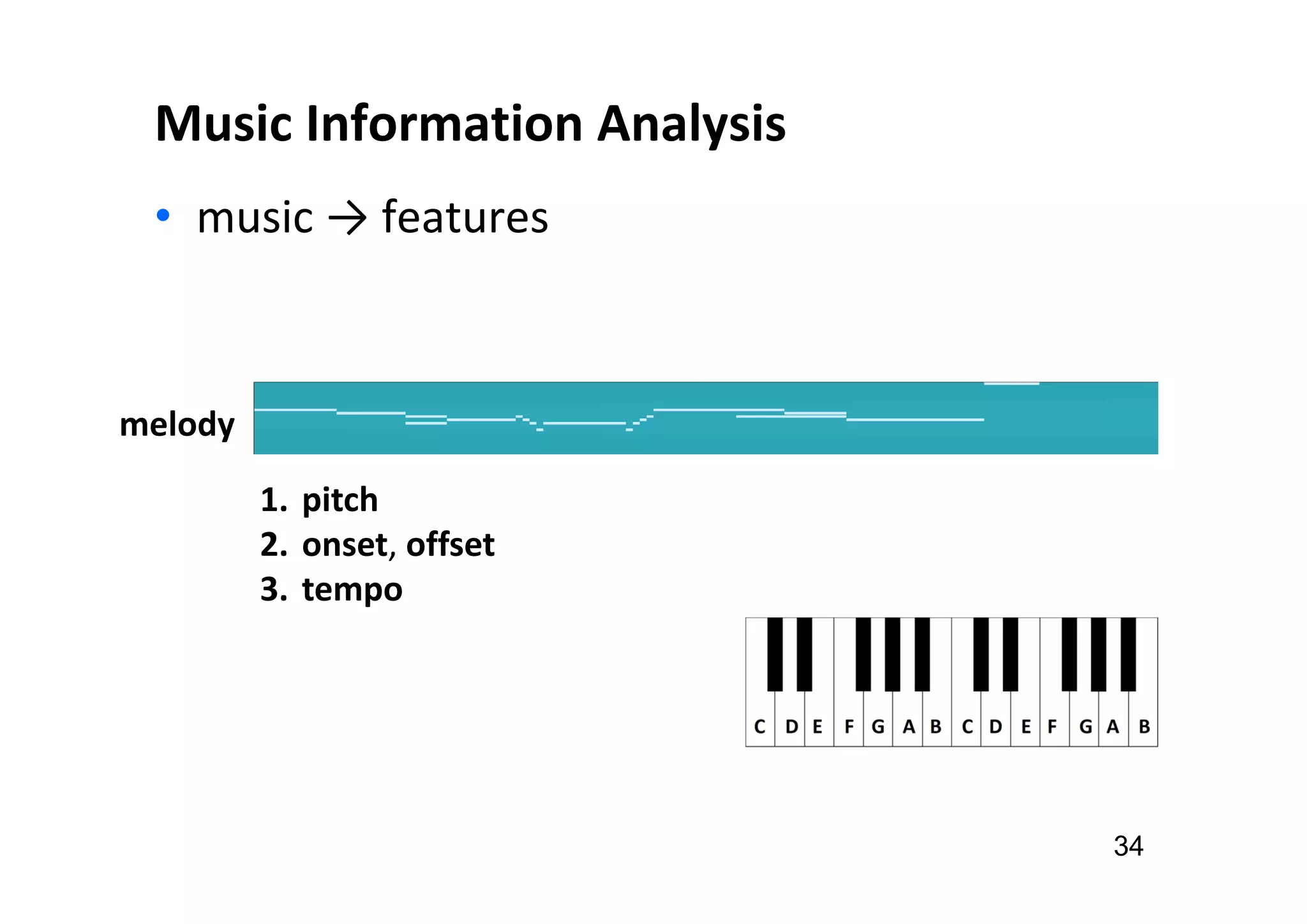
Music Information Analysis
• music → features
34
melody
1. pitch
2. onset, offset
3. tempo
Music Information Analysis
• music → features
35
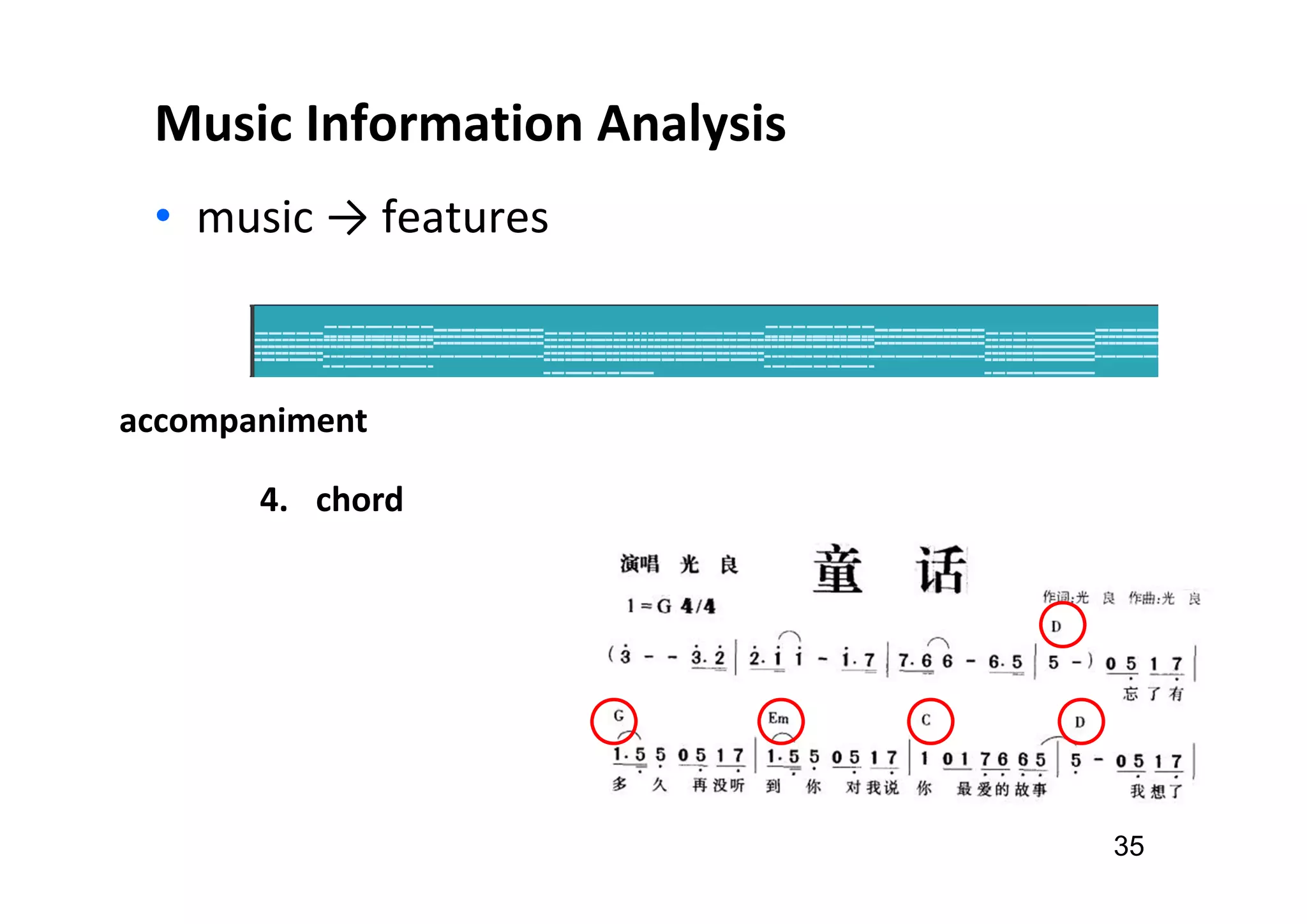
accompaniment
4. chord
Music Information Analysis
• music → features
36
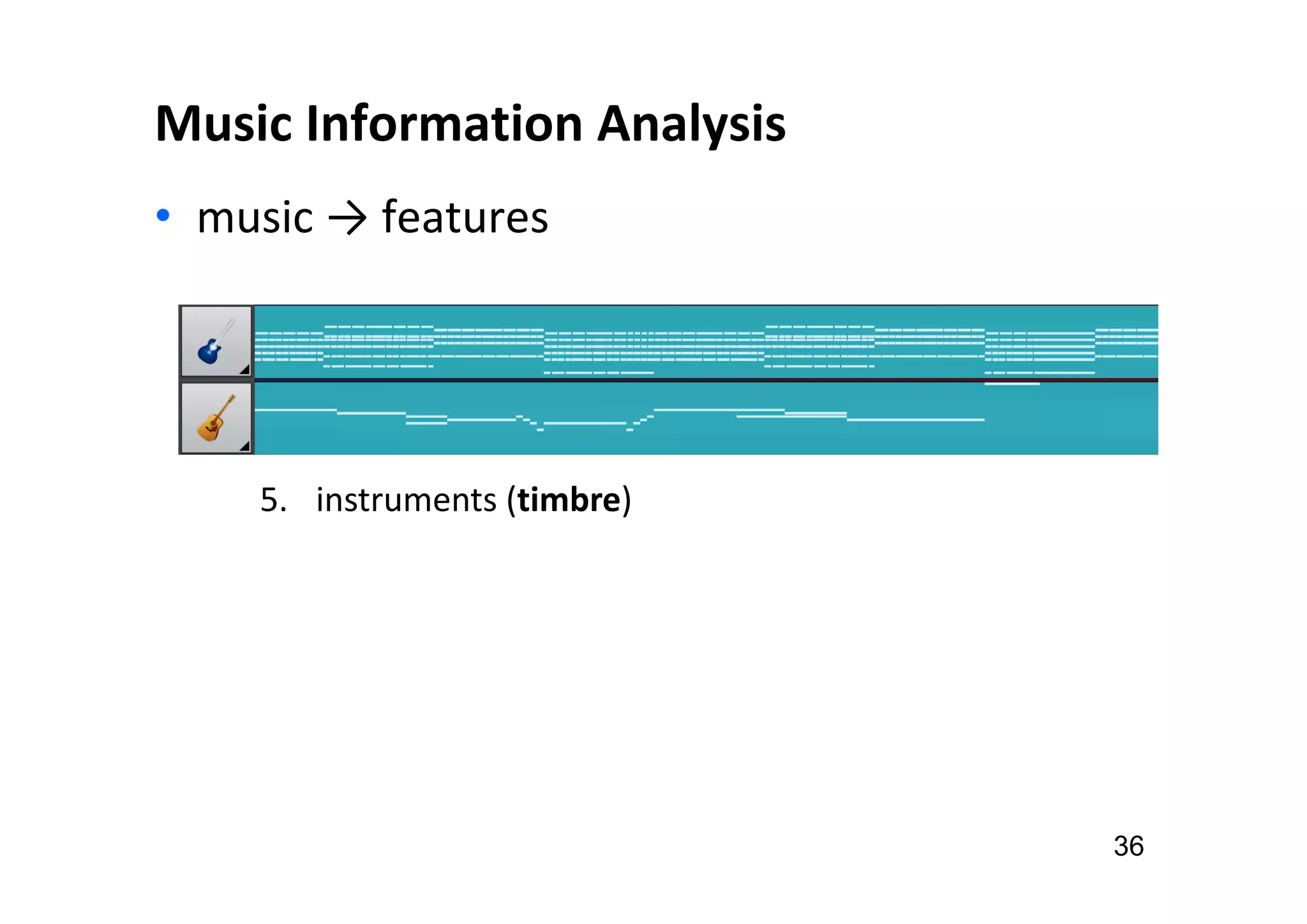
5. instruments (timbre)
Music Information Analysis
• music → features
37
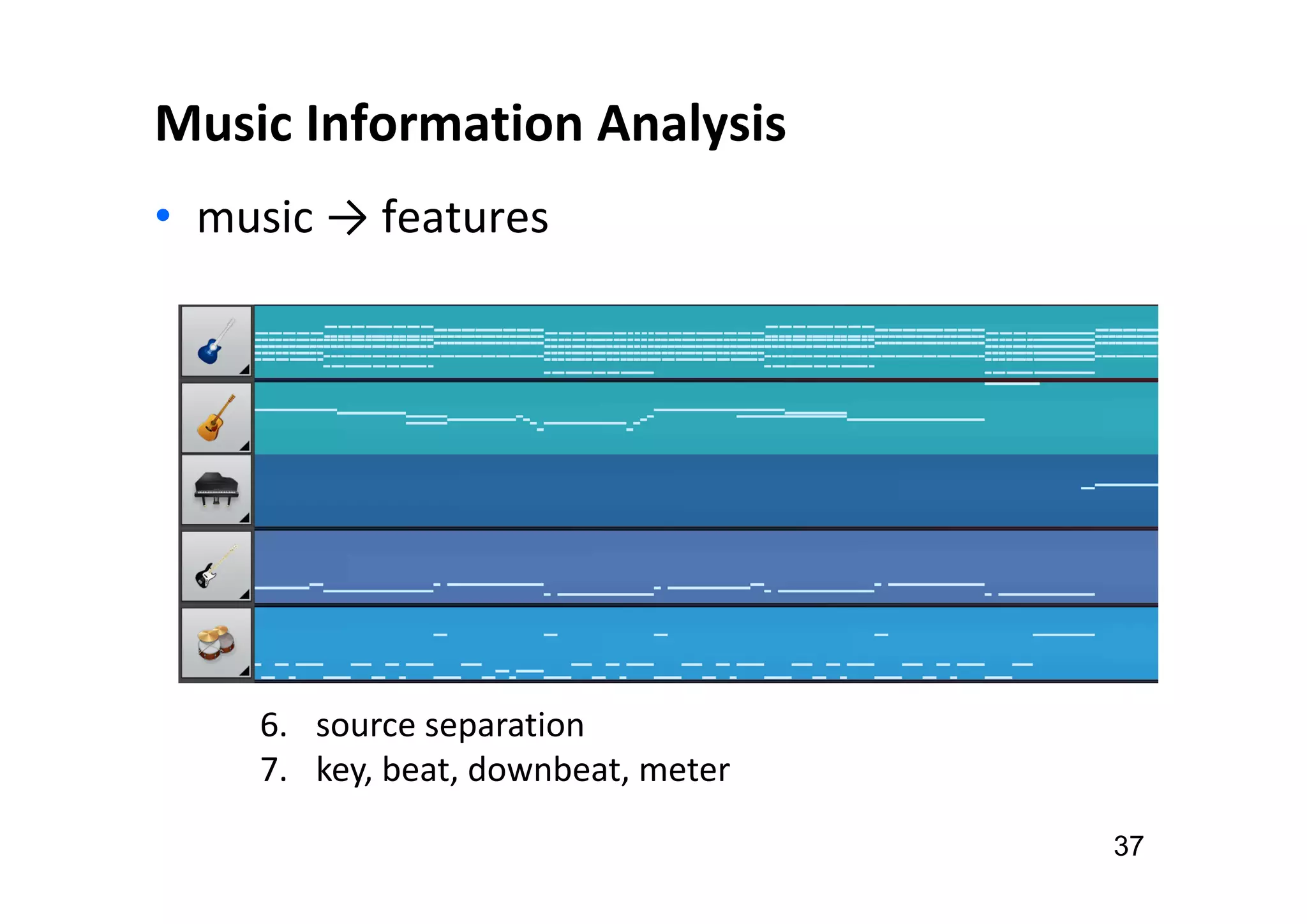
6. source separation
7. key, beat, downbeat, meter
Music Information Analysis
• music → features
38
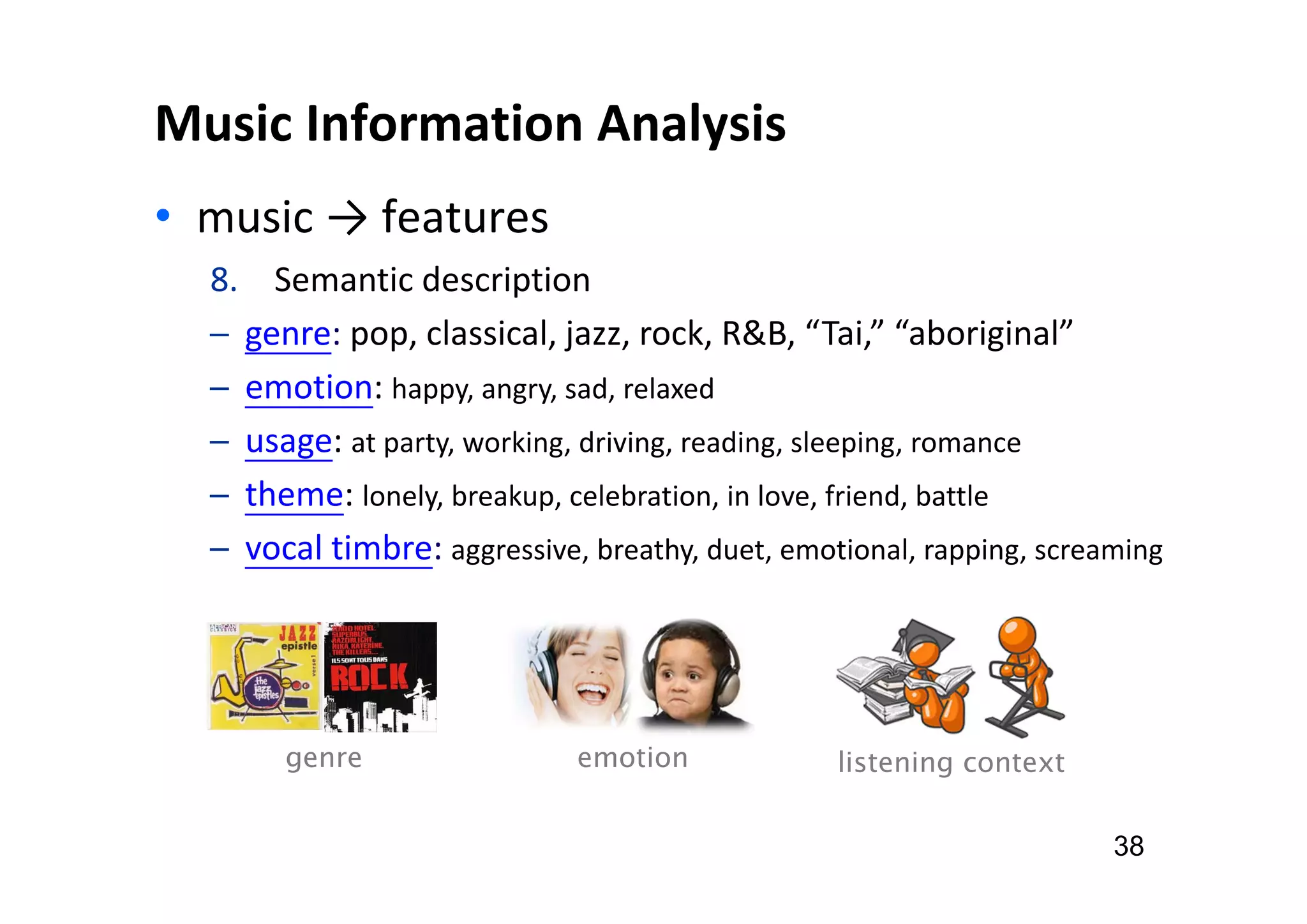
8. Semantic description
─ genre: pop, classical, jazz, rock, R&B, “Tai,” “aboriginal”
─ emotion: happy, angry, sad, relaxed
─ usage: at party, working, driving, reading, sleeping, romance
─ theme: lonely, breakup, celebration, in love, friend, battle
─ vocal timbre: aggressive, breathy, duet, emotional, rapping, screaming
genre listening context
emotion
Fundamentals of Music Signal Processing
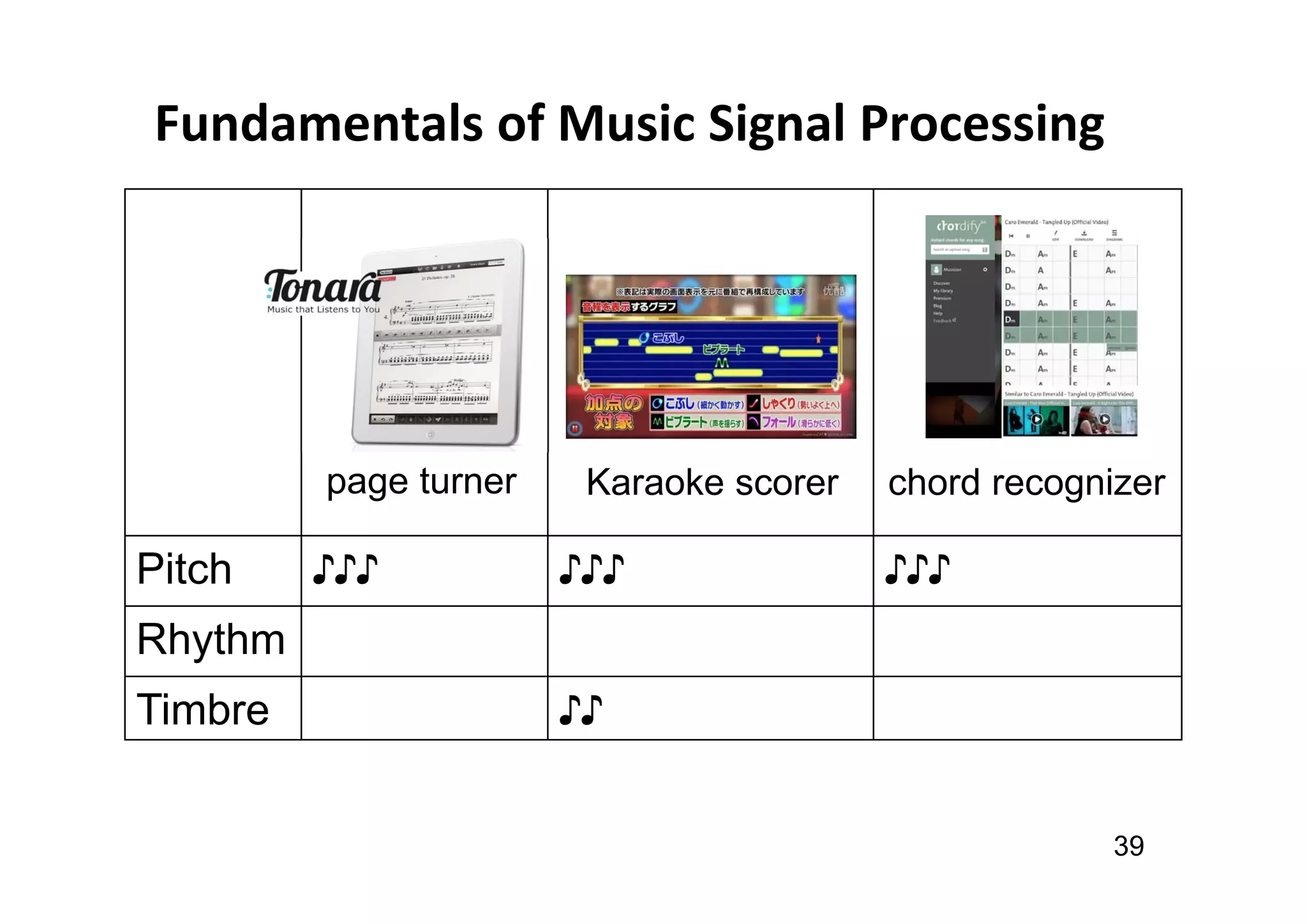
Pitch ♪♪♪ ♪♪♪ ♪♪♪
Rhythm
Timbre ♪♪
39
Karaoke scorer chord recognizer
page turner
Fundamentals of Music Signal Processing
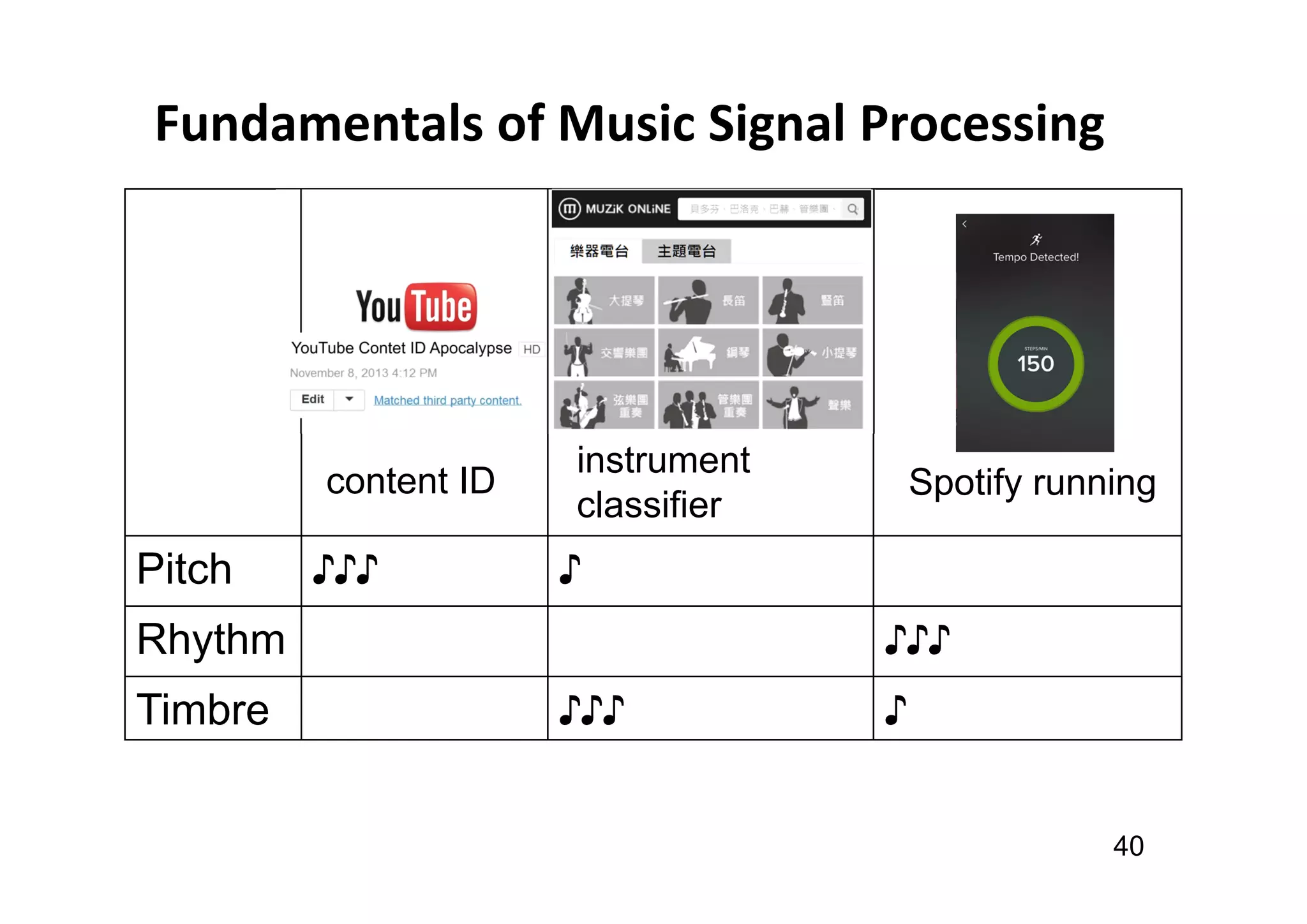
Pitch ♪♪♪ ♪
Rhythm ♪♪♪
Timbre ♪♪♪ ♪
40
instrument
classifier
content ID Spotify running
Fundamentals of Music Signal Processing
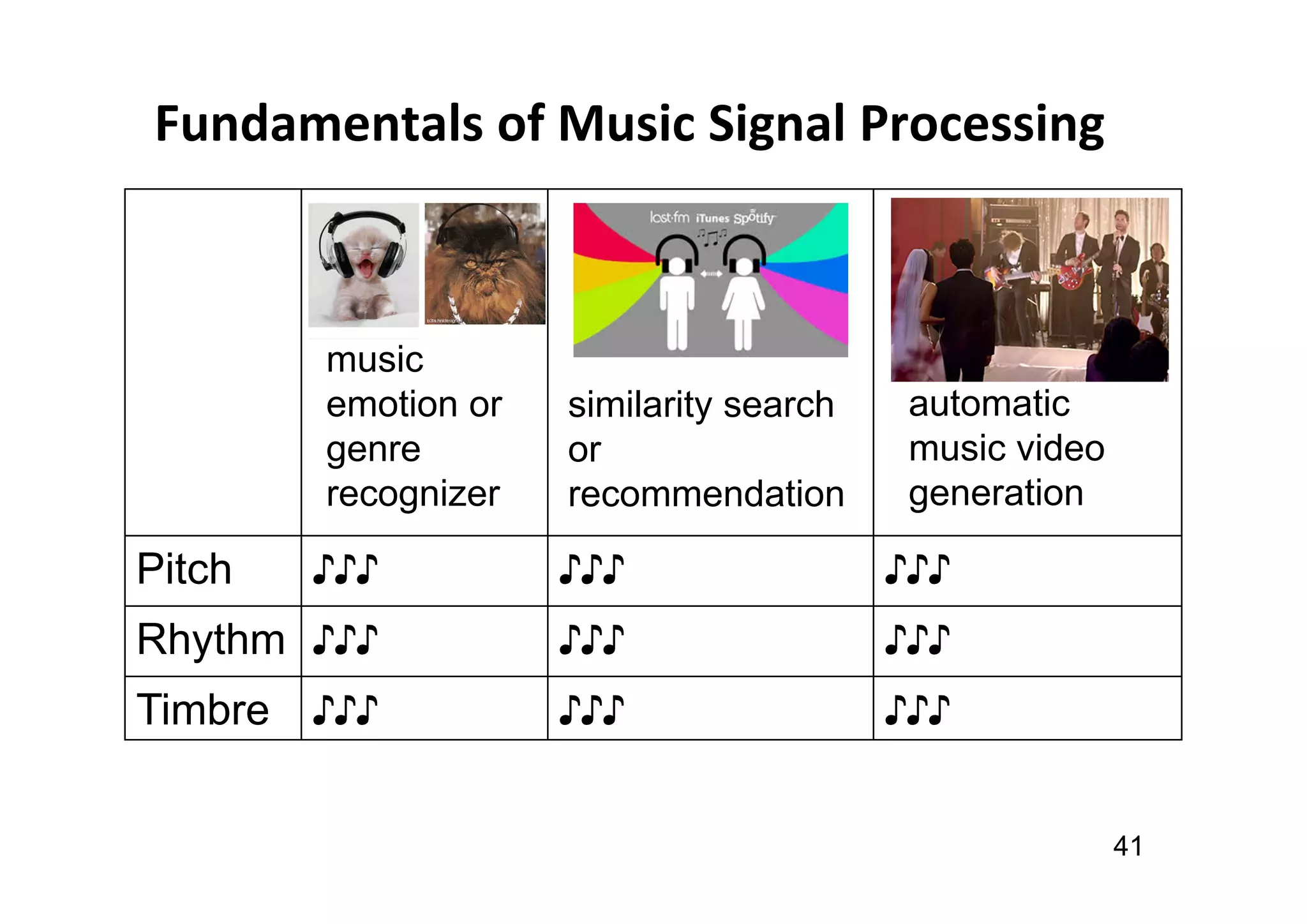
Pitch ♪♪♪ ♪♪♪ ♪♪♪
Rhythm ♪♪♪ ♪♪♪ ♪♪♪
Timbre ♪♪♪ ♪♪♪ ♪♪♪
41
similarity search
or
recommendation
music
emotion or
genre
recognizer
automatic
music video
generation
Fundamentals of Music Signal Processing
42
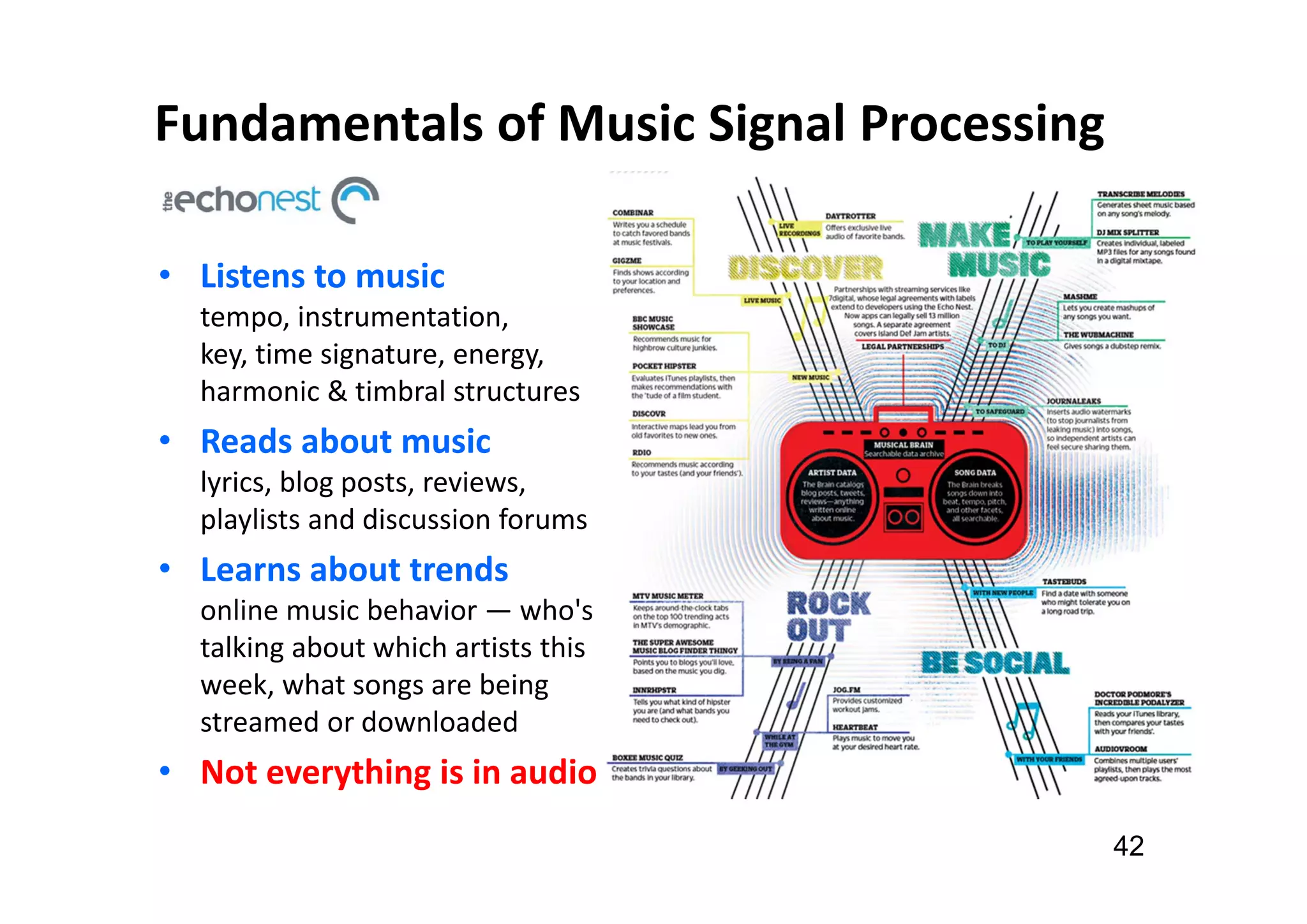
• Listens to music
tempo, instrumentation,
key, time signature, energy,
harmonic & timbral structures
• Reads about music
lyrics, blog posts, reviews,
playlists and discussion forums
• Learns about trends
online music behavior — who's
talking about which artists this
week, what songs are being
streamed or downloaded
• Not everything is in audio
Fundamentals of Music Signal Processing
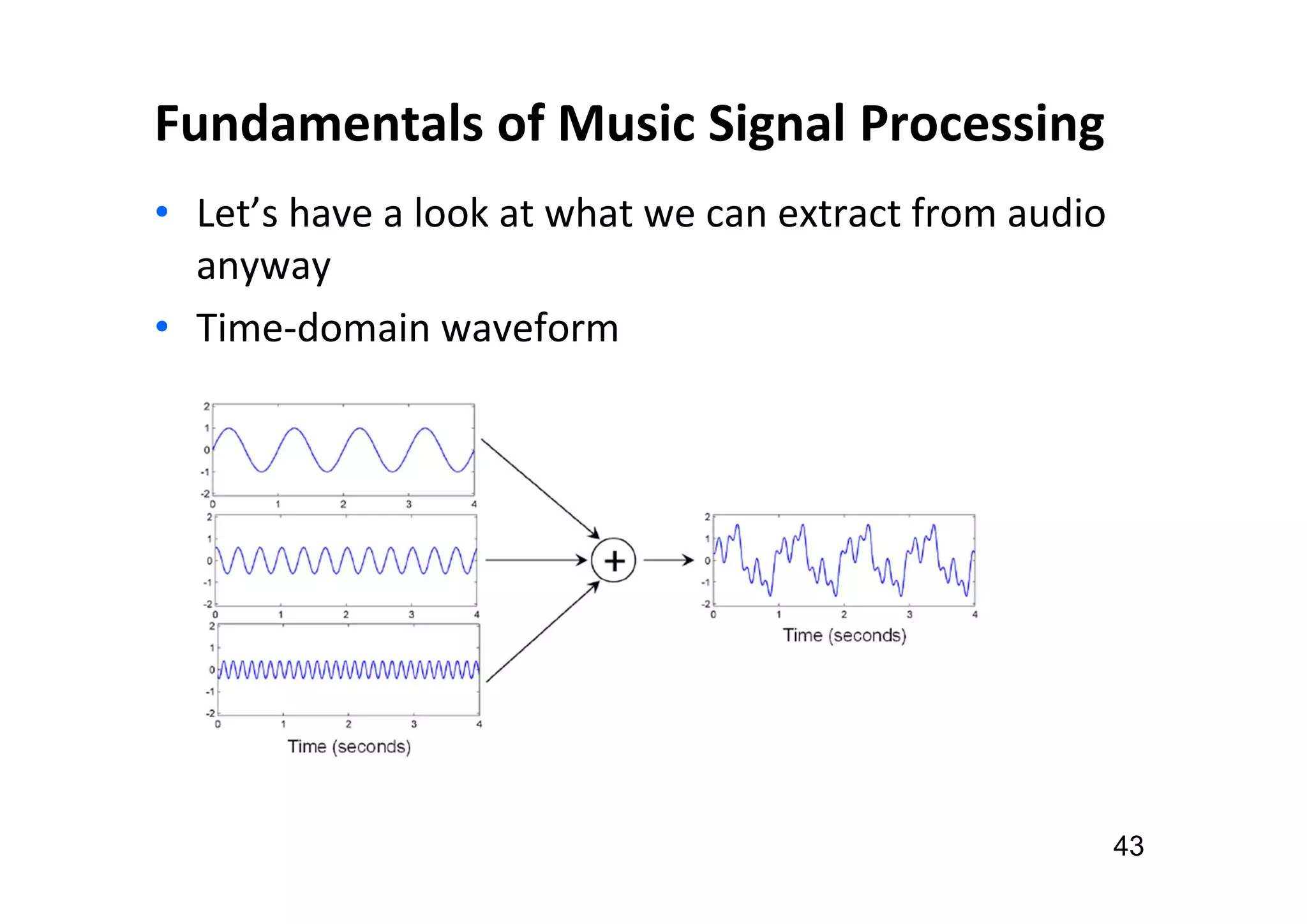
• Let’s have a look at what we can extract from audio
anyway
• Time-domain waveform
43
Fundamentals of Music Signal Processing
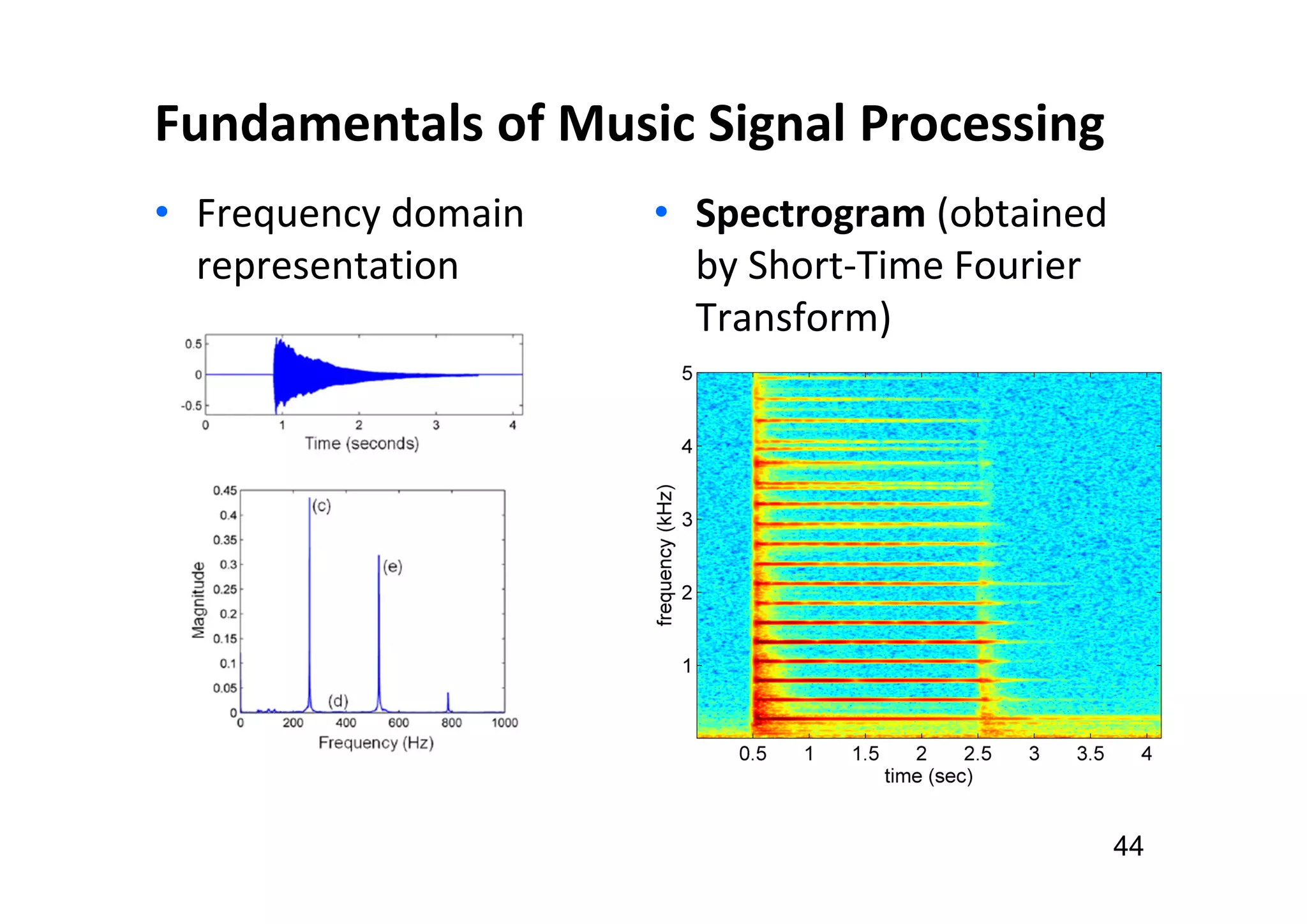
• Frequency domain
representation
• Spectrogram (obtained
by Short-Time Fourier
Transform)
44
Fundamentals of Music Signal Processing
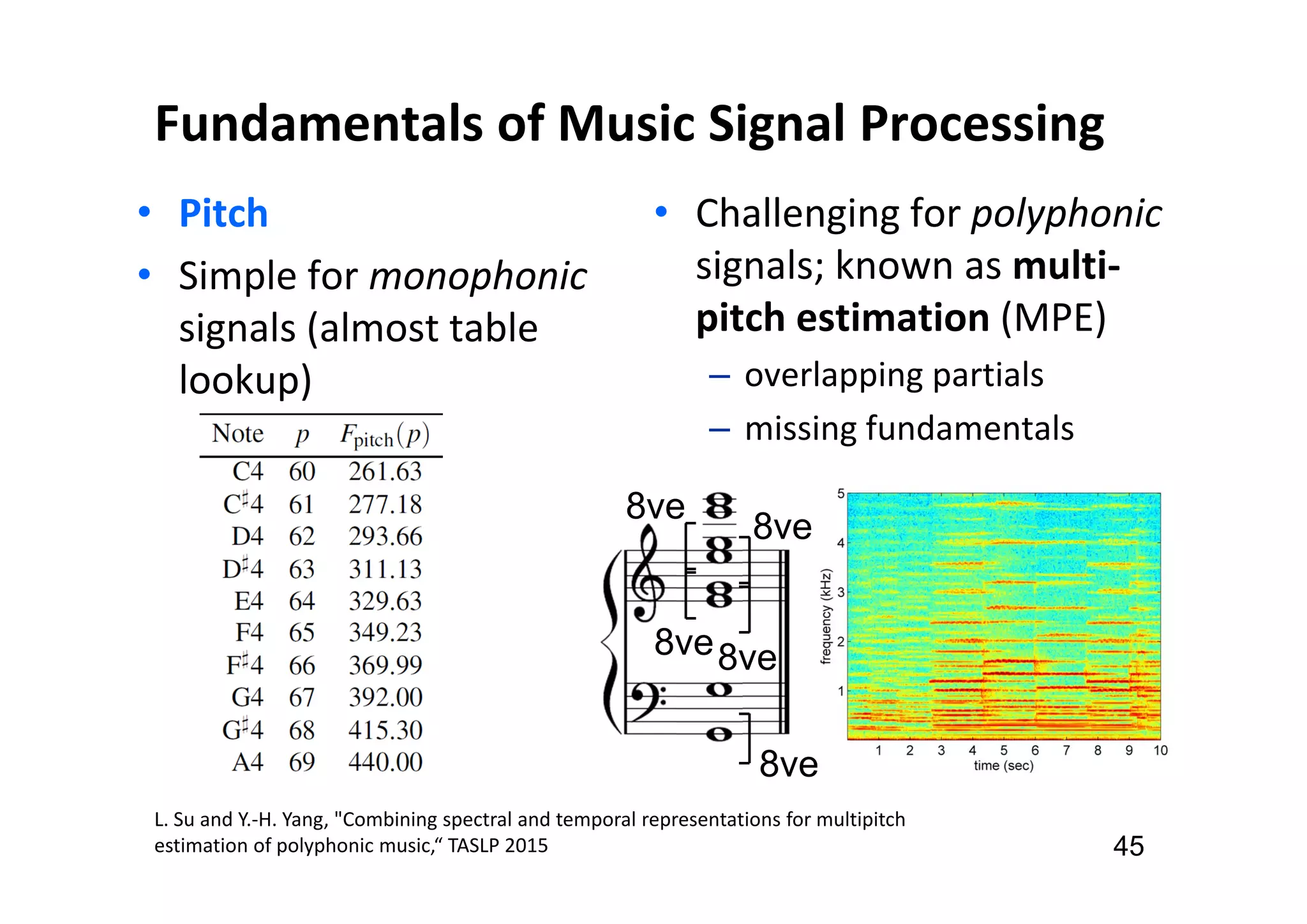
• Pitch
• Simple for monophonic
signals (almost table
lookup)
• Challenging for polyphonic
signals; known as multi-
pitch estimation (MPE)
‒ overlapping partials
‒ missing fundamentals
45
8ve
8ve
8ve
8ve
8ve
L. Su and Y.-H. Yang, "Combining spectral and temporal representations for multipitch
estimation of polyphonic music,“ TASLP 2015
Fundamentals of Music Signal Processing
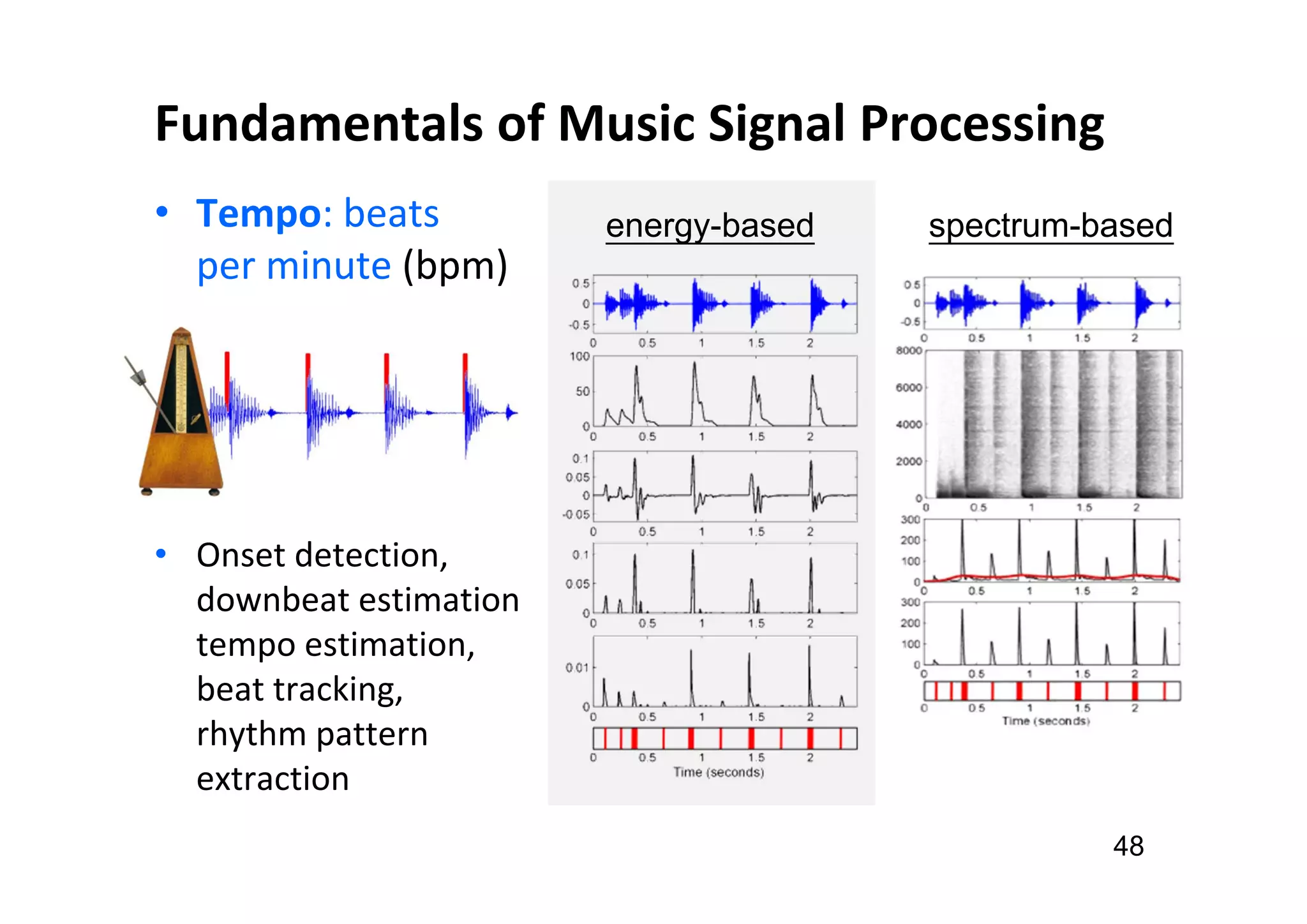
• Tempo: beats
per minute (bpm)
• Onset detection,
downbeat estimation
tempo estimation,
beat tracking,
rhythm pattern
extraction
48
energy-based spectrum-based
Fundamentals of Music Signal Processing
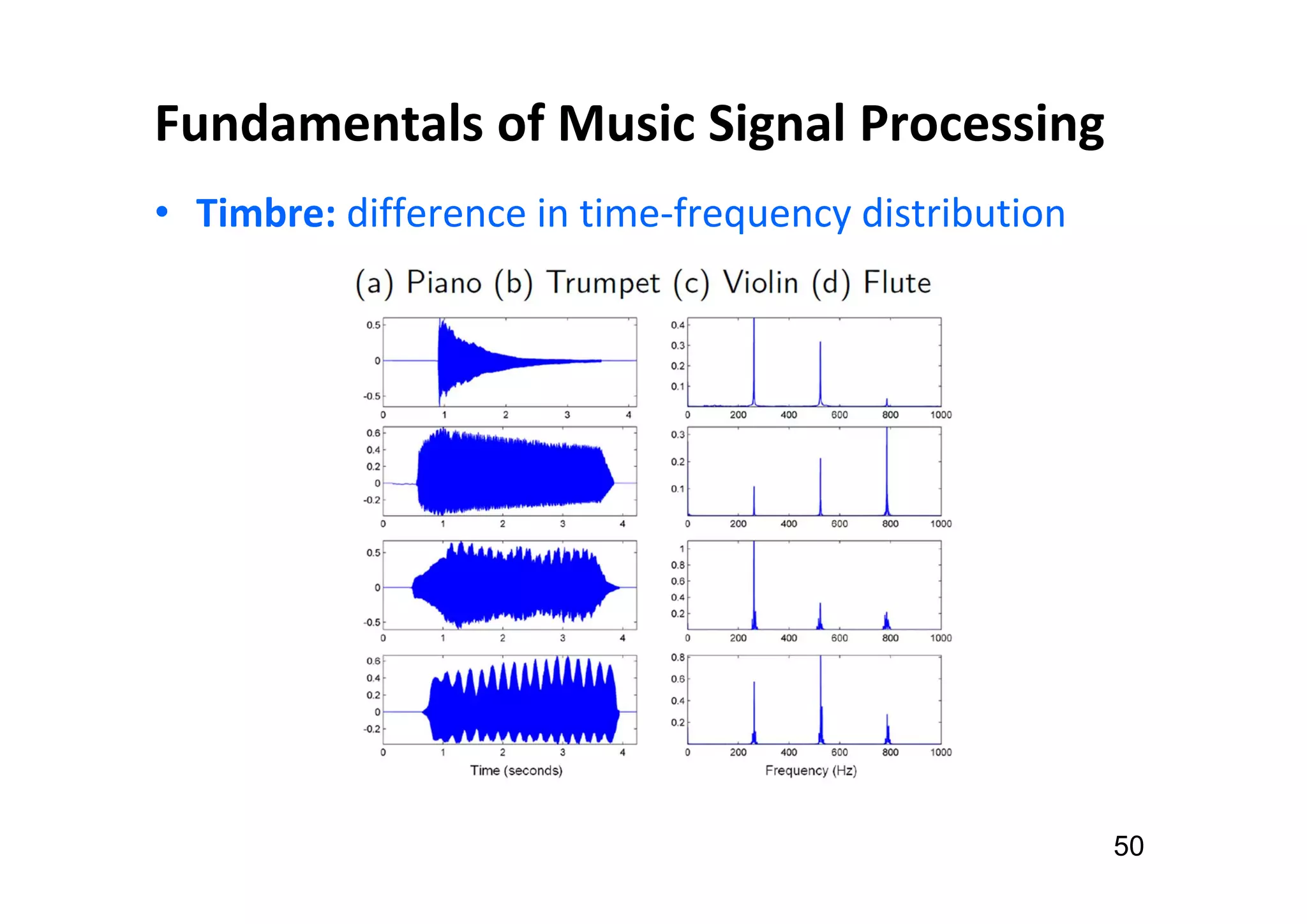
• Timbre: difference in time-frequency distribution
50
Fundamentals of Music Signal Processing
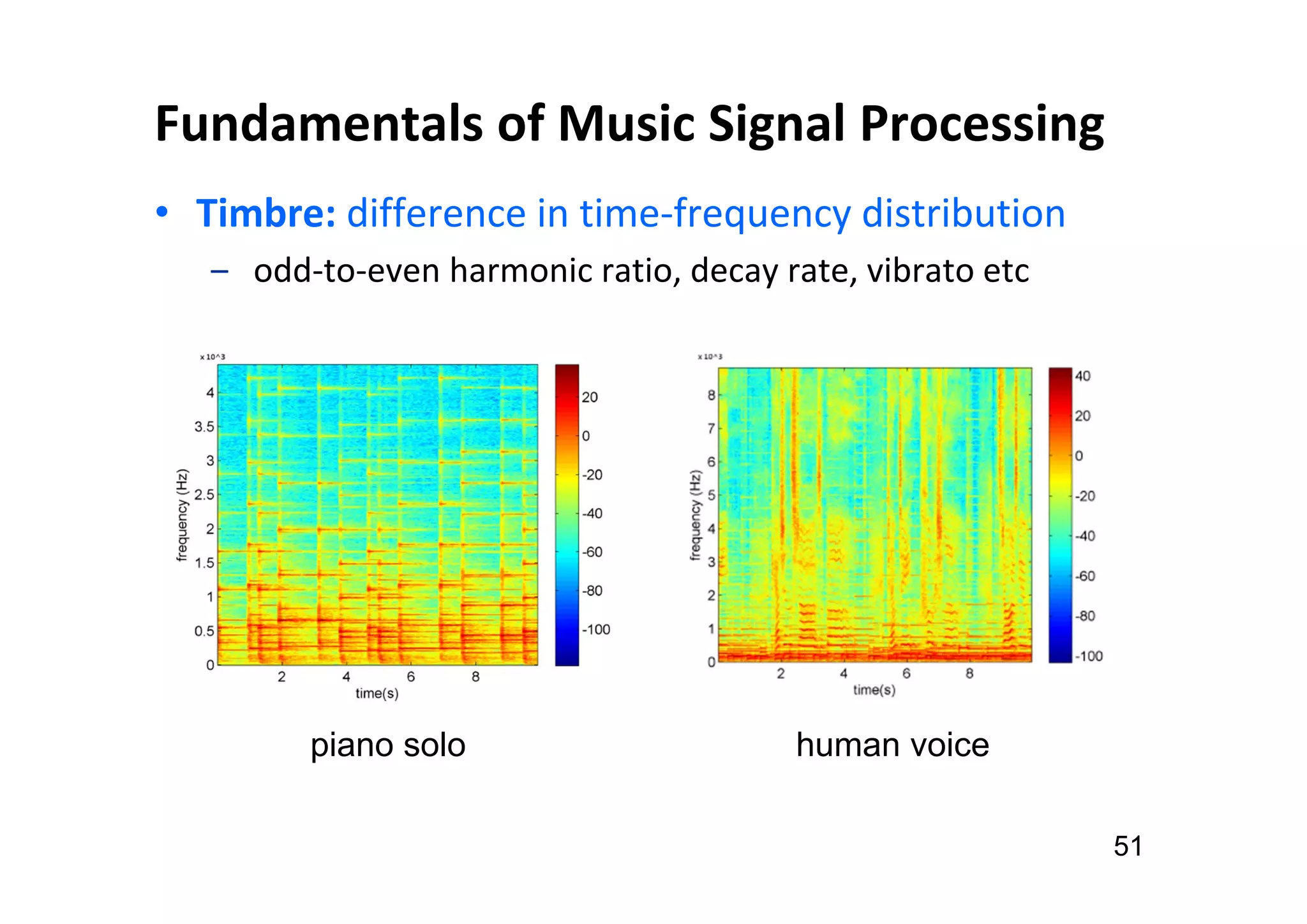
• Timbre: difference in time-frequency distribution
‒ odd-to-even harmonic ratio, decay rate, vibrato etc
51
piano solo human voice
Fundamentals of Music Signal Processing
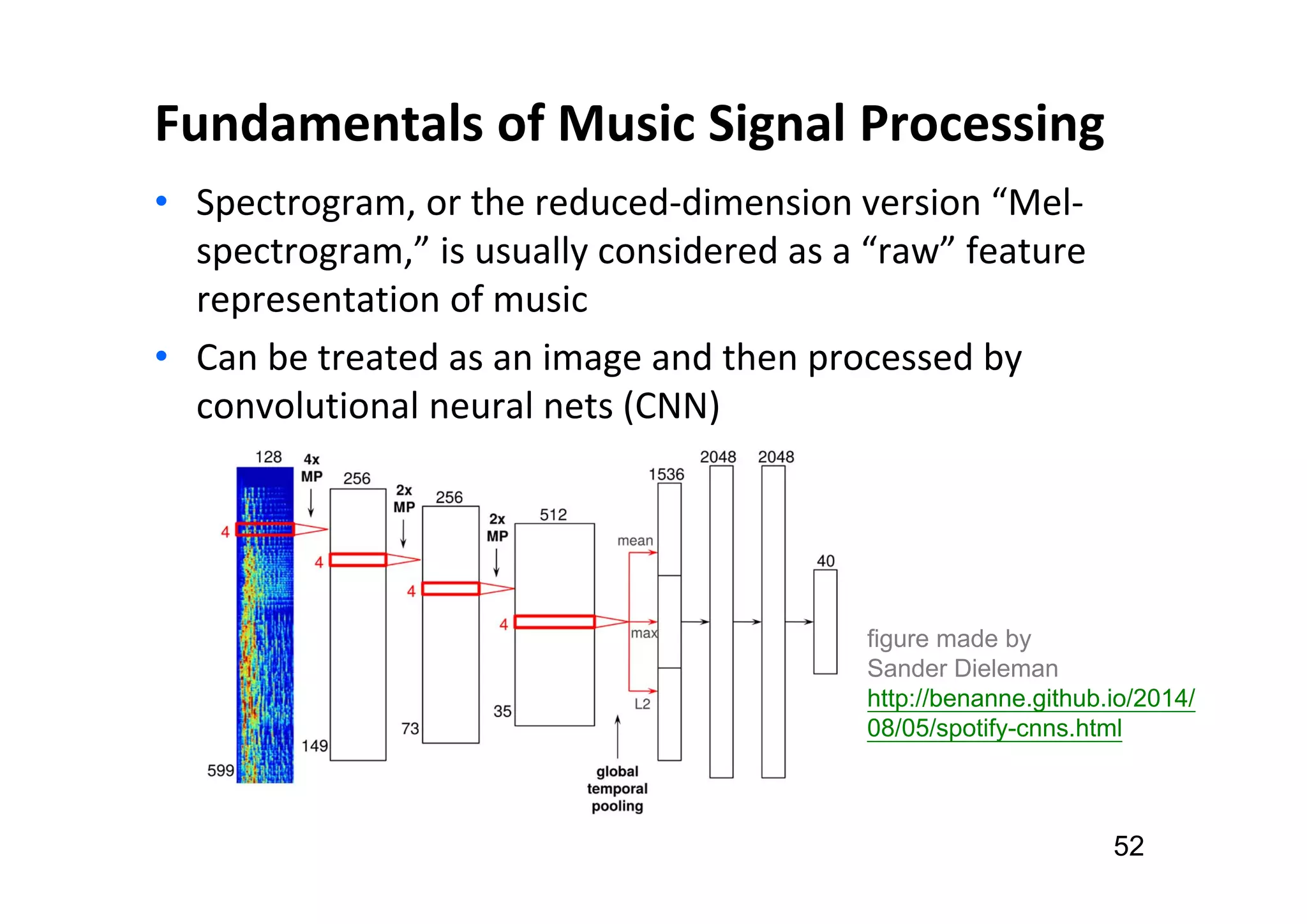
• Spectrogram, or the reduced-dimension version “Mel-
spectrogram,” is usually considered as a “raw” feature
representation of music
• Can be treated as an image and then processed by
convolutional neural nets (CNN)
52
figure made by
Sander Dieleman
http://benanne.github.io/2014/
08/05/spotify-cnns.html
Fundamentals of Music Signal Processing
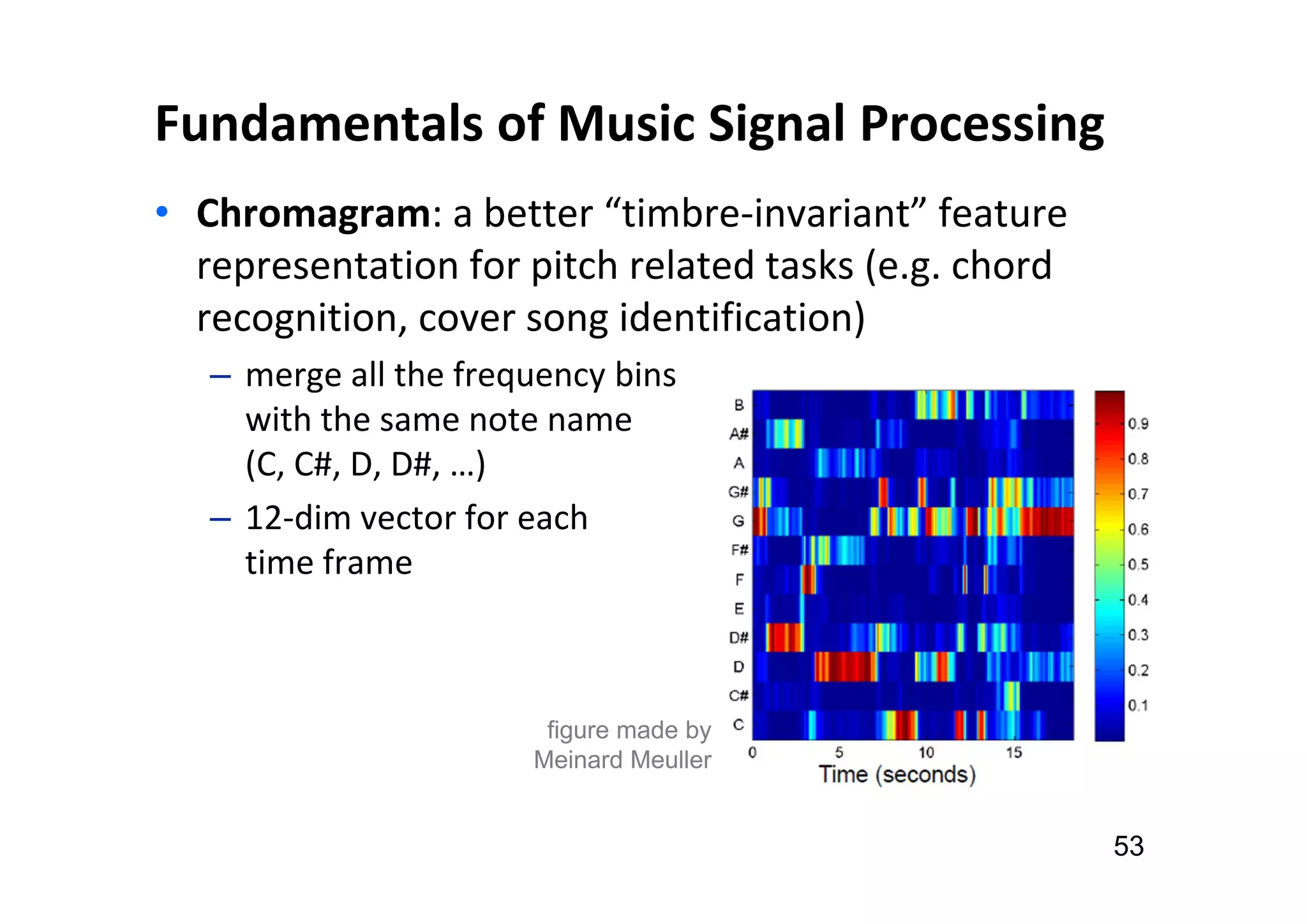
• Chromagram: a better “timbre-invariant” feature
representation for pitch related tasks (e.g. chord
recognition, cover song identification)
‒ merge all the frequency bins
with the same note name
(C, C#, D, D#, …)
‒ 12-dim vector for each
time frame
53
figure made by
Meinard Meuller
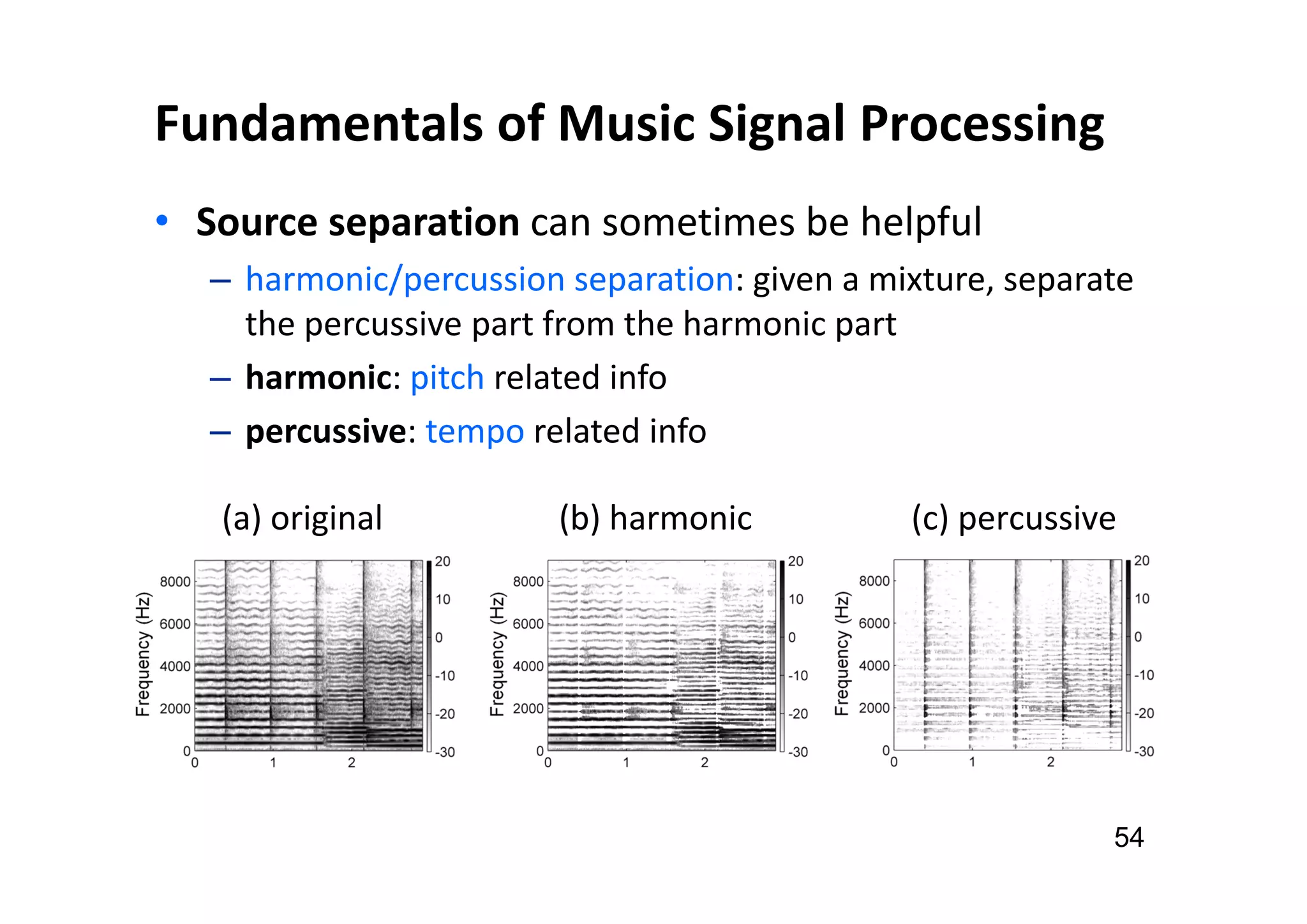
• Source separation can sometimes be helpful
‒ harmonic/percussion separation: given a mixture, separate
the percussive part from the harmonic part
‒ harmonic: pitch related info
‒ percussive: tempo related info
Fundamentals of Music Signal Processing
54
(a) original (b) harmonic (c) percussive
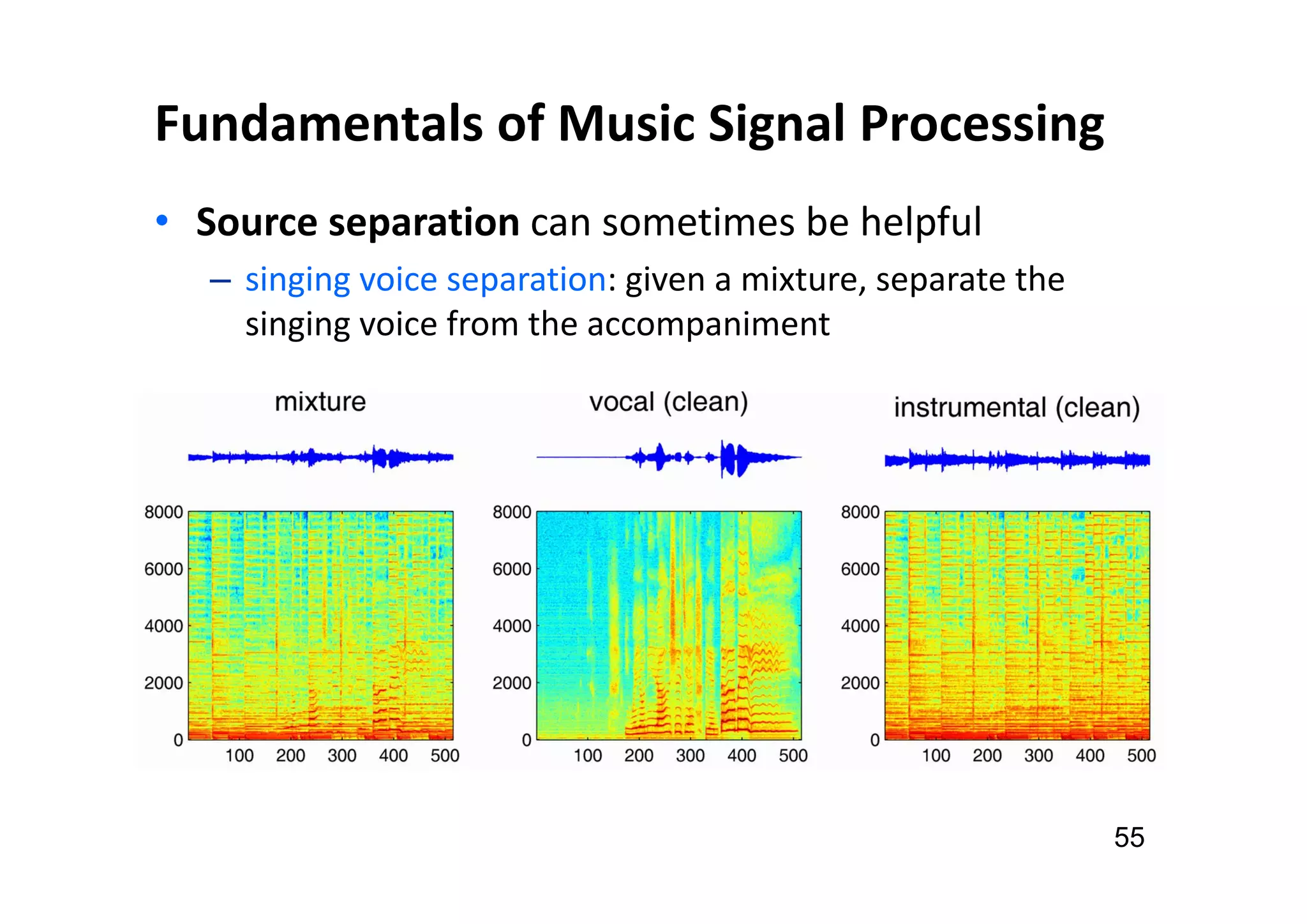
• Source separation can sometimes be helpful
‒ singing voice separation: given a mixture, separate the
singing voice from the accompaniment
Fundamentals of Music Signal Processing
55
Fundamentals of Music Signal Processing
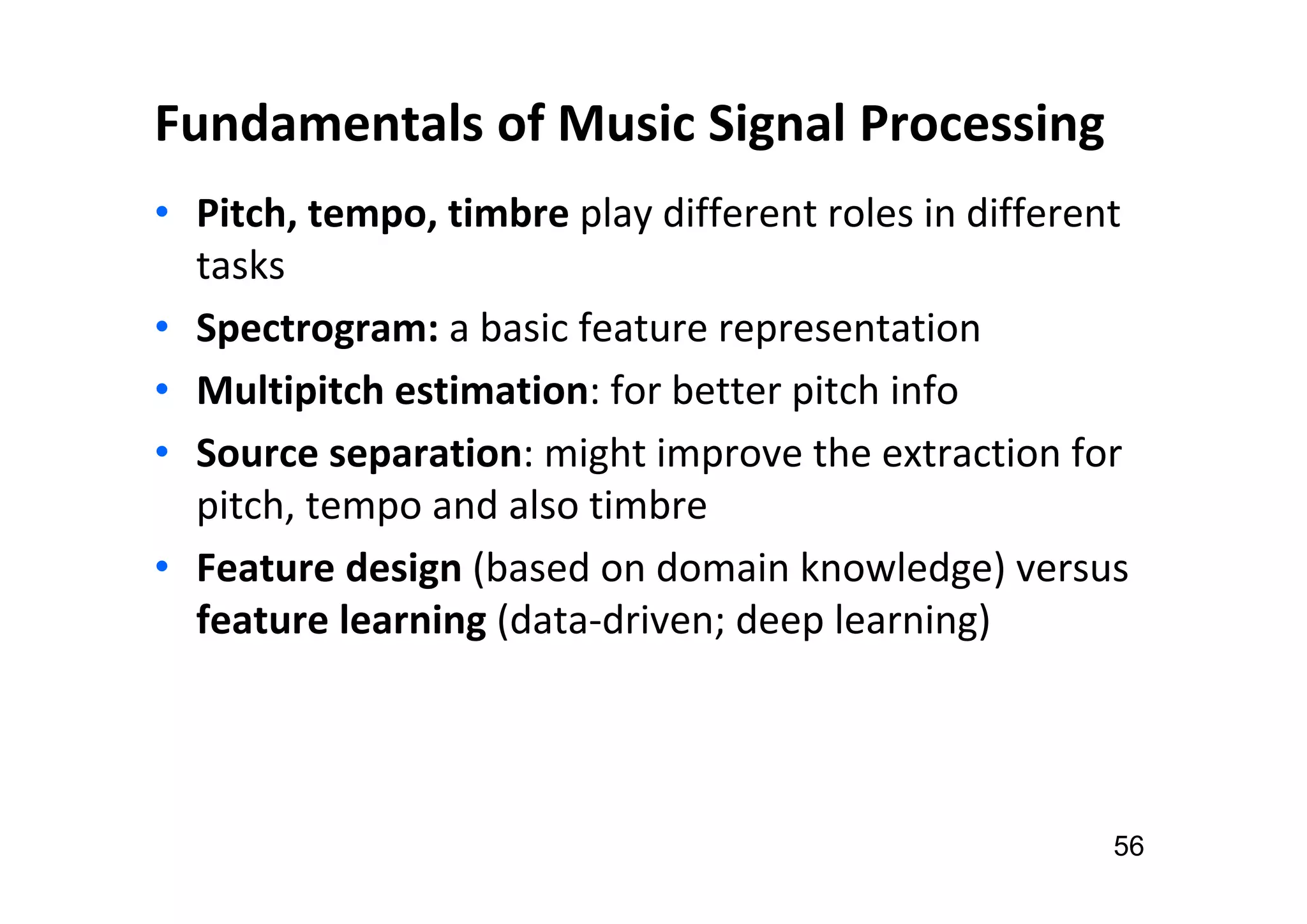
• Pitch, tempo, timbre play different roles in different
tasks
• Spectrogram: a basic feature representation
• Multipitch estimation: for better pitch info
• Source separation: might improve the extraction for
pitch, tempo and also timbre
• Feature design (based on domain knowledge) versus
feature learning (data-driven; deep learning)
56
Outline
• Types of music related research/products
• Fundamentals of music signal processing
• Types of data
57
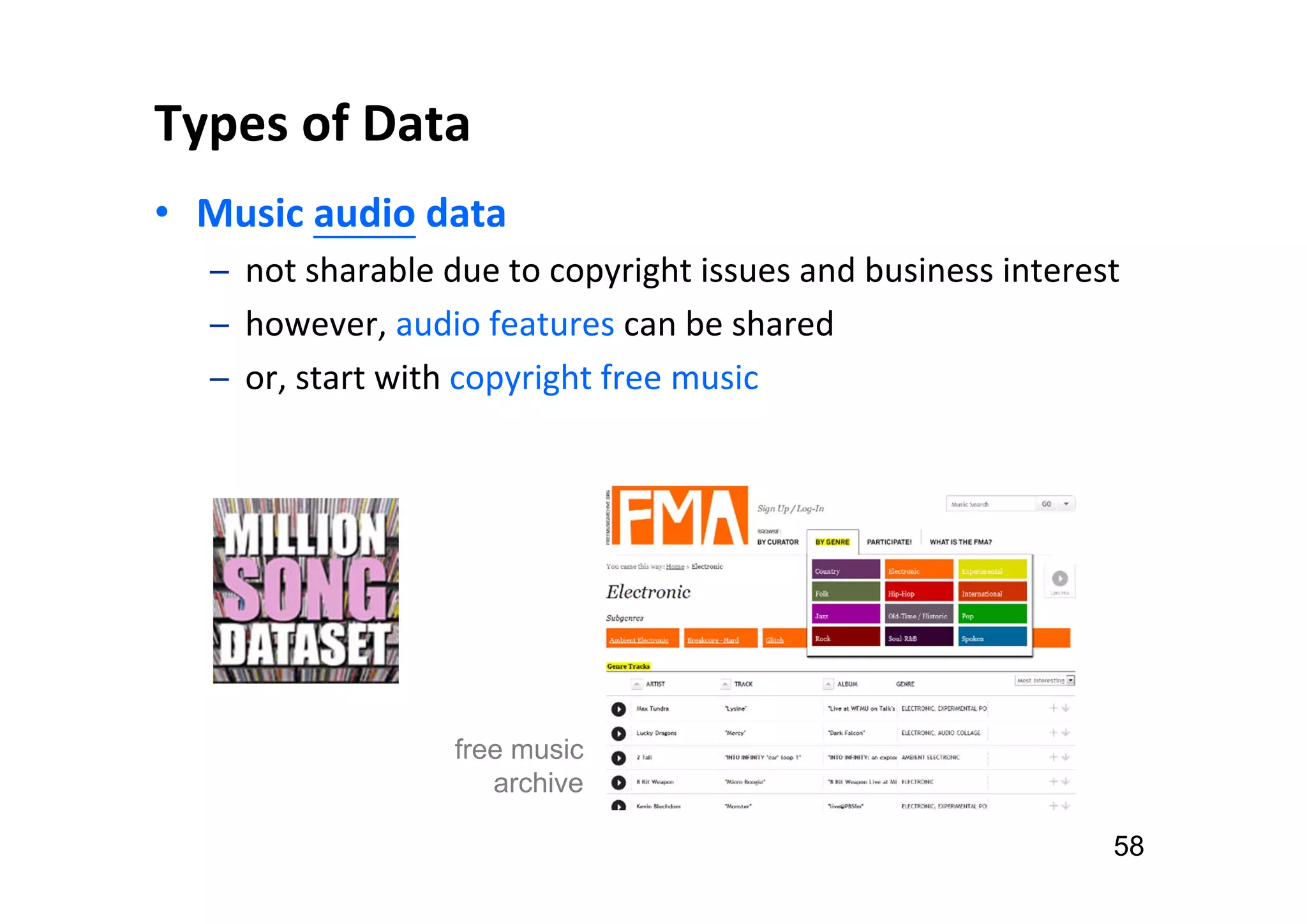
Types of Data
• Music audio data
─ not sharable due to copyright issues and business interest
─ however, audio features can be shared
─ or, start with copyright free music
58
free music
archive
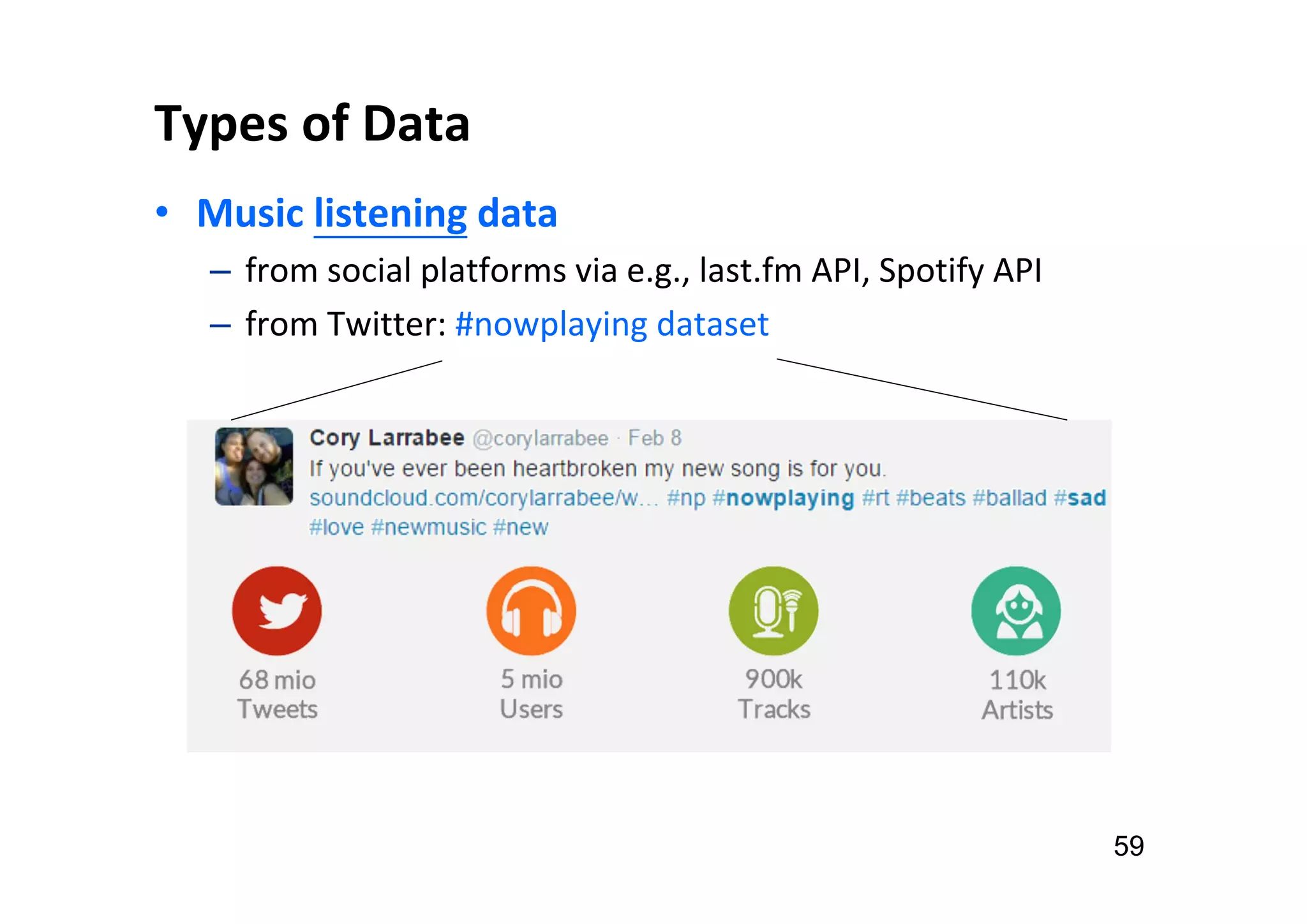
Types of Data
• Music listening data
‒ from social platforms via e.g., last.fm API, Spotify API
‒ from Twitter: #nowplaying dataset
59
Types of Data
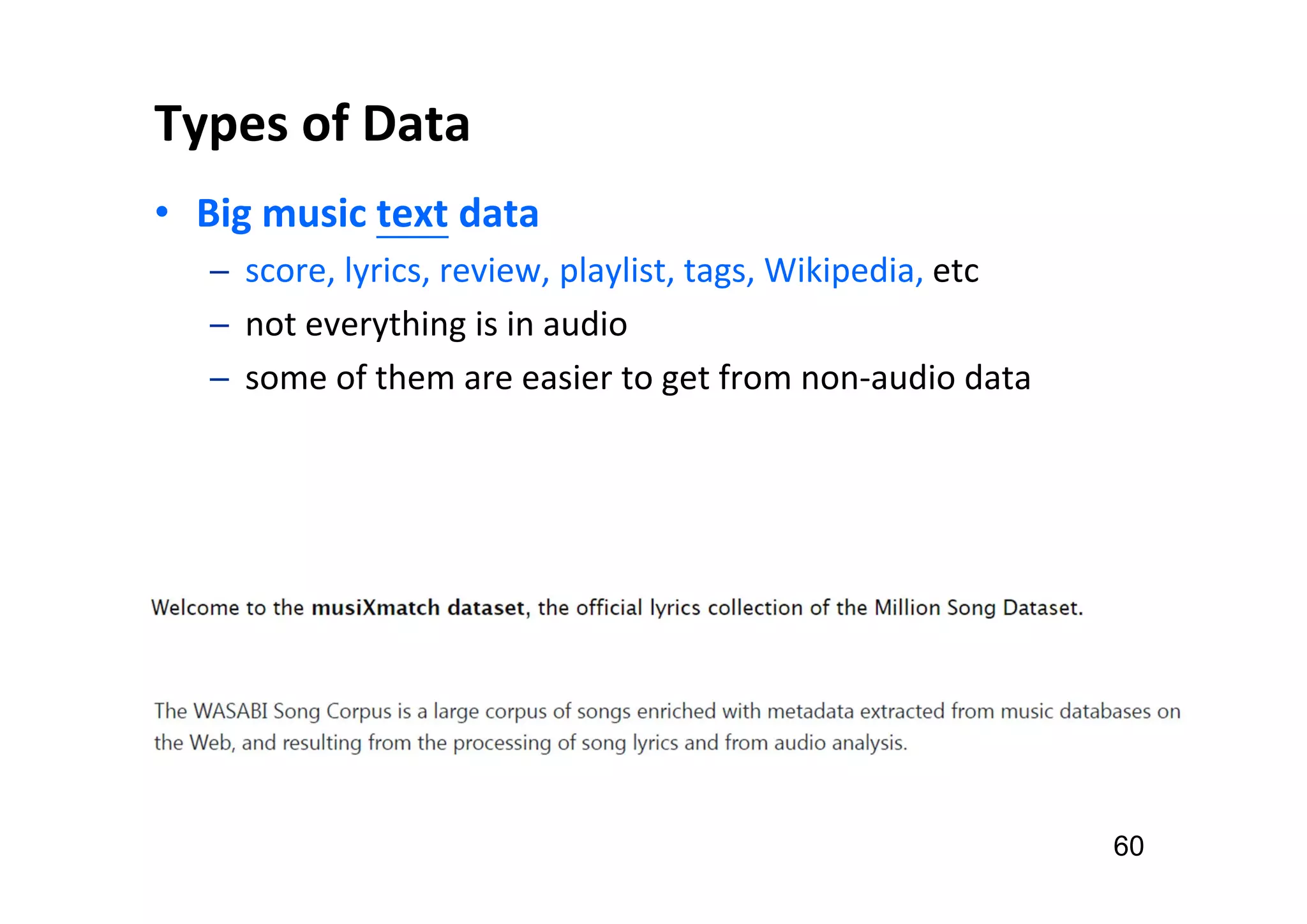
• Big music text data
─ score, lyrics, review, playlist, tags, Wikipedia, etc
─ not everything is in audio
─ some of them are easier to get from non-audio data
60
Types of Data
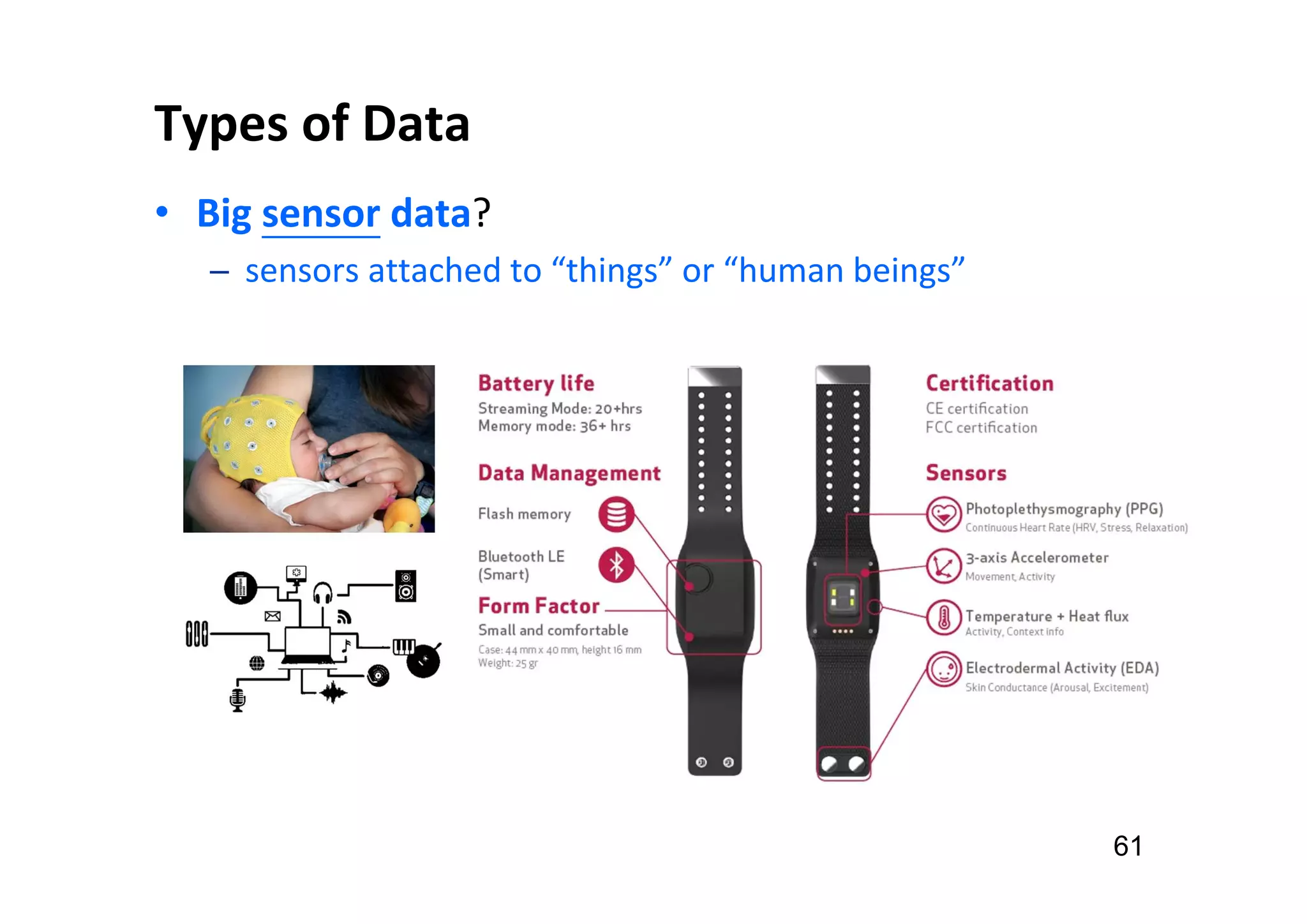
• Big sensor data?
─ sensors attached to “things” or “human beings”
61
Data Science in Music
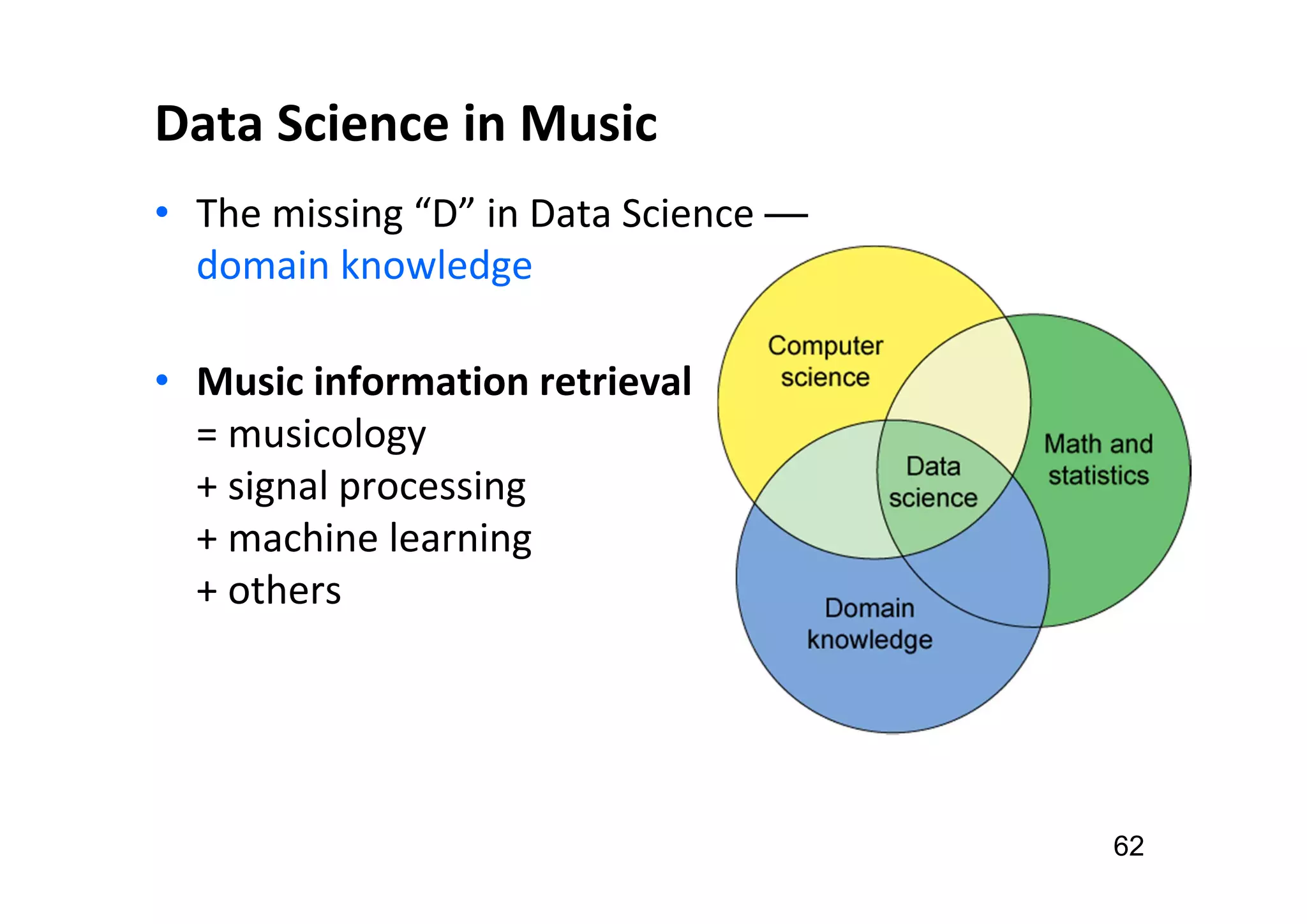
• The missing “D” in Data Science —
domain knowledge
• Music information retrieval
= musicology
+ signal processing
+ machine learning
+ others
62
Resources
• Conference proceedings
‒ Int’l Soc. Music Information Retrieval Conf. (ISMIR)
‒ Int’l Conf. Acoustic, Speech, and Signal Processing (ICASSP)
‒ AAAI, IJCAI, ICML, NeurIPS, ICLR, ACM MM
• Transactions
‒ Transactions of the Int’l Soc. Music Information Retrieval
(TISMIR)
‒ IEEE Trans. Audio, Speech and Language Processing (TASLP)
‒ IEEE Trans. Multimedia (TMM)
63
Resources
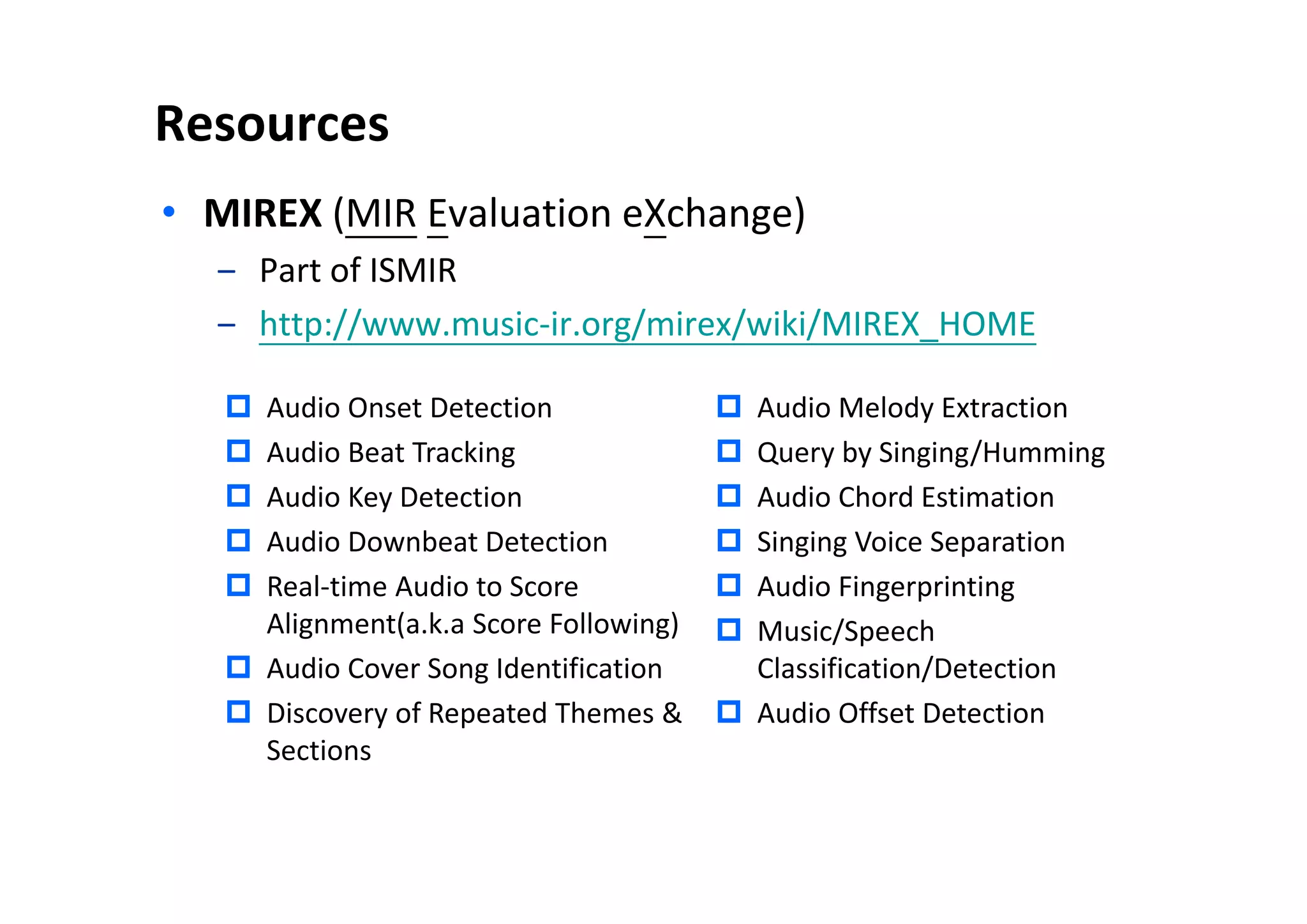
• MIREX (MIR Evaluation eXchange)
‒ Part of ISMIR
‒ http://www.music-ir.org/mirex/wiki/MIREX_HOME
 Audio Onset Detection
 Audio Beat Tracking
 Audio Key Detection
 Audio Downbeat Detection
 Real-time Audio to Score
Alignment(a.k.a Score Following)
 Audio Cover Song Identification
 Discovery of Repeated Themes &
Sections
 Audio Melody Extraction
 Query by Singing/Humming
 Audio Chord Estimation
 Singing Voice Separation
 Audio Fingerprinting
 Music/Speech
Classification/Detection
 Audio Offset Detection
Resources
• Courses
‒ Juhan Nam @ KAIST
https://mac.kaist.ac.kr/~juhan/gct634/index.html
‒ Meinard Meuller @ Universität Erlangen-Nürnberg
https://www.audiolabs-
erlangen.de/fau/professor/mueller/teaching
‒ Juan Bello @ NYU
https://wp.nyu.edu/jpbello/teaching/mir/
‒ CCRMA summer school @ Stanford
https://ccrma.stanford.edu/workshops/music-
information-retrieval-mir-2015
‒ Xavier Serra @ UPF, Spain
https://zh-tw.coursera.org/course/audio
65

20211026 taicca 1 intro to mir

  • 1.
    http://mac.citi.sinica.edu.tw/~yang/ yhyang@ailabs.tw yang@citi.sinica.edu.tw Yi-Hsuan Yang Ph.D.1,2 1 Taiwan AI Labs 2 Research Center for IT Innovation, Academia Sinica October 26, 2021
  • 2.
    About Me • Ph.D.National Taiwan University 2010 • Research Professor, Music & AI Lab, Academia Sinica, since 2011 • Chief Music Scientist, Taiwan AI Labs, 2019/3‒2023/2 • Over 200 publications 2
  • 3.
    About the Musicand AI Lab @ Sinica About Academia Sinica  National academy of Taiwan, founded in 1928  About 1,000 Full/Associate/Assistant Researchers About Music and AI Lab (musicai)  Since Sep 2011  Members  PI [me]  research assistants  PhD/master students 3
  • 4.
    About the MusicAI Team @ About Taiwan AI Labs  Privately-funded research organization, founded by Ethan Tu (PTT) in 2017  Three main research area: 1) HCI, 2) medicine, 3) smart city About the Music AI team  Members  scientist [me; since March 2019]  ML engineers (for models)  musicians  program manager  software engineers (for frontend/backend) 4 (an image of our musicians)
  • 5.
    Outline • Types ofmusic related research/products • Fundamentals of music signal processing • Types of data 9
  • 6.
    Types of MusicRelated Research/Products 10 • Intelligent ways to analyze, retrieve, and create music 1. Music informa- tion analysis 2. Music informa- tion retrieval 3. Music generation music → features query → music X → music
  • 7.
    Types of MusicRelated Research/Products 1. Music information “analysis” 11 automatic page turner automatic Karaoke scoring interactive concert
  • 8.
    Types of MusicRelated Research/Products 1. Music information “analysis” 12 chord recognizer music browsing assistant
  • 9.
    Types of MusicRelated Research/Products 2. Music information “retrieval” • Search ‒ through keywords/labels (genre, instrument, emotion) 13
  • 10.
    Types of MusicRelated Research/Products 2. Music information “retrieval” • Search ‒ through keywords/labels (genre, instrument, emotion) 14 musical event localization J.-Y. Liu and Y.-H. Yang, "Event localization in music auto-tagging," MM 2016
  • 11.
    Types of MusicRelated Research/Products 2. Music information “retrieval” • Search ‒ through keywords/labels (genre, instrument, emotion) ‒ through audio examples (humming, audio recording) 15
  • 12.
    Types of MusicRelated Research/Products 2. Music information “retrieval” • Search ‒ through keywords/labels (genre, instrument, emotion) ‒ through audio examples (humming, audio recording) 16 …
  • 13.
    Types of MusicRelated Research/Products 2. Music information “retrieval” • Match ‒ to match 1) a video clip, 2) a photo slideshow, 3) a song lyrics, or 4) a given context ‒ cross-domain retrieval 17
  • 14.
    Types of MusicRelated Research/Products 2. Music information “retrieval” • Discover ‒ recommendation: diversity, serendipity, explanations 18
  • 15.
    Types of MusicRelated Research/Products 2. Music information “retrieval” • Discover ‒ recommendation: diversity, serendipity, explanations 19
  • 16.
    Types of MusicRelated Research/Products Context Music User • Activity: driving, studying, working, walking • Mood: happy, sad, angry, relaxed • Location: home, work, public place • Social company: alone, w/ friends, w/ strangers • age • gender • personality • cultural background • musical background 2. Music information “retrieval” • Discover ‒ Context-aware Music Recommendation
  • 17.
    Types of MusicRelated Research/Products 3. Music creation 21
  • 18.
    Types of MusicRelated Research/Products 3. Music creation 22 https://www.youtube.com/watch?v=k1DgNfz1g_s
  • 19.
    Types of MusicRelated Research/Products 3. Music creation 23
  • 20.
    Types of MusicRelated Research/Products 3. Music creation 24 http://www.inside.com.tw/2016/05/04/positive-grid-bias-head
  • 21.
    Types of MusicRelated Research/Products 3. Music creation 25 https://youtu.be/rL5YKZ9ecpg?t=50m
  • 22.
    Types of MusicRelated Research/Products 1. Music information analysis • Education, data visualization 2. Music information retrieval • Search: through keywords (genre, instrument, emotion) or audio examples (humming or audio recording) • Match: cross domain retrieval • Discover: recommendation 3. Music creation • Google Magenta, Smule AutoRap, Samsung Hum-On, Positive Grid, Yamaha Vocaloid 26
  • 23.
    ML in Music:“Music Info Retrieval/Analysis” 28 Music transcription (audio2score) • audio → note (pitch, onset, offset) • audio → instrument (flute, cello) • audio → meter (4/4) • audio → key (E-flat major) audio score Music semantic labeling • audio → genre (classical) • audio → emotion (yearning) • audio → other attributes (slow/fast) labels applications in music retrieval, education, archival, etc (existing song) AI listener
  • 24.
    Music transcription (audio2score) •audio → note (pitch, onset, offset) • audio → instrument (flute, cello) • audio → meter (4/4) • audio → key (E-flat major) ML in Music: “Music Generation/Synthesis” 29 audio score Music semantic labeling • audio → genre (classical) • audio → emotion (yearning) • audio → other attributes (slow/fast) labels (new song) AI composer random seed AI performer (score2audio)
  • 25.
    Music transcription (audio2score) •audio → note (pitch, onset, offset) • audio → instrument (flute, cello) • audio → meter (4/4) • audio → key (E-flat major) ML in Music: “Music Generation/Synthesis” 30 audio features Music semantic labeling • audio → genre (classical) • audio → emotion (yearning) • audio → other attributes (slow/fast) labels (existing songs) AI listener score AI DJ audio (a new song) remix, mashup, etc (image from the Internet)
  • 26.
    Music AI Research •Four broad topics  audio → audio: signal processing  audio → score: transcription  score → score: composition  score → audio: synthesis 31
  • 27.
    Outline • Types ofmusic related research/products • Fundamentals of music signal processing • Types of data 32
  • 28.
    Fundamentals of MusicSignal Processing • Pitch: which notes are played? • Rhythm: how fast? • Timbre: which instrument(s)? 33 Mozart’s Variationen (1st phrase)
  • 29.
    Music Information Analysis •music → features 34 melody 1. pitch 2. onset, offset 3. tempo
  • 30.
    Music Information Analysis •music → features 35 accompaniment 4. chord
  • 31.
    Music Information Analysis •music → features 36 5. instruments (timbre)
  • 32.
    Music Information Analysis •music → features 37 6. source separation 7. key, beat, downbeat, meter
  • 33.
    Music Information Analysis •music → features 38 8. Semantic description ─ genre: pop, classical, jazz, rock, R&B, “Tai,” “aboriginal” ─ emotion: happy, angry, sad, relaxed ─ usage: at party, working, driving, reading, sleeping, romance ─ theme: lonely, breakup, celebration, in love, friend, battle ─ vocal timbre: aggressive, breathy, duet, emotional, rapping, screaming genre listening context emotion
  • 34.
    Fundamentals of MusicSignal Processing Pitch ♪♪♪ ♪♪♪ ♪♪♪ Rhythm Timbre ♪♪ 39 Karaoke scorer chord recognizer page turner
  • 35.
    Fundamentals of MusicSignal Processing Pitch ♪♪♪ ♪ Rhythm ♪♪♪ Timbre ♪♪♪ ♪ 40 instrument classifier content ID Spotify running
  • 36.
    Fundamentals of MusicSignal Processing Pitch ♪♪♪ ♪♪♪ ♪♪♪ Rhythm ♪♪♪ ♪♪♪ ♪♪♪ Timbre ♪♪♪ ♪♪♪ ♪♪♪ 41 similarity search or recommendation music emotion or genre recognizer automatic music video generation
  • 37.
    Fundamentals of MusicSignal Processing 42 • Listens to music tempo, instrumentation, key, time signature, energy, harmonic & timbral structures • Reads about music lyrics, blog posts, reviews, playlists and discussion forums • Learns about trends online music behavior — who's talking about which artists this week, what songs are being streamed or downloaded • Not everything is in audio
  • 38.
    Fundamentals of MusicSignal Processing • Let’s have a look at what we can extract from audio anyway • Time-domain waveform 43
  • 39.
    Fundamentals of MusicSignal Processing • Frequency domain representation • Spectrogram (obtained by Short-Time Fourier Transform) 44
  • 40.
    Fundamentals of MusicSignal Processing • Pitch • Simple for monophonic signals (almost table lookup) • Challenging for polyphonic signals; known as multi- pitch estimation (MPE) ‒ overlapping partials ‒ missing fundamentals 45 8ve 8ve 8ve 8ve 8ve L. Su and Y.-H. Yang, "Combining spectral and temporal representations for multipitch estimation of polyphonic music,“ TASLP 2015
  • 41.
    Fundamentals of MusicSignal Processing • Tempo: beats per minute (bpm) • Onset detection, downbeat estimation tempo estimation, beat tracking, rhythm pattern extraction 48 energy-based spectrum-based
  • 42.
    Fundamentals of MusicSignal Processing • Timbre: difference in time-frequency distribution 50
  • 43.
    Fundamentals of MusicSignal Processing • Timbre: difference in time-frequency distribution ‒ odd-to-even harmonic ratio, decay rate, vibrato etc 51 piano solo human voice
  • 44.
    Fundamentals of MusicSignal Processing • Spectrogram, or the reduced-dimension version “Mel- spectrogram,” is usually considered as a “raw” feature representation of music • Can be treated as an image and then processed by convolutional neural nets (CNN) 52 figure made by Sander Dieleman http://benanne.github.io/2014/ 08/05/spotify-cnns.html
  • 45.
    Fundamentals of MusicSignal Processing • Chromagram: a better “timbre-invariant” feature representation for pitch related tasks (e.g. chord recognition, cover song identification) ‒ merge all the frequency bins with the same note name (C, C#, D, D#, …) ‒ 12-dim vector for each time frame 53 figure made by Meinard Meuller
  • 46.
    • Source separationcan sometimes be helpful ‒ harmonic/percussion separation: given a mixture, separate the percussive part from the harmonic part ‒ harmonic: pitch related info ‒ percussive: tempo related info Fundamentals of Music Signal Processing 54 (a) original (b) harmonic (c) percussive
  • 47.
    • Source separationcan sometimes be helpful ‒ singing voice separation: given a mixture, separate the singing voice from the accompaniment Fundamentals of Music Signal Processing 55
  • 48.
    Fundamentals of MusicSignal Processing • Pitch, tempo, timbre play different roles in different tasks • Spectrogram: a basic feature representation • Multipitch estimation: for better pitch info • Source separation: might improve the extraction for pitch, tempo and also timbre • Feature design (based on domain knowledge) versus feature learning (data-driven; deep learning) 56
  • 49.
    Outline • Types ofmusic related research/products • Fundamentals of music signal processing • Types of data 57
  • 50.
    Types of Data •Music audio data ─ not sharable due to copyright issues and business interest ─ however, audio features can be shared ─ or, start with copyright free music 58 free music archive
  • 51.
    Types of Data •Music listening data ‒ from social platforms via e.g., last.fm API, Spotify API ‒ from Twitter: #nowplaying dataset 59
  • 52.
    Types of Data •Big music text data ─ score, lyrics, review, playlist, tags, Wikipedia, etc ─ not everything is in audio ─ some of them are easier to get from non-audio data 60
  • 53.
    Types of Data •Big sensor data? ─ sensors attached to “things” or “human beings” 61
  • 54.
    Data Science inMusic • The missing “D” in Data Science — domain knowledge • Music information retrieval = musicology + signal processing + machine learning + others 62
  • 55.
    Resources • Conference proceedings ‒Int’l Soc. Music Information Retrieval Conf. (ISMIR) ‒ Int’l Conf. Acoustic, Speech, and Signal Processing (ICASSP) ‒ AAAI, IJCAI, ICML, NeurIPS, ICLR, ACM MM • Transactions ‒ Transactions of the Int’l Soc. Music Information Retrieval (TISMIR) ‒ IEEE Trans. Audio, Speech and Language Processing (TASLP) ‒ IEEE Trans. Multimedia (TMM) 63
  • 56.
    Resources • MIREX (MIREvaluation eXchange) ‒ Part of ISMIR ‒ http://www.music-ir.org/mirex/wiki/MIREX_HOME  Audio Onset Detection  Audio Beat Tracking  Audio Key Detection  Audio Downbeat Detection  Real-time Audio to Score Alignment(a.k.a Score Following)  Audio Cover Song Identification  Discovery of Repeated Themes & Sections  Audio Melody Extraction  Query by Singing/Humming  Audio Chord Estimation  Singing Voice Separation  Audio Fingerprinting  Music/Speech Classification/Detection  Audio Offset Detection
  • 57.
    Resources • Courses ‒ JuhanNam @ KAIST https://mac.kaist.ac.kr/~juhan/gct634/index.html ‒ Meinard Meuller @ Universität Erlangen-Nürnberg https://www.audiolabs- erlangen.de/fau/professor/mueller/teaching ‒ Juan Bello @ NYU https://wp.nyu.edu/jpbello/teaching/mir/ ‒ CCRMA summer school @ Stanford https://ccrma.stanford.edu/workshops/music- information-retrieval-mir-2015 ‒ Xavier Serra @ UPF, Spain https://zh-tw.coursera.org/course/audio 65