MEASLES (RUBEOLA)
By – Shreya P
Introduction
• DEFINITION - An acute highly infectious disease of
childhood caused by a specific group of MYXOVIRUSES.
• Clinically characterized by fever and catarrhal symptoms
of URT followed by a typical rash.
• Associated with high morbidity and mortality in developing
countries.
• VIRTUALLY ENDEMIC in all parts of the world.
• In India, measles is a major cause of morbidity and
significant contributor to childhood mortality however the
rate has decreased after immunization programme.
Epidemiological determinants
• AGENT – Caused by an RNA virus
Cannot survive outside human body
• SOURCE – Case of measles by droplet nuclei
• ONSET - from 4 days before onset of rash until 5 days
thereafter
• MODE OF TRANSMISSION – Secretions of URT during
prodromal period and early stage of rash (highly infectious)
• INCUBATION PERIOD – 10 days from exposure to onset of
fever and 14 days to appearance of rash
• Infection confers lifelong immunity
• Maternal immunity usually lasts up to 6 months in infants
• HOST – 6 months to 3 years in developing countries
Usually over 5 years in developed countries
Epidemics are common in India during winter and early spring.
Clinical Features
• 3 Stages
PRODORMAL STAGE – 10 days after infection and lasts
till day 14
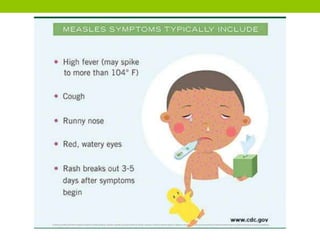
Fever, coryza with sneezing and nasal discharge, cough,
redness in eyes, lacrimation and often photophobia
Rarely – vomiting and diarrhoea
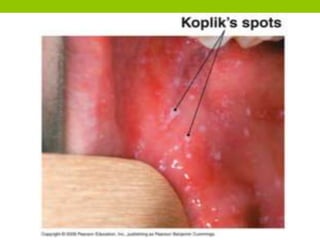
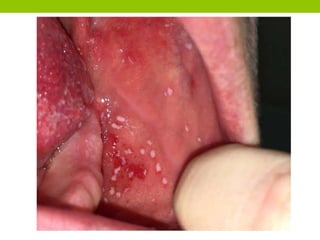
Pathognomic sign – KOPLIX SPOTS :- They are small
bluish-white spots on a red base, smaller than the head of
a pin appearing on buccal mucosa opposite to first and
second upper molars.
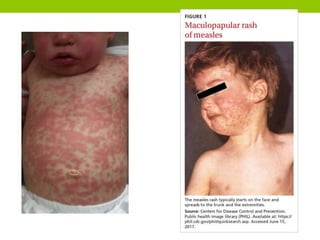
ERUPTIVE PHASE – Characterized by typical dusky-red
macular or maculopapular rash which begins behind ears and
spreads rapidly over face and neck and extends down the body
taking 2 to 3 days to progress to the lower extremities
Rash may remain discrete but often becomes confluent and
blotchy.
Fades in the same order of appearance leaving a brownish
discoloration which may persist for 2 months or more.
In developed countries, where measles is uncommon, specific
IgM antibodies are being used for diagnosis.
• POST-MEASLES STAGE – The child will have lost weight
and will remain weak for a number of days.
There may be – failure to recover and gradual deterioration
into chronic illness due to increased susceptibility to other
infections, growth retardation, diarrhoea, reactivation of
pulmonary TB etc.
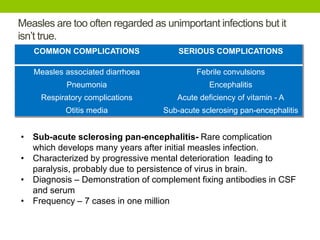
Measles are too often regarded as unimportant infections but it
isn’t true.
COMMON COMPLICATIONS SERIOUS COMPLICATIONS
Measles associated diarrhoea Febrile convulsions
Pneumonia Encephalitis
Respiratory complications Acute deficiency of vitamin - A
Otitis media Sub-acute sclerosing pan-encephalitis
• Sub-acute sclerosing pan-encephalitis- Rare complication
which develops many years after initial measles infection.
• Characterized by progressive mental deterioration leading to
paralysis, probably due to persistence of virus in brain.
• Diagnosis – Demonstration of complement fixing antibodies in CSF
and serum
• Frequency – 7 cases in one million
• Encephalitis is another rare complication. The cause is
unknown.
• Measles vaccination definitely constitutes a protection
against the neurological and other complications by
preventing natural measles from occurring.
• All cases of severe measles and all cases of measles in
areas of high fatality rate should be treated with Vitamin-A
as many children may develop deficiency leading to
keratomalacia and blindness from corneal scarring.
• MEASLES AND CHICKENPOX – May occur together and
the most remarkable finding in cases of double infection is
that the first infection may diminish the severity of rash of
the second infection.
PREVENTION
MEASLES VACCINATION -
• Best prevented by active immunization.
• All tissue cultured vaccine – either chick embryo or human
diploid cell line.
• Principle problem – before 9 months of age runs the risk of
vaccine being rendered ineffective by natural antibodies
acquired through mother. Immunization later than 9 months
means that significant proportion of children will contract
measles in interval between wearing off natural protection and
introduction of vaccine. Therefore, the most effective
compromise is immunization closed to 9 months of age.
• The vaccine is presented as a freeze dried product.
• Prevented by MMR vaccine – 1st- 9 – 15 months
2nd – 15 m – 6 years ( 4 wks. apart)
• The WHO Expanded Programme on Immunization
recommends immunization at 9 months age. This age can be
to 6 months, if there is measles outbreak in the community. For
infants immunized between 6 and 9 months, a second dose
should be administered after 4 weeks have elapsed.
• ADMINISTRATION - A single subcutaneous dose of 0.5 ml
• Kept cold at 4-8 degree Celsius.
• REACTION- Induces a mild measles illness 5-10 days after
immunized reaction but in reduced frequency and severity.
• 95% protection
• Immunity develops after 11-12 days.
• CONTACTS – susceptible contacts over 9 - 12 months may be
protected when given within 3 days.
• CONTRAINDICATION - Pregnancy is a contraindication along
with use of steroids and immunosuppressive drugs.
• ADVERSE EFFECTS– Contaminated vaccine can cause TSS.
Vaccine should not be used 4 hours after opening the vial.
Symptoms of TSS – watery diarrhoea, vomiting and high fever
within a few hours.
HIGH FATALITY RATE WITHIN 48 YEARS
• Combined vaccine – combined with MUMPS and RUBELLA
vaccine (highly effective).
• Passive immunization – administration of immunoglobulin
(human) early in incubation period.
Dose – 0.25ml per kg body weight
Should be given within 3 – 4 days of exposure.
8 – 12 weeks later – live measles vaccine is administered.
• Its is believed that measles is amenable to eradication.
Control Measures
Isolation for 7 days after onset of rash.
Immunization of contacts within 2 days of exposure ( if
vaccine contraindicated – immunoglobulin administration
within 3 – 4 days)
Prompt immunization at the beginning of an epidemic is
essential to limit the spread.

Measles (rubeola)

  • 1.
  • 2.
    Introduction • DEFINITION -An acute highly infectious disease of childhood caused by a specific group of MYXOVIRUSES. • Clinically characterized by fever and catarrhal symptoms of URT followed by a typical rash. • Associated with high morbidity and mortality in developing countries. • VIRTUALLY ENDEMIC in all parts of the world. • In India, measles is a major cause of morbidity and significant contributor to childhood mortality however the rate has decreased after immunization programme.
  • 3.
    Epidemiological determinants • AGENT– Caused by an RNA virus Cannot survive outside human body • SOURCE – Case of measles by droplet nuclei • ONSET - from 4 days before onset of rash until 5 days thereafter • MODE OF TRANSMISSION – Secretions of URT during prodromal period and early stage of rash (highly infectious) • INCUBATION PERIOD – 10 days from exposure to onset of fever and 14 days to appearance of rash • Infection confers lifelong immunity • Maternal immunity usually lasts up to 6 months in infants • HOST – 6 months to 3 years in developing countries Usually over 5 years in developed countries Epidemics are common in India during winter and early spring.
  • 4.
    Clinical Features • 3Stages PRODORMAL STAGE – 10 days after infection and lasts till day 14 Fever, coryza with sneezing and nasal discharge, cough, redness in eyes, lacrimation and often photophobia Rarely – vomiting and diarrhoea Pathognomic sign – KOPLIX SPOTS :- They are small bluish-white spots on a red base, smaller than the head of a pin appearing on buccal mucosa opposite to first and second upper molars.
  • 8.
    ERUPTIVE PHASE –Characterized by typical dusky-red macular or maculopapular rash which begins behind ears and spreads rapidly over face and neck and extends down the body taking 2 to 3 days to progress to the lower extremities Rash may remain discrete but often becomes confluent and blotchy. Fades in the same order of appearance leaving a brownish discoloration which may persist for 2 months or more. In developed countries, where measles is uncommon, specific IgM antibodies are being used for diagnosis.
  • 10.
    • POST-MEASLES STAGE– The child will have lost weight and will remain weak for a number of days. There may be – failure to recover and gradual deterioration into chronic illness due to increased susceptibility to other infections, growth retardation, diarrhoea, reactivation of pulmonary TB etc.
  • 11.
    Measles are toooften regarded as unimportant infections but it isn’t true. COMMON COMPLICATIONS SERIOUS COMPLICATIONS Measles associated diarrhoea Febrile convulsions Pneumonia Encephalitis Respiratory complications Acute deficiency of vitamin - A Otitis media Sub-acute sclerosing pan-encephalitis • Sub-acute sclerosing pan-encephalitis- Rare complication which develops many years after initial measles infection. • Characterized by progressive mental deterioration leading to paralysis, probably due to persistence of virus in brain. • Diagnosis – Demonstration of complement fixing antibodies in CSF and serum • Frequency – 7 cases in one million
  • 12.
    • Encephalitis isanother rare complication. The cause is unknown. • Measles vaccination definitely constitutes a protection against the neurological and other complications by preventing natural measles from occurring. • All cases of severe measles and all cases of measles in areas of high fatality rate should be treated with Vitamin-A as many children may develop deficiency leading to keratomalacia and blindness from corneal scarring. • MEASLES AND CHICKENPOX – May occur together and the most remarkable finding in cases of double infection is that the first infection may diminish the severity of rash of the second infection.
  • 13.
    PREVENTION MEASLES VACCINATION - •Best prevented by active immunization. • All tissue cultured vaccine – either chick embryo or human diploid cell line. • Principle problem – before 9 months of age runs the risk of vaccine being rendered ineffective by natural antibodies acquired through mother. Immunization later than 9 months means that significant proportion of children will contract measles in interval between wearing off natural protection and introduction of vaccine. Therefore, the most effective compromise is immunization closed to 9 months of age. • The vaccine is presented as a freeze dried product. • Prevented by MMR vaccine – 1st- 9 – 15 months 2nd – 15 m – 6 years ( 4 wks. apart)
  • 14.
    • The WHOExpanded Programme on Immunization recommends immunization at 9 months age. This age can be to 6 months, if there is measles outbreak in the community. For infants immunized between 6 and 9 months, a second dose should be administered after 4 weeks have elapsed. • ADMINISTRATION - A single subcutaneous dose of 0.5 ml • Kept cold at 4-8 degree Celsius. • REACTION- Induces a mild measles illness 5-10 days after immunized reaction but in reduced frequency and severity. • 95% protection • Immunity develops after 11-12 days. • CONTACTS – susceptible contacts over 9 - 12 months may be protected when given within 3 days.
  • 15.
    • CONTRAINDICATION -Pregnancy is a contraindication along with use of steroids and immunosuppressive drugs. • ADVERSE EFFECTS– Contaminated vaccine can cause TSS. Vaccine should not be used 4 hours after opening the vial. Symptoms of TSS – watery diarrhoea, vomiting and high fever within a few hours. HIGH FATALITY RATE WITHIN 48 YEARS • Combined vaccine – combined with MUMPS and RUBELLA vaccine (highly effective). • Passive immunization – administration of immunoglobulin (human) early in incubation period. Dose – 0.25ml per kg body weight Should be given within 3 – 4 days of exposure. 8 – 12 weeks later – live measles vaccine is administered. • Its is believed that measles is amenable to eradication.
  • 16.
    Control Measures Isolation for7 days after onset of rash. Immunization of contacts within 2 days of exposure ( if vaccine contraindicated – immunoglobulin administration within 3 – 4 days) Prompt immunization at the beginning of an epidemic is essential to limit the spread.