Digital Natives Seminar:
Open Access, Predatory
Publishing & Constellation
3.15.2017
Sarah Kurpiel, Emerging Technologies Librarian
Katy Scullin, Archives & Special Collections Librarian
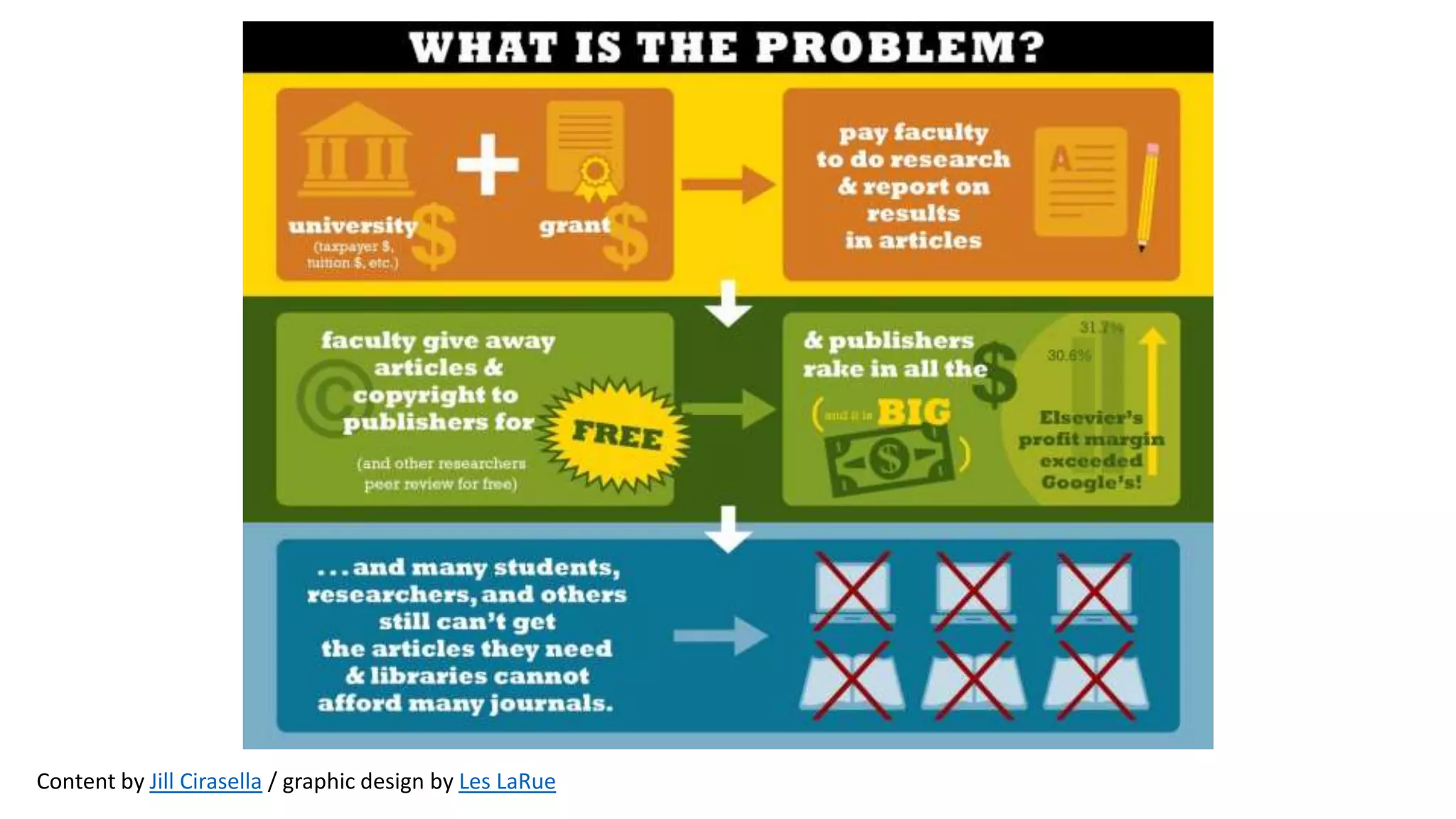
Content by Jill Cirasella / graphic design by Les LaRue
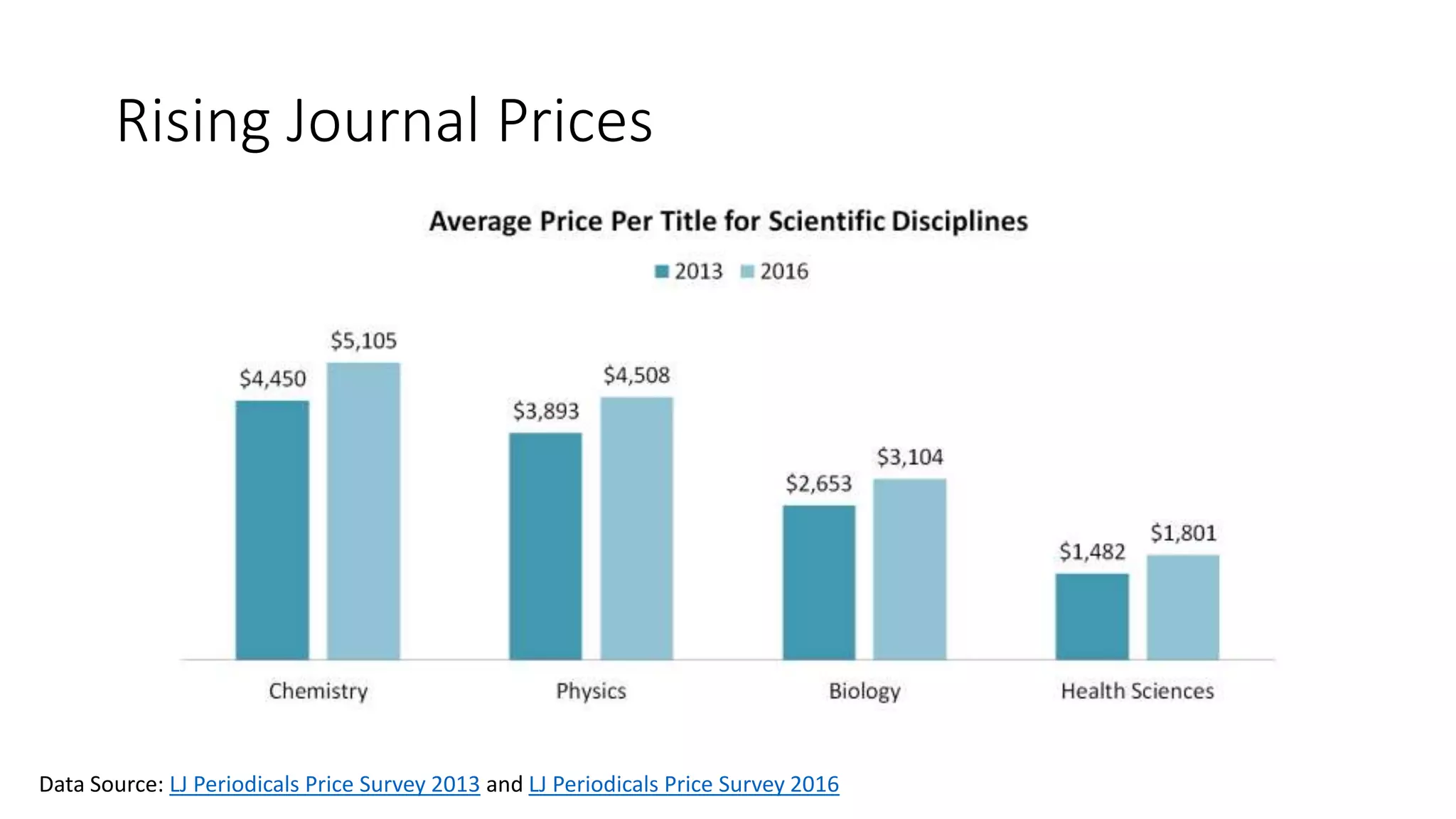
Rising Journal Prices
Data Source: LJ Periodicals Price Survey 2013 and LJ Periodicals Price Survey 2016
Publisher (Typically) Retains Copyright
Myth
Faculty can freely use their own
published content in courses they
teach.
Fact
This is often not true. If you
transferred your copyright to the
publisher at the time of
publication, as most authors do,
the publisher may restrict your
right to re-use your content.
Source: Busting OA Myths by UNC Health Sciences Library
Open Access
In 2002, the Budapest Open Access
Initiative defined open access as the
“world-wide electronic distribution of
the peer-reviewed journal literature and
completely free and unrestricted access
to it by all scientists, scholars, teachers,
students, and other curious minds.”
Gold Open Access
Author publishes with an open access publisher and the work is freely available
from the moment of publication.
How It Works
• Open Access Journals
• Publisher may be commercial or nonprofit.
• Article published under Creative Commons Attribution License.
• Author retains copyright.
• Various funding strategies:
• Article Processing Charges (APC)
• Subsidies from institutions
• Advertising
• Membership fees
• Hybrid Journals
• Delayed Open Access Journals
Peer Reviewed Open Access Journals
• The economic or access policy of a journal doesn’t determine its peer
review policy. Most scholarly journals , whether open access or
controlled-access, follow peer-review procedures.
• Public Library of Science (PLoS) – Nonprofit publisher
• BioMed Central (BMC) – For-profit publisher
• Directory of Open Access Journals (DOAJ) – Nonprofit index
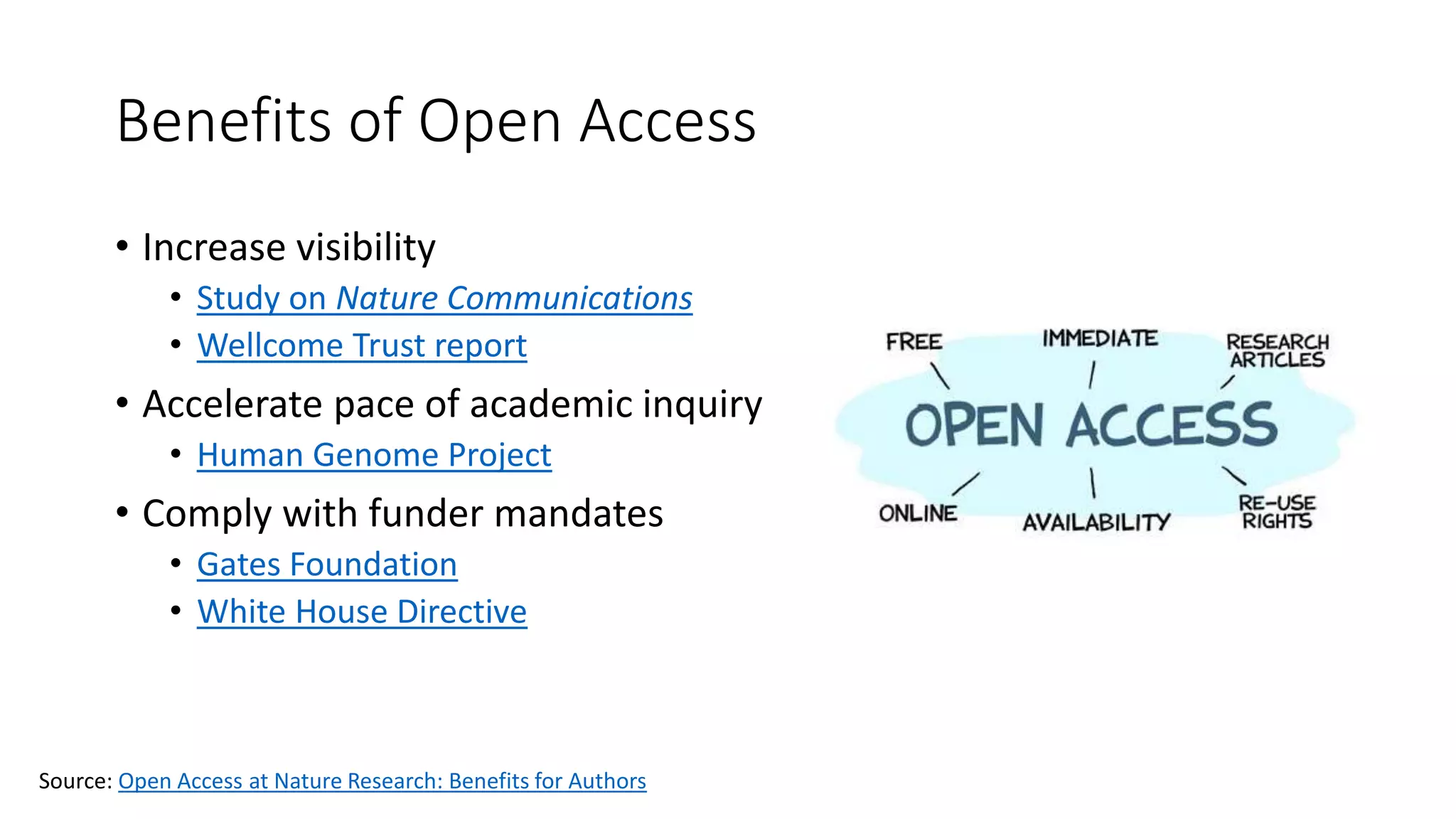
Benefits of Open Access
• Increase visibility
• Study on Nature Communications
• Wellcome Trust report
• Accelerate pace of academic inquiry
• Human Genome Project
• Comply with funder mandates
• Gates Foundation
• White House Directive
Source: Open Access at Nature Research: Benefits for Authors
Predatory Publishers
• They exist to make money by taking advantage of the “author-pays
model” of open access journal publishing.
• They engage in questionable business practices, such as charging
excessive author fees or failing to disclose publication fees to
potential authors.
• They fail to follow accepted standards of scholarly publishing,
particularly in regards to peer review.
Source: “Predatory Publishers” by Julia K. Nims available under CC BY-NC-SA 4.0
Federal Trade Commission v. OMICS GROUP INC.
• Lawsuit filed in August 2016
• Allegations:
• Publisher hides its fees until the papers have been accepted, making it
difficult for authors to pull their articles and submit to other journals.
• Many articles are not peer-reviewed.
• Many scientists listed on editorial boards never agreed to appear there.
• Some journals have names very similar to legitimate publications.
• Publisher calculated its own impact scores without disclosing that fact.
• Publisher includes names of prominent researchers as participants at the
conferences when many did not agree to participate.
Source: “FTC Charges Academic Journal Publisher OMICS Group Deceived Researchers”. Federal Trade Commission. 8/26/2016.
Identifying Predatory Journals
• Quality Indicators
• Open Access Journal Quality Indicators - Grand Valley State University
• Think. Check. Submit. - COPE, DOAJ, SPARC, BioMed Central, and other orgs.
• Beall’s List of Predatory Publishers (archived Jan. 2017)
• Potential, possible, or probable predatory scholarly open-access journals -
Scholarly Open Access (1,312 journals)
• Potential, possible, or probable predatory scholarly open-access publishers -
Scholarly Open Access (1,162 publishers)
Green Open Access
Author adds a version of their article to a repository to allow for free access. Also
called self-archiving.
Institutional Repositories
• An online archive for collecting, preserving, and disseminating digital
copies of the intellectual output of a university or research
institution.
• Types of items that may appear in an institutional repository:
• Copies of published scholarly articles
• Research data
• Student scholarship (theses, dissertations, etc.)
• Archival materials
• Controversial repositories
• ResearchGate.net, Academia.edu, Sci-Hub
SHERPA/RoMEO
• A searchable database of publisher’s policies regarding the self-
archiving of journal articles on the web and in Open Access
repositories.
• http://www.sherpa.ac.uk/romeo/index.php
SPARC Author Addendum
• A legal instrument created by the Scholarly Publishing and Academic
Resources Coalition (SPARC) that you can use to modify your
copyright transfer agreements with non-Open Access journal
publishers. It allows you to select which individual rights out of the
bundle of copyrights you want to keep, such as:
• Distributing copies in the course of teaching and research,
• Posting the article on a personal or institutional website, or
• Creating derivative works.
Source: Author Rights: Using the SPARC Author Addendum
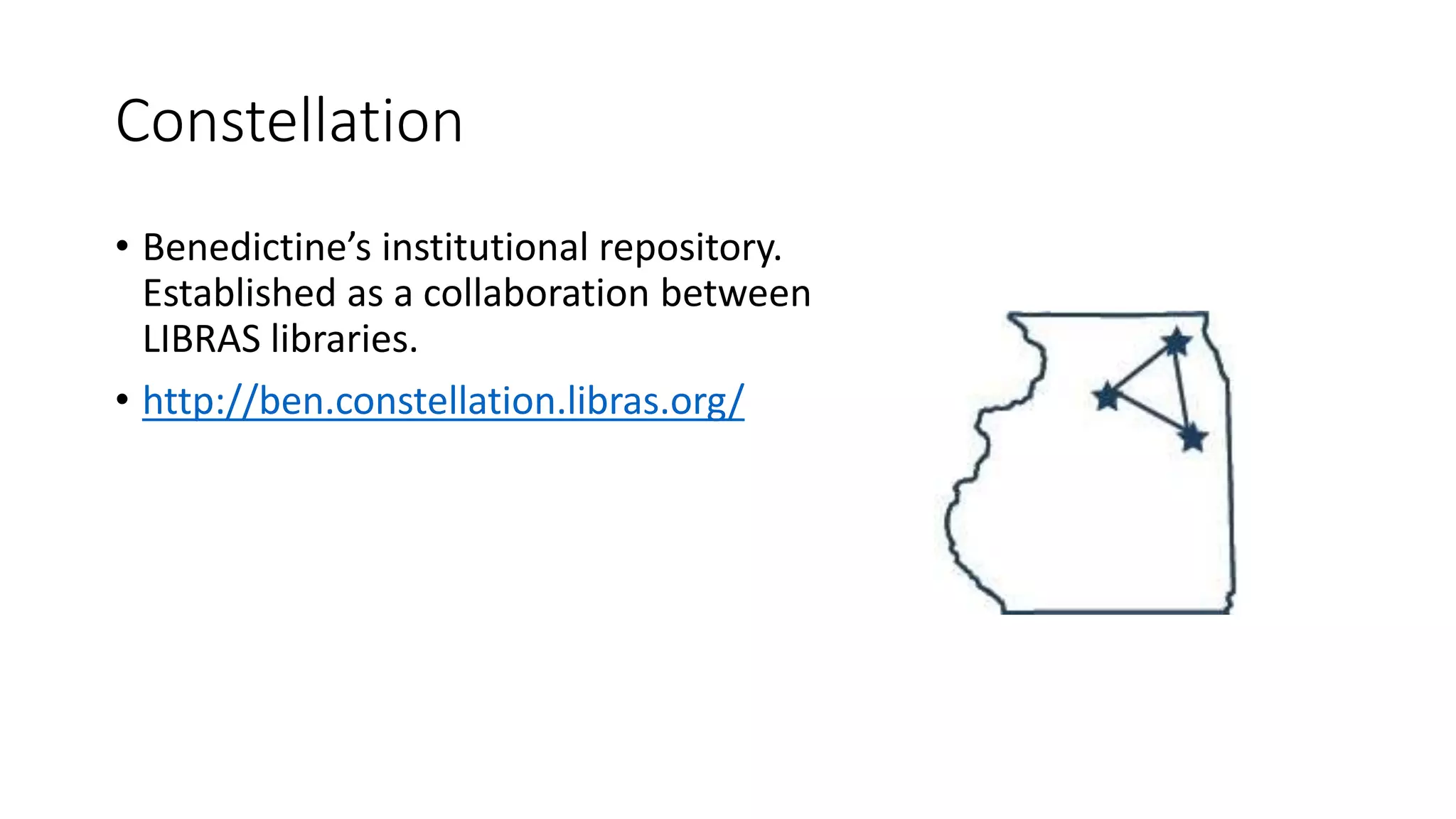
Constellation
• Benedictine’s institutional repository.
Established as a collaboration between
LIBRAS libraries.
• http://ben.constellation.libras.org/
Thank You!
Presenters
Sarah Kurpiel
Emerging Technologies Librarian
skurpiel@ben.edu
Katy Scullin
Archives & Special Collections
Librarian
kscullin@ben.edu

2017 03 open-access_public

  • 1.
    Digital Natives Seminar: OpenAccess, Predatory Publishing & Constellation 3.15.2017 Sarah Kurpiel, Emerging Technologies Librarian Katy Scullin, Archives & Special Collections Librarian
  • 2.
    Content by JillCirasella / graphic design by Les LaRue
  • 3.
    Rising Journal Prices DataSource: LJ Periodicals Price Survey 2013 and LJ Periodicals Price Survey 2016
  • 4.
    Publisher (Typically) RetainsCopyright Myth Faculty can freely use their own published content in courses they teach. Fact This is often not true. If you transferred your copyright to the publisher at the time of publication, as most authors do, the publisher may restrict your right to re-use your content. Source: Busting OA Myths by UNC Health Sciences Library
  • 5.
    Open Access In 2002,the Budapest Open Access Initiative defined open access as the “world-wide electronic distribution of the peer-reviewed journal literature and completely free and unrestricted access to it by all scientists, scholars, teachers, students, and other curious minds.”
  • 6.
    Gold Open Access Authorpublishes with an open access publisher and the work is freely available from the moment of publication.
  • 7.
    How It Works •Open Access Journals • Publisher may be commercial or nonprofit. • Article published under Creative Commons Attribution License. • Author retains copyright. • Various funding strategies: • Article Processing Charges (APC) • Subsidies from institutions • Advertising • Membership fees • Hybrid Journals • Delayed Open Access Journals
  • 8.
    Peer Reviewed OpenAccess Journals • The economic or access policy of a journal doesn’t determine its peer review policy. Most scholarly journals , whether open access or controlled-access, follow peer-review procedures. • Public Library of Science (PLoS) – Nonprofit publisher • BioMed Central (BMC) – For-profit publisher • Directory of Open Access Journals (DOAJ) – Nonprofit index
  • 9.
    Benefits of OpenAccess • Increase visibility • Study on Nature Communications • Wellcome Trust report • Accelerate pace of academic inquiry • Human Genome Project • Comply with funder mandates • Gates Foundation • White House Directive Source: Open Access at Nature Research: Benefits for Authors
  • 10.
    Predatory Publishers • Theyexist to make money by taking advantage of the “author-pays model” of open access journal publishing. • They engage in questionable business practices, such as charging excessive author fees or failing to disclose publication fees to potential authors. • They fail to follow accepted standards of scholarly publishing, particularly in regards to peer review. Source: “Predatory Publishers” by Julia K. Nims available under CC BY-NC-SA 4.0
  • 11.
    Federal Trade Commissionv. OMICS GROUP INC. • Lawsuit filed in August 2016 • Allegations: • Publisher hides its fees until the papers have been accepted, making it difficult for authors to pull their articles and submit to other journals. • Many articles are not peer-reviewed. • Many scientists listed on editorial boards never agreed to appear there. • Some journals have names very similar to legitimate publications. • Publisher calculated its own impact scores without disclosing that fact. • Publisher includes names of prominent researchers as participants at the conferences when many did not agree to participate. Source: “FTC Charges Academic Journal Publisher OMICS Group Deceived Researchers”. Federal Trade Commission. 8/26/2016.
  • 12.
    Identifying Predatory Journals •Quality Indicators • Open Access Journal Quality Indicators - Grand Valley State University • Think. Check. Submit. - COPE, DOAJ, SPARC, BioMed Central, and other orgs. • Beall’s List of Predatory Publishers (archived Jan. 2017) • Potential, possible, or probable predatory scholarly open-access journals - Scholarly Open Access (1,312 journals) • Potential, possible, or probable predatory scholarly open-access publishers - Scholarly Open Access (1,162 publishers)
  • 13.
    Green Open Access Authoradds a version of their article to a repository to allow for free access. Also called self-archiving.
  • 14.
    Institutional Repositories • Anonline archive for collecting, preserving, and disseminating digital copies of the intellectual output of a university or research institution. • Types of items that may appear in an institutional repository: • Copies of published scholarly articles • Research data • Student scholarship (theses, dissertations, etc.) • Archival materials • Controversial repositories • ResearchGate.net, Academia.edu, Sci-Hub
  • 15.
    SHERPA/RoMEO • A searchabledatabase of publisher’s policies regarding the self- archiving of journal articles on the web and in Open Access repositories. • http://www.sherpa.ac.uk/romeo/index.php
  • 16.
    SPARC Author Addendum •A legal instrument created by the Scholarly Publishing and Academic Resources Coalition (SPARC) that you can use to modify your copyright transfer agreements with non-Open Access journal publishers. It allows you to select which individual rights out of the bundle of copyrights you want to keep, such as: • Distributing copies in the course of teaching and research, • Posting the article on a personal or institutional website, or • Creating derivative works. Source: Author Rights: Using the SPARC Author Addendum
  • 17.
    Constellation • Benedictine’s institutionalrepository. Established as a collaboration between LIBRAS libraries. • http://ben.constellation.libras.org/
  • 18.
    Thank You! Presenters Sarah Kurpiel EmergingTechnologies Librarian skurpiel@ben.edu Katy Scullin Archives & Special Collections Librarian kscullin@ben.edu