Above and beyond. Association Communications ACSM Annual Conference  and Technology Exhibition Orlando, April 25, 2006 Jason Clurman Ilse Genovese
Association Communications Communication about communication Types of communication Understanding the needs and challenges Trends in scholarly communications Response to new trends Know the facts Adapt or perish
Communication about Communication Why talk about association communications? Commitment to share information Change driven by ICT Practical and economic realities
Types of Communication Scientific [scholarly, academic]  Professional [technology] Publicity, marketing WWW, Intranet, Extranets Broadcast mail and e-mail Speaking engagements Conferences
Types of Communication Scholarly publishing Started 400 years ago in England with Royal Society’s  Philosophical Transactions Supports and furthers R&D Many of the best known science and technology journals are published by professional societies The publisher-pays/retains copyright model is being challenged
Understanding the Needs and Challenges Increasing demand for free access to scientific information Expanding online publishing Greater scrutiny of publishers and their journals
Trends in scholarly communications Trends The state of the publishing business Online vs. print Open access
The state of the publishing business RoweCom/Divine… the gracing of subscriptions Librarians faced with declining budgets ~2% increase in government funding for 2004-2005 College and University Endowments are down ~5% Subscriptions are falling Advertising revenue is falling
Online vs. Print Pros of Online Online journal is becoming the journal of record Younger audience is finding more information online Online journal provides a more interactive way to read material Easier to disseminate information to a broader audience Cons of Online Cost of online can be as expensive if not more  How do we guarantee the integrity of electronic data over the long-term? How do we attract advertisers? Copyright issues… how do we control access to information?
Open Access… What is it? “ The author(s) and copyright holder(s) grant(s) to all users a free, irrevocable, worldwide, perpetual right of access to, and a license to copy, use, distribute, transmit and display the work publicly and to make and distribute derivative works, in any digital medium for any responsible purpose, subject to proper attribution of authorship, as well as the right to make small numbers of printed copies for their personal use… A complete version of the work and all supplemental materials, including a copy of the permission as stated above, in a suitable standard electronic format is deposited immediately upon initial publication in at least one online repository that is supported by an academic institution, scholarly society, government agency, or other well-established organization that seeks to enable open access, unrestricted distribution, interoperability, and long-term archiving”  –  PubMed Central
Open Access… What it really is! Scientific, technical, medical and scholarly research made freely available to the public at the cost of Publishers and Authors, through the support of grants, author fees and government funding. Example: Authors are asked to voluntarily deposit articles (funded by the government) to the NIH database 6 months after publish date.
Initiatives Los Alamos – 1991 Paul Ginspang; Los Alamos Physicist http://www.lanl.gov Scholarly Publishing & Academic Resources Alliance (SPARC) – 1998 Rick Johnson; Enterprise Director http://www.arl.org/sparc/home/index.asp?page=0 PubMed Central – 2000 Harold Varmus; Director of NIH http://www.pubmedcentral.nih.gov BioMed Central –  Jan Velterop; Publisher http://www.biomedcentral.com Public Library of Science – 2003 Harold Varmus, Chairman of the Board; Patrick Brown, Stanford Professor; Michael Eisen, Berkeley Professor http://www.publiclibraryofscience.org
Los Alamos First free-access electronic archive arXiv.org e-print archive Pre-prints in physics, mathematics, computer science and cognitive science. Electronic posting of pre-published articles 1,000 – 2,000 electronic transactions per hour More than 50% of all research articles in physics are posted to this server
Scholarly Publishing and Academic  Resources Coalition (SPARC) Alliance of universities and research libraries aiming to improve the dissemination of information. Goals Drive down publishing costs Aid libraries in information dissemination Develops competitive alternatives to high-priced commercial journals and digital aggregations
PubMed Central NIH developed and funded electronic publishing archive (Not a publisher). Peer reviewed life sciences articles.  No Pre-prints are accepted. Participation is voluntary and copyright remains with the publisher. Access if free and unrestricted. 100 plus journals are hosted. Many publishers/societies/associations currently utilizing site to host articles. PNAS Molecular Biology of the Cell
BioMed Central Independent Publishing House publishing both print and online. Free access to 100+ Journals in biology and medicine hosted. Online submission and peer-review technology is free of charge to groups of scientists wishing to run an open-access journal under their editorial control. Authors’ fees and institutional memberships fund open-access. Authors who publish in BioMed hold copyright.
Public Library of Science (PLOS) Coalition of Research Scientists dedicated to making scientific and medical literature freely available to the public. Circulated a letter that was signed by over 30,000 scientists in over 180 countries in support of Open Access. Operating on Authors fees and a 9 million dollar grant from the Gordon and Betty Moore Foundation. Publishes in Print and Online PLOS Biology (October 03’) PLOS Medicine (Fall 04’)  PLOS Chemistry PLOS Genetics Etc… Peer-reviewed and edited by a leading academic and professional editorial board.
Open Access… Sabo Bill Sabo Bill   Works of the United States Government are   beyond the reach of copyright protection   so that they will be freely available for the benefit of the people of the United States; United States Government funded research belongs to, and should be freely available to, every person in the United States. Copyright protection   under this title is not available for any work produced pursuant to scientific research substantially funded by the Federal Government to the extent provided in the funding agreement entered into by the relevant Federal agency pursuant to paragraph (2). PROVISION IN FUNDING AGREEMENTS- Any Federal department or agency that enters into a   funding agreement with any person for the performance of scientific research substantially funded by the Federal Government   shall include in the agreement a provision that states that copyright protection under this title is not available for any work produced pursuant to such research under the agreement.
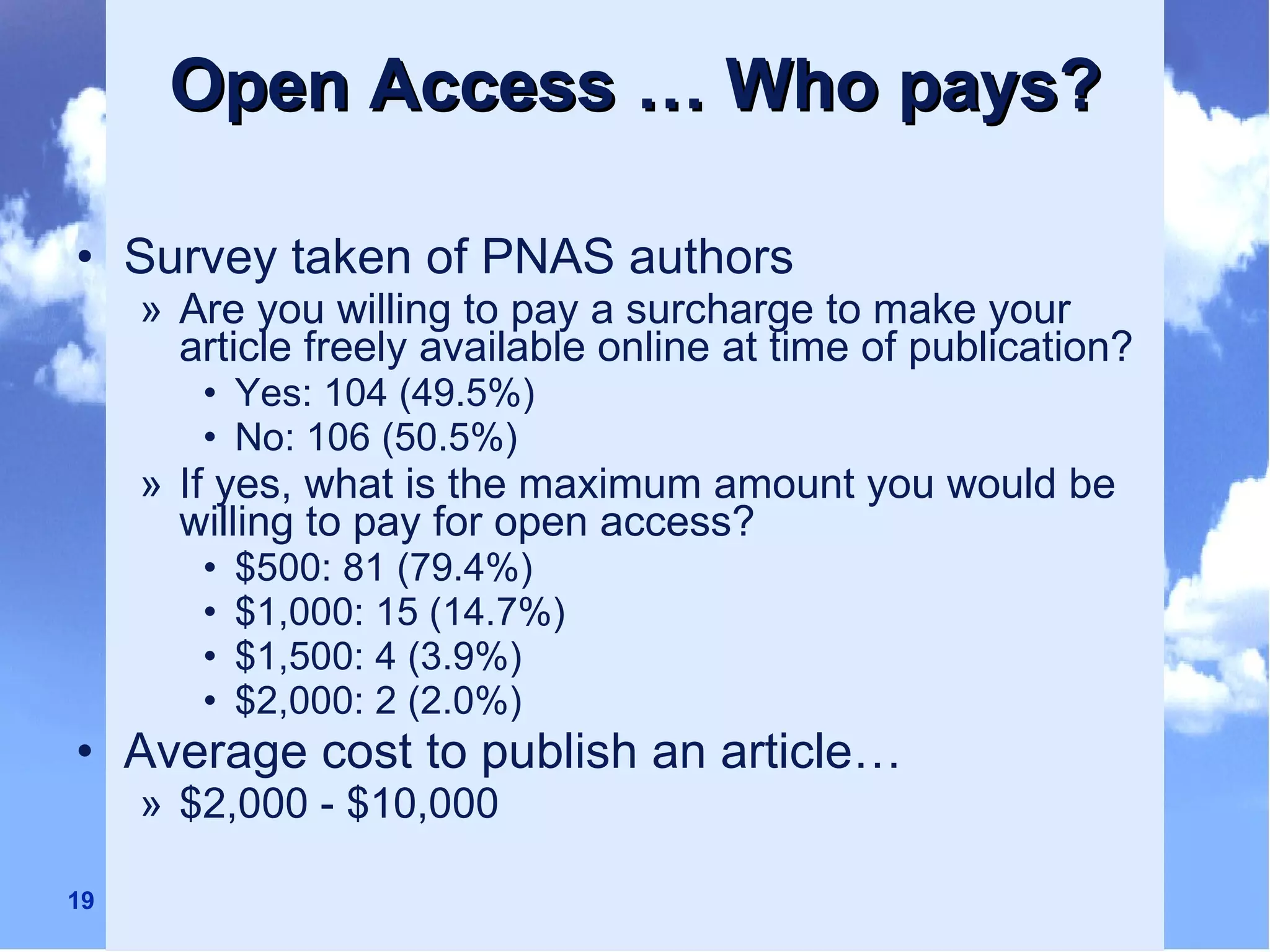
Open Access … Who pays? Survey taken of PNAS authors Are you willing to pay a surcharge to make your article freely available online at time of publication? Yes: 104 (49.5%) No: 106 (50.5%) If yes, what is the maximum amount you would be willing to pay for open access? $500: 81 (79.4%) $1,000: 15 (14.7%) $1,500: 4 (3.9%) $2,000: 2 (2.0%) Average cost to publish an article… $2,000 - $10,000
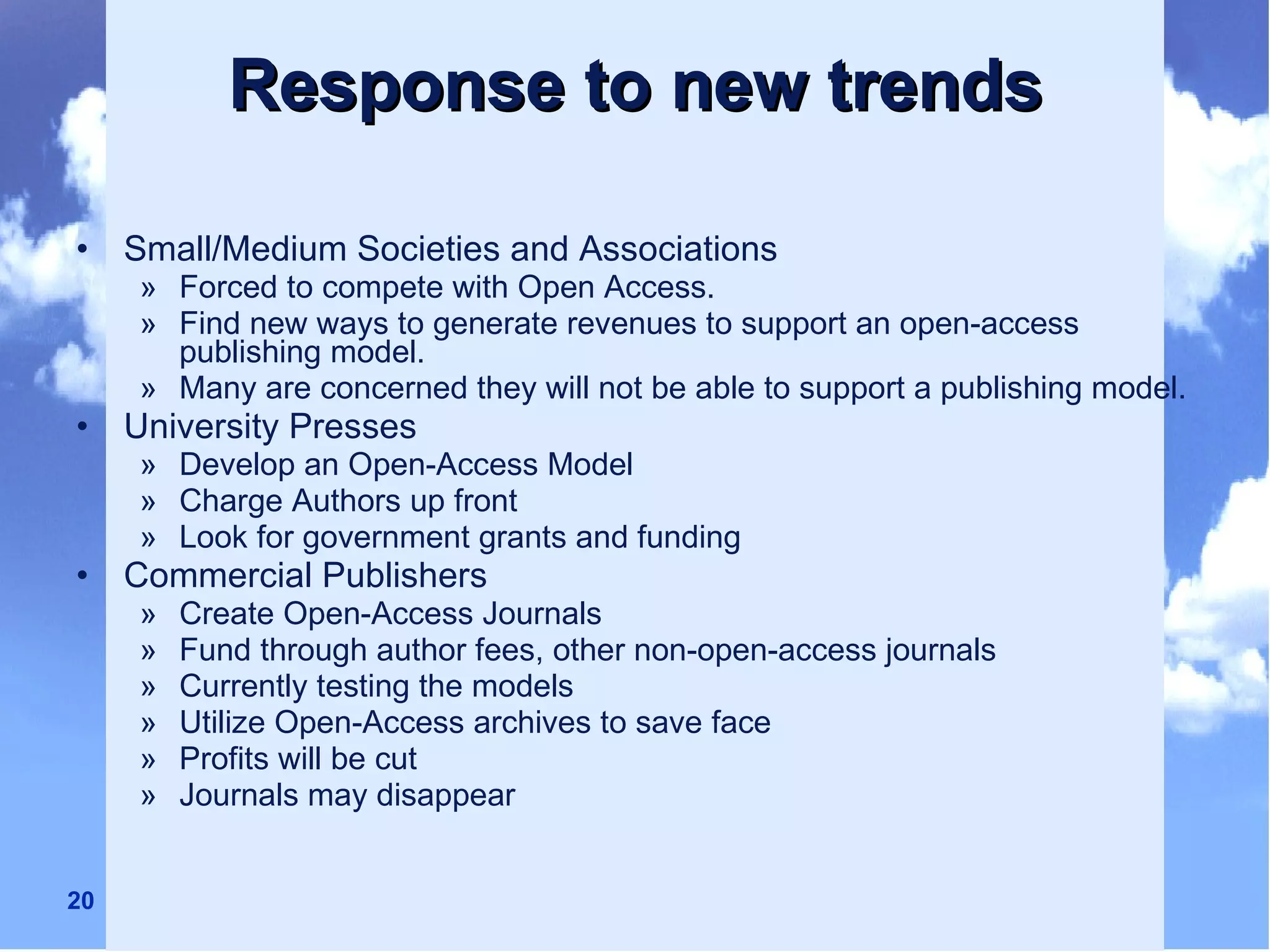
Response to new trends Small/Medium Societies and Associations Forced to compete with Open Access. Find new ways to generate revenues to support an open-access publishing model. Many are concerned they will not be able to support a publishing model. University Presses Develop an Open-Access Model Charge Authors up front Look for government grants and funding Commercial Publishers Create Open-Access Journals Fund through author fees, other non-open-access journals Currently testing the models Utilize Open-Access archives to save face Profits will be cut Journals may disappear
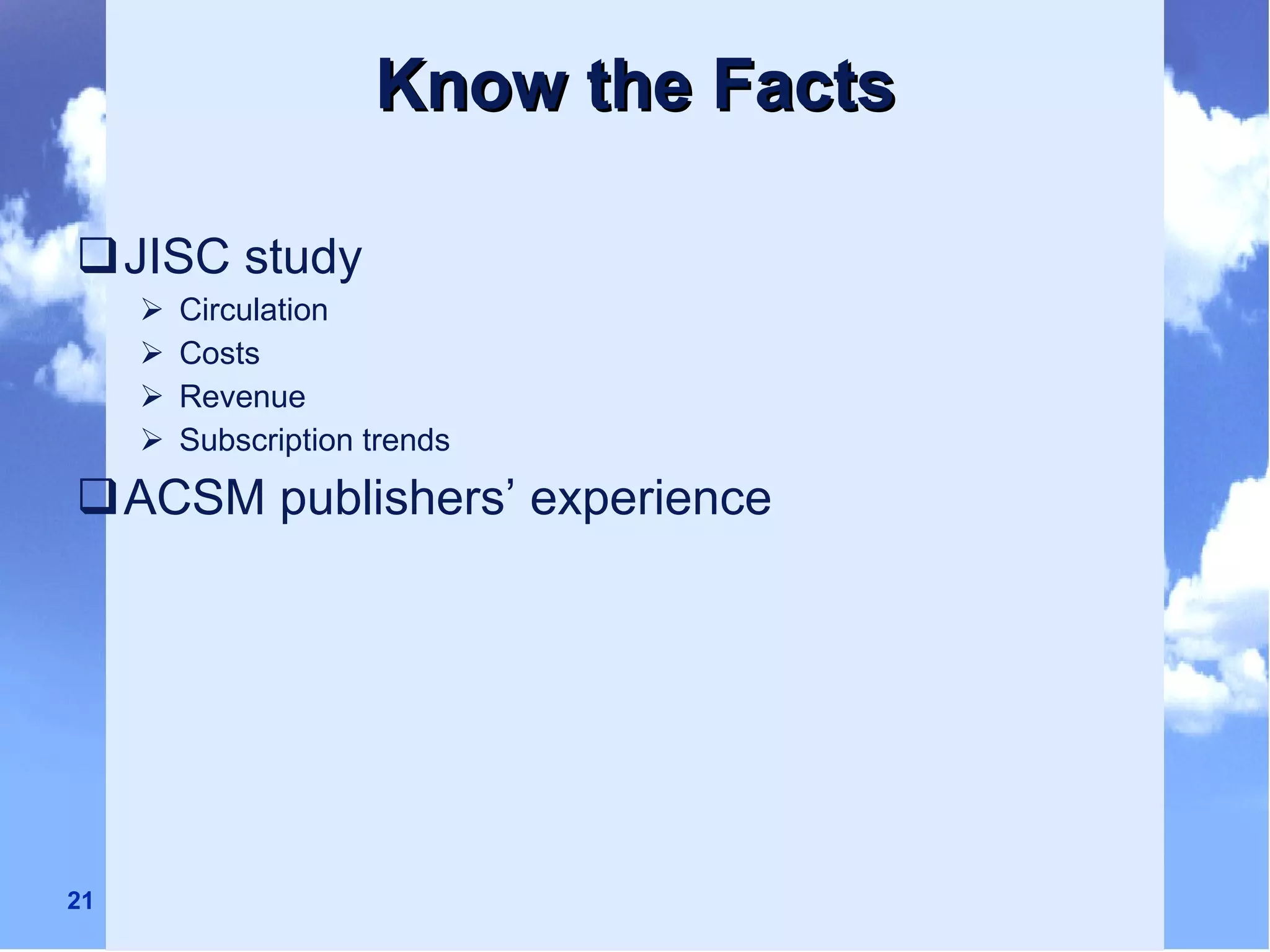
Know the Facts JISC study  Circulation  Costs Revenue Subscription trends ACSM publishers’ experience
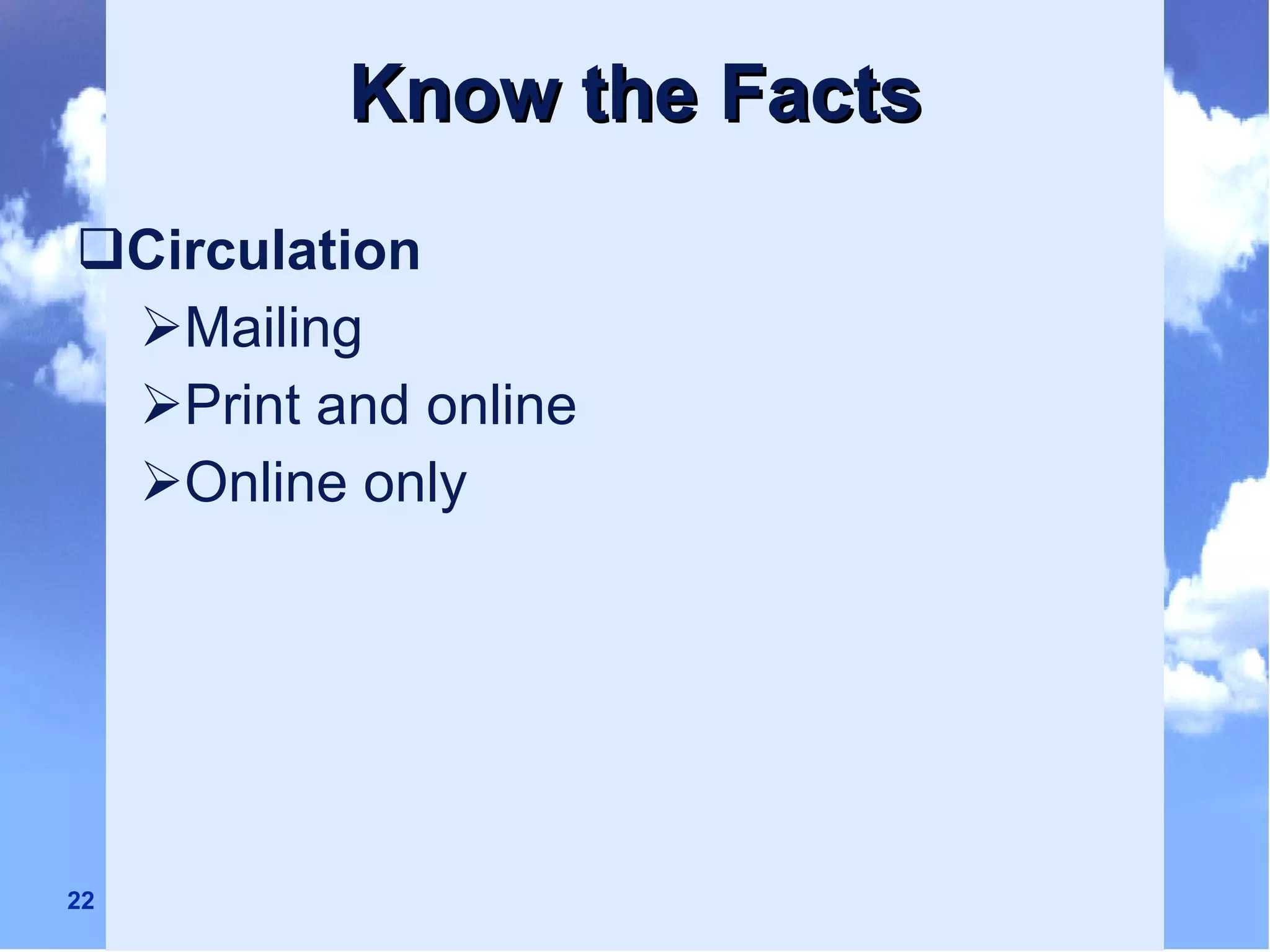
Know the Facts Circulation  Mailing Print and online Online only
Know the Facts Costs :  Trends: Fixed costs up; variable driven by market forces and technology
Know the Facts Costs :  Printed journal Cost of mailing single most important cost Content creation up  Member subscriptions account for 2/3 of total subscriptions filled Member subscriptions filled below cost  Online journal   Content creation variable Cost of distribution down Members receive online journal as a member benefit
Know the Facts Revenue sources Institutional subscriptions  97% of total subscription revenue (2004)  86% of total journal revenue Member subscriptions  6% of journal revenue Author payments  Non-member [personal] subscriptions  2% of total subscription revenue received
Know the Facts Subscription trends Institutional  Overall, institutional subscriptions fell [22%] 56% fall in print subscriptions Online only up [23%] Mainly technology fields Mainly international subscriptions Members subs Depends on membership drive Push to encourage online only
Know the Facts CaGIS , 2005-2006  Subscriptions 2005: Institutional  449 [40 print/online; 19 online only] 2005: Membership  569 2006: Institutional  380 [ 45  print/online;  23  online only] 2006: Membership  449   Revenue Total 2005 subscription [I+M] revenue:  $86,040 Member portion of dues declared for publishing:  $25,605  30 % total sub revenue Institutional subs revenue:   $60,435 70 % total sub revenue Costs: high fixed costs [review]; low print run = no economies of scale
Know the Facts SaLIS , 2005-2006  *online coming w/ March 2006 Subscriptions 2005: Institutional  377  2005: Membership  4,701 2006: Institutional  330 2006: Membership  4,330   Revenue Total 2005 subscription [I+M] revenue: $245,545 Member portion of dues declared for publishing: $211,545  86 % total subscriptions Institutional subs revenue: $  34,000 14 % total sub revenue Total  SaLIS  cost: $  56,000 Paid from membership dues: $56k-$34k = $  22,000
Know the Facts Summary   CaGIS  SaLIS
Adapt or Perish Seeking the full potential of academic publishing Cutting cost of content creation Taking advantage of technology (Digital Art)
Adapt or Perish Seeking the full potential of publishing Online Journal  Utilizing Digital Art  Online Peer-review and submission  Online Manuscript Tracking Offering Alternative publishing options for authors Color online vs. b/w in print Conventional reprints Electronic reprints
Adapt or Perish Cutting cost of content creation Artwork for print and online publishing—Different requirements
Digital Art… “ The Good…   “ The Bad…   “ The ‘I didn’t know it was a problem’…   “ The Good… keep up the good work ”  “ The Bad… see if we can help ”  “ The ‘I didn’t know it was a problem’…   a little education can go a long way ”  Preparing artwork
Time savings. Promotion of online distribution. Image quality improvements. Online submission creates opportunities to realize full benefits of peer-review and manuscript tracking systems.   Expectations from  Usable  Digital Art
Incompatible file formats Poor quality for print production Insufficient resolution Wrong size for page layout Assumptions about appearance of art in print reflecting monitor appearance Digital Art Challenges
Certifying digital art files A few necessary checks to certify art files: File type  Resolution RGB vs CMYK  Fonts included? Compression type
Image Fundamentals Above and beyond.
From hardcopy art using scanning equipment can be accomplished, with mixed results, by anyone who purchases a scanner From computer software Illustrator, PhotoShop, and others… From digital imaging equipment scientific and medical lab environments Digitizing art
File Formats FOR PRINTING TIFF -  T agged  I mage  F ile  F ormat EPS -  E ncapsulated  P ost S cript FOR THE WEB GIF -  G raphic  I nterchange  F ormat JPEG -  J oint  P hotographic  E xperts  G roup Digital Image Fundamentals
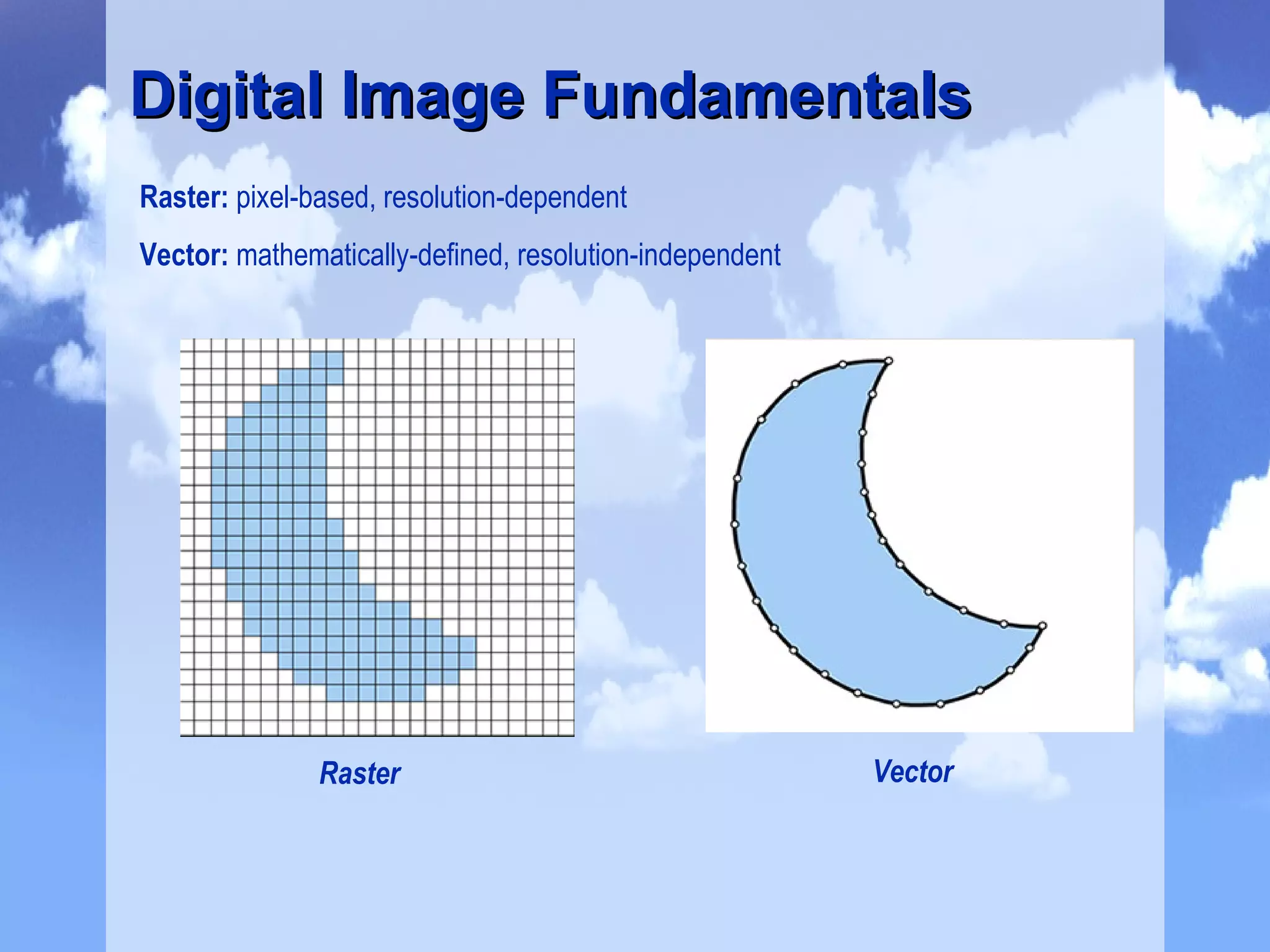
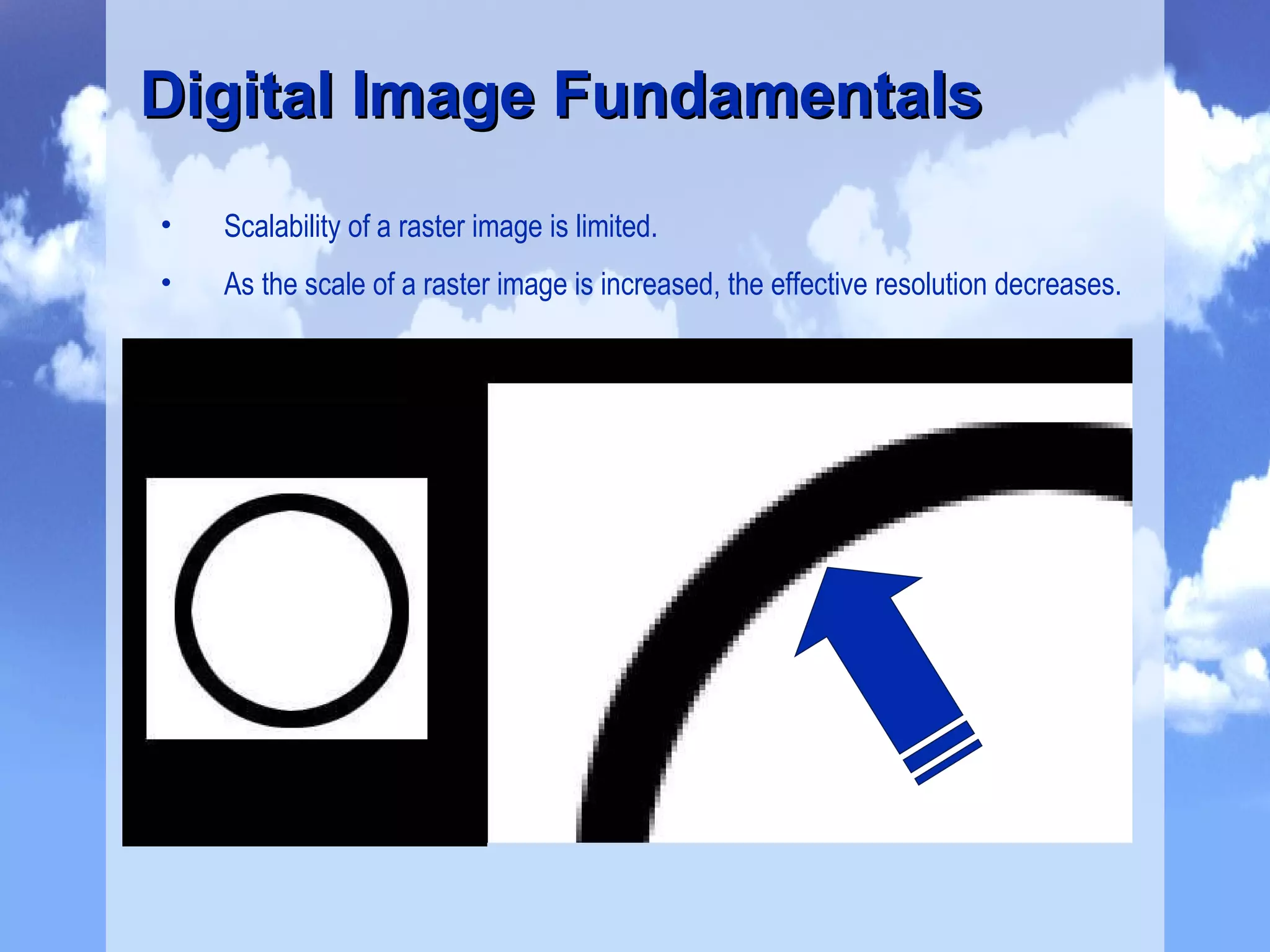
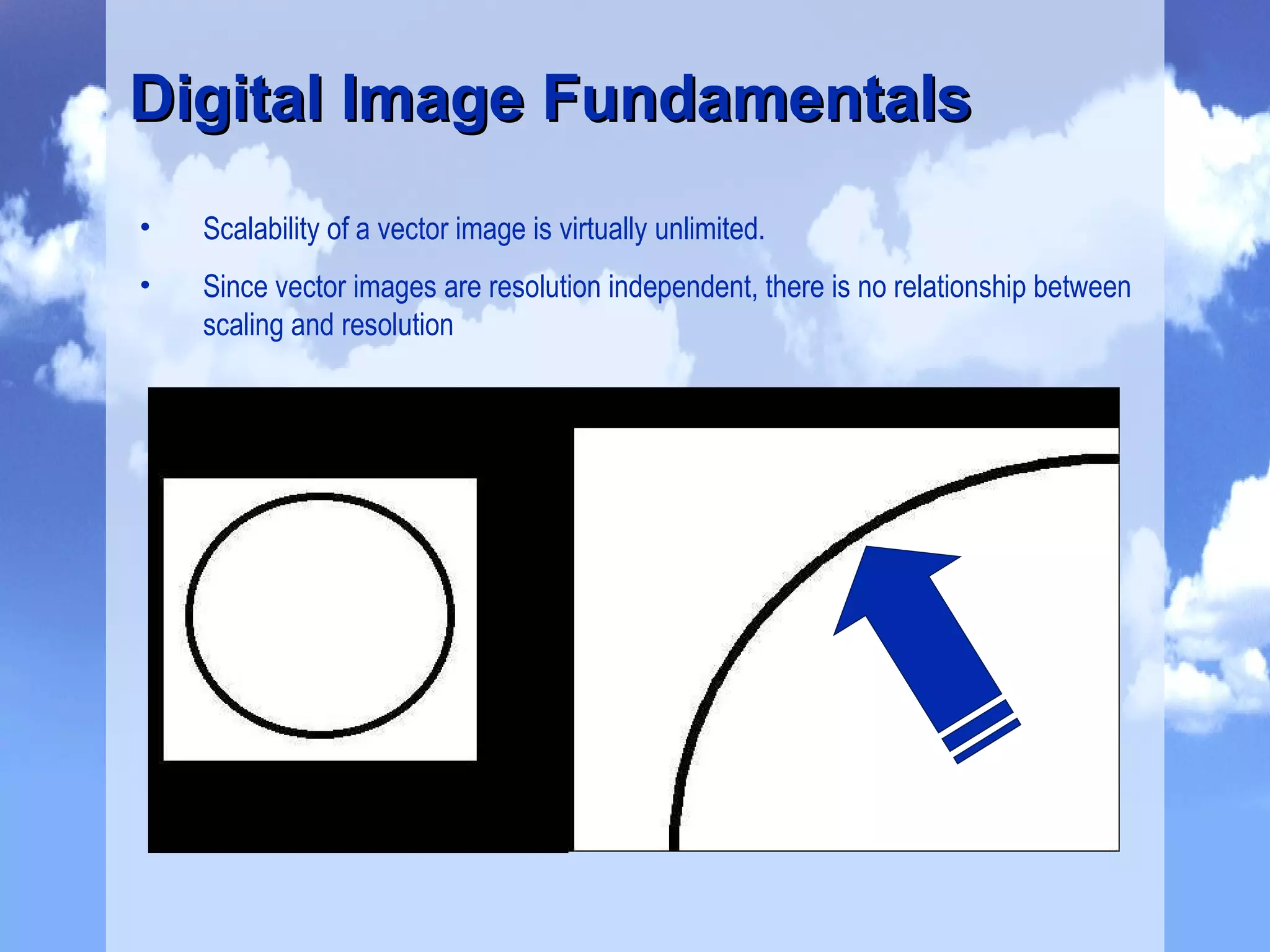
Digital Image Fundamentals Raster:  pixel-based, resolution-dependent Vector:  mathematically-defined, resolution-independent Vector Raster
Digital Image Fundamentals Scalability of a raster image is limited. As the scale of a raster image is increased, the effective resolution decreases.
Scalability of a vector image is virtually unlimited. Since vector images are resolution independent, there is no relationship between scaling and resolution Digital Image Fundamentals
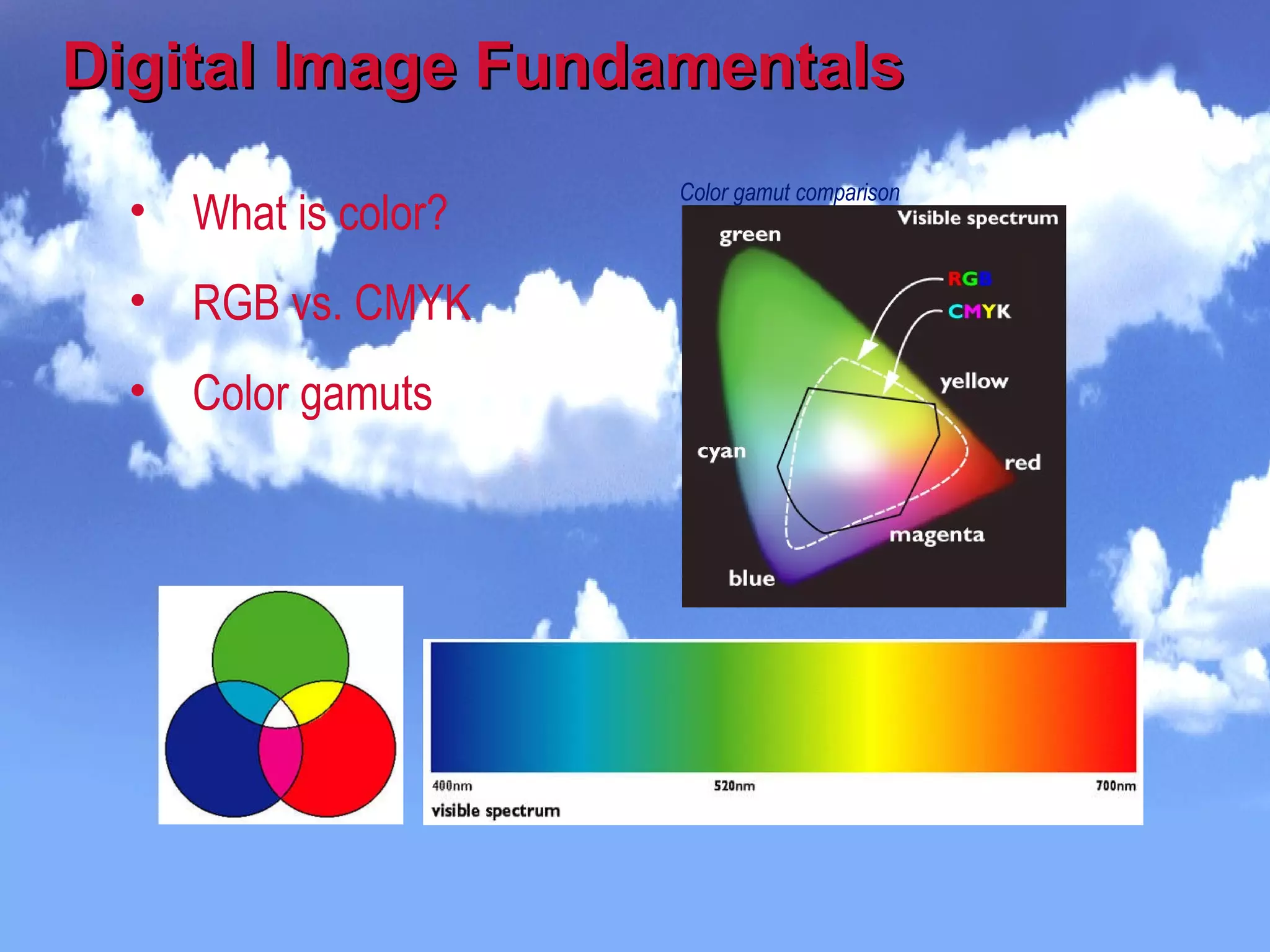
Digital Image Fundamentals What is color? RGB vs. CMYK  Color gamuts Color gamut comparison
Color Gamut Dimensional representation of color space. All the possible colors that the human eye can see The RGB gamut    – versus –  The CMYK gamut Digital Image Fundamentals
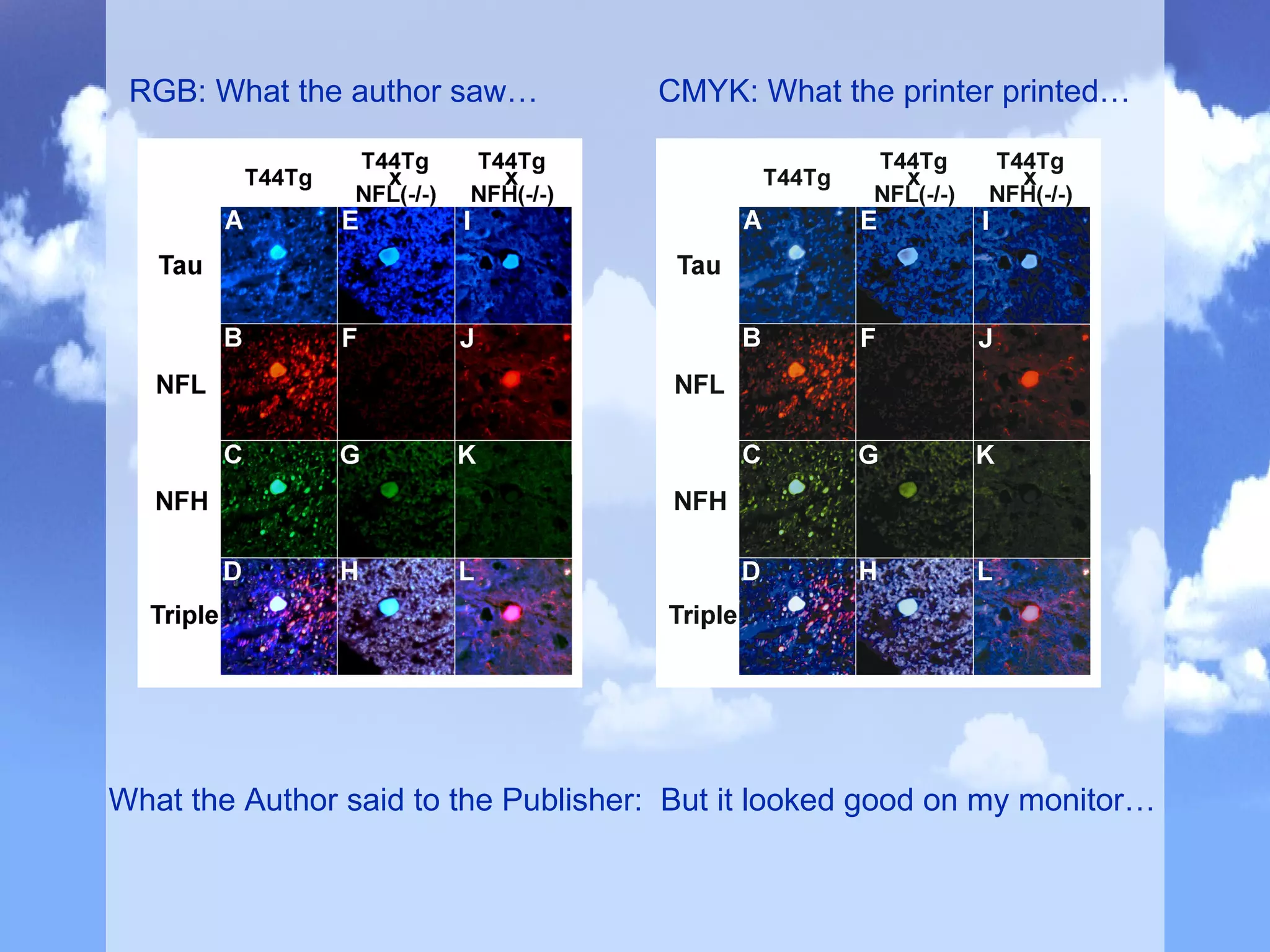
RGB: What the author saw… CMYK: What the printer printed… What the Author said to the Publisher:  But it looked good on my monitor…
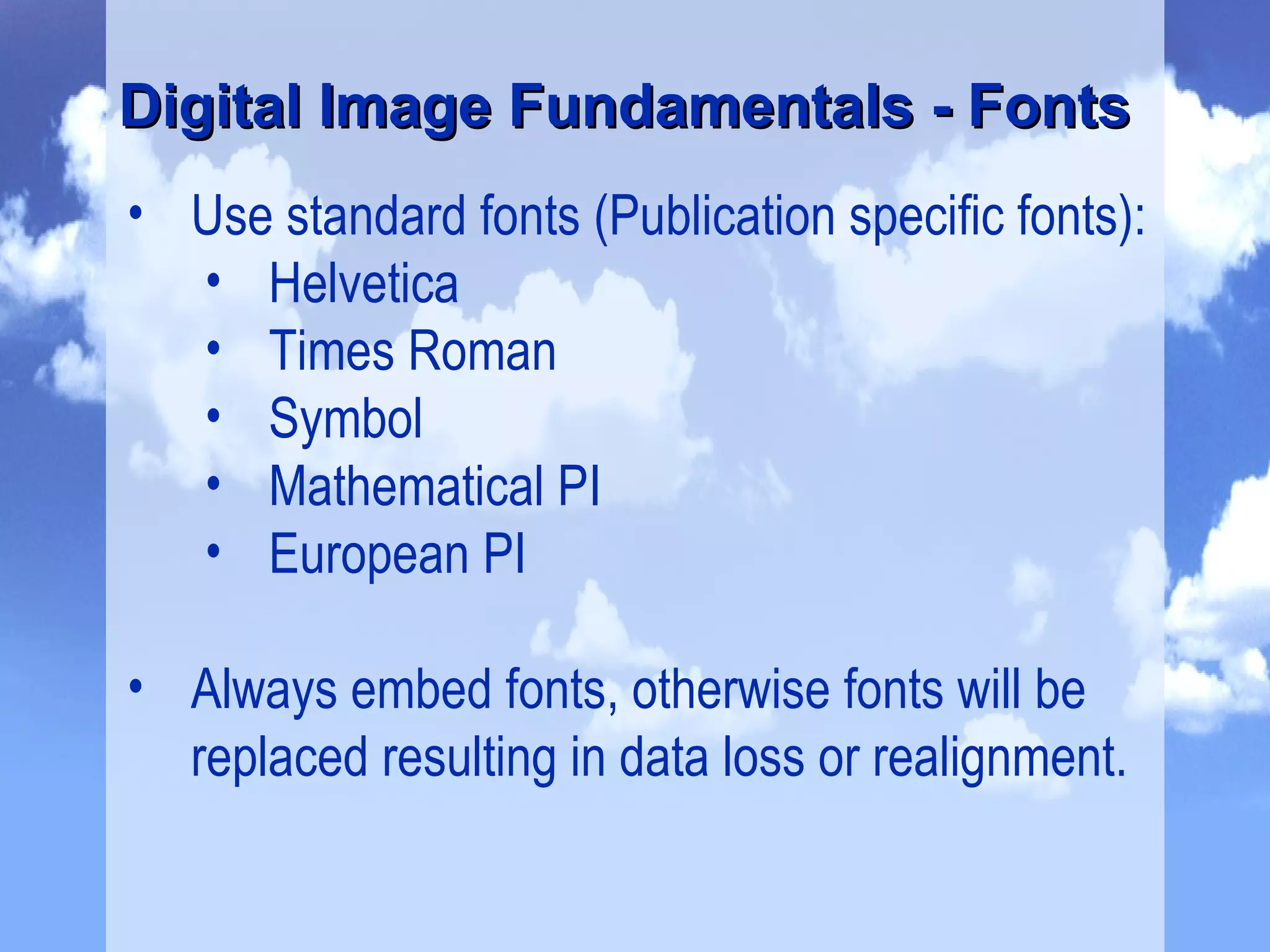
Typical systems and applications for exchanging and outputting digital files: Mac or PC Adobe Illustrator Adobe PhotoShop These applications are not recommended for print production: Microsoft Powerpoint Microsoft Word Microsoft Excel Microsoft Publisher Software  -  what works?
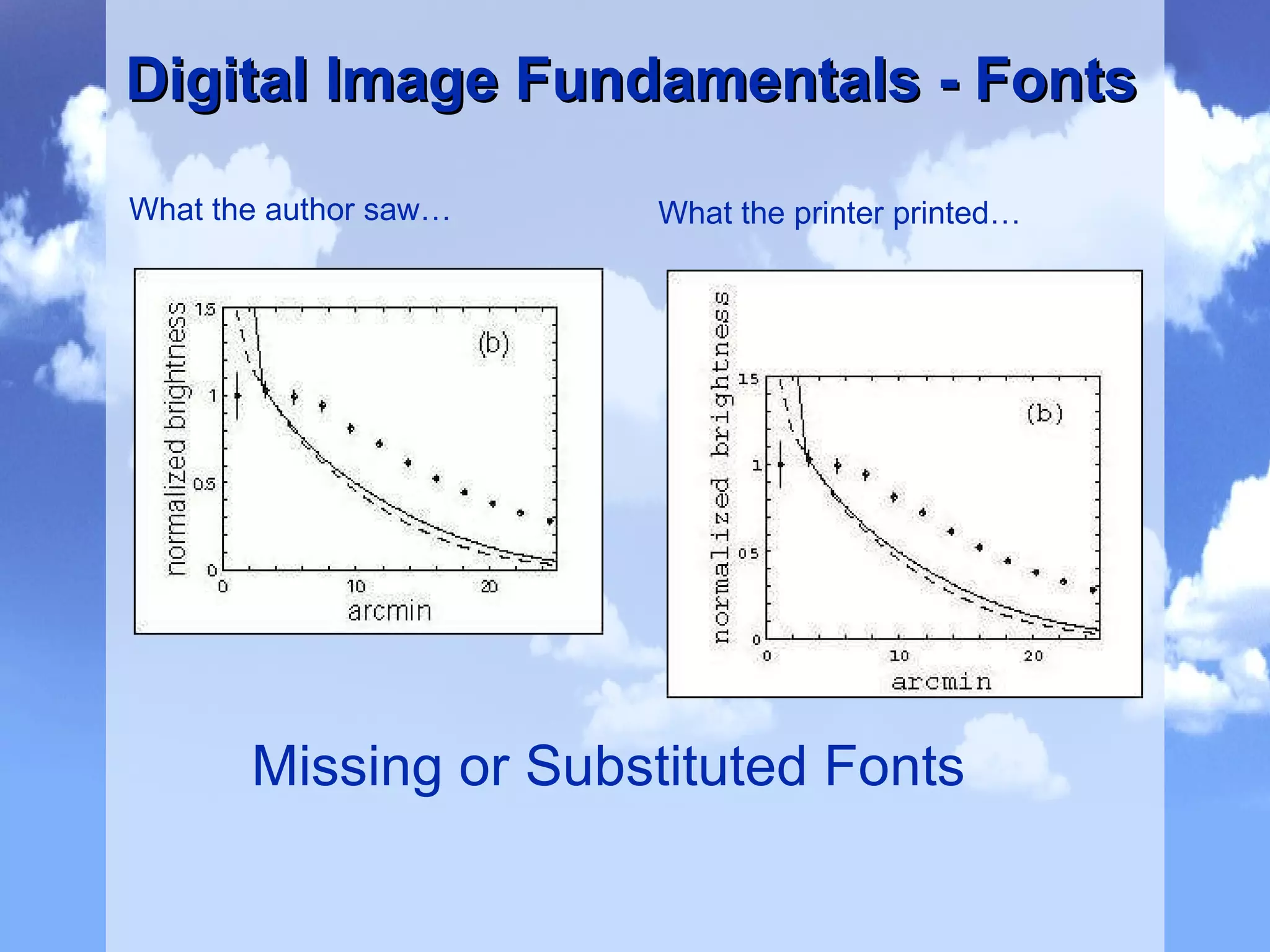
Use standard fonts (Publication specific fonts): Helvetica Times Roman Symbol Mathematical PI European PI Always embed fonts, otherwise fonts will be replaced resulting in data loss or realignment. Digital Image Fundamentals - Fonts
Digital Image Fundamentals - Fonts Missing or Substituted Fonts What the author saw… What the printer printed…
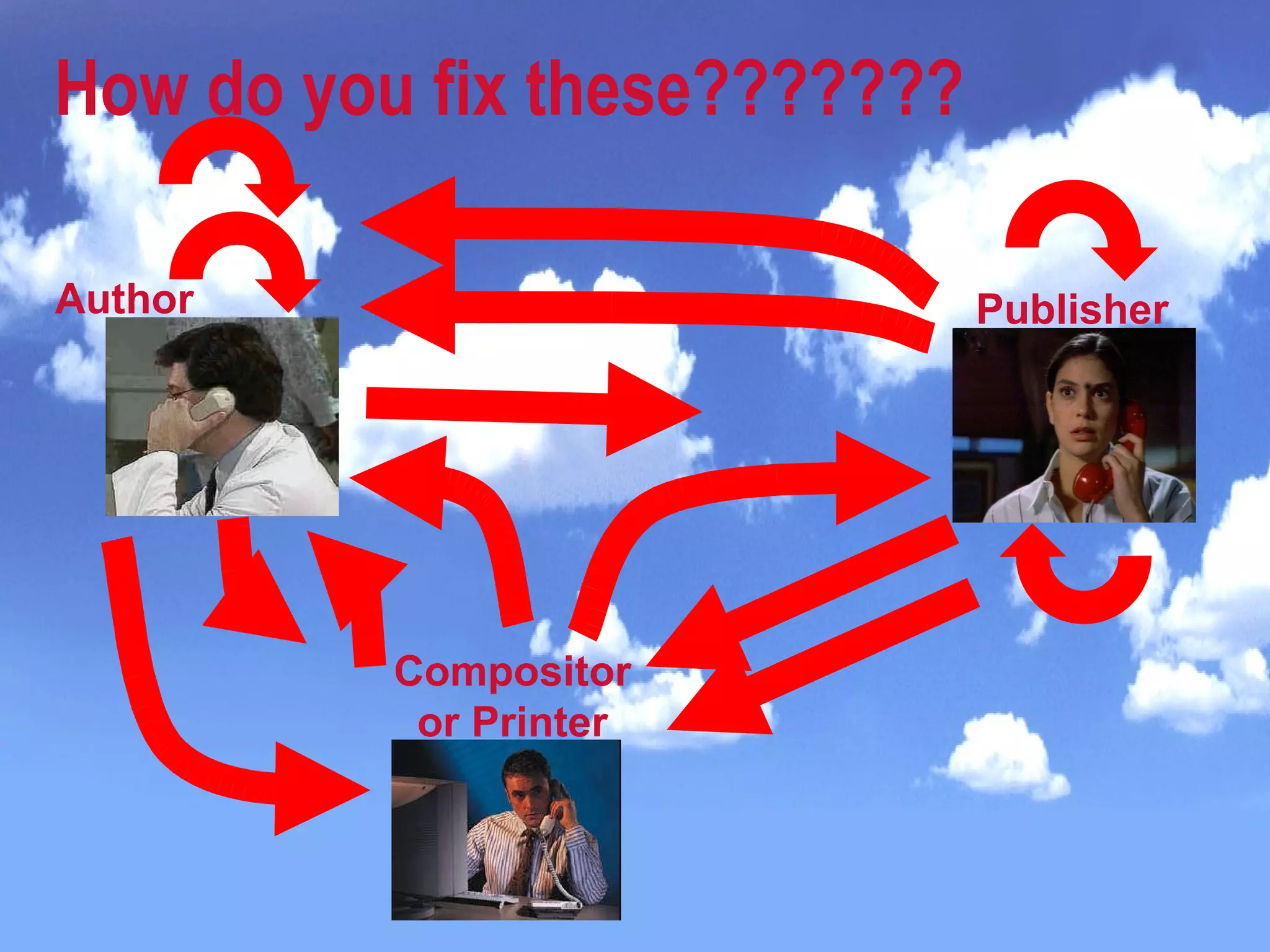
Compositor or Printer Author Publisher How do you fix these???????
DigitalExpert   TM   Major Components DX Advisor  an extensive web site that contains information dealing with digital files for print, for the web, and for other media. Accessible at:  http://dx.sheridan.com DX Online  a web based, digital art checking tool. The user can submit 10 files per session via a web transfer of the digital art to the TSG server. Files will be checked for 150+  issues/problems. An e-mail to the user will link to a DX report detailing the printability of the digital art. Accessible at:  http://dx.sheridan.com/onl DigitalExpert   TM   (DX) an umbrella name for TSG’s digital print and media solutions.
Association publishing is changing Industry and economic factors The online journal and Open Access as a new way to publish We must shift our thinking about how we prepare our content as the publishing model changes Digital art preparation Editorial policies In closing
Questions? Jason Clurman The Sheridan Group, Journals Division 450 Fame Avenue Hanover, PA 17331 410-267-1618 [email_address] Ilse Genovese American Congress on Surveying and Mapping 6 Montgomery Village Ave. Suite 403 Gaithersburg, MD 20879 [email_address]

Association Communications 4 23

  • 1.
    Above and beyond.Association Communications ACSM Annual Conference and Technology Exhibition Orlando, April 25, 2006 Jason Clurman Ilse Genovese
  • 2.
    Association Communications Communicationabout communication Types of communication Understanding the needs and challenges Trends in scholarly communications Response to new trends Know the facts Adapt or perish
  • 3.
    Communication about CommunicationWhy talk about association communications? Commitment to share information Change driven by ICT Practical and economic realities
  • 4.
    Types of CommunicationScientific [scholarly, academic] Professional [technology] Publicity, marketing WWW, Intranet, Extranets Broadcast mail and e-mail Speaking engagements Conferences
  • 5.
    Types of CommunicationScholarly publishing Started 400 years ago in England with Royal Society’s Philosophical Transactions Supports and furthers R&D Many of the best known science and technology journals are published by professional societies The publisher-pays/retains copyright model is being challenged
  • 6.
    Understanding the Needsand Challenges Increasing demand for free access to scientific information Expanding online publishing Greater scrutiny of publishers and their journals
  • 7.
    Trends in scholarlycommunications Trends The state of the publishing business Online vs. print Open access
  • 8.
    The state ofthe publishing business RoweCom/Divine… the gracing of subscriptions Librarians faced with declining budgets ~2% increase in government funding for 2004-2005 College and University Endowments are down ~5% Subscriptions are falling Advertising revenue is falling
  • 9.
    Online vs. PrintPros of Online Online journal is becoming the journal of record Younger audience is finding more information online Online journal provides a more interactive way to read material Easier to disseminate information to a broader audience Cons of Online Cost of online can be as expensive if not more How do we guarantee the integrity of electronic data over the long-term? How do we attract advertisers? Copyright issues… how do we control access to information?
  • 10.
    Open Access… Whatis it? “ The author(s) and copyright holder(s) grant(s) to all users a free, irrevocable, worldwide, perpetual right of access to, and a license to copy, use, distribute, transmit and display the work publicly and to make and distribute derivative works, in any digital medium for any responsible purpose, subject to proper attribution of authorship, as well as the right to make small numbers of printed copies for their personal use… A complete version of the work and all supplemental materials, including a copy of the permission as stated above, in a suitable standard electronic format is deposited immediately upon initial publication in at least one online repository that is supported by an academic institution, scholarly society, government agency, or other well-established organization that seeks to enable open access, unrestricted distribution, interoperability, and long-term archiving” – PubMed Central
  • 11.
    Open Access… Whatit really is! Scientific, technical, medical and scholarly research made freely available to the public at the cost of Publishers and Authors, through the support of grants, author fees and government funding. Example: Authors are asked to voluntarily deposit articles (funded by the government) to the NIH database 6 months after publish date.
  • 12.
    Initiatives Los Alamos– 1991 Paul Ginspang; Los Alamos Physicist http://www.lanl.gov Scholarly Publishing & Academic Resources Alliance (SPARC) – 1998 Rick Johnson; Enterprise Director http://www.arl.org/sparc/home/index.asp?page=0 PubMed Central – 2000 Harold Varmus; Director of NIH http://www.pubmedcentral.nih.gov BioMed Central – Jan Velterop; Publisher http://www.biomedcentral.com Public Library of Science – 2003 Harold Varmus, Chairman of the Board; Patrick Brown, Stanford Professor; Michael Eisen, Berkeley Professor http://www.publiclibraryofscience.org
  • 13.
    Los Alamos Firstfree-access electronic archive arXiv.org e-print archive Pre-prints in physics, mathematics, computer science and cognitive science. Electronic posting of pre-published articles 1,000 – 2,000 electronic transactions per hour More than 50% of all research articles in physics are posted to this server
  • 14.
    Scholarly Publishing andAcademic Resources Coalition (SPARC) Alliance of universities and research libraries aiming to improve the dissemination of information. Goals Drive down publishing costs Aid libraries in information dissemination Develops competitive alternatives to high-priced commercial journals and digital aggregations
  • 15.
    PubMed Central NIHdeveloped and funded electronic publishing archive (Not a publisher). Peer reviewed life sciences articles. No Pre-prints are accepted. Participation is voluntary and copyright remains with the publisher. Access if free and unrestricted. 100 plus journals are hosted. Many publishers/societies/associations currently utilizing site to host articles. PNAS Molecular Biology of the Cell
  • 16.
    BioMed Central IndependentPublishing House publishing both print and online. Free access to 100+ Journals in biology and medicine hosted. Online submission and peer-review technology is free of charge to groups of scientists wishing to run an open-access journal under their editorial control. Authors’ fees and institutional memberships fund open-access. Authors who publish in BioMed hold copyright.
  • 17.
    Public Library ofScience (PLOS) Coalition of Research Scientists dedicated to making scientific and medical literature freely available to the public. Circulated a letter that was signed by over 30,000 scientists in over 180 countries in support of Open Access. Operating on Authors fees and a 9 million dollar grant from the Gordon and Betty Moore Foundation. Publishes in Print and Online PLOS Biology (October 03’) PLOS Medicine (Fall 04’) PLOS Chemistry PLOS Genetics Etc… Peer-reviewed and edited by a leading academic and professional editorial board.
  • 18.
    Open Access… SaboBill Sabo Bill Works of the United States Government are beyond the reach of copyright protection so that they will be freely available for the benefit of the people of the United States; United States Government funded research belongs to, and should be freely available to, every person in the United States. Copyright protection under this title is not available for any work produced pursuant to scientific research substantially funded by the Federal Government to the extent provided in the funding agreement entered into by the relevant Federal agency pursuant to paragraph (2). PROVISION IN FUNDING AGREEMENTS- Any Federal department or agency that enters into a funding agreement with any person for the performance of scientific research substantially funded by the Federal Government shall include in the agreement a provision that states that copyright protection under this title is not available for any work produced pursuant to such research under the agreement.
  • 19.
    Open Access …Who pays? Survey taken of PNAS authors Are you willing to pay a surcharge to make your article freely available online at time of publication? Yes: 104 (49.5%) No: 106 (50.5%) If yes, what is the maximum amount you would be willing to pay for open access? $500: 81 (79.4%) $1,000: 15 (14.7%) $1,500: 4 (3.9%) $2,000: 2 (2.0%) Average cost to publish an article… $2,000 - $10,000
  • 20.
    Response to newtrends Small/Medium Societies and Associations Forced to compete with Open Access. Find new ways to generate revenues to support an open-access publishing model. Many are concerned they will not be able to support a publishing model. University Presses Develop an Open-Access Model Charge Authors up front Look for government grants and funding Commercial Publishers Create Open-Access Journals Fund through author fees, other non-open-access journals Currently testing the models Utilize Open-Access archives to save face Profits will be cut Journals may disappear
  • 21.
    Know the FactsJISC study Circulation Costs Revenue Subscription trends ACSM publishers’ experience
  • 22.
    Know the FactsCirculation Mailing Print and online Online only
  • 23.
    Know the FactsCosts : Trends: Fixed costs up; variable driven by market forces and technology
  • 24.
    Know the FactsCosts : Printed journal Cost of mailing single most important cost Content creation up Member subscriptions account for 2/3 of total subscriptions filled Member subscriptions filled below cost Online journal Content creation variable Cost of distribution down Members receive online journal as a member benefit
  • 25.
    Know the FactsRevenue sources Institutional subscriptions 97% of total subscription revenue (2004) 86% of total journal revenue Member subscriptions 6% of journal revenue Author payments Non-member [personal] subscriptions 2% of total subscription revenue received
  • 26.
    Know the FactsSubscription trends Institutional Overall, institutional subscriptions fell [22%] 56% fall in print subscriptions Online only up [23%] Mainly technology fields Mainly international subscriptions Members subs Depends on membership drive Push to encourage online only
  • 27.
    Know the FactsCaGIS , 2005-2006 Subscriptions 2005: Institutional 449 [40 print/online; 19 online only] 2005: Membership 569 2006: Institutional 380 [ 45 print/online; 23 online only] 2006: Membership 449 Revenue Total 2005 subscription [I+M] revenue: $86,040 Member portion of dues declared for publishing: $25,605 30 % total sub revenue Institutional subs revenue: $60,435 70 % total sub revenue Costs: high fixed costs [review]; low print run = no economies of scale
  • 28.
    Know the FactsSaLIS , 2005-2006 *online coming w/ March 2006 Subscriptions 2005: Institutional 377 2005: Membership 4,701 2006: Institutional 330 2006: Membership 4,330 Revenue Total 2005 subscription [I+M] revenue: $245,545 Member portion of dues declared for publishing: $211,545 86 % total subscriptions Institutional subs revenue: $ 34,000 14 % total sub revenue Total SaLIS cost: $ 56,000 Paid from membership dues: $56k-$34k = $ 22,000
  • 29.
    Know the FactsSummary CaGIS SaLIS
  • 30.
    Adapt or PerishSeeking the full potential of academic publishing Cutting cost of content creation Taking advantage of technology (Digital Art)
  • 31.
    Adapt or PerishSeeking the full potential of publishing Online Journal Utilizing Digital Art Online Peer-review and submission Online Manuscript Tracking Offering Alternative publishing options for authors Color online vs. b/w in print Conventional reprints Electronic reprints
  • 32.
    Adapt or PerishCutting cost of content creation Artwork for print and online publishing—Different requirements
  • 33.
    Digital Art… “The Good… “ The Bad… “ The ‘I didn’t know it was a problem’… “ The Good… keep up the good work ” “ The Bad… see if we can help ” “ The ‘I didn’t know it was a problem’… a little education can go a long way ” Preparing artwork
  • 34.
    Time savings. Promotionof online distribution. Image quality improvements. Online submission creates opportunities to realize full benefits of peer-review and manuscript tracking systems. Expectations from Usable Digital Art
  • 35.
    Incompatible file formatsPoor quality for print production Insufficient resolution Wrong size for page layout Assumptions about appearance of art in print reflecting monitor appearance Digital Art Challenges
  • 36.
    Certifying digital artfiles A few necessary checks to certify art files: File type Resolution RGB vs CMYK Fonts included? Compression type
  • 37.
  • 38.
    From hardcopy artusing scanning equipment can be accomplished, with mixed results, by anyone who purchases a scanner From computer software Illustrator, PhotoShop, and others… From digital imaging equipment scientific and medical lab environments Digitizing art
  • 39.
    File Formats FORPRINTING TIFF - T agged I mage F ile F ormat EPS - E ncapsulated P ost S cript FOR THE WEB GIF - G raphic I nterchange F ormat JPEG - J oint P hotographic E xperts G roup Digital Image Fundamentals
  • 40.
    Digital Image FundamentalsRaster: pixel-based, resolution-dependent Vector: mathematically-defined, resolution-independent Vector Raster
  • 41.
    Digital Image FundamentalsScalability of a raster image is limited. As the scale of a raster image is increased, the effective resolution decreases.
  • 42.
    Scalability of avector image is virtually unlimited. Since vector images are resolution independent, there is no relationship between scaling and resolution Digital Image Fundamentals
  • 43.
    Digital Image FundamentalsWhat is color? RGB vs. CMYK Color gamuts Color gamut comparison
  • 44.
    Color Gamut Dimensionalrepresentation of color space. All the possible colors that the human eye can see The RGB gamut – versus – The CMYK gamut Digital Image Fundamentals
  • 45.
    RGB: What theauthor saw… CMYK: What the printer printed… What the Author said to the Publisher: But it looked good on my monitor…
  • 46.
    Typical systems andapplications for exchanging and outputting digital files: Mac or PC Adobe Illustrator Adobe PhotoShop These applications are not recommended for print production: Microsoft Powerpoint Microsoft Word Microsoft Excel Microsoft Publisher Software - what works?
  • 47.
    Use standard fonts(Publication specific fonts): Helvetica Times Roman Symbol Mathematical PI European PI Always embed fonts, otherwise fonts will be replaced resulting in data loss or realignment. Digital Image Fundamentals - Fonts
  • 48.
    Digital Image Fundamentals- Fonts Missing or Substituted Fonts What the author saw… What the printer printed…
  • 49.
    Compositor or PrinterAuthor Publisher How do you fix these???????
  • 50.
    DigitalExpert TM Major Components DX Advisor an extensive web site that contains information dealing with digital files for print, for the web, and for other media. Accessible at: http://dx.sheridan.com DX Online a web based, digital art checking tool. The user can submit 10 files per session via a web transfer of the digital art to the TSG server. Files will be checked for 150+ issues/problems. An e-mail to the user will link to a DX report detailing the printability of the digital art. Accessible at: http://dx.sheridan.com/onl DigitalExpert TM (DX) an umbrella name for TSG’s digital print and media solutions.
  • 51.
    Association publishing ischanging Industry and economic factors The online journal and Open Access as a new way to publish We must shift our thinking about how we prepare our content as the publishing model changes Digital art preparation Editorial policies In closing
  • 52.
    Questions? Jason ClurmanThe Sheridan Group, Journals Division 450 Fame Avenue Hanover, PA 17331 410-267-1618 [email_address] Ilse Genovese American Congress on Surveying and Mapping 6 Montgomery Village Ave. Suite 403 Gaithersburg, MD 20879 [email_address]