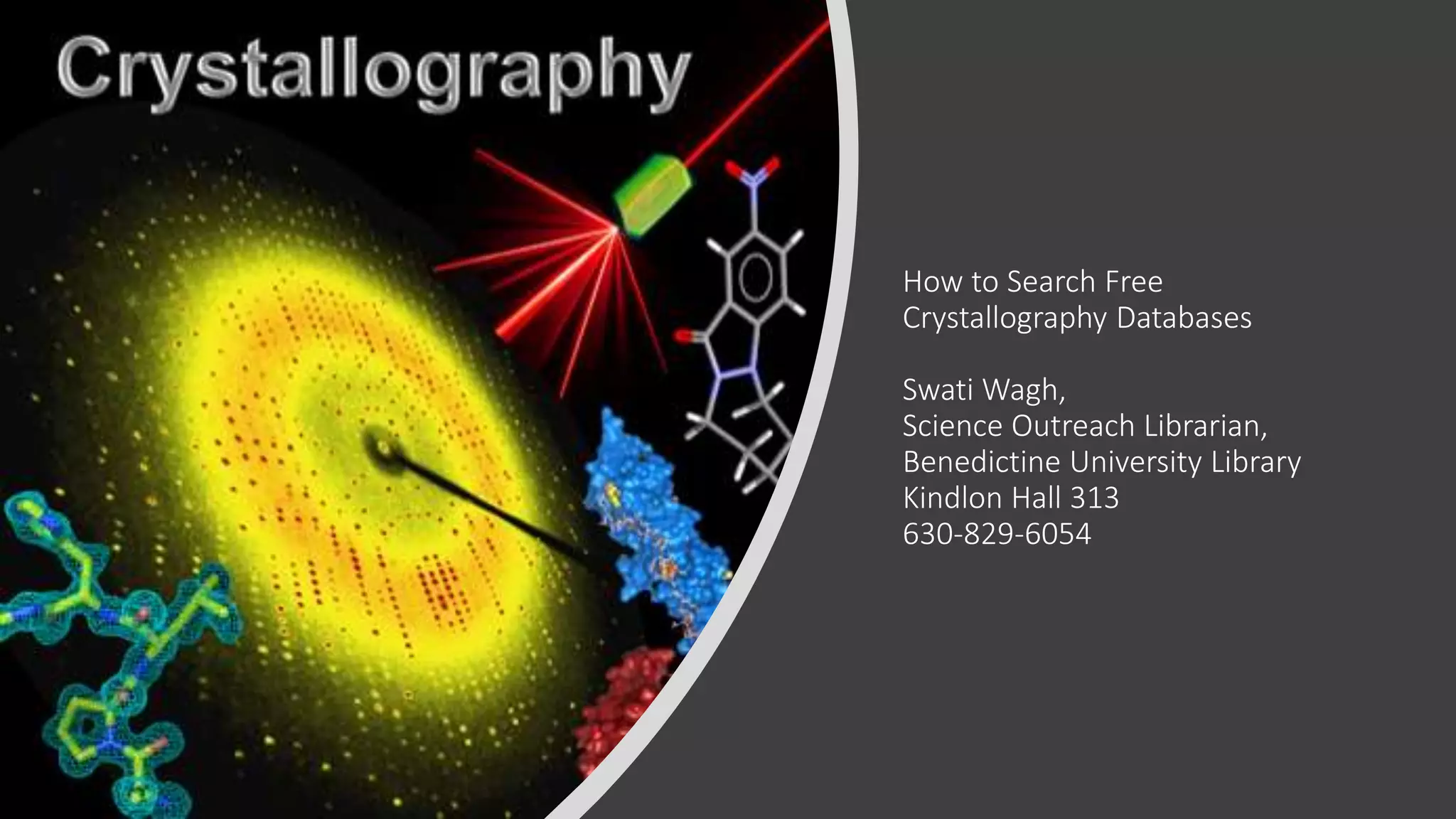
How to Search Free
Crystallography Databases
Swati Wagh,
Science Outreach Librarian,
Benedictine University Library
Kindlon Hall 313
630-829-6054
• Introduction:
• Crystallography is the study of Crystals.
• Crystallography, is the study of chemical structure of solid materials, through the
spatial arrangement of its atoms or ions in unit cells, the bonds that are formed.
The data obtained is then used to predict the synthesis, reactions, decomposition
of the material, its physical properties applications.
• Why look for free resources?
• Commercial sources for crystallography data are easier to use. But with a little
planning free sources can be searched to get a similar output?
• All crystallography databases get their data from published primary literature. So,
it is NOT imperative that we go to these databases exclusively. The advantage is
that data derived from the primary resources (journals) is arranged in some
logical way to be able to understand it better
Introduction…contd
• What is Crystallography, and why is it needed?
• Please Read the Introduction
• https://www.xtal.iqfr.csic.es/Cristalografia/index-en.html
• Before I go to the actual databases, I would like you to look at what
the Benedictine University library catalog offers in terms of Online
avaialibility.
• Rhodes, Gale. Crystallography Made Crystal Clear: A Guide for Users of
Macromolecular Models. Elsevier Science & Technology, 2006.
• Available:
• https://i-share-
ben.primo.exlibrisgroup.com/permalink/01CARLI_BEN/6i8k7f/cdi_askewsholts_vlebo
oks_9780080455549
• Ladd, Mark, and Rex Palmer. Structure Determination by X-Ray Crystallography:
Analysis by X-Rays and Neutrons. 5th ed. 2013, Springer, 2014, doi:10.1007/978-1-4614-
doi:10.1007/978-1-4614-3954-7.
• Available: https://i-share-
ben.primo.exlibrisgroup.com/permalink/01CARLI_BEN/6i8k7f/cdi_springer_books_10
_1007_978_1_4614_3954_7
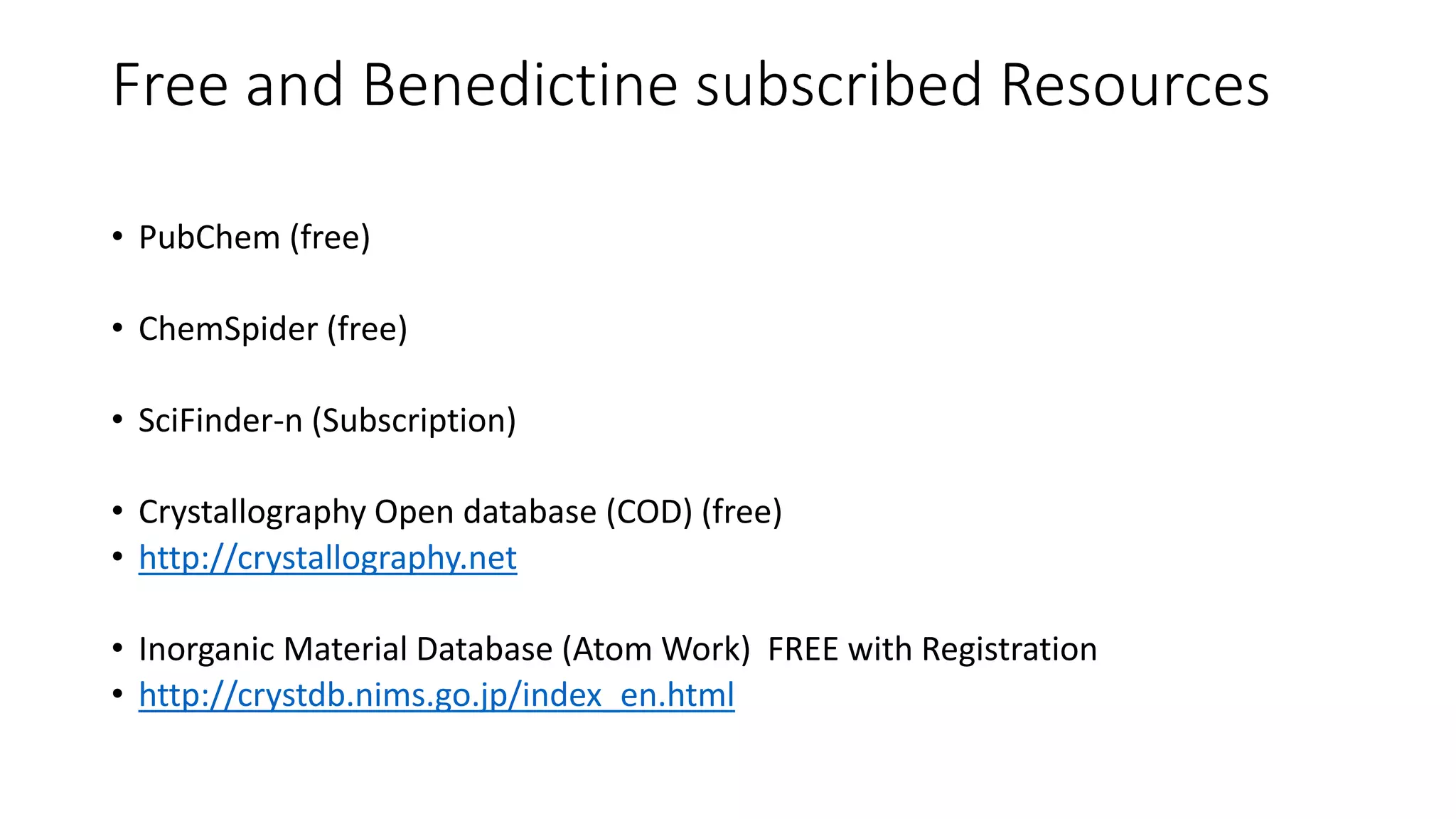
Free and Benedictine subscribed Resources
• PubChem (free)
• ChemSpider (free)
• SciFinder-n (Subscription)
• Crystallography Open database (COD) (free)
• http://crystallography.net
• Inorganic Material Database (Atom Work) FREE with Registration
• http://crystdb.nims.go.jp/index_en.html
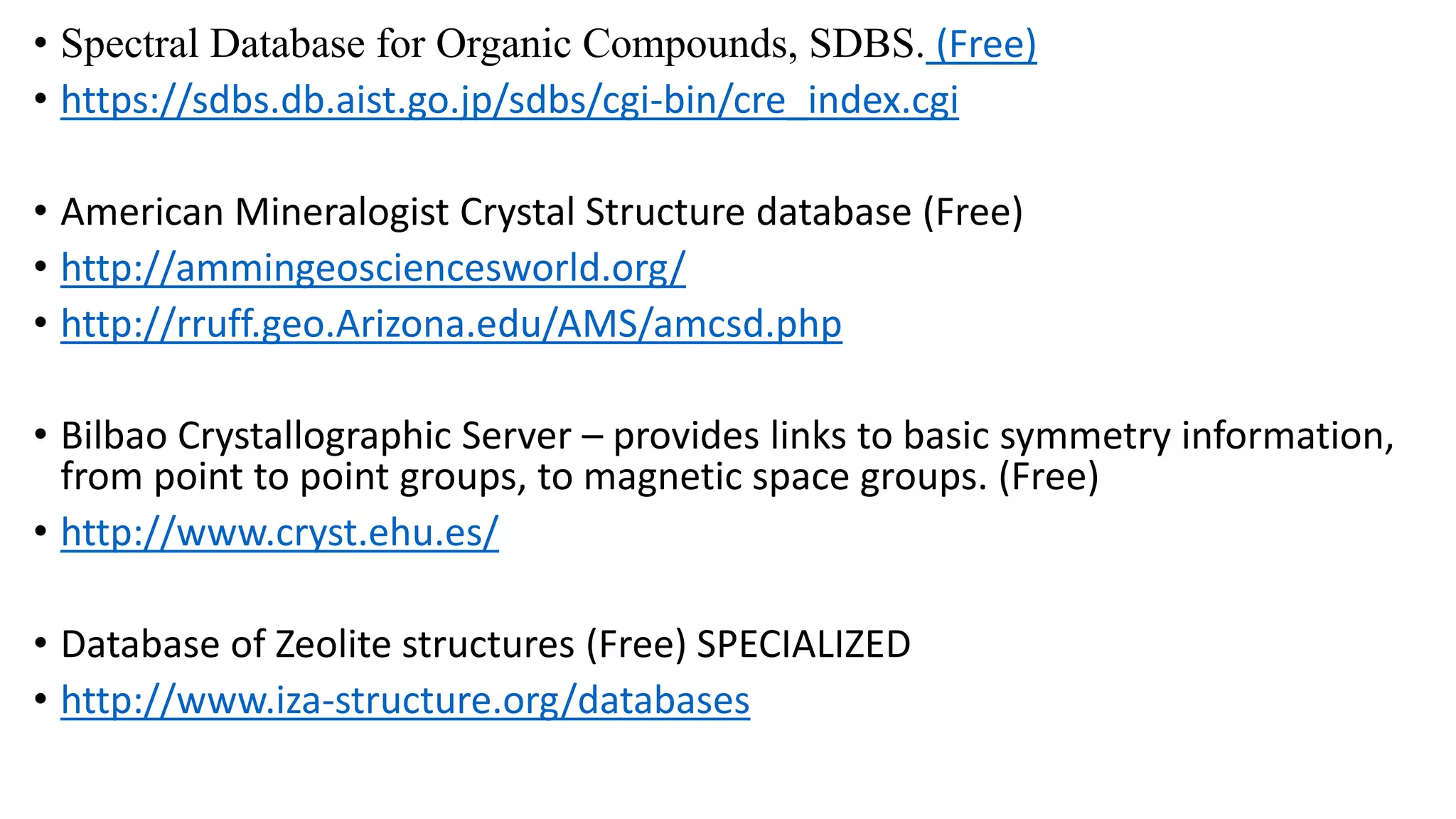
• Spectral Database for Organic Compounds, SDBS. (Free)
• https://sdbs.db.aist.go.jp/sdbs/cgi-bin/cre_index.cgi
• American Mineralogist Crystal Structure database (Free)
• http://ammingeosciencesworld.org/
• http://rruff.geo.Arizona.edu/AMS/amcsd.php
• Bilbao Crystallographic Server – provides links to basic symmetry information,
from point to point groups, to magnetic space groups. (Free)
• http://www.cryst.ehu.es/
• Database of Zeolite structures (Free) SPECIALIZED
• http://www.iza-structure.org/databases
PUBCHEM
• This database is the best so far.
• PubChem is put out by the National Library of Medicine under NIH.
• PubChem
• The world's largest collection of freely accessible chemical
information. Search chemicals by name, molecular formula, structure,
and other identifiers. Find chemical and physical properties, biological
activities, safety and toxicity information, patents, literature citations
and more.
• Access PubChem through
• www.ben.edu/Library, click on Databases and go to P for PubChem
.
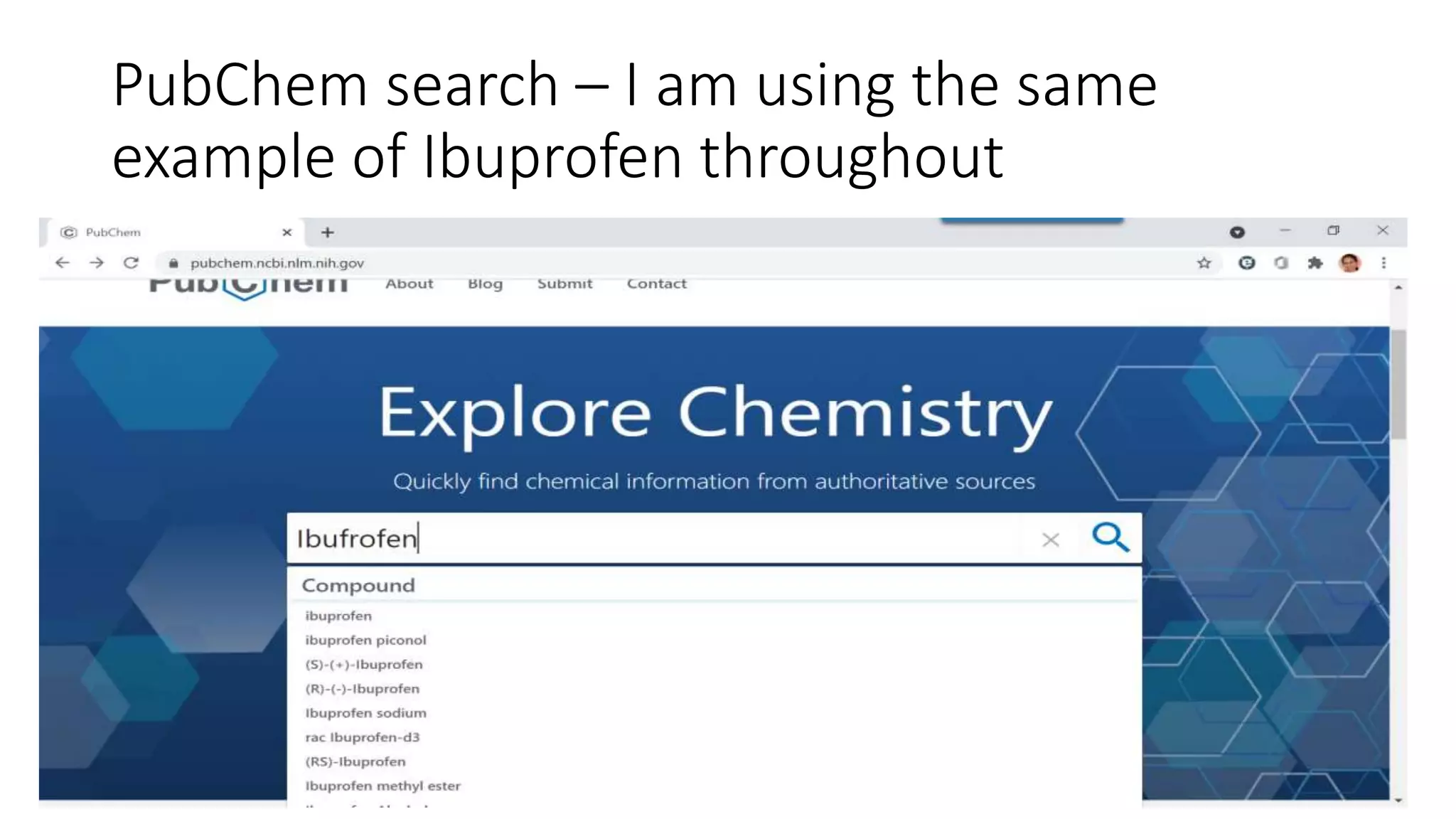
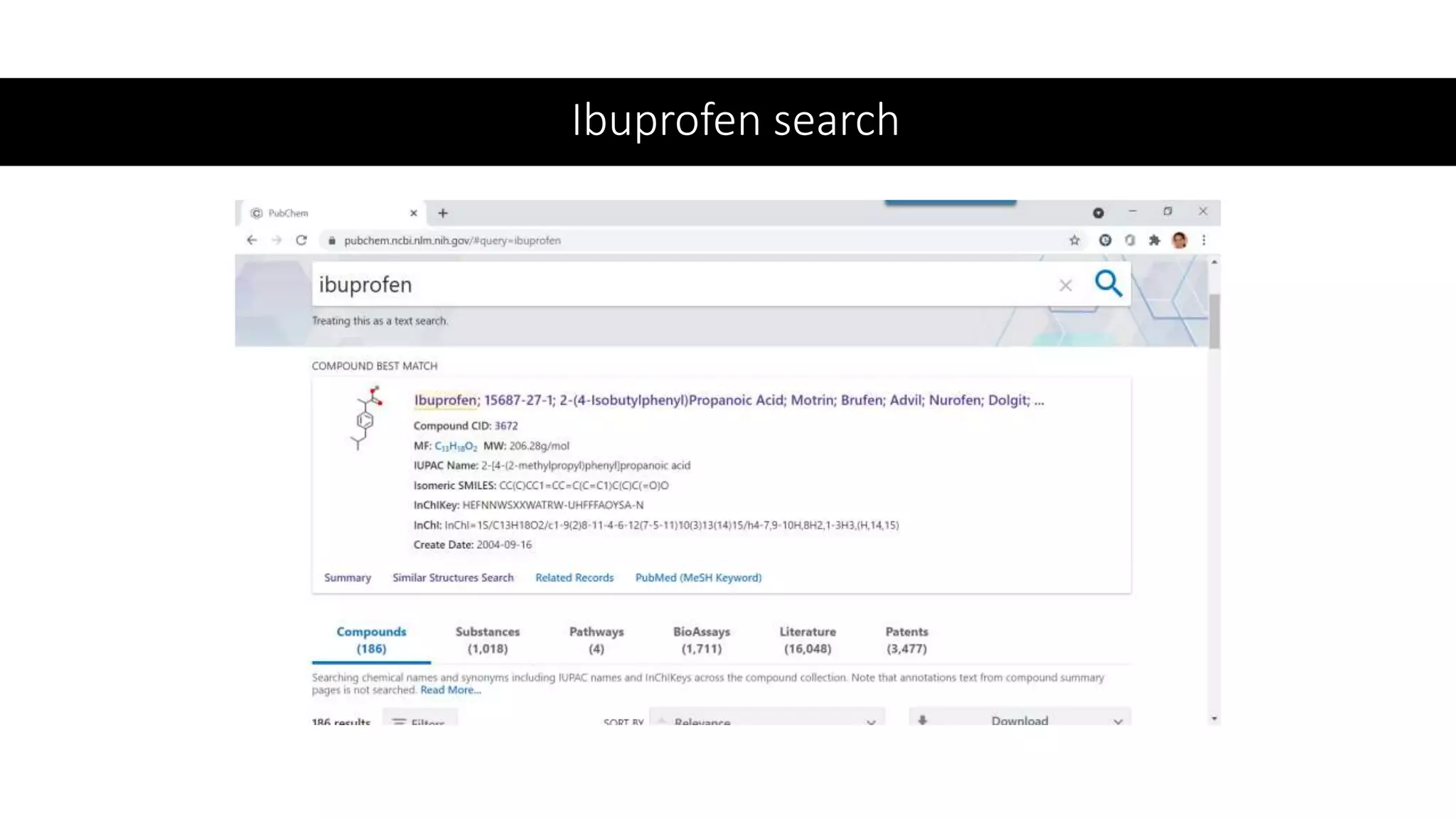
PubChem search – I am using the same
example of Ibuprofen throughout
Ibuprofen search
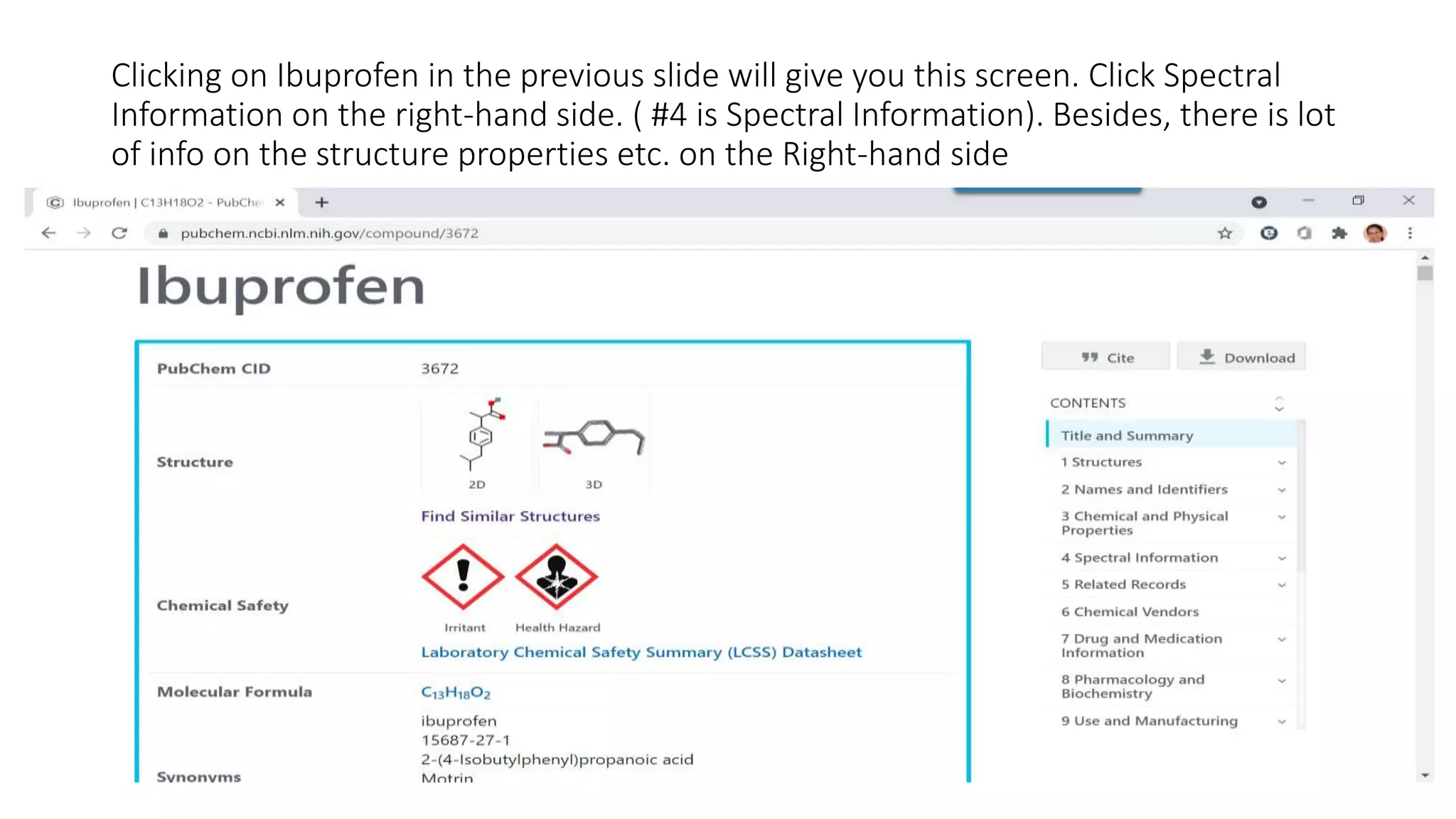
Clicking on Ibuprofen in the previous slide will give you this screen. Click Spectral
Information on the right-hand side. ( #4 is Spectral Information). Besides, there is lot
of info on the structure properties etc. on the Right-hand side
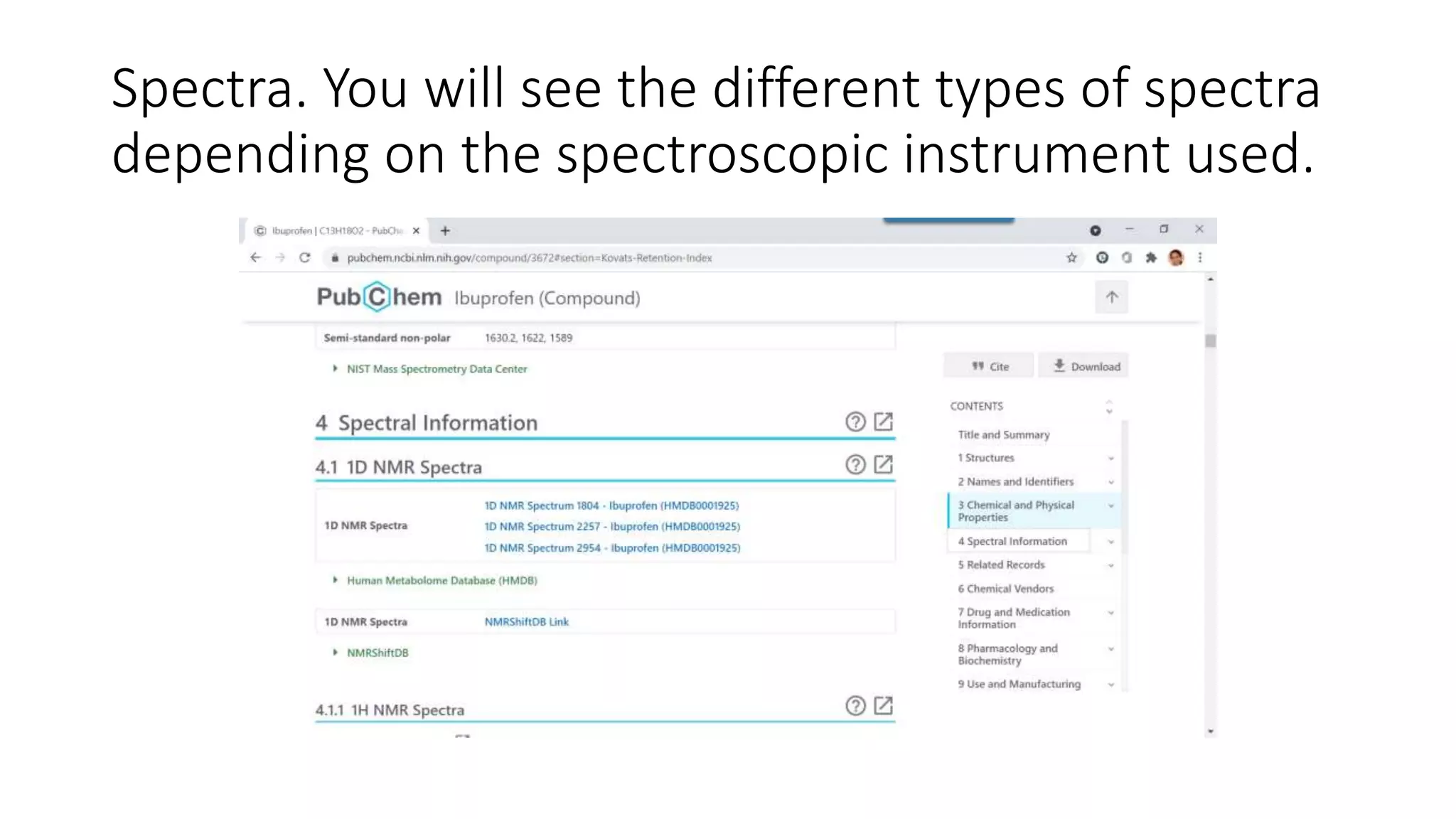
Spectra. You will see the different types of spectra
depending on the spectroscopic instrument used.
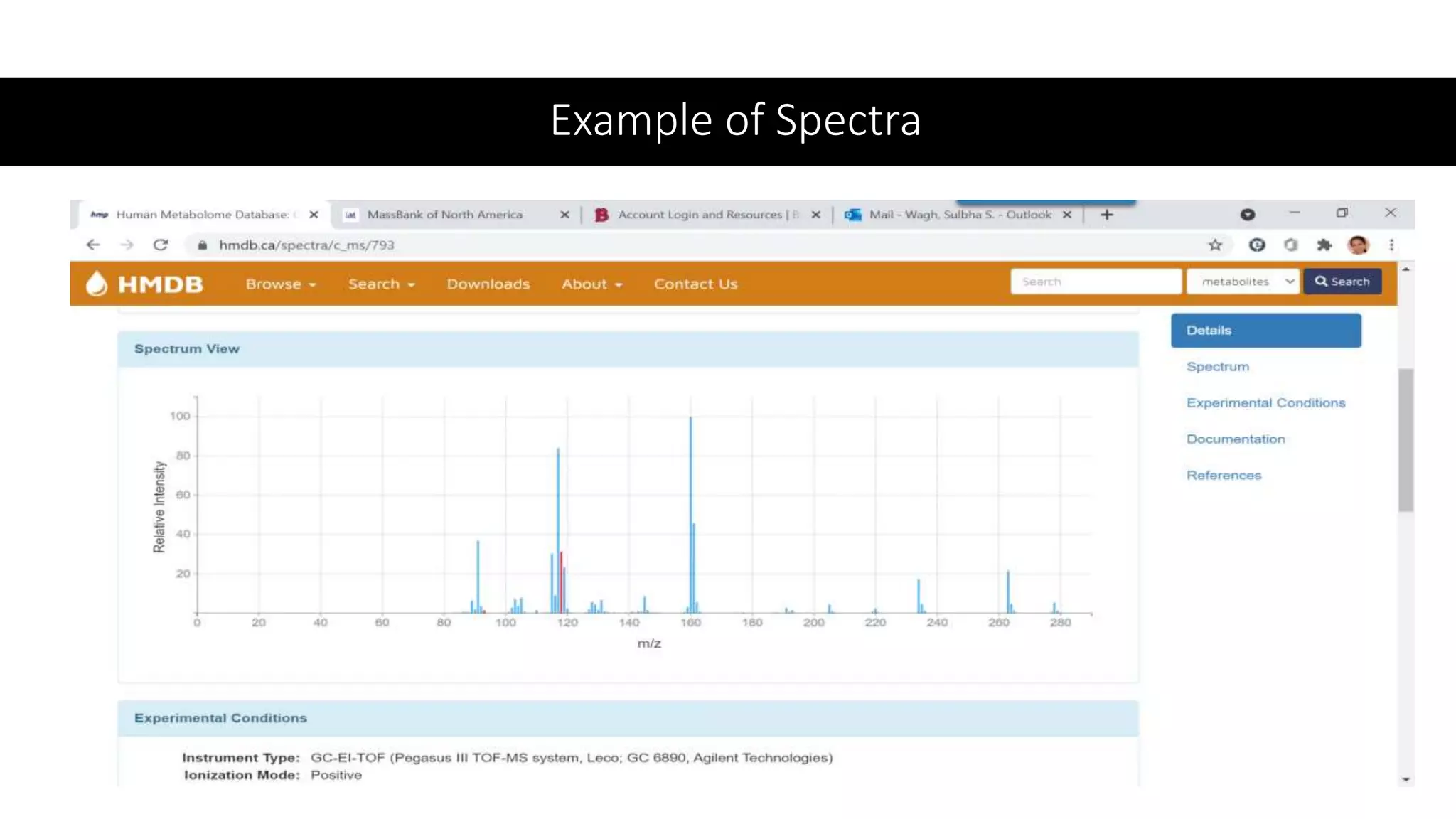
Example of Spectra
Explanation of Spectra-1H-NMR
• Principles of NMR: How to Read Spectra and Couplings
• How to calculate coupling constants
• 1H NMR Spectrum (1D, 500 MHz, CDCl3
• , experimental) (HMDB0001925)
•ChemSpider
• Linking from CHEMSPIDER To Crystallography database
• CHEMSPIDER is put out by the Royal Society of Chemistry. It is a free database
and is similar to SciFinder-n
• http://www.chemspider.com/
• OR from https://www.ben.edu/library/index.cfm
• Scroll to the Cs. Advantage of going through ben.edu library is that all full text
articles that will appear in the search will be available for free (we have a
subscription) or ILL.
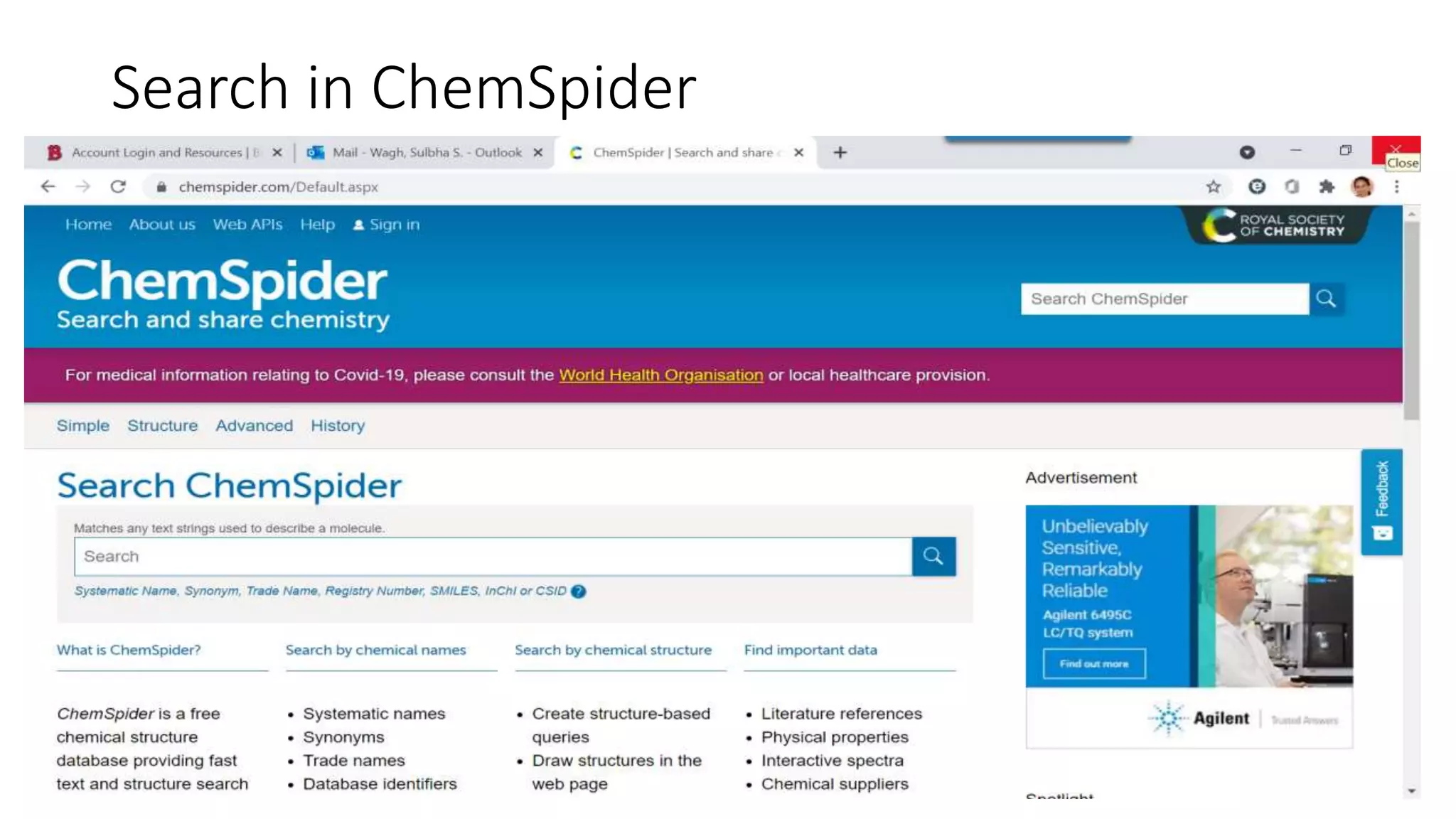
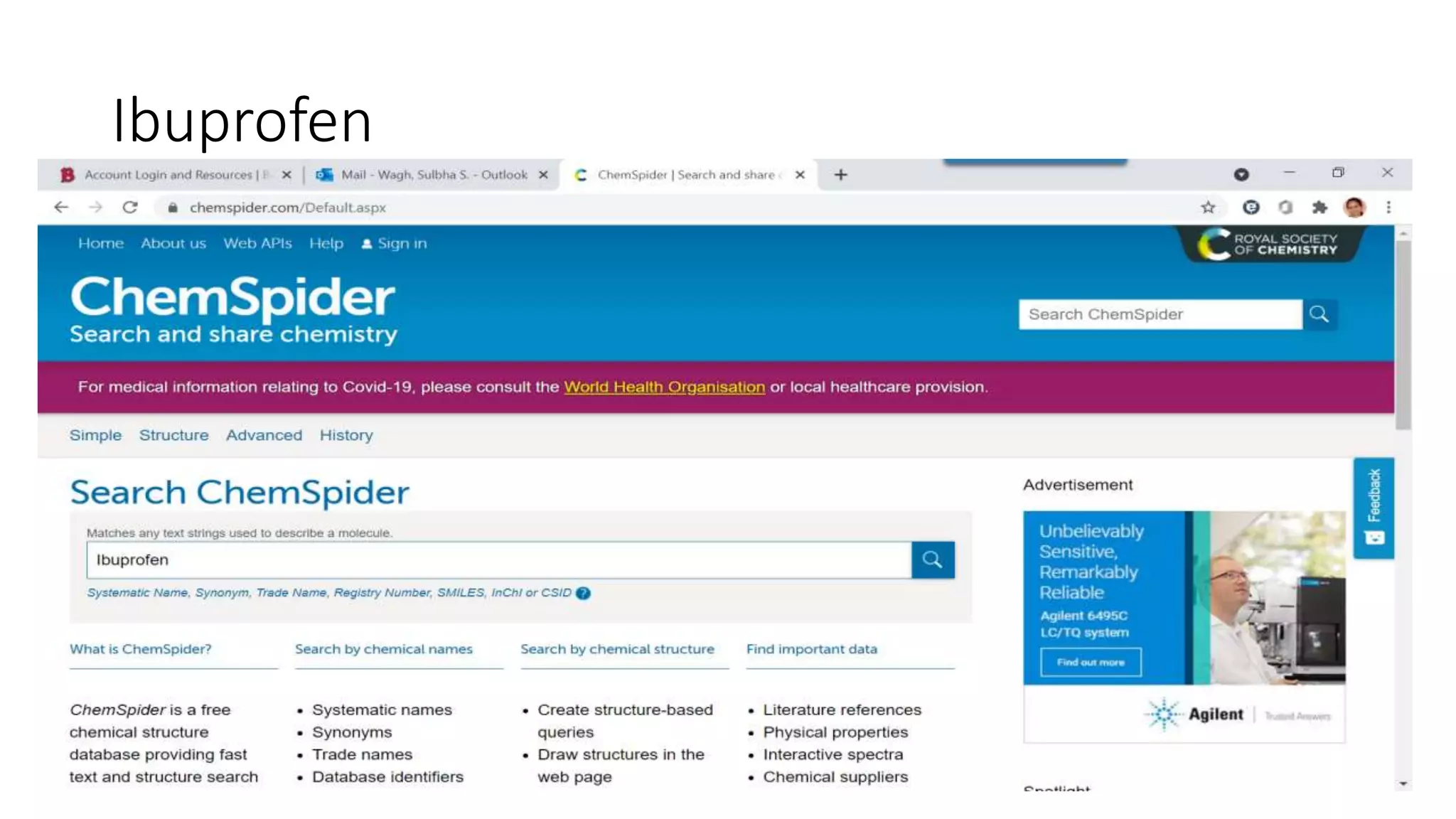
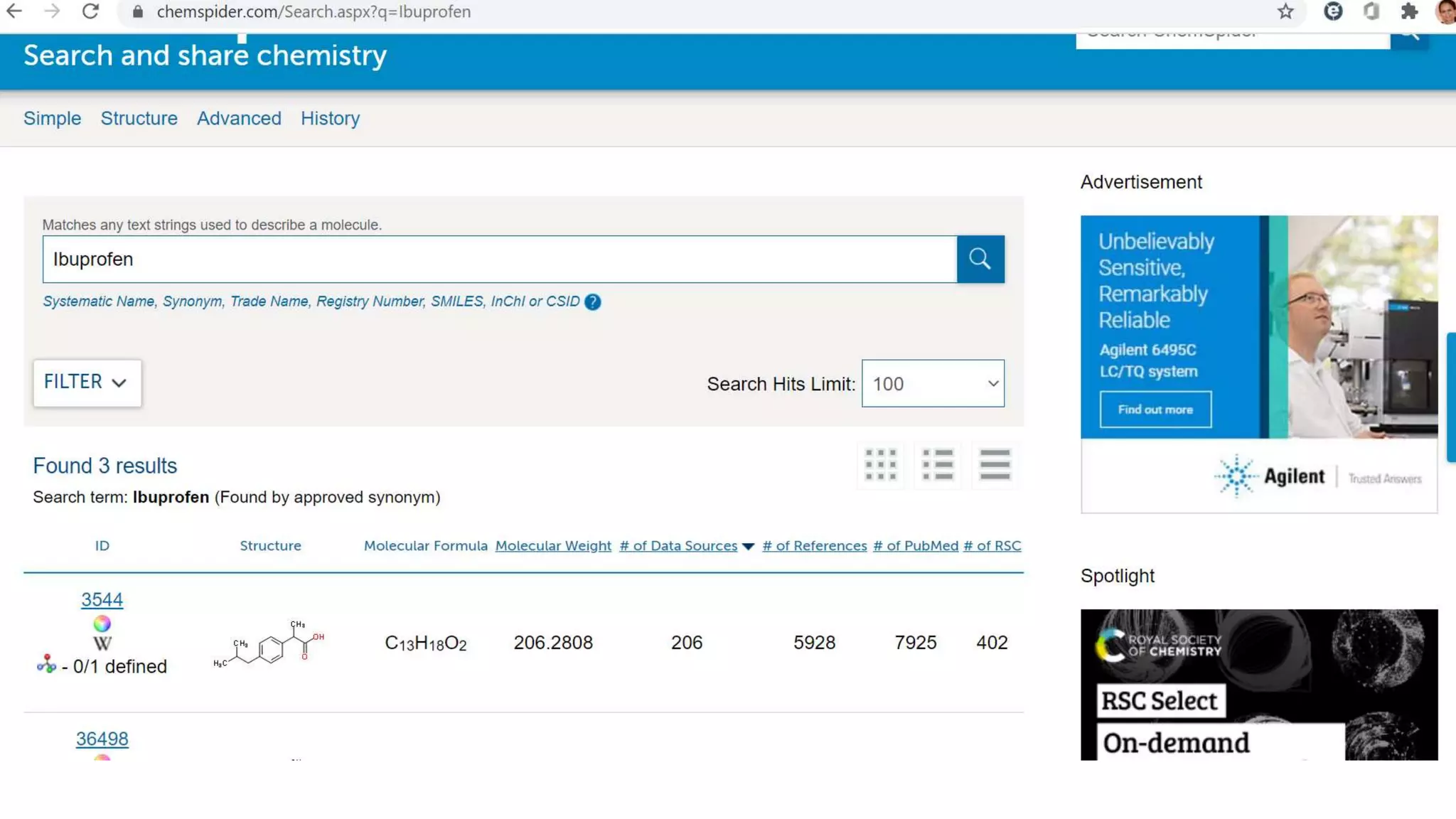
• An actual search for spectral data follows showing different screen shots.
Search in ChemSpider
Ibuprofen
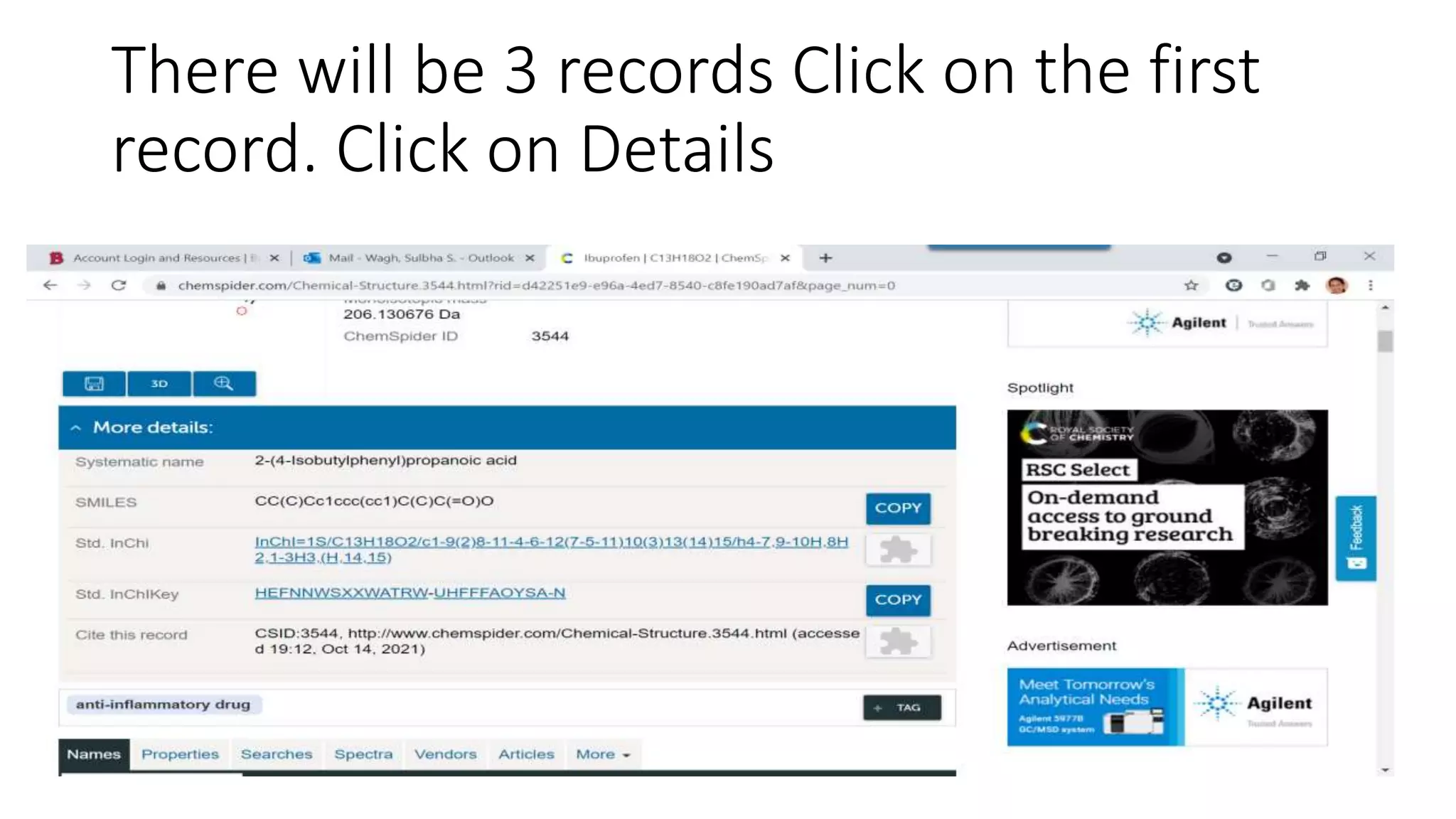
There will be 3 records Click on the first
record. Click on Details
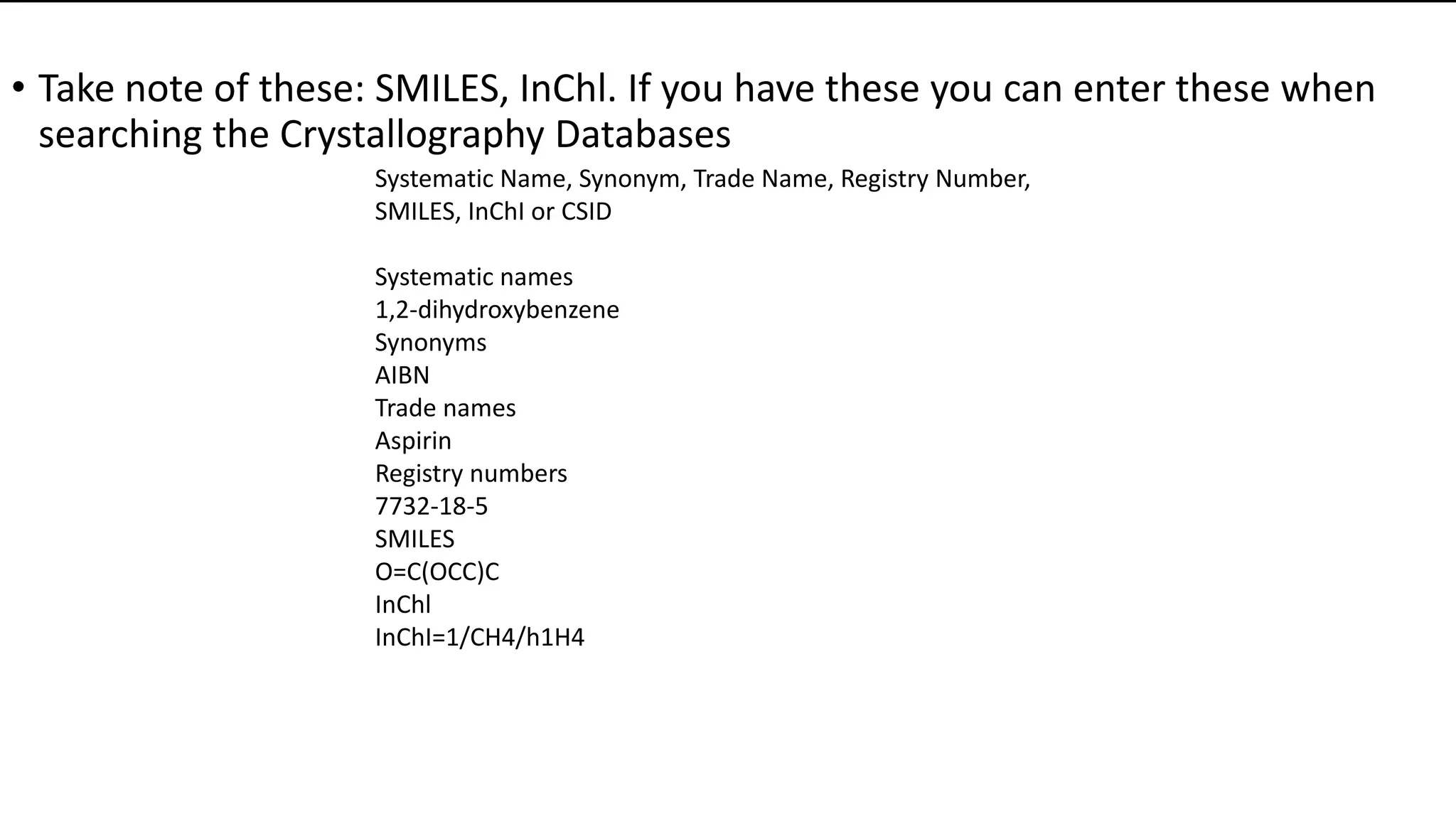
• Take note of these: SMILES, InChl. If you have these you can enter these when
searching the Crystallography Databases
Systematic Name, Synonym, Trade Name, Registry Number,
SMILES, InChI or CSID
Systematic names
1,2-dihydroxybenzene
Synonyms
AIBN
Trade names
Aspirin
Registry numbers
7732-18-5
SMILES
O=C(OCC)C
InChl
InChI=1/CH4/h1H4
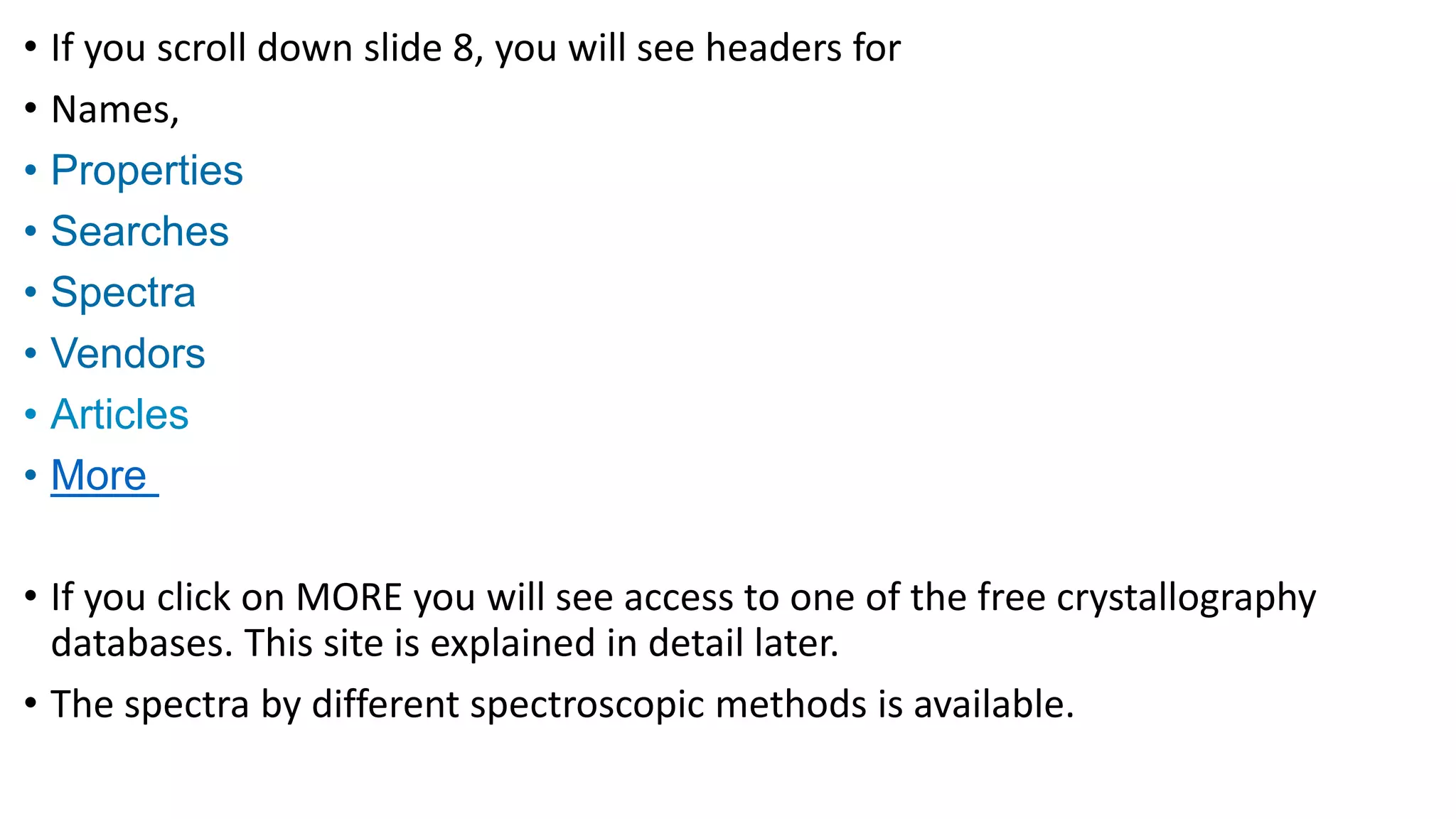
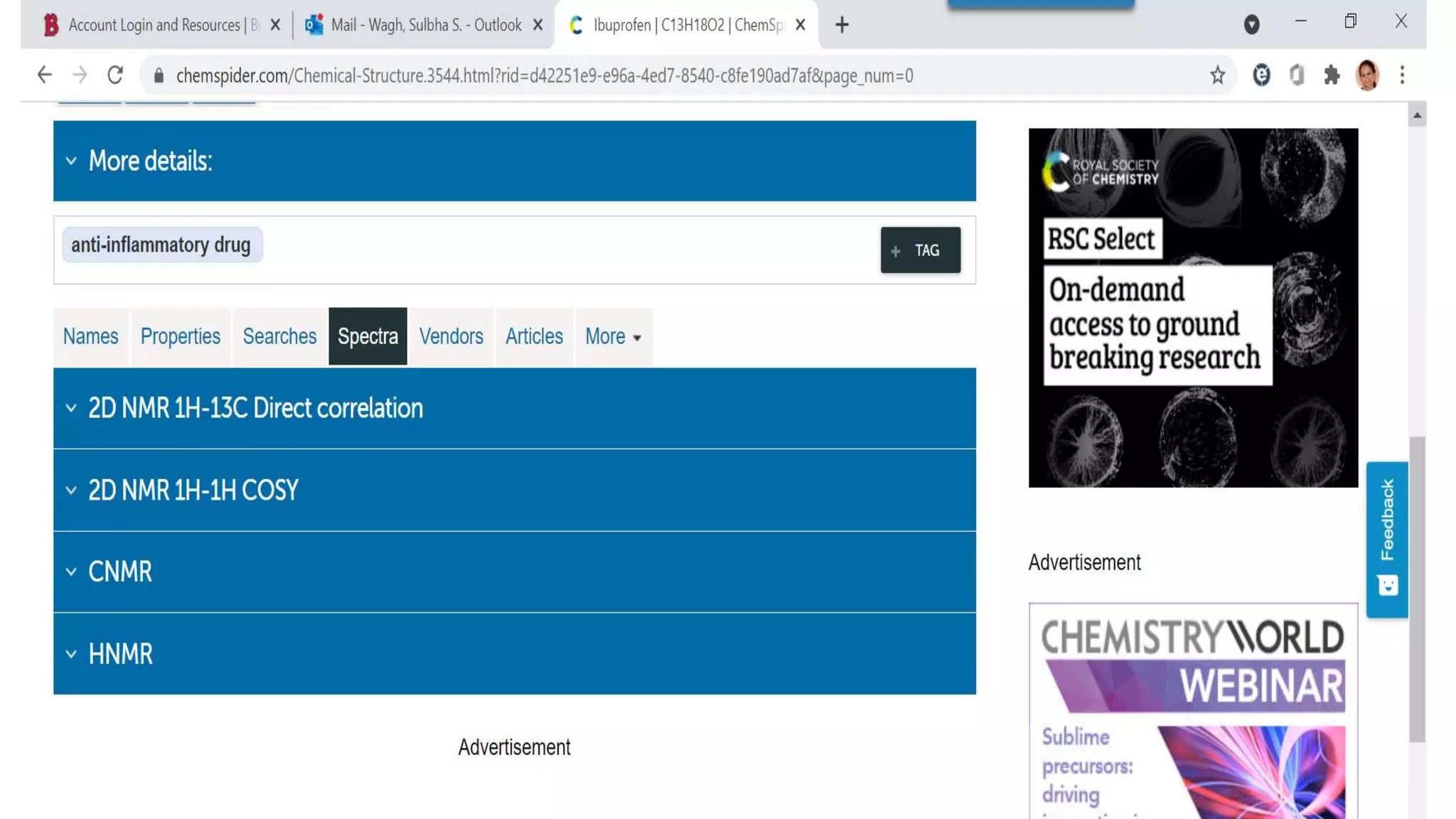
• If you scroll down slide 8, you will see headers for
• Names, Names
• Properties
• Searches
• Spectra
• Vendors
• Articles
• More
• If you click on MORE you will see access to one of the free crystallography
databases. This site is explained in detail later.
• The spectra by different spectroscopic methods is available.
•In the Introduction I said that all
databases for crystallography curate the
material data from SciFinder-n or other
research systems.
•Now we will address how to search
SciFinder-n for crystallography data.
SciFinder-n searches
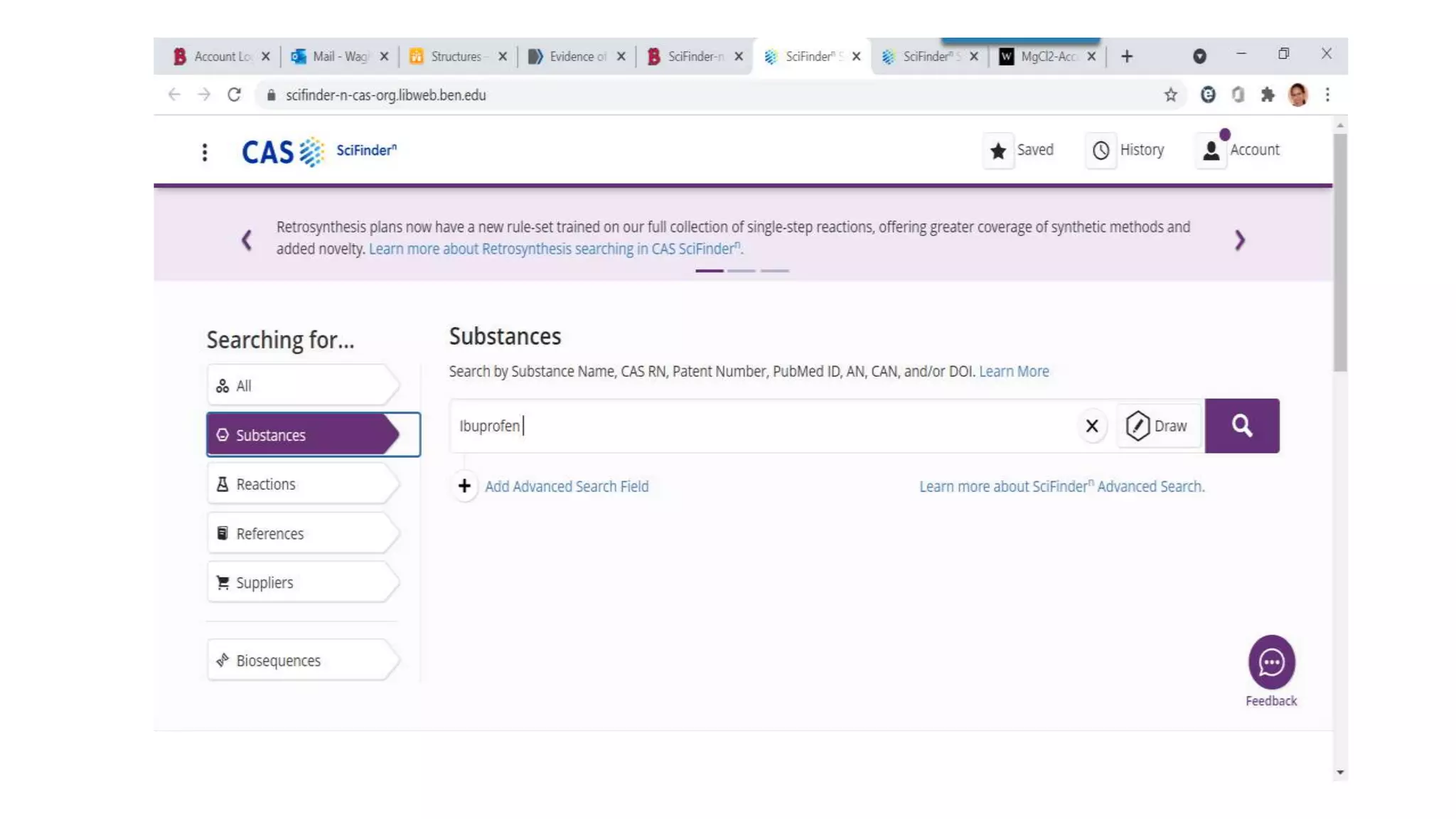
• SciFinder-n is the premier indexing and abstracting service of the
American Chemical Society. We have a subscription. Access through
the Benedictine University Library Portal at
www.ben.edu/library/databases. Scroll down to the Ss. Click on either
choice and follow screen prompts.
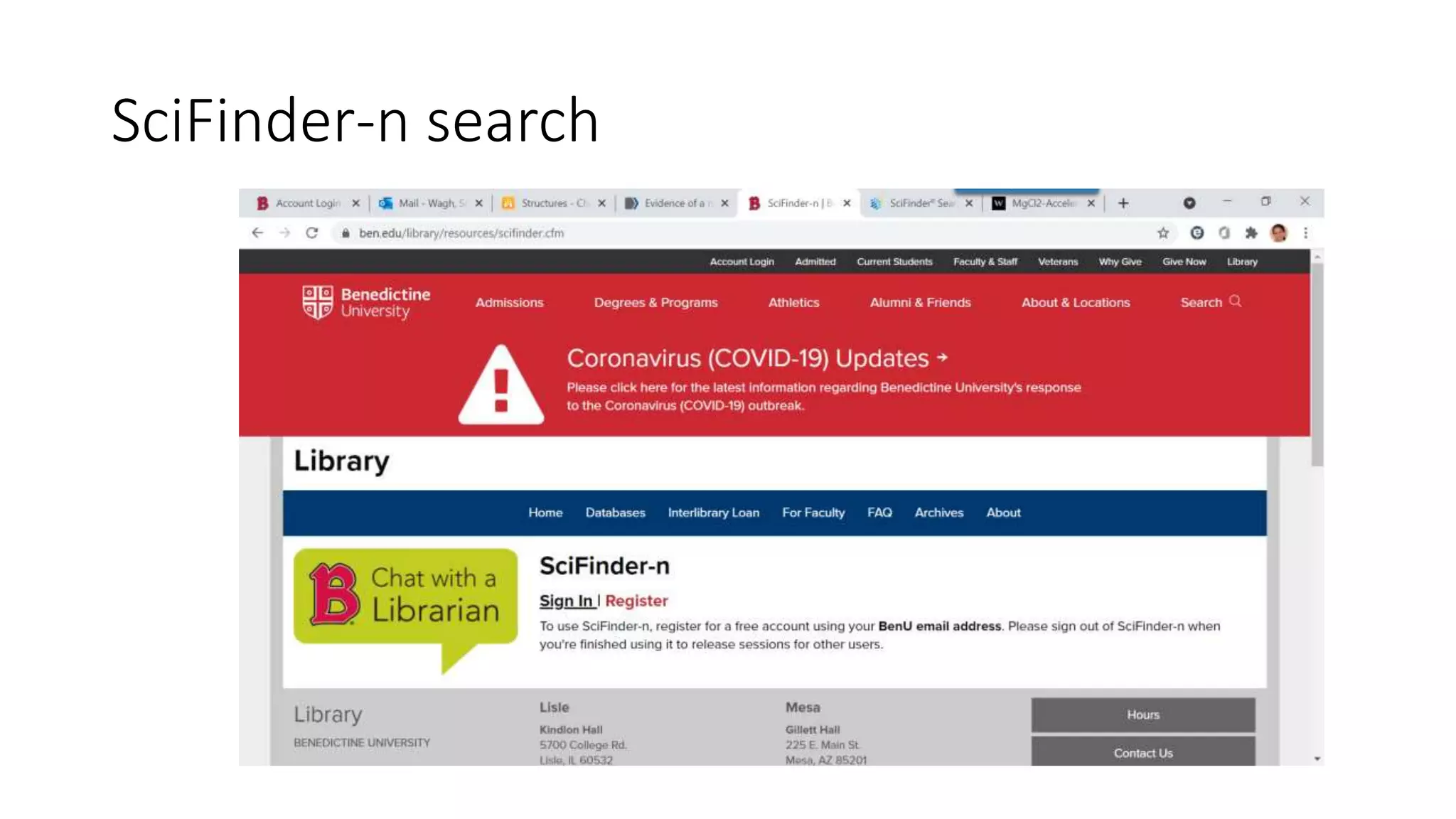
SciFinder-n search
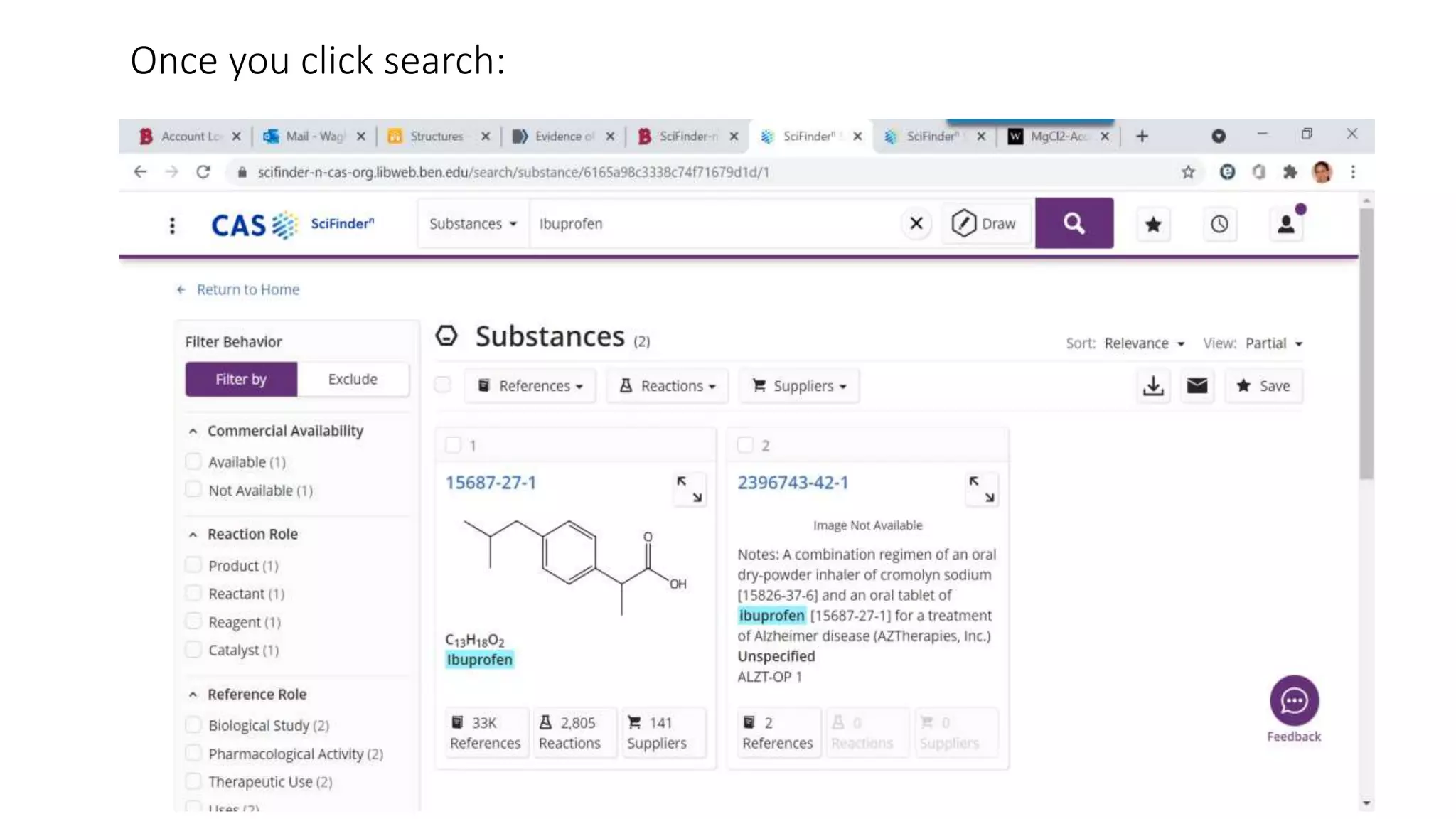
Once you click search:
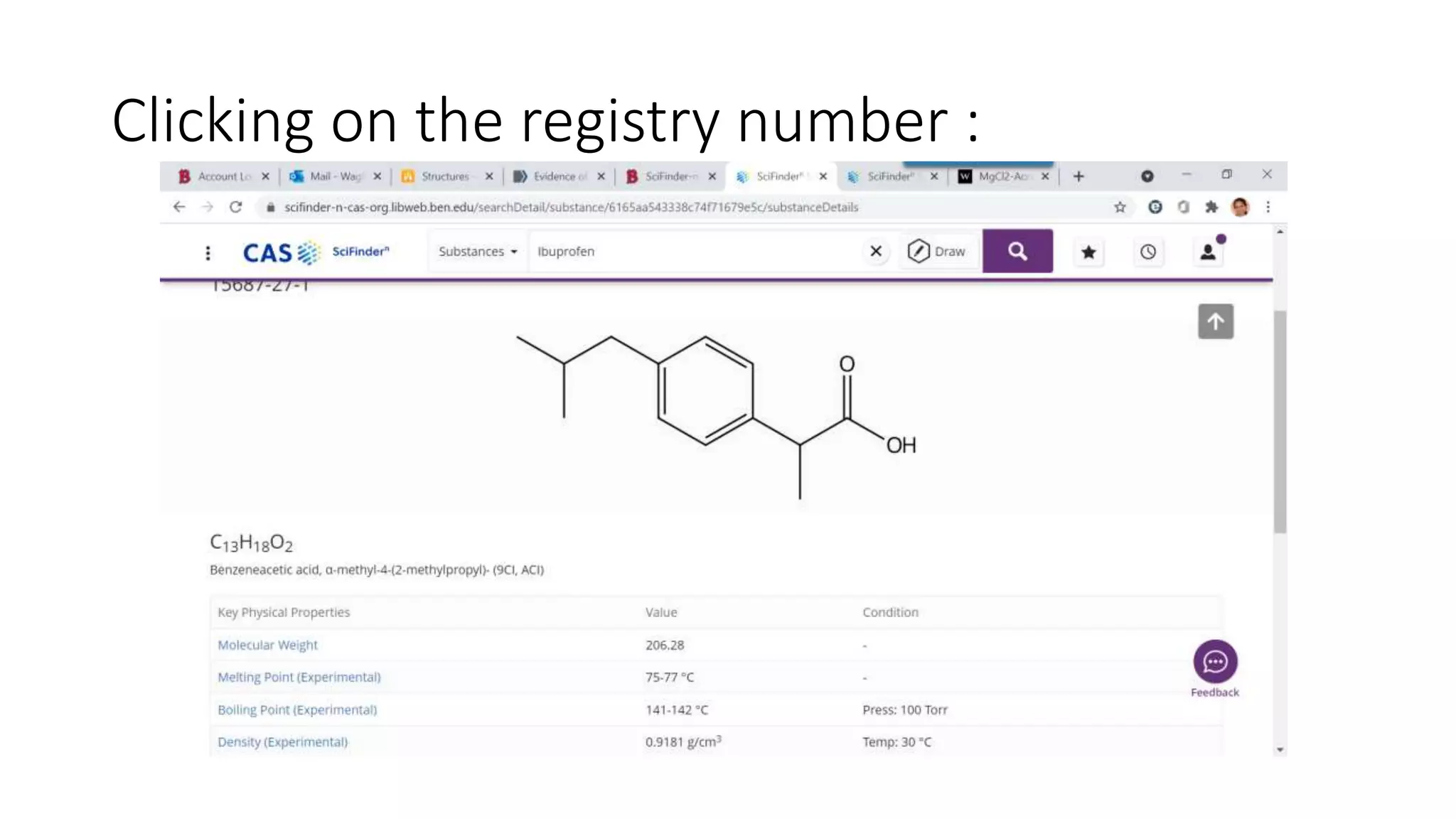
Clicking on the registry number :
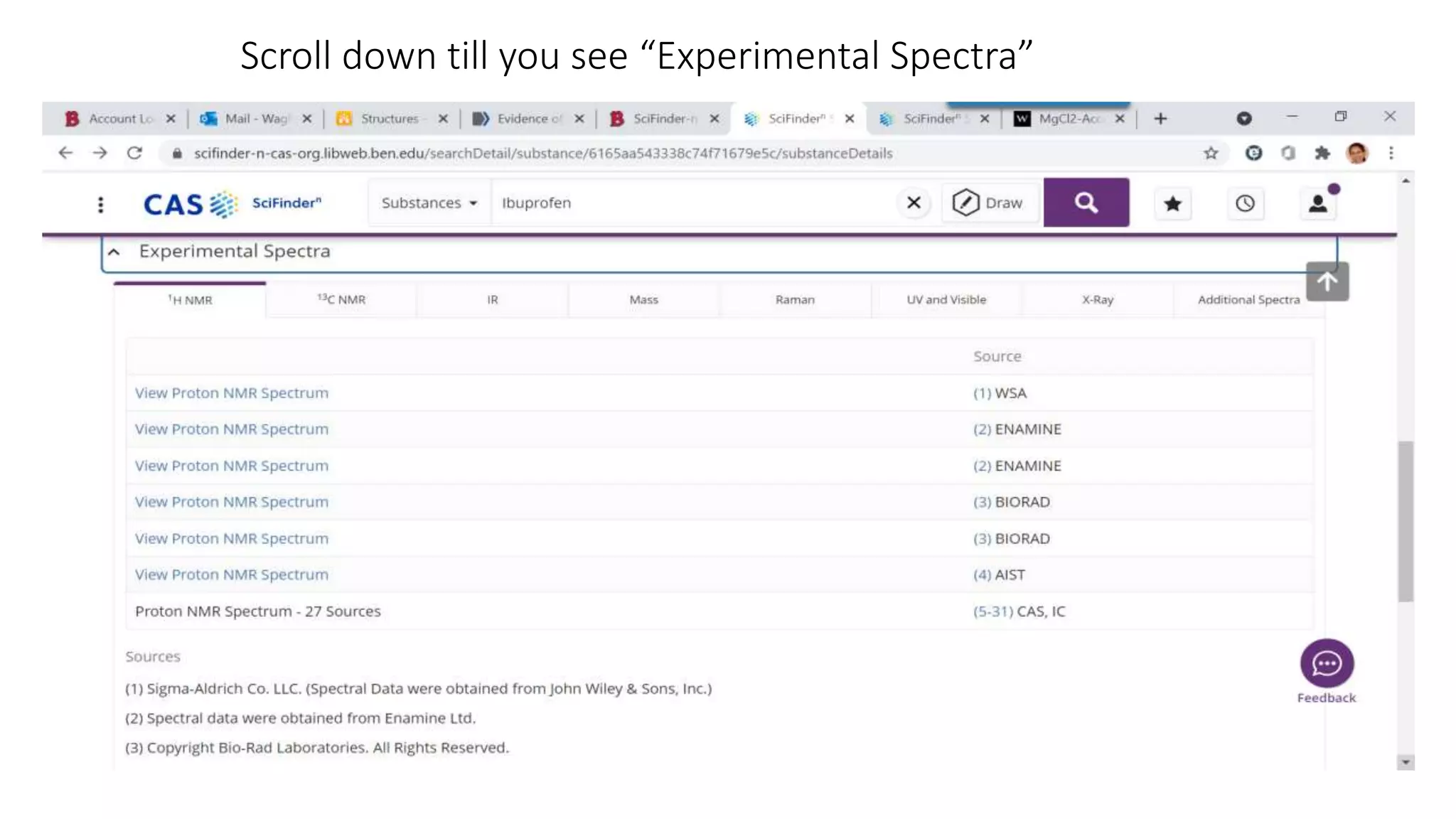
Scroll down till you see “Experimental Spectra”
Other ways to search
SciFinder-n
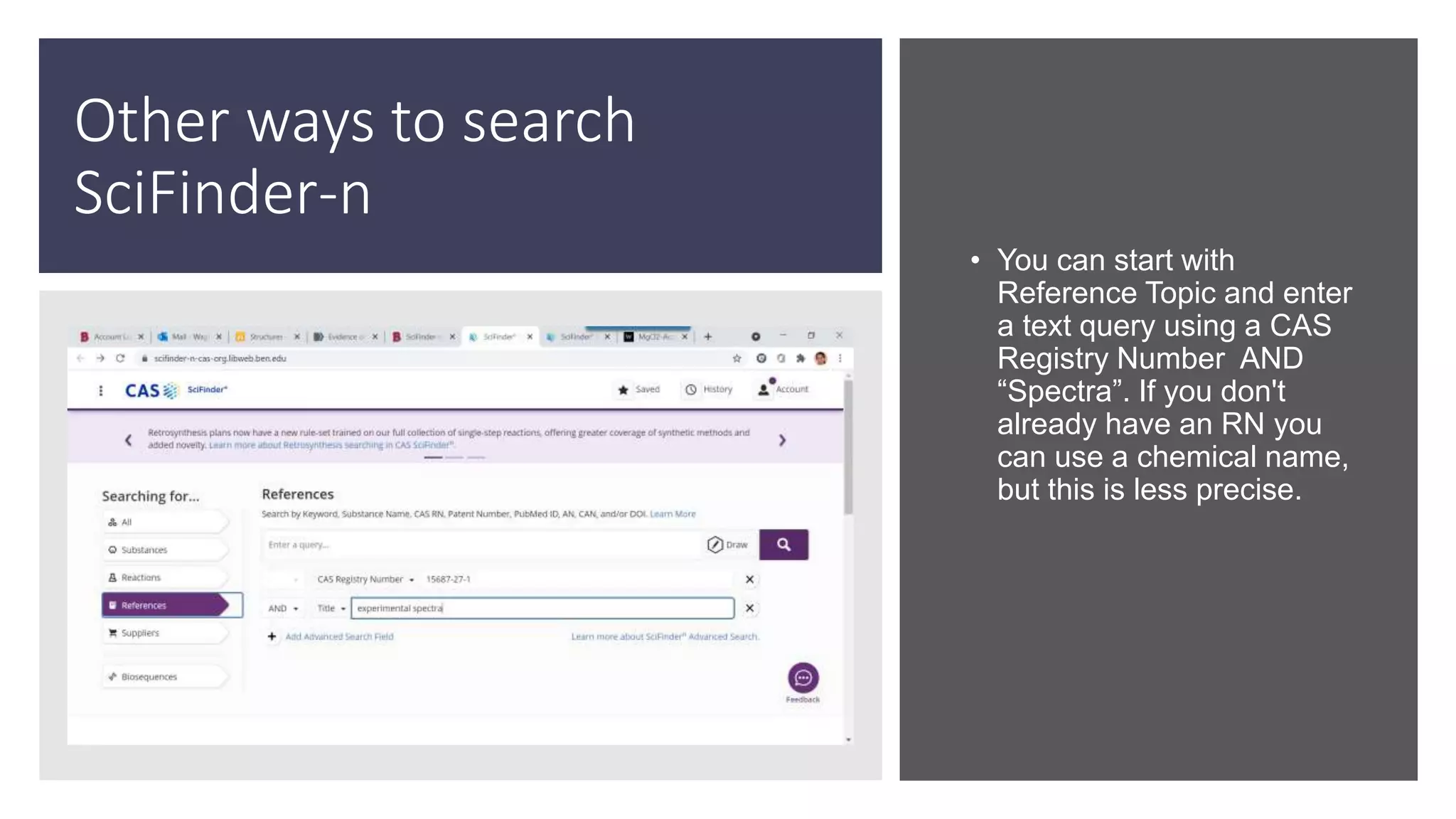
• You can start with
Reference Topic and enter
a text query using a CAS
Registry Number AND
“Spectra”. If you don't
already have an RN you
can use a chemical name,
but this is less precise.
• I am going to concentrate on Four free Databases. The last two by
appointment ONLY. * databases are not included here.
• Crystallography Open database (COD)
• http://crystallography.net
• Inorganic Material Database (Atom Work) FREE with Registration *
• http://crystdb.nims.go.jp/index_en.html
• Spectral Database for Organic Compounds, SDBS.
• https://sdbs.db.aist.go.jp/sdbs/cgi-bin/cre_index.cgi
• American Mineralogist Crystal Structure database
• http://ammingeosciencesworld.org/
• http://rruff.geo.Arizona.edu/AMS/amcsd.php
• Bilbao Crystallographic Server – provides links to basic symmetry information, from point to point groups, to magnetic space groups. *
• http://www.cryst.ehu.es/
• FYI
• Database of Zeolite structures*
• http://www.iza-structure.org/databases
Crystallography
Open Database
COD
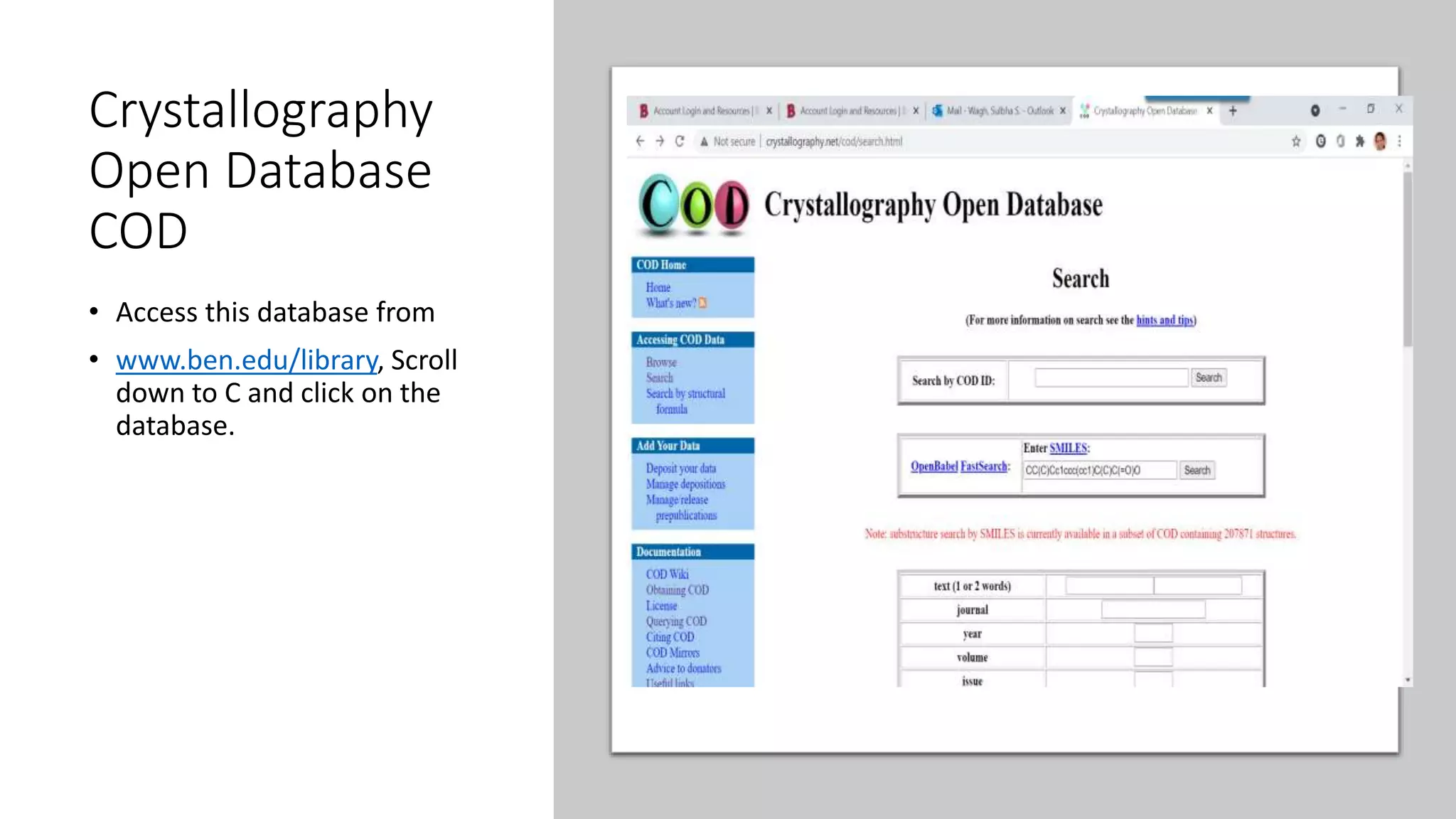
• Access this database from
• www.ben.edu/library, Scroll
down to C and click on the
database.
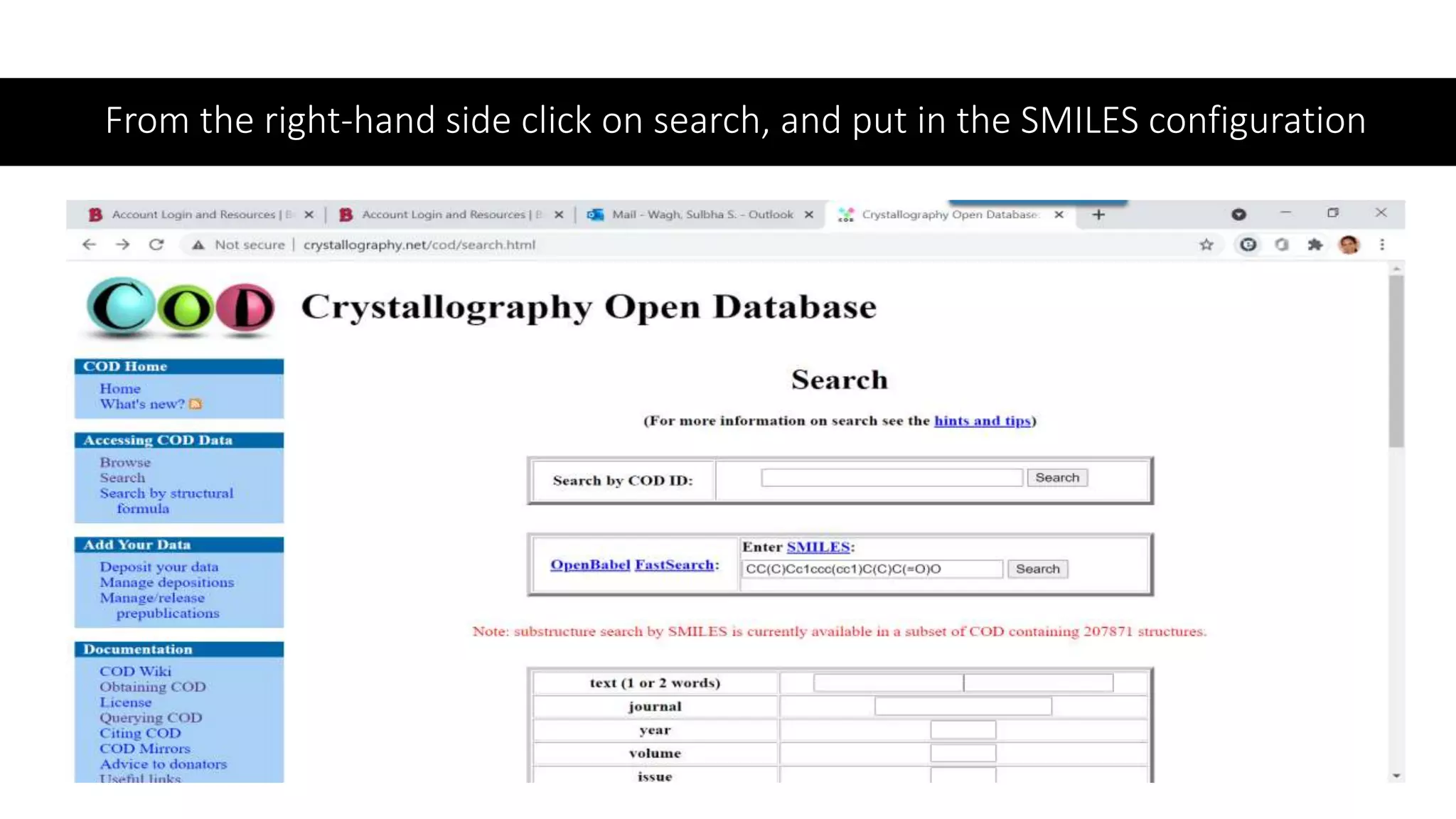
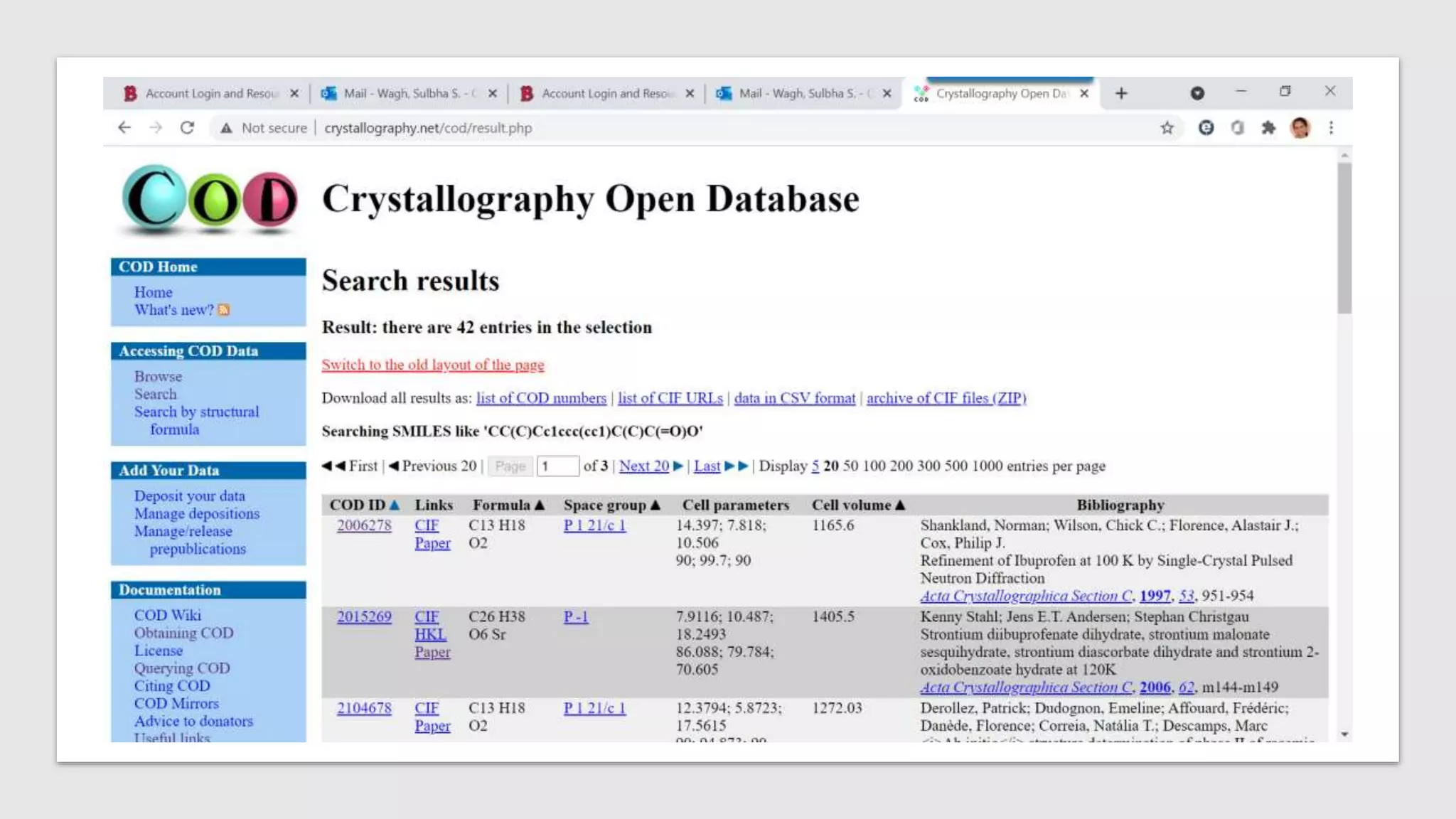
From the right-hand side click on search, and put in the SMILES configuration
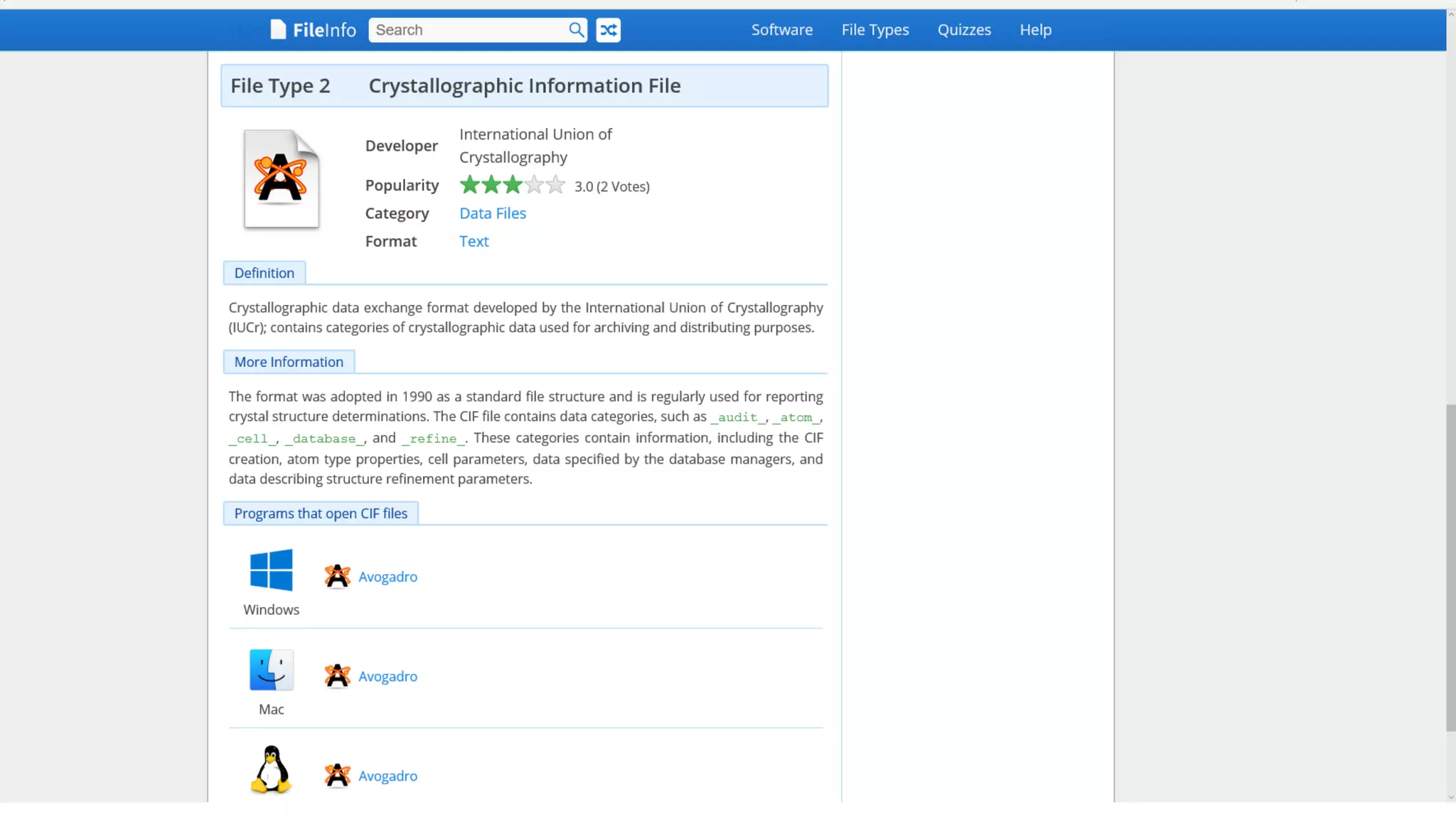
• You will notice that most files are in .CIF OR .Hkl format.
• That means you need to download the software that lets you open these
files?the software
• Any word file will open the .CIF file. But if you want to make changes then you
need to download the software explained below.
• CIF (Crystallographic Information Framework)
• The International Union of Crystallography is the sponsor of the Crystallographic
Information Framework, a standard for information interchange in
crystallography.
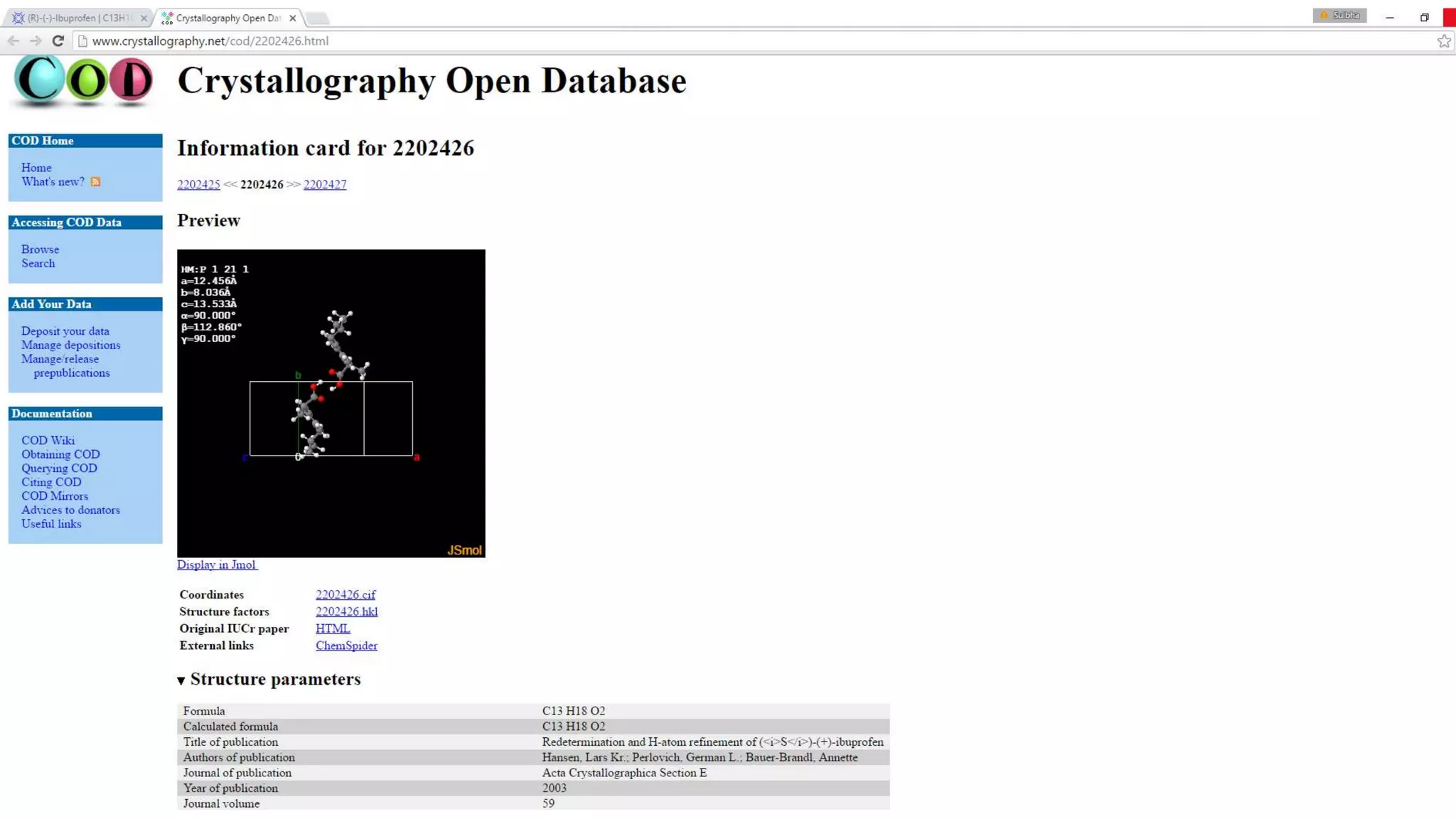
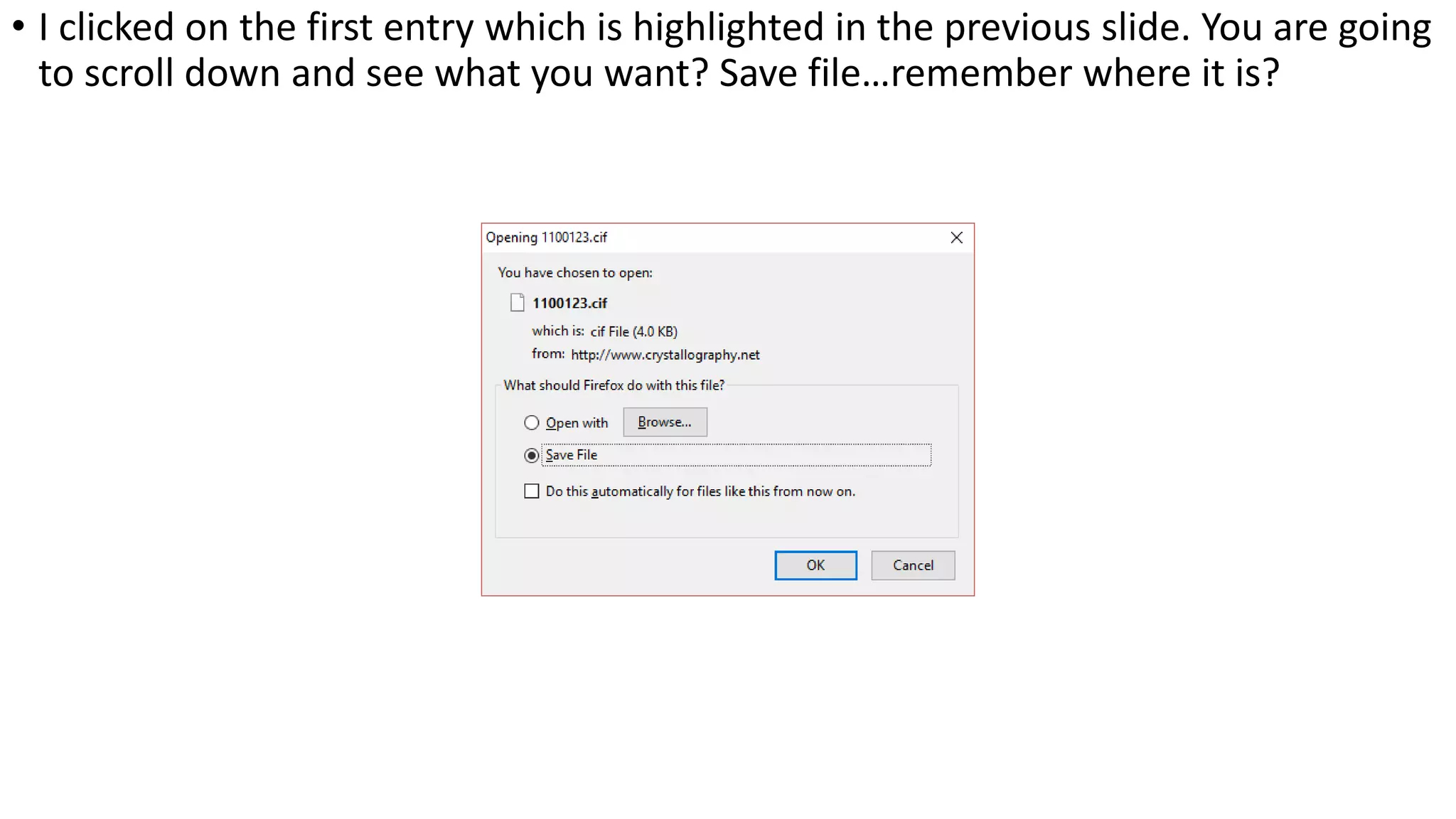
• I clicked on the first entry which is highlighted in the previous slide. You are going
to scroll down and see what you want? Save file…remember where it is?
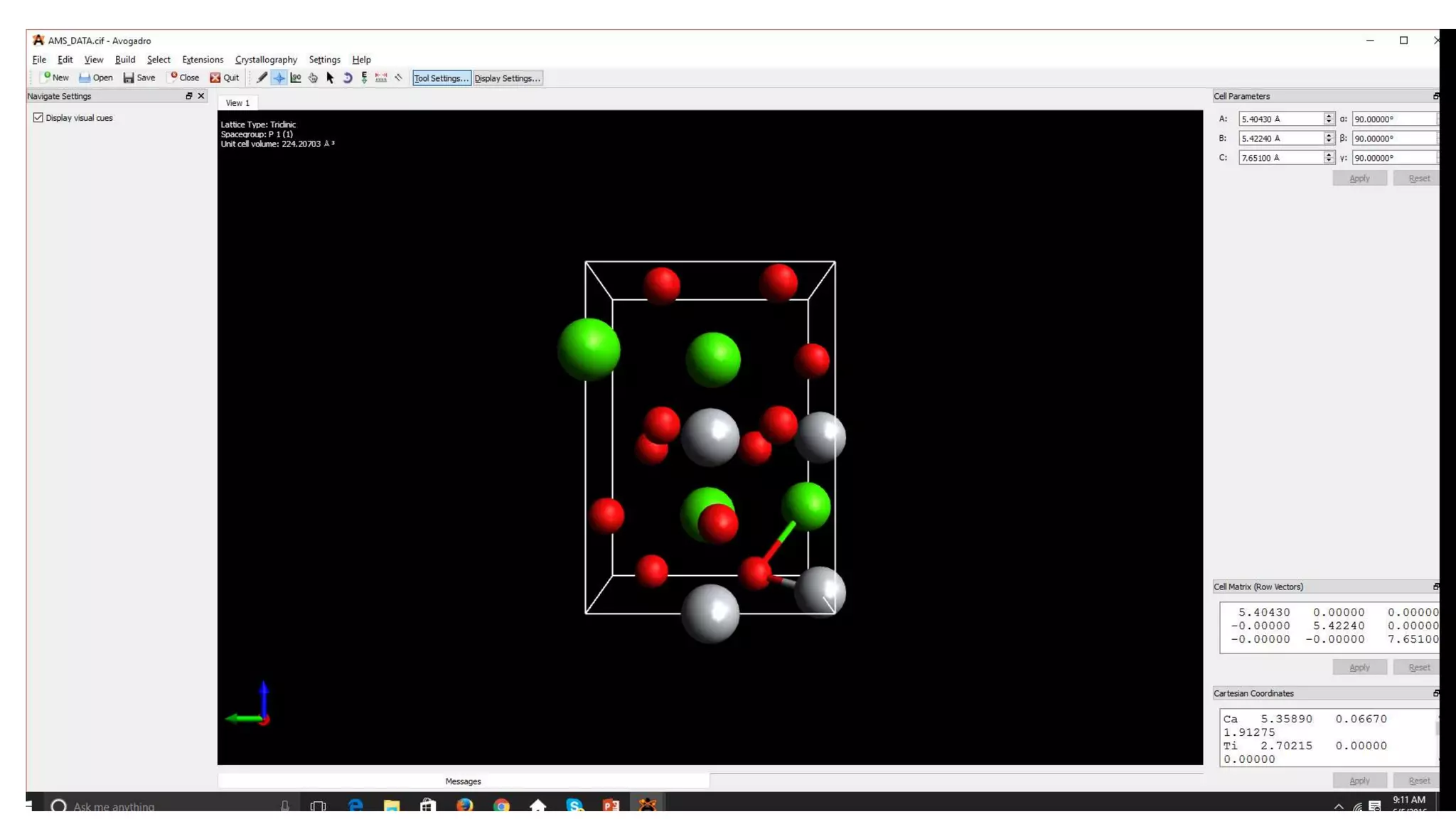
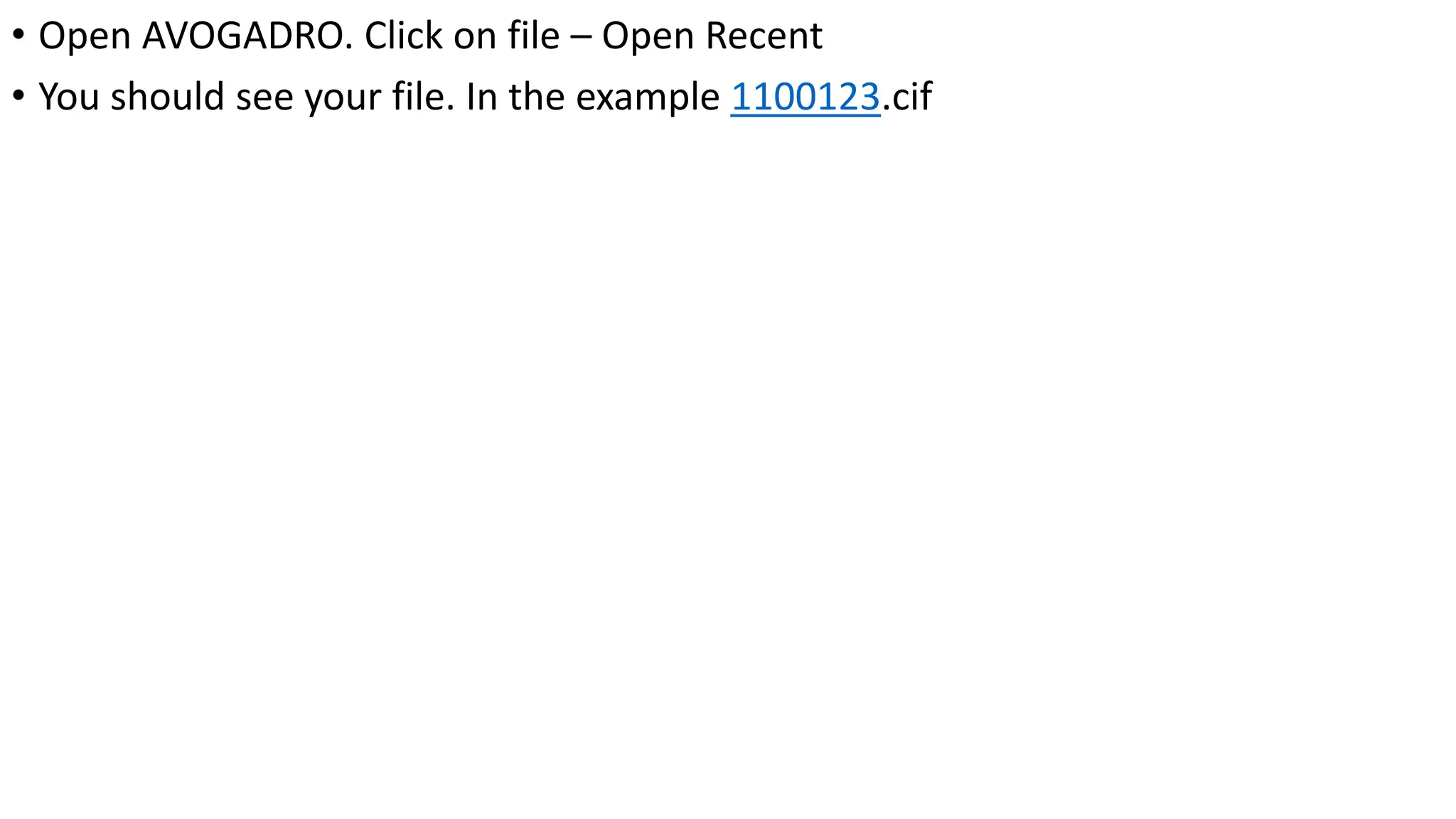
• Open AVOGADRO. Click on file – Open Recent
• You should see your file. In the example 1100123.cif
SDBS
• Spectral Database for Organic Compounds
• Search Help
• https://sdbs.db.aist.go.jp/sdbs/LINKS/help_eng.html
• This link will take you to the Help screens for doing a search.
• This is a link to a power point presentation of screens of the Search
Help document.
• SDBS Integrated Spectral Database for Organic Compounds
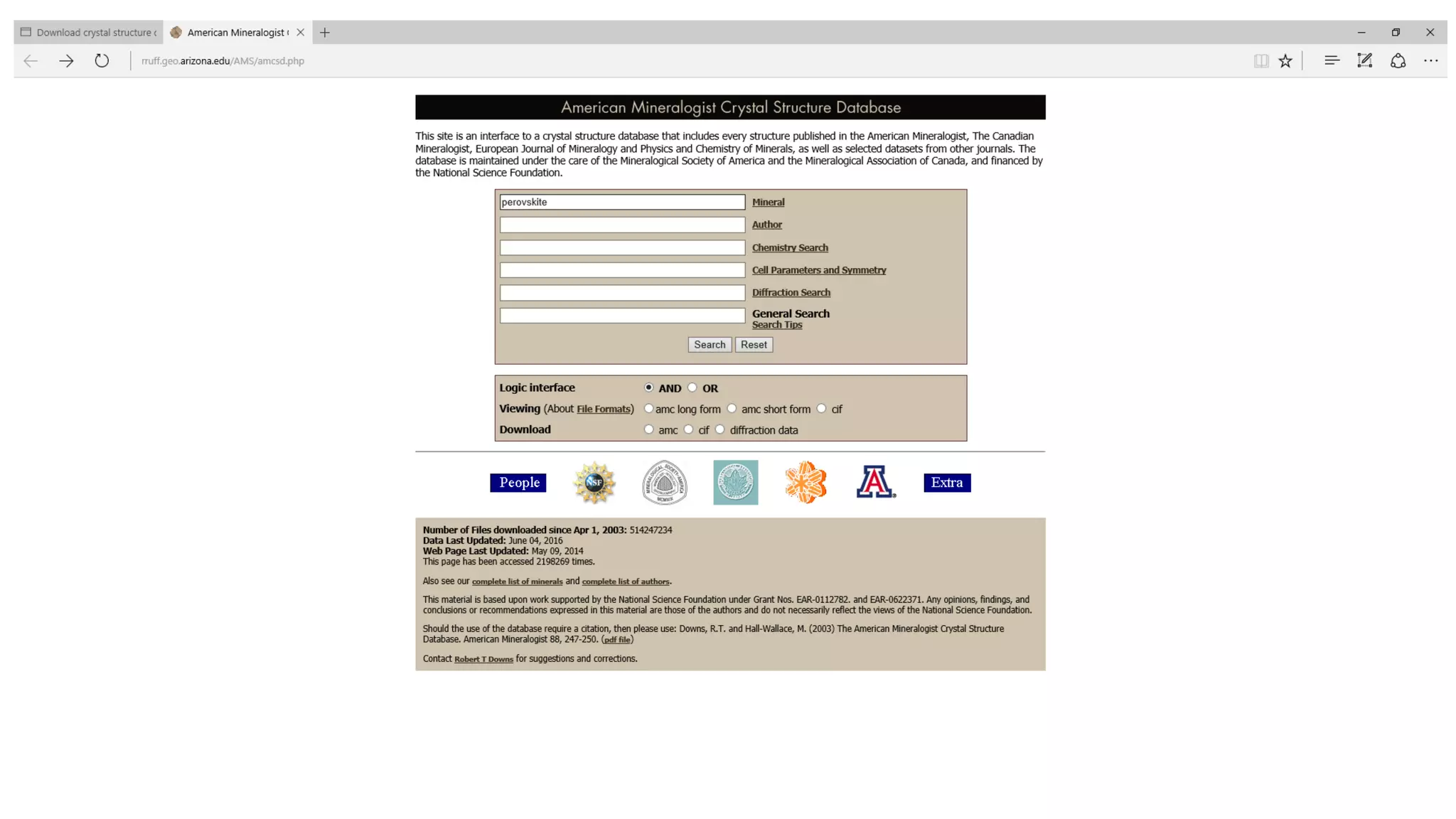
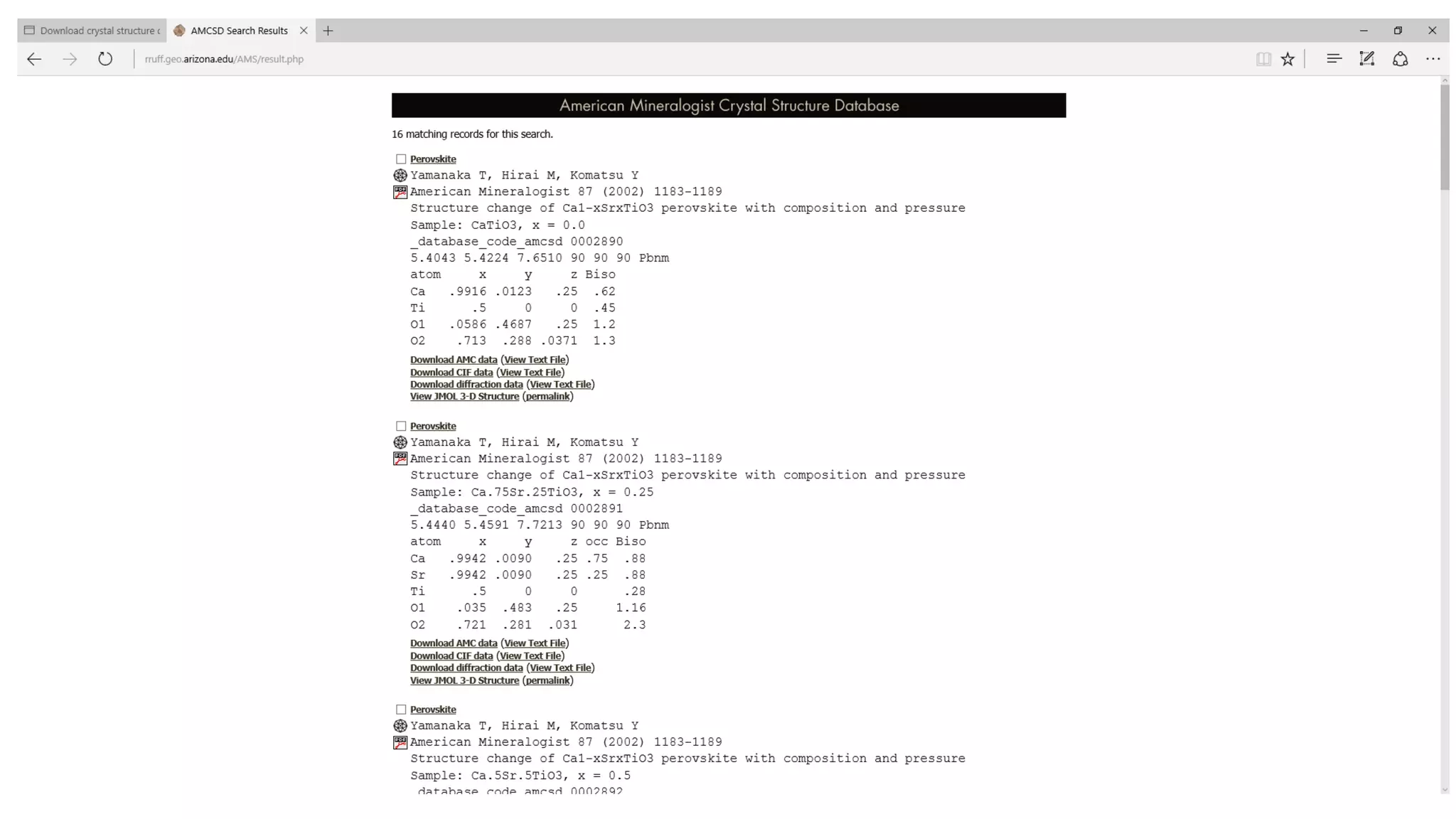
American Mineralogist Crystal Structure
Database
• American Mineralogist Crystal Structure database
• http://ammingeosciencesworld.org/
• http://rruff.geo.Arizona.edu/AMS/amcsd.php
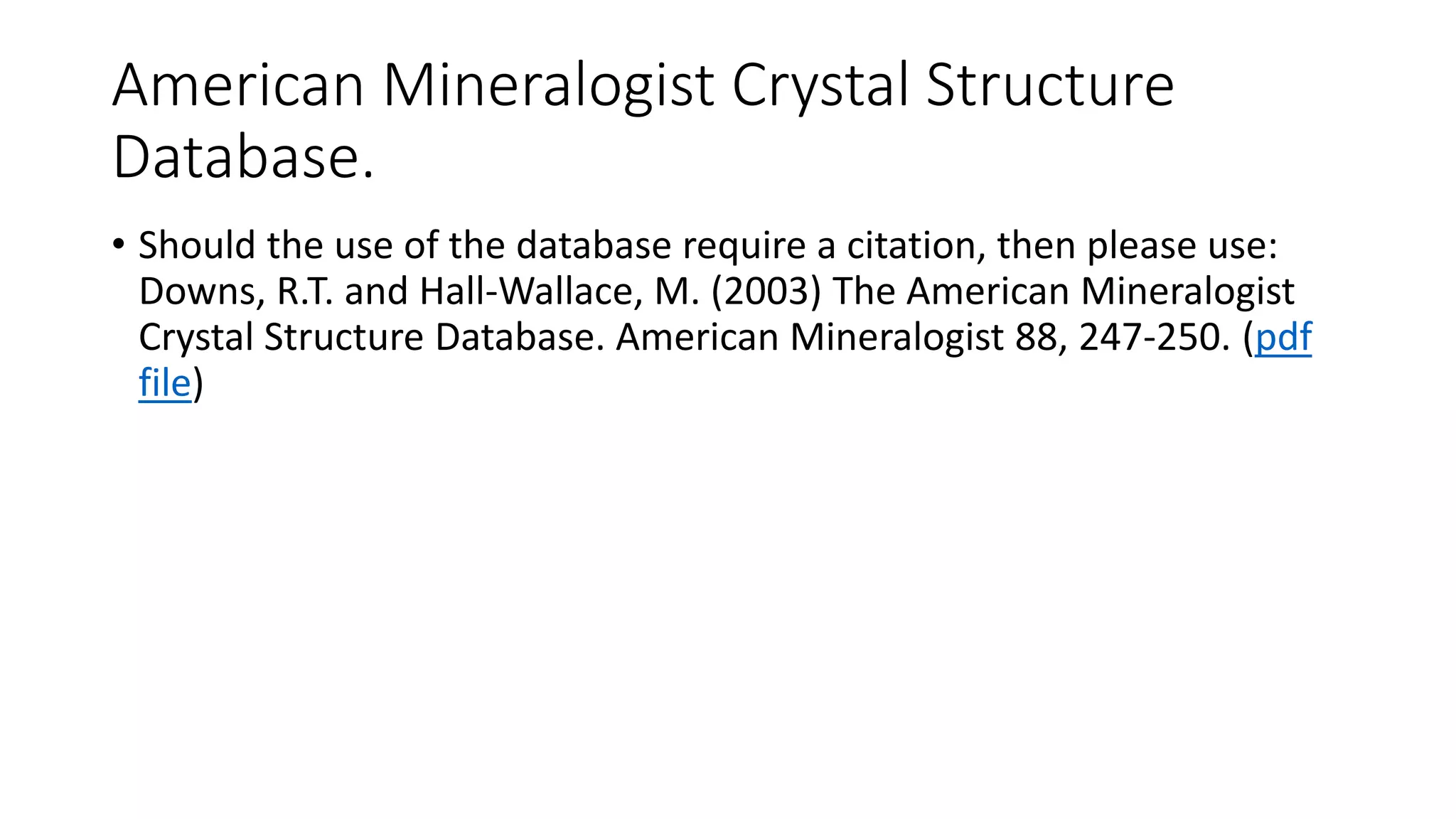
American Mineralogist Crystal Structure
Database.
• Should the use of the database require a citation, then please use:
Downs, R.T. and Hall-Wallace, M. (2003) The American Mineralogist
Crystal Structure Database. American Mineralogist 88, 247-250. (pdf
file)
[Free]Crystallographic Information resources
• Glasser, L. (2016). Crystallographic information
resources. Journal of chemical education, 93(3), 542-549.
•

How to search_free_crystallography_databases_benedictine_university final 11182021

  • 1.
    How to SearchFree Crystallography Databases Swati Wagh, Science Outreach Librarian, Benedictine University Library Kindlon Hall 313 630-829-6054
  • 2.
    • Introduction: • Crystallographyis the study of Crystals. • Crystallography, is the study of chemical structure of solid materials, through the spatial arrangement of its atoms or ions in unit cells, the bonds that are formed. The data obtained is then used to predict the synthesis, reactions, decomposition of the material, its physical properties applications. • Why look for free resources? • Commercial sources for crystallography data are easier to use. But with a little planning free sources can be searched to get a similar output? • All crystallography databases get their data from published primary literature. So, it is NOT imperative that we go to these databases exclusively. The advantage is that data derived from the primary resources (journals) is arranged in some logical way to be able to understand it better
  • 3.
    Introduction…contd • What isCrystallography, and why is it needed? • Please Read the Introduction • https://www.xtal.iqfr.csic.es/Cristalografia/index-en.html
  • 4.
    • Before Igo to the actual databases, I would like you to look at what the Benedictine University library catalog offers in terms of Online avaialibility. • Rhodes, Gale. Crystallography Made Crystal Clear: A Guide for Users of Macromolecular Models. Elsevier Science & Technology, 2006. • Available: • https://i-share- ben.primo.exlibrisgroup.com/permalink/01CARLI_BEN/6i8k7f/cdi_askewsholts_vlebo oks_9780080455549 • Ladd, Mark, and Rex Palmer. Structure Determination by X-Ray Crystallography: Analysis by X-Rays and Neutrons. 5th ed. 2013, Springer, 2014, doi:10.1007/978-1-4614- doi:10.1007/978-1-4614-3954-7. • Available: https://i-share- ben.primo.exlibrisgroup.com/permalink/01CARLI_BEN/6i8k7f/cdi_springer_books_10 _1007_978_1_4614_3954_7
  • 5.
    Free and Benedictinesubscribed Resources • PubChem (free) • ChemSpider (free) • SciFinder-n (Subscription) • Crystallography Open database (COD) (free) • http://crystallography.net • Inorganic Material Database (Atom Work) FREE with Registration • http://crystdb.nims.go.jp/index_en.html
  • 6.
    • Spectral Databasefor Organic Compounds, SDBS. (Free) • https://sdbs.db.aist.go.jp/sdbs/cgi-bin/cre_index.cgi • American Mineralogist Crystal Structure database (Free) • http://ammingeosciencesworld.org/ • http://rruff.geo.Arizona.edu/AMS/amcsd.php • Bilbao Crystallographic Server – provides links to basic symmetry information, from point to point groups, to magnetic space groups. (Free) • http://www.cryst.ehu.es/ • Database of Zeolite structures (Free) SPECIALIZED • http://www.iza-structure.org/databases
  • 7.
    PUBCHEM • This databaseis the best so far. • PubChem is put out by the National Library of Medicine under NIH. • PubChem • The world's largest collection of freely accessible chemical information. Search chemicals by name, molecular formula, structure, and other identifiers. Find chemical and physical properties, biological activities, safety and toxicity information, patents, literature citations and more. • Access PubChem through • www.ben.edu/Library, click on Databases and go to P for PubChem .
  • 8.
    PubChem search –I am using the same example of Ibuprofen throughout
  • 9.
  • 10.
    Clicking on Ibuprofenin the previous slide will give you this screen. Click Spectral Information on the right-hand side. ( #4 is Spectral Information). Besides, there is lot of info on the structure properties etc. on the Right-hand side
  • 11.
    Spectra. You willsee the different types of spectra depending on the spectroscopic instrument used.
  • 12.
  • 13.
    Explanation of Spectra-1H-NMR •Principles of NMR: How to Read Spectra and Couplings • How to calculate coupling constants • 1H NMR Spectrum (1D, 500 MHz, CDCl3 • , experimental) (HMDB0001925)
  • 14.
    •ChemSpider • Linking fromCHEMSPIDER To Crystallography database • CHEMSPIDER is put out by the Royal Society of Chemistry. It is a free database and is similar to SciFinder-n • http://www.chemspider.com/ • OR from https://www.ben.edu/library/index.cfm • Scroll to the Cs. Advantage of going through ben.edu library is that all full text articles that will appear in the search will be available for free (we have a subscription) or ILL. • An actual search for spectral data follows showing different screen shots.
  • 15.
  • 16.
  • 18.
    There will be3 records Click on the first record. Click on Details
  • 19.
    • Take noteof these: SMILES, InChl. If you have these you can enter these when searching the Crystallography Databases Systematic Name, Synonym, Trade Name, Registry Number, SMILES, InChI or CSID Systematic names 1,2-dihydroxybenzene Synonyms AIBN Trade names Aspirin Registry numbers 7732-18-5 SMILES O=C(OCC)C InChl InChI=1/CH4/h1H4
  • 20.
    • If youscroll down slide 8, you will see headers for • Names, Names • Properties • Searches • Spectra • Vendors • Articles • More • If you click on MORE you will see access to one of the free crystallography databases. This site is explained in detail later. • The spectra by different spectroscopic methods is available.
  • 22.
    •In the IntroductionI said that all databases for crystallography curate the material data from SciFinder-n or other research systems. •Now we will address how to search SciFinder-n for crystallography data.
  • 23.
    SciFinder-n searches • SciFinder-nis the premier indexing and abstracting service of the American Chemical Society. We have a subscription. Access through the Benedictine University Library Portal at www.ben.edu/library/databases. Scroll down to the Ss. Click on either choice and follow screen prompts.
  • 24.
  • 26.
  • 27.
    Clicking on theregistry number :
  • 28.
    Scroll down tillyou see “Experimental Spectra”
  • 29.
    Other ways tosearch SciFinder-n • You can start with Reference Topic and enter a text query using a CAS Registry Number AND “Spectra”. If you don't already have an RN you can use a chemical name, but this is less precise.
  • 30.
    • I amgoing to concentrate on Four free Databases. The last two by appointment ONLY. * databases are not included here. • Crystallography Open database (COD) • http://crystallography.net • Inorganic Material Database (Atom Work) FREE with Registration * • http://crystdb.nims.go.jp/index_en.html • Spectral Database for Organic Compounds, SDBS. • https://sdbs.db.aist.go.jp/sdbs/cgi-bin/cre_index.cgi • American Mineralogist Crystal Structure database • http://ammingeosciencesworld.org/ • http://rruff.geo.Arizona.edu/AMS/amcsd.php • Bilbao Crystallographic Server – provides links to basic symmetry information, from point to point groups, to magnetic space groups. * • http://www.cryst.ehu.es/ • FYI • Database of Zeolite structures* • http://www.iza-structure.org/databases
  • 31.
    Crystallography Open Database COD • Accessthis database from • www.ben.edu/library, Scroll down to C and click on the database.
  • 32.
    From the right-handside click on search, and put in the SMILES configuration
  • 35.
    • You willnotice that most files are in .CIF OR .Hkl format. • That means you need to download the software that lets you open these files?the software • Any word file will open the .CIF file. But if you want to make changes then you need to download the software explained below. • CIF (Crystallographic Information Framework) • The International Union of Crystallography is the sponsor of the Crystallographic Information Framework, a standard for information interchange in crystallography.
  • 37.
    • I clickedon the first entry which is highlighted in the previous slide. You are going to scroll down and see what you want? Save file…remember where it is?
  • 38.
    • Open AVOGADRO.Click on file – Open Recent • You should see your file. In the example 1100123.cif
  • 39.
    SDBS • Spectral Databasefor Organic Compounds • Search Help • https://sdbs.db.aist.go.jp/sdbs/LINKS/help_eng.html • This link will take you to the Help screens for doing a search. • This is a link to a power point presentation of screens of the Search Help document. • SDBS Integrated Spectral Database for Organic Compounds
  • 40.
    American Mineralogist CrystalStructure Database • American Mineralogist Crystal Structure database • http://ammingeosciencesworld.org/ • http://rruff.geo.Arizona.edu/AMS/amcsd.php
  • 44.
    American Mineralogist CrystalStructure Database. • Should the use of the database require a citation, then please use: Downs, R.T. and Hall-Wallace, M. (2003) The American Mineralogist Crystal Structure Database. American Mineralogist 88, 247-250. (pdf file)
  • 45.
    [Free]Crystallographic Information resources •Glasser, L. (2016). Crystallographic information resources. Journal of chemical education, 93(3), 542-549.
  • 46.