TEACHERS` PRACTICES OF
USING GAMES IN SCHOOLS: A
PATTERNS APPROACH
Triinu Jesmin
Research Seminar
20.04.2016
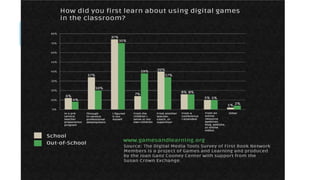
“SURVEY HIGHLIGHTS: USE OF GAMES
REMAINS A DIY AFFAIR” A JOAN
COONEY CENTER RESEARCH REPORT
A research done in March
2016 with 1099 teachers
and out-of-school program
officials
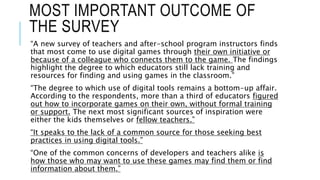
MOST IMPORTANT OUTCOME OF
THE SURVEY
“A new survey of teachers and after-school program instructors finds
that most come to use digital games through their own initiative or
because of a colleague who connects them to the game. The findings
highlight the degree to which educators still lack training and
resources for finding and using games in the classroom.”
“The degree to which use of digital tools remains a bottom-up affair.
According to the respondents, more than a third of educators figured
out how to incorporate games on their own, without formal training
or support. The next most significant sources of inspiration were
either the kids themselves or fellow teachers.”
“It speaks to the lack of a common source for those seeking best
practices in using digital tools.”
“One of the common concerns of developers and teachers alike is
how those who may want to use these games may find them or find
information about them.”
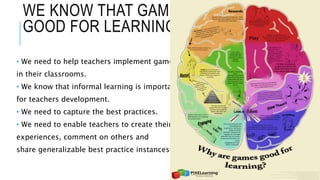
WE KNOW THAT GAMES ARE
GOOD FOR LEARNING
• We need to help teachers implement games
in their classrooms.
• We know that informal learning is important
for teachers development.
• We need to capture the best practices.
• We need to enable teachers to create their own
experiences, comment on others and
share generalizable best practice instances.
PATTERNS ARE USED TO CAPTURE
EXPERIENTIAL KNOWLEDGE
Patterns are proven solutions to a reoccurring problem. They hold a powerful
promise for recording, calibrating and collaboratively refining expert
knowledge.
I used Critical Incident Technique to capture the best practices of teachers
game use. CIT is an appropriate qualitative tool for examining events that
are considered to be examples of success or failure.
15 interviews with Estonian active teachers were made. No limitation to
students age or game type.
12 patterns were extracted through iterative qualitative analysis. The
patterns were given a name, problem description, solution and example(s).
The patterns were validated twice: first with the initial sample and then with
all Estonian teacher community through an online forum.
The feedback was positive – although no new patterns were added! Why?
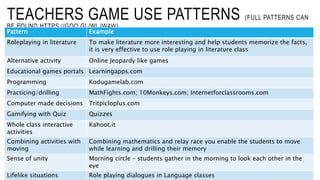
TEACHERS GAME USE PATTERNS (FULL PATTERNS CAN
BE FOUND HTTPS://GOO.GL/WLJW4W)
Pattern Example
Roleplaying in literature To make literature more interesting and help students memorize the facts,
it is very effective to use role playing in literature class
Alternative activity Online Jeopardy like games
Educational games portals Learningapps.com
Programming Kodugamelab.com
Practicing/drilling MathFights.com; 10Monkeys.com; Internetforclassrooms.com
Computer made decisions Tritpicloplus.com
Gamifying with Quiz Quizzes
Whole class interactive
activities
Kahoot.it
Combining activities with
moving
Combining mathematics and relay race you enable the students to move
while learning and drilling their memory
Sense of unity Morning circle – students gather in the morning to look each other in the
eye
Lifelike situations Role playing dialogues in Language classes
WHAT`S NEXT?
My aim is to provide an online community for teachers to foster their
game use practices by formulizing individual experience into a well
adaptable social knowledge.
Online learning communities enable sharing of experiences and
knowledge building with a clear focus on practice and collaboration.
Informal online communities and networks offer teachers the
possibility of voluntary engaging in shared learning, reflecting about
teaching practice and receiving emotional and social support.
Basically, it takes individual unique and well refined experiences,
formulates them into patterns and publishes them to the larger
audience who will try to copy them or revise the patterns (adapt to
their own context).
This will end up in refined patterns and helps other teachers to
incorporate games in their studies more easily.
What I need to do next is to figure out and map the requirements for
a platform that enables coevolution of cognitive (individual) and
THANK YOU ALL FOR YOUR
TIME
Any supportive questions?

2016-04-20 research seminar

  • 1.
    TEACHERS` PRACTICES OF USINGGAMES IN SCHOOLS: A PATTERNS APPROACH Triinu Jesmin Research Seminar 20.04.2016
  • 2.
    “SURVEY HIGHLIGHTS: USEOF GAMES REMAINS A DIY AFFAIR” A JOAN COONEY CENTER RESEARCH REPORT A research done in March 2016 with 1099 teachers and out-of-school program officials
  • 4.
    MOST IMPORTANT OUTCOMEOF THE SURVEY “A new survey of teachers and after-school program instructors finds that most come to use digital games through their own initiative or because of a colleague who connects them to the game. The findings highlight the degree to which educators still lack training and resources for finding and using games in the classroom.” “The degree to which use of digital tools remains a bottom-up affair. According to the respondents, more than a third of educators figured out how to incorporate games on their own, without formal training or support. The next most significant sources of inspiration were either the kids themselves or fellow teachers.” “It speaks to the lack of a common source for those seeking best practices in using digital tools.” “One of the common concerns of developers and teachers alike is how those who may want to use these games may find them or find information about them.”
  • 5.
    WE KNOW THATGAMES ARE GOOD FOR LEARNING • We need to help teachers implement games in their classrooms. • We know that informal learning is important for teachers development. • We need to capture the best practices. • We need to enable teachers to create their own experiences, comment on others and share generalizable best practice instances.
  • 6.
    PATTERNS ARE USEDTO CAPTURE EXPERIENTIAL KNOWLEDGE Patterns are proven solutions to a reoccurring problem. They hold a powerful promise for recording, calibrating and collaboratively refining expert knowledge. I used Critical Incident Technique to capture the best practices of teachers game use. CIT is an appropriate qualitative tool for examining events that are considered to be examples of success or failure. 15 interviews with Estonian active teachers were made. No limitation to students age or game type. 12 patterns were extracted through iterative qualitative analysis. The patterns were given a name, problem description, solution and example(s). The patterns were validated twice: first with the initial sample and then with all Estonian teacher community through an online forum. The feedback was positive – although no new patterns were added! Why?
  • 7.
    TEACHERS GAME USEPATTERNS (FULL PATTERNS CAN BE FOUND HTTPS://GOO.GL/WLJW4W) Pattern Example Roleplaying in literature To make literature more interesting and help students memorize the facts, it is very effective to use role playing in literature class Alternative activity Online Jeopardy like games Educational games portals Learningapps.com Programming Kodugamelab.com Practicing/drilling MathFights.com; 10Monkeys.com; Internetforclassrooms.com Computer made decisions Tritpicloplus.com Gamifying with Quiz Quizzes Whole class interactive activities Kahoot.it Combining activities with moving Combining mathematics and relay race you enable the students to move while learning and drilling their memory Sense of unity Morning circle – students gather in the morning to look each other in the eye Lifelike situations Role playing dialogues in Language classes
  • 8.
    WHAT`S NEXT? My aimis to provide an online community for teachers to foster their game use practices by formulizing individual experience into a well adaptable social knowledge. Online learning communities enable sharing of experiences and knowledge building with a clear focus on practice and collaboration. Informal online communities and networks offer teachers the possibility of voluntary engaging in shared learning, reflecting about teaching practice and receiving emotional and social support. Basically, it takes individual unique and well refined experiences, formulates them into patterns and publishes them to the larger audience who will try to copy them or revise the patterns (adapt to their own context). This will end up in refined patterns and helps other teachers to incorporate games in their studies more easily. What I need to do next is to figure out and map the requirements for a platform that enables coevolution of cognitive (individual) and
  • 9.
    THANK YOU ALLFOR YOUR TIME Any supportive questions?