A framework for designing and deploying e-health
systems in developing countries
Abdul Wahid Samadzai
PhD Student
David Lamas, Vladimir Tomberg
Supervisors
Tallinn University,
School of Digital Technologies
Tallinn, Estonia
16- March-2016
1
Agenda
 Research problem
 Research goal
 Research questions
 Current study
 Work plan
 Futures work
 References
Research Problem
 There is a lack of the systematic framework for
designing and deploying e-health systems in
developing countries
Research Goals
 To improve the health care system in
Afghanistan
 To improve it through the adoption of IT related
solutions
 To improve it by enabling the adoption of
electronic health records
Research question
 The main research question is:
How to support developing countries in
development of health management systems?
Research question Cont…
 What is the current state?
 Why is this relevant?
 Why electronic health records and not
something else?
Current study (First paper)
 Challenges and Opportunities in eHealth: the
Afghan Case
Literature review
 Considering existing literature
[6,9,11,13,15,16], the most typical e-health
related challenges in the developing countries
are:
• Poor economy;
• Undeveloped infrastructures;
• High cost of medical services;
• Absence of the computerized systems and database;
• Lack of Internet connection;
Literature review (Con…)
• Paper based patients' records;
• Low level of patient education;
• Lack of time of healthcare professional.
Current study (Cont…)
 Electronic Health (E-health), is defined as
the use of Information and Communication
Technologies (ICT) in health systems
 We focused on healthcare problems,
challenges, and opportunities in Afghanistan
10
Current study (Cont…)
 For this study, we aimed the following
research question:
 What is the current state?
Methodology
 To achieve this target, we used the purposive
case sampling [2].
 The typical case sampling imports taking a
sample of what one would call typical, normal
or average for a specific phenomenon.
Methodology (Con…)
 Afghanistan consists of 34 provinces; each
province has one, two, or three public
hospital. There are 21 big public hospitals in
Kabul, and also some public clinics in Kabul
city. We have some private’s hospitals and
clinics in this city.
 For this study we have selected three hospitals
and used the typical case sampling.
Study Design
 We conducted the study during November -
December 2014 and we used focus group
interview method.
 The study was divided to two phases. In the first
phase we have made a pre-survey, where we
have focused on the main challenges.
 In the second phase we have conducted an
interview to find the deeper challenges related
to development of the e-health system.
The pre-survey (first survey)
 In the pre-survey, we at first interviewed 25
peoples in Ali Abad hospital
 This hospital has 190 people staff, including:
faculties, specialists & trainers, nurses,
technicians, anesthetists, administrative
personnel and supportive staff who are
involved in delivering teaching, researches
and healthcare services for the citizens.
Pre-survey(Cont…)
 In the second interview, we have interviewed 16
people in Maiwand Teaching Hospital, formerly
known as Mastoorat Hospital has one-century
long history. Maiwand is an internship-based
hospital which pertains to the Kabul Medical
University(KMU). This hospital has totally 137
people's staff including; faculties, specialists,
doctors, nurses, radiologists, and service
personnel who are involved to a function of
teaching and healthcare services to KMU
students and citizens.
Pre-survey result
In the pre survey interview questions, we identified
the following challenges:
◦ Patients' records;
◦ Prescriptions management;
◦ Medical decision support;
◦ Rooms/ beds management;
◦ Billing management;
◦ Health information collection methods;
◦ Communication infrastructures;
◦ Health system cost.
Second Phase Interviews
 In the second phase we have conducted
interviews in several hospitals. We used a
structured questionnaire
 We used focus group interview for collecting
data for our research from interviewer
 We have conducted focus group interviews
in three public hospitals in two big cities
(Kabul and Jalalabad).
Second Phase Interview (Ali Abad
hospital)
 In Kabul city, we did the first interview in Ali
Abad public hospital with doctors, nurses,
managers and patients. We asked the same
question to all respondents. In that interview
the respondents gave answers to the
interviewer questions and they mentioned to
some health system challenges in their hospital.
Second Phase Interviews (Jalalabad)
 In Jalalabad city, we did the second interview in
Jalalabad public health hospital. In that hospital
we did interview with doctors, nurses, managers
and patients.
Results
 As mentioned above, during the interviews, we
focused on challenges which we identified in
previous research: patients' records,
prescription management, medical decision
support, rooms/beds management, billing
management, reliable communication
infrastructure and lack of data accuracy and
consistency of reporting health data.
Results (Cont…)
 In first set of interviews the respondents were
invited to discuss these challenge in their
health units. In these interviews all respondents
mentioned that they do not have computerized
system, computerized patient registration
system, central database system in the
hospital. They also have mentioned about
some problems in ambulance system, lack of
system for medicine expiration date.
Results (Cont…)
 The participants of the study in Jalalabad Public
Health Hospital mentioned the following
challenges: the patient’s records are paper-
based; they are not secure and the patients
cannot receive their information quickly.
Conclusion
 The challenges that we have identified in our
study were quite similar to the challenges
defined in the literature.
 The biggest challenges for Afghan case are
lack of Internet connection, electronic power
system, big cost of health service, lack of
computerized systems, and the paper based
system.
Conclusion(Cont..)
We see some future opportunities that e-health
solutions can bring into the country. They are
related to the following issues:
 Patient records are paper-based. This issue is
related to a general e-health challenge of
computerization of health care sector;
 A cost of health services and time lack. After
investing into E-health system, it can
significantly reduce an amount of manual
work and make the services more accessible
in terms of the price;
Conclusion(Cont..)
 Patient education. E-health communications
channels can be used for informing patients
about upcoming threats and improve the
general level of awareness among them;
 Lack of the infrastructure. Some provinces
hospitals do not have the computerized
system, network connections, and database
systems, some hospitals have problems with
the Internet connection.
Goals of second paper
 To improve it through the adoption of IT related
solutions
 To improve it by enabling the adoption of
electronic health records
Second paper(Research questions)
For this study, we aimed the following research
questions:
 Why is this relevant?
 Why electronic health records and not
something else?
Literature review
 We did literature review
◦ Information Technology in health system
◦ Patient records
Methodology
We used ethnography survey for this research in
some hospitals.
Ethnography is the observation of social practices
and interaction. It includes semi-structured
interviews, photo elicitation, Participant
observation in libraries and mapping exercises,
among other things.
First Observation at( Arianna private hospital)
 Arianna private hospital was built in 2007,
Exactly 9 years ago.
we did first observation in October 21 2015 in
Arianna private hospital. The Arianna private
hospital has totally 40 doctors. 30 of them are
male 10 and the remaining is female. 3 doctors
also teach in the Kabul medical faculty. Others
are specialists and therapists. This hospital also
has 50 nurses. Among them 20 nurses are male
and 30 nurses are female.
First Observation at( Arianna private
hospital) Con…
 The doctors does not write the final diagnose in
the registration book.
 They just write the primary diagnose in the
registration book. After checkup, the doctors
write final diagnose in the prescriptions that is
taken away by the patient.
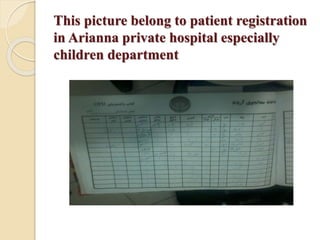
 The following picture is taken in Arianna private
hospital especially children department
This picture belong to patient registration
in Arianna private hospital especially
children department
Second observation (Khair khana
provincial hospital)
 Khair khana provincial hospital was built in
1984. Exactly 32 years ago.
 October 23, 2015 in Khair khana provincial
hospital. The Khair Khana hospital has totally
100 doctors. 70 of them are male 30 and the
remaining is female. All doctors are specialists
and therapists. This hospital also has 45 nurses.
Among them 25 nurses are male and 15 nurses
are female.
Second observation (Khair khana
provincial hospital) Con…
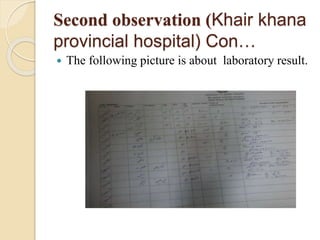
 The following picture is about laboratory result.
Second observation (Khair khana
provincial hospital) Con…
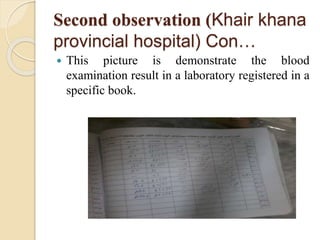
 This picture is demonstrate the blood
examination result in a laboratory registered in a
specific book.
The sample of the prescription
 The prescription, that is prescribed by the
doctor. This is the actual treatment of the patient
that is not registered in the book and this paper
is also taken by the patient. So if a patient
revisits the same doctor, he or she has to show
this prescription to the doctor to continue his
treatment. If a patient lost the paper, then the
doctor will not know about the patient’s
previous treatment.
The prescription
Third Observation (Aliabad medical
hospital)
 Aliabad hospital was built in 1932. Exactly 83
years ago.
 The Aliabad hospital has totally 190 doctors.
180 of them are male 10 and the remaining is
female. 90 doctors also teach in the Kabul
medical faculty. Others are specialists and
therapists. This hospital also has 55 nurses.
Among them 35 nurses are male and 20 nurses
are female.
Third observation (Aliabad medical
hospital) Con…
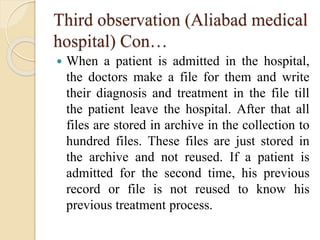
 When a patient is admitted in the hospital,
the doctors make a file for them and write
their diagnosis and treatment in the file till
the patient leave the hospital. After that all
files are stored in archive in the collection to
hundred files. These files are just stored in
the archive and not reused. If a patient is
admitted for the second time, his previous
record or file is not reused to know his
previous treatment process.
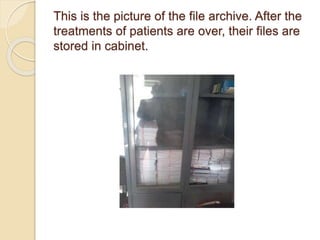
This is the picture of the file archive. After the
treatments of patients are over, their files are
stored in cabinet.
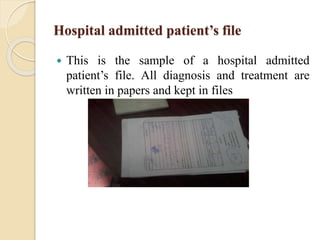
Hospital admitted patient’s file
 This is the sample of a hospital admitted
patient’s file. All diagnosis and treatment are
written in papers and kept in files
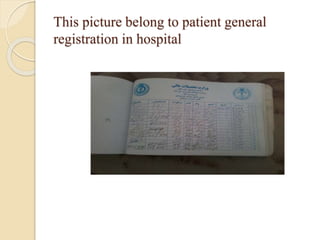
The patients’ admitting Registration Book
 When a patient is admitted in hospital, his or her
name is just written in this book with a special
serial number and date. But this is not the only
book where the patient is registered. After
registering in this book the patient is referred to
a special section or department and is re-
registered there.
This picture belong to patient general
registration in hospital
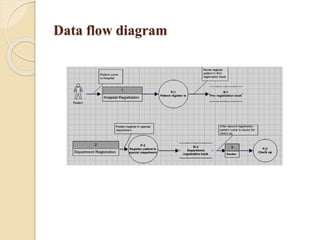
Data flow diagram
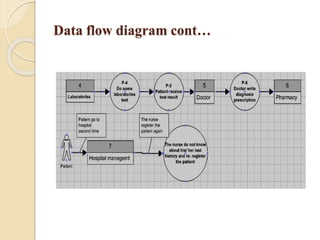
Data flow diagram cont…
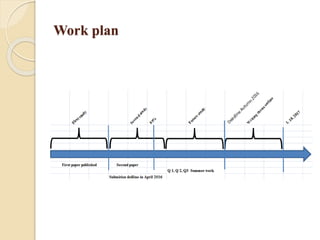
Work plan
Future work
 Questions
 What are the existing record keeping practices in Afghanistan?
◦ In context study of existing practices
 Misses regulatory framework
 How to bridge the gap between current practices and an ideal
scenario?
◦ Comparative study
 About how other countries moved from paper based to some
form of electronic health record
 What were the main challenges of moving from paper based
to some form of electronic health record, and how were they
addressed?
 These are just our tentative ideas...
 Semi-connected environments
 Perceived usefulness
 TAM (one of the several flavours)
References
[1]! Adams, A., & Cox, A. L. (2008). Questionnaires , in-depth interviews and focus groups
Open Research Online The Open University ’ s repository of research publications
Questionnaires , in-depth interviews and focus groups Book Chapter. In P. Cairns & A. L. Cox
(Eds.), Research Methods for Human Computer Interaction (pp. 17–34). Cambridge, UK:
Cambridge University Press.
[2]! Creswell, J. (2002). Educational research: Planning, conducting, and evaluating
quantitative. Prentice Hall. Retrieved from
http://www.scis.nova.edu/~nasutif/MCTE690-syllabus-summer2003.pdf
[3] eHealth Industries Innovation Centre. (n.d.). What is eHealth? Retrieved May 16, 2015,
from http://www.ehi2.swan.ac.uk/en/what-is-ehealth.htm
[4] Eysenbach, G. (2001). What is e-health? Journal of Medical Internet Research, 3(2), 1–5.
doi:10.2196/jmir.3.2.e20
[5] Gurak, L., & Lay, M. (2002). Research in technical communication. Retrieved from
https://books.google.com/books?hl=en&lr=&id=t_uwgE-
ollQC&oi=fnd&pg=PR7&dq=Research+in+technical+communication&ots=SF89cA3hdk&sig=
KCwW9dvjeth-USLUP7jrSAwmmWk
[6] Hanson, K., Ranson, M. K., Oliveira-Cruz, V., & Mills, A. (2003). Expanding access to priority
health interventions: A framework for understanding the constraints to scaling-up. Journal of
International Development, 15(1), 1–14. doi:10.1002/jid.963
[7] Higginbottom, G. M. A. (2004). Sampling issues in qualitative research. Nurse Researcher,
12(1), 7–19.
doi:10.7748/nr2004.07.12.1.7.c5927
References
[8]! Hiramani, A. B., & Sharma, N. (1992). Health Communication in India: A Policy Perspective.
In Communication and Development: Issues and Perspectives. Rawat Publications.
[9]! Kahn, J., Yang, J., & Kahn, J. (2010). “Mobile” Health Needs And Opportunities In Developing
Countries. Health Affairs, 2(2), 252–258. doi:10.1377/hlthaff
[10]! Knight, W. E. (2012). 2012 ASSESSMENT WORKBOOK. (R. A. Costomiris, Ed.). Office of
Institutional Effectiveness.
[11]! Lewis, T., Synowiec, C., Lagomarsino, G., & Schweitzer, J. (2012). E-health in low- and
middle-income countries: findings from the Center for Health Market Innovations. Bulletin
of the World Health Organization, 90(5), 332–340. doi:10.2471/BLT.11.099820
[12]! Lund Research Ltd. (2012). Purposive sampling. Lærd Dissertation. Retrieved March 2, 2015,
from http://dissertation.laerd.com/purposive-sampling.php
[13]! Macpherson, Y., & Chamberlain, S. (2013). Can mobile phones save lives? BBC Policy
Briefing, (7 (February)).
[14]! Murphy, E., Dingwall, R., Greatbatch, D., Parker, S., & Watson, P. (1998). Qualitative
research methods in health technology assessment: a review of the literature. Health
Technology Assessment (Winchester, England), 2(16), iii–ix, 1–274. Retrieved from
http://www.ncbi.nlm.nih.gov/pubmed/9919458
[15]! Ouma, S., & Herselman, M. E. (2008). E-health in Rural Areas!: Case of Developing Countries,
194–200.
[16]! Rodrigues, R. J., & Risk, A. (2003). eHealth in Latin America and the Caribbean:
Development and policy issues. Journal of Medical Internet Research, 5(1), 16–32.
doi:10.2196/jmir.5.1.e4
Thank you!

2016 03-16 research seminar

  • 1.
    A framework fordesigning and deploying e-health systems in developing countries Abdul Wahid Samadzai PhD Student David Lamas, Vladimir Tomberg Supervisors Tallinn University, School of Digital Technologies Tallinn, Estonia 16- March-2016 1
  • 2.
    Agenda  Research problem Research goal  Research questions  Current study  Work plan  Futures work  References
  • 3.
    Research Problem  Thereis a lack of the systematic framework for designing and deploying e-health systems in developing countries
  • 4.
    Research Goals  Toimprove the health care system in Afghanistan  To improve it through the adoption of IT related solutions  To improve it by enabling the adoption of electronic health records
  • 5.
    Research question  Themain research question is: How to support developing countries in development of health management systems?
  • 6.
    Research question Cont… What is the current state?  Why is this relevant?  Why electronic health records and not something else?
  • 7.
    Current study (Firstpaper)  Challenges and Opportunities in eHealth: the Afghan Case
  • 8.
    Literature review  Consideringexisting literature [6,9,11,13,15,16], the most typical e-health related challenges in the developing countries are: • Poor economy; • Undeveloped infrastructures; • High cost of medical services; • Absence of the computerized systems and database; • Lack of Internet connection;
  • 9.
    Literature review (Con…) •Paper based patients' records; • Low level of patient education; • Lack of time of healthcare professional.
  • 10.
    Current study (Cont…) Electronic Health (E-health), is defined as the use of Information and Communication Technologies (ICT) in health systems  We focused on healthcare problems, challenges, and opportunities in Afghanistan 10
  • 11.
    Current study (Cont…) For this study, we aimed the following research question:  What is the current state?
  • 12.
    Methodology  To achievethis target, we used the purposive case sampling [2].  The typical case sampling imports taking a sample of what one would call typical, normal or average for a specific phenomenon.
  • 13.
    Methodology (Con…)  Afghanistanconsists of 34 provinces; each province has one, two, or three public hospital. There are 21 big public hospitals in Kabul, and also some public clinics in Kabul city. We have some private’s hospitals and clinics in this city.  For this study we have selected three hospitals and used the typical case sampling.
  • 14.
    Study Design  Weconducted the study during November - December 2014 and we used focus group interview method.  The study was divided to two phases. In the first phase we have made a pre-survey, where we have focused on the main challenges.  In the second phase we have conducted an interview to find the deeper challenges related to development of the e-health system.
  • 15.
    The pre-survey (firstsurvey)  In the pre-survey, we at first interviewed 25 peoples in Ali Abad hospital  This hospital has 190 people staff, including: faculties, specialists & trainers, nurses, technicians, anesthetists, administrative personnel and supportive staff who are involved in delivering teaching, researches and healthcare services for the citizens.
  • 16.
    Pre-survey(Cont…)  In thesecond interview, we have interviewed 16 people in Maiwand Teaching Hospital, formerly known as Mastoorat Hospital has one-century long history. Maiwand is an internship-based hospital which pertains to the Kabul Medical University(KMU). This hospital has totally 137 people's staff including; faculties, specialists, doctors, nurses, radiologists, and service personnel who are involved to a function of teaching and healthcare services to KMU students and citizens.
  • 17.
    Pre-survey result In thepre survey interview questions, we identified the following challenges: ◦ Patients' records; ◦ Prescriptions management; ◦ Medical decision support; ◦ Rooms/ beds management; ◦ Billing management; ◦ Health information collection methods; ◦ Communication infrastructures; ◦ Health system cost.
  • 18.
    Second Phase Interviews In the second phase we have conducted interviews in several hospitals. We used a structured questionnaire  We used focus group interview for collecting data for our research from interviewer  We have conducted focus group interviews in three public hospitals in two big cities (Kabul and Jalalabad).
  • 19.
    Second Phase Interview(Ali Abad hospital)  In Kabul city, we did the first interview in Ali Abad public hospital with doctors, nurses, managers and patients. We asked the same question to all respondents. In that interview the respondents gave answers to the interviewer questions and they mentioned to some health system challenges in their hospital.
  • 20.
    Second Phase Interviews(Jalalabad)  In Jalalabad city, we did the second interview in Jalalabad public health hospital. In that hospital we did interview with doctors, nurses, managers and patients.
  • 21.
    Results  As mentionedabove, during the interviews, we focused on challenges which we identified in previous research: patients' records, prescription management, medical decision support, rooms/beds management, billing management, reliable communication infrastructure and lack of data accuracy and consistency of reporting health data.
  • 22.
    Results (Cont…)  Infirst set of interviews the respondents were invited to discuss these challenge in their health units. In these interviews all respondents mentioned that they do not have computerized system, computerized patient registration system, central database system in the hospital. They also have mentioned about some problems in ambulance system, lack of system for medicine expiration date.
  • 23.
    Results (Cont…)  Theparticipants of the study in Jalalabad Public Health Hospital mentioned the following challenges: the patient’s records are paper- based; they are not secure and the patients cannot receive their information quickly.
  • 24.
    Conclusion  The challengesthat we have identified in our study were quite similar to the challenges defined in the literature.  The biggest challenges for Afghan case are lack of Internet connection, electronic power system, big cost of health service, lack of computerized systems, and the paper based system.
  • 25.
    Conclusion(Cont..) We see somefuture opportunities that e-health solutions can bring into the country. They are related to the following issues:  Patient records are paper-based. This issue is related to a general e-health challenge of computerization of health care sector;  A cost of health services and time lack. After investing into E-health system, it can significantly reduce an amount of manual work and make the services more accessible in terms of the price;
  • 26.
    Conclusion(Cont..)  Patient education.E-health communications channels can be used for informing patients about upcoming threats and improve the general level of awareness among them;  Lack of the infrastructure. Some provinces hospitals do not have the computerized system, network connections, and database systems, some hospitals have problems with the Internet connection.
  • 27.
    Goals of secondpaper  To improve it through the adoption of IT related solutions  To improve it by enabling the adoption of electronic health records
  • 28.
    Second paper(Research questions) Forthis study, we aimed the following research questions:  Why is this relevant?  Why electronic health records and not something else?
  • 29.
    Literature review  Wedid literature review ◦ Information Technology in health system ◦ Patient records
  • 30.
    Methodology We used ethnographysurvey for this research in some hospitals. Ethnography is the observation of social practices and interaction. It includes semi-structured interviews, photo elicitation, Participant observation in libraries and mapping exercises, among other things.
  • 31.
    First Observation at(Arianna private hospital)  Arianna private hospital was built in 2007, Exactly 9 years ago. we did first observation in October 21 2015 in Arianna private hospital. The Arianna private hospital has totally 40 doctors. 30 of them are male 10 and the remaining is female. 3 doctors also teach in the Kabul medical faculty. Others are specialists and therapists. This hospital also has 50 nurses. Among them 20 nurses are male and 30 nurses are female.
  • 32.
    First Observation at(Arianna private hospital) Con…  The doctors does not write the final diagnose in the registration book.  They just write the primary diagnose in the registration book. After checkup, the doctors write final diagnose in the prescriptions that is taken away by the patient.  The following picture is taken in Arianna private hospital especially children department
  • 33.
    This picture belongto patient registration in Arianna private hospital especially children department
  • 34.
    Second observation (Khairkhana provincial hospital)  Khair khana provincial hospital was built in 1984. Exactly 32 years ago.  October 23, 2015 in Khair khana provincial hospital. The Khair Khana hospital has totally 100 doctors. 70 of them are male 30 and the remaining is female. All doctors are specialists and therapists. This hospital also has 45 nurses. Among them 25 nurses are male and 15 nurses are female.
  • 35.
    Second observation (Khairkhana provincial hospital) Con…  The following picture is about laboratory result.
  • 36.
    Second observation (Khairkhana provincial hospital) Con…  This picture is demonstrate the blood examination result in a laboratory registered in a specific book.
  • 37.
    The sample ofthe prescription  The prescription, that is prescribed by the doctor. This is the actual treatment of the patient that is not registered in the book and this paper is also taken by the patient. So if a patient revisits the same doctor, he or she has to show this prescription to the doctor to continue his treatment. If a patient lost the paper, then the doctor will not know about the patient’s previous treatment.
  • 38.
  • 39.
    Third Observation (Aliabadmedical hospital)  Aliabad hospital was built in 1932. Exactly 83 years ago.  The Aliabad hospital has totally 190 doctors. 180 of them are male 10 and the remaining is female. 90 doctors also teach in the Kabul medical faculty. Others are specialists and therapists. This hospital also has 55 nurses. Among them 35 nurses are male and 20 nurses are female.
  • 40.
    Third observation (Aliabadmedical hospital) Con…  When a patient is admitted in the hospital, the doctors make a file for them and write their diagnosis and treatment in the file till the patient leave the hospital. After that all files are stored in archive in the collection to hundred files. These files are just stored in the archive and not reused. If a patient is admitted for the second time, his previous record or file is not reused to know his previous treatment process.
  • 41.
    This is thepicture of the file archive. After the treatments of patients are over, their files are stored in cabinet.
  • 42.
    Hospital admitted patient’sfile  This is the sample of a hospital admitted patient’s file. All diagnosis and treatment are written in papers and kept in files
  • 43.
    The patients’ admittingRegistration Book  When a patient is admitted in hospital, his or her name is just written in this book with a special serial number and date. But this is not the only book where the patient is registered. After registering in this book the patient is referred to a special section or department and is re- registered there.
  • 44.
    This picture belongto patient general registration in hospital
  • 45.
  • 46.
  • 47.
  • 48.
    Future work  Questions What are the existing record keeping practices in Afghanistan? ◦ In context study of existing practices  Misses regulatory framework  How to bridge the gap between current practices and an ideal scenario? ◦ Comparative study  About how other countries moved from paper based to some form of electronic health record  What were the main challenges of moving from paper based to some form of electronic health record, and how were they addressed?  These are just our tentative ideas...  Semi-connected environments  Perceived usefulness  TAM (one of the several flavours)
  • 49.
    References [1]! Adams, A.,& Cox, A. L. (2008). Questionnaires , in-depth interviews and focus groups Open Research Online The Open University ’ s repository of research publications Questionnaires , in-depth interviews and focus groups Book Chapter. In P. Cairns & A. L. Cox (Eds.), Research Methods for Human Computer Interaction (pp. 17–34). Cambridge, UK: Cambridge University Press. [2]! Creswell, J. (2002). Educational research: Planning, conducting, and evaluating quantitative. Prentice Hall. Retrieved from http://www.scis.nova.edu/~nasutif/MCTE690-syllabus-summer2003.pdf [3] eHealth Industries Innovation Centre. (n.d.). What is eHealth? Retrieved May 16, 2015, from http://www.ehi2.swan.ac.uk/en/what-is-ehealth.htm [4] Eysenbach, G. (2001). What is e-health? Journal of Medical Internet Research, 3(2), 1–5. doi:10.2196/jmir.3.2.e20 [5] Gurak, L., & Lay, M. (2002). Research in technical communication. Retrieved from https://books.google.com/books?hl=en&lr=&id=t_uwgE- ollQC&oi=fnd&pg=PR7&dq=Research+in+technical+communication&ots=SF89cA3hdk&sig= KCwW9dvjeth-USLUP7jrSAwmmWk [6] Hanson, K., Ranson, M. K., Oliveira-Cruz, V., & Mills, A. (2003). Expanding access to priority health interventions: A framework for understanding the constraints to scaling-up. Journal of International Development, 15(1), 1–14. doi:10.1002/jid.963 [7] Higginbottom, G. M. A. (2004). Sampling issues in qualitative research. Nurse Researcher, 12(1), 7–19. doi:10.7748/nr2004.07.12.1.7.c5927
  • 50.
    References [8]! Hiramani, A.B., & Sharma, N. (1992). Health Communication in India: A Policy Perspective. In Communication and Development: Issues and Perspectives. Rawat Publications. [9]! Kahn, J., Yang, J., & Kahn, J. (2010). “Mobile” Health Needs And Opportunities In Developing Countries. Health Affairs, 2(2), 252–258. doi:10.1377/hlthaff [10]! Knight, W. E. (2012). 2012 ASSESSMENT WORKBOOK. (R. A. Costomiris, Ed.). Office of Institutional Effectiveness. [11]! Lewis, T., Synowiec, C., Lagomarsino, G., & Schweitzer, J. (2012). E-health in low- and middle-income countries: findings from the Center for Health Market Innovations. Bulletin of the World Health Organization, 90(5), 332–340. doi:10.2471/BLT.11.099820 [12]! Lund Research Ltd. (2012). Purposive sampling. Lærd Dissertation. Retrieved March 2, 2015, from http://dissertation.laerd.com/purposive-sampling.php [13]! Macpherson, Y., & Chamberlain, S. (2013). Can mobile phones save lives? BBC Policy Briefing, (7 (February)). [14]! Murphy, E., Dingwall, R., Greatbatch, D., Parker, S., & Watson, P. (1998). Qualitative research methods in health technology assessment: a review of the literature. Health Technology Assessment (Winchester, England), 2(16), iii–ix, 1–274. Retrieved from http://www.ncbi.nlm.nih.gov/pubmed/9919458 [15]! Ouma, S., & Herselman, M. E. (2008). E-health in Rural Areas!: Case of Developing Countries, 194–200. [16]! Rodrigues, R. J., & Risk, A. (2003). eHealth in Latin America and the Caribbean: Development and policy issues. Journal of Medical Internet Research, 5(1), 16–32. doi:10.2196/jmir.5.1.e4
  • 51.