1
What is Gamification?
Gamification consists of applying
dynamic and playful mechanics to
contexts in principle non-playful. In
this way, the students are
motivated and participate much
more in the classes. In addition,
since they are having a good time
and are concentrated in the task,
they acquire in a significant way
the contents worked.
2
When can I use it?
You can use games at many
points in a lesson, for example:
1.- To identify prior knowledge.
2.- To help acquire knowledge
and facilitate understanding.
3.- To review what was learned at
the end of a didactic unit.
Create your own games!
Some times it is quite difficult to find
games with the contents you want to
work, for this reason, it is very important
to be ready to create your own games if
you need them.
It is important not only to make games to
review the lesson with tools like Kahoot,
Quizizz, Cerebriti, Trivinet ... but to be
able to integrate them into more moments
of the class and even use the creation of
games by students as a resource to
understand and reinforce the contents.
3
4
Their own games
It should be noted that when
we talk about gamification we
do not only refer to the use or
creation of digital games, but
we can also make a session of
"physical" games created by
the students so that, in groups,
they go through the different
games And, after acquiring the
contents and having a good
time, vote for the best
(indicating us which are the
indicators that should gather
the best game of the class).
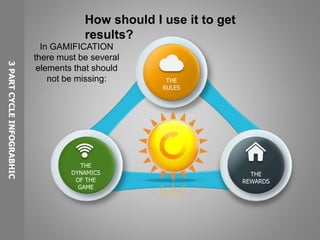
THE
RULES
THE
DYNAMICS
OF THE
GAME
THE
REWARDS
3PARTCYCLEINFOGRABHIC
How should I use it to get
results?
In GAMIFICATION
there must be several
elements that should
not be missing:
They must be very clear
for the students before
starting to play. It is
important that they know
what they will achieve if
they win the game, that
will happen if the last
ones are left, or that
attitudes and actions are
prohibited.
THE RULES
THE DYNAMICS OF THE GAME
Although we should seek to promote
consensus and flee competitiveness ... there is
nothing that motivates more chic than to get
more points than others, achieve goals before,
or better than any Group the challenges.
Dynamics can be created to favor cooperation
and collaboration, but unfortunately, most of
the platforms that allow you to generate your
own games are based more on the system of
points, goals and challenges than on
enhancing collaboration and cooperation.
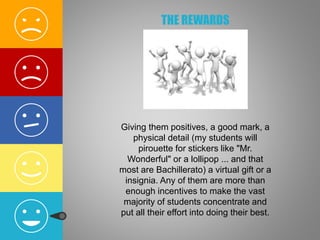
THE REWARDS
Giving them positives, a good mark, a
physical detail (my students will
pirouette for stickers like "Mr.
Wonderful" or a lollipop ... and that
most are Bachillerato) a virtual gift or a
insignia. Any of them are more than
enough incentives to make the vast
majority of students concentrate and
put all their effort into doing their best.
GIVE BADGETS
Make your own with Canvas!!
Creative
Thinking
Critical
Thinking
Ethical
Thinking
The game allows to
encourage creativity,
motivate, put ourselves
in unreal situations and
see how we would
develop, find
alternative solutions,
look for questions and
answers ...
With the game we learn to
cooperate, to internalize rules,
to be responsible, to respect
shifts, to value others, to
understand them better, to
practice active listening ...
With the game we
practice deduction,
inference, relational
thinking, hypothesis-
building, means-ends,
cause-effect
relationships ...
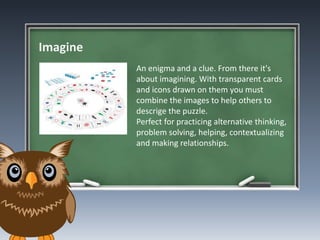
Imagine
An enigma and a clue. From there it's
about imagining. With transparent cards
and icons drawn on them you must
combine the images to help others to
descrige the puzzle.
Perfect for practicing alternative thinking,
problem solving, helping, contextualizing
and making relationships.
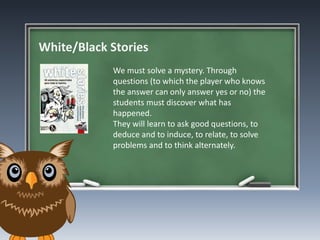
White/Black Stories
We must solve a mystery. Through
questions (to which the player who knows
the answer can only answer yes or no) the
students must discover what has
happened.
They will learn to ask good questions, to
deduce and to induce, to relate, to solve
problems and to think alternately.
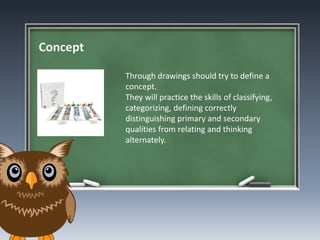
Concept
Through drawings should try to define a
concept.
They will practice the skills of classifying,
categorizing, defining correctly
distinguishing primary and secondary
qualities from relating and thinking
alternately.
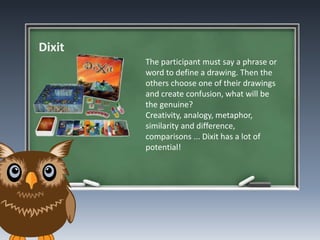
Dixit
The participant must say a phrase or
word to define a drawing. Then the
others choose one of their drawings
and create confusion, what will be
the genuine?
Creativity, analogy, metaphor,
similarity and difference,
comparisons ... Dixit has a lot of
potential!
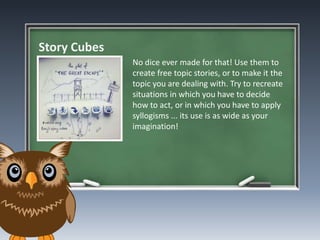
Story Cubes
No dice ever made for that! Use them to
create free topic stories, or to make it the
topic you are dealing with. Try to recreate
situations in which you have to decide
how to act, or in which you have to apply
syllogisms ... its use is as wide as your
imagination!
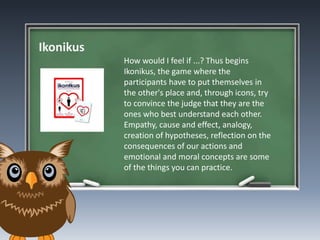
Ikonikus
How would I feel if ...? Thus begins
Ikonikus, the game where the
participants have to put themselves in
the other's place and, through icons, try
to convince the judge that they are the
ones who best understand each other.
Empathy, cause and effect, analogy,
creation of hypotheses, reflection on the
consequences of our actions and
emotional and moral concepts are some
of the things you can practice.
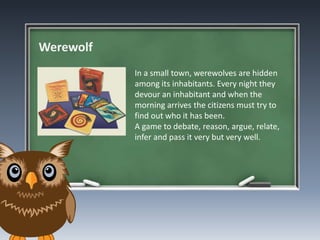
Werewolf
In a small town, werewolves are hidden
among its inhabitants. Every night they
devour an inhabitant and when the
morning arrives the citizens must try to
find out who it has been.
A game to debate, reason, argue, relate,
infer and pass it very but very well.
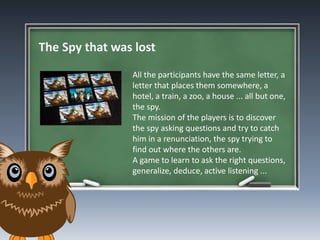
The Spy that was lost
All the participants have the same letter, a
letter that places them somewhere, a
hotel, a train, a zoo, a house ... all but one,
the spy.
The mission of the players is to discover
the spy asking questions and try to catch
him in a renunciation, the spy trying to
find out where the others are.
A game to learn to ask the right questions,
generalize, deduce, active listening ...
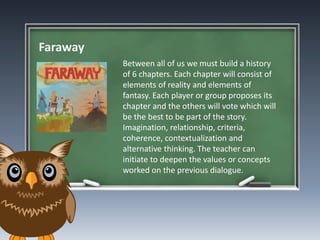
Faraway
Between all of us we must build a history
of 6 chapters. Each chapter will consist of
elements of reality and elements of
fantasy. Each player or group proposes its
chapter and the others will vote which will
be the best to be part of the story.
Imagination, relationship, criteria,
coherence, contextualization and
alternative thinking. The teacher can
initiate to deepen the values or concepts
worked on the previous dialogue.
1. Inventium.
Understanding of innovation.
2. Escape room: The game.
Decrypt codes. Cooperative.
3. The inseparable.
Historical & cooperative.
4. Pandemic.
Cooperative for teenagers.
5. Red November
Cooperative for all ages.
OTHERSCOOPERATIVEGAMES
Time to Practice
Head to the tables with
games and sit in the
one that most catches
your eye. Little by little,
we will try the games
and see their potential.
Get ready for several
days of fun and
thought!
Thank you so much for your attention
http://lourdescardenal.com
Lourdes_C_M

Gamification and Games Based Learning

  • 2.
    1 What is Gamification? Gamificationconsists of applying dynamic and playful mechanics to contexts in principle non-playful. In this way, the students are motivated and participate much more in the classes. In addition, since they are having a good time and are concentrated in the task, they acquire in a significant way the contents worked.
  • 3.
    2 When can Iuse it? You can use games at many points in a lesson, for example: 1.- To identify prior knowledge. 2.- To help acquire knowledge and facilitate understanding. 3.- To review what was learned at the end of a didactic unit.
  • 4.
    Create your owngames! Some times it is quite difficult to find games with the contents you want to work, for this reason, it is very important to be ready to create your own games if you need them. It is important not only to make games to review the lesson with tools like Kahoot, Quizizz, Cerebriti, Trivinet ... but to be able to integrate them into more moments of the class and even use the creation of games by students as a resource to understand and reinforce the contents. 3
  • 5.
    4 Their own games Itshould be noted that when we talk about gamification we do not only refer to the use or creation of digital games, but we can also make a session of "physical" games created by the students so that, in groups, they go through the different games And, after acquiring the contents and having a good time, vote for the best (indicating us which are the indicators that should gather the best game of the class).
  • 6.
    THE RULES THE DYNAMICS OF THE GAME THE REWARDS 3PARTCYCLEINFOGRABHIC How shouldI use it to get results? In GAMIFICATION there must be several elements that should not be missing:
  • 7.
    They must bevery clear for the students before starting to play. It is important that they know what they will achieve if they win the game, that will happen if the last ones are left, or that attitudes and actions are prohibited. THE RULES
  • 8.
    THE DYNAMICS OFTHE GAME Although we should seek to promote consensus and flee competitiveness ... there is nothing that motivates more chic than to get more points than others, achieve goals before, or better than any Group the challenges. Dynamics can be created to favor cooperation and collaboration, but unfortunately, most of the platforms that allow you to generate your own games are based more on the system of points, goals and challenges than on enhancing collaboration and cooperation.
  • 9.
    THE REWARDS Giving thempositives, a good mark, a physical detail (my students will pirouette for stickers like "Mr. Wonderful" or a lollipop ... and that most are Bachillerato) a virtual gift or a insignia. Any of them are more than enough incentives to make the vast majority of students concentrate and put all their effort into doing their best.
  • 10.
    GIVE BADGETS Make yourown with Canvas!!
  • 12.
    Creative Thinking Critical Thinking Ethical Thinking The game allowsto encourage creativity, motivate, put ourselves in unreal situations and see how we would develop, find alternative solutions, look for questions and answers ... With the game we learn to cooperate, to internalize rules, to be responsible, to respect shifts, to value others, to understand them better, to practice active listening ... With the game we practice deduction, inference, relational thinking, hypothesis- building, means-ends, cause-effect relationships ...
  • 13.
    Imagine An enigma anda clue. From there it's about imagining. With transparent cards and icons drawn on them you must combine the images to help others to descrige the puzzle. Perfect for practicing alternative thinking, problem solving, helping, contextualizing and making relationships.
  • 14.
    White/Black Stories We mustsolve a mystery. Through questions (to which the player who knows the answer can only answer yes or no) the students must discover what has happened. They will learn to ask good questions, to deduce and to induce, to relate, to solve problems and to think alternately.
  • 15.
    Concept Through drawings shouldtry to define a concept. They will practice the skills of classifying, categorizing, defining correctly distinguishing primary and secondary qualities from relating and thinking alternately.
  • 16.
    Dixit The participant mustsay a phrase or word to define a drawing. Then the others choose one of their drawings and create confusion, what will be the genuine? Creativity, analogy, metaphor, similarity and difference, comparisons ... Dixit has a lot of potential!
  • 17.
    Story Cubes No diceever made for that! Use them to create free topic stories, or to make it the topic you are dealing with. Try to recreate situations in which you have to decide how to act, or in which you have to apply syllogisms ... its use is as wide as your imagination!
  • 18.
    Ikonikus How would Ifeel if ...? Thus begins Ikonikus, the game where the participants have to put themselves in the other's place and, through icons, try to convince the judge that they are the ones who best understand each other. Empathy, cause and effect, analogy, creation of hypotheses, reflection on the consequences of our actions and emotional and moral concepts are some of the things you can practice.
  • 19.
    Werewolf In a smalltown, werewolves are hidden among its inhabitants. Every night they devour an inhabitant and when the morning arrives the citizens must try to find out who it has been. A game to debate, reason, argue, relate, infer and pass it very but very well.
  • 20.
    The Spy thatwas lost All the participants have the same letter, a letter that places them somewhere, a hotel, a train, a zoo, a house ... all but one, the spy. The mission of the players is to discover the spy asking questions and try to catch him in a renunciation, the spy trying to find out where the others are. A game to learn to ask the right questions, generalize, deduce, active listening ...
  • 21.
    Faraway Between all ofus we must build a history of 6 chapters. Each chapter will consist of elements of reality and elements of fantasy. Each player or group proposes its chapter and the others will vote which will be the best to be part of the story. Imagination, relationship, criteria, coherence, contextualization and alternative thinking. The teacher can initiate to deepen the values or concepts worked on the previous dialogue.
  • 22.
    1. Inventium. Understanding ofinnovation. 2. Escape room: The game. Decrypt codes. Cooperative. 3. The inseparable. Historical & cooperative. 4. Pandemic. Cooperative for teenagers. 5. Red November Cooperative for all ages. OTHERSCOOPERATIVEGAMES
  • 23.
    Time to Practice Headto the tables with games and sit in the one that most catches your eye. Little by little, we will try the games and see their potential. Get ready for several days of fun and thought!
  • 24.
    Thank you somuch for your attention http://lourdescardenal.com Lourdes_C_M