Framework for Ontology-Based Modeling of
Vocational ICT Curricula in Developing Countries
Mohammad Hadi Hedayati, 3rd Year PhD Student
Supervisor: Mart Laanpere 10th February 2106
My research statement
o Background
o Research Problem
o Research Objectives
o Research Questions
o Research Design
o Research Mythology
o Publications
o Conclusion
Background: TVET in Developing Countries
(Afghanistan)
Four hundred thousand graduates from high school
(UNESCO and NESP, 2015)
 High unemployment among youth
 Universities are capable to enroll 20-25 %
 No standard curriculum in TVET
 Mismatch between TVET curricula and job market needs
 Some curriculum copied from two year program
University
http://unesdoc.unesco.org/images/0023/002327/232702e.pdf
International standards for ICT education
EUCIP and e-CF models,
 Most of the specific areas and competences can be considered between
these two models.
 The e-CF is mostly used as a reference framework for designing IT
practitioner competence models.
 The EUCIP is used in many EU countries in certification process and
developing training services.
http://www.eqavet.eu/gns/policy-context/european-vet-initiatives/european-qualifications-
framework.aspx
Research Problem
How can semantic tools help us to set up a modern
and scalable national curriculum framework for
vocational ICT education in developing countries
while maintaining balance between international
standards and unique local needs?!
Research Objectives
 To identify the requirements based on analysis of
local context and needs
 To create a reference model of vocational ICT
curriculum and its development process, based on
integration of international standards and
requirements for developing countries
 To develop a reference framework and validate it in
the context of developing countries, including
Afghanistan
Research Questions
1. What are the restrictions, expectations and needs of main target
groups of vocational ICT curriculum framework in developing
countries?
2. What are the major conflicts, gaps, overlaps between international
standards and local needs regarding vocational education in ICT
domain in developing countries?
3. How a shared understanding about the reference framework for
curriculum can be built and maintained among vocational ICT
curriculum stakeholders?
Research Design
The research design carried out in three phases and each dedicated to one of the
main research objectives:
1. Contextual inquiry cycle, involving content analysis on regulative documents,
focus group interviews using personas and scenarios to identify the local
needs in vocational education on ICT
2. Domain modeling cycle, involving content analysis on international standards
for ICT qualifications (ACM, IEEE, IFIP, EUCIP), identifying gaps and conflicts
between standards and local needs in developing countries, domain modeling
and building a reference model for vocational ICT curriculum development in
developing countries
3. Reference model development cycle, involving participatory design of
reference model and its validation in focus groups and expert panels
Research Methodology
Mixed methods research:
 Exploratory, participatory, scenario-based design
 Ontology-driven modeling of vocational ICT curriculum
 development and validation of an instrument
Research Methodology…
In the first phase:
 Visits
 One Vocational Institute in Estonia (Saarama)
 Three Vocational institutes in Kabul (ATVI, CTI and AIT)
 data collection (Qualitative method)
 through focus interviews (4 groups of 6 subjects representing
various stakeholder groups as Employers, Teachers, Alumni
and Deans, open coding of interview data using NVivo
 Used software engineering techniques (Personas and
Scenarios) for qualitative data collection
Research Methodology…
In the second phase:
 Development Conceptual framework and ontology
 based focus groups result
 describing and studying the field
of vocational ICT curriculum development in countries like
Afghanistan.
Research Methodology…
The third phase will be:
 Validation of the Ontology-Based reference Model of
Vocational ICT Curricula in Developing Countries
Research Methodology…
Best interaction design technique
 Creating and validating five personas and five scenarios
 creating and validating the conceptual model of ICT vocational
curriculum and competence domain in Afghanistan
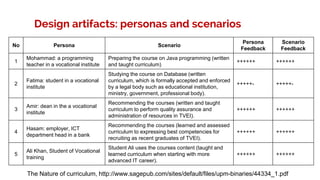
Design artifacts: personas and scenarios
Scenario
Feedback
Persona
Feedback
ScenarioPersonaNo
++++++++++++
Preparing the course on Java programming (written
and taught curriculum)
Mohammad: a programming
teacher in a vocational institute
1
+++++-+++++-
Studying the course on Database (written
curriculum, which is formally accepted and enforced
by a legal body such as educational institution,
ministry, government, professional body).
Fatima: student in a vocational
institute
2
++++++++++++
Recommending the courses (written and taught
curriculum to perform quality assurance and
administration of resources in TVEI).
Amir: dean in the a vocational
institute
3
++++++++++++
Recommending the courses (learned and assessed
curriculum to expressing best competencies for
recruiting as recent graduates of TVEI).
Hasam: employer, ICT
department head in a bank
4
++++++++++++
Student Ali uses the courses content (taught and
learned curriculum when starting with more
advanced IT career).
Ali Khan, Student of Vocational
training
5
The Nature of curriculum, http://www.sagepub.com/sites/default/files/upm-binaries/44334_1.pdf
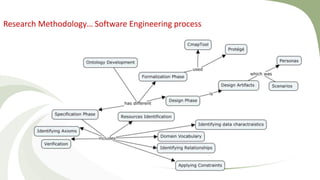
Research Methodology… Software Engineering process
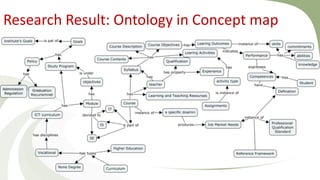
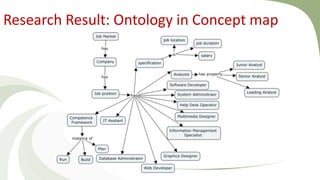
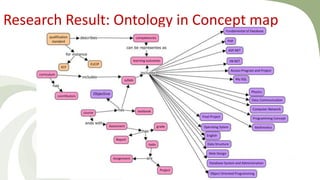
Research Result: Ontology in Concept map
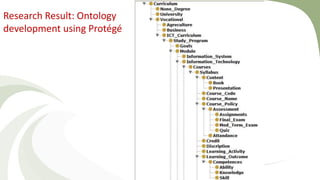
Research Result: Ontology
development using Protégé
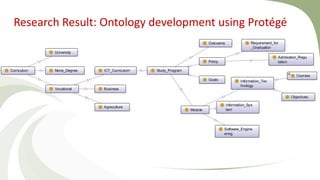
Research Result: Ontology development using Protégé
Publications
1. Identifying Requirements for Vocational Information and Communication
Technology Curricula in Afghanistan, Published
2. Analyzing the Skill Gaps of the Graduates of Vocational ICT Programs in
Afghanistan, Published
3. Scenario-based Design and Conceptual Modeling on Vocational ICT Curricula: a
Case Study in Afghanistan, under work
4. Modeling the Culturally-Sensitive Curriculum Development Process: a Case Study
in the Context of Vocational ICT Education in Afghanistan, accepted
5. Reference model for vocational ICT curriculum in developing countries, next final
•Collecting Data and working on Design Research
•Paper III
Persona-based Design of Vocational ICT Curricula in Afghanistan
Conclusion
The first phase of research is done
no standard curriculum, mismatch with job market
The second phase is almost done
Software engineering method, scenario-base design
Ontology-based Model vocational ICT curriculum
development
The third phase will be done in next step
Validation of instrument (Media Wiki or ???)
Sharing the framework for future reusability
quality assurance of institutions
Thanks for your attention!
Questions?

2016-02-10 research seminar, part 1

  • 1.
    Framework for Ontology-BasedModeling of Vocational ICT Curricula in Developing Countries Mohammad Hadi Hedayati, 3rd Year PhD Student Supervisor: Mart Laanpere 10th February 2106
  • 2.
    My research statement oBackground o Research Problem o Research Objectives o Research Questions o Research Design o Research Mythology o Publications o Conclusion
  • 3.
    Background: TVET inDeveloping Countries (Afghanistan) Four hundred thousand graduates from high school (UNESCO and NESP, 2015)  High unemployment among youth  Universities are capable to enroll 20-25 %  No standard curriculum in TVET  Mismatch between TVET curricula and job market needs  Some curriculum copied from two year program University http://unesdoc.unesco.org/images/0023/002327/232702e.pdf
  • 4.
    International standards forICT education EUCIP and e-CF models,  Most of the specific areas and competences can be considered between these two models.  The e-CF is mostly used as a reference framework for designing IT practitioner competence models.  The EUCIP is used in many EU countries in certification process and developing training services. http://www.eqavet.eu/gns/policy-context/european-vet-initiatives/european-qualifications- framework.aspx
  • 5.
    Research Problem How cansemantic tools help us to set up a modern and scalable national curriculum framework for vocational ICT education in developing countries while maintaining balance between international standards and unique local needs?!
  • 6.
    Research Objectives  Toidentify the requirements based on analysis of local context and needs  To create a reference model of vocational ICT curriculum and its development process, based on integration of international standards and requirements for developing countries  To develop a reference framework and validate it in the context of developing countries, including Afghanistan
  • 7.
    Research Questions 1. Whatare the restrictions, expectations and needs of main target groups of vocational ICT curriculum framework in developing countries? 2. What are the major conflicts, gaps, overlaps between international standards and local needs regarding vocational education in ICT domain in developing countries? 3. How a shared understanding about the reference framework for curriculum can be built and maintained among vocational ICT curriculum stakeholders?
  • 8.
    Research Design The researchdesign carried out in three phases and each dedicated to one of the main research objectives: 1. Contextual inquiry cycle, involving content analysis on regulative documents, focus group interviews using personas and scenarios to identify the local needs in vocational education on ICT 2. Domain modeling cycle, involving content analysis on international standards for ICT qualifications (ACM, IEEE, IFIP, EUCIP), identifying gaps and conflicts between standards and local needs in developing countries, domain modeling and building a reference model for vocational ICT curriculum development in developing countries 3. Reference model development cycle, involving participatory design of reference model and its validation in focus groups and expert panels
  • 9.
    Research Methodology Mixed methodsresearch:  Exploratory, participatory, scenario-based design  Ontology-driven modeling of vocational ICT curriculum  development and validation of an instrument
  • 10.
    Research Methodology… In thefirst phase:  Visits  One Vocational Institute in Estonia (Saarama)  Three Vocational institutes in Kabul (ATVI, CTI and AIT)  data collection (Qualitative method)  through focus interviews (4 groups of 6 subjects representing various stakeholder groups as Employers, Teachers, Alumni and Deans, open coding of interview data using NVivo  Used software engineering techniques (Personas and Scenarios) for qualitative data collection
  • 11.
    Research Methodology… In thesecond phase:  Development Conceptual framework and ontology  based focus groups result  describing and studying the field of vocational ICT curriculum development in countries like Afghanistan.
  • 12.
    Research Methodology… The thirdphase will be:  Validation of the Ontology-Based reference Model of Vocational ICT Curricula in Developing Countries
  • 13.
    Research Methodology… Best interactiondesign technique  Creating and validating five personas and five scenarios  creating and validating the conceptual model of ICT vocational curriculum and competence domain in Afghanistan
  • 14.
    Design artifacts: personasand scenarios Scenario Feedback Persona Feedback ScenarioPersonaNo ++++++++++++ Preparing the course on Java programming (written and taught curriculum) Mohammad: a programming teacher in a vocational institute 1 +++++-+++++- Studying the course on Database (written curriculum, which is formally accepted and enforced by a legal body such as educational institution, ministry, government, professional body). Fatima: student in a vocational institute 2 ++++++++++++ Recommending the courses (written and taught curriculum to perform quality assurance and administration of resources in TVEI). Amir: dean in the a vocational institute 3 ++++++++++++ Recommending the courses (learned and assessed curriculum to expressing best competencies for recruiting as recent graduates of TVEI). Hasam: employer, ICT department head in a bank 4 ++++++++++++ Student Ali uses the courses content (taught and learned curriculum when starting with more advanced IT career). Ali Khan, Student of Vocational training 5 The Nature of curriculum, http://www.sagepub.com/sites/default/files/upm-binaries/44334_1.pdf
  • 15.
  • 16.
  • 17.
  • 18.
  • 19.
  • 20.
    Research Result: Ontologydevelopment using Protégé
  • 21.
    Publications 1. Identifying Requirementsfor Vocational Information and Communication Technology Curricula in Afghanistan, Published 2. Analyzing the Skill Gaps of the Graduates of Vocational ICT Programs in Afghanistan, Published 3. Scenario-based Design and Conceptual Modeling on Vocational ICT Curricula: a Case Study in Afghanistan, under work 4. Modeling the Culturally-Sensitive Curriculum Development Process: a Case Study in the Context of Vocational ICT Education in Afghanistan, accepted 5. Reference model for vocational ICT curriculum in developing countries, next final
  • 22.
    •Collecting Data andworking on Design Research •Paper III Persona-based Design of Vocational ICT Curricula in Afghanistan Conclusion The first phase of research is done no standard curriculum, mismatch with job market The second phase is almost done Software engineering method, scenario-base design Ontology-based Model vocational ICT curriculum development The third phase will be done in next step Validation of instrument (Media Wiki or ???) Sharing the framework for future reusability quality assurance of institutions
  • 23.
    Thanks for yourattention! Questions?