INTRODUCTION TO THE CHARACTERISTICS OF THE VOCATIONAL AND
TECHNICAL CURRICULUM ACCORDING TO FINCH AND CRUNKILTON
NAME: NAMBOBI MUTWALIBI, ALIEU .E. JAMMEH
ABDULHADI,SHAKIL AHMED
•ID: 153404,153407,153432,153401
•COURSE NO: TVE 4117
•PROGRAM: BSC.T.E (computer Science and Engineering |
Electrical Engineering)
•DEPARTMENT: TVE
OVERVIEW
• ORIENTATION,
• JUSTIFICATION,
• FOCUS,
• IN-SCHOOL SUCCESS STANDARDS,
• OUT- OF - SCHOOL SUCCESS STANDARDS,
• SCHOOL COMMUNITY RELATIONSHIPS,
• FEDERAL INVOLVEMENT,
• RESPONSIVE,
• LOGISTICS AND EXPENSES.
CHARACTERISTICS OF THE VOCATIONAL AND TECHNICAL
CURRICULUM
One must ,however, recognize that from a conceptual point of view the ideal curriculum is
neither ‘’academic’’ nor ‘’vocational and technical.’’
These characteristics represent a curriculum focus that may be best associated with curriculum
building, maintenance and immediate and long - term outcomes.
These basic characteristics of the vocational and technical curriculum include orientation,
justification, focus, in-school success standards, out- of - school success standards, school
community relationships, federal involvement, responsive, logistics and expensive.
ORIENTATION
• Although a major concern of vocational education has been to provide a means for each
student to achieve curricular outcomes, the ultimate outcome is more far – reaching than the
educational process.
• The ultimate success of a vocational and technical is not measure merely through student
educational achievement but through the results of that achievement- results that take the
form of performance in the work world.
• Thus, the vocational and technical curriculum is oriented toward process(experience and
activities within the school setting) and product (effects of these experience and activities on
former students).
JUSTIFICATION
• That exist for the graduate. The vocational and technical curriculum is based on identified
occupational needs of a particular locale.
• These needs are not merely general feelings ; they are clarified to the point that no question
exist about the demand for works in the selected occupation or occupational field.
• Thus, curriculum justification extends beyond the school setting and into the community.
• Curriculum is oriented toward the student, support for that curriculum is derived from
employment opportunities
FOCUS
• Curriculum focus in vocational and technical education is not limited to the development of
knowledge about a particular area.
• The vocational and technical curriculum deals directly with helping the students to develop a
broad range of knowledge, skills, attitudes, and values, each of which ultimately contributes in
some manner to the graduate’s employability.
• The vocational and education curricular focus also includes the integration of academic studies
such as communication skills and science with applied studies so that students are better able
to link these academic content areas to applied vocational and technical education content.
IN – SCHOOL SUCCESS STANDARDS
• Although it is important for each student to be knowledgeable about many aspect of the
occupation he or she will enter, the true assessment of the students success in school must be
with ‘’hands – on ‘’ or applied performance.
• For example repairing a car.
• In school success standards must be closely aligned with performance expected in the
occupation, with criteria used by instructors often being standards of the occupation.
OUT- OF- SCHOOL SUCCESS STANDARDS
• The determination of success is not limited to what transpires in a school setting. A vocational
and technical curriculum must also be judge in terms of its former success.
• Success standards vary from school to school and from state to state, they quiet often take the
form of affective job skills, technical skills, occupational survival skills, job search skills and
entrepreneurial skills.
• The above items are out- of –school success standards that vocational and technical education
as well as business and industry leaders ranks as being very important curricular outcomes.
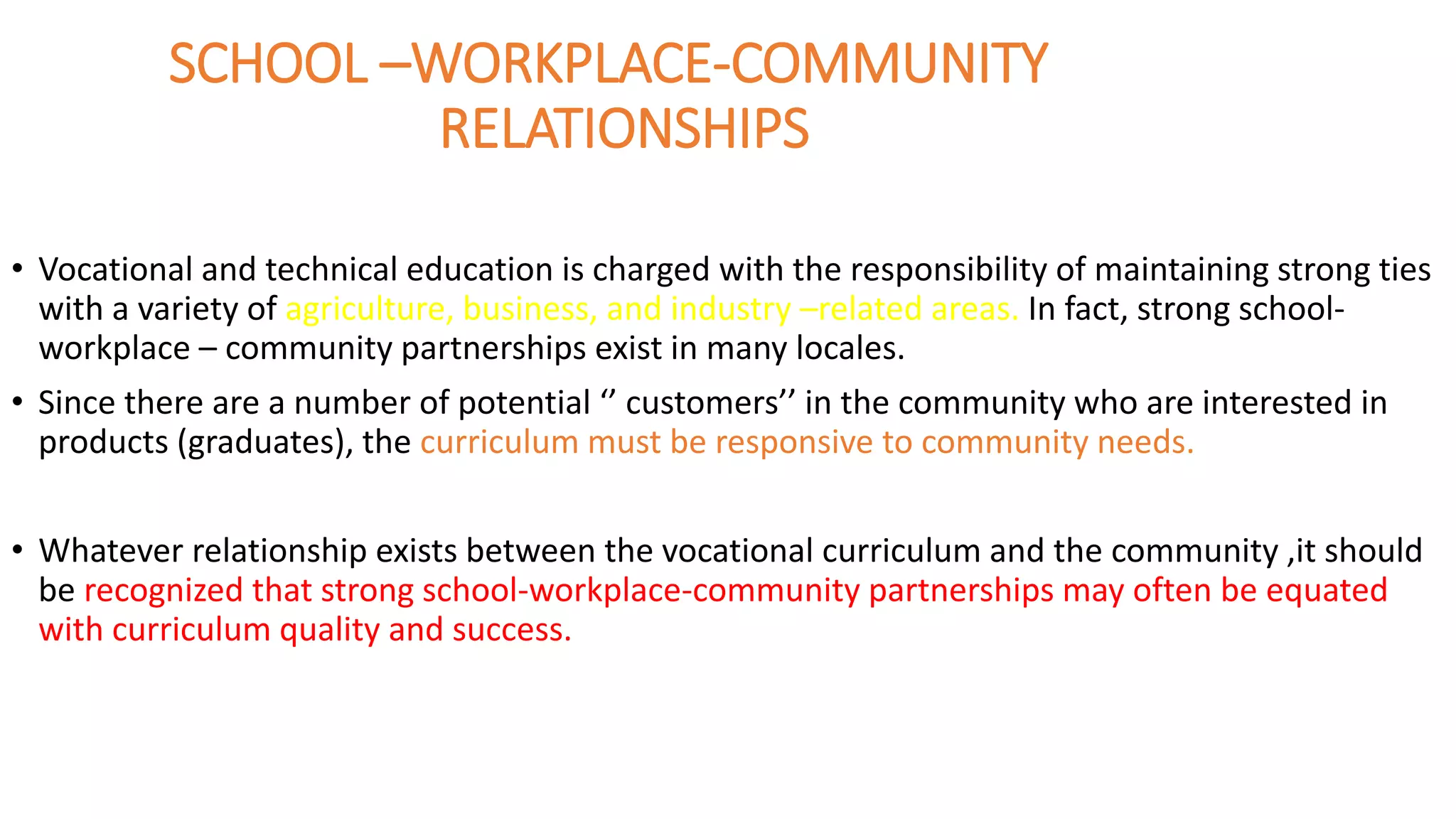
SCHOOL –WORKPLACE-COMMUNITY
RELATIONSHIPS
• Vocational and technical education is charged with the responsibility of maintaining strong ties
with a variety of agriculture, business, and industry –related areas. In fact, strong school-
workplace – community partnerships exist in many locales.
• Since there are a number of potential ‘’ customers’’ in the community who are interested in
products (graduates), the curriculum must be responsive to community needs.
• Whatever relationship exists between the vocational curriculum and the community ,it should
be recognized that strong school-workplace-community partnerships may often be equated
with curriculum quality and success.
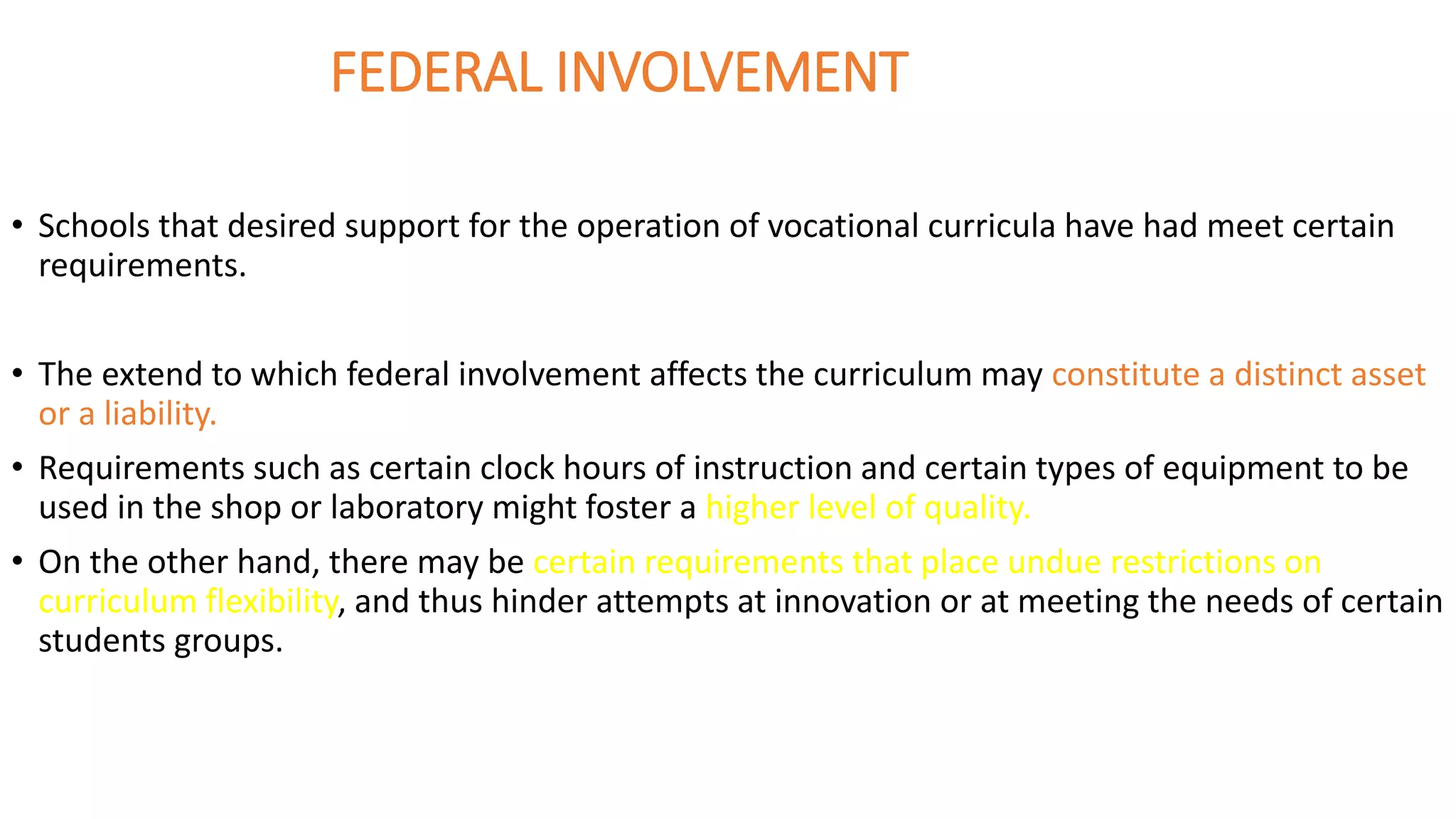
FEDERAL INVOLVEMENT
• Schools that desired support for the operation of vocational curricula have had meet certain
requirements.
• The extend to which federal involvement affects the curriculum may constitute a distinct asset
or a liability.
• Requirements such as certain clock hours of instruction and certain types of equipment to be
used in the shop or laboratory might foster a higher level of quality.
• On the other hand, there may be certain requirements that place undue restrictions on
curriculum flexibility, and thus hinder attempts at innovation or at meeting the needs of certain
students groups.
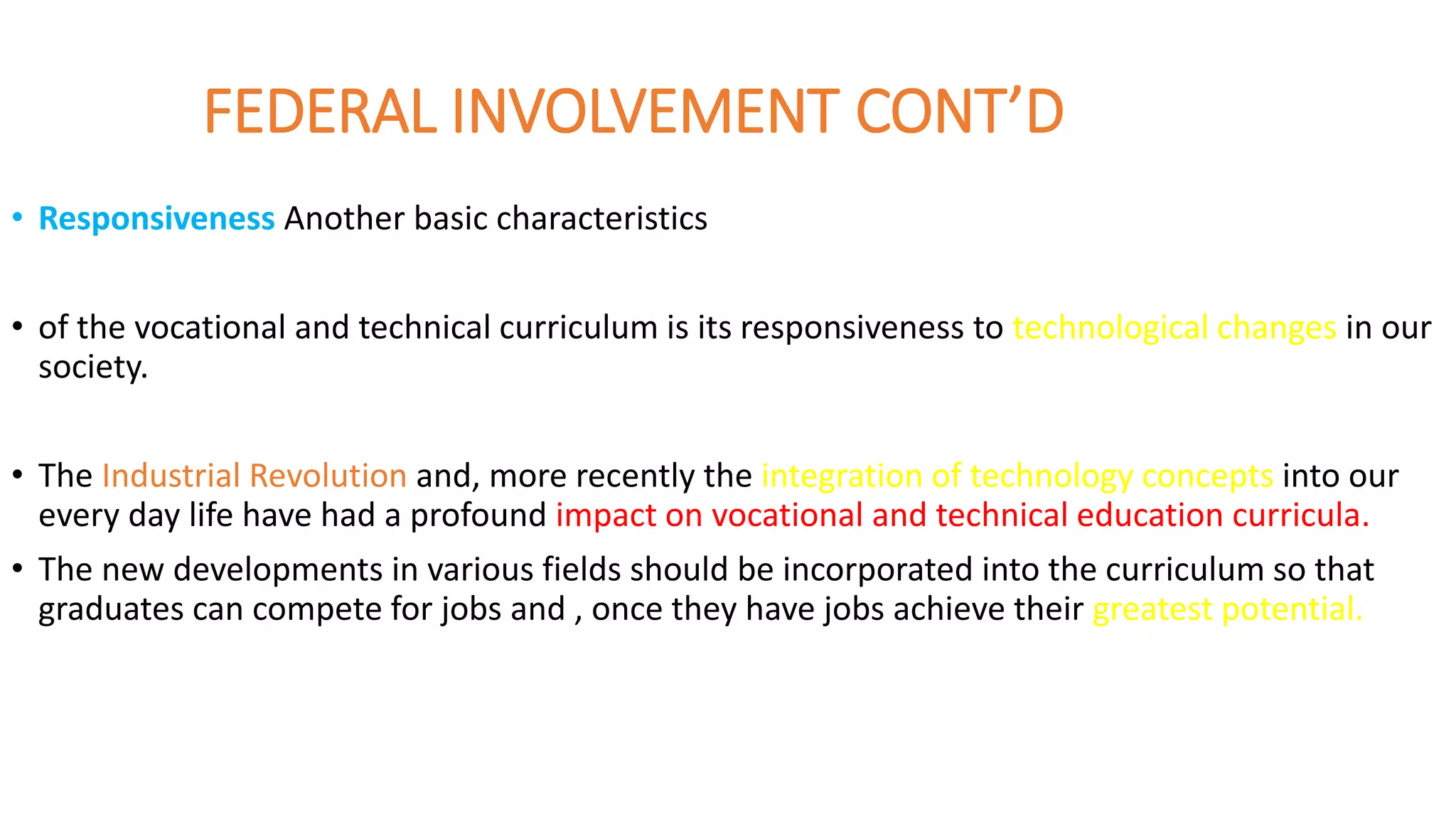
FEDERAL INVOLVEMENT CONT’D
• Responsiveness Another basic characteristics
• of the vocational and technical curriculum is its responsiveness to technological changes in our
society.
• The Industrial Revolution and, more recently the integration of technology concepts into our
every day life have had a profound impact on vocational and technical education curricula.
• The new developments in various fields should be incorporated into the curriculum so that
graduates can compete for jobs and , once they have jobs achieve their greatest potential.
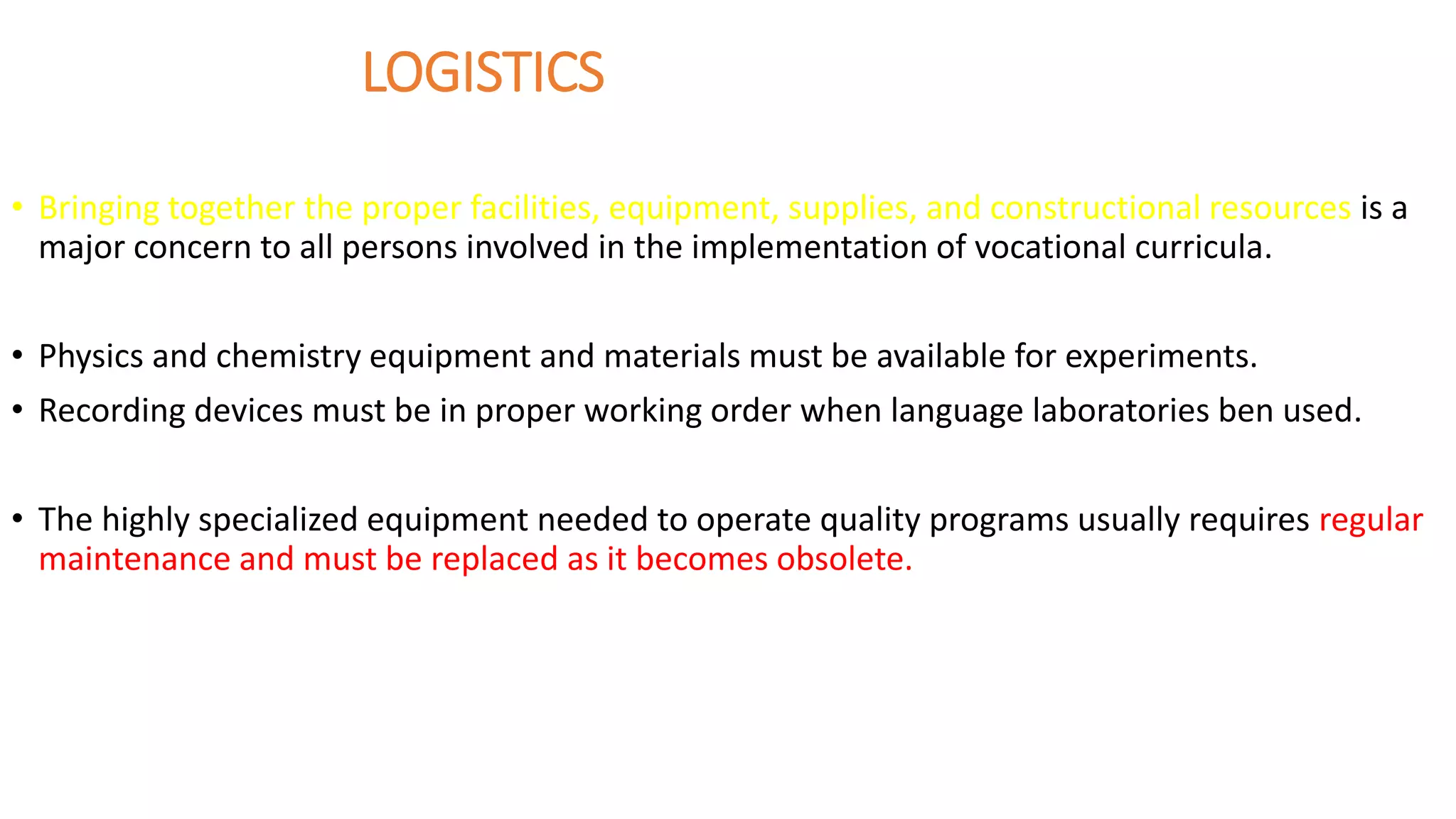
LOGISTICS
• Bringing together the proper facilities, equipment, supplies, and constructional resources is a
major concern to all persons involved in the implementation of vocational curricula.
• Physics and chemistry equipment and materials must be available for experiments.
• Recording devices must be in proper working order when language laboratories ben used.
• The highly specialized equipment needed to operate quality programs usually requires regular
maintenance and must be replaced as it becomes obsolete.
EXPENSE
• The vocational and technical curriculum may often require greater basic operating
expenditures because of facilities that have a large square footage or equipment such as
welders, oven, or computers that requires large amounts of energy for their operation.
• Equipment must be updated periodically if the instructor expects to provide students with
realistic instruction, and this updating process can be very expensive.
• The ever Increasing costs associated with the purchase of high-quality equipment make this
area one of tremendous concern to vocational educators.
CONCLUSION
• Reference Book: Curriculum Development in Vocational and Technical
Education: Planning, Content, and Implementation, 5th Edition
Curtis R. Finch, Virginia Polytechnic Institute & State University John R.
Crunkilton, Virginia Polytechnic Institute & State University
PLEASE ANY QUESTION
THANK YOU

Curriculum development: CHARACTERISTICS OF THE VOCATIONAL AND TECHNICAL CURRICULUM

  • 1.
    INTRODUCTION TO THECHARACTERISTICS OF THE VOCATIONAL AND TECHNICAL CURRICULUM ACCORDING TO FINCH AND CRUNKILTON NAME: NAMBOBI MUTWALIBI, ALIEU .E. JAMMEH ABDULHADI,SHAKIL AHMED •ID: 153404,153407,153432,153401 •COURSE NO: TVE 4117 •PROGRAM: BSC.T.E (computer Science and Engineering | Electrical Engineering) •DEPARTMENT: TVE
  • 2.
    OVERVIEW • ORIENTATION, • JUSTIFICATION, •FOCUS, • IN-SCHOOL SUCCESS STANDARDS, • OUT- OF - SCHOOL SUCCESS STANDARDS, • SCHOOL COMMUNITY RELATIONSHIPS, • FEDERAL INVOLVEMENT, • RESPONSIVE, • LOGISTICS AND EXPENSES.
  • 3.
    CHARACTERISTICS OF THEVOCATIONAL AND TECHNICAL CURRICULUM One must ,however, recognize that from a conceptual point of view the ideal curriculum is neither ‘’academic’’ nor ‘’vocational and technical.’’ These characteristics represent a curriculum focus that may be best associated with curriculum building, maintenance and immediate and long - term outcomes. These basic characteristics of the vocational and technical curriculum include orientation, justification, focus, in-school success standards, out- of - school success standards, school community relationships, federal involvement, responsive, logistics and expensive.
  • 4.
    ORIENTATION • Although amajor concern of vocational education has been to provide a means for each student to achieve curricular outcomes, the ultimate outcome is more far – reaching than the educational process. • The ultimate success of a vocational and technical is not measure merely through student educational achievement but through the results of that achievement- results that take the form of performance in the work world. • Thus, the vocational and technical curriculum is oriented toward process(experience and activities within the school setting) and product (effects of these experience and activities on former students).
  • 5.
    JUSTIFICATION • That existfor the graduate. The vocational and technical curriculum is based on identified occupational needs of a particular locale. • These needs are not merely general feelings ; they are clarified to the point that no question exist about the demand for works in the selected occupation or occupational field. • Thus, curriculum justification extends beyond the school setting and into the community. • Curriculum is oriented toward the student, support for that curriculum is derived from employment opportunities
  • 6.
    FOCUS • Curriculum focusin vocational and technical education is not limited to the development of knowledge about a particular area. • The vocational and technical curriculum deals directly with helping the students to develop a broad range of knowledge, skills, attitudes, and values, each of which ultimately contributes in some manner to the graduate’s employability. • The vocational and education curricular focus also includes the integration of academic studies such as communication skills and science with applied studies so that students are better able to link these academic content areas to applied vocational and technical education content.
  • 7.
    IN – SCHOOLSUCCESS STANDARDS • Although it is important for each student to be knowledgeable about many aspect of the occupation he or she will enter, the true assessment of the students success in school must be with ‘’hands – on ‘’ or applied performance. • For example repairing a car. • In school success standards must be closely aligned with performance expected in the occupation, with criteria used by instructors often being standards of the occupation.
  • 8.
    OUT- OF- SCHOOLSUCCESS STANDARDS • The determination of success is not limited to what transpires in a school setting. A vocational and technical curriculum must also be judge in terms of its former success. • Success standards vary from school to school and from state to state, they quiet often take the form of affective job skills, technical skills, occupational survival skills, job search skills and entrepreneurial skills. • The above items are out- of –school success standards that vocational and technical education as well as business and industry leaders ranks as being very important curricular outcomes.
  • 9.
    SCHOOL –WORKPLACE-COMMUNITY RELATIONSHIPS • Vocationaland technical education is charged with the responsibility of maintaining strong ties with a variety of agriculture, business, and industry –related areas. In fact, strong school- workplace – community partnerships exist in many locales. • Since there are a number of potential ‘’ customers’’ in the community who are interested in products (graduates), the curriculum must be responsive to community needs. • Whatever relationship exists between the vocational curriculum and the community ,it should be recognized that strong school-workplace-community partnerships may often be equated with curriculum quality and success.
  • 10.
    FEDERAL INVOLVEMENT • Schoolsthat desired support for the operation of vocational curricula have had meet certain requirements. • The extend to which federal involvement affects the curriculum may constitute a distinct asset or a liability. • Requirements such as certain clock hours of instruction and certain types of equipment to be used in the shop or laboratory might foster a higher level of quality. • On the other hand, there may be certain requirements that place undue restrictions on curriculum flexibility, and thus hinder attempts at innovation or at meeting the needs of certain students groups.
  • 11.
    FEDERAL INVOLVEMENT CONT’D •Responsiveness Another basic characteristics • of the vocational and technical curriculum is its responsiveness to technological changes in our society. • The Industrial Revolution and, more recently the integration of technology concepts into our every day life have had a profound impact on vocational and technical education curricula. • The new developments in various fields should be incorporated into the curriculum so that graduates can compete for jobs and , once they have jobs achieve their greatest potential.
  • 12.
    LOGISTICS • Bringing togetherthe proper facilities, equipment, supplies, and constructional resources is a major concern to all persons involved in the implementation of vocational curricula. • Physics and chemistry equipment and materials must be available for experiments. • Recording devices must be in proper working order when language laboratories ben used. • The highly specialized equipment needed to operate quality programs usually requires regular maintenance and must be replaced as it becomes obsolete.
  • 13.
    EXPENSE • The vocationaland technical curriculum may often require greater basic operating expenditures because of facilities that have a large square footage or equipment such as welders, oven, or computers that requires large amounts of energy for their operation. • Equipment must be updated periodically if the instructor expects to provide students with realistic instruction, and this updating process can be very expensive. • The ever Increasing costs associated with the purchase of high-quality equipment make this area one of tremendous concern to vocational educators.
  • 14.
    CONCLUSION • Reference Book:Curriculum Development in Vocational and Technical Education: Planning, Content, and Implementation, 5th Edition Curtis R. Finch, Virginia Polytechnic Institute & State University John R. Crunkilton, Virginia Polytechnic Institute & State University PLEASE ANY QUESTION THANK YOU