Meeting Number 2 of the Grand Junction Socratic Club
               December 17 th , 2011
Notes for SlideShare presentation
The following slides are basically the ones used in the
presentation I gave at our second Socratic Club meeting.
Many of the points require further elaboration to be
made well, but the slides here presented give a basic
idea.

At this club meeting, the opposing position was given in
the form of a video presentation of Sam Harris’s TED
talk on the subject.
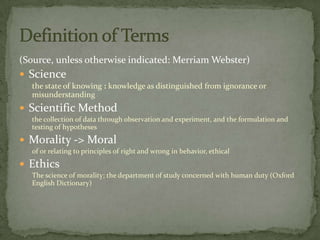
(Source, unless otherwise indicated: Merriam Webster)
 Science
  the state of knowing : knowledge as distinguished from ignorance or
  misunderstanding
 Scientific Method
  the collection of data through observation and experiment, and the formulation and
  testing of hypotheses
 Morality -> Moral
  of or relating to principles of right and wrong in behavior, ethical
 Ethics
  The science of morality; the department of study concerned with human duty (Oxford
  English Dictionary)
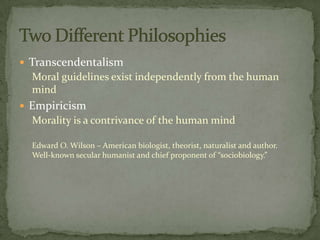
 Transcendentalism
  Moral guidelines exist independently from the human
  mind
 Empiricism
  Morality is a contrivance of the human mind

  Edward O. Wilson – American biologist, theorist, naturalist and author.
  Well-known secular humanist and chief proponent of “sociobiology.”
The choice between transcendentalism and empiricism
 will be the coming century's version of the struggle for
men's souls. Moral reasoning will either remain centered
in idioms of theology and philosophy, where it is now, or
  shift toward science-based material analysis. Where it
    settles will depend on which world view is proved
 correct, or at least which is more widely perceived to be
                          correct.

           Edward O. Wilson, The Atlantic, 1998
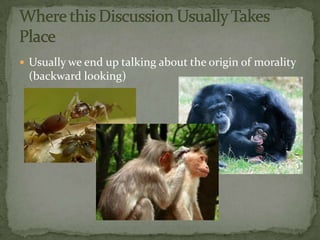
 Usually we end up talking about the origin of morality
 (backward looking)
 The origin of moral judgment is not the real issue,
  although it would be an interesting discussion
 Morality, as in the determination of intrinsic “right”
  and “wrong” is
  outside the realm
  of science
 Ockham’s razor is
  the best way of
  deciding who needs
  to demonstrate the
  burden of proof
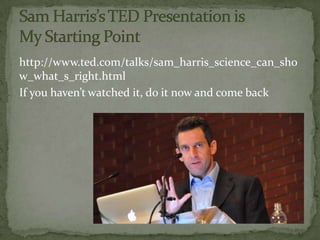
http://www.ted.com/talks/sam_harris_science_can_sho
w_what_s_right.html
If you haven’t watched it, do it now and come back
Emotionally based argumentation, evidenced by Harris’s
quotes…
  “Now the irony, from my perspective, is that the only people
  who seem to seem to generally agree with me and who think
  that there are right and wrong answers to moral questions are
  religious demagogues of one form or another.”

  “And of course they think they have the right answers to moral
  questions because they got these answers from a voice in a
  whirlwind, not because they made an intelligent analysis of the
  causes and condition of human and animal well-being.”
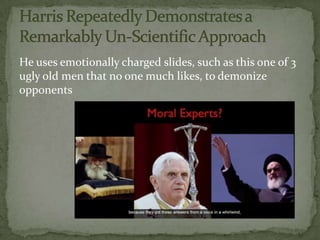
He uses emotionally charged slides, such as this one of 3
ugly old men that no one much likes, to demonize
opponents
Questions that Arise
 How do we define “well-being”?
 Is it at an individual or group level?
 What happens when the well-being of two individuals
  or two groups are in competition?
 To what degree is an individual given autonomy in
  deciding their own well-being, and what is the role of
  society in forcing it’s own conception of “well-being”
  on an autonomous individual?
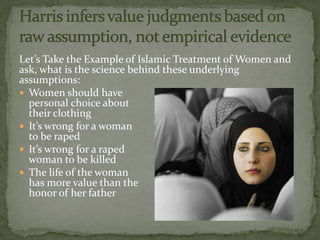
Let’s Take the Example of Islamic Treatment of Women and
ask, what is the science behind these underlying
assumptions:
 Women should have
  personal choice about
  their clothing
 It’s wrong for a woman
  to be raped
 It’s wrong for a raped
  woman to be killed
 The life of the woman
  has more value than the
  honor of her father
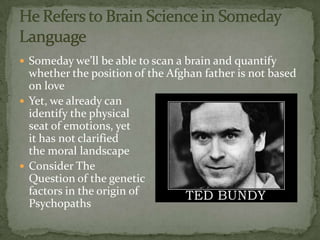
 Someday we’ll be able to scan a brain and quantify
  whether the position of the Afghan father is not based
  on love
 Yet, we already can
  identify the physical
  seat of emotions, yet
  it has not clarified
  the moral landscape
 Consider The
  Question of the genetic
  factors in the origin of
  Psychopaths
 “Values are facts about the well-being of conscious
    creatures”
   “Why is it that we don’t have ethical obligations toward
    rocks … because we don’t think that rocks can suffer”
   “We know, we know that there are right and wrong answers
    to how to move in this space [ the human condition ]”
   “How is the Talliban’s ignorance on the subject of human
    well-being any less obvious [than their ignorance on the
    subject of physics]?”
   “Positive social emotion, like empathy and compassion…”
 Science is concerned with “what is”
 Morality and human values deal with “what ought to
  be”
 This is a key difference that is often overlooked
 According to Edward O. Wilson: Ought is the
  translation not of human nature but of the public will
 Wilson also says: “Most of these proximate rewards are
  converted into the universal bottom line of Darwinian
  genetic fitness: greater longevity and a secure, growing
  family.”
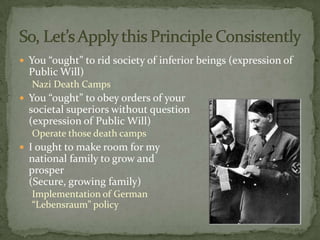
 You “ought” to rid society of inferior beings (expression of
  Public Will)
  Nazi Death Camps
 You “ought” to obey orders of your
  societal superiors without question
  (expression of Public Will)
  Operate those death camps
 I ought to make room for my
  national family to grow and
  prosper
  (Secure, growing family)
  Implementation of German
  “Lebensraum” policy
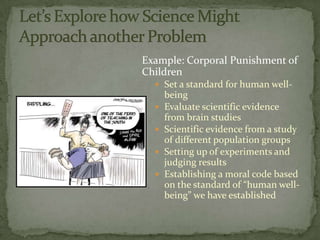
Example: Corporal Punishment of
Children
   Set a standard for human well-
      being
     Evaluate scientific evidence
      from brain studies
     Scientific evidence from a study
      of different population groups
     Setting up of experiments and
      judging results
     Establishing a moral code based
      on the standard of “human well-
      being” we have established
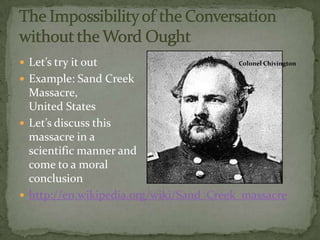
 Let’s try it out                       Colonel Chivington

 Example: Sand Creek
  Massacre,
  United States
 Let’s discuss this
  massacre in a
  scientific manner and
  come to a moral
  conclusion
 http://en.wikipedia.org/wiki/Sand_Creek_massacre
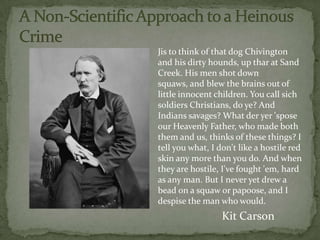
Jis to think of that dog Chivington
and his dirty hounds, up thar at Sand
Creek. His men shot down
squaws, and blew the brains out of
little innocent children. You call sich
soldiers Christians, do ye? And
Indians savages? What der yer 'spose
our Heavenly Father, who made both
them and us, thinks of these things? I
tell you what, I don't like a hostile red
skin any more than you do. And when
they are hostile, I've fought 'em, hard
as any man. But I never yet drew a
bead on a squaw or papoose, and I
despise the man who would.
                  Kit Carson
The Grand Junction Socratic Club
Meeting the 1st and 3rd Saturdays of Every
                  Month

  For more information, please email
       info@gjsocraticclub.org

Can science provide a basis for morality, slideshare version

  • 1.
    Meeting Number 2of the Grand Junction Socratic Club December 17 th , 2011
  • 2.
    Notes for SlideSharepresentation The following slides are basically the ones used in the presentation I gave at our second Socratic Club meeting. Many of the points require further elaboration to be made well, but the slides here presented give a basic idea. At this club meeting, the opposing position was given in the form of a video presentation of Sam Harris’s TED talk on the subject.
  • 3.
    (Source, unless otherwiseindicated: Merriam Webster)  Science the state of knowing : knowledge as distinguished from ignorance or misunderstanding  Scientific Method the collection of data through observation and experiment, and the formulation and testing of hypotheses  Morality -> Moral of or relating to principles of right and wrong in behavior, ethical  Ethics The science of morality; the department of study concerned with human duty (Oxford English Dictionary)
  • 4.
     Transcendentalism Moral guidelines exist independently from the human mind  Empiricism Morality is a contrivance of the human mind Edward O. Wilson – American biologist, theorist, naturalist and author. Well-known secular humanist and chief proponent of “sociobiology.”
  • 5.
    The choice betweentranscendentalism and empiricism will be the coming century's version of the struggle for men's souls. Moral reasoning will either remain centered in idioms of theology and philosophy, where it is now, or shift toward science-based material analysis. Where it settles will depend on which world view is proved correct, or at least which is more widely perceived to be correct. Edward O. Wilson, The Atlantic, 1998
  • 6.
     Usually weend up talking about the origin of morality (backward looking)
  • 7.
     The originof moral judgment is not the real issue, although it would be an interesting discussion  Morality, as in the determination of intrinsic “right” and “wrong” is outside the realm of science  Ockham’s razor is the best way of deciding who needs to demonstrate the burden of proof
  • 8.
  • 9.
    Emotionally based argumentation,evidenced by Harris’s quotes… “Now the irony, from my perspective, is that the only people who seem to seem to generally agree with me and who think that there are right and wrong answers to moral questions are religious demagogues of one form or another.” “And of course they think they have the right answers to moral questions because they got these answers from a voice in a whirlwind, not because they made an intelligent analysis of the causes and condition of human and animal well-being.”
  • 10.
    He uses emotionallycharged slides, such as this one of 3 ugly old men that no one much likes, to demonize opponents
  • 11.
    Questions that Arise How do we define “well-being”?  Is it at an individual or group level?  What happens when the well-being of two individuals or two groups are in competition?  To what degree is an individual given autonomy in deciding their own well-being, and what is the role of society in forcing it’s own conception of “well-being” on an autonomous individual?
  • 12.
    Let’s Take theExample of Islamic Treatment of Women and ask, what is the science behind these underlying assumptions:  Women should have personal choice about their clothing  It’s wrong for a woman to be raped  It’s wrong for a raped woman to be killed  The life of the woman has more value than the honor of her father
  • 13.
     Someday we’llbe able to scan a brain and quantify whether the position of the Afghan father is not based on love  Yet, we already can identify the physical seat of emotions, yet it has not clarified the moral landscape  Consider The Question of the genetic factors in the origin of Psychopaths
  • 14.
     “Values arefacts about the well-being of conscious creatures”  “Why is it that we don’t have ethical obligations toward rocks … because we don’t think that rocks can suffer”  “We know, we know that there are right and wrong answers to how to move in this space [ the human condition ]”  “How is the Talliban’s ignorance on the subject of human well-being any less obvious [than their ignorance on the subject of physics]?”  “Positive social emotion, like empathy and compassion…”
  • 15.
     Science isconcerned with “what is”  Morality and human values deal with “what ought to be”  This is a key difference that is often overlooked  According to Edward O. Wilson: Ought is the translation not of human nature but of the public will  Wilson also says: “Most of these proximate rewards are converted into the universal bottom line of Darwinian genetic fitness: greater longevity and a secure, growing family.”
  • 16.
     You “ought”to rid society of inferior beings (expression of Public Will) Nazi Death Camps  You “ought” to obey orders of your societal superiors without question (expression of Public Will) Operate those death camps  I ought to make room for my national family to grow and prosper (Secure, growing family) Implementation of German “Lebensraum” policy
  • 17.
    Example: Corporal Punishmentof Children  Set a standard for human well- being  Evaluate scientific evidence from brain studies  Scientific evidence from a study of different population groups  Setting up of experiments and judging results  Establishing a moral code based on the standard of “human well- being” we have established
  • 18.
     Let’s tryit out Colonel Chivington  Example: Sand Creek Massacre, United States  Let’s discuss this massacre in a scientific manner and come to a moral conclusion  http://en.wikipedia.org/wiki/Sand_Creek_massacre
  • 19.
    Jis to thinkof that dog Chivington and his dirty hounds, up thar at Sand Creek. His men shot down squaws, and blew the brains out of little innocent children. You call sich soldiers Christians, do ye? And Indians savages? What der yer 'spose our Heavenly Father, who made both them and us, thinks of these things? I tell you what, I don't like a hostile red skin any more than you do. And when they are hostile, I've fought 'em, hard as any man. But I never yet drew a bead on a squaw or papoose, and I despise the man who would. Kit Carson
  • 20.
    The Grand JunctionSocratic Club Meeting the 1st and 3rd Saturdays of Every Month For more information, please email info@gjsocraticclub.org