Embedded platform
choices
Tavish Naruka
BaseApp Systems
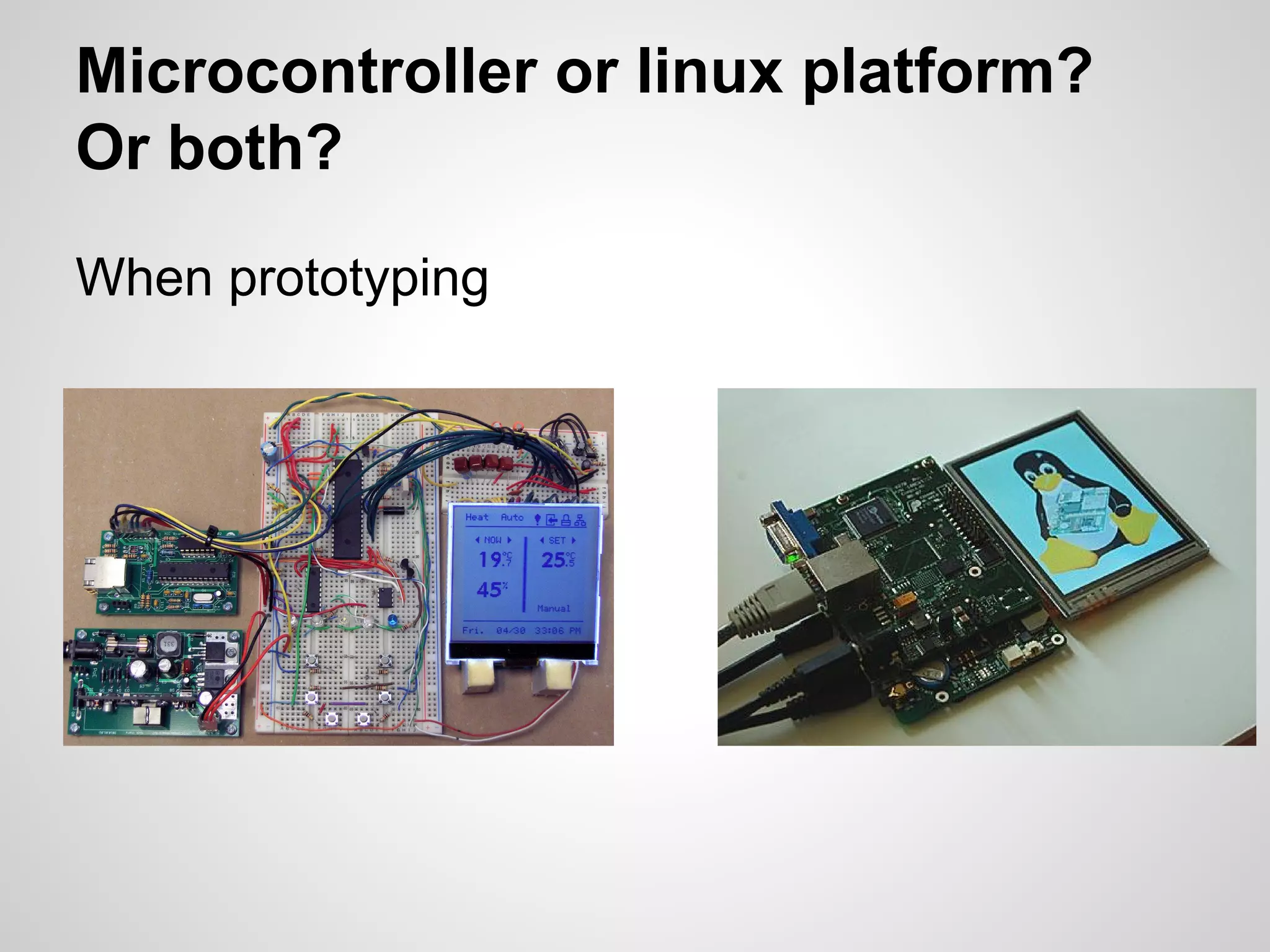
Microcontroller or linux platform?
Or both?
When prototyping
OR
System which uses only microcontrollers to
function
System which has a linux cpu (may have
microcontrollers too)
Working with microcontrollers
● First step is component selection
○ Does the controller have all the interfaces required
○ Voltage range, cost, memory sizes(flash and ram)
○ Familiarity with the architecture, supported software,
documentation, even community
○ debugger/programmer, toolchain
○ Is some development kit available? If not, then can
you make a pcb for prototyping yourself? Maybe
someone has published a design using this online
Some popular choices
● AVR is probably most popular due to
arduino.
● PIC family of microcontrollers is also popular
● ST microelectronics
● has a few not too expensive dev kits
● TI MSP
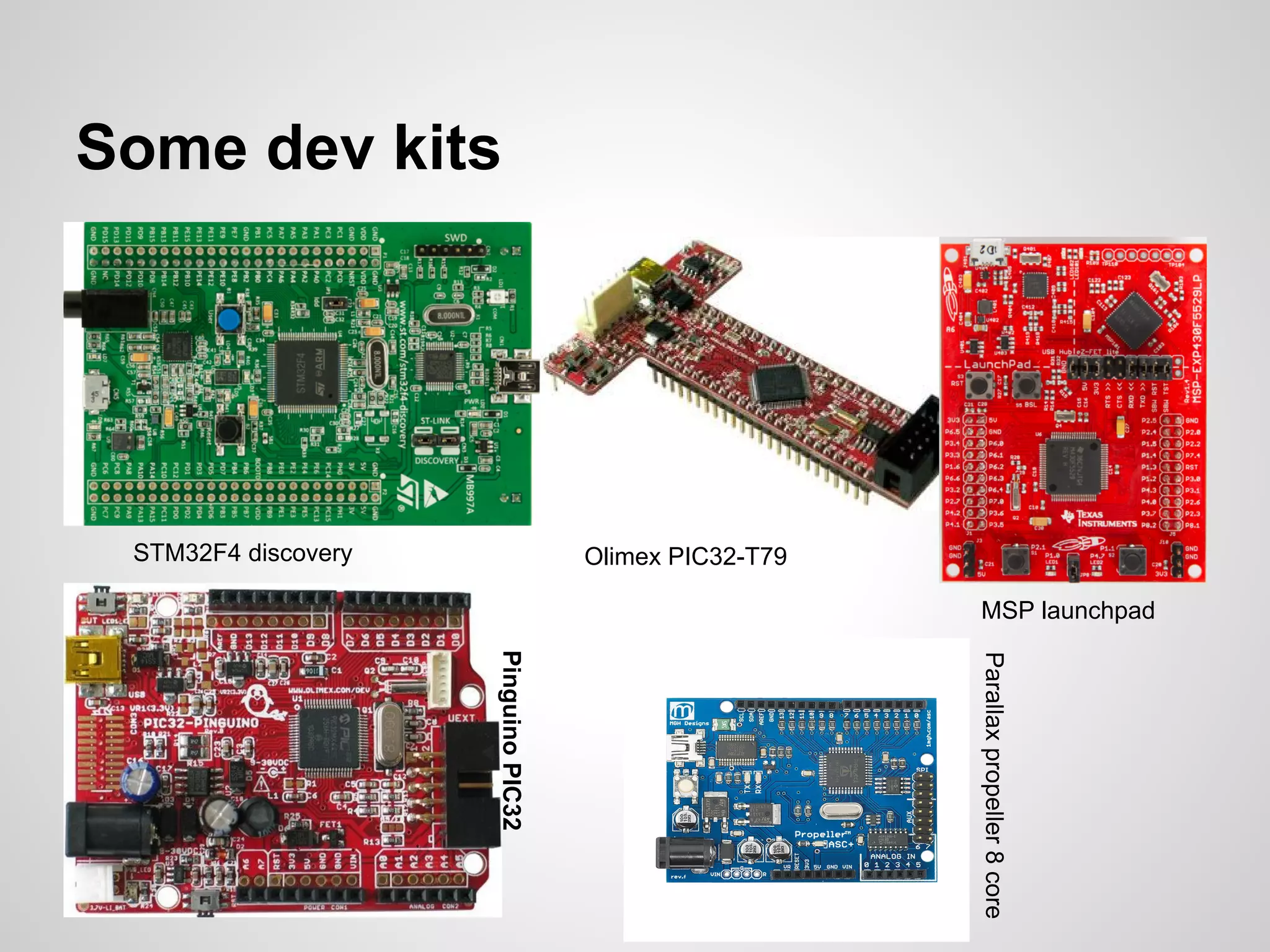
Some dev kits
STM32F4 discovery Olimex PIC32-T79
MSP launchpad
PinguinoPIC32
Parallaxpropeller8core
Firmware
● Most code is in C, or assembly. sometimes
C++
● compilers and chip makers often provides
driver libraries and example code for things
like USB, TCP/IP stack, and other
peripherals
● The reference manual is usually a reference
for a family of similar chips, and the
datasheet is the ultimate reference
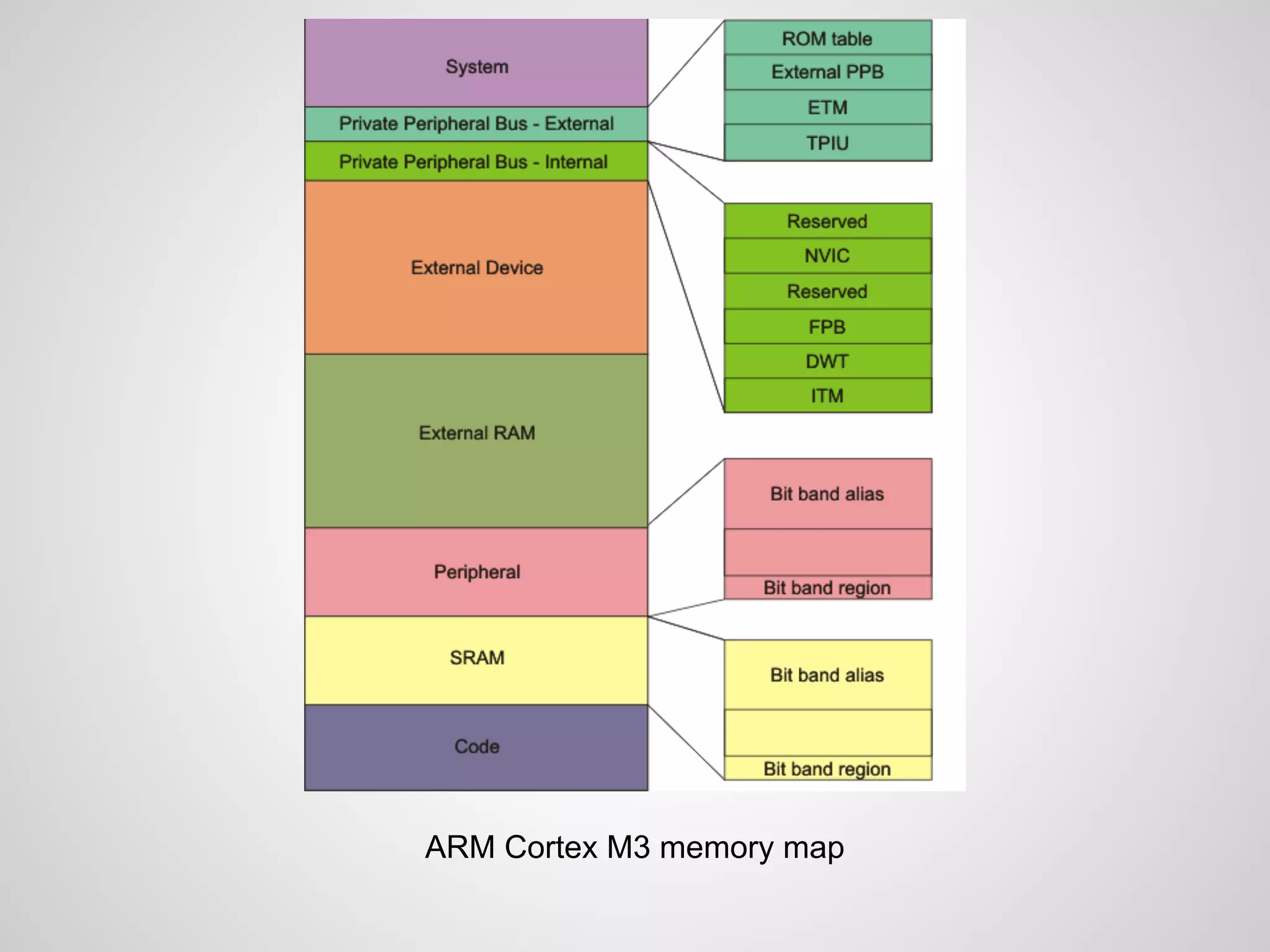
ARM Cortex M3 memory map
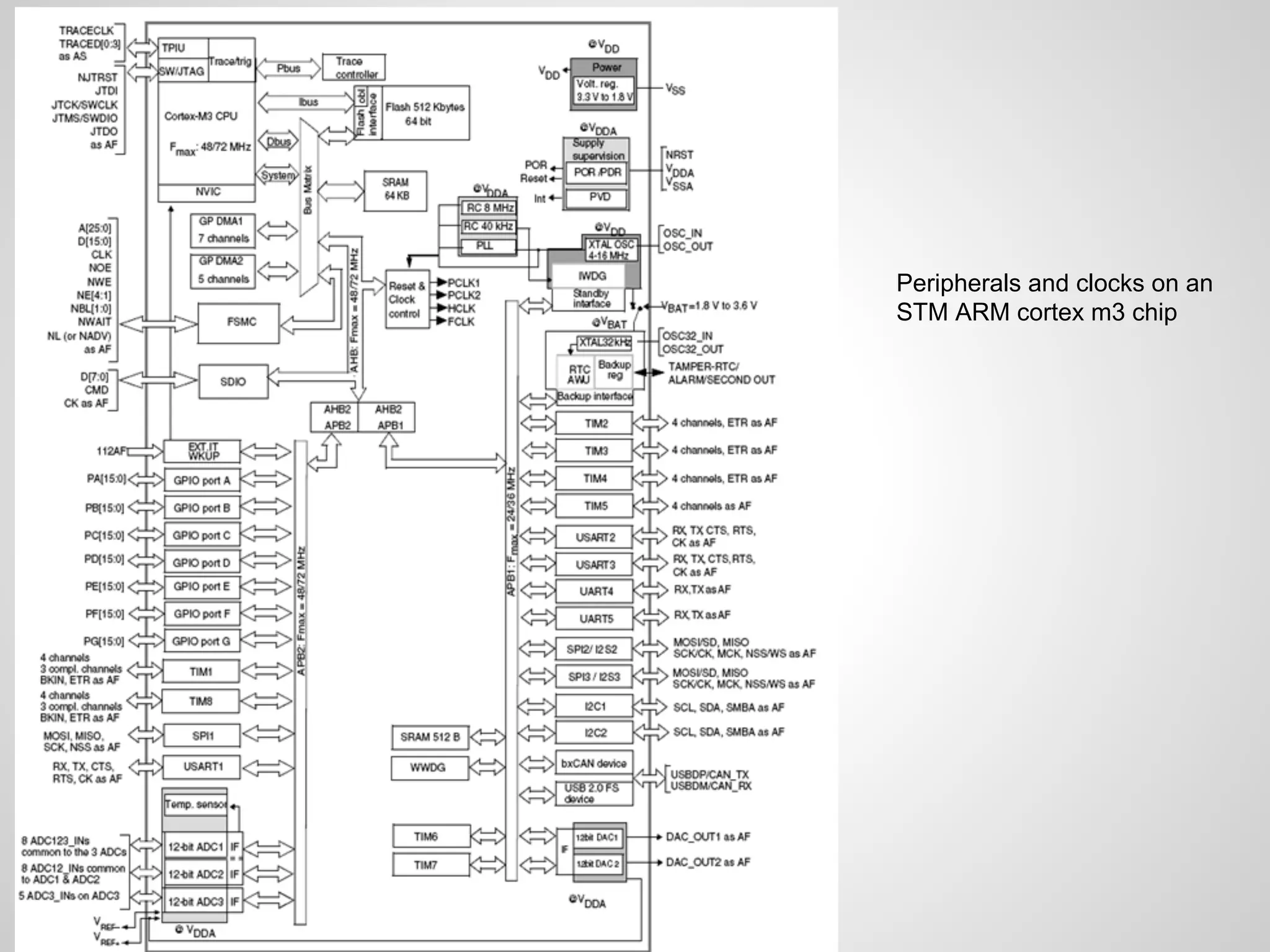
Peripherals and clocks on an
STM ARM cortex m3 chip
● Input voltages
● Memory layout
● How does it boot
● How do interrupts work in this chip
● System clocks
● Details about any peripherals you want to
use like USB, SPI, serial, DMA, timers etc.
Things to read in the manuals
Difference between bare metal and
hosted programs
● Userspace programs running inside an operating
system are hosted
● Code running on a microcontroller, (and linux kernel)
are compiled for a freestanding environment. You (or
mostly the compiler) provides C ‘runtime’
● C startup =
○ Initialize stack, cannot use variables without it
(mostly), or call functions
○ copy values to Initialized variables’ locations in RAM
○ initialize globals to 0
○ Copy read only data like strings to RAM
Why memory layout is important
● There is a well defined way how a chip boots, might
start executing from a particular location
● Peripherals are memory mapped
● Interrupt handlers, are locations reserved for function
pointers in some
● If you want a bootloader, then the application code must
not have any portion located in flash occupied by
bootloader
● This is done using linker scripts
● The C startup code used locations exported by the
linker script to know where from/to copy or paste code
Why microcontrollers
● Small codebase, everything can be controlled
● Instant on
● Real-time behavior
● Low power
● Less supporting hardware
● cheap
● Low level things are easier to tweak than on linux
Why not microcontrollers
● limited choice of languages, toolchain
● debugging can be difficult
● File Systems, networking, graphics etc.
These things may be done on some
microcontrollers, but with a lot more effort
than if using linux
● application portability to a different system
Embedded linux platform
● Embedded, because its not general purpose,
unlike a desktop
● Platform, because it can carry payload of
your application, and become whatever
specific purpose system you design it to be
Hardware
● Linux supports many architectures x86,
x86_64, ARM, MIPS, powerpc, AVR32 etc.
● Not designed for small microcontrollers
● RAM requirement depends on application,
but on a minimum is around 8MB
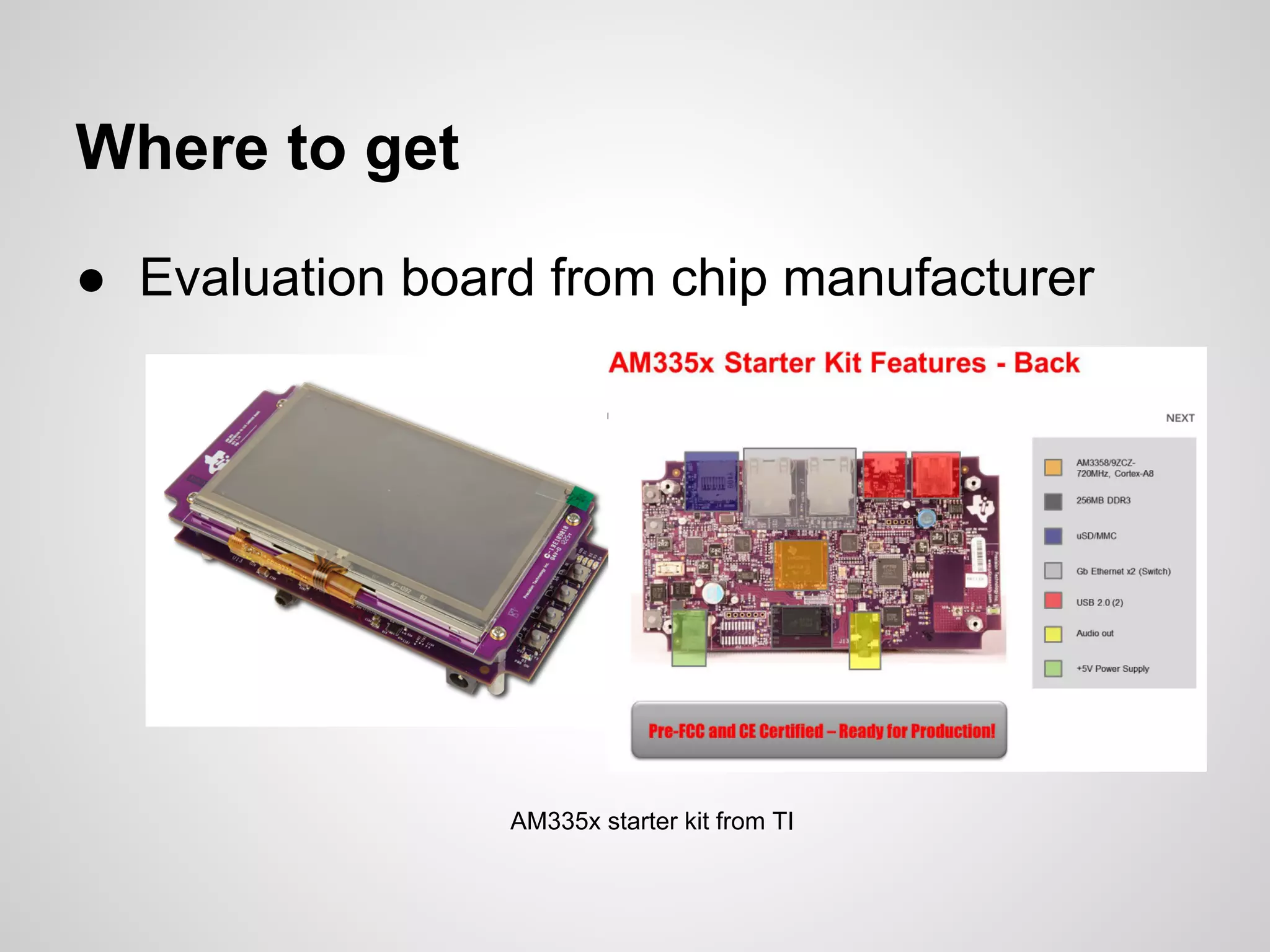
Where to get
● Evaluation board from chip manufacturer
AM335x starter kit from TI
cont..
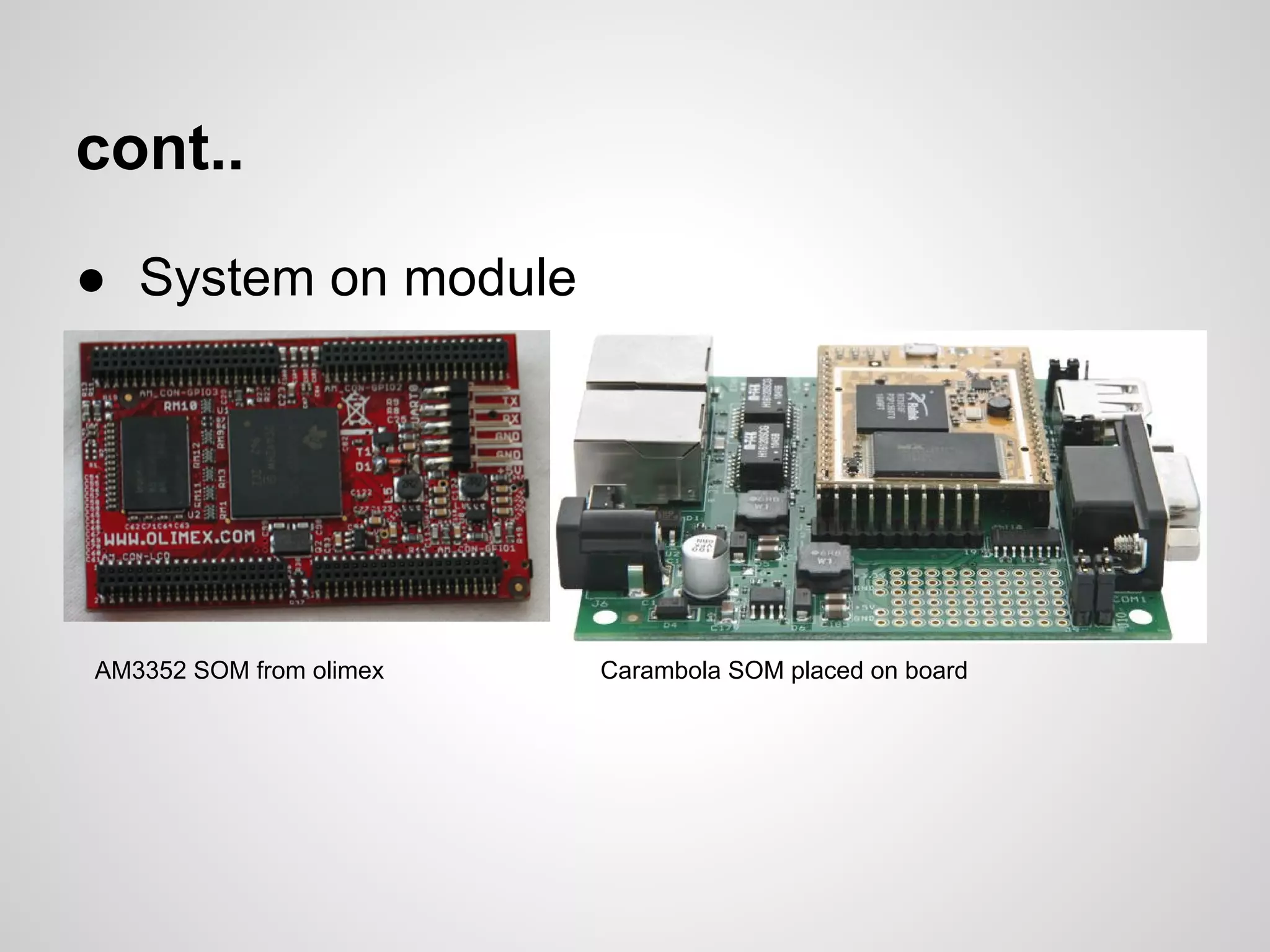
● System on module
AM3352 SOM from olimex Carambola SOM placed on board
cont..
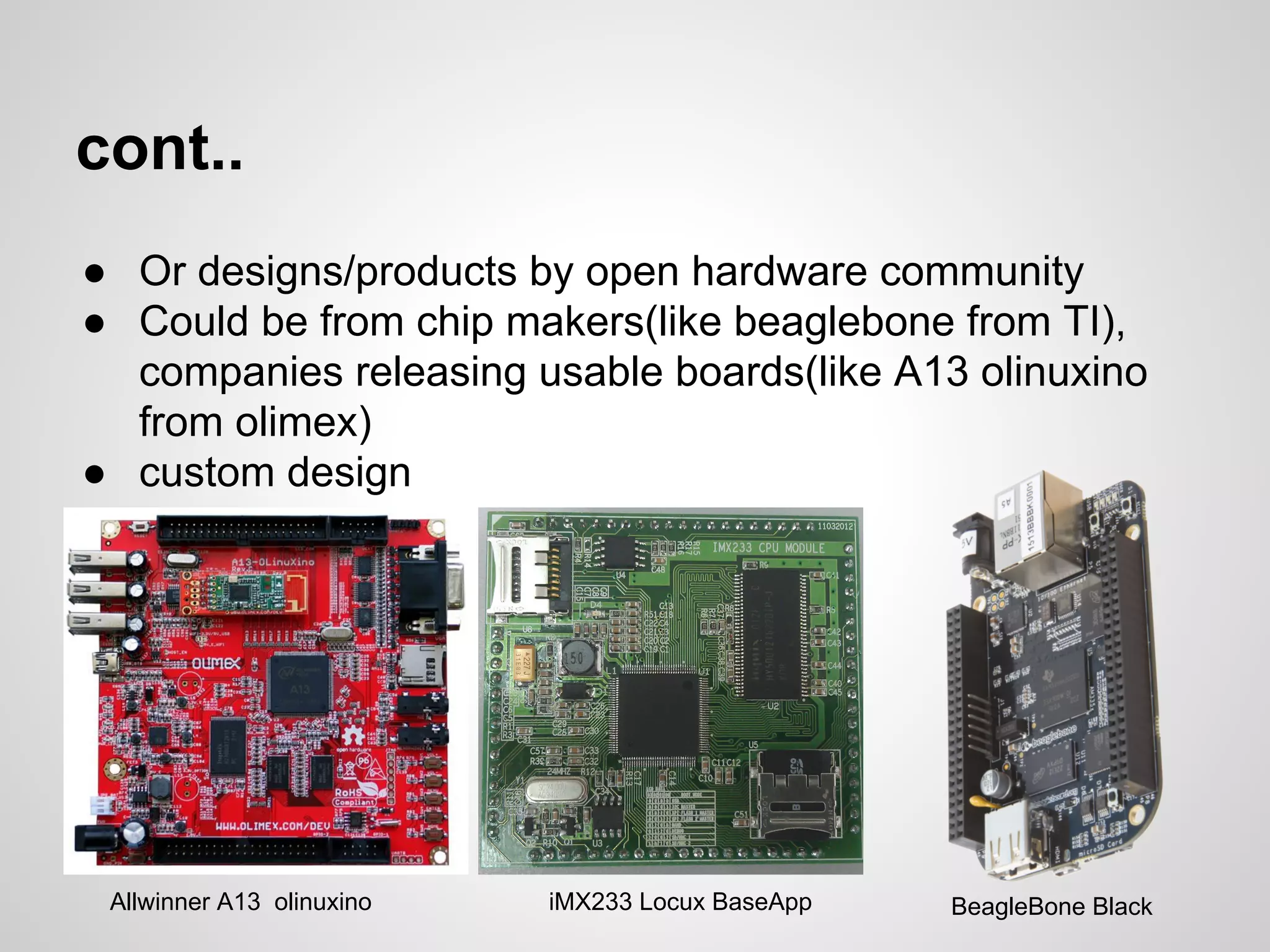
● Or designs/products by open hardware community
● Could be from chip makers(like beaglebone from TI),
companies releasing usable boards(like A13 olinuxino
from olimex)
● custom design
Allwinner A13 olinuxino iMX233 Locux BaseApp BeagleBone Black
cont..
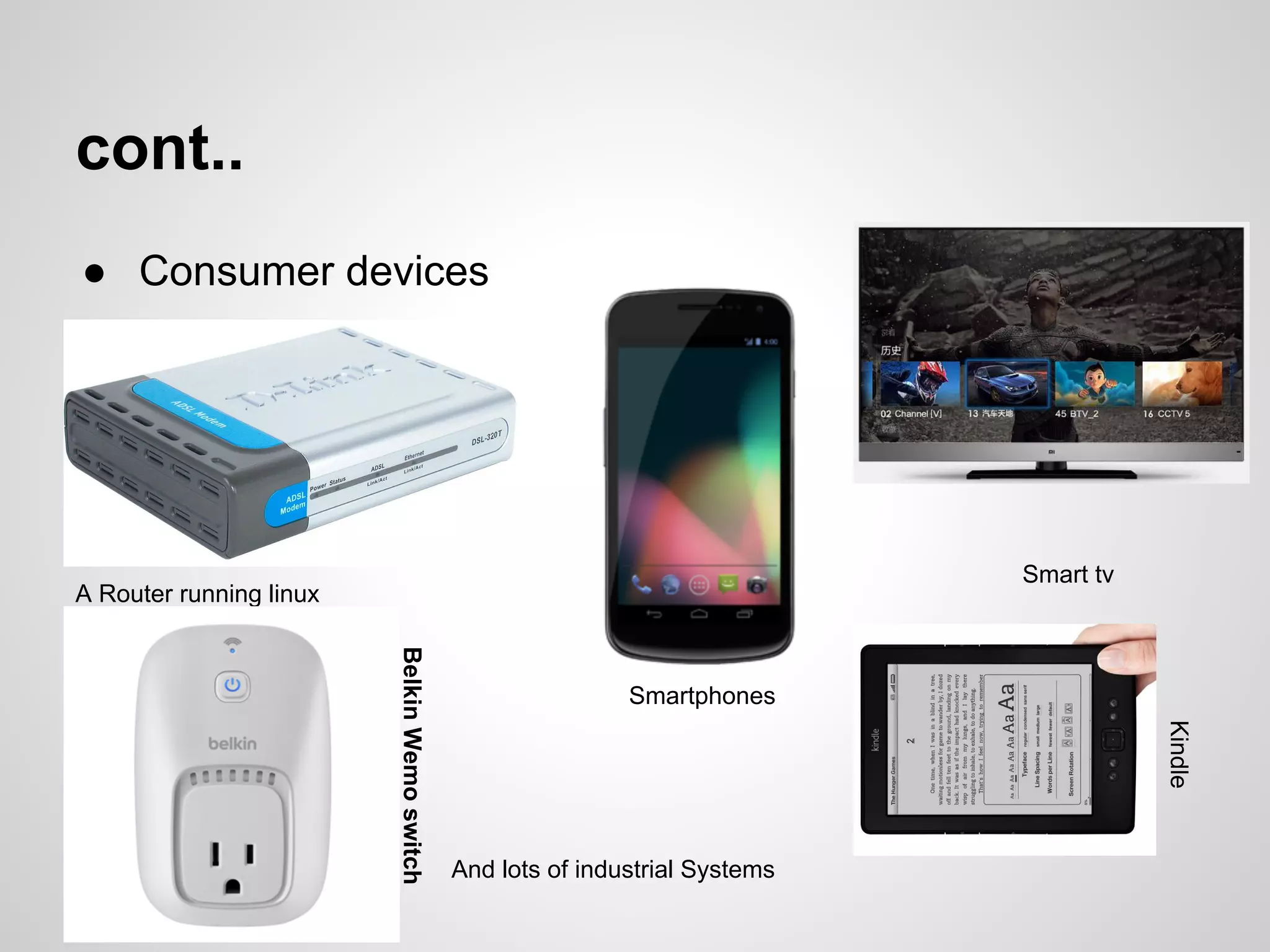
● Consumer devices
A Router running linux
BelkinWemoswitch
Smartphones
Smart tv
And lots of industrial Systems
Kindle
● Some ways to create a linux system(root filesystem) are
○ [Yocto project, openembedded, angstrom]
○ [Buildroot, Openwrt]
○ debian debootstrap
○ Can use full featured distros too, like debian(without
desktop environment)
● Sometimes need to optimize for space/speed
○ provide common tools using busybox
○ simpler init, only necessary programs run on boot
○ only required drivers in kernel
○ compressed fs like squashfs
Making a linux system for an
embedded platform
Linux system boot process
● (not x86)
● first instructions execute a bootloader from
ROM which loads another bootloader, or
sometimes linux kernel itself
● The bootloader loads the kernel, passes it
kernel command line(can be hard coded in
kernel image too)
● after loading, it jumps to the kernel’s entry
point
● kernel command line option ‘rootfs’ is
mounted
cont..
● After mounting rootfs, kernel looks for init program,
which becomes the first process, and all other
processes spawn from it.
● kernel loads modules as required
● Usually init would be a standard program, like
○ systemV init
○ systemd(debian uses this)
○ upstart(ubuntu)
○ busybox provided sysV init(common in embedded
systems to conserve space)
● Init parses its init scripts to launch programs as required
● Suppose you need character LCD, keypad,
CD ROM, SD card, network, USB hard disk
● Choose linux platform which is most suitable
○ Needs USB, ethernet, fast enough
● Decide to use serial port to connect to a
microcontroller, which connects to LCD and
keypad
● If only one USB port, put usb hub
● Linux has drivers for serial(for this particular
cpu), usb-storage(both hard disk and SD
card), and usb CD ROM
Example application
cont..
● Program microcontroller so that it accepts
commands for LCD on serial RX, sends
keypad presses on serial TX
● Choose python to write application
● Can mount/unmount hard disk/SD card(usb
mass storage) and cd-rom with
mount/umount
● can use eject to open tray
● can write to serial port with say pyserial
● can access network easily

Embedded platform choices

  • 1.
  • 2.
    Microcontroller or linuxplatform? Or both? When prototyping OR
  • 3.
    System which usesonly microcontrollers to function System which has a linux cpu (may have microcontrollers too)
  • 4.
    Working with microcontrollers ●First step is component selection ○ Does the controller have all the interfaces required ○ Voltage range, cost, memory sizes(flash and ram) ○ Familiarity with the architecture, supported software, documentation, even community ○ debugger/programmer, toolchain ○ Is some development kit available? If not, then can you make a pcb for prototyping yourself? Maybe someone has published a design using this online
  • 5.
    Some popular choices ●AVR is probably most popular due to arduino. ● PIC family of microcontrollers is also popular ● ST microelectronics ● has a few not too expensive dev kits ● TI MSP
  • 6.
    Some dev kits STM32F4discovery Olimex PIC32-T79 MSP launchpad PinguinoPIC32 Parallaxpropeller8core
  • 7.
    Firmware ● Most codeis in C, or assembly. sometimes C++ ● compilers and chip makers often provides driver libraries and example code for things like USB, TCP/IP stack, and other peripherals ● The reference manual is usually a reference for a family of similar chips, and the datasheet is the ultimate reference
  • 8.
    ARM Cortex M3memory map
  • 9.
    Peripherals and clockson an STM ARM cortex m3 chip
  • 10.
    ● Input voltages ●Memory layout ● How does it boot ● How do interrupts work in this chip ● System clocks ● Details about any peripherals you want to use like USB, SPI, serial, DMA, timers etc. Things to read in the manuals
  • 11.
    Difference between baremetal and hosted programs ● Userspace programs running inside an operating system are hosted ● Code running on a microcontroller, (and linux kernel) are compiled for a freestanding environment. You (or mostly the compiler) provides C ‘runtime’ ● C startup = ○ Initialize stack, cannot use variables without it (mostly), or call functions ○ copy values to Initialized variables’ locations in RAM ○ initialize globals to 0 ○ Copy read only data like strings to RAM
  • 12.
    Why memory layoutis important ● There is a well defined way how a chip boots, might start executing from a particular location ● Peripherals are memory mapped ● Interrupt handlers, are locations reserved for function pointers in some ● If you want a bootloader, then the application code must not have any portion located in flash occupied by bootloader ● This is done using linker scripts ● The C startup code used locations exported by the linker script to know where from/to copy or paste code
  • 13.
    Why microcontrollers ● Smallcodebase, everything can be controlled ● Instant on ● Real-time behavior ● Low power ● Less supporting hardware ● cheap ● Low level things are easier to tweak than on linux
  • 14.
    Why not microcontrollers ●limited choice of languages, toolchain ● debugging can be difficult ● File Systems, networking, graphics etc. These things may be done on some microcontrollers, but with a lot more effort than if using linux ● application portability to a different system
  • 15.
    Embedded linux platform ●Embedded, because its not general purpose, unlike a desktop ● Platform, because it can carry payload of your application, and become whatever specific purpose system you design it to be
  • 16.
    Hardware ● Linux supportsmany architectures x86, x86_64, ARM, MIPS, powerpc, AVR32 etc. ● Not designed for small microcontrollers ● RAM requirement depends on application, but on a minimum is around 8MB
  • 17.
    Where to get ●Evaluation board from chip manufacturer AM335x starter kit from TI
  • 18.
    cont.. ● System onmodule AM3352 SOM from olimex Carambola SOM placed on board
  • 19.
    cont.. ● Or designs/productsby open hardware community ● Could be from chip makers(like beaglebone from TI), companies releasing usable boards(like A13 olinuxino from olimex) ● custom design Allwinner A13 olinuxino iMX233 Locux BaseApp BeagleBone Black
  • 20.
    cont.. ● Consumer devices ARouter running linux BelkinWemoswitch Smartphones Smart tv And lots of industrial Systems Kindle
  • 21.
    ● Some waysto create a linux system(root filesystem) are ○ [Yocto project, openembedded, angstrom] ○ [Buildroot, Openwrt] ○ debian debootstrap ○ Can use full featured distros too, like debian(without desktop environment) ● Sometimes need to optimize for space/speed ○ provide common tools using busybox ○ simpler init, only necessary programs run on boot ○ only required drivers in kernel ○ compressed fs like squashfs Making a linux system for an embedded platform
  • 22.
    Linux system bootprocess ● (not x86) ● first instructions execute a bootloader from ROM which loads another bootloader, or sometimes linux kernel itself ● The bootloader loads the kernel, passes it kernel command line(can be hard coded in kernel image too) ● after loading, it jumps to the kernel’s entry point ● kernel command line option ‘rootfs’ is mounted
  • 23.
    cont.. ● After mountingrootfs, kernel looks for init program, which becomes the first process, and all other processes spawn from it. ● kernel loads modules as required ● Usually init would be a standard program, like ○ systemV init ○ systemd(debian uses this) ○ upstart(ubuntu) ○ busybox provided sysV init(common in embedded systems to conserve space) ● Init parses its init scripts to launch programs as required
  • 24.
    ● Suppose youneed character LCD, keypad, CD ROM, SD card, network, USB hard disk ● Choose linux platform which is most suitable ○ Needs USB, ethernet, fast enough ● Decide to use serial port to connect to a microcontroller, which connects to LCD and keypad ● If only one USB port, put usb hub ● Linux has drivers for serial(for this particular cpu), usb-storage(both hard disk and SD card), and usb CD ROM Example application
  • 25.
    cont.. ● Program microcontrollerso that it accepts commands for LCD on serial RX, sends keypad presses on serial TX ● Choose python to write application ● Can mount/unmount hard disk/SD card(usb mass storage) and cd-rom with mount/umount ● can use eject to open tray ● can write to serial port with say pyserial ● can access network easily