OpenWRT
Basic tutorial guide, memo.
by Antony.Wu
1
OpenWRT builtroot
• It is a set of Makefiles and patches that allows users to generate
a cross-toolchain and a root filesystem for embeded system.
• It generates cross-compiler toolchain and use the toolchain to
build an image for your target board, such as AR-5387un router.
• It can also download packages (feeds), patches (using quilt) it
for you.
• # make toolchain/gdb/prepare QUILT=1
• <modify files in build_dir/>
• # make toolchain/gdb/updatevim
• It has modified make targets: component/name/action.
• # make toolchain/gdb/compile V=s
• V=s means “Verboase = stdout/stderror”
• # make toolchain/gdb/clean V=s
2
V=?
s standard output/error
w shows only warning
3
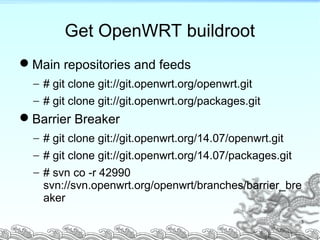
Get OpenWRT buildroot
Main repositories and feeds
− # git clone git://git.openwrt.org/openwrt.git
− # git clone git://git.openwrt.org/packages.git
Barrier Breaker
− # git clone git://git.openwrt.org/14.07/openwrt.git
− # git clone git://git.openwrt.org/14.07/packages.git
− # svn co -r 42990
svn://svn.openwrt.org/openwrt/branches/barrier_bre
aker
4
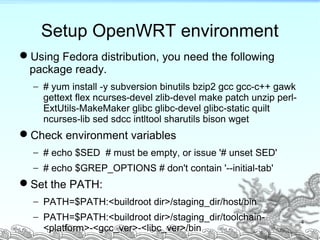
Setup OpenWRT environment
Using Fedora distribution, you need the following
package ready.
− # yum install -y subversion binutils bzip2 gcc gcc-c++ gawk
gettext flex ncurses-devel zlib-devel make patch unzip perl-
ExtUtils-MakeMaker glibc glibc-devel glibc-static quilt
ncurses-lib sed sdcc intltool sharutils bison wget
Check environment variables
− # echo $SED # must be empty, or issue '# unset SED'
− # echo $GREP_OPTIONS # don't contain '--initial-tab'
Set the PATH:
− PATH=$PATH:<buildroot dir>/staging_dir/host/bin
− PATH=$PATH:<buildroot dir>/staging_dir/toolchain-
<platform>-<gcc_ver>-<libc_ver>/bin
5
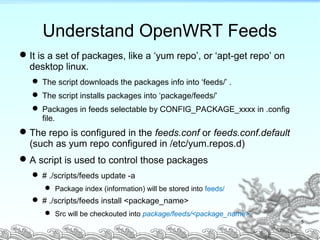
Understand OpenWRT Feeds
It is a set of packages, like a ‘yum repo’, or ‘apt-get repo’ on
desktop linux.
 The script downloads the packages info into ‘feeds/’ .
 The script installs packages into ‘package/feeds/’
 Packages in feeds selectable by CONFIG_PACKAGE_xxxx in .config
file.
The repo is configured in the feeds.conf or feeds.conf.default
(such as yum repo configured in /etc/yum.repos.d)
A script is used to control those packages
 # ./scripts/feeds update -a
 Package index (information) will be stored into feeds/
 # ./scripts/feeds install <package_name>
 Src will be checkouted into package/feeds/<package_name>
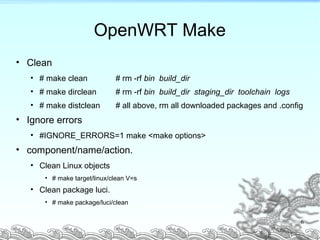
OpenWRT Make
• Clean
• # make clean # rm -rf bin build_dir
• # make dirclean # rm -rf bin build_dir staging_dir toolchain logs
• # make distclean # all above, rm all downloaded packages and .config
• Ignore errors
• #IGNORE_ERRORS=1 make <make options>
• component/name/action.
• Clean Linux objects
• # make target/linux/clean V=s
• Clean package luci.
• # make package/luci/clean
6
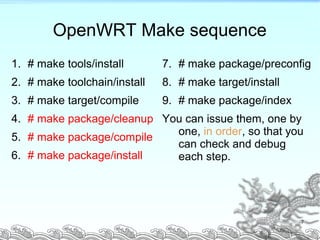
OpenWRT Make sequence
1. # make tools/install
2. # make toolchain/install
3. # make target/compile
4. # make package/cleanup
5. # make package/compile
6. # make package/install
7. # make package/preconfig
8. # make target/install
9. # make package/index
You can issue them, one by
one, in order, so that you
can check and debug
each step.
7
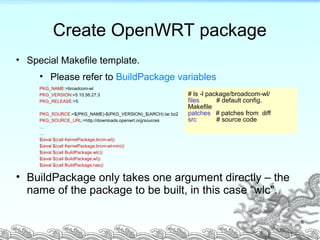
Create OpenWRT package
• Special Makefile template.
• Please refer to BuildPackage variables
PKG_NAME:=broadcom-wl
PKG_VERSION:=5.10.56.27.3
PKG_RELEASE:=5
PKG_SOURCE:=$(PKG_NAME)-$(PKG_VERSION)_$(ARCH).tar.bz2
PKG_SOURCE_URL:=http://downloads.openwrt.org/sources
…
…
$(eval $(call KernelPackage,brcm-wl))
$(eval $(call KernelPackage,brcm-wl-mini))
$(eval $(call BuildPackage,wlc))
$(eval $(call BuildPackage,wl))
$(eval $(call BuildPackage,nas))
• BuildPackage only takes one argument directly – the
name of the package to be built, in this case “wlc".
# ls -l package/broadcom-wl/
files # default config.
Makefile
patches # patches from diff
src # source code
8
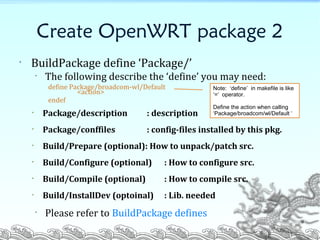
Create OpenWRT package 2
• BuildPackage define ‘Package/’
• The following describe the ‘define’ you may need:
define Package/broadcom-wl/Default
<action>
endef
• Package/description : description
• Package/conffiles : config-files installed by this pkg.
• Build/Prepare (optional): How to unpack/patch src.
• Build/Configure (optional) : How to configure src.
• Build/Compile (optional) : How to compile src.
• Build/InstallDev (optoinal) : Lib. needed
• Please refer to BuildPackage defines
Note: ‘define’ in makefile is like
‘=‘ operator.
Define the action when calling
‘Package/broadcom/wl/Default ‘
9
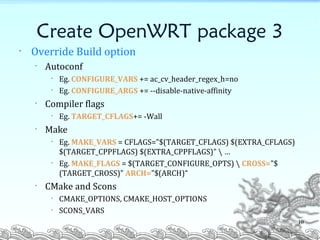
Create OpenWRT package 3
• Override Build option
• Autoconf
• Eg. CONFIGURE_VARS += ac_cv_header_regex_h=no
• Eg. CONFIGURE_ARGS += --disable-native-affinity
• Compiler flags
• Eg. TARGET_CFLAGS+= -Wall
• Make
• Eg. MAKE_VARS = CFLAGS="$(TARGET_CFLAGS) $(EXTRA_CFLAGS)
$(TARGET_CPPFLAGS) $(EXTRA_CPPFLAGS)"  …
• Eg. MAKE_FLAGS = $(TARGET_CONFIGURE_OPTS)  CROSS="$
(TARGET_CROSS)" ARCH="$(ARCH)“
• CMake and Scons
• CMAKE_OPTIONS, CMAKE_HOST_OPTIONS
• SCONS_VARS
10
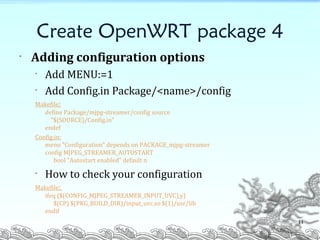
Create OpenWRT package 4
• Adding configuration options
• Add MENU:=1
• Add Config.in Package/<name>/config
Makefile:
define Package/mjpg-streamer/config source
"$(SOURCE)/Config.in“
endef
Config.in:
menu "Configuration" depends on PACKAGE_mjpg-streamer
config MJPEG_STREAMER_AUTOSTART
bool "Autostart enabled" default n
• How to check your configuration
Makefile:
ifeq ($(CONFIG_MJPEG_STREAMER_INPUT_UVC),y)
$(CP) $(PKG_BUILD_DIR)/input_uvc.so $(1)/usr/lib
endif
11
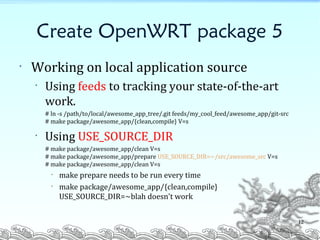
Create OpenWRT package 5
• Working on local application source
• Using feeds to tracking your state-of-the-art
work.
# ln -s /path/to/local/awesome_app_tree/.git feeds/my_cool_feed/awesome_app/git-src
# make package/awesome_app/{clean,compile} V=s
• Using USE_SOURCE_DIR
# make package/awesome_app/clean V=s
# make package/awesome_app/prepare USE_SOURCE_DIR=~/src/awesome_src V=s
# make package/awesome_app/clean V=s
• make prepare needs to be run every time
• make package/awesome_app/{clean,compile}
USE_SOURCE_DIR=~blah doesn't work
12
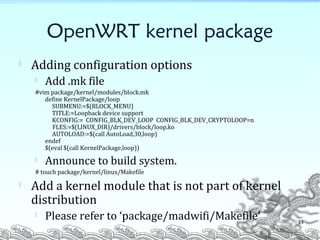
OpenWRT kernel package

Adding configuration options

Add .mk file
#vim package/kernel/modules/block.mk
define KernelPackage/loop
SUBMENU:=$(BLOCK_MENU)
TITLE:=Loopback device support
KCONFIG:= CONFIG_BLK_DEV_LOOP CONFIG_BLK_DEV_CRYPTOLOOP=n
FLES:=$(LINUX_DIR)/drivers/block/loop.ko
AUTOLOAD:=$(call AutoLoad,30,loop)
endef
$(eval $(call KernelPackage,loop))
 Announce to build system.
# touch package/kernel/linux/Makefile

Add a kernel module that is not part of kernel
distribution
 Please refer to ‘package/madwifi/Makefile’ 13
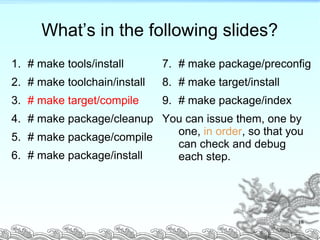
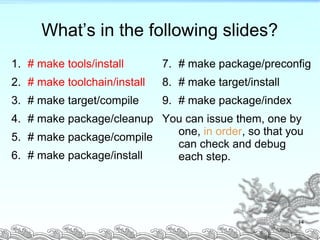
What’s in the following slides?
1. # make tools/install
2. # make toolchain/install
3. # make target/compile
4. # make package/cleanup
5. # make package/compile
6. # make package/install
7. # make package/preconfig
8. # make target/install
9. # make package/index
You can issue them, one by
one, in order, so that you
can check and debug
each step.
14
External Toolchain
 Compile everything with the target board,
you will have a dir named toolchain, called
build1

Copy the .config-file from the build1 and
make menuconfig.
[*] Advanced configuration options (for developers)
[*] Use external toolchain
Target name: arm-openwrt-linux-uclibcgnueabi (in my case, yours may vary)
Toolchain prefix: arm-openwrt-linux-uclibcgnueabi- (mind the dash at the end)
Toolchain root: /path/to/toolchain/staging_dir/toolchain-arm_v5te_gcc-
linaro_uClibc-0.9.32_eabi
15
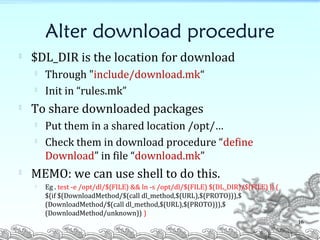
Alter download procedure

$DL_DIR is the location for download

Through "include/download.mk“

Init in “rules.mk”

To share downloaded packages

Put them in a shared location /opt/…

Check them in download procedure “define
Download” in file “download.mk”

MEMO: we can use shell to do this.

Eg . test -e /opt/dl/$(FILE) && ln -s /opt/dl/$(FILE) $(DL_DIR)/$(FILE) || (
$(if $(DownloadMethod/$(call dl_method,$(URL),$(PROTO))),$
(DownloadMethod/$(call dl_method,$(URL),$(PROTO))),$
(DownloadMethod/unknown)) )
16
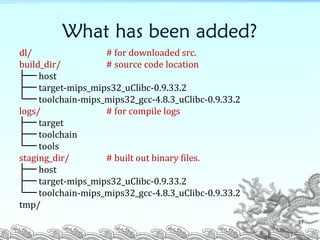
What has been added?
dl/ # for downloaded src.
build_dir/ # source code location
├── host
├── target-mips_mips32_uClibc-0.9.33.2
└── toolchain-mips_mips32_gcc-4.8.3_uClibc-0.9.33.2
logs/ # for compile logs
├── target
├── toolchain
└── tools
staging_dir/ # built out binary files.
├── host
├── target-mips_mips32_uClibc-0.9.33.2
└── toolchain-mips_mips32_gcc-4.8.3_uClibc-0.9.33.2
tmp/
17
What’s in the following slides?
1. # make tools/install
2. # make toolchain/install
3. # make target/compile
4. # make package/cleanup
5. # make package/compile
6. # make package/install
7. # make package/preconfig
8. # make target/install
9. # make package/index
You can issue them, one by
one, in order, so that you
can check and debug
each step.
18
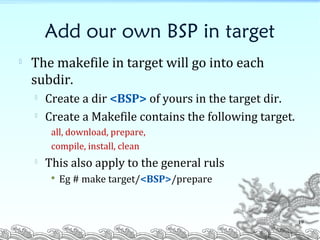
Add our own BSP in target

The makefile in target will go into each
subdir.

Create a dir <BSP> of yours in the target dir.

Create a Makefile contains the following target.
all, download, prepare,
compile, install, clean

This also apply to the general ruls
 Eg # make target/<BSP>/prepare
19
Reference
1. http://wiki.openwrt.org/doc/start
2. http://wiki.openwrt.org/about/toolchain
3. http://wiki.openwrt.org/doc/devel/packages
20

OpenWRT guide and memo

  • 1.
    OpenWRT Basic tutorial guide,memo. by Antony.Wu 1
  • 2.
    OpenWRT builtroot • Itis a set of Makefiles and patches that allows users to generate a cross-toolchain and a root filesystem for embeded system. • It generates cross-compiler toolchain and use the toolchain to build an image for your target board, such as AR-5387un router. • It can also download packages (feeds), patches (using quilt) it for you. • # make toolchain/gdb/prepare QUILT=1 • <modify files in build_dir/> • # make toolchain/gdb/updatevim • It has modified make targets: component/name/action. • # make toolchain/gdb/compile V=s • V=s means “Verboase = stdout/stderror” • # make toolchain/gdb/clean V=s 2 V=? s standard output/error w shows only warning
  • 3.
    3 Get OpenWRT buildroot Mainrepositories and feeds − # git clone git://git.openwrt.org/openwrt.git − # git clone git://git.openwrt.org/packages.git Barrier Breaker − # git clone git://git.openwrt.org/14.07/openwrt.git − # git clone git://git.openwrt.org/14.07/packages.git − # svn co -r 42990 svn://svn.openwrt.org/openwrt/branches/barrier_bre aker
  • 4.
    4 Setup OpenWRT environment UsingFedora distribution, you need the following package ready. − # yum install -y subversion binutils bzip2 gcc gcc-c++ gawk gettext flex ncurses-devel zlib-devel make patch unzip perl- ExtUtils-MakeMaker glibc glibc-devel glibc-static quilt ncurses-lib sed sdcc intltool sharutils bison wget Check environment variables − # echo $SED # must be empty, or issue '# unset SED' − # echo $GREP_OPTIONS # don't contain '--initial-tab' Set the PATH: − PATH=$PATH:<buildroot dir>/staging_dir/host/bin − PATH=$PATH:<buildroot dir>/staging_dir/toolchain- <platform>-<gcc_ver>-<libc_ver>/bin
  • 5.
    5 Understand OpenWRT Feeds Itis a set of packages, like a ‘yum repo’, or ‘apt-get repo’ on desktop linux.  The script downloads the packages info into ‘feeds/’ .  The script installs packages into ‘package/feeds/’  Packages in feeds selectable by CONFIG_PACKAGE_xxxx in .config file. The repo is configured in the feeds.conf or feeds.conf.default (such as yum repo configured in /etc/yum.repos.d) A script is used to control those packages  # ./scripts/feeds update -a  Package index (information) will be stored into feeds/  # ./scripts/feeds install <package_name>  Src will be checkouted into package/feeds/<package_name>
  • 6.
    OpenWRT Make • Clean •# make clean # rm -rf bin build_dir • # make dirclean # rm -rf bin build_dir staging_dir toolchain logs • # make distclean # all above, rm all downloaded packages and .config • Ignore errors • #IGNORE_ERRORS=1 make <make options> • component/name/action. • Clean Linux objects • # make target/linux/clean V=s • Clean package luci. • # make package/luci/clean 6
  • 7.
    OpenWRT Make sequence 1.# make tools/install 2. # make toolchain/install 3. # make target/compile 4. # make package/cleanup 5. # make package/compile 6. # make package/install 7. # make package/preconfig 8. # make target/install 9. # make package/index You can issue them, one by one, in order, so that you can check and debug each step. 7
  • 8.
    Create OpenWRT package •Special Makefile template. • Please refer to BuildPackage variables PKG_NAME:=broadcom-wl PKG_VERSION:=5.10.56.27.3 PKG_RELEASE:=5 PKG_SOURCE:=$(PKG_NAME)-$(PKG_VERSION)_$(ARCH).tar.bz2 PKG_SOURCE_URL:=http://downloads.openwrt.org/sources … … $(eval $(call KernelPackage,brcm-wl)) $(eval $(call KernelPackage,brcm-wl-mini)) $(eval $(call BuildPackage,wlc)) $(eval $(call BuildPackage,wl)) $(eval $(call BuildPackage,nas)) • BuildPackage only takes one argument directly – the name of the package to be built, in this case “wlc". # ls -l package/broadcom-wl/ files # default config. Makefile patches # patches from diff src # source code 8
  • 9.
    Create OpenWRT package2 • BuildPackage define ‘Package/’ • The following describe the ‘define’ you may need: define Package/broadcom-wl/Default <action> endef • Package/description : description • Package/conffiles : config-files installed by this pkg. • Build/Prepare (optional): How to unpack/patch src. • Build/Configure (optional) : How to configure src. • Build/Compile (optional) : How to compile src. • Build/InstallDev (optoinal) : Lib. needed • Please refer to BuildPackage defines Note: ‘define’ in makefile is like ‘=‘ operator. Define the action when calling ‘Package/broadcom/wl/Default ‘ 9
  • 10.
    Create OpenWRT package3 • Override Build option • Autoconf • Eg. CONFIGURE_VARS += ac_cv_header_regex_h=no • Eg. CONFIGURE_ARGS += --disable-native-affinity • Compiler flags • Eg. TARGET_CFLAGS+= -Wall • Make • Eg. MAKE_VARS = CFLAGS="$(TARGET_CFLAGS) $(EXTRA_CFLAGS) $(TARGET_CPPFLAGS) $(EXTRA_CPPFLAGS)" … • Eg. MAKE_FLAGS = $(TARGET_CONFIGURE_OPTS) CROSS="$ (TARGET_CROSS)" ARCH="$(ARCH)“ • CMake and Scons • CMAKE_OPTIONS, CMAKE_HOST_OPTIONS • SCONS_VARS 10
  • 11.
    Create OpenWRT package4 • Adding configuration options • Add MENU:=1 • Add Config.in Package/<name>/config Makefile: define Package/mjpg-streamer/config source "$(SOURCE)/Config.in“ endef Config.in: menu "Configuration" depends on PACKAGE_mjpg-streamer config MJPEG_STREAMER_AUTOSTART bool "Autostart enabled" default n • How to check your configuration Makefile: ifeq ($(CONFIG_MJPEG_STREAMER_INPUT_UVC),y) $(CP) $(PKG_BUILD_DIR)/input_uvc.so $(1)/usr/lib endif 11
  • 12.
    Create OpenWRT package5 • Working on local application source • Using feeds to tracking your state-of-the-art work. # ln -s /path/to/local/awesome_app_tree/.git feeds/my_cool_feed/awesome_app/git-src # make package/awesome_app/{clean,compile} V=s • Using USE_SOURCE_DIR # make package/awesome_app/clean V=s # make package/awesome_app/prepare USE_SOURCE_DIR=~/src/awesome_src V=s # make package/awesome_app/clean V=s • make prepare needs to be run every time • make package/awesome_app/{clean,compile} USE_SOURCE_DIR=~blah doesn't work 12
  • 13.
    OpenWRT kernel package  Addingconfiguration options  Add .mk file #vim package/kernel/modules/block.mk define KernelPackage/loop SUBMENU:=$(BLOCK_MENU) TITLE:=Loopback device support KCONFIG:= CONFIG_BLK_DEV_LOOP CONFIG_BLK_DEV_CRYPTOLOOP=n FLES:=$(LINUX_DIR)/drivers/block/loop.ko AUTOLOAD:=$(call AutoLoad,30,loop) endef $(eval $(call KernelPackage,loop))  Announce to build system. # touch package/kernel/linux/Makefile  Add a kernel module that is not part of kernel distribution  Please refer to ‘package/madwifi/Makefile’ 13
  • 14.
    What’s in thefollowing slides? 1. # make tools/install 2. # make toolchain/install 3. # make target/compile 4. # make package/cleanup 5. # make package/compile 6. # make package/install 7. # make package/preconfig 8. # make target/install 9. # make package/index You can issue them, one by one, in order, so that you can check and debug each step. 14
  • 15.
    External Toolchain  Compileeverything with the target board, you will have a dir named toolchain, called build1  Copy the .config-file from the build1 and make menuconfig. [*] Advanced configuration options (for developers) [*] Use external toolchain Target name: arm-openwrt-linux-uclibcgnueabi (in my case, yours may vary) Toolchain prefix: arm-openwrt-linux-uclibcgnueabi- (mind the dash at the end) Toolchain root: /path/to/toolchain/staging_dir/toolchain-arm_v5te_gcc- linaro_uClibc-0.9.32_eabi 15
  • 16.
    Alter download procedure  $DL_DIRis the location for download  Through "include/download.mk“  Init in “rules.mk”  To share downloaded packages  Put them in a shared location /opt/…  Check them in download procedure “define Download” in file “download.mk”  MEMO: we can use shell to do this.  Eg . test -e /opt/dl/$(FILE) && ln -s /opt/dl/$(FILE) $(DL_DIR)/$(FILE) || ( $(if $(DownloadMethod/$(call dl_method,$(URL),$(PROTO))),$ (DownloadMethod/$(call dl_method,$(URL),$(PROTO))),$ (DownloadMethod/unknown)) ) 16
  • 17.
    What has beenadded? dl/ # for downloaded src. build_dir/ # source code location ├── host ├── target-mips_mips32_uClibc-0.9.33.2 └── toolchain-mips_mips32_gcc-4.8.3_uClibc-0.9.33.2 logs/ # for compile logs ├── target ├── toolchain └── tools staging_dir/ # built out binary files. ├── host ├── target-mips_mips32_uClibc-0.9.33.2 └── toolchain-mips_mips32_gcc-4.8.3_uClibc-0.9.33.2 tmp/ 17
  • 18.
    What’s in thefollowing slides? 1. # make tools/install 2. # make toolchain/install 3. # make target/compile 4. # make package/cleanup 5. # make package/compile 6. # make package/install 7. # make package/preconfig 8. # make target/install 9. # make package/index You can issue them, one by one, in order, so that you can check and debug each step. 18
  • 19.
    Add our ownBSP in target  The makefile in target will go into each subdir.  Create a dir <BSP> of yours in the target dir.  Create a Makefile contains the following target. all, download, prepare, compile, install, clean  This also apply to the general ruls  Eg # make target/<BSP>/prepare 19
  • 20.