kTLV Windows Internals for Linux Kernel Developers @goldshtn
kTLV https://s.sashag.net/ktlv0316 @goldshtn
Sasha Goldshtein
@goldshtn
Windows Internals for
Linux Kernel Developers
kTLV Windows Internals for Linux Kernel Developers @goldshtn
kTLV https://s.sashag.net/ktlv0316 @goldshtn
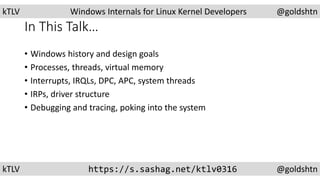
In This Talk…
• Windows history and design goals
• Processes, threads, virtual memory
• Interrupts, IRQLs, DPC, APC, system threads
• IRPs, driver structure
• Debugging and tracing, poking into the system
kTLV Windows Internals for Linux Kernel Developers @goldshtn
kTLV https://s.sashag.net/ktlv0316 @goldshtn
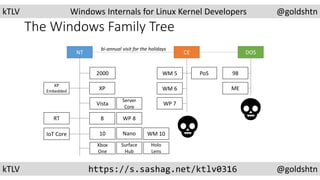
The Windows Family Tree
NT CE DOS
2000
XP
Vista
8RT
10IoT Core Nano
Server
Core
WM 6
WP 7
WP 8
PoS
💀
98
ME
💀
Xbox
One
XP
Embedded
bi-annual visit for the holidays
Surface
Hub
Holo
Lens
WM 10
WM 5
kTLV Windows Internals for Linux Kernel Developers @goldshtn
kTLV https://s.sashag.net/ktlv0316 @goldshtn
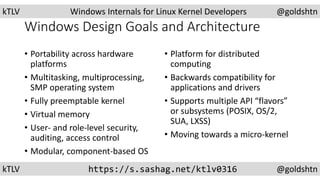
Windows Design Goals and Architecture
• Portability across hardware
platforms
• Multitasking, multiprocessing,
SMP operating system
• Fully preemptable kernel
• Virtual memory
• User- and role-level security,
auditing, access control
• Modular, component-based OS
• Platform for distributed
computing
• Backwards compatibility for
applications and drivers
• Supports multiple API “flavors”
or subsystems (POSIX, OS/2,
SUA, LXSS)
• Moving towards a micro-kernel
kTLV Windows Internals for Linux Kernel Developers @goldshtn
kTLV https://s.sashag.net/ktlv0316 @goldshtn
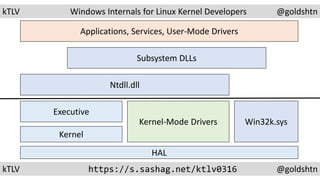
HAL
Kernel
Executive
Kernel-Mode Drivers Win32k.sys
Ntdll.dll
Subsystem DLLs
Applications, Services, User-Mode Drivers
kTLV Windows Internals for Linux Kernel Developers @goldshtn
kTLV https://s.sashag.net/ktlv0316 @goldshtn
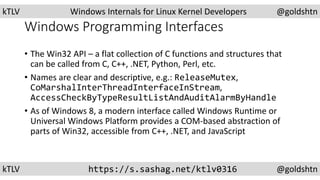
Windows Programming Interfaces
• The Win32 API – a flat collection of C functions and structures that
can be called from C, C++, .NET, Python, Perl, etc.
• Names are clear and descriptive, e.g.: ReleaseMutex,
CoMarshalInterThreadInterfaceInStream,
AccessCheckByTypeResultListAndAuditAlarmByHandle
• As of Windows 8, a modern interface called Windows Runtime or
Universal Windows Platform provides a COM-based abstraction of
parts of Win32, accessible from C++, .NET, and JavaScript
kTLV Windows Internals for Linux Kernel Developers @goldshtn
kTLV https://s.sashag.net/ktlv0316 @goldshtn
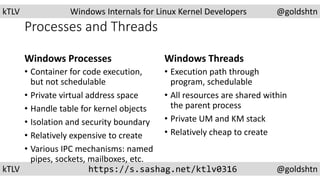
Processes and Threads
Windows Processes
• Container for code execution,
but not schedulable
• Private virtual address space
• Handle table for kernel objects
• Isolation and security boundary
• Relatively expensive to create
• Various IPC mechanisms: named
pipes, sockets, mailboxes, etc.
Windows Threads
• Execution path through
program, schedulable
• All resources are shared within
the parent process
• Private UM and KM stack
• Relatively cheap to create
kTLV Windows Internals for Linux Kernel Developers @goldshtn
kTLV https://s.sashag.net/ktlv0316 @goldshtn
Jobs
• Windows does not maintain a meaningful process tree (although
parent pid is recorded)
• Processes may be assigned to a job
• Jobs can be controlled as a unit (e.g., wait, terminate)
• Jobs can be assigned limits (quotas)
kTLV Windows Internals for Linux Kernel Developers @goldshtn
kTLV https://s.sashag.net/ktlv0316 @goldshtn
Thread Scheduling
• Threads are scheduled according to priority (0-31) and CPU affinity
• Priorities are not weights; the highest-priority thread always runs
• Using “realtime” priorities (16-31) requires a special privilege,
because they can directly compete with important system threads
• Thread quantum is configured globally (ranging from 30ms to 180ms)
• Tickless kernel since Windows 8
• Special priority and quantum boosts in some scenarios
• SMP scheduling based on processor-local queues and work stealing,
NUMA and HyperThreading awareness
kTLV Windows Internals for Linux Kernel Developers @goldshtn
kTLV https://s.sashag.net/ktlv0316 @goldshtn
Synchronization
• Large variety of user-mode synchronization mechanisms: mutex,
semaphore, event, condition variable, one-time init, reader-writer
lock, WaitOnAddress (a la futex)
• Some kernel-only synchronization mechanisms: ERESOURCE, fast
mutex, gate, spinlock, queued (FIFO) spinlocks
kTLV Windows Internals for Linux Kernel Developers @goldshtn
kTLV https://s.sashag.net/ktlv0316 @goldshtn
Virtual Memory
• 32-bit: 4GB address space, 1-2GB reserved for kernel
• 64-bit: 256TB address space, 128TB reserved for kernel
• Memory is reserved and then committed, no over-commit, physical
mapping only on first access
• Paging out based on age, size, process memory priority
• Services for protecting memory (RWX), sharing memory, mapping
files into memory, locking physical pages, and more
• User-mode heap layer in ntdll.dll, kernel-mode pools (paged and non-
paged), lookaside lists
kTLV Windows Internals for Linux Kernel Developers @goldshtn
kTLV https://s.sashag.net/ktlv0316 @goldshtn
Interrupts and Kernel Processing
• Support for both classic interrupts and MSI (since Windows Vista)
• Interrupt priorities (IRQL) 0-15 or 0-31 (determined by PnP manager)
• Waiting (or paging) is not allowed at IRQL 2+
• Deferred work goes into DPC (IRQL 2 or priority 31 thread) which can
be delivered to current or other processor
• Context-sensitive work goes into APC (IRQL 1)
• Can also use system threads, kernel thread pool
kTLV Windows Internals for Linux Kernel Developers @goldshtn
kTLV https://s.sashag.net/ktlv0316 @goldshtn
Windows I/O Concepts
• Applications perform I/O operations on file handles, which are
internally translated to _FILE_OBJECT
• File objects are created by drivers and associated with
_DEVICE_OBJECT (that has a pointer to _DRIVER_OBJECT)
• The I/O manager manages I/O requests using IRPs that are routed
between drivers; the IRP knows which driver is currently handling it
• Any I/O can be synchronous or asynchronous – it’s just a flag that tells
the I/O manager whether to block the calling thread
• Most I/Os can be prioritized by the calling thread
• Most disk and network I/Os are cancelable
kTLV Windows Internals for Linux Kernel Developers @goldshtn
kTLV https://s.sashag.net/ktlv0316 @goldshtn
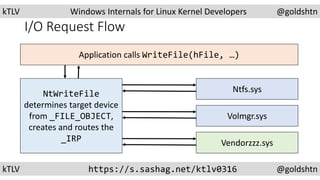
I/O Request Flow
NtWriteFile
determines target device
from _FILE_OBJECT,
creates and routes the
_IRP
Ntfs.sys
Application calls WriteFile(hFile, …)
Volmgr.sys
Vendorzzz.sys
kTLV Windows Internals for Linux Kernel Developers @goldshtn
kTLV https://s.sashag.net/ktlv0316 @goldshtn
Plug and Play
• At boot time, the Plug and Play (PnP) manager creates a device
enumeration tree
• For each bus (PCIe, 1394, USB, etc.), a bus driver is responsible for
detecting and configuring new hardware and its power state
• Buses can be nested
• Resources such as IRQs, DMA channels, I/O memory ranges are
arbitrated by the PnP manager
• Driver software can be installed on-demand using a user-mode
component that optionally talks to Windows Update
kTLV Windows Internals for Linux Kernel Developers @goldshtn
kTLV https://s.sashag.net/ktlv0316 @goldshtn
Driver Frameworks
• Non-software-only drivers adhere to the Windows Driver Model
(WDM), which has bus drivers, function drivers, and filter drivers
• A driver is a collection of callback functions (DriverEntry, AddDevice,
DispatchNnn, Isr, DpcForIsr, …)
• Windows Driver Framework, introduced in Windows Vista, provides a
more object-oriented wrapper on top of WDM
• Also introduces user-mode drivers (UMDF) originally based on COM
• In UMDF 2.0, APIs for user-mode and kernel-mode drivers are
identical; in theory, can port a kernel-mode driver to user-mode
kTLV Windows Internals for Linux Kernel Developers @goldshtn
kTLV https://s.sashag.net/ktlv0316 @goldshtn
Debugging and Tracing
• A kernel debugger is built into the kernel and Windows boot process
• Can debug over serial port, USB, 1394, Ethernet (as of Windows 8)
• Local kernel debugging enables view-only, no breakpoint kernel
debugging on a single machine (Livekd emulates a memory dump)
• Crash dumps are generated by default when the system fails, can be
analyzed later and/or reported to Microsoft (and then vendor)
• ETW (Event Tracing for Windows) is a tracepoint-like framework for
tracing – performance and general diagnostics
• Windows Performance Toolkit has ETW recording and analysis tools
kTLV Windows Internals for Linux Kernel Developers @goldshtn
kTLV https://s.sashag.net/ktlv0316 @goldshtn
Thank You!
Sasha Goldshtein
@goldshtn

Windows Internals for Linux Kernel Developers

  • 1.
    kTLV Windows Internalsfor Linux Kernel Developers @goldshtn kTLV https://s.sashag.net/ktlv0316 @goldshtn Sasha Goldshtein @goldshtn Windows Internals for Linux Kernel Developers
  • 2.
    kTLV Windows Internalsfor Linux Kernel Developers @goldshtn kTLV https://s.sashag.net/ktlv0316 @goldshtn In This Talk… • Windows history and design goals • Processes, threads, virtual memory • Interrupts, IRQLs, DPC, APC, system threads • IRPs, driver structure • Debugging and tracing, poking into the system
  • 3.
    kTLV Windows Internalsfor Linux Kernel Developers @goldshtn kTLV https://s.sashag.net/ktlv0316 @goldshtn The Windows Family Tree NT CE DOS 2000 XP Vista 8RT 10IoT Core Nano Server Core WM 6 WP 7 WP 8 PoS 💀 98 ME 💀 Xbox One XP Embedded bi-annual visit for the holidays Surface Hub Holo Lens WM 10 WM 5
  • 4.
    kTLV Windows Internalsfor Linux Kernel Developers @goldshtn kTLV https://s.sashag.net/ktlv0316 @goldshtn Windows Design Goals and Architecture • Portability across hardware platforms • Multitasking, multiprocessing, SMP operating system • Fully preemptable kernel • Virtual memory • User- and role-level security, auditing, access control • Modular, component-based OS • Platform for distributed computing • Backwards compatibility for applications and drivers • Supports multiple API “flavors” or subsystems (POSIX, OS/2, SUA, LXSS) • Moving towards a micro-kernel
  • 5.
    kTLV Windows Internalsfor Linux Kernel Developers @goldshtn kTLV https://s.sashag.net/ktlv0316 @goldshtn HAL Kernel Executive Kernel-Mode Drivers Win32k.sys Ntdll.dll Subsystem DLLs Applications, Services, User-Mode Drivers
  • 6.
    kTLV Windows Internalsfor Linux Kernel Developers @goldshtn kTLV https://s.sashag.net/ktlv0316 @goldshtn Windows Programming Interfaces • The Win32 API – a flat collection of C functions and structures that can be called from C, C++, .NET, Python, Perl, etc. • Names are clear and descriptive, e.g.: ReleaseMutex, CoMarshalInterThreadInterfaceInStream, AccessCheckByTypeResultListAndAuditAlarmByHandle • As of Windows 8, a modern interface called Windows Runtime or Universal Windows Platform provides a COM-based abstraction of parts of Win32, accessible from C++, .NET, and JavaScript
  • 7.
    kTLV Windows Internalsfor Linux Kernel Developers @goldshtn kTLV https://s.sashag.net/ktlv0316 @goldshtn Processes and Threads Windows Processes • Container for code execution, but not schedulable • Private virtual address space • Handle table for kernel objects • Isolation and security boundary • Relatively expensive to create • Various IPC mechanisms: named pipes, sockets, mailboxes, etc. Windows Threads • Execution path through program, schedulable • All resources are shared within the parent process • Private UM and KM stack • Relatively cheap to create
  • 8.
    kTLV Windows Internalsfor Linux Kernel Developers @goldshtn kTLV https://s.sashag.net/ktlv0316 @goldshtn Jobs • Windows does not maintain a meaningful process tree (although parent pid is recorded) • Processes may be assigned to a job • Jobs can be controlled as a unit (e.g., wait, terminate) • Jobs can be assigned limits (quotas)
  • 9.
    kTLV Windows Internalsfor Linux Kernel Developers @goldshtn kTLV https://s.sashag.net/ktlv0316 @goldshtn Thread Scheduling • Threads are scheduled according to priority (0-31) and CPU affinity • Priorities are not weights; the highest-priority thread always runs • Using “realtime” priorities (16-31) requires a special privilege, because they can directly compete with important system threads • Thread quantum is configured globally (ranging from 30ms to 180ms) • Tickless kernel since Windows 8 • Special priority and quantum boosts in some scenarios • SMP scheduling based on processor-local queues and work stealing, NUMA and HyperThreading awareness
  • 10.
    kTLV Windows Internalsfor Linux Kernel Developers @goldshtn kTLV https://s.sashag.net/ktlv0316 @goldshtn Synchronization • Large variety of user-mode synchronization mechanisms: mutex, semaphore, event, condition variable, one-time init, reader-writer lock, WaitOnAddress (a la futex) • Some kernel-only synchronization mechanisms: ERESOURCE, fast mutex, gate, spinlock, queued (FIFO) spinlocks
  • 11.
    kTLV Windows Internalsfor Linux Kernel Developers @goldshtn kTLV https://s.sashag.net/ktlv0316 @goldshtn Virtual Memory • 32-bit: 4GB address space, 1-2GB reserved for kernel • 64-bit: 256TB address space, 128TB reserved for kernel • Memory is reserved and then committed, no over-commit, physical mapping only on first access • Paging out based on age, size, process memory priority • Services for protecting memory (RWX), sharing memory, mapping files into memory, locking physical pages, and more • User-mode heap layer in ntdll.dll, kernel-mode pools (paged and non- paged), lookaside lists
  • 12.
    kTLV Windows Internalsfor Linux Kernel Developers @goldshtn kTLV https://s.sashag.net/ktlv0316 @goldshtn Interrupts and Kernel Processing • Support for both classic interrupts and MSI (since Windows Vista) • Interrupt priorities (IRQL) 0-15 or 0-31 (determined by PnP manager) • Waiting (or paging) is not allowed at IRQL 2+ • Deferred work goes into DPC (IRQL 2 or priority 31 thread) which can be delivered to current or other processor • Context-sensitive work goes into APC (IRQL 1) • Can also use system threads, kernel thread pool
  • 13.
    kTLV Windows Internalsfor Linux Kernel Developers @goldshtn kTLV https://s.sashag.net/ktlv0316 @goldshtn Windows I/O Concepts • Applications perform I/O operations on file handles, which are internally translated to _FILE_OBJECT • File objects are created by drivers and associated with _DEVICE_OBJECT (that has a pointer to _DRIVER_OBJECT) • The I/O manager manages I/O requests using IRPs that are routed between drivers; the IRP knows which driver is currently handling it • Any I/O can be synchronous or asynchronous – it’s just a flag that tells the I/O manager whether to block the calling thread • Most I/Os can be prioritized by the calling thread • Most disk and network I/Os are cancelable
  • 14.
    kTLV Windows Internalsfor Linux Kernel Developers @goldshtn kTLV https://s.sashag.net/ktlv0316 @goldshtn I/O Request Flow NtWriteFile determines target device from _FILE_OBJECT, creates and routes the _IRP Ntfs.sys Application calls WriteFile(hFile, …) Volmgr.sys Vendorzzz.sys
  • 15.
    kTLV Windows Internalsfor Linux Kernel Developers @goldshtn kTLV https://s.sashag.net/ktlv0316 @goldshtn Plug and Play • At boot time, the Plug and Play (PnP) manager creates a device enumeration tree • For each bus (PCIe, 1394, USB, etc.), a bus driver is responsible for detecting and configuring new hardware and its power state • Buses can be nested • Resources such as IRQs, DMA channels, I/O memory ranges are arbitrated by the PnP manager • Driver software can be installed on-demand using a user-mode component that optionally talks to Windows Update
  • 16.
    kTLV Windows Internalsfor Linux Kernel Developers @goldshtn kTLV https://s.sashag.net/ktlv0316 @goldshtn Driver Frameworks • Non-software-only drivers adhere to the Windows Driver Model (WDM), which has bus drivers, function drivers, and filter drivers • A driver is a collection of callback functions (DriverEntry, AddDevice, DispatchNnn, Isr, DpcForIsr, …) • Windows Driver Framework, introduced in Windows Vista, provides a more object-oriented wrapper on top of WDM • Also introduces user-mode drivers (UMDF) originally based on COM • In UMDF 2.0, APIs for user-mode and kernel-mode drivers are identical; in theory, can port a kernel-mode driver to user-mode
  • 17.
    kTLV Windows Internalsfor Linux Kernel Developers @goldshtn kTLV https://s.sashag.net/ktlv0316 @goldshtn Debugging and Tracing • A kernel debugger is built into the kernel and Windows boot process • Can debug over serial port, USB, 1394, Ethernet (as of Windows 8) • Local kernel debugging enables view-only, no breakpoint kernel debugging on a single machine (Livekd emulates a memory dump) • Crash dumps are generated by default when the system fails, can be analyzed later and/or reported to Microsoft (and then vendor) • ETW (Event Tracing for Windows) is a tracepoint-like framework for tracing – performance and general diagnostics • Windows Performance Toolkit has ETW recording and analysis tools
  • 18.
    kTLV Windows Internalsfor Linux Kernel Developers @goldshtn kTLV https://s.sashag.net/ktlv0316 @goldshtn Thank You! Sasha Goldshtein @goldshtn

Editor's Notes

  • #9 Demo: Process Explorer looking for jobs
  • #10 Demo: Priorities.exe starvation, Priorities.exe foreground
  • #12 Demo: VMMap
  • #16 Demo: Device Manager devices by connection
  • #18 Demo: Livekd -ml and then run !process 0 0 WPA analysis of CPU sampling, disk I/O, ISR and DPC latency